• 검색 결과가 없습니다.

The Effects of Vibration Frequency and Amplitude on Serratus Anterior Muscle Activation During Knee Push-up Plus Exercise in Individuals with Scapular Winging

N/A
N/A
Protected

Academic year: 2021

Share "The Effects of Vibration Frequency and Amplitude on Serratus Anterior Muscle Activation During Knee Push-up Plus Exercise in Individuals with Scapular Winging"

Copied!
8
0
0

로드 중.... (전체 텍스트 보기)

전체 글

(1)

Research Article Open Access

어깨뼈 익상에 대한 푸쉬업플러스 시 부가적 진동의 주파수와 진폭이 어깨안정근 근활성도에 미치는 영향

박원영⋅구현모 1†

양산부산대학교병원 재활의학과, 1 경성대학교 물리치료학과

The Effects of Vibration Frequency and Amplitude on Serratus Anterior Muscle Activation During Knee Push-up Plus Exercise in Individuals with Scapular Winging

Won-Young Park, PT, MS⋅Hyun-Mo Koo, PT, PhD 1†

Department of Rehabilitation Medicine, Pusan National University Yangsan Hospital

1 Department of Physical Therapy, Kyungsung University

Received: July 10, 2018 / Revised: July 11, 2018 / Accepted: August 1, 2018

ⓒ 2018 J Korean Soc Phys Med


| Abstract |

1)

PURPOSE: This study was conducted to investigate the effects of vibration frequency and amplitude on scapular winging during the knee push-up plus exercise.

METHODS: A total of 26 female subjects with scapular winging were evaluated while performing the knee push-up plus exercise with no vibration, low-frequency/low-amplitude (5 Hz/3 mm) vibration, low-frequency/high-amplitude (5 Hz/9 mm) vibration, high-frequency/low-amplitude (15 Hz/3 mm) vibration, and high-frequency/high-amplitude (15 Hz/9 mm) vibration. The surface EMG of the serratus anterior (SA) muscle was compared between the vibration frequency and amplitude. The EMG amplitude was normalized using the

†Corresponding Author : Hyun-Mo Koo

[email protected], https://orcid.org/0000-0003-4231-7527 This is an Open Access article distributed under the terms of the Creative Commons Attribution Non-Commercial License (http://creativecommons.org/licenses/by-nc/3.0) which permits unrestricted non-commercial use, distribution, and reproduction in any medium, provided the original work is properly cited.

maximal voluntary isometric contraction (MVIC). The statistical significance of the results was evaluated using one-way ANOVA.

RESULTS: The SA muscle EMG values increased at low-frequency/low-amplitude vibration and at low-frequency/

high-amplitude vibration compared to no vibration.

Furthermore, the same values increased at high-frequency/

low-amplitude vibration and high-frequency/high-amplitude vibration compared to no vibration. In general, a higher vibration frequency and amplitude was associated with higher EMG values of the SA muscle, with particularly greater increases observed during high-frequency/high-amplitude vibration.

There was also a significant difference between each condition with a high-frequency/high-amplitude vibration (p<.05).

CONCLUSION: This study suggests that there were

remarkable clinical effect of the knee push-up plus exercise

with vibration, which enhanced the SA muscle activation in

persons with scapular winging. Furthermore, applying a

higher vibration frequency and amplitude more effectively

increased for increasing SA muscle activation.

(2)

Key Words: Push-up plus exercise, Scapular winging, Vibration

Ⅰ. 서 론

어깨뼈의 운동손상은 움직임이나 정렬의 이상에 따라 어깨뼈 아래쪽돌림 증후군(scapular downward-rotation syndrome), 어깨뼈 내림 증후군(scapular depression syndrome), 어깨뼈 벌림 증후군(scapular abduction syndrome), 그리 고 어깨뼈 익상 증후군(scapular winging syndrome)으로 분류된다(Sahrmann, 2002).

이 중 어깨뼈 익상은 흔히 발생되는 어깨가슴관절의 기능장애로서(Duralde, 2000), 어깨뼈 안쪽면이 돌출되 고, 어깨관절의 굽힘 및 벌림 시에 가동범위의 제한과 힘의 소실을 야기한다(Kibler et al., 2002). 대부분의 어 깨뼈 익상은 앞톱니근을 지배하는 긴가슴신경, 등세모 근을 지배하는 척수더부신경의 병변으로 일어나며, 마 름모근을 지배하는 등쪽어깨신경의 병변에 의해서도 발생될 수 있다(Martin and Fish, 2008).

어깨 손상과 비정상적 어깨뼈 움직임의 원인을 어깨 가슴 근육의 전반적 약화보다는 개별 근육들의 근활성 도 변화에 따른 근육 불균형으로 설명할 수 있다 (Sahrmann, 2002). 어깨 부위에서 앞톱니근의 약화는 어깨뼈 움직임의 작용시점과 범위에 변이를 일으켜 스 트레스로 인한 어깨관절의 손상을 유발하고(Sahrmann, 2002; Ludewig et al., 2004), 어깨관절 벌림 시에 어깨뼈 의 위쪽돌림(upward rotation)을 위한 보상작용으로 위 등세모근이 과도하게 활성화되어 충돌증후군과 같은 다양한 임상적 문제가 발생될 수 있다(Ludewig et al., 2004). 앞톱니근의 약화 시에는 협력근인 큰가슴근의 과도한 활성화가 동반되어(Park et al., 2013), 어깨관절 에서 위팔뼈가 앞으로 전이되고 관절내압이 감소되어 불안정성이 증가될 가능성도 있다(Sahrmann, 2002;

Park et al., 2013).

이를 근거로 어깨뼈 익상에 대한 중재로서 앞톱니근 의 선택적인 근력강화가 강조되어 왔고(Lee, 2013; Park et al., 2013; Kim et al., 2014), 이를 위한 운동법들이 다양하게 연구되어 왔다. 그 예로 팔 앞으로 들기

(shoulder forward flexion), 벽 쓰다듬어 올리기(wall slide exercise), 팔 앞으로 밀기(forward reach) 등이 제시되었 고(McCann et al., 1993; Ludewig et al., 1996; Ellenbecker, 2006), 특히 푸쉬업플러스(push-up plus), 무릎 푸쉬업플 러스(knee push-up plus), 다이나믹 허그(dynamic hug)와 같이 어깨뼈 내밈을 강조하면서 어깨뼈 위쪽 돌림을 유지하는 운동이 앞톱니근의 강화에 적합하다고 받아 들여지고 있다(Decker et al., 1999).

푸쉬업플러스는 상대적으로 고정된 어깨뼈에 대해 등뼈를 뒤로 전이시킴으로써 표준 푸쉬업(standard push-up)보다 강한 앞톱니근의 활성화를 유도할 수 있 다(Park and Yoo, 2011). 푸쉬업플러스는 손을 바닥에 고정시켜 수행하는 닫힌사슬 운동으로 근력과 지구력 을 증진시킬 뿐만 아니라 관절면에 기계적인 압박을 제공하여 어깨관절 주변 근육들의 협응수축을 일으키 며, 관절주위의 구심성 수용체를 자극하여 고유수용성 감각을 더욱 활성화 시킨다(Ellenbecker and Davies, 2001; Park et al., 2007).

푸쉬업플러스 동안 어깨안정근 강화운동의 효과를 높이기 위해 지지면의 각도 변화(Gu, 2015), 불안정한 지지면(Lee and Bae, 2016) 등의 다양한 방법들이 적용 되었고, 최근에는 근육신경계 질환의 치료와 스포츠 트레이닝을 위한 방법으로 진동의 부가적 적용도 증가 하고 있다(Hong et al., 2010). 근육이나 힘줄에 가해지는 기계적 진동자극은 반사적 근수축을 일으키게 되는데 (Bosco et al., 1999), 이러한 긴장성 진동반사(tonic vibration reflex)는 진동의 주파수와 진폭에 의해 발생되 는 근육의 길이 변화에 반응하여 나타나는 척수반사이 다(Hazell et al., 2007). Roelants 등(2006)은 등척성 자세 에서 진동자극을 적용하여 넙다리곧은근, 가쪽넓은근, 안쪽넓은근, 장딴지근의 근활성도를 비교하였을 때, 무 진동 조건에 비해 유의한 근활성도 증가를 확인하였다.

Fontana 등(2005)도 정적인 반스쿼트 자세를 유지하는 동안 전신진동을 적용한 그룹에서 허리엉치관절의 위 치 감각이 향상되었음을 보고하여 진동의 임상적 효과 를 뒷받침하였다.

진동의 임상적 효과에 관한 최근까지의 연구는 몸통

및 하지 근육의 근활성화에 대하여 집중되어왔고, 현재

(3)

Fig. 1. Knee push-up plus 까지 어깨안정화 근육의 활성화에 대한 연구는 미흡한

실정이다. 또한, 푸쉬업플러스 시 어깨뼈 안정근의 근 활성도를 분석한 대부분의 연구가 정상인을 대상으로 이루어졌으며, 어깨뼈 익상 등과 같은 임상적 문제를 대상으로 수행된 연구는 부족한 실정이다.

따라서, 본 연구는 어깨뼈 익상 소견을 가진 성인을 대상으로 무릎 푸쉬업플러스 동안 부가적으로 적용된 진동의 유무 및 주파수와 진폭에 따라 앞톱니근의 활성 도에 미치는 영향을 알아보고자 하였다.

Ⅱ. 연구방법

1. 연구대상자

본 연구는 다음의 연구 조건을 충족 할 수 있는 성인 26명을 대상으로 실시하였다. 참여하는 연구대상자가 실 험 내용을 이해할 수 있도록 연구의 목적과 방법에 대해 충분히 숙지시킨 후 동의를 얻어 실시하였으며, 경성대 학교 생명윤리위원회(Kyungsung University Institutional Review Board) 의 승인(승인번호 : KSU-17-04-001-0510) 을 받은 후 진행하였다. 대상자의 선정을 위해서 Park 등(2007)의 연구에서 사용한 기준인 팔굽혀펴기 시작 자세에서 어깨뼈 안쪽면이 3 cm 이상 들리는 자로 하였 고, 부가적인으로 선 자세에서 어깨뼈 안쪽면이 1.5 cm 이상 들리고, 어깨, 팔꿈치, 손목, 손에 통증이 없으며, 최근 6개월 이내에 어깨안정근의 강화운동을 실시하지 않은 자로 하였다.

2. 푸쉬업플러스와 진동의 적용

1) 푸쉬업플러스의 적용

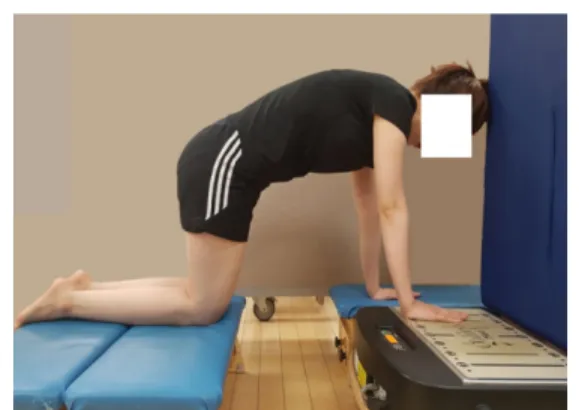
대상자의 오른손은 진동판 위에 위치시켰으며, 왼손 과 양쪽 무릎은 같은 높이의 지지면 위에 위치시켰다.

양 팔은 바닥에 수직이 되도록 완전히 펴고, 최대한 어깨뼈를 내밈(protraction)한 자세를 유지하도록 하였 다(Fig. 1). 각 조건에서 푸쉬업플러스 자세를 10초 동안 유지시켰고, 3회씩 반복시켰으며, 각 회당 2분의 휴식 을 취하도록 하였다.

2) 부가적 진동의 적용

푸쉬업플러스 자세에서 부가적 진동의 적용을 위해 Galileo 진동기(Galileo Mrd S, Galileo Therapy system, Germany)를 사용하였다. Galileo 진동기의 주파수는 5~27 Hz, 진폭은 3 mm, 6 mm, 9 mm로 조절 가능하므로, 본 연구에서는 가장 낮은 주파수인 5 Hz를 저주파수로, 대상자들이 무릎 푸쉬업플러스 운동 시에 진동에 대항 하여 자세를 유지 할 수 있는 가장 높은 주파수인 15 Hz를 고주파수로 설정하였으며, 가장 낮은 진폭인 3 mm 를 저진폭으로, 가장 높은 진폭인 9 mm를 고진폭으 로 설정하였다.

진동은 주파수와 진폭에 따라 무진동(0 Hz/0 mm), 저주파수/저진폭(5 Hz/3 mm), 저주파수/고진폭(5 Hz/9 mm), 고주파수/저진폭(15 Hz/3 mm), 고주파수/고진폭 (15 Hz/9 mm) 의 다섯 가지 조건으로 설정하여 무작위 순서로 적용하였고, 각 진동 조건의 적용 사이에 5분간 의 휴식 시간을 제공하여 측정 간의 상호 영향을 최소화 하였다.

3. 근활성도의 측정과 분석

푸쉬업플러스 적용 시에 어깨안정근의 표면 근활성

도를 분석하고자 무선 표면 근전도(TeleMyo DTS,

Noraxon Inc., USA)를 이용하였다. Cram 등(1998)의 연구

를 참고하여 근전도 전극을 5, 6번째 갈비뼈 높이의 겨드

랑이 중심선 앞쪽 부위에 부착하였고, 근육의 활동전위

를 표준화하기 위해 최대수의적 등척성수축(maximal

voluntary isometric contraction, MVIC)을 사용하였다. 최

(4)

Variables Mean±Standard deviation

Age (year) 27.61±3.60

Height (cm) 163.15±4.92

Weight (kg) 54.57±5.12

Winging scapular length (cm) 3.45±.42 Table 1. General Characteristics of Subjects (n=26) 대수의적 등척성수축 측정을 위한 도수근력은 Hislop

과 Montgomery (2007)의 방법에 따라 측정하였다. 앞톱 니근의 최대수의적 등척성수축은 대상자가 체간을 펴고 바로 앉은 상태에서 팔을 편 채로 위팔을 약 130도 앞으 로 올리고 어깨뼈는 위돌림 하며, 실험자는 대상자가 어깨 내밈을 할 때, 팔꿈치에 최대 저항을 주었다. 최대수 의적 등척성수축은 3회 측정하여 평균값을 구하였으며, 최대수의적 등척성수축 시 5초간 측정한 후, 처음과 끝 부분의 각 1초를 제외한 3초 동안의 평균 근전도 신호량 을 %최대수의적 등척성수축(%MVIC)으로 사용하였다.

근전도 신호의 처리를 위해 표본 추출률(sampling rate) 은 1,000 Hz, 대역 필터(band pass filter)는 10~450 Hz, 노치 필터(notch filter)는 60 Hz를 사용하였다(Park et al., 2013).

표면 근전도 아날로그 신호는 아날로그-디지털 변환기에 의하여 1초에 1,024개의 디지털 신호로 변환되며, 개인용 컴퓨터에서 MyoResearch XP Master Edition 소프트웨어 (Noraxon Inc., USA) 를 이용하여 저장 및 분석하였다. 측 정된 모든 근전도 원자료(raw data)는 300 ms로 RMS (root mean square) 변환을 통해 평균 근전도 신호량을 %최대수 의적 등척성수축(%MVIC)으로 사용하였다.

4. 자료 분석

자료 분석은 SPSS 23.0 Version (IBM SPSS Inc., USA) 을 이용하여 통계처리 하였다. 진동 조건 간의 분석을 위해 one-way ANOVA를 이용하였으며, 사후검정으로 Bonferroni test 를 이용하였다. 통계학적 유의 수준은 .05 로 설정하였다.

Ⅲ. 연구 결과

1. 연구 대상자의 일반적 특성

본 연구에 참여한 대상자의 평균 연령은 27.61±3.60 세, 평균 신장은 163.15±4.92 cm, 평균 체중은 54.57±

5.12 kg이었고, 팔굽혀펴기 시작 자세에서의 평균 어깨 뼈 익상 높이는 3.45±.42 cm였다(Table 1).

2. 진동의 적용조건별 앞톱니근의 근활성도 앞톱니근 근활성도는 무진동 조건에서 13.84±5.47

%MVIC, 저주파수/저진폭 조건에서 14.10±4.97 %MVIC, 저주파수/고진폭 조건에서 16.63±6.31 %MVIC, 고주파 수/저진폭 조건에서 18.92±6.34 %MVIC, 고주파수/고 진폭 조건에서 29.28±10.79 %MVIC로 유의한 차이를 보였다(p<.05). 그리고, 사후 검정 결과에서는 고주파수 /고진폭 조건이 무진동, 저주파수/저진폭, 저주파수/저 진폭, 고주파수/저진폭 조건보다 유의하게 높은 근활성 도를 보였다(p<.05)(Table 2).

Ⅳ. 고 찰

앞톱니근의 약화는 어깨뼈 익상을 유발할 수 있으 며, 이로 인해 어깨 벌림 움직임에서 위등세모근의 과 활성을 통해서 어깨뼈의 위쪽돌림을 보상하게 된다 (Ludewig and Cook, 2000; Ludewig et al., 2004). 이로 인해 다양한 임상적 문제들을 야기되고, 이에 대한 중 재를 위해 앞톱니근의 선택적 강화를 위한 푸쉬업플러 스가 다양한 형태로 활용되고 있으므로 이와 관련된 연구의 필요성이 증가하고 있다.

본 연구에서는 무진동 조건보다 진동 조건에서 앞톱

니근의 근활성도가 증가하였으며, 상대적으로 높은 주

파수와 높은 진폭에서 근활성도가 증가되었다. Hazell

등(2007)의 연구에서 25 Hz, 30 Hz, 35 Hz, 40 Hz, 45

Hz 의 다섯 가지 주파수 조건과 2 mm, 4 mm의 두 가지

진폭 조건에서 등척성 반 스쿼트, 동적 스쿼트, 양 상지

의 정적 및 동적 팔 운동(biceps curl)을 실시하여 높은

주파수와 진폭 조건에서 넙다리근과 위팔두갈래근, 위

팔세갈래근의 근활성도가 증가하였으며, Krol 등(2011)

의 연구에서도 20 Hz, 40 Hz, 60 Hz의 세 가지 주파수

조건과 2 mm, 4 mm의 두 가지 진폭 조건에서 가쪽넓은

(5)

Type of Vibration Mean±SD F p Post-Hoc

Muscle activation

No-vibration (a) 13.84±5.47

20.788 .000

ae be ce de Low frequency /

Low amplitude (b) 14.10±4.97 Low frequency /

High amplitude (c) 16.63±6.31 High frequency /

Low amplitude (d) 18.92±6.34 High frequency /

High Amplitude (e) 29.28±10.79

ae : p<.05 significant difference between no-vibration and high frequency/high amplitude

be : p<.05 significant difference between low frequency/low amplitude and high frequency/high amplitude ce : p<.05 significant difference between low frequency/high amplitude and high frequency/high amplitude de : p<.05 significant difference between high frequency/low amplitude and high frequency/high amplitude

Table 2. Result of Serratus Anterior Muscle Activation in Accordance with Vibration Frequency and Amplitude (unit : %MVIC)

근과 안쪽넓은근의 근활성도를 측정하였을 때, 높은 주파수와 진폭 조건에서 근활성도가 증가하여 본 연구 와 유사한 결과를 제시하였다. 이는 높은 주파수와 진 폭이 근복을 통해 더 많은 수의 운동 단위를 자극하고 (Cardinale and Erskine, 2008), 이를 통해 근활성도가 증 가하였을 것으로 사료된다.

푸쉬업플러스 자세 유지 시 진동판의 수직 상하 움직 임과 진동에 따른 가속도의 증가는 근육과 같은 인체 부위를 과중력 상태에 노출시킴으로써 앞톱니근의 근 활성도에 영향을 미치게 된다(Kim, 2013). 선행연구에 서 가장 높은 주파수인 25 Hz의 진동이 가해졌을 경우, 더 낮은 주파수에 비해 상대적으로 진폭의 증가에 따라 최대 가속도의 크기 증가율이 유의하게 높아지는 결과 를 확인할 수 있었으며, 높은 주파수는 진폭에 따라 증폭이 용이하기 때문이라고 설명하였다(Choi et al., 2008). 따라서 본 연구의 고주파수 조건에서도 진폭이 증가함에 따라 최대 가속도가 증가하였을 것이며, 이로 인해 앞톱니근이 과중력 상태에 노출되어 근활성도가 증가하였을 것으로 판단된다.

반사적인 수축은 자발적인 뼈대근육 활성과 더불어 근육 수행력을 증가시키며, 신경근육계통의 기능을 향 상시킨다(Roelants et al., 2004). 진동기 위에서 중력에 대항하는 근육의 협응수축은 관절의 동적 안정성과 운 동 회로의 동원을 증가 시킨다(Abercromby et al., 2007).

본 연구에서 무릎 푸쉬업플러스 동안 대상자가 중력과 체중에 대항할 뿐만 아니라 주파수가 증가할수록 수직 상하 움직임의 빈도가 증가하므로(Hong et al., 2010), 진동에 대항하는 빈도도 증가하여 앞톱니근의 근활성 도가 증가되었다고 사료된다.

또한, 진동은 일시적 효과 뿐만 아니라 장기적인 적용 시에도 긍정적인 영향을 기대할 수 있다. Verschueren 등(2004)은 전신진동기에서 무릎관절 폄 훈련을 6개월 간 실시한 결과 통제군에 비해 전신진동훈련그룹에서 등척성 근력 및 동적 근력이 현저하게 향상되었다고 보고하였다. Osawa와 Oguma (2011)도 7주간, 주 2회씩 전신진동과 함께 저항훈련을 실시한 그룹이 저항훈련만 실시한 그룹보다 최대등척성 및 구심성 무릎 폄 근력에 서 현저한 증가를 보였다고 하였다. 선행연구에서 전신 진동의 적용 시 중력에 대항하는 무릎 폄 근력이 증가한 결과와 같이, 앞톱니근이 무릎 푸쉬업플러스 자세에서 수직 상하 움직임에 의해 중력에 대항하게 되므로 진폭 이 증가할수록 앞톱니근에 작용하는 중력도 증가하므 로 앞톱니근의 근활성도가 증가하였다고 볼 수 있다.

그러나 Cardinale과 Lim (2003)의 연구에서는 20 Hz

의 진동 조건에서 스쿼트 점프 능력이 향상되었으나,

40 Hz의 진동 조건에서는 신경근의 적응으로 스쿼트

점프 능력이 감소되었다는 결과를 제시하였다. 이는

고주파수 진동이 하지의 신경근육 활성을 증가시키는

(6)

강한 긴장성진동반사를 유발하여 신체에 전달되는 진 동파를 감소시켰기 때문으로 볼 수 있다. 0 Hz와 8 Hz, 26 Hz, 40 Hz의 진동 주파수에 따라 하지근 파워 및 점프수행력을 실험한 Yoon 등(2014)의 연구에서도 0 Hz 에 비해 26 Hz 조건에서만 유의한 근 파워의 향상을 보였으며 8 Hz, 40 Hz에서는 유의한 차이가 나타나지 않았다. 이와 같은 결과는, 8 Hz에서 상승된 근활성도가 오히려 근피로를 유발하여 근육의 수행력이 증가하지 않았으며, 40 Hz에서는 교감신경계의 자극 감소와 부교 감신경계의 자극을 증가로 근육이 이완되기 때문이라고 설명하였다(Buss et al., 1997). 본 연구에서는 상대적으로 높은 주파수와 높은 진폭 조건에서 앞톱니근의 근활성 도가 증가하였으나, 임상적 기대효과에 따라서 진동자 극의 적절한 주파수와 진폭을 선택할 필요가 있다.

본 연구는 몇 가지 제한점이 있다. 연구 대상자 수가 적었고, 특정 조건의 어깨뼈 익상 소견을 가진 대상자 들로 한정하였으므로 모든 어깨뼈 익상 환자들에게 일 반화 하기에는 다소의 어려움이 있다고 생각한다. 또 한, 본 연구에서 측정한 주파수/진폭 조건만으로는 모 든 주파수와 진폭 조건을 대변할 수 없다고 생각하며, 진동자극의 장기적인 중재에 따른 효과에 대한 추가적 연구가 필요할 것으로 생각된다.

Ⅴ. 결 론

본 연구는 어깨뼈 익상이 있는 성인을 대상으로 무릎 푸쉬업플러스 동안 부가적으로 적용된 진동의 주파수 와 진폭에 따라 앞톱니근의 활성도에 미치는 영향을 알아보고자 진행하였다.

무진동, 저주파수/저진폭, 저주파수/고진폭, 고주파 수/저진폭, 고주파수/고진폭 진동 조건에서 측정한 앞 톱니근의 근활성도가 유의한 차이를 나타냈고, 고주파/

고진폭 조건이 다른 진동 조건들 보다 유의하게 높은 근활성도를 보였다. 이를 통해 어깨뼈 익상이 있는 성 인에게 어깨안정근의 근활성도를 증진시키기 위해 진 동을 적용한 무릎 푸쉬업플러스가 적절하고, 높은 주파 수와 진폭의 진동을 적용한다면 더 큰 효과를 기대할 수 있음을 알 수 있다.

Acknowledgements

이 논문은 2018학년도 경성대학교 학술연구비지원 에 의하여 연구되었음.

References

Abercromby AF, Amoentte WE, Layne CS, et al. Variation in neuromuscular responses during acute whole-body vibration exercise. Med Sci Sport Exerc. 2007;

37(9):1642–50.

Bosco C, Colli R, Introini E, et al. Adaptive responses of human skeletal muscle to vibration exposure. Clin Physiol. 1999;19(2):183-7.

Buss IC, Halfens RJC, Abu-Saad HH. The effectiveness of massage in preventing pressure sores: A literature review. Rehabil Nurs. 1997;22(5):229-34.

Cardinale M, Erskine JA. Vibration training in elite sport:

Effective training solution or just another fad?. Int J Sports Physiol Perform. 2008;3(2):232-9.

Cardinale M, Lim J. The acute effects of two different whole body vibration frequencies on vertical jump performance. Med Sport. 2003;56(4):287-92.

Choi HH, Lim DH, Hwang SH, et al. A study of biomechanical response in human body during whole-body vibration through musculoskeletal model development. Journal of the Korean Society for Precision Engineering.

2008;25(5):155-63.

Cram JR, Kasman GS, Holtz J. Introduction to surface electromyography. Gaithersburg: Apsen. 1998.

Decker MJ, Hintermeister RA, Faber KJ, et al. Serratus anterior muscle activity during selected rehabilitation exercises. Am J Sports Med. 1999;27(6):784-91.

Duralde XA. Neurologic injuries in the athlete's shoulder. J Athl Train. 2000;35(3):316-28.

Ellenbecker T. Shoulder rehabilitation: Non-operative treatment.

Thieme Medical Publishers. 2006.

Ellenbecker TS, Davies GJ. Closed kinetic exercise. Champaign:

(7)

Human kinetics. 2001.

Fontana TL, Richardson CA, Stanton WR. The effect of weightbearing exercise with low frequency, whole body vibration on lumbosacral proprioception: A pilot study on normal subjects. Aust J Physiother. 2005;

51(4):259-63.

Gu Q. The changes of electromyographic activities in upper trapezius, serratus anterior and pectoralis major according to surface tilt angle during push-up plus exercise. Doctor’s Degree. Daegu University. 2015.

Hazell TJ, Jakobi JM, Kenno KA. The effects of whole-body vibration on upper- and lower-body EMG during static and dynamic contractions. Appl physiol Nutr Metab. 2007;32(6):1156-63.

Hislop HJ, Montgomery J. Daniels and Worthingham's Muscle testing: Techniques of manual examination(8 th ed).

Elsevier Health Science. 2007.

Hong J, Velez M, Moland A, et al. Acute effects of whole body vibration on shoulder muscular strength and joint position sense. J Hum Kinet. 2010:25:17-25.

Kibler WB, Uhl TL, Maddux JW, et al. Qualitative clinical evaluation of scapular dysfunction: A reliability study.

J Shoulder Elbow Surg. 2002;11(6):550-6.

Kim SE. Influence of whole body vibration frequency on EMG activity of shoulder stabilizing muscles while maintaining push up plus position. Doctor’s Degree.

Yonsei University. 2013.

Kim SH, Kwon OY, Kim SJ, et al. Serratus anterior muscle activation during knee push-up plus exercise performed on static stable, static unstable, and oscillating unstable surfaces in healthy subjects. Phys Ther Sport. 2014;15(1):20-5.

Krol P, Piecha M, Slomka K, et al. The effect of whole-body vibration frequency and amplitude on the myoelectric activity of vastus medialis and vastus lateralis. J Sports Sci Med. 2011;10(1):169-74.

Lee KC, Bae WS. Effect of push-up plus exercise on serratus anterior and upper trapezius muscle activation based

on the application method of Togu. Journal of The Korean Society of Integrative Medicine. 2016;4(2):

29-36.

Lee SK. The Effects of vibration stimuli applied to the shoulder joint on the activity of the muscles around the shoulder joint. J Phys Ther Sci. 2013;25(11):1407-9.

Ludewig PM, Cook TM, Nawoczenski DA. Three-dimensional scapular orientation and muscle activity at selected positions of humeral elevation. J Orthop Sports Phys Ther. 1996;24(2):57-65.

Ludewig PM, Cook TM. Alterations in shoulder kinematics and associated muscle activity in people with symptoms of shoulder impingement. Phys Ther. 2000;

80(3):276-91.

Ludewig PM, Hoff MS, Osowski EE, et al. Relative balance of serratus anterior and upper trapezius muscle activity during push-up exercises. Am J Sports Med. 2004;

32(2):484-93.

Martin RM, Fish DE. Scapular winging: Anatomical review, diagnosis, and treatments. Curr Rev Musculoskelet Med. 2008;1(1):1-11.

McCann PD, Wootten ME, Kadaba MP, et al. A kinematic and electromyographic study of shoulder rehabilitation exercises. Clin Orthop Relat Res.

1993;288:179-88.

Osawa Y, Oguma Y. Effects of whole-body vibration on resistance training for untrained adults. J Sports Sci Med. 2011;10(2):328-37.

Park JS, Jeon HS, Kwon OY. A comparison of the shoulder stabilizer muscle activities during push-up plus between persons with and without winging scapula.

Physical Therapy Korea. 2007;14(2):44-52.

Park KM, Cynn HS, Yi CH, et al. Effect of isometric horizontal abduction on pectoralis major and serratus anterior EMG activity during three exercises in subjects with scapular winging. J Electromyogr Kinesiol. 2013;

23(2):462-8.

Park SY, Yoo WG. Differential activation of parts of the serratus

(8)

anterior muscle during push-up variations on stable and unstable bases of support. J Electromyogr Kinesiol. 2011;21(5):861-7.

Roelants M, Delecluse C, Verschueren SM. Whole-body- vibration training increases knee-extension strength and speed of movement in order women. J Am Geriatr Soc. 2004;52(6);901-8.

Roelants M, Verschueren SM, Delecluse C, et al.

Whole-body-vibration-induced increase in leg muscle activity during different squat exercises. J Strength Cond Res. 2006;20(1):124-9.

Sahrmann S. Diagnosis and treatment of movement impairment syndromes. Elsevier Health Sciences. 2002.

Verschueren SM, Roelants M, Delecluse C, et al. Effect of 6-month whole body vibration training on hip density, muscle strength, and postural control in postmenopausal women: A randomized controlled pilot study. J Bone Miner Res. 2004;19(3):352-9.

Yoon GH, Ji CG, Park JS, et al. The effect of the frequency

of whole body vibration on power and jump

performance capability of lower limb. Journal of Sport

and Leisure Studies. 2014;56(2):877-84.

수치

Fig. 1. Knee push-up plus까지 어깨안정화 근육의 활성화에 대한 연구는 미흡한 실정이다. 또한, 푸쉬업플러스 시 어깨뼈 안정근의 근활성도를 분석한 대부분의 연구가 정상인을 대상으로 이루어졌으며, 어깨뼈 익상 등과 같은 임상적 문제를 대상으로 수행된 연구는 부족한 실정이다.따라서, 본 연구는 어깨뼈 익상 소견을 가진 성인을 대상으로 무릎 푸쉬업플러스 동안 부가적으로 적용된 진동의 유무 및 주파수와 진폭에 따라 앞톱니근의 활성도에 미치는 영
Table 2. Result of Serratus Anterior Muscle Activation in Accordance with Vibration Frequency and Amplitude (unit : %MVIC)

참조

관련 문서

Comparisons of the UT/LT and UT/SA muscle activity ratios between the preferred PUP exercise and PUP exercise with ADIM (UT: upper trapezius, LT: lower trapezius, SA:

This study was conducted to investigate the ef- fects of the application of CCF on the muscle activ- ities of the scapular upward rotator muscles during the push-up plus

Objects: The purpose of this study was to examine differences in surface electromyography (EMG) activity of upper trapezius, pectoralis major, and serratus anterior

The Comparison of Electromyographic Ratio of Serratus Anterior and Upper Trapezius According to Exercise Position and Shoulder Flexion Angle during Scapular

Methods: Based on the inclusion criteria, 26 healthy adults, both males and females, were recruited for the measurement of muscle activation of the upper trapezius and

(2011), Differential activation of parts of the serratus anterior muscle during push-up variations on stable and unstable bases of support.. (2000), A guide

Methods: Based on the inclusion criteria, 26 healthy adults, both males and females, were recruited for the measurement of muscle activation of the upper trapezius

Purpose: The aim of this study was to investigate the effects of trapezius and serratus anterior strengthening exercise on the shoulder pain and muscle activation of