Effects of Acupuncture on Heart Rate Variability in Obese Premenopausal Korean Women
Yo-Chan Yang
1, Je-In Kim
1, Koh-Woon Kim
1, Jae-Heung Cho
1, Song-Yi Kim
2, Hi-Joon Park
2, Mi-YeonSong
11Dept. of Korean Rehabilitation Medicine, College of Korean Medicine, Kyung Hee University
2Studies of Translational Acupuncture Research, Acupuncture and Meridian Science Research Center, Kyung Hee University
Original Article
⋅Received:23 October 2014 ⋅Revised:19 November 2014 ⋅Accepted:21 November 2014
⋅Correspondence to:Mi-Yeon Song
Dept. of Korean Rehabilitation Medicine, College of Korean Medicine, Kyung Hee University, Hoegi-dong, Dongdaemun-gu, Seoul, Korea, 130-701
Tel:+82-2-440-7580, Fax:+82-2-440-6854, Email:[email protected]
Objectives: Although the autonomic nervous system (ANS) is thought to play an important role in treatment of obesity, no study has been conducted to investigate acupuncture’s effects on this aspect of the ANS. This study aimed to describe the effects of acupuncture in the ANS by means of heart rate variability (HRV) analysis.
Methods: A total of 46 obese women aged from 21 to 54 with body mass index ranging from 25.1 to 39.3 kg/m2 were recruited and randomized into both the real acupuncture group (n=23) and sham acupuncture group (n=23). A total of 3 instances of HRV analysis were conducted before, during, and after treatment. Statistically significant differences between time and groups were analyzed using repeated measure analysis of variance.
Results: All parameters of time domain analysis and frequency domain analysis except for the square root of the mean squared differences of successive normal sinus intervals (RMSSD) and very low frequency (VLF) showed significant differences between times. The mean of all R-R intervals (mean RR) showed significant level of interaction between time and group. Between groups, time domain analysis of standard deviation of the normal-to-normal intervals (SDNN), RMSSD and frequency domain analysis of total power (TP) and high frequency (HF) showed significant differences.
Conclusions: The real acupuncture group showed deactivation of parasympathetic function and relative increase of sympathetic activity in obese subjects. Further studies are necessary to uncover the mechanisms of acupuncture in obesity treatment.
Key Words : Obesity, acupuncture, autonomic nervous system, heart rate variability
Introduction
Heart rate variability (HRV) refers to beat-to-beat fluctuations in the rhythm of the heart, or the way in which the time intervals between heart beats change over time
1). This variation results from the regulation of the sinoatrial node of the heart by the sympathetic and parasympathetic branches of the autonomic nervous system (ANS). HRV therefore reflects the
activity of the ANS and is a reliable, useful, and non-invasive means to provide a comprehensive, quantitative, and qualitative evaluation of neuroautonomic function
2). Various studies utilize this tool for researching physiological mechanisms of the body and predicting mortality of certain patient populations such as myocardiac infarction patients
3).
Numerous studies have investigated the impact of
acupuncture on HRV in both humans and animals. A
systematic review of human studies
4)was published in 2010 and this study included 12 randomized controlled trials (RCTs) which compared acupuncture to a sham (placebo) acupuncture intervention. A recent study
5)added four more RCTs to these 12 studies and revealed that only 4 of 16 RCTs studied subjects with medically diagnosed conditions (depression and anxiety, migraine headaches, post stroke insomnia, and congestive heart failure). The rest of the RCTs studied healthy subjects in their normal baseline state or under certain conditions of artificially induced stress. RCTs for the effects of acupuncture on HRV in obese subjects have never been conducted.
Considering the autonomic nervous system plays an important role in the regulation of energy expenditure and body fat storage
6, 7), the utilization of HRV measurements in studies concerning obesity is plausible. Several studies which used HRV in obese subjects have shown that regional body fat distribution is related to HRV indices
8)and weight loss increased parasympathetic control of HRV
9). Acupuncture has been applied extensively around the world as an alternative treatment to reduce body weight
10). The underlying mechanisms of acupuncture in weight reduction might result from reducing appetite
11)and splitting fat
12), but regulating the activity of ANS could also be a possible mechanism.
The purpose of this study was to evaluate the effects of acupuncture on HRV in obese premenopausal Korean women.
Methods
1. Subjects
This was a prospective study conducted from 4 April to 16 May, 2014. All study procedures were approved by the Institutional Review Board (IRB) of Kyung Hee University Hospital at Gang-dong (IRB file No.: 2013-01-020). Subjects were recruited
through newspaper advertisements and announcements on the hospital's noticeboard. To minimize hormonal effects
13), obese Korean women between 18 and 55 years of age who were in premenopausal state were enrolled in this study. A total of 50 subjects accepted the allocation and gave written informed consent. All subjects met the following inclusion criteria: (i) >25kg/m
2body-mass index (BMI), (ii) 18 to 55 years of age, (iii) in premenopausal state with regular menstruation. Individuals with the following conditions were excluded: (i) gynecological disease including hysterectomy and/or oophorectomy, (ii) cardiac arrhythmia or an implanted cardiac pacemaker, (iii) history of taking medication including female hormones, thyroid hormones, oral steroids, or antihypertensives in the 3 months preceding the study, (iv) pregnant or lactating state.
2. Groups and intervention
The subjects were randomly assigned to either the real acupuncture group (RA) or sham acupuncture group (SA) in a 1:1 ratio using a random number generator (Excel, Microsoft Corp., Redmond, WA, USA).
This study was composed of one treatment session. The intervention was delivered in the outpatient department at the Wellness Center of Kyung Hee University Hospital at Gang-dong. Each subject received the intervention in an individual room and lay on a bed throughout the process.
The intervention combined manual acupuncture and electroacupuncture. Considering the fact that electroacupuncture is widely used to treat obese patients in many clinics, we decided to set intervention including electroacupuncture. In addition to electroacupuncture, we set manual acupuncture to promote the effects and chose acupuncture points based on traditional acupuncture theory.
The acupuncture treatment comprised a total of 30
minutes session in both groups. As clinical settings
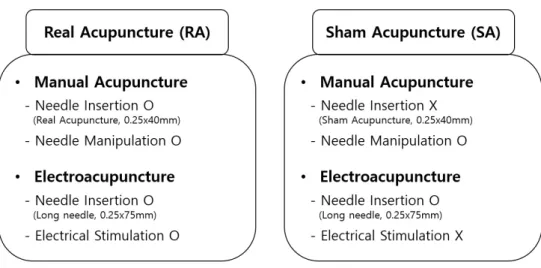
Fig. 1. Groups and intervention.
Both groups received the intervention of manual acupuncture and electroacupuncture. In manual acupuncture, while the real acupuncture (RA) group was treated with real acupuncture needle insertion, the sham acupuncture (SA) group was not. In electroacupuncture, RA received electrical stimulation through the needles inserted, and SA received actual needle insertion without electrical stimulation.
for electroacupuncture treatments in obese patients, 25 minutes of “lypolytic phase” with 25Hz electrical stimulation followed by 5 minutes of “elasticity maintenance phase” with 60Hz electrical stimulation comprised the 30-minute session. The acupuncture points were chosen in accordance with the theories of traditional Korean medicine and followed the World Health Organization Standard Acupuncture Point Locations
14). For the RA group, 10 acupuncture needles (Dongbangacupuncture, 0.25 X 40 mm) were inserted vertically in Zhongwan (CV12, middle), Qihai (CV6, middle), Hegu (LI4, bilateral), Quchi (LI11, bilateral), Zusanli (ST36, bilateral), and Sanyinjiao (SP6, bilateral). For the purpose of patient blinding, Park tube designed for Park's sham needle
15)was attached to these 10 acupuncture points before inserting needles. Additionally, four long needles (Dongbangacupuncture, 0.25 X 75 mm) were inserted obliquely in Tianshu (ST25, bilateral) and Shuidao (ST28, bilateral). Electrical stimulation was applied to these 4 acupuncture points in which long needles were inserted.
In the SA group, Park's sham needle
15)was administered for each subject. Sham acupuncture needles (Acuprime, 0.25 X 40mm) were used in 10 Park tube-attached acupuncture points. The tips of the sham needles were blunt, so that these needles were not inserted intradermally but just held in place by Park tubes. Insertion of 4 long needles was conducted same as with the RA group, but the leads to these 4 needles were connected to an inactive channel of the electrical stimulator. The stimulator was turned on, but electrical pulses were delivered to an unconnected channel. In contrast, the RA group received real electrical pulses through the long needles. However, the intensity of pulses was set under the detection threshold so that subjects of the RA group also couldn't sense the electrical stimulation.
In both groups, needle manipulation (twisting and
pressuring) for enhancing the acupuncture sensation
(called de qi in Korean medicine) was performed
with inserting needles. All subjects were told that
they would receive real acupuncture treatment with
Fig. 2. The experimental sequence.
Heart rate variability (HRV) was measured 3 times during whole session; 5 minutes before acupuncture treatment, 5 minutes after electrical pulses started, and 5 minutes after the removal of acupuncture. Each measurement was preceded by 5 minutes of rest.
real electrical stimulation which can't be felt due to low intensity, so that subject blinding was achieved.
Comparison of both groups’ intervention is summarized in Figure 1.
3. HRV measurement
HRV was recorded in a supine position after a 5-minutes rest and in a quiet room at room temperature using the Heart Rhythm Scanner (Version 2.0, Biocomtechnologies, Washington, USA).
In this study, 5 minutes of data were recorded to analyze the short-term effect of heart and pulse rates.
Three leads of HRV were attached, 4 cm above the right nipple, 4 cm below the left nipple, and on the lateral left side. The subjects were earlier told to avoid alcohol, coffee, and cigarettes within 12 h and any kinds of food ingestion within 1 h before the measurement. The experimental sequence is shown in Figure 2. HRV was measured 3 times during the experiment; 5 minutes before acupuncture treatment, 5 minutes after electrical pulses started, and 5 minutes after the removal of acupuncture. All HRV data were collected between 9 am and 1 pm.
The time domain analysis of HRV included the heart rate (HR), the mean of all R-R intervals (mean RR), the standard deviation of all R-R intervals (SDNN), and the square root of the mean squared differences of successive normal sinus intervals (RMSSD). SDNN was considered to reflect overall
HRV (like TP), whereas RMSSD was considered to be an index of parasympathetic modulations of heart rate
16). The frequency domain analysis included the total power (TP), the very low frequency (VLF: ≤ 0.04 Hz), the low frequency (LF: 0.04-0.15 Hz), and the high frequency (HF: 0.15-0.4 Hz) spectral components. The LF domain reflects both the sympathetic and the parasympathetic nervous systems and the HF domain primarily reflects vagal cardiac control (like RMSSD)
16). The LFnu and HFnu represented the relative value of the LF or HF power in proportion to the total power minus the VLF power. The LF/HF ratio, considered to reflect sympatho-vagal balance,
16)was calculated.
4. Data analysis
All values are expressed as mean ± standard deviation (SD). Student’s t-test was used to test for differences between the two groups at baseline.
Repeated measure analysis of variance (ANOVA)
was performed to compare the before/during/after
changes in HRV indices for both the RA and SA
groups. All analyses were conducted by Statistical
Package for the Social Sciences (SPSS) version 16.0
program for Windows. A p-value less than 0.05 was
considered statistically significant.
RA (n=23)
SA
(n=23) p-value
Age (years) 35.74±9.44 37.57±7.15 .463
Height (cm) 163.06±5.09 160.11±6.15 .085
Weight (kg) 78.39±9.39 75.13±11.14 .290
BMI (kg/m2) 29.52±3.64 29.26±3.53 .808
HR (bpm) 69.49±8.32 67.38±9.51 .427
Mean RR (ms) 874.79±100.00 905.05±109.83 .334
SDNN (ms) 36.04±11.99 43.36±16.99 .098
RMSSD (ms) 25.03±11.18 34.16±19.80 .061
TP (ms2) 473.90±343.13 690.05±730.35 .208
VLF(ms2) 290.40±273.73 376.82±483.98 .460
LF(ms2) 124.39±100.54 194.48±209.11 .157
HF (ms2) 59.12±52.72 110.96±115.43 .059
LFnu (%) 67.73±16.39 62.65±21.28 .369
HFnu(%) 32.27±16.39 37.35±21.28 .369
LF/HF 3.79±4.84 3.35±4.19 .744
Values are mean ± standard deviation RA: real acupuncture
SA: sham acupuncture
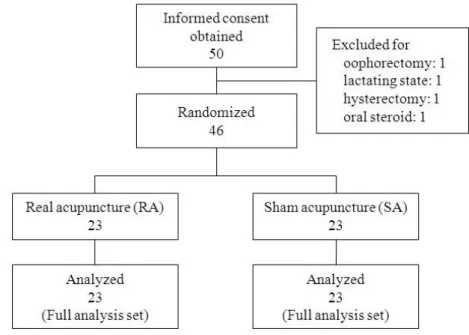
Table 1. Subjects' General Characteristics and Baseline Data of Heart Rate Variability (n=46) Fig. 3. `Flow chart of the study.
50 applicants provided written informed consent. 4 of 50 subjects were excluded by exclusion criteria, resulting in a sample population of 46 subjects. 46 subjects were randomly assigned to either the real acupuncture (RA) group or the sham acupuncture (SA) group in a 1:1 ratio, and results of 46 subjects were analyzed.
HRV Group Before Treatment
During Treatment
After
Treatment p-value
HR (bpm)
RA SA
69.49±8.32 67.38±9.51
67.45±8.55#
64.91±7.11#
68.80±7.86 64.55±7.81#
Time .000**
Time× Group.069 Group .216 Mean RR
(ms)
RA SA
874.79±100.00 905.05±109.83
902.84±110.54#
934.04±94.60#
882.58±96.77$
942.30±112.33#
Time.000**
Time× Group.035*
Group.183 SDNN
(ms)
RA SA
36.04±11.99 43.36±16.99
36.24±10.43 45.10±20.25
41.94±13.00#, $ 54.49±25.30#, $
Time.000**
Time× Group.411 Group.039*
RMSSD (ms)
RA SA
25.03±11.18 34.16±19.80
27.54±11.58 38.47±27.73
24.56±10.44 39.56±25.46
Time.053 Time× Group.110
Group.035*
Values are mean ± standard deviation
#: significantly different from before-treatment by paired t-test
$: significantly different from during-treatment by paired t-test
*: significant at p<0.05 by repeated measure ANOVA
**: significant at p<0.01 by repeated measure ANOVA RA: real acupuncture
SA: sham acupuncture
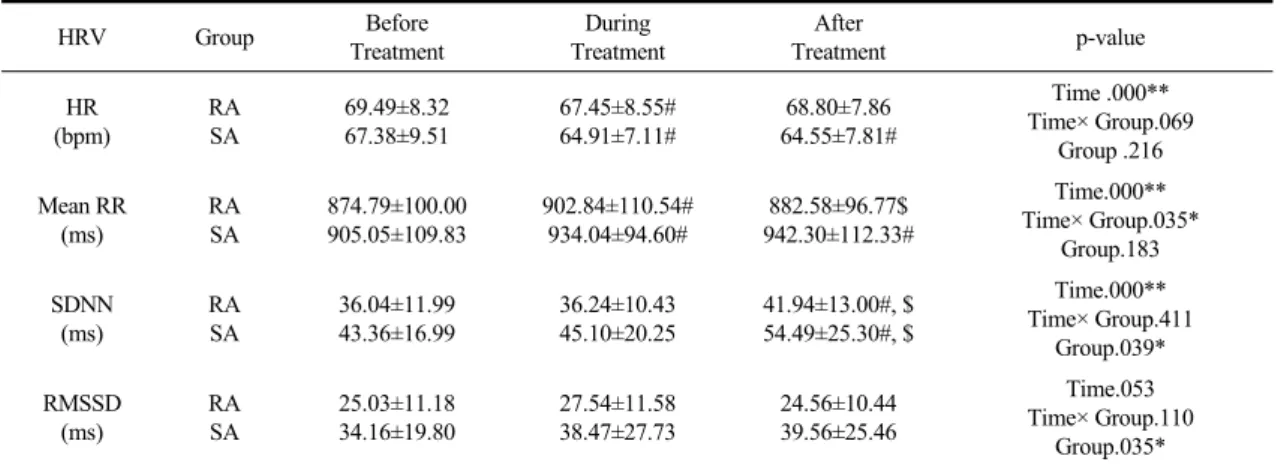
Table 2. The Changes of Heart Rate Variability Indices (Time Domain Analysis)
Results
1. General characteristics of subjects
50 applicants provided written informed consent;
4 of them were excluded based on exclusion criteria (1 for history of hysterectomy, 1 for history of oophorectomy, 1 for lactating state, 1 for history of taking oral steroids), resulting in a sample population of 46 subjects (Fig. 3). The 46 subjects were aged from 21 to 54 years and had a BMI range of 25.1 to 39.3 kg/m
2. All included subjects were randomly assigned to either the RA group (n=23) or the SA group (n=23). Subjects' demographics, anthropometric data, and baseline data of HRV are summarized based on groups in Table 1. There were no statistically significant differences between the groups.
2. Changes of HRV parameters during the whole session
All parameters of time domain analysis and frequency domain analysis except for RMSSD and
VLF showed significant differences between times.
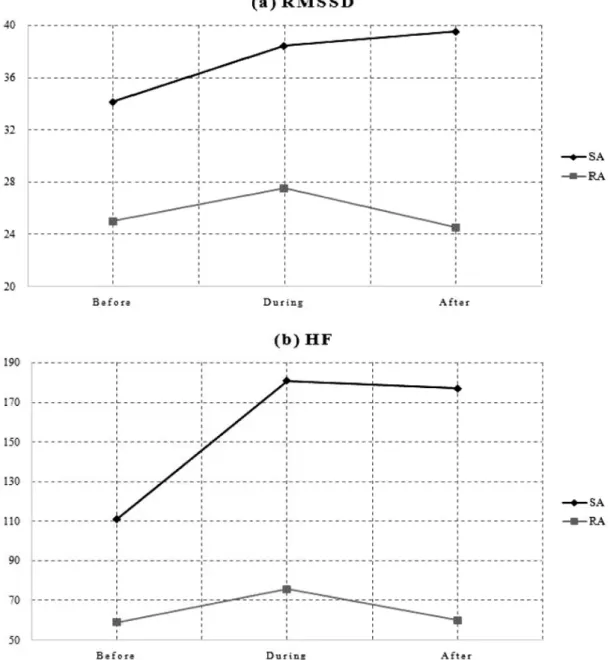
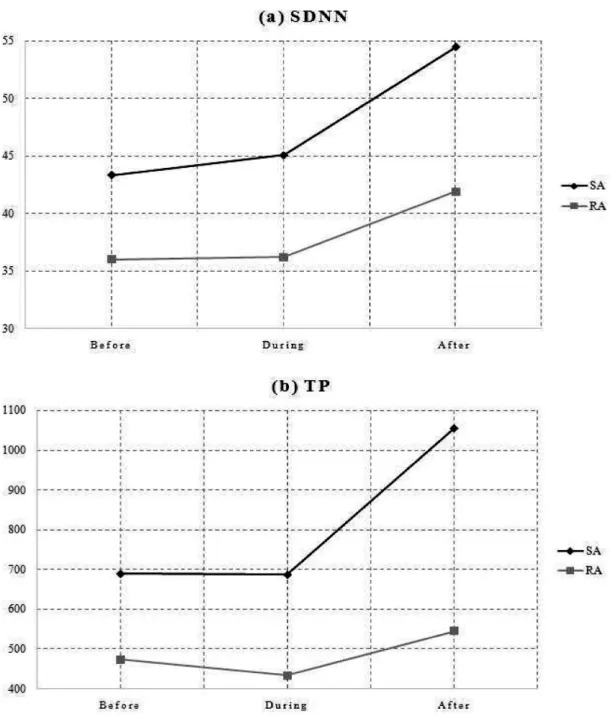
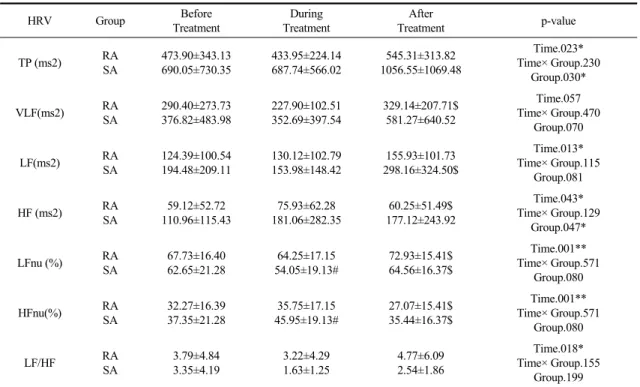
Mean RR showed significant level of interaction between time and group (p=0.035), but the rest of the parameters had no significant interaction between time and group. Between groups, time domain analysis of SDNN, RMSSD and frequency domain analysis of TP, HF showed significant differences (SDNN for p=0.039, RMSSD for p=0.035, TP for p=0.030, HF for p=0.047) (Table 2). Compared to SA, RA showed the effects of relative decrease in RMSSD, HF, SDNN, and TP (Fig.4-5).
Discussion
The ANS directs voluntary and involuntary
physiologic processes such as digestion, blood
pressure, hormonal regulation, energy metabolism,
and heart rate and is therefore considered an
important regulator of homeostasis
17, 18). HRV is
widely used in various studies for measuring and
evaluating the ANS. However, several variables that
can affect HRV make it difficult to draw a firm
Fig. 4. The change patterns of RMSSD and HF parameters.
Both the real acupuncture (RA) and the sham acupuncture (SA) groups showed no significant differences between 3 measurements in RMSSD. RA showed a significant decrease at after-treatment measurement compared to during-treatment measurement in HF (p=0.023).
Fig. 5. The change patterns of SDNN and TP parameters.
Both the real acupuncture (RA) and the sham acupuncture (SA) groups showed no significant differences between 3 measurements in TP. Both groups showed a significant increase at after-treatment measurement compared to previous 2 measurements in SDNN.
HRV Group Before Treatment
During Treatment
After
Treatment p-value
TP (ms2) RA
SA
473.90±343.13 690.05±730.35
433.95±224.14 687.74±566.02
545.31±313.82 1056.55±1069.48
Time.023*
Time× Group.230 Group.030*
VLF(ms2) RA
SA
290.40±273.73 376.82±483.98
227.90±102.51 352.69±397.54
329.14±207.71$
581.27±640.52
Time.057 Time× Group.470
Group.070
LF(ms2) RA
SA
124.39±100.54 194.48±209.11
130.12±102.79 153.98±148.42
155.93±101.73 298.16±324.50$
Time.013*
Time× Group.115 Group.081
HF (ms2) RA
SA
59.12±52.72 110.96±115.43
75.93±62.28 181.06±282.35
60.25±51.49$
177.12±243.92
Time.043*
Time× Group.129 Group.047*
LFnu (%) RA
SA
67.73±16.40 62.65±21.28
64.25±17.15 54.05±19.13#
72.93±15.41$
64.56±16.37$
Time.001**
Time× Group.571 Group.080
HFnu(%) RA
SA
32.27±16.39 37.35±21.28
35.75±17.15 45.95±19.13#
27.07±15.41$
35.44±16.37$
Time.001**
Time× Group.571 Group.080
LF/HF RA
SA
3.79±4.84 3.35±4.19
3.22±4.29 1.63±1.25
4.77±6.09 2.54±1.86
Time.018*
Time× Group.155 Group.199 Values are mean ± standard deviation
#: significantly different from before-treatment by paired t-test
$: significantly different from during-treatment by paired t-test
*: significant at p<0.05 by repeated measure ANOVA
**: significant at p<0.01 by repeated measure ANOVA RA: real acupuncture
SA: sham acupuncture
Table 3. The Changes of Heart Rate Variability Indices (Frequency Domain Analysis)