
INTRODUCTION
The idea of Patient Blood Management (PBM) has emerged mainly due to problems caused by blood transfusion and periop- erative anemia. This concept is based on the 5 elements suggested by Hofmann et al. [1] (2011): gaps between supply and demand for blood, high transfusion costs, risk of contaminated blood products, adverse outcomes of transfusion, and a paucity of evidence to prove transfusions efficacy. Furthermore, there is a serious issue related to perioperative anemia. The significance of managing perioperative
anemia is particularly underestimated, and medical professionals use blood transfusions indiscriminately to rapidly return hemoglobin (Hb) levels to normal [2,3].
PBM is a group of multi-disciplinary protocols under the con- cept of 3 pillars that are applied to a patient’s clinical course (before, during and after the operation): optimizing red blood cells (RBCs) production, reducing bleeding, and harnessing the tolerance of ane- mia [1,4]. One of the advantages of PBM is cost-effectiveness. The Department of Health in Western Australia started comprehensive PBM; they experienced cost savings of Australian dollar (AUD)
A Paradigm Shift: Perioperative
Iron and Erythropoietin Therapy for Patient Blood Management
Hyesun Lee1, Young Jin Yuh2
1Department of Surgery, Hanyang University College of Medicine, Seoul, Korea
2Department of Internal Medicine, Inje University Paik Hospital, Seoul, Korea Hanyang Med Rev 2018 Mar;38(1):16-26
https://doi.org/10.7599/hmr.2018.38.1.16 pISSN 1738-429X eISSN 2234-4446
Allogeneic blood transfusion is often restricted due to its adverse effects, a lack of blood supply, and religious or cultural constraints. As a result, patient blood man- agement (PBM) has been gaining attention. PBM is an evidence-based, patient- centered bundle of technologies that manages perioperative anemia and reduces bleeding during surgery. PBM improves the postoperative prognoses. Periopera- tive anemia is the main concern in PBM; therefore, to diagnose and treat it is im- portant. This review focuses on the perioperative use of oral or intravenous iron and erythropoietin (EPO), in relevant fields such as cardiac surgery, orthopedics, and neurosurgery. IV administration of iron has been controversial due to safety concerns, such as increased risk of infection. However, using IV iron appropriately is beneficial in most surgical settings. Although recombinant human EPO may increase thromboembolic risks, this can be mitigated through various methods including limiting the target Hb level, using it in combination with IV iron, or pro- phylaxis for deep venous thrombosis. EPO is recommended in patients undergo- ing cardiac or orthopedic surgery. As PBM becomes globally implemented, the blood management methods, including tranexamic acid, hemostatic agents, and cell salvage have become more variable as well. Among them, administration of iron and EPO would be the most common pharmacologic choices based on cur- rent practice. However, controversy still exists. Therefore, further studies on iron and EPO are needed to ensure better and safer patient care.
Key words: Anemia; Iron; Erythropoietin; Bloodless medical and surgical proce- dures; Perioperative care
Corresponding Author: Young Jin Yuh Cancer Center, Inje University Sanggye- Paik Hospital, 1342 Dongil-ro, Nowon-gu, Seoul 01757, Korea
Tel: +82-2-2-950-1460 Fax: +82-2-2-938-1464 E-mail: [email protected] Received
Revised Accepted
11 Oct 2017 28 Jan 2018 12 Feb 2018
This is an Open Access article distributed under the terms of the Creative Commons Attribution Non-Commercial License (http://creativecommons.org/licenses/by-nc/4.0/) which permits unrestricted non-commercial use, distribution, and reproduction in any medium, provided the original work is properly cited.
10,725,750 (approximately $8,500,000 US dollars) in blood products and hospital-related blood transfusions during the 3 years after PBM initiation [5]. The World Health Assembly of the World Health Or- ganization (WHO) shared some guidelines and recommended PBM to its members in the 63rd session in 2010 [5]. PBM includes various techniques such as oral and intravenous iron supplementation, he- mostatic agents, erythropoietin (EPO), tranexamic acid (TXA), and cell salvage.
Among the numerous methods in PBM, iron and EPO therapies were chosen in this review because they are more commonly used pharmacologically compared to transfusion [6]. The aim of this review was to use recent data to demonstrate the effectiveness of PBM using iron therapy and EPO management in clinical depart- ments such as cardiac surgery, orthopedics, and neurosurgery.
THE LIMITATIONS OF BLOOD TRANSFUSION Allogeneic blood transfusion has contributed to advances in medicine and surgery. However, the threshold for blood transfu- sions is still controversial. A Canadian critical care trial in 1999 showed that a restrictive transfusion policy (transfusion of RBCs if Hb level is less than 7 g/dL) is possibly more effective than a liberal transfusion strategy (transfusion of RBCs if Hb level is lower than 10 g/dL) except for patients with active coronary ischemia [2]. The National Institute for Health and Care Excellence (NICE) guidelines also encourage restrictive transfusion policy; however, for patients with cardiovascular disease, transfusions are needed if the Hb level is lower than 8 g/dL [7].
Despite restrictive transfusion, there are still some limitations to transfusion, such as blood supply, transfusion risks, and patient re- fusal of treatment.
First, there is a global blood shortage. For example, the Korean Red Cross, undertaking the essential role in blood services in South Korea, reported in 2014 that the blood supply for transfusion did not match the demand of blood in March and October. After that, in the first half of 2016, there was a shortage of blood supply coun- trywide, and this phenomenon continued through 2017 [8].
Second, there are some dangers to transfusion. Although al- logeneic blood transfusion has contributed to the development of medical and surgical advances, several studies have reported that blood transfusion causes medical problems and worsens the patient’s outcome and safety. Risks of transfusion include urticaria (1–3%), anaphylaxis (1 in 20,000 to 1 in 50,000 transfusions), transfusion- related acute lung injury (approximately 1 in 5,000 transfusions), delayed hemolytic transfusion reactions (approximately 1 in 6,000
transfusion units), circulatory or iron overload [9], and infectious diseases such as hepatitis B and C, bacterial sepsis, malaria, and hu- man immunodeficiency virus (HIV) infection. The incidence of adverse events is approximately 0.5–3% [10].
Lastly, there might be some people who cannot receive transfu- sions due to RBC antibodies or religious or cultural beliefs.
PREOPERATIVE ANEMIA
The WHO defines anemia as the Hb level below 13.0 g/dL in men, 12.0 g/dL in non-pregnant women, and 11.0 g/dL in pregnant women [4]. It is a serious health problem affecting 1 in every 3 or 4 people worldwide; hence, it needs to be considered a disease that should be evaluated and treated [11].
Especially surgical patients commonly have preoperative and postoperative anemia. According to 18 large studies, the average preoperative anemia prevalence was approximately 35% in more than 650,000 surgical patients [12]. Preoperative anemia is closely as- sociated with longer hospital stays, higher mortality, greater blood transfusion needs, and increased postoperative complications [4].
One cohort study of 3,500 patients undergoing anterior cervical discectomy and fusion demonstrated that preoperative anemia is significantly associated with an increase in minor or major com- plications; pulmonary, renal, or central nervous system complica- tions; blood transfusion needs; and length of hospital stay [13]. Mild anemia increases perioperative complication risk by 30–40%, and this risk increases with the increase in the severity of the anemia.
Owing to the deleterious effects of preoperative anemia, major and non-urgent surgeries may need to be rescheduled to diagnose and treat anemia and iron deficiency. It is recommended that patients be assessed at least 30 days before any major planned surgery, and the type of anemia might be distinguished using tests such as blood count test, iron tests, and an inflammation marker test including C- reactive protein (CRP) [4,14].
Preoperative anemia has multifactorial causes including iron or other nutritional deficiencies such as folate or protein, inflammatory cytokines’ activation, and diagnostic phlebotomies that many vials of blood are drawn. In a study with 715 patients undergoing major orthopedic surgery, 75 people were anemic. Among them, about 30.8% had nutrient deficiencies, and 30.8% had chronic inflamma- tion, as a cause of anemia [12].
Iron, one of the most important types of nutritional deficiencies, is an essential element in cellular function and oxygen transporta- tion in the human body. Stored iron can be reflected as ferritin levels. A peptide hormone hepcidin targets an iron exporter called
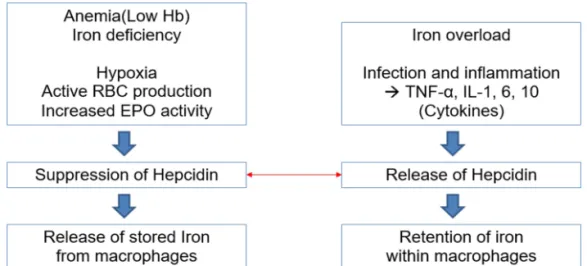
ferroportin on the cell surface. This interaction between hepcidin and ferroportin regulates iron homeostasis, and the expression of hepcidin gets influenced by some physiological conditions. In ane- mia, iron deficiency, active erythropoiesis, and hypoxia, hepcidin synthesis is decreased in normal homeostasis (Fig. 1). Decreased hep- cidin levels increase the iron absorption in the intestines. However, if the absorbed amount of iron is less than the lost amount, stored iron would be exhausted. Then, the patient gets iron deficiency, and if this repeats again and again, iron deficiency anemia (IDA) occurs.
IDA comprises 3 stages: the first stage is the paucity of stored iron, the second stage is erythropoiesis with iron deficiency, and the third stage is lack of iron supply which cannot return Hb levels to the normal levels [15].
In case of anemia of chronic inflammation, cytokines including interleukin-1 (IL-1), IL-6, IL-10, and tumor necrosis factor (TNF)-α are produced. Subsequently, expression of hepcidin is increased (Fig.
1). This phenomenon is related to a decrease of serum iron level and an increase of serum ferritin levels, thus limiting iron’s availability for erythropoiesis. Moreover, there is resistance to EPO, and the responses to EPO are reduced, resulting in chronic inflammation- induced anemia [16].
In conclusion, the prevention and appropriate management of preoperative anemia through PBM can decrease mortality and the need for intensive care in patients undergoing surgeries. One PBM strategy that can be commonly and importantly used at this stage is to offer patients iron and/or EPO management.
IRON THERAPY FOR PBM: ORAL AND INTRAVENOUS IRON SUPPLEMENTATION
According to various studies, oral or IV iron treatment before orthopedic, colorectal, or gynecological surgery contributes to treat- ing anemia and reducing blood transfusion rates and duration of admission days [14,17]. A systemic review of 72 randomized clinical trials (RCTs) including 10,605 subjects demonstrated that IV iron raises Hb levels and lowers the risk of needing a blood transfusion [18].
Iron can be administered either orally or intravenously. When there is enough time to elevate Hb levels to normal levels before surgery (more than 6 weeks), oral iron supplements would usually be chosen for replacing iron reserves. After taking iron orally, Hb levels start to increase 2–2.5 weeks later, and Hb levels return to normal values 2 months later. In contrast, after taking intravenous iron, Hb levels start to increase only after 7 days [19,20]. Most studies conducted focused on preoperative iron therapy, but there are also some recent data using postoperative intravenous iron [21,22]. Khala- fallah and colleagues conducted a prospective RCT with 201 patients undergoing major orthopedic, abdominal, gynecological, urological, and other operations. They demonstrated that postoperative admin- istration of intravenous ferric carboxymaltose (FCM) significantly improves Hb recovery at 4 weeks and serum ferritin level at both 4 and 12 weeks [22].
There are several oral iron formulations such as polysaccharide iron complexes, ferrous sulfate, fumarate, and gluconate. A dose of 100–200 mg daily (approximately 70 mg of iron, 3 times a day) is
Fig. 1. Expression of hepcidin that is influenced by some physiological conditions. This figure shows two different expression of hepcidin getting influenced by some physiological conditions. Physiological conditions including anemia, active RBC producing state, iron deficiency and hypoxia suppress the hepcidin synthesis. This environment leads to the increased extracellular iron in the body for the iron homeostasis. In contrast, when there is overloaded iron or inflammation, hepcidin expression is increased.
suggested as the right dose of oral iron therapy for treating patients who have IDA, but recently giving iron every other day is recom- mended for better absorption of iron [23]. In a study, 90 octogenar- ian patients with IDA were randomly assigned to 3 groups with different dosages of elemental iron treatment: 15 mg, 50 mg, and 150 mg administered for 2 months. There was a significant increase in Hb levels (average was 1.3 g/dL) in all 3 groups without between- group differences, and lower dose groups resulted in fewer adverse events such as black stools. Therefore, this study demonstrated that low doses of iron supplements are effective in the elderly patients [24].
However, some patients may not respond to oral iron supple- ments or cannot tolerate the adverse gastrointestinal effects of oral iron [14]. In such cases, IV iron supplementation is needed. IV iron supplementation is also preferable for patients who have chronic kidney disease (CKD), who are pregnant, or who receive surgery because IV iron is more effective in treating anemia, thus decreasing the demand for allogeneic blood transfusion significantly [19,20]. In
addition, IV iron is better than oral iron in keeping postoperative Hb values higher and the duration of hospital stay shorter [17]. A recent RCT (2016) with 116 anemic patients who had nonmetastatic colorectal cancer found no significant difference between IV iron (FCM) and oral iron (ferrous sulfate) in reducing the need for blood transfusion. However, IV iron was better than oral iron for treating preoperative anemia and iron deficiency [25].
Table 1 shows different IV iron formulations. There are no pub- lished data about the benefit of one formulation over another, but between iron IV preparations there exist structural differences which might affect the total cost of treatment [26]. One RCT dem- onstrated that ferumoxytol and iron sucrose, 2 types of IV iron, showed similar rates of adverse events and similar effects on Hb in- crease; however, another RCT showed that ferumoxytol resulted in a greater increment in the Hb levels than iron sucrose did (P=0.0124) [27,28].
About 1,000–1,500 mg of iron is a standard dose for most surgi- cal patients in practice [14]; to estimate Total iron deficit (TID) of
Table 1. Characteristics of different intravenous iron agents
Brand Name (approval year, FDA)
Molecular Weight (kD)
Plasma half-life (hour)
Carbo-hydrate
Iron concentration
(mg/mL)
Maximal single dose (mg)
FCM Ferinject®
Injectafer® (in the US, 2013)
150 16 Carboxymaltose
(branched polysac- charide)
50 20 mg/kg (max
1000 mg) in Europe
2 doses of 750 mg in the US
Iron gluconate Ferrlecit® (1999) 289–440 1 Gluconate (monosac-
charide)
12.5 125
Iron sucrose Venofer® (in Europe & in the US, 2000)
30–60 6 Sucrose (disaccharide) 20 200
Ferumoxytol Rienso® (in Europe)
FeraHeme® (in the US, 2009)
750 15 Polyglucose sorbitol
carboxy-methylether (branched polysac- charide)
30 510
Iron isomaltoside 1000
Monofer® Monoferro®
150 20 Isomaltoside (linear
Oligosaccharide)
100 20 mg/kg
LMW-ID Cosmofer® (in Europe) INFeD® (in the US, 1992)
165 20 Dextran (branched
polysaccharide)
50 20 mg/kg
HMW-ID Not available in Europe
Dexferrum® (in the US, 1996)
265 60
FDA, food and drug administration; HMW-ID, high molecular weight iron dextran; LMW-ID, low molecular weight iron dextran.
patients, the modified Ganzoni formula can be used, which is TID (mg)=2.4×[target Hb–actual Hb (g/dL)]×body weight (kg)+500 mg [7,29].
However, it was revealed that IV iron increases the risk of infec- tion. This result is in contradiction to another meta-analysis (2014) including 2,658 dialysis patients with functional iron deficiency that demonstrated that IV iron did not increase infection risk [30]. Nev- ertheless, IV FCM can induce hypophosphatemia. The frequency of hypophosphatemia is much higher when using FCM than when us- ing IV iron sucrose or iron isomaltoside 1000 [21]. Furthermore, there could be infrequent hypersensitivity reactions [7]. Therefore, it is essential to monitor patients precisely in a clinical setting when the IV iron supplementation is administered. However, in 2013, a study suggested that the advantages of using IV iron appropriately surpass the associated risks [3].
EPO THERAPY FOR PBM
Erythropoietin (EPO), mainly secreted by the adult kidney, is an essential regulator of RBC production. In Europe, recombinant hu- man erythropoietin (rHuEPO) is allowed to be used to reduce rates of allogeneic blood transfusion for patients who are expected to undergo elective orthopedic surgery with moderate blood loss and have a Hb value between 10 and 13 g/dL and enough stored iron.
In the US, the range of this indication is expanded to other non- cardiac, nonvascular elective surgeries [3]. One meta-analysis in 2016, including 7 studies (2,439), showed that there is a decreased chance to get allogeneic transfusions when EPO was used preoperatively for patients undergoing total hip arthroplasty (THA) and/or total knee arthroplasty (TKA) [31].
Moreover, using erythropoiesis-stimulating agents (ESAs) includ- ing EPO, rHuEPO, epoetin alfa, darbepoetin alfa, and continuous erythropoiesis receptor activator (CERA) together with iron therapy may be more effective. According to the Cochrane Database sys- temic review, the addition of iron supplementation to ESAs (com- pared with ESAs alone) proved to have a significantly positive effect on hematopoietic response in patients with chemotherapy-induced anemia (P<0.0001) [32]. Iron supplementation with ESAs can be help- ful in treating anemic patients with CKD or inflammatory bowel disease [19,33].
Patients who have Hb levels lower than 13 g/dL should start EPO therapy 1 month before surgery [29]. A recent review suggested that it is not standardized to use iron or EPO during the acute phase of critical illnesses. The limitation is because both iron and EPO management slowly affect RBC production and Hb level increases
during the acute phase of illnesses [34]. Steuber et al. [35] showed the expected time to have a peak effect in some iron and ESA agents to be 3–6 months for oral ferrous sulfate and 2–4 weeks for IV iron sucrose, FCM, and subcutaneous (SC) epoetin alfa. The approved dose of subcutaneous rHuEPO is 300 U/kg per day (10 days before surgery, on the day of surgery, and 4 days after surgery) or 600 U/
kg per week (21, 14, 7 days prior to surgery, and on the day of sur- gery) [3].
However, NICE guidelines advised that it is dangerous to use EPO routinely, unless patients refuse blood transfusions or have RBC antibodies. The cost of EPO is high, and there are increased risks of thromboembolic events and tumor growth with accelerating angio- genesis [4]. According to a review of many studies, thromboembolic hazard of ESAs was mostly found in patients with CKD who had been treated with numerous doses of ESAs for a long time and in high risk populations such as critically ill and cancer patients [30], as opposed to the use of ESA in the preoperative setting, which typi- cally involves much shorter duration of treatment and lower doses often used in combination with anticoagulants [30]. Nevertheless, thromboembolic episodes can be reduced through numerous mea- sures. One of the most important measures is to ensure that the Hb concentration is not excessively high. Although the target Hb level has not been clearly defined yet, EPO injection must be stopped if the Hb value exceeds 15 g/dL in elective orthopedic surgery [29].
Another method is to administer IV iron with rHuEPO [3]. Preop- erative administration of IV iron is recommended to avoid the risk of decreased iron stores caused by EPO therapy [7] since the iron deficiency is a cause of thrombocytosis that may lead to a high thromboembolic risk, especially in cancer patients [33]. The addition of oral iron can have cost-saving effects on EPO, which is discussed in the orthopedic surgery section later.
CLINICAL USE: CARDIAC SURGERY
Cardiothoracic surgery is one of the specialties requiring effective PBM. More than 30% of patients who undergo elective coronary ar- tery bypass graft (CABG) need an allogeneic blood transfusion, and approximately 20% of total transfusions are related to the cardiac surgery [36]. After a blood conservation program in cardiac surgery was introduced in a community hospital, the transfusion rate fell to 10.6% as compared with 42.5% in other institutions without the pro- gram [2].
A single-center study reported that low dose of preoperatively administered IV rHuEPO improved erythropoiesis rapidly and in- creased Hb values of patients undergoing heart surgery [37]. Accord-
ing to a meta-analysis of 11 RCTs, administration of rHuEPO before cardiac surgery decreased the rate of allogeneic blood transfusions [38]. One randomized blind controlled study in 2010 also showed that 5 perioperative injections of rHuEPO reduced the requirements of allogeneic blood transfusions postoperatively in patients undergo- ing CABG [36]. In another RCT conducted in 2011, 74 preoperative anemic patients scheduled for valvular heart surgeries received IV rHuEPO and iron sucrose therapy 1 day before surgery. As a result, the requirement for pre- and postoperative transfusion was reduced significantly [39].
However, a randomized study in 2004 concluded that postopera- tive IV iron sucrose therapy did not increase Hb levels significantly after cardiac surgery [40]. An RCT by Garrido-Martin et al. [41]
including 159 patients (2012) showed that IV or oral iron supplemen- tation did not effectively correct anemia after cardiopulmonary by- pass and did not decrease the need for blood transfusions. However, Johansson et al. [42] (2015) stated that Garrido-Martin et al..’s results
(2012) were due to lower doses of IV iron used in their trial. Also, Johansson et al. [42] (2015) demonstrated that the decrease in Hb values in the IV iron group was smaller than that of Hb levels in the placebo group. However, the need for blood transfusions and the rate of adverse events were similar between the two groups.
Gross et al. [43] (2015) analyzed a total of 2,662 patients undergo- ing cardiac surgeries including CABG and valve procedures and divided them into two groups, 387 before the PBM era (2006–2007) and 2,275 in the PBM era (2007–2012). Although the intervention in this study included not only preoperative IV iron and EPO, but also antifibrinolytics such as TXA, the study concluded that PBM in cardiac surgery reduced the length of hospital stay, perioperative loss of RBCs, and need for transfusions.
More studies are needed to evaluate iron and EPO treatment as a part of PBM strategies during cardiac surgery. Most studies have demonstrated that perioperative IV iron and rHuEPO are beneficial for cardiac surgical patients, although the results varied depending
Table 2. Iron and erythropoietin administration in cardiac surgery
Study Population and surgery Intervention Outcomes
Yazicioğlu et al.
(2001) [37]
53 patients
Elective on-pump CABG
(Preoperatively)
IV rHuEPO 100 IU/kg, 4 days before sur- gery (n=25)
Hb level↑
Madi-Jebara et al.
(2004) [40]
94 patients
Elective cardiopulmonary bypass
(Postoperatively)
IV iron sucrose 200 mg/day (n=30), SC rHuEPO 300 U/kg+IV iron sucrose 200
mg/day (n=33)
Transfusion need and Hb level:
no benefits
Weltert et al.
(2010) [36]
320 patients Off-pump CABG
(Perioperatively)
SC rHuEPO 14,000 IU, 2 days and 1 day before surgery+8,000 IU, on the day of surgery, 1 and 2 days after surgery (n=158)
Transfusion need↓ Hb level↑
Yoo et al. (2011) [39]
74 patients
On pump valvular heart surgery
(Preoperatively)
IV rHuEPO 500IU/kg+IV iron sucrose 200 mg, 16–24 hours before surgery (n=37)
Transfusion need↓
Garrido-Martin et al. (2012) [41]
159 patients
Cardiopulmonary bypass
(Perioperatively)
IV iron sucrose 3 doses of 100 mg/day (n=54),
Oral ferrous fumarate 1 pill (105 mg of iron)/day (n=53)
Transfusion need and Hb level:
no benefits
Johansson et al.
(2015) [42]
60 non-anemic patients Elective CABG and/or valvular
heart surgery
(Perioperatively)
IV iron isomaltoside 1000, 1000 mg (n=30)
Transfusion need: no difference Hb level↑
Gross et al.
(2015) [43]
2,662 patients
CABG and/or valvular heart surgery
(Perioperatively)
SC epoetin alfa 600 U/kg+IV iron sucrose 3x200 mg doses and/or other PBM choices (n=2,275)
Length of hospital stay↓ Perioperative loss of RBCs↓ Transfusion needs↓ Acute kidney injury↓
on the dosing, injection route, types of surgery, and other interven- tions (Table 2). In addition, the Spanish consensus in 2013suggests administration of postoperative IV iron for treatment of postopera- tive anemia after cardiac surgery (Grade 2C) [44]. Furthermore, a study introduced an index, called Percentage HEmatocrit VARiation (PHEVAR). The authors concluded that the index may be used as an objective quality index for PBM in cardiac surgery patients, i.e., the higher the index, the worse the outcome postoperatively [45].
Further studies would be necessary to see if the same results can be reproduced by others.
CLINICAL USE: ORTHOPEDIC SURGERY
There are many studies dealing with PBM in orthopedic surgery (Table 3). THA, TKA, and hip fracture repair surgery are the major orthopedic surgeries requiring approximately 8% of total transfused units [46]. The first published study on IV iron therapy in patients with hip fracture was conducted by Goodnough and Merkel in 1996, but the first studies (Cuenca et al.) containing considerable
study population were published in 2004 and 2005, respectively [47].
In a pilot study in 2004, 157 patients were categorized into 2 groups. Group II patients (n=55) undergoing pertrochanteric hip fracture (PHF) repair surgery received 100 mg of IV iron sucrose on the admission day and before the operation, while Group I patients (n=102) did not. This study reported that, in patients with PHF, pre- operative IV iron management seemed to lower the need for blood transfusion and morbidity after surgery. However, the results were significant only when the patient’s Hb level was higher than 12 g/dL at admission [48].
According to an RCT study of 200 elderly patients with hip frac- ture surgery conducted in 2011, IV iron administration resulted in requiring fewer transfusions, but the results were not statistically significant. However, a panel constituted by Network for Advance- ment of Transfusion Alternatives recommended perioperative IV iron therapy for patients with scheduled orthopedic surgery [47].
The Spanish consensus in 2013 recommends perioperative IV iron administration in anemic patients undergoing orthopedic surgery (Grade 2B) [44]. Muñoz et al. [49] (2014) conducted a meta-analysis
Table 3. Iron and erythropoietin administration in orthopedic surgery
Study Population and Surgery Intervention Outcomes
Cuenca et al.
(2004) [48]
157 patients older than 65 PHF repair surgery
(Preoperatively)
IV iron sucrose 100 mg, 3 days prior to and on the day of surgery
(Additional 100 mg if Hb<12 g/dL) (n=55)
Transfusion need↓
(Significant when Hb >12 g/dL) Postoperative morbidity↓
Serrano-Trenas et al. (2011) [47]
179 patients older than 65 Hip fracture surgery
(Preoperatively)
IV iron sucrose 200 mg (n=20), 400 mg (n=63), 600 mg (n=16)
Transfusion need↓
Muñoz et al.
(2014) [49]
2547 patients
Elective PHF, subcapital hip fracture, TKA, THA
(Perioperatively)
IV iron sucrose 100–200 mg, 3 times, very short term
+ (Postoperatively) IV FCM 600 mg (n=1,538)
With or without SC rHuEPO 40,000 IU (if Preop- erative Hb<13 g/dL)
Transfusion need↓
Length of hospital stay↓
So-Osman et al.
(2014) [50]
683 patients (Hb level 10–13 g/dL) THA and/or TKA
(Preoperatively)
SC EPO 40,000 U weekly and Ferrofumarate 200 mg, 3 times a day, for 3 weeks before surgery
+ SC EPO 40,000 U on the day of surgery (if Hb >15 g/dL, stop EPO) (n=339)
Transfusion rate↓
High cost↑
Petis et al. (2017) [52]
3435 patients THA or TKA
(Preoperatively, before PAC)
1) Oral ferrous gluconate (35 mg of iron) daily or
2) Oral ferrous fumarate (100 mg of iron) daily (n=2,088)
Transfusion need↓
Use of EPO and IV iron before surgery↓
that included 2,547 patients. They concluded that very short-term perioperative injection of IV iron reduced the blood transfusion re- quirements and length of hospital stay.
A randomized, multicenter study in 2014 involved 2,442 adult patients who were scheduled for THA or TKA surgery. They ap- plied the restrictive transfusion policy (threshold of 8 g/dL) to all patients and concluded that EPO significantly contributed to reduc- ing the number of transfusions [50]. In addition, according to French guidelines for blood transfusion in 2014, EPO usage for preoperative anemia is highly recommended for major orthopedic surgery [29].
Bedair et al. [51] (2015) showed that the preoperative use of eryth- ropoietin alfa for THA and TKA surgical patients with Hb values lower than 13 g/dL is effective in decreasing the need for transfu- sions and increasing postoperative hematocrit values.
In addition, using IV FCM with EPO raises the pre- and postoper- ative Hb levels. Rineau et al. [29] (2017) modified the PBM protocol, so the target Hb level to discontinue EPO was higher than 13 g/dL rather than 15 g/dL. They administrated subcutaneous EPO twice, 4 weeks and 3 weeks before surgery, with intravenous FCM injection 3 weeks before surgery. If the Hb level was still lower than 13 g/dL, then the third EPO was injected 2 weeks before surgery. In conclu- sion, this report demonstrated that the use of this new protocol re- duced the number of EPO injections needed but with no change in transfusion rates. Petis et al. [52] (2017) showed that preoperative oral iron supplementation, which was administrated before preadmission clinic (PAC) blood retraction in patients undergoing THA or TKA,
increased Hb and ferritin levels. It also reduced the need for trans- fusions and for preoperative EPO or IV iron therapies, which may lead to cost-saving effects. This implies that the high cost associated with the use of EPO can be decreased by using iron formulations.
Most studies confirmed that preoperative IV or oral iron therapy and EPO therapy, either in combination or separately, are effective in orthopedic surgery. Furthermore, postoperative IV iron management can also be helpful. In 2014, Bisbe et al. showed postoperative IV iron improved some quality of life (EQ-5D) scores such as usual activity and anxiety/depression through a randomized trial of TKA patients [53]. Khalafallah et al. [22] (2016) also demonstrated that postoperative IV FCM might be beneficial for the patients with functional iron deficiency anemia who undergo major orthopedic surgery.
CLINICAL USE: NEUROSURGERY
In this section, surgery for neurosurgical trauma such as trau- matic brain injury (TBI) would be excluded.
There is a lack of data about blood transfusions for patients un- dergoing neurosurgery. Also, there is limited literature regarding the relationship between PBM and neurosurgery (Table 4). These could be partially explained by a transfusion rate of 1.7% during neurosur- gery, which is substantially low compared to other surgeries [54].
Cohen et al. [6] (2017) mentioned that the efficacy of iron supplementation and ESA in cranial surgery had not been studied independently. They reported that blood transfusion significantly
Table 4. Iron and erythropoietin administration in neurosurgery
Study Population and surgery Intervention Outcomes
Springborg et al.
(2007) [58]
54 patients SAH surgery or Coiling
IV rHuEPO 500 IU/kg/day for three days (n=24)
Glasgow Outcome Scale: no difference
Kisilevsky et al.
(2016) [55]
4 patients
Spinal surgery for tumor resection
(Prerioperatively)
Oral ferrous fumarate 300 mg twice daily (n=3)
IV iron sucrose 200 mg for the first dose+
300 mg for subsequent doses (n=2) SC EPO 20,000 U/dose (≤65 kg) & 40,000
U/dose (>65 kg) (n=2) Other PBM strategies were used.
No severe perioperative anemia
Hardesty et al.
(2017) [54]
136 patients
Cranial and spinal surgery (Arte- riovenous malformation, brain tumor, laminectomy, Anterior cervicala discectomy and fu- sion, posterior spinal fusion)
(Perioperatively)
EPO (n=4), Iron (n=1), with other PBM strategies (n=68)
Mortality, average blood loss, Intensive care unit stay: similar
increased the major morbidity risk and death within 30 days after surgery. Outcomes of neurosurgical patients can be worsened by both anemia and transfusion, while some other studies insist that increasing Hb levels higher than 11 g/dL through blood transfusion may be beneficial [54].
Although the data is derived from a single center with only 4 cases of spinal tumor resection surgery, Kisilevsky et al. [55] (2016) reported that patients who were treated with one or more PBM methods peri- operatively were found not to have postoperative anemia or severe complications. The preoperative strategies were beneficial. However, antifibrinolytic agents were also used in these cases, so this study does not prove the advantages of iron supplementation and EPO management alone. In contrast, Hardesty et al. [54] (2017) compared 68 patients who refused blood transfusion with 68 control patients who accepted blood transfusion. The mortality, complications after surgery, duration of hospital stay, and readmission rates were similar in both patient groups. Other PBM modalities such as cell saver were also used intraoperatively in this study; therefore, it is hard to prove the efficacy of iron and EPO management independently.
Apart from PBM, EPO can be administered for another reason in neurosurgery. EPO acts not only during erythropoiesis but also against vasospasm during subarachnoid hemorrhage (SAH). That is, EPO also has neuroprotective activity in improving functional out- comes and preventing ischemic damage in the brain [56]. Additional detailed studies are necessary to prove the efficacy of iron and EPO administration in neurosurgery, especially considering EPO’s neuro- protective role.
CONCLUSION AND PERSPECTIVES
This review included not only case studies but also meta-analysis, systemic reviews, and RCTs. Numerous meta-analyses and RCTs have demonstrated the efficacy of preoperative oral and IV iron and EPO, and recently postoperative iron usage in elective surgical pa- tients. The most efficient way in each situation may vary depending on the patient’s condition, surgery categories, doses of administered supplements, and other variables.
In most cases, IV iron is preferable to oral iron, and EPO is rec- ommended for use in combination with IV iron. Perioperative IV iron and EPO therapy has been proved to be useful in cardiac and orthopedic surgery. However, in the department of neurosurgery, there is still a paucity of information about iron and EPO manage- ment.
In addition, there are increasing numbers of patients who un- dergo major urological surgery, and the reported prevalence of pre-
operative anemia associated with urological surgery is high, 39.7%
in nephroureterectomy and 45% in radical cystectomy [57]. Accord- ingly, there is a need for future studies assessing the efficacy of iron and EPO therapy as well as other PBM modalities in urological op- erations.
In the near future, iron and EPO management for PBM may evolve into a more individualized system [4]. As PBM becomes es- sential and widely used, there is a need for multi-disciplinary co- operation involving surgeons, hematologists, anesthesiologists, and other physicians and technicians to use PBM effectively.
REFERENCES
1. Hofmann A, Farmer S, Shander A. Five drivers shifting the para- digm from product-focused transfusion practice to patient blood management. Oncologist 2011;16 Suppl 3:3-11.
2. Leahy MF, Mukhtar SA. From blood transfusion to patient blood management: a new paradigm for patient care and cost assessment of blood transfusion practice. Intern Med J 2012;42:332-8.
3. Munoz M, Gomez-Ramirez S, Kozek-Langeneker S, Shander A, Richards T, Pavia J, et al. ‘Fit to fly’: overcoming barriers to preop- erative haemoglobin optimization in surgical patients. Br J Anaesth 2015;115:15-24.
4. Eeles A, Baikady RR. Peri-operative blood management. Indian J Anaesth 2017;61:456-62.
5. Shander A, Isbister J, Gombotz H. Patient blood management: the global view. Transfusion 2016;56 Suppl 1:S94-102.
6. Cohen JA, Alan N, Seicean A, Weil RJ. Risk associated with periop- erative red blood cell transfusion in cranial surgery. Neurosurg Rev 2017.
7. Song JH, Park JW, Lee YK, Kim IS, Nho JH, Lee KJ, et al. Manage- ment of blood loss in hip arthroplasty: Korean Hip Society Current Consensus. Hip Pelvis 2017;29:81-90.
8. Lee HJ, Shin KH, Song D, Lee SM, Kim IS, Chang CL, et al. Analy- sis of blood donors in a tertiary care hospital as a fixed collection site. Korean J Blood Transfus 2017;28:28-35.
9. Sahu S, Hemlata, Verma A. Adverse events related to blood trans- fusion. Indian J Anaesth 2014;58:543-51.
10. Kumar P, Thapliyal R, Coshic P, Chatterjee K. Retrospective evalu- ation of adverse transfusion reactions following blood product transfusion from a tertiary care hospital: a preliminary step towards hemovigilance. Asian J Transfus Sci 2013;7:109-15.
11. Zacharowski K, Spahn DR. Patient blood management equals pa- tient safety. Best Pract Res Clin Anaesthesiol 2016;30:159-69.
12. Munoz M, Gomez-Ramirez S, Campos A, Ruiz J, Liumbruno GM.
Pre-operative anaemia: prevalence, consequences and approaches to management. Blood Transfus 2015;13:370-9.
13. Phan K, Wang N, Kim JS, Kothari P, Lee NJ, Xu J, et al. Effect of Preoperative Anemia on the Outcomes of Anterior Cervical Dis- cectomy and Fusion. Global Spine J 2017;7:441-7.
14. Munoz M, Acheson AG, Auerbach M, Besser M, Habler O, Kehlet H, et al. International consensus statement on the peri-operative management of anaemia and iron deficiency. Anaesthesia 2017;72:
233-47.
15. Chung M, Chan JA, Moorthy D, Hadar N, Ratichek SJ, Concannon TW, et al. AHRQ Future Research Needs Papers. In Biomarkers for assessing and managing iron deficiency anemia in late-stage chronic kidney disease: future research needs: identification of fu- ture research needs from comparative effectiveness review No 83.
Rockville (MD): Agency for Healthcare Research and Quality (US);
2013.
16. de Oliveira Junior WV, Sabino Ade P, Figueiredo RC, Rios DR. In- flammation and poor response to treatment with erythropoietin in chronic kidney disease. J Bras Nefrol 2015;37:255-63.
17. Quinn EM, Meland E, McGinn S, Anderson JH. Correction of iron-deficiency anaemia in colorectal surgery reduces perioperative transfusion rates: a before and after study. Int J Surg 2017;38:1-8.
18. Litton E, Xiao J, Ho KM. Safety and efficacy of intravenous iron therapy in reducing requirement for allogeneic blood transfusion:
systematic review and meta-analysis of randomised clinical trials.
Bmj 2013;347:f4822.
19. Muñoz M, García-Erce JA, Bisbe E. Iron deficiency: causes, diag- nosis, and management. In Alternatives to Blood Transfusion in Transfusion Medicine: Wiley-Blackwell; 2010:329-47.
20. Maniatis A. The role of iron in anaemia management: can intrave- nous iron contribute to blood conservation? ISBT Science Series 2008;3:139-43.
21. Munoz M, Auerbach M. Postoperative intravenous iron: a simple strategy to improve outcomes. Lancet Haematol 2016;3:e401-2.
22. Khalafallah AA, Yan C, Al-Badri R, Robinson E, Kirkby BE, Ingram E, et al. Intravenous ferric carboxymaltose versus standard care in the management of postoperative anaemia: a prospective, open- label, randomised controlled trial. Lancet Haematol 2016;3:e415- 25.
23. Schrier SL. So you know how to treat iron deficiency anemia. Blood 2015;126:1971.
24. Rimon E, Kagansky N, Kagansky M, Mechnick L, Mashiah T, Namir M, et al. Are we giving too much iron? Low-dose iron thera- py is effective in octogenarians. Am J Med 2005;118:1142-7.
25. Keeler BD, Simpson JA, Ng O, Padmanabhan H, Brookes MJ,
Acheson AG. Randomized clinical trial of preoperative oral versus intravenous iron in anaemic patients with colorectal cancer. Br J Surg 2017;104:214-21.
26. Munoz M, Gomez-Ramirez S, Besser M, Pavia J, Gomollon F, Liumbruno GM, et al. Current misconceptions in diagnosis and management of iron deficiency. Blood Transfus 2017;15:422-37.
27. Hetzel D, Strauss W, Bernard K, Li Z, Urboniene A, Allen LF. A Phase III, randomized, open-label trial of ferumoxytol compared with iron sucrose for the treatment of iron deficiency anemia in patients with a history of unsatisfactory oral iron therapy. Am J Hematol 2014;89:646-50.
28. Macdougall IC, Strauss WE, McLaughlin J, Li Z, Dellanna F, Hertel J. A randomized comparison of ferumoxytol and iron sucrose for treating iron deficiency anemia in patients with CKD. Clin J Am Soc Nephrol 2014;9:705-12.
29. Rineau E, Stoyanov A, Samson E, Hubert L, Lasocki S. Patient blood management in major orthopedic surgery: less erythropoi- etin and more iron? Anesth Analg 2017.
30. Shander A, Javidroozi M. Blood conservation strategies and the management of perioperative anaemia. Curr Opin Anaesthesiol 2015;28:356-63.
31. Voorn VM, van der Hout A, So-Osman C, Vliet Vlieland TP, Ne- lissen RG, van den Akker-van Marle ME, et al. Erythropoietin to reduce allogeneic red blood cell transfusion in patients undergoing total hip or knee arthroplasty. Vox Sang 2016;111:219-25.
32. Mhaskar R, Wao H, Miladinovic B, Kumar A, Djulbegovic B. The role of iron in the management of chemotherapy-induced anemia in cancer patients receiving erythropoiesis-stimulating agents. Co- chrane Database Syst Rev 2016;2:Cd009624.
33. Kulnigg-Dabsch S, Evstatiev R, Dejaco C, Gasche C. Effect of iron therapy on platelet counts in patients with inflammatory bowel disease-associated anemia. PLoS One 2012;7:e34520.
34. Docherty AB, Walsh TS. Anemia and blood transfusion in the criti- cally ill patient with cardiovascular disease. Crit Care 2017;21:61.
35. Steuber TD, Howard ML, Nisly SA. Strategies for the management of postoperative anemia in elective orthopedic surgery. Ann Phar- macother 2016;50:578-85.
36. Weltert L, D’Alessandro S, Nardella S, Girola F, Bellisario A, Maselli D, et al. Preoperative very short-term, high-dose erythropoietin administration diminishes blood transfusion rate in off-pump cor- onary artery bypass: a randomized blind controlled study. J Thorac Cardiovasc Surg 2010;139:621-6; discussion 6-7.
37. Yazicioglu L, Eryilmaz S, Sirlak M, Inan MB, Aral A, Tasoz R, et al. Recombinant human erythropoietin administration in cardiac surgery. J Thorac Cardiovasc Surg 2001;122:741-5.
38. Alghamdi AA, Albanna MJ, Guru V, Brister SJ. Does the use of erythropoietin reduce the risk of exposure to allogeneic blood transfusion in cardiac surgery? A systematic review and meta- analysis. J Card Surg 2006;21:320-6.
39. Yoo YC, Shim JK, Kim JC, Jo YY, Lee JH, Kwak YL. Effect of single recombinant human erythropoietin injection on transfusion re- quirements in preoperatively anemic patients undergoing valvular heart surgery. Anesthesiology 2011;115:929-37.
40. Madi-Jebara SN, Sleilaty GS, Achouh PE, Yazigi AG, Haddad FA, Hayek GM, et al. Postoperative intravenous iron used alone or in combination with low-dose erythropoietin is not effective for cor- rection of anemia after cardiac surgery. J Cardiothorac Vasc Anesth 2004;18:59-63.
41. Garrido-Martin P, Nassar-Mansur MI, de la Llana-Ducros R, Vir- gos-Aller TM, Rodriguez Fortunez PM, Avalos-Pinto R, et al. The effect of intravenous and oral iron administration on perioperative anaemia and transfusion requirements in patients undergoing elec- tive cardiac surgery: a randomized clinical trial. Interact Cardio- vasc Thorac Surg 2012;15:1013-8.
42. Johansson PI, Rasmussen AS, Thomsen LL. Intravenous iron isomaltoside 1000 (Monofer(R)) reduces postoperative anaemia in preoperatively non-anaemic patients undergoing elective or subacute coronary artery bypass graft, valve replacement or a com- bination thereof: a randomized double-blind placebo-controlled clinical trial (the PROTECT trial). Vox Sang 2015;109:257-66.
43. Gross I, Seifert B, Hofmann A, Spahn DR. Patient blood manage- ment in cardiac surgery results in fewer transfusions and better outcome. Transfusion 2015;55:1075-81.
44. Leal-Noval SR, Munoz M, Asuero M, Contreras E, Garcia-Erce JA, Llau JV, et al. Spanish Consensus Statement on alternatives to allogeneic blood transfusion: the 2013 update of the “Seville Docu- ment”. Blood Transfus 2013;11:585-610.
45. Ranucci M, Carboni G, Cotza M, Pelissero G. Percentage hema- tocrit variation (PHEVAR) index as a quality indicator of pa- tient blood management in cardiac surgery. Minerva Anestesiol 2014;80:885-93.
46. Spahn DR. Anemia and patient blood management in hip and knee surgery: a systematic review of the literature. Anesthesiology 2010;
113:482-95.
47. Serrano-Trenas JA, Ugalde PF, Cabello LM, Chofles LC, Lazaro PS, Benitez PC. Role of perioperative intravenous iron therapy in elderly hip fracture patients: a single-center randomized controlled trial. Transfusion 2011;51:97-104.
48. Cuenca J, Garcia-Erce JA, Munoz M, Izuel M, Martinez AA, Her-
rera A. Patients with pertrochanteric hip fracture may benefit from preoperative intravenous iron therapy: a pilot study. Transfusion 2004;44:1447-52.
49. Munoz M, Gomez-Ramirez S, Cuenca J, Garcia-Erce JA, Iglesias- Aparicio D, Haman-Alcober S, et al. Very-short-term perioperative intravenous iron administration and postoperative outcome in major orthopedic surgery: a pooled analysis of observational data from 2547 patients. Transfusion 2014;54:289-99.
50. So-Osman C, Nelissen RG, Koopman-van Gemert AW, Kluyver E, Poll RG, Onstenk R, et al. Patient blood management in elective total hip- and knee-replacement surgery (Part 1): a randomized controlled trial on erythropoietin and blood salvage as transfusion alternatives using a restrictive transfusion policy in erythropoietin- eligible patients. Anesthesiology 2014;120:839-51.
51. Bedair H, Yang J, Dwyer MK, McCarthy JC. Preoperative erythro- poietin alpha reduces postoperative transfusions in THA and TKA but may not be cost-effective. Clin Orthop Relat Res 2015;473:590- 6.
52. Petis SM, Lanting BA, Vasarhelyi EM, Naudie DDR, Ralley FE, Howard JL. Is There a role for preoperative iron supplementation in patients preparing for a total hip or total knee arthroplasty? J Arthroplasty 2017.
53. Bisbe E, Molto L, Arroyo R, Muniesa JM, Tejero M. Randomized trial comparing ferric carboxymaltose vs oral ferrous glycine sul- phate for postoperative anaemia after total knee arthroplasty. Br J Anaesth 2014;113:402-9.
54. Hardesty DA, Doerfler S, Sandhu S, Whitmore RG, Ford P, Rush- ton S, et al. “Bloodless” neurosurgery among jehovah’s witnesses: a comparison with matched concurrent controls. World Neurosurg 2017;97:132-9.
55. Kisilevsky AE, Stobart L, Roland K, Flexman AM. Spine tumor resection among patients who refuse blood product transfusion: a retrospective case series. J Clin Anesth 2016;35:434-40.
56. Grasso G, Tomasello G, Noto M, Alafaci C, Cappello F. Erythro- poietin for the treatment of subarachnoid hemorrhage: A feasible ingredient for a successful medical recipe. Mol Med 2015.
57. Cui HW, Turney BW, Griffiths J. The preoperative assessment and optimization of patients undergoing major urological surgery. Curr Urol Rep 2017;18:54.
58. Springborg JB, Moller C, Gideon P, Jorgensen OS, Juhler M, Olsen NV. Erythropoietin in patients with aneurysmal subarachnoid haemorrhage: a double blind randomised clinical trial. Acta Neu- rochir (Wien) 2007;149:1089-101; discussion 101.
![Table 1 shows different IV iron formulations. There are no pub- pub-lished data about the benefit of one formulation over another, but between iron IV preparations there exist structural differences which might affect the total cost of treatment [26]](https://thumb-ap.123doks.com/thumbv2/123dokinfo/5229919.126568/4.1003.96.915.653.1193/different-formulations-benefit-formulation-preparations-structural-differences-treatment.webp)


