lematic phenomenon. The prevalence of IA has increased rapidly in East Asia. Additionally, younger and younger children are using the internet, which is a trend that has increased over the years. Internet users in China and the United States usually start surfing the internet from approxi- mately 6 to 9 years old, and 62.7% of Korean users begin using the internet when they are between 3 and 5 years old [1-3]. The IA rates of children and youths have continuously increased, such that they were 7.3% for Korean children (5–9 years old) and 10.7% for teenagers (10–19 years old), which are higher than the rate of 6.8% of adults (30–49 years old) [3].
From the investigation of previous studies into individual factors that could influence childhood IA, self-control and self-esteem were suggested as important variables [4,5]. For school-aged children, their self-control and judgment is very poor for cognitive, psychological, and emotional growth
Effects of Psychosocial Interventions for School- aged Children’s Internet Addiction, Self-control and Self-esteem: Meta-Analysis
Young Ran Yeun, PhD, RN1, Suk Jung Han, PhD, RN2
1Department of Nursing, Kangwon National University, Samcheok, Korea; 2Department of Nursing, Sahmyook University, Seoul, Korea
Objectives: This study was conducted to perform an effect size analysis of psychosocial interventions for internet addiction and to identify the intervention moderators applied to school-aged children. Methods: For the meta-analysis, studies were included that were published in English or Korean until January 2015, without limitation in terms of the year. They were retrieved from 11 electronic databases and by manual searches according to predefined inclusion criteria. Results: A total of 37 studies were selected, which included 11 treatment conditions and covered a total of 1,490 participants. The effect size estimates showed that psychosocial interventions had a large effect for reducing internet addiction (standardized mean dif- ference [SMD], –1.19; 95% confidence interval [CI], –1.52 to –0.87) and improving self-control (SMD, 0.29; 95% CI, 0.11 to 0.47) and self-esteem (mean difference, 3.58; 95% CI, 2.03 to 5.12). The moderator analyses reveals that group treatments, a selective approach, a long duration, a community setting, or higher school grade had a larger effect. Conclusions: The find- ings of this review suggest that psychosocial intervention may be used to prevent Internet addiction in school-aged children, although further research should be conducted using a randomized controlled trial design or diverse age groups to provide evidence-based recommendations.
Keywords: Internet, Addictive Behavior, Schools, Child, Meta-Analysis
Healthc Inform Res. 2016 July;22(3):217-230.
http://dx.doi.org/10.4258/hir.2016.22.3.217 pISSN 2093-3681 • eISSN 2093-369X
Original Article
Submitted: May 20, 2016
Revised: 1st, July 15, 2016; 2nd, July 18, 2016 Accepted: July 18, 2016
Corresponding Author Suk Jung Han, PhD, RN
Department of Nursing, Sahmyook University, 815, Hwarang-ro, Nowon-gu, Seoul 01795, Korea. Tel: +82-2-3399-1591, E-mail:
This is an Open Access article distributed under the terms of the Creative Com- mons Attribution Non-Commercial License (http://creativecommons.org/licenses/by- nc/4.0/) which permits unrestricted non-commercial use, distribution, and reproduc- tion in any medium, provided the original work is properly cited.
ⓒ 2016 The Korean Society of Medical Informatics
I. Introduction
Internet addiction (IA) is becoming a widespread and prob-
when compared to adults or teenagers [6]. This can lead to various problems, such as difficulty in adjusting to school life; poor relationships with friends; insufficient communica- tion with family members; the avoidance of interpersonal relationships; insufficient sleep; symptoms of depression, nervousness, hostility, fear and paranoia; and behavioral is- sues, such as violence and distraction [7-9].
Since IA has been increasingly recognized as a serious men- tal disorder, there have been several reviews addressing its causes, diagnosis, epidemiology, phenomenology, comorbid disorders, and neuroimaging findings. However, few studies have focused on the prevention and treatment of IA. There have been three meta-analyses investing the effects of the prevention or intervention treatment for IA. The effects of psychological and pharmacological interventions have been investigated for all ages [10]. The effects of group counseling programs have been analyzed for teenagers [11] and Oh and Kim [12] conducted a meta-analysis of teenagers in terms of the effects of a program of IA prevention and interventions.
However, no study has produced clinical recommendations for school-aged children based on meta-analysis. There- fore, we conducted a meta-analysis to evaluate the available evidence of the effectiveness of various psychosocial inter- ventions and to identify intervention moderators for IA in children. Potential moderating variables were determined based on previous research [10-12] and methodological con- siderations. Type of intervention, approach, duration, grade, and setting were chosen as potential moderators.
II. Methods
1. Eligibility Criteria
The PICOTS-SD (participants, interventions, comparisons, outcomes, timing of outcome measurement, settings, study design) formulation was used to conduct a systematic review and meta-analysis to identify the scope of the literature on psychosocial interventions for IA.
1) Inclusion criteria
The participants were the general population of school-aged children. Types of interventions included psychosocial inter- vention defined as an intervention primarily designed to em- phasize psychological or social factors rather than biological factors [13]. The main comparisons of interventions were usual care, no intervention, or a comparison intervention.
The types of outcome measures were internet addiction, self- control, and self-esteem. The timing of outcome measure- ment was immediately after the psychosocial intervention
or the follow-up period. The trial settings considered were both schools and community settings, such as community children centers. The study design included randomized controlled trials (RCT), non-randomized controlled trials (NRCT), and controlled before-after studies.
2) Exclusion criteria
Studies that met the following criteria were excluded (1) case studies, (2) studies where the full text was unavailable, (3) studies that provided insufficient data to perform an analysis of the effect sizes, and (4) studies that failed to report the re- sults for at least one of the three outcome variables.
2. Search Procedure
With guidance from informatics experts, search strategies were applied from February 3 to March 30, 2015. Studies were identified by searching PubMed, the Cochrane Clini- cal Trial Library, EMBASE, CINAHL, NANET, DBpia, KSI KISS, KMbase, KoreaMed, NDSL, RISS, and KCI. Extensive searches were conducted for studies published between the first available year and January 2015 using the follow- ing search string: ‘internet addiction OR internet usage OR problematic internet’ AND ‘psychosocial OR non-phar- macological OR behavior’ AND ‘treatment OR therapy OR program’ AND ‘child OR elementary students’. Unpublished data, conference proceedings, theses, and dissertations were included. We also conducted a manual review of relevant journals and of reference lists of relevant articles. Each search was limited to the English and Korean languages.
Each identified article was further examined by two inde- pendent reviewers. Disagreements were resolved through discussion.
3. Quality Assessment
The methodological quality of the studies was evaluated us- ing the Risk of Bias Assessment Tool for Non-randomized Studies (RoBANS) [14]. This tool consists of the following six domains: the selection of participants, confounding vari- ables, the exposure evaluation, the blinding of the outcome assessments, incomplete outcome data, and selective out- come reporting. Individual domains were estimated as ‘low risk of bias’, ‘unclear’, or ‘high risk of bias’ by two authors who had experience with meta-analysis (Appendix 1).
4. Data Extraction
The following information was collected: author, publication year, study design, the country in which the study had been performed, school grade, total sample size, the number of
participants in different groups, the type of treatment, ap- proach, session, duration, hours of intervention, the type of control group, setting, mean and standard deviation of outcome variables, assessment tools, follow-up period, and study quality. In the case of two experimental groups, the data were extracted by dividing the individual studies.
5. Data Synthesis and Analysis
RevMan 5.3, a program of the Cochrane Library, calculated the meta-analysis of the effect size of an intervention. A Co- chrane’s chi-square test and Higgin’s I2 were performed to determine the homogeneity of this study. When significant homogeneity (p > 0.1 and I2 < 50%) was present, a fixed- effects model was employed for pooled analysis. When sig- nificant heterogeneity (p ≤ 0.1 and I2 ≥ 50%) was present, a random-effects model was employed for pooled analysis.
The statistical meaning of the effect size was decided by the whole effect test and a 95% confidence interval (CI), and it was based on a 5% significance level. The statistic created by this procedure is Cohen’s d [15], of which an effect size of 0.20 is considered small, 0.5 is considered moderate, and 0.8 is considered large. The confidence verification for the cal- culated effect size was estimated using fail-safe numbers that examine whether the effect size calculated from the results of published studies so far is insignificantly affected by un- published results. Because so few papers have been written on this topic, it could be concluded that the effect from the meta-analysis was reliable [16].
III. Results
1. Study Selection
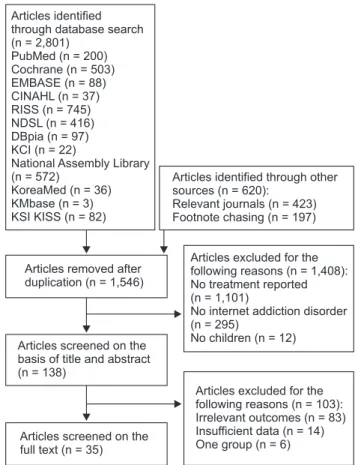
Figure 1 shows the study selection process. As a result of the first bibliographic search, a total of 3,421 papers were retrieved and 1,546 papers were selected by the removal of duplicates. Then, 138 papers were selected after confirma- tion that the titles and abstracts were applicable. Finally, 35 papers were selected for systematic review by confirmation of the full text. By the inclusion of 2 papers with two experi- mental groups, a total of 37 papers were selected for meta- analysis (Appendix 2).
2. Study Characteristics
The characteristics of the included studies are summarized in Table 1. Of the total 1,490 participants, the experimental group included 759 people, and the control group contained 731 people. The study design included 5 RCT studies and 32 NRCT studies.
3. Methodological Quality of the Intervention Studies There was a high bias in seven of the studies in relation to the selection of participants, where participants were as- signed to the intervention group or the control group. From the evaluation of confounding variables, 21 studies had high selection bias. Two studies were unclear in their reporting.
For the blinding of the outcome assessments, 29 studies were considered to have a low bias risk because the blinding did not affect the measurement.
4. Effects of Interventions 1) Internet addiction
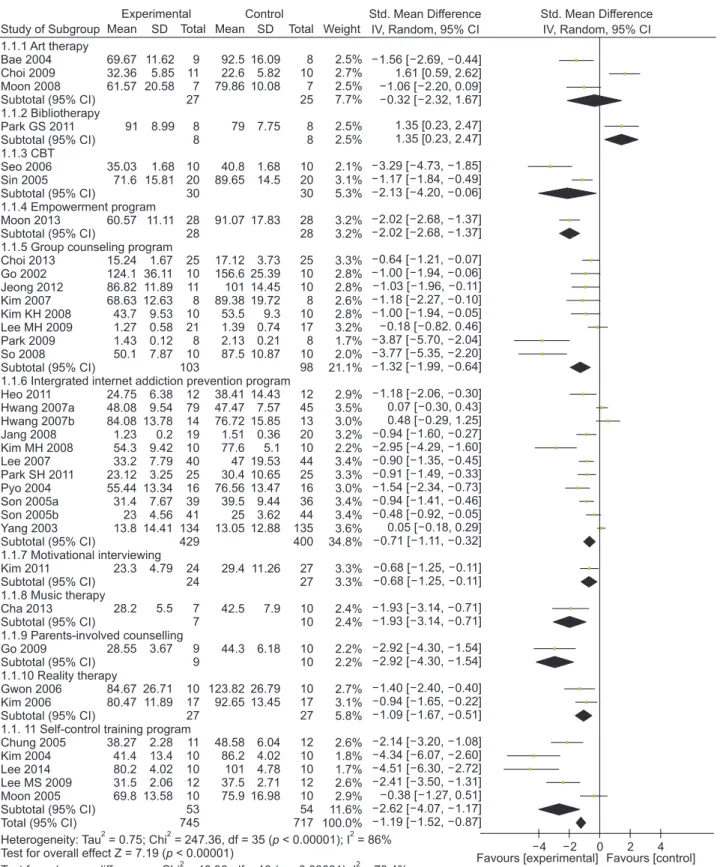
Thirty-six of the 37 included studies measured IA. The total population involved in these studies was 1,462. Psychosocial intervention applied to school-aged children had a large, sta- tistically significant effect on the decrease of IA (standardized mean difference [SMD], –1.19; 95% CI, –1.52 to –0.87), and the overall heterogeneity was high (I2 = 86%) (Figure 2).
To identify the intervention moderators, further analyses were carried out. The types of intervention with a large ef- fect on reducing IA were parent-involved counseling (SMD, –2.92; 95% CI, –4.30 to –1.54) and self-control training programs (SMD, –2.62; 95% CI, –4.07 to –1.17) (Figure 2).
Figure 1. Flow diagram of the study selection.
Articles identified through database search (n = 2,801)
PubMed (n = 200) Cochrane (n = 503) EMBASE (n = 88) CINAHL (n = 37) RISS (n = 745) NDSL (n = 416) DBpia (n = 97) KCI (n = 22)
National Assembly Library (n = 572)
KoreaMed (n = 36) KMbase (n = 3) KSI KISS (n = 82)
Articles identified through other sources (n = 620):
Relevant journals (n = 423) Footnote chasing (n = 197)
Articles excluded for the following reasons (n = 1,408):
No treatment reported (n = 1,101)
No internet addiction disorder (n = 295)
No children (n = 12)
Articles excluded for the following reasons (n = 103):
Irrelevant outcomes (n = 83) Insufficient data (n = 14) One group (n = 6) Articles removed after
duplication (n = 1,546)
Articles screened on the basis of title and abstract (n = 138)
Articles screened on the full text (n = 35)
Table 1. Characteristics of included studies Author (yr)Total N (eN/cN)Study designInterventionNumber of session/Min.SettingGradeFollow-up (wk)CountryOutcome variables (assessment tools)Quality assessmentApproachType (group/individual) Bae (2004)17 (9/8)NRCTSelectiveArt therapy (group)22/75School5,6NoneKoreaIA (K-scale)++ Cha (2013)17 (7/10)NRCTSelectiveMusic therapy (group)14/60School5,6NoneKoreaIA (K-scale), SC (SCRS)+ Choi (2009)21 (11/10)NRCTSelectiveArt therapy (group)8/90School4,5,6NoneKoreaIA (K-scale), SE (SES)++ Choi (2013)50 (25/25)NRCTUniversalGroup counseling (group)10/40School2NoneKoreaIA (K-scale)++ Chung (2005)23 (11/12)NRCTSelectiveSelf-control training program (group)11/50School54KoreaIA (YIAS), SC (SCS)++ Go (2002)20 (10/10)NRCTSelectiveGroup counseling (group)10/55School6NoneKoreaIA (YIAS)+ Go (2009)19 (9/10)NRCTUniversalParents-involved counseling (group)10/40School5,6NoneKoreaIA (IGAS)+ Gwon (2006)20 (10/10)NRCTSelectiveReality therapy (group)8/90School5,6NoneKoreaIA (K-scale)+ Gwon (2012)28 (14/14)NRCTSelectiveParents-involved counseling (group)10/50RCC5,6NoneKoreaSC (SCS), SE (SES)++ Heo (2011)24 (12/12)NRCTUniversalIIAP: CBT, play and art therapy, bibliothera- py (group)8/50RCC4,5,6NoneKoreaIA (YIAS), SE (SES)++ Hwang (2007a, 2007b) 124 (79/45) 27 (14/13)NRCTUniversal SelectiveIIAP: CBT, time and conflict management, alternative actives, positive psychology program (group)
6/40School4NoneKoreaIA (K-scale)++ Jang (2008)39 (19/20)RCTUniversalIIAP: Self-control strategies, CBT (group)6/40School4NoneKoreaIA (K-scale)++ Jeong (2012)21 (11/10)NRCTSelectiveGroup counseling (group)6/90NR5,68KoreaIA (K-scale)++ Kim (2004)20 (10/10)NRCTSelectiveSelf-control training program (group) 11/50School62KoreaIA (YIAS)++ Kim (2006)34 (17/17)RCTSelectiveReality therapy (group)8/80School6NoneKoreaIA (K-scale), SE (SES)++ Kim (2007)16 (8/8)NRCTSelectiveGroup counseling (group)8/50School6NoneKoreaIA (K-scale), SC (SCRS) + Kim KH (2008)20 (10/10)NRCTSelectiveGroup counseling (group)10/50School64KoreaIA (K-scale)+ Kim MH (2008)20 (10/10)NRCTSelectiveIIAT: CBT, art therapy (group) 10/50School65KoreaIA (K-scale)+ Kim (2011)51 (24/27)NRCTUniversalMotivational interviewing (group)9/40School5,6NoneKoreaIA (K-scale)++ Lee (2007)84 (40/44)NRCTUniversalIIAP: Stress management, CBT (group)10/40School66KoreaIA (IGAS)++
Table 1. Continued Author (yr)Total N (eN/cN)Study designInterventionNumber of session/Min.SettingGradeFollow-up (wk)CountryOutcome variables (assessment tools)Quality assessmentApproachType (group/individual) Lee MH (2009)38 (21/17)NRCTUniversalGroup counseling (group)8/40School3NoneKoreaIA (K-scale), SC (SCRS)++ Lee MS (2009)24 (12/12)NRCTSelectiveSelf-control training program (group) 10/40School5,6NoneKoreaIA (K-scale), SC (SCS)++ Lee (2014)20 (10/10)NRCTUniversalSelf-control training program (group) 8/75School52ChinaIA (K-scale), SC (SCS)++ Moon (2005)20 (10/10)NRCTUniversalSelf-control training program (group) 9/NRSchool6NoneKoreaIA (K-scale), SE (SEI)++ Moon (2008)14 (7/7)NRCTSelectiveArt therapy (group)10/60School5,6NoneKoreaIA (K-scale), SC (SCRS)+ Moon (2013)56 (28/28)NRCTUniversalEmpowerment program (group)8/50School4,5,64KoreaIA (K-scale)++ Park (2009)16 (8/8)RCTSelectiveGroup counseling (group)6/55School5,6NoneKoreaIA (K-scale), SC (SCRS)++ Park GS (2011)16 (8/8)NRCTSelectiveBibliotherapy (group)12/NRSchool5NoneKoreaIA (K-scale), SE (SEI)+ Park SH (2011)50 (25/25)RCTUniversalIIAP: Play, art therapy, conflict management (group)6/80School5NoneKoreaIA (K-scale)++ Pyo (2004)32 (16/16)NRCTSelectiveIIAP: CBT, stress management (group)8/NRSchool5NoneKoreaIA (IGAS)++ Seo (2006)20 (10/10)NRCTSelectiveCBT (group) 10/70School6NoneKoreaIA (IGAS), SE (SEI)++ Sin (2005)40 (20/20)NRCTSelectiveCBT (group) 10/45School6NoneKoreaIA (K-scale), SC (SCS)+ So (2008)20 (10/10)NRCTSelectiveGroup counseling (group)9/50NR4,5,6NoneKoreaIA (K-scale)++ Son (2005a, 2005b)75 (39/36) 85 (41/44)NRCTSelective UniversalIIAP: Conflict and stress management, CBT (group)8/60School5NoneKoreaIA (IGAS), SC (SCRS)++ Yang (2003)269 (134/135)NRCTUniversalIIAP: Stress management, alternative activi- ties (group)6/40School5,66KoreaIA (IGAS)++ RCT: randomized controlled trials, NRCT: non-randomized controlled trials, IIAP: integrated internet addiction prevention program, RCC: regional children's center, K-scale: Korean Internet addiction self-diagnosis test, YIAS: Young Internet Addiction Scale, IGAS: Internet Game Addiction Scale, SCRS: Self-control Rating Scale, SCS: self-control scale, SES: self-esteem scale, SEI: self-esteem inventory, NR: not reported, ++: 5 or more of the criteria have been fulfilled, +: under 5 of the criteria have been fulfilled.
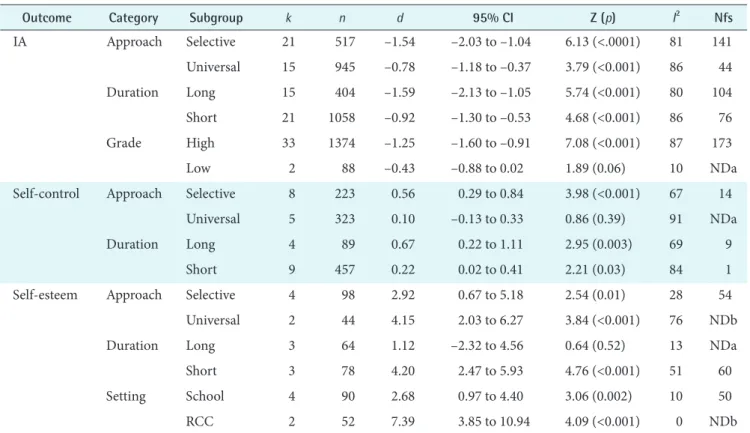
Even if both had a statistically significant effect, the selective approach (SMD, –1.54; 95% CI, –2.03 to –1.04) showed a larger effect than the universal approach (SMD, –0.78; 95%
CI, –1.18 to –0.37). Comparing the effectiveness of the in-
terventions based on their duration and grade, the programs consisting of more than 10 sessions (SMD, –1.59; 95% CI, –2.13 to –1.05) showed a significantly larger effect than the programs consisting of fewer than 10 sessions (SMD, –0.92;
Figure 2. Effect of psychosocial interventions on internet addiction.
Study of Subgroup SD Weight
Experimental Control
IV, Random, 95% CI
Std. Mean Difference Std. Mean Difference IV, Random, 95% CI 1.1.1 Art therapy
Bae 2004 Choi 2009 Moon 2008 Subtotal (95% CI) 1.1.2 Bibliotherapy Park GS 2011 Subtotal (95% CI) 1.1.3 CBT Seo 2006 Sin 2005 Subtotal (95% CI)
1.1.4 Empowerment program Moon 2013
Subtotal (95% CI)
1.1.5 Group counseling program Choi 2013
Go 2002 Jeong 2012 Kim 2007 Kim KH 2008 Lee MH 2009 Park 2009 So 2008 Subtotal (95% CI)
1.1.6 Intergrated internet addiction prevention program Heo 2011
Hwang 2007a Hwang 2007b Jang 2008 Kim MH 2008 Lee 2007 Park SH 2011 Pyo 2004 Son 2005a Son 2005b Yang 2003 Subtotal (95% CI)
1.1.7 Motivational interviewing Kim 2011
Subtotal (95% CI) 1.1.8 Music therapy Cha 2013
Subtotal (95% CI)
1.1.9 Parents-involved counselling Go 2009
Subtotal (95% CI) 1.1.10 Reality therapy Gwon 2006
Kim 2006 Subtotal (95% CI)
1.1. 11 Self-control training program Chung 2005
Kim 2004 Lee 2014 Lee MS 2009 Moon 2005 Subtotal (95% CI) Total (95% CI)
Heterogeneity: Tau = 0.75; Chi = 247.36, df = 35 ( < 0.00001); I = 86%
Test for overall effect Z = 7.19 ( < 0.00001)
Test for subgroup differences: Chi = 46.36, df = 10 ( < 0.00001), I = 78.4%
2 2 2
2 2
p p
p 69.67
32.36 61.57
91
35.03 71.6
60.57
15.24 124.1 86.82 68.63 43.7 1.27 1.43 50.1
24.75 48.08 84.08 1.23 54.3 33.2 23.12 55.44 31.4 23 13.8
23.3
28.2
28.55
84.67 80.47
38.27 41.4 80.2 31.5 69.8
11.62 5.85 20.58
Mean Total
9 11 7 27
92.5 22.6 79.86
16.09 5.82 10.08
8 10 7 25
1.56 [ 2.69, 0.44]
1.61 [0.59, 2.62]
1.06 [ 2.20, 0.09]
0.32 [ 2.32, 1.67]
SD
Mean Total
8.99 8 8
79 7.75 8
8
1.35 [0.23, 2.47]
1.35 [0.23, 2.47]
1.68 15.81
11.11
1.67 36.11 11.89 12.63 9.53 0.58 0.12 7.87
6.38 9.54 13.78 0.2 9.42 7.79 3.25 13.34 7.67 4.56 14.41
12 79 14 19 10 40 25 16 39 41 134 429 10 20 30
40.8 89.65
1.68 14.5
10 20 30 28
28
91.07 17.83 28 28 25
10 11 8 10 21 8 10 103
17.12 156.6 101 89.38 53.5 1.39 2.13 87.5
3.73 25.39 14.45 19.72 9.3 0.74 0.21 10.87
25 10 10 8 10 17 8 10 98 38.41
47.47 76.72 1.51 77.6 47 30.4 76.56 39.5 25 13.05
14.43 7.57 15.85 0.36 5.1 19.53 10.65 13.47 9.44 3.62 12.88
12 45 13 20 10 44 25 16 36 44 135 400 4.79
5.5
3.67
26.71 11.89
2.28 13.4 4.02 2.06 13.58
24 24 7 7 9 9 10 17 27 11 10 10 12 10 53 745
48.58 86.2 101 37.5 75.9
6.04 4.02 4.78 2.71 16.98
12 10 10 12 10 54 717 123.82
92.65 26.79 13.45
10 17 27
2.5%
2.7%
2.5%
7.7%
2.5%
2.5%
2.1%
3.1%
5.3%
3.2%
3.2%
3.3%
2.8%
2.8%
2.6%
2.8%
3.2%
1.7%
2.0%
21.1%
2.9%
3.5%
3.0%
3.2%
2.2%
3.4%
3.3%
3.0%
3.4%
3.4%
3.6%
34.8%
2.6%
1.8%
1.7%
2.6%
2.9%
11.6%
100.0%
2.7%
3.1%
5.8%
3.3%
3.3%
2.4%
2.4%
2.2%
2.2%
44.3 6.18 10 10 10 10 27 27 29.4
42.5 7.9 11.26
3.29 [ 4.73, 1.85]
1.17 [ 1.84, 0.49]
2.13 [ 4.20, 0.06]
2.02 [ 2.68, 1.37]
2.02 [ 2.68, 1.37]
0.64 [ 1.21, 0.07]
1.00 [ 1.94, 0.06]
1.03 [ 1.96, 0.11]
1.18 [ 2.27, 0.10]
1.00 [ 1.94, 0.05]
0.18 [ 0.82. 0.46]
3.87 [ 5.70, 2.04]
3.77 [ 5.35, 2.20]
1.32 [ 1.99, 0.64]
1.18 [ 2.06, 0.30]
0.07 [ 0.30, 0.43]
0.48 [ 0.29, 1.25]
0.94 [ 1.60, 0.27]
2.95 [ 4.29, 1.60]
0.90 [ 1.35, 0.45]
0.91 [ 1.49, 0.33]
1.54 [ 2.34, 0.73]
0.94 [ 1.41, 0.46]
0.48 [ 0.92, 0.05]
0.05 [ 0.18, 0.29]
0.71 [ 1.11, 0.32]
0.68 [ 1.25, 0.11]
0.68 [ 1.25, 0.11]
1.93 [ 3.14, 0.71]
1.93 [ 3.14, 0.71]
2.92 [ 4.30, 1.54]
2.92 [ 4.30, 1.54]
1.40 [ 2.40, 0.40]
0.94 [ 1.65, 0.22]
1.09 [ 1.67, 0.51]
2.14 [ 3.20, 1.08]
4.34 [ 6.07, 2.60]
4.51 [ 6.30, 2.72]
2.41 [ 3.50, 1.31]
0.38 [ 1.27, 0.51]
2.62 [ 4.07, 1.17]
1.19 [ 1.52, 0.87]
Favours [experimental] Favours [control]
4 2 0 2 4
95% CI, –1.30 to –0.53). The studies that targeted the up- per grades (SMD, –1.25; 95% CI, –1.60 to –0.91) showed a statistically significant effect, but the studies that targeted the lower grades showed no statistically significant effect (SMD, –0.43; 95% CI, –0.88 to 0.02). The effect size at follow-up for the IA outcome variables was large and significant (SMD, –1.69; 95% CI, –2.73 to –0.65) (Table 2).
2) Self-control
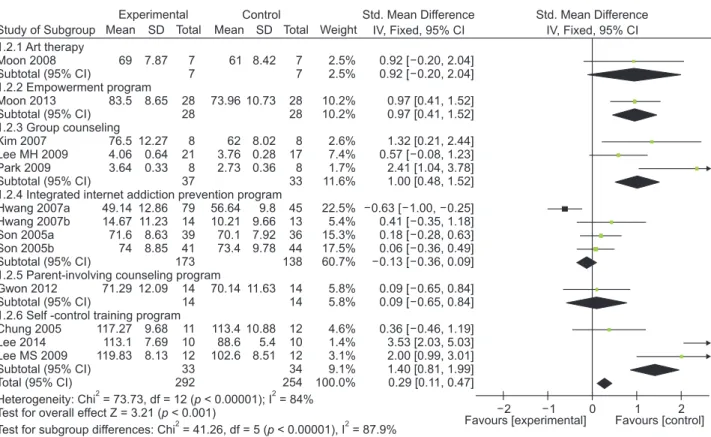
Self-control was reported in 13 studies. The total number of participants available for analysis was 546. The analysis of these studies showed a small, statistically significant effect (SMD, 0.29; 95% CI, 0.11 to 0.47). The overall heterogeneity for the effects on self-control was high (I2 = 84%) (Figure 3).
The interventions with a large effect size on improving self- control were the self-control training program (SMD, 1.40;
95% CI, 0.81 to 1.99), and group counseling (SMD, 1.00;
95% CI, 0.48 to 1.52) (Figure 3). The interventions that used the selective approach showed a statistically significant im- provement in self-control (SMD, 0.56; 95% CI, 0.29 to 0.84), while the universal preventive approach was not statistically significant (SMD, 0.10; 95% CI, –0.13 to 0.33). For improv- ing self-control, the longer programs (SMD, 0.67; 95% CI,
0.22 to 1.11) had a larger effect than shorter programs (SMD, 0.22; 95% CI, 0.02 to 0.41) (Table 2). A subgroup analysis of grade and follow-up was considered. However, sufficient data were not provided for self-control.
3) Self-esteem
Six studies assessed the effects of psychosocial interventions on the level of self-esteem among school-aged children. The total number of participants was 142. Figure 4 shows that there was a large and statistically significant increase in the psychosocial intervention group when compared with the control group at the end of the intervention (mean differ- ence, 3.58; 95% CI, 2.03 to 5.12). The overall inconsistency was at an acceptable level (I2 = 44%).
The interventions with a large effect were the integrated IA prevention program (mean difference, 7.25; 95% CI, 3.58 to 10.92) and reality therapy (mean difference, 4.29; 95% CI, 1.30 to 7.28) (Figure 4). Both of these approaches showed a large, statistically significant improvement in self-esteem (selective approach: mean difference, 2.92; 95% CI, 0.67 to 5.18; universal approach: mean difference, 4.51; 95% CI, 2.03 to 6.27). The studies with shorter interventions (mean dif- ference, 4.20; 95% CI, 2.47 to 5.93) showed a statistically sig-
Table 2. Effect sizes of the subgroups of interventions
Outcome Category Subgroup k n d 95% CI Z (p) I2 Nfs
IA Approach Selective 21 517 –1.54 –2.03 to –1.04 6.13 (<.0001) 81 141
Universal 15 945 –0.78 –1.18 to –0.37 3.79 (<0.001) 86 44
Duration Long 15 404 –1.59 –2.13 to –1.05 5.74 (<0.001) 80 104
Short 21 1058 –0.92 –1.30 to –0.53 4.68 (<0.001) 86 76
Grade High 33 1374 –1.25 –1.60 to –0.91 7.08 (<0.001) 87 173
Low 2 88 –0.43 –0.88 to 0.02 1.89 (0.06) 10 NDa
Self-control Approach Selective 8 223 0.56 0.29 to 0.84 3.98 (<0.001) 67 14
Universal 5 323 0.10 –0.13 to 0.33 0.86 (0.39) 91 NDa
Duration Long 4 89 0.67 0.22 to 1.11 2.95 (0.003) 69 9
Short 9 457 0.22 0.02 to 0.41 2.21 (0.03) 84 1
Self-esteem Approach Selective 4 98 2.92 0.67 to 5.18 2.54 (0.01) 28 54
Universal 2 44 4.15 2.03 to 6.27 3.84 (<0.001) 76 NDb
Duration Long 3 64 1.12 –2.32 to 4.56 0.64 (0.52) 13 NDa
Short 3 78 4.20 2.47 to 5.93 4.76 (<0.001) 51 60
Setting School 4 90 2.68 0.97 to 4.40 3.06 (0.002) 10 50
RCC 2 52 7.39 3.85 to 10.94 4.09 (<0.001) 0 NDb
Nfs: fail-safe number, IA: Internet addiction, RCC: regional children’s center, NDa: the Nfs was not determined because p was not significant, NDb: the Nfs could not be determined because fewer than three studies were available.
nificant positive effect, while the longer interventions (mean difference, 1.12; 95% CI, –2.32 to 4.56) had no statistically significant effect. Only the self-esteem outcome provided ap- propriate data that could be used for analyzing the effect size by setting. The mean effect size of the studies conducted in a community child center (mean difference, 7.39; 95% CI, 3.85 to 10.94) was larger than that of the studies conducted in a
school (mean difference, 2.68; 95% CI, 0.9 to 4.40) (Table 2).
Grade and follow-up data for self-esteem were not available.
IV. Discussion
Even though IA has become a serious concern in modern so- ciety, research analyzing the effects of intervention to prevent
1.2.1 Art therapy Moon 2008 Subtotal (95% CI)
1.2.2 Empowerment program Moon 2013
Subtotal (95% CI) 1.2.3 Group counseling Kim 2007
Lee MH 2009 Park 2009 Subtotal (95% CI)
1.2.4 Integrated internet addiction prevention program Hwang 2007a
Hwang 2007b Son 2005a Son 2005b Subtotal (95% CI)
1.2.5 Parent-involving counseling program Gwon 2012
Subtotal (95% CI)
1.2.6 Self -control training program Chung 2005
Lee 2014 Lee MS 2009 Subtotal (95% CI) Total (95% CI)
Heterogeneity: Chi = 73.73, df = 12 ( < 0.00001); I = 84%
Test for overall effect Z = 3.21 ( < 0.001)
Test for subgroup differences: Chi = 41.26, df = 5 ( < 0.00001), I = 87.9%
2 2
2 2
p p
p
Study of Subgroup SD Weight
Experimental Control
IV, Fixed, 95% CI
Std. Mean Difference Std. Mean Difference IV,Fixed, 95% CI 7.87
Mean Total
7 7
61 8.42 7 7
0.92 [ 0.20, 2.04]
0.92 [ 0.20, 2.04]
0.97 [0.41, 1.52]
0.97 [0.41, 1.52]
1.32 [0.21, 2.44]
0.57 [ 0.08, 1.23]
2.41 [1.04, 3.78]
1.00 [0.48, 1.52]
0.63 [ 1.00, 0.25]
0.41 [ 0.35, 1.18]
0.18 [ 0.28, 0.63]
0.06 [ 0.36, 0.49]
0.13 [ 0.36, 0.09]
0.09 [ 0.65, 0.84]
0.09 [ 0.65, 0.84]
0.36 [ 0.46, 1.19]
3.53 [2.03, 5.03]
2.00 [0.99, 3.01]
1.40 [0.81, 1.99]
0.29 [0.11, 0.47]
SD
Mean Total
8.65 28 28 12.27
0.64 0.33
2.5%
2.5%
10.2%
10.2%
2.6%
7.4%
1.7%
11.6%
22.5%
5.4%
15.3%
17.5%
60.7%
5.8%
5.8%
4.6%
1.4%
3.1%
9.1%
100.0%
Favours [experimental]2 1 0 Favours [control]1 2 69
83.5
76.5 4.06 3.64
49.14 14.67 71.6 74
71.29
117.27 113.1 119.83
12.86 11.23 8.63 8.85
8 21 8 37 79 14 39 41 173 12.09 14 14 9.68 7.69 8.13
11 10 12 33 292
73.96 10.73 28 28 62
3.76 2.73
8.02 0.28 0.36
8 17 8 33 56.64
10.21 70.1 73.4
9.8 9.66 7.92 9.78
45 13 36 44 138 70.14 11.63 14 14 113.4
88.6 102.6
12 10 12 34 254 10.88
5.4 8.51
Figure 3. Effect of psychosocial interventions on self-control.
1.3.1 Bibliotherapy Park GS 2011 Subtotal (95% CI) 1.3.2 CBT Seo 2006 Subtotal (95% CI)
1.3.3 Integrated internet addiction prevention program Heo 2011
Subtotal (95% CI)
1.3.4 Parent-involving counseling program Gwon 2012
Subtotal (95% CI) 1.3.5 Reality therapy Kim 2006
Subtotal (95% CI)
1.3.6 Self-control training program Moon 2005
Subtotal (95% CI) Total (95% CI)
Heterogeneity: Chi = 8.89, df = 5 ( = 0.11); = 44%
Test for overall effect Z = 4.54 ( < 0.00001)
Test for subgroup differences: Chi = 8.89, df = 5 ( = 0.11), I = 43.8%
2
2 2
p p
p
p
Study of Subgroup SD Weight
Experimental Control
IV, Fixed, 95% CI
Mean Difference Mean Difference IV,Fixed, 95% CI 9.96
Mean Total
8 8
74.88 8
8
3.29 [ 12.24, 5.66]
3.29 [ 12.24, 5.66]
1.30 [ 2.57, 5.17]
1.30 [ 2.57, 5.17]
7.25 [3.58, 10.92]
7.25 [3.58, 10.92]
9.47 [ 4.51, 23.45]
9.47 [ 4.51, 23.45]
4.29 [1.30, 7.28]
4.29 [1.30, 7.28]
2.60 [0.00, 5.20]
2.60 [0.00, 5.20]
3.58 [2.03, 5.12]
SD
Mean Total
4.41 10 10
3.0%
3.0%
16.0%
16.0%
17.8%
17.8%
1.2%
1.2%
26.7%
26.7%
35.4%
35.4%
100.0%
Favours [experimental] Favours [control]
20 10 0 10 20
71.59
95.1
35
116.07
4.14 12 12 14 14 17 17 10 10 71
93.8 10
10
27.75 12
12 14 14 106.6
29.12
12.7 8.22
4.41
3.84
21.58
4.74
3.59 10 10 71 33.41
15.3 5.22
15.71
2.16
17 17
Figure 4. Effect of psychosocial interventions on self-esteem.
or mitigate it is still lacking. This review found that psycho- social interventions have been beneficial for reducing IA and improving self-control and self-esteem at certain times. Self- control training programs, integrated IA prevention pro- grams, and parents-involved counseling have had large and robust significant effects out of all of the outcome variables.
The self-control training programs consisted of four com- ponents, such as self-consideration, environment planning, self-evaluation, and self-reinforcement [17]. Self-control training programs have been suggested by many experts to increase the effect of interventions in treating addiction [18].
They have also been reported to promote mental health [19].
Programs connected with various theoretical backgrounds, such as cognitive behavior therapy (CBT), music therapy, art therapy, reading therapy, time or stress management, and es- tablishment of a coping plan were more effective than simple approaches [20]. Song and Park [21] identified the following items for IA programs based on the opinions of field experts:
ability enhancement for self-control, social training en- hancement, life goals and values establishment, support and intervention of family, promoting self-esteem or overcoming depression, and so on. Family-based interventions appear to be the most promising, not only with these outcomes but also for adolescent alcohol use [22] and depression symp- toms in children and adolescents [23]. Due to limited studies verifying this approach, more studies are needed to assess the involvement of family members or other relatives in the treatment of IA.
All studies included in this analysis were developed for a group. Evidence suggests that group counseling appears to be the predominant modality for treating addiction. One ad- vantage of a group program is its economical factor, because it targets many students simultaneously. In addition, the sup- port, confrontation, and insight gained from other individu- als experiencing similar recognition and emotions facilitate therapeutic recovery [24]. A previous study also mentioned that a group of less than 14 people showed more than a 90th percentile of effect size [12]. However, group therapy may not become truly beneficial until parents overcome the bar- riers associated with social anxiety, social isolation, and lack of social competence. Therefore, it is necessary to develop a program with appropriate methods for the participants’
characteristics.
When interventions were analyzed according to the inter- vention purpose, trials with selective samples were more practicable and beneficial than those that target universal samples. A similar effect was found in a previous review [12].
However, it is possible that, although universal programs
yield a low effect, they still could be cost-effective if they can prevent IA at comparatively low cost.
Regarding the effect of intervention according to duration, two-thirds of those studies reviewed had more than 10 inter- vention sessions. This group exhibited statistically significant effects for IA and self-esteem outcomes. A previous review of psychosocial interventions analyzing such outcomes as depression symptoms among older adults demonstrated that longer interventions showed statistically significant effects [19]. Likewise, this meta-analysis verified IA program inter- ventions of more than seven sessions, which included more than a 90th percentile of effect size, for the target of adoles- cents [12]. Therefore, because a certain period is necessary to change the recognition and behaviors of participants, long- term programs might be more effective than short-term pro- grams.
The results indicated that the pooled effect sizes for short- term efficacy for all outcomes were statically significant.
However, many studies made it difficult to determine the long-term efficacy of the intervention because they failed to conduct a sufficiently long follow-up. Only nine studies reviewed here conducted a follow-up. To address this im- portant topic, further research should consider long-term efficacy.
Another interesting result of our analysis was that 36 out of 37 studies were performed in South Korea, and one study was conducted in China. There were no studies available in the United States or Europe that investigated psychosocial intervention and its effect on the target of school-aged chil- dren. This reflects that the language was limited to English and Korean when the papers were extracted, but it can also be interpreted that IA is rapidly increasing in East Asia. Even from previous studies, 13 out of a total of 17 articles were published in South Korea and China, meaning that it was absolutely higher than for other regions [9]. Due to a lack of conclusive evidence of cultural differences in IA, further research is highly recommended in this area.
This study offers insight into the current state of psychoso- cial intervention programs for IA for the target population of school-aged children, and it is a first step in the development of evidence-based intervention recommendations. Neverthe- less, a number of limitations should be noted. First, as fewer studies applied RCT, the confirmative evaluation results were not included for the effect size. As noted in a previous review [25], IA intervention studies tend to lack conformity, with inconsistencies in the definition and diagnosis of IA and a lack of randomization, and adequate comparison groups.
The methodological weaknesses of the included studies are
potentially a problem because a meta-analysis can only be as good as the studies upon which it is based [26]. Second, as the studies included in this analysis had high heterogeneity and there was a limited number of articles, sub-analyses on scale were not indicated. Scale selection with consideration of the characteristics of programs and subjects is necessary to identify the effects of IA improvement programs more precisely, and it can be considered that scales can verify the effect size if more articles are accumulated in the future.
Conflict of Interest
No potential conflict of interest relevant to this article was reported.
References
1. Li Y, Zhang X, Lu F, Zhang Q, Wang Y. Internet addic- tion among elementary and middle school students in China: a nationally representative sample study. Cyber- psychol Behav Soc Netw 2014;17(2):111-6.
2. Li W, O'Brien JE, Snyder SM, Howard MO. Character- istics of internet addiction/pathological internet use in U.S. university students: a qualitative-method investiga- tion. PLoS One 2015;10(2):e0117372.
3. Korea Internet & Security Agency. Annual report of the 2013 Korea Internet White Paper. Seoul: Korea Internet
& Security Agency; 2013.
4. Cha ES, Kim TH. Effects of the group music therapy on behavior, self-control, social interaction and stress for the internet-addicted students in elementary school.
Youth Facil Environ 2013;11(1):79-91.
5. Joo AR. Correlations among internet games addiction, self-esteem and physical health in middle school stu- dents. J Korean Acad Community Health Nurs 2007;
18(2):331-9.
6. Lee IS. Internet addiction, internet expectancy, and self- efficacy in elementary school students. J Korean Acad Child Health Nurs 2003;9(4):376-83.
7. Chung HS, Park K. A review of primary school student with internet addiction. J Psychother 2009;9(1):27-45.
8. Ozturk C, Bektas M, Ayar D, Ozguven Oztornaci B, Yagci D. Association of personality traits and risk of in- ternet addiction in adolescents. Asian Nurs Res (Korean Soc Nurs Sci) 2015;9(2):120-4.
9. Korea Internet & Security Agency. Annual report of the 2013 Internet Addiction Status Survey. Seoul: Korea In- ternet & Security Agency; 2014.
10. Winkler A, Dorsing B, Rief W, Shen Y, Glombiewski JA.
Treatment of internet addiction: a meta-analysis. Clin Psychol Rev 2013;33:317-29.
11. Park SM. A meta-analysis on the effects of adolescent internet addiction group counseling program in Korea.
Korean J Couns Psychother 2009;21(3):607-23.
12. Oh IS, Kim C. Meta-analysis on the effects of the pre- vention and intervention programs for internet addic- tion. J Korean Assoc Inf Educ 2009;13(4):529-37.
13. Ruddy R, House A. Psychosocial interventions for con- version disorder. Cochrane Database Syst Rev 2005;(4):
CD005331.
14. Kim SY, Park JE, Lee YJ, Seo HJ, Sheen SS, Hahn S, et al.
Testing a tool for assessing the risk of bias for nonran- domized studies showed moderate reliability and prom- ising validity. J Clin Epidemiol 2013;66(4):408-14.
15. Cohen J. Statistical power analysis for the behavioral sciences. 2nd ed. Hillsdale (NJ): Lawrence Erlbaum As- sociates; 1988.
16. Orwin RG. A fail-safe N for effect size in meta-analysis.
J Educ Stat 1983;8(2):157-9.
17. Pyo MH, Lee YM. The effects of game control program on the mitigation of internet game addiction and self- efficacy. Korean J Elem Couns 2004;3(1):105-18.
18. Yu F, Albers J, Gao T, Wang M, Bilberg A, Stenager E. A smartphone application of alcohol resilience treatment for behavioral self-control training. Conf Proc IEEE Eng Med Biol Soc 2012;2012:1976-9.
19. Forsman AK, Nordmyr J, Wahlbeck K. Psychosocial interventions for the promotion of mental health and the prevention of depression among older adults. Health Promot Int 2011;26 Suppl 1:i85-107.
20. Park BK, Lee E. Effects of my child's safety web-based program for caregivers of children with cancer in South Korea. Health Inform Res 2014;20(3):199-208.
21. Song SM, Park SM. Study on the development of inter- vention programs for internet addiction types. Seoul:
Korea Youth Counseling & Welfare Institute; 2008.
22. Mason WA, Spoth RL. Sequence of alcohol involvement from early onset to young adult alcohol abuse: differen- tial predictors and moderation by family-focused pre- ventive intervention. Addiction 2012;107(12):2137-48.
23. Horowitz JL, Garber J. The prevention of depressive symptoms in children and adolescents: a meta-analytic review. J Consult Clin Psychol 2006;74(3):401-15.
24. Fisher GL, Harrison TC. Substance abuse: information for school counselors, social workers, therapists, and counselors. Boston (MA): Allyn & Bacon; 1996.
25. King DL, Delfabbro PH, Griffiths MD, Gradisar M. As- sessing clinical trials of Internet addiction treatment: a systematic review and CONSORT evaluation. Clin Psy-
chol Rev 2011;31(7):1110-6.
26. Hofmann SG, Smits JA. Pitfalls of meta-analyses. J Nerv Ment Dis 2008;196(9):716-7.
Appendix 1. Quality assessment of the studies included in the meta-analysis
No. Author (yr) Selection of participants
Confounding variables
Exposure evaluation
Blinding of the outcome assessments
Incomplete outcome data
Selective outcome reporting
Total quality assessment
1 Bae (2004) L H L L L L ++
2 Cha (2013) H H L L L L +
3 Choi (2009) L H L L L L ++
4 Choi (2013) L H L L L L ++
5 Chung (2005) L L L U L L ++
6 Go (2002) H H L L L L +
7 Go (2009) H H L L L L +
8 Gwon (2006) L H L U L L +
9 Gwon (2012) L H L L L L ++
10 Heo (2011) L H L L L L ++
11 Hwang (2007) L H L L L L ++
12 Jang (2008) L L L L L L ++
13 Jeong (2012) L H L L L L ++
14 Kim (2004) L L L L L L ++
15 Kim (2006) L L L L L L ++
16 Kim (2007) L U L U L L +
17 Kim KH (2008) L H L U L L +
18 Kim MH (2008) L H L U L L +
19 Kim (2011) L H L L L L ++
20 Lee (2007) L L L L L L ++
21 Lee (2014) H L L L L L ++
22 Lee MH (2009) L H L L L L ++
23 Lee MS (2009) L H L L L L ++
24 Moon (2005) H L L L L L ++
25 Moon (2008) H U L L L L +
26 Moon (2013) L L L L L L ++
27 Park (2009) H L L L L L ++
28 Park GS (2011) L H L U L L +
29 Park SH (2011) L L L L L L ++
30 Pyo (2004) L H L L L L ++
31 Seo (2006) L L L L L L ++
32 Sin (2005) L H L U L L +
33 So (2008) L H L L L L ++
34 Son (2005) L H L L L L ++
35 Yang (2003) L L L U L L ++
L: low risk of bias, U: unclear, H: high risk of bias, ++: 5 or more of the criteria have been fulfilled, +: under 5 of the criteria have been fulfilled.
Appendix 2. Studies included in the meta-analysis
No. Author (yr) Title
1 Bae (2004) The effects of group art activity on emotional intelligence and improvement in addiction of elementary school students addicted to the Internet.
2 Cha (2013) Effects of the group music therapy on behavior, self-control, social interaction and stress for the Internet- addicted students in elementary school.
3 Choi (2009) Effect of group art therapy on self-esteem and child-parent communication in Internet overuse by elemen- tary school children.
4 Choi (2013) The development of group program for the Internet game addiction prevention of lower grades in elemen- tary school.
5 Chung (2005) The effects of self-control training for the reduction of the Internet addiction and self-control of elemen- tary school students.
6 Go (2002) The effect of self-regulation counseling program on the Internet addiction of children.
7 Go (2009) The development of a parents-involved group counseling program for prevention of game addiction in el- ementary school students.
8 Gwon (2006) The effect of a reality therapy group counseling program upon elementary students’ Internet addiction and mental health.
9 Gwon (2012) The development and effects of parents-child participatory group counseling programs for the prevention of elementary school age Internet addiction.
10 Heo (2011) The development and effects of an integrated approach for prevention of Internet addiction in elementary students.
11 Hwang (2007) The effects of Internet game addiction prevention program in elementary students.
12 Jang (2008) The effect of Internet-overuse prevention program on elementary school students’ Internet use.
13 Jeong (2012) The effect of group counseling program for the Internet addiction and cyber delinquent children based on Adlerian therapy.
14 Kim (2004) The effect of self-control training on the Internet game addiction of elementary school students.
15 Kim (2006) The effect of the reality therapy group counseling program on the improvement of self-esteem, internal control, and addictive Internet use of the Internet-addicted elementary school students.
16 Kim (2007) The effects of self-regulation group counseling program according to upper elementary children with In- ternet addiction.
17 Kim KH (2008) The development of group counseling program for enhancing school adaptive ability in elementary-school students with Internet addiction.
18 Kim MH (2008) The effect of integrated approach prevention program on Internet addiction among elementary school stu- dents.
19 Kim (2011) Effect of Internet games addiction prevention program on Internet games addiction inclined and stress coping methods of elementary school children.
20 Lee (2007) The effects of Internet addiction prevention program on interpersonal tendencies in elementary students.
21 Lee (2014) A study on the effect of play based self-control training program on Internet addicted Chinese elementary school students and their self-controlling ability.
22 Lee MH (2009) Influence of an Internet addiction preventive program to relieve Internet game addiction and self-regula- tion for the elementary school lower grades.
23 Lee MS (2009) A study of the development of self-control improvement program for elementary school students with the potential addiction to Internet games.
24 Moon (2005) A study on the effects of integrative self-management program for Internet-addiction prevention in ele- mentary-school students.
Appendix 2. Continued
No. Author (yr) Title
25 Moon (2008) The effects of group art therapy on self-control and social skill of Internet-addicted elementary school children.
26 Moon (2013) The effects of an Internet-addiction prevention program on elementary students’ self-regulation and Inter- net addiction.
27 Park (2009) Impact of group counseling program for the regulation of Internet overuse on child Internet abusers.
28 Park GS (2011) The effect of bibliotherapy on the improvement of self-esteem and the reduction of Internet addiction of elementary school students addicted to the Internet.
29 Park SH (2011) Effectiveness analysis of children’s program for preventing Internet game addiction focused on primary school students.
30 Pyo (2004) The effects of game control program on the mitigation of Internet game addiction and self-efficacy.
31 Seo (2006) The effects of a REBT group counseling on relieving Internet game addiction, self-esteem and interper- sonal relationships of elementary school students.
32 Sin (2005) The effects of cognitive-behavioral group counseling according to the level of self-control on the elemen- tary school students’ Internet addiction.
33 So (2008) The development of a group counseling program for improving social skills of Internet overusing elemen- tary school students.
34 Son (2005) The effect of Internet overuse prevention program to self-control in elementary school students.
35 Yang (2003) The effect of the Internet game addiction prevention educational program for higher grade students at el- ementary school.