• 검색 결과가 없습니다.

Relationship among Maternal Sociodemographics, Oral Health Behavior, and the Prevalence of Early Childhood Caries

N/A
N/A
Protected

Academic year: 2021

Share "Relationship among Maternal Sociodemographics, Oral Health Behavior, and the Prevalence of Early Childhood Caries"

Copied!
7
0
0

로드 중.... (전체 텍스트 보기)

전체 글

(1)

RESEARCH ARTICLE

Received: April 24, 2017, Revised: May 1, 2017, Accepted: May 28, 2017 ISSN 1598-4478 (Print) / ISSN 2233-7679 (Online)

Correspondence to: Min-Young Kim

Department of Dental Hygiene, Sahmyook Health University College, 82 Mangu-ro, Dongdaemun-gu, Seoul 02500, Korea Tel: +82-2-2212-0082, Fax: +82-2-2215-2380, E-mail: [email protected]

Copyright © 2017 by Journal of Dental Hygiene Science

Relationship among Maternal Sociodemographics, Oral Health Behavior, and the Prevalence of Early Childhood Caries

Boo Wol Kang, Eunsuk Ahn 1 , and Min-Young Kim 2†

Department of Dental Hygiene, Dongnam Health University, Suwon 16328,

1

Department of Dental Hygiene, Kyung-bok University, Pocheon 11138,

2
Department of Dental Hygiene, Sahmyook Health University College, Seoul 02500, Korea

The purpose of this study was to examine the influence of maternal socioeconomic status, maternal oral health behaviors, and oral health behaviors of children, on the prevalence of early childhood caries in children aged 5 years. The Korean National Health and Nutrition Examination Survey data collected between 2007 and 2014 were applied to this study, and the study sample included 824 children who received oral examinations and participated in the health behavior survey. The factor that affected the prevalence of early childhood caries were confirmed by maternal and child factors. The data were analyzed using multiple linear regression. The mothers’ age, income level, and job status affected the prevalence of early childhood caries. There was a significant difference in the analysis considering the factors of motherhood and children in the prevalence of early childhood caries according to mother’s age, education level, income level, and the child’s oral examination. The prevalence of early childhood caries was higher in children who received oral examinations than in those who did not. When the mother’s educational level was higher than college education, it was found that the index of child, i.e., there was a difference in the prevalence of early childhood caries according to the mother’s educational and income levels. These results indicate that maternal socioeconomic characteristics are correlated with the oral health of children.

Therefore, oral health education programs that include mothers for the prevention of early dental caries in children may improve the dental health of children. In addition, specific oral health policies are necessary to address the differences in the oral health between the income groups.

Key Words: Early dental caries, Oral health behaviors, Socioeconomic status

Introduction

Dental caries is a major global health problem. Dental caries not only causes suffering and requires expensive treatment but is also responsible for chewing difficulties, speech problems, and aesthetic impairment 1,2) . According to age groups, dental caries is more prevalent in preschool childhood, primary school childhood, and adolescence 3) . Among preschool children, dental caries in those aged 5 years or younger is referred to as early childhood caries 4,5) . Early childhood caries is a cause of early loss of primary teeth and is strongly associated with permanent tooth caries, which may eventually lead to malocclusion 6,7) . The

prevalence of dental caries in 5-year-old American children

is approximately 28% 8) whereas the prevalence in 3-year-old

Japanese children is 25.9% 5) . Moreover, the prevalence of

dental caries in 5-year-old children belonging to low-in-

come groups in developing countries reaches 85% 9,10) . In

Korea, approximately 53.96% of 5-year-old children de-

veloped early childhood caries between 2007 and 2014 11) .

The incidence of dental caries in preschool children is

high because these children often consume sugar-con-

taining foods but lack the ability for self-oral care 1,6) . In

this context, the role of the parents or legal guardians is

critical in maintaining and improving the oral health of

children, and several studies indicated that oral health-re-

(2)

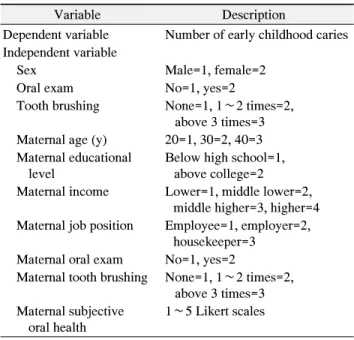
Table 1. Definition of Variables

Variable Description

Dependent variable Number of early childhood caries Independent variable

Sex Male=1, female=2

Oral exam No=1, yes=2

Tooth brushing None=1, 1∼2 times=2, above 3 times=3 Maternal age (y) 20=1, 30=2, 40=3 Maternal educational

level

Below high school=1, above college=2

Maternal income Lower=1, middle lower=2, middle higher=3, higher=4 Maternal job position Employee=1, employer=2,

housekeeper=3 Maternal oral exam No=1, yes=2

Maternal tooth brushing None=1, 1∼2 times=2, above 3 times=3 Maternal subjective

oral health

1∼5 Likert scales lated practices in children are not achieved by the

intentions and attitudes of children alone and that the parents or guardians play a major role in ensuring these practices 1,12-15) . Factors such as the low education of the mother, high age, living in rural areas, occasional tooth brushing, and high sugar consumption are associated with poor oral health in children 12,13,16,17)

. Sufia et al. 3) reported that the mother’s attitude played an important role in implementing and modifying oral health practices in children. Similarly, Mattila et al. 16) showed that the higher education of them other reduced the probability of dental caries in children and that regular tooth brushing by the parents or guardians decreased the incidence of dental caries in children.

Some studies reported that the mother’s socioeconomic status and oral health awareness have effect on the oral health of children. Oral health awareness during childhood influences oral health over one’s lifetime, and thus, good oral habits should be encouraged in childhood. Con- sidering the important role of the mother in achieving this goal, the joint participation of mothers and children in oral health education programs is essential. However, the studies conducted in Korea to date have been limited to some geographical areas, which limits the evaluation of the association between early childhood caries and the socioeconomic status of the mother 1,6,14,18-20) . Therefore, this study used representative data to assess the prevalence of early childhood caries in 5-year-old children according to the socioeconomic characteristics and oral health behaviors of the mothers and to provide reference data needed for improving the oral health education of mothers of preschool children and implementing policies for enhancing the oral health of children.

Materials and Methods

1. Subjects

The present study used data from the Korean National Health and Nutrition Examination Survey (KNHANES) collected from 2007 to 2014. These complex sample survey data were obtained using a stratified cluster sam- pling strategy, and the enumeration districts in the population and housing census were used as the sampling

frame; this strategy allowed the calculation of statistical data at the national level. KNHANES data included a health questionnaire, health examination, and nutrition survey. However, the present study used only data from the health questionnaire and oral examination survey.

Because the objective of the present study was to de- termine the association between early childhood caries in 5-year-old children and the socioeconomic characteristics and oral health behaviors of the mothers, 824 children among all 5-year-old children who completed the oral examination and health questionnaire were included in the analysis. The study was approved by the Institutional Review Board of our Institution (P01-201703-22-009).

2. Study variables

The dependent variable used in the analysis was the decayed, missing, and filled teeth (DMFT) index for primary teeth whereas the independent variables were selected by the characteristics of the children and mothers.

The characteristics of the study children were sex, type of

health insurance, performance of oral examination, and

number of tooth brushings. The characteristics of the

evaluated mothers were age, education level, income

level, job status, performance of oral examination, number

of tooth brushings, and subjective oral health status. These

(3)

Fig. 1. Distribution of number of early childhood caries.

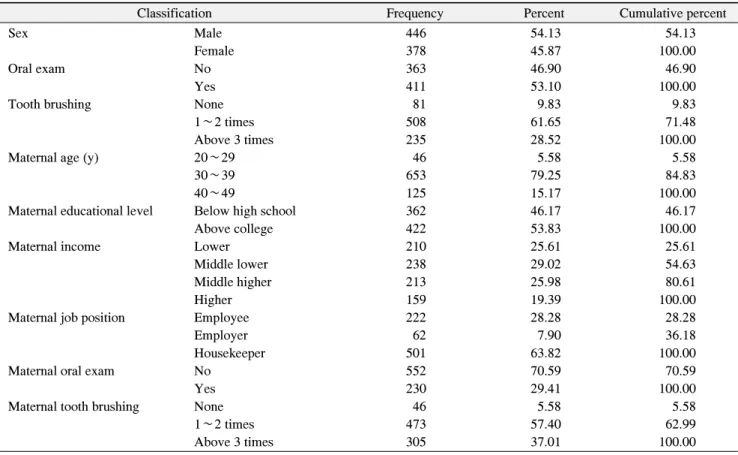
Table 2. Characteristic Variable of Children and Mother

Classification Frequency Percent Cumulative percent

Sex Male 446 54.13 54.13

Female 378 45.87 100.00

Oral exam No 363 46.90 46.90

Yes 411 53.10 100.00

Tooth brushing None 81 9.83 9.83

1∼2 times 508 61.65 71.48

Above 3 times 235 28.52 100.00

Maternal age (y) 20∼29 46 5.58 5.58

30∼39 653 79.25 84.83

40∼49 125 15.17 100.00

Maternal educational level Below high school 362 46.17 46.17

Above college 422 53.83 100.00

Maternal income Lower 210 25.61 25.61

Middle lower 238 29.02 54.63

Middle higher 213 25.98 80.61

Higher 159 19.39 100.00

Maternal job position Employee 222 28.28 28.28

Employer 62 7.90 36.18

Housekeeper 501 63.82 100.00

Maternal oral exam No 552 70.59 70.59

Yes 230 29.41 100.00

Maternal tooth brushing None 46 5.58 5.58

1∼2 times 473 57.40 62.99

Above 3 times 305 37.01 100.00

Maternal subjective oral health status: mean±standard deviaton (range)=3.47±0.76 (1.00∼5.00).

variables are shown in Table 1.

3. Analysis methods

Regression analysis was used to identify the influencing factors of early childhood caries. Fig. 1 shows the

distribution of the number of carious primary teeth, which was the dependent variable used in the analysis. The dependent variable deviated from normal and showed a long-tail distribution to the right, and thus, exponentially transformed values of the dmft index for primary teeth were used. For the identification of the influencing factors of the dmft index, an analysis was conducted using multiple linear regression separately for the characteristics of the children and mothers. STATA software version 14.0 (Stata Corp, College Station, TX, USA) was used in all analyses, and the significance level was set to 0.05.

Results

1. General characteristics of children and mothers

The general characteristics of the children and mothers

included in the study are shown in Table 2. The evaluated

children included 446 boys (54.13%) and 378 girls

(45.87%). A total of 411 children (53.10%) received an

(4)

Table 3. Factors on Early Childhood Caries of Children

Factor Model 1 Model 2

Sex Male

Female 0.017±0.061 (−0.102∼0.137)

Oral exam No

Yes 0.218±0.062 (0.096∼0.339)

Tooth brushing None

1∼2 times 0.105±0.131 (−0.153∼0.363)

Above 3 times 0.061±0.140 (−0.215∼0.336)

Maternal age (y) 20∼29

30∼39 −0.358±0.134 (−0.621∼−0.094) −0.339±0.135 (−0.603∼−0.075)

40∼49 −0.163±0.150 (−0.458∼0.132) −0.143±0.151 (−0.440∼0.153)

Maternal educational level Below high school

Above college −0.109±0.064 (−0.234∼0.017) −0.146±0.066 (−0.275∼−0.017)

Maternal income Lower

Middle lower −0.210±0.081 (−0.368∼−0.051) −0.226±0.082 (−0.388∼−0.065) Middle higher −0.091±0.084 (−0.256∼0.073) −0.092±0.085 (−0.259∼0.076) Higher −0.023±0.092 (−0.204∼0.159) −0.015±0.095 (−0.201∼0.170) Maternal job position Employee

Employer 0.329±0.119 (0.096∼0.562) 0.342±0.123 (0.101∼0.582) Housekeeper 0.067±0.067 (−0.065∼0.199) 0.062±0.069 (−0.073∼0.198)

Maternal oral exam No

Yes 0.045±0.067 (−0.086∼0.175) 0.005±0.069 (−0.131∼0.141)

Maternal tooth brushing None

1∼2 times 0.169±0.338 (−0.495∼0.833) 0.019±0.372 (−0.712∼0.749) Above 3 times 0.161±0.339 (−0.504∼0.827) 0.048±0.375 (−0.688∼0.783) Maternal subjective oral health status 0.028±0.040 (−0.050∼0.106) 0.034±0.040 (−0.045∼0.113)

Constant 0.877±0.393 (0.106∼1.648) 0.841±0.438 (−0.020∼1.701)

Values are presented as coefficient±standard error (95% confidence inverval).

Using multiple linear regression model.

oral examination. One to two tooth brushings per day was the most common, corresponding to 61.65% of the total sample. The age distribution of the mothers was 30∼39 years (79.25%), 40∼49 years (15.17%), and 20∼29 years (5.58%). With regard to the education level, college or higher education levels were the most common, corre- sponding to 53.83% of the total sample.

2. Influencing factors of early childhood caries in 5-year-old children

Table 3 shows the results of linear regression analysis using models 1 and 2 for the identification of the influ- encing factors of early childhood caries in 5-year-old children. In model 1, in which only the characteristics of the mothers were taken into account, the mother’s age, income level, and job status had a statistically significant influence on the dmft index. There was a decrease in the

number of early childhood caries by 0.358 in children of mothers in the age group 30∼39 years compared with mothers in the age group 20∼29 years, whereas the prevalence of caries decreased by 0.210 in children of mothers in the middle-to-low income group compared with mothers in the low-income group.

In model 2, linear regression analysis was performed

taking into account the characteristics of both the children

and mothers. Our results indicated that the oral exami-

nation of the child, along with age, education level,

income level, and job status of the mother had a stati-

stically significant influence on the dmft index. Therefore,

the dmft index for primary teeth of children of mothers

belonging to the middle-to-low income group were lower

by 0.226 compared with children of mothers belonging to

the low-income group. The dmft index of children who

received an oral examination was higher by 0.218

(5)

compared with children who did not receive an oral exa- mination. Moreover, the dmft index of children of mothers with college or higher education was lower by 0.146 compared with the index of children of mothers with a high school or lower education.

Discussion

Early childhood caries is one of the most prevalent oral diseases among children aged 5 years or younger. This study used highly representative data from KNHANES (2007 to 2014) to examine early childhood caries in 5-year-old children and the effects of demographic characteristics and oral health behavior of children and mothers on early childhood caries. The analysis used the dmft index. However, because the data showed a long-tail distribution to the right, exponentially transformed values were used in the linear regression analysis. Different models were used to determine the degree of influence by the characteristics of the mothers versus those of the children.

In model 1, only the characteristics of the mothers were taken into account for the identification of the influencing factors of early childhood caries. Our results revealed that age, income level, and job status of the mother strongly affected the number of caries. The dmft index of children in the age group 30∼39 years of mother was lower than that of mothers in the age group 20∼29 years. The dmft index of children in mothers belonging to the middle-to-low income group was higher than that of mothers from the low-income group. The dmft index of children who were maternal self-employed or were employers was higher by 0.329 than that of mothers who were wage workers. The pattern of prevalence of dental caries changed according to the socioeconomic status 1,2,17,21,22)

. Furthermore, the number of carious primary teeth decreased as the mother’s income level, which indicates the socioeconomic status, increased. Baggio et al. 21) observed that the higher job status of them other decreased the incidence of early childhood caries. These results appear to contradict the findings of the present study; however, the limitations in the ranking of the job status (wage worker versus self-em- ployed or employer as having a higher or lower status)

prevented the comparison with other studies. Therefore, more in-depth studies are needed to determine the influ- encing factors of early childhood caries according to the job status of the mother.

In model 2, the characteristics of both the mothers and children were taken into account for the identification of the influencing factors of early childhood caries. The identified factors were oral examination of the child as well as the age, education level, income level, and job status of the mother. Several studies reported that the differences in early childhood caries according to the age and education level of the mother showed a lower dmft index with lower age and higher education level 12,13,21,23,24)

, and this result was supported by our findings. Children who contract oral diseases or require treatment for pain usually have a high probability of visiting a dental clinic 25) . The oral status of children was assessed by asking the question, “Have you had an oral examination in the past year?” As a result, the incidence of early childhood caries may have been higher among children who received an oral examination. The limitations of the dmft index should also be considered. Although the dmft index is commonly used to assess the oral health status, the in ability of this index to properly indicate the health status of oral tissues based on oral disorders has been considered a limitation 26,27) . Marcenes and Sheiham 27) observed that because the dmft index is calculated by assigning one point to each carious, filled, or extracted tooth, the weighted values that reflect the health status of the oral tissues should be considered. These results may be because individuals who receive regularly scheduled oral exami- nations have higher oral health awareness, and the number of dental treatments should increase for the prevention and early treatment of oral diseases. Notwithstanding, future studies should use and compare other indices other than dmft index for evaluating oral health.

The strength of the present study is the use of samples

that represent the entire Korean population and the

consideration of the socioeconomic characteristics and

oral health behavior of mothers and the characteristics of

children for the identification of these influencing factors

from multiple perspectives. However, the limitation of the

study was the inability to determine whether the mother

(6)

was the primary caregiver.

In conclusion, our findings indicated that the socioe- conomic status of the mother affected the number of carious primary teeth in 5-year-old children. Furthermore, the pattern of occurrence of early childhood caries differed according to the age, education level, and income level of the mother, demonstrating the strong differences in oral health according to the socioeconomic status of the mothers. Therefore, water fluoridation programs need to be implemented to decrease the prevalence of caries among the social classes, and health intervention measures should be established for the health promotion of high-pri- ority populations.

Acknowledgements

This study was carried out by the support of the research fund of Dongnam Health University.

References

1. Jung Y, Kim SJ, Kim KN, Kang SJ, Doh SJ: Effect of mother's education level on prevalence of dental caries among preschool children: analysis of Korea national oral health survey 2006. Korean J Health Educ Promot 26:

117-128, 2009.

2. Bhardwaj SV, Bhardwaj A: Early childhood caries and its correlation with maternal education level and socio-economic status. J Orofac Sci 6: 53-57, 2014.

3. Sufia S, Khan A, Khan S, Chaudhry S: Maternal factors and child’s dental health. J Oral Health Comm Dent 3: 45-48, 2009.

4. Drury TF, Horowitz AM, Ismail AI, Maertens MP, Rozier RG, Selwitz RH: Diagnosing and reporting early childhood caries for research purposes. A report of a workshop spon- sored by the national institute of dental and craniofacial research, the health resources and services administration, and the health care financing administration. J Public Health Dent 59: 192-197, 1999.

5. Kawashita Y, Kitamura M, Saito T: Early childhood caries.

Int J Dent 2011: 725320, 2011.

6. Park HS, Kim JS: A survey of parent’s oral health perception for the oral health promotion of the preschool children. J Dent

Hyg Sci 7: 135-139, 2007.

7. Baginska J, Rodakowska E, Milewski R, Kierklo A: Dental caries in primary and permanent molars in 7-8-year-old schoolchildren evaluated with Caries Assessment Spectrum and Treatment (CAST) index. BMC Oral Health 14: 74, 2014.

8. Dye BA, Tan S, Smith V, et al.: Trends in oral health status:

United States, 1988-1994 and 1999-2004. Vital Health Stat (248): 1-92, 2007.

9. Cariño KM, Shinada K, Kawaguchi Y: Early childhood caries in northern Philippines. Community Dent Oral Epi- demiol 31: 81-89, 2003.

10. Rajab LD, Hamdan MA: Early childhood caries and risk factors in Jordan. Community Dent Health 19: 224-229, 2002.

11. Korea Centers for Disease Control and Prevention: Korea National Health and Nutrition Examination Survey (KNHANES) 2007-2014. Korea, 2007-2014. Korea Centers for Disease Control and Prevention, Osong, 2007-2014.

12. Shearer DM, Thomson WM, Broadbent JM, Poulton R:

Maternal oral health predicts their children's caries experi- ence in adulthood. J Dent Res 90: 672-677, 2011.

13. Retnakumari N, Cyriac G: Childhood caries as influenced by maternal and child characteristics in pre-school children of Kerala-an epidemiological study. Contemp Clin Dent 3: 2-8, 2012.

14. Kim YS, Kim JI: Relationship of early childhood caries and the influential factor of mothers in children under 6 years old.

J Dent Hyg Sci 14: 311-318, 2014.

15. Flynn P, Chang V, Lunos JMS: Intergenerational caries among mother-child pairs following migration. Pediatr Dent Care 1: 1-5, 2016.

16. Mattila ML, Rautava P, Aromaa M, et al.: Behavioural and demographic factors during early childhood and poor dental health at 10 years of age. Caries Res 39: 85-91, 2005.

17. Katageri AA, Arora R, Bhayya D, Patil K: Prevalence of dental caries and its association to maternal education as a risk indicator: a cross section study in udaipur - Rajasthan.

Sch J App Med Sci 2: 983-986, 2014.

18. Ryu K, Jeong SH, Kim JY, Choi YH, Song KB: Effect of

mothers’ oral health behaviour and knowledge on dental

caries in their preschool children. J Korean Acad Oral Health

28: 105-115, 2004.

(7)

19. Chang BJ: Relations between mothers, oral health knowledge and behavior and their children’s oral health behavior. J Korean Soc Sch Health 19: 49-57, 2006.

20. Lee JH, Kim JH: Prevalence rate of deciduous dental caries of 5-year-old children and the risk factors related to their mothers. J Korean Soc Dent Hyg 13: 881-888, 2013.

21. Baggio S, Abarca M, Bodenmann P, Gehri M, Madrid C:

Early childhood caries in Switzerland: a marker of social inequalities. BMC Oral Health 15: 82, 2015.

22. Schwendicke F, Dörfer CE, Schlattmann P, Foster Page L, Thomson WM, Paris S: Socioeconomic inequality and caries:

a systematic review and meta-analysis. J Dent Res 94: 10-18, 2015.

23. Wulaerhan J, Abudureyimu A, Bao XL, Zhao J: Risk deter- minants associated with early childhood caries in Uygur

children: a preschool-based cross-sectional study. BMC Oral Health 14: 136, 2014.

24. Steele J, Shen J, Tsakos G, et al.: The Interplay between socioeconomic inequalities and clinical oral health. J Dent Res 94: 19-26, 2015.

25. Beil H, Rozier RG, Preisser JS, Stearns SC, Lee JY: Effects of early dental office visits on dental caries experience. Am J Public Health 104: 1979-1985, 2014.

26. Bernabé E, Suominen-Taipale AL, Vehkalahti MM, Nordblad A, Sheiham A: The T-Health index: a composite indicator of dental health. Eur J Oral Sci 117: 385-389, 2009.

27. Marcenes WS, Sheiham A: Composite indicators of dental health: functioning teeth and the number of sound-equivalent teeth (T-Health). Community Dent Oral Epidemiol 21:

374-378, 1993.

수치

Table  1.  Definition  of  Variables
Table  2.  Characteristic  Variable  of  Children  and  Mother
Table  3.  Factors  on  Early  Childhood  Caries  of  Children

참조

관련 문서

This study aimed to identify the relations between mental health, organizational commitment and self-resilience of early childhood teachers and verify

Therefore, it suggests that sensorial activities based performance play can be used in early childhood education to improve playfulness and creative

The purpose of this study was to examine how children from broken families were affected by their family type, gender and academic school year in terms

The purpose of this study is to examine the relationship between the social support and mental health of university taekwondo athletes, and clearly clas sify

Oulis CJ, Tsinidou K, Vadiakas G, Mamai-Homata E, Polychronopoulou A, Athanasouli T : Caries prevalence of 5, 12 and 15-year-old Greek children: A

The purpose of this study is to examine the relationship among marketing mix factors, motivation for watching, relationship quality, and consumption

Therefore, this study aims to reveal the educational value of modern early childhood learners' emotional cultivation and to present a method of art

Sources of the German education law are the German Constitution(Basic Law) and the constitutions of the states, legal bases of (early) childhood education and care,