pISSN 2288-6575 • eISSN 2288-6796 https://doi.org/10.4174/astr.2021.100.4.235 Annals of Surgical Treatment and Research
Postoperative outcomes of purely laparoscopic donor hepatectomy compared to open living donor
hepatectomy: a preliminary observational study
Yu Jeong Bang1,*, Joo Hyun Jun2,*, Mi Sook Gwak1, Justin Sangwook Ko1, Jong Man Kim3, Gyu Seong Choi3, Jae Won Joh3, Gaab Soo Kim1
1Department of Anesthesiology and Pain Medicine, Samsung Medical Center, Sungkyunkwan University School of Medicine, Seoul, Korea
2Department of Anesthesiology and Pain Medicine, Kangnam Sacred Heart Hospital, Hallym University College of Medicine, Seoul, Korea
3Department of Surgery, Samsung Medical Center, Sungkyunkwan University School of Medicine, Seoul, Korea
INTRODUCTION
Liver transplantation is an established treatment option for patients with end-stage liver disease. However, the shortage of suitable grafts is a difficult obstacle to overcome. Since the first
living donor liver transplantation (LDLT) was performed in a pediatric recipient in 1989 [1], it has been widely practiced as an alternative to deceased donor liver transplantation. LDLT not only can solve the severe graft shortage, it also has the advantage of being able to use a high-quality graft at an optimal timing [2].
Received October 7, 2020, Revised November 27, 2020, Accepted January 5, 2021
Corresponding Author: Gaab Soo Kim
Department of Anesthesiology and Pain Medicine, Samsung Medical Center, Sungkyunkwan University School of Medicine, 81 Irwon-ro, Gangnam-gu, Seoul 06351, Korea
Tel: +82-2-3410-0360, Fax: +82-2-3410-0361 E-mail: [email protected]
ORCID: https://orcid.org/0000-0002-9383-2652
*Yu Jeong Bang and Joo Hyun Jun contributed equally to this study as co- first authors.
Copyright ⓒ 2021, the Korean Surgical Society
cc Annals of Surgical Treatment and Research is an Open Access Journal. All articles are distributed under the terms of the Creative Commons Attribution Non- Commercial License (http://creativecommons.org/licenses/by-nc/4.0/) which permits unrestricted non-commercial use, distribution, and reproduction in any medium, provided the original work is properly cited.
Purpose: To lessen the physical, cosmetic, and psychological burden of donors, purely laparoscopic donor hepatectomy (PLDH) has been proposed as an ideal method for living donors. Our study aimed to prospectively compare the effect of PLDH and 2 other types of open living donor hepatectomy (OLDH) on postoperative pain and recovery.
Methods: Sixty donors scheduled to undergo donor hepatectomy between March 2015 and November 2017 were included.
Donors were divided into 3 groups by surgical technique: OLDH with a subcostal incision (n = 20), group S; OLDH with an upper midline incision (n = 20), group M; and PLDH (n = 20), group L. The primary outcomes were postoperative pain and analgesic requirement during postoperative day (POD) 3. Other variables regarding postoperative recovery were also analyzed.
Results: Although pain relief during POD 3, assessed by visual analog scale (VAS) score and analgesic requirement, was similar among the 3 groups, group L showed lower VAS scores and opioid requirements than group M. Moreover, group L was associated with a rapid postoperative recovery evidenced by the shorter hospital length of stay and more frequent return to normal activity on POD 30.
Conclusion: This pilot study failed to verify the hypothesis that PLDH reduces postoperative pain. PLDH did not reduce postoperative pain but showed faster recovery than OLDH.
[Ann Surg Treat Res 2021;100(4):235-245]
Key Words: Laparoscopy, Liver transplantation, Living donors, Postoperative pain, Treatment outcome
When performing an LDLT, donor safety and good recovery should be a top priority because healthy donors may be exposed to serious morbidity and mortality risks [3]. Hence, purely laparoscopic living donor hepatectomy (PLDH) has been introduced to lessen donor burden. Previous studies reported that laparoscopic surgery could be superior to open surgery with regard to blood loss, postoperative complications, and recovery [4]. However, the use of PLDH was not as widespread as expected at the time of its introduction due to concerns about donor safety and technical difficulties.
Our institution is a large tertiary center with LDLT experience. We launched a PLDH program in May 2013.
Since 2017, nearly all living donor hepatectomies have been performed laparoscopically; to date, more than 300 cumulative PLDH procedures have been performed. In 2015 to 2017, before the PLDH program was firmly established, 3 different surgical techniques were performed for donor surgery at the surgeon’s discretion: open living donor hepatectomy (OLDH) with a subcostal incision, OLDH with an upper midline incision, or a PLDH. We conducted this pilot study to compare postoperative pain and other postoperative outcomes in living donor hepatectomy among the 3 different surgical techniques. To the best of our knowledge, no comprehensive study of the degree of postoperative pain and recovery of PLDH versus 2 types of open surgical techniques during the same period was performed.
Here, we report our experience with a transitional period using a mixed approach to living donor hepatectomy. Sharing our results may benefit many centers that plan to implement a PLDH program.
METHODS
Study participants
This was a single-center non-randomized observational study.
The study was approved by the Institutional Review Board of Samsung Medical Center, Seoul, Korea (No. SMC 2015-01-016- 002). We recruited 20 participants in each group for a pilot study without detailed sample size calculations. After obtaining
written informed consent, we enrolled adult donors with American Society of Anesthesiologists (ASA) physical status (PS) classification I to II scheduled for elective donor hepatectomy between April 2015 and November 2017 at Samsung Medical Center, Seoul, Korea. We excluded donors with pre-existing chronic pain [5].
Surgical procedure
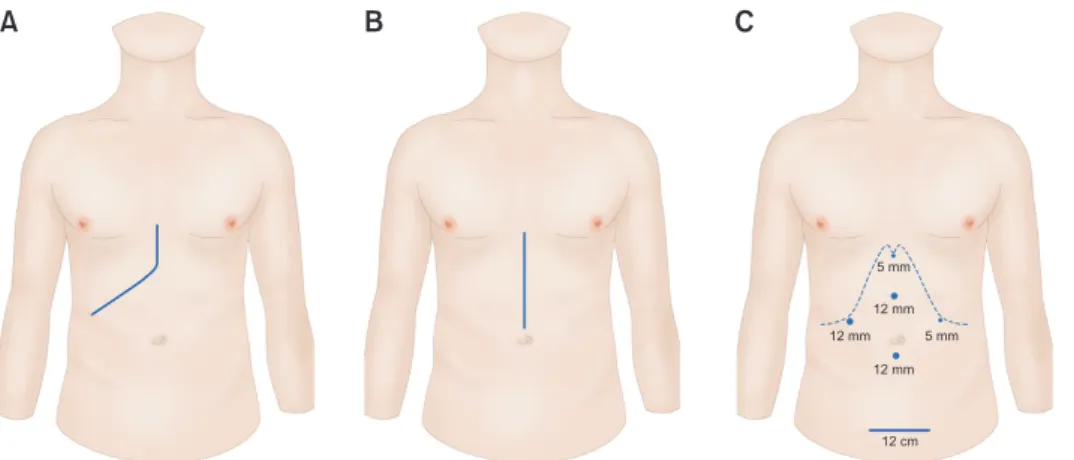
Three experienced transplant surgeons performed the living donor hepatectomies during the study period (Fig. 1). In ODLH, the laparotomy was performed using a right subcostal incision with extension up to xiphoid process (group S) or using an upper midline incision extending from the xiphoid process to the supra-umbilical region (group M). In PLDH (group L), 5 trocar ports were inserted as follows: 2 operative trocars of 12 mm were placed, one at the subcostal margin in the right midaxillary line and one in the midline between the umbilicus and the xiphoid process. 2 trocars of 5 mm for instrumental assistance were placed along the subcostal margin in the left midclavicular line and the subxiphoid region.
Pneumoperitoneum was maintained at 12 mmHg through the umbilical port. The hepatic graft was removed through a 12–14 cm Pfannenstiel incision in the suprapubic area. Surgical technique was determined according to donor anatomy and surgeon preference.
Intraoperative management
No premedication was given to any of the donors. All donors were administered intrathecal morphine (ITM) prior to the induction of general anesthesia according to our institutional protocol [6]. In the operating room, supplemental oxygen and intravenous (IV) midazolam (1–2 mg) was administered with standard ASA monitoring. An intrathecal injection of morphine 400 μg (0.4 mL of morphine sulfate 1 mg/mL diluted in 1.6 mL of cerebrospinal fluid aspirated at the time of the dural puncture) was administered at the lower lumbar level with a 25 or 27 gauge Whitacre spinal needle in the lateral position. After ITM administration, the donors were returned to the supine
A B C
5 mm
12 mm
12 mm 12 mm 5 mm
12 cm
Fig. 1. Three surgical techniques for living donor hepatectomy.
(A) Group S (open living donor hepatectomy with a subcostal incision). (B) Group M (open living donor hepatectomy with an upper midline incision). (C) Group L (purely laparoscopic living donor hepatectomy).
position and general anesthesia was induced with IV thiopental sodium (5–6 mg/kg), vecuronium (0.1 mg/kg), and remifentanil (0.05–0.1 μg/kg/min) followed by tracheal intubation.
Anesthesia was maintained with isoflurane in a 1:1 oxygen and air mixture and IV remifentanil infusion. The isoflurane concentration and remifentanil infusion dose were adjusted to achieve a bispectral index of 40–60 and maintain a mean arterial blood pressure and heart rate within 20% of the pre- induction values. All donors received 25 mg of IV meperidine 30 minutes before the end of surgery.
Postoperative management
After surgery, donors were transferred to the post-anesthesia care unit, where they stayed until they met the discharge criteria (modified Aldrete score ≥ 9/10). The postoperative analgesia was standardized. Pain severity was measured using a visual analog scale (VAS; 0 mm, no pain and 100 mm, worst imaginable pain).
All donors received IV patient-controlled analgesia (PCA) with fentanyl programmed to deliver a 15 μg/hr (1 mL/hr) with a 15 μg bolus (1 mL) dose and 15 minute lockout time. The IV PCA was continued until the postoperative day (POD) 3. If a donor presented with breakthrough pain (VAS ≥ 40 mm) despite IV PCA administration, IV meperidine 50 mg was administered. If this proved ineffective after 15 minutes, IV hydromorphone 2 mg was administered. Postoperative pruritus was treated with IV chlorpheniramine 4 mg and postoperative nausea or vomiting was treated with IV metoclopramide 10 mg.
In the surgical ward, all donors were managed according to a standardized protocol. Hospital discharge was determined by the independent surgical team. Donors were followed up at the surgical outpatient clinic on POD 21.
Data collection and outcomes
Our primary outcomes were VAS scores of the resting/
coughing pain during POD 3. We also investigated opioid consumption (converted to IV morphine equivalent) [7] and the number of rescue opioid administrations during POD 3. Secondary outcomes included the presence or absence of opioid-related side effects (nausea, pruritus, and respiratory depression) during POD 3; sleep satisfaction during POD 3 measured using a numeric rating scale ranging from 0 (poor quality) to 10 (excellent quality).
All donors completed the quality of recovery-15 (QoR-15) questionnaire on POD 7 that effectively evaluates the quality of recovery after surgery and anesthesia [8,9]. The QoR-15 scores are 0–150, with higher scores representing better recovery.
Other parameters related to postoperative recovery such as the time for the return of a gastrointestinal function (time from the end of surgery to the first flatus), length of hospital stay, and incidence of postoperative complication during the 21-day follow-up were collected. In addition, persistent postoperative pain and abdominal wall sensorineural deficit (numbness and differences in tactile and temperature sensation) on POD 7 and 30 were compared. We also investigated whether the donors were disabled in their daily lives or returned to their jobs on POD 30.
AST, ALT, and total bilirubin (TB) were collected before and immediately after the surgery and followed up to POD 21. PT expressed as the international normalized ratio (INR) was collected before and immediately after surgery and followed until POD 3.
The anesthesiologist who assessed donors during the postoperative period was blinded to the donor assignments.
Donor evaluations on POD 30 were conducted by telephone
Table 1. Demographic and intraoperative data
Parameter Group S (n = 20) Group M (n = 20) Group L (n = 20) Pvalue
Age (yr) 34.7 ± 12.6 34.4 ± 11.2 28.1 ± 9.2 0.061
Sex, male:female 14:6 11:9 12:8 0.610
Body mass index (kg/m2) 24.3 ± 3.1 23.2 ± 2.5 23.7 ± 2.7 0.495
ASA PS classification (I/II) 19/1a) 20 19/1b)
Previous abdominal surgery 0 1 1
Anesthetic time (min) 400.3 ± 51.6 357.0 ± 61.7 440.8 ± 51.6 <0.001
Surgical time (min) 344.5 ± 60.0 301.4 ± 57.2 368.1 ± 55.0 0.002
Remifentanil infusion (mg) 1.2 ± 0.7 0.9 ± 0.4 1.3 ± 0.8 0.315
Crystalloid (mL) 1,890.0 ± 366.9 1,677.5 ± 311.4 2,187.5 ± 413.9 <0.001
Transfusion (pack) 0 0 0
EBL (mL) 265.0 ± 84.4 480.0 ± 715.0 350.0 ± 174.0 0.057
Urine output (mL) 348.6 ± 121.3 331.3 ± 144.6 366.7 ± 155.6 0.859
Values are presented as mean ± standard deviation or number of donors.
Group S, open living donor hepatectomy (OLDH) with a subcostal incision; Group M, OLDH with an upper midline incision; Group L, purely laparoscopic living donor hepatectomy.
ASA, American Society of Anesthesiologists; PS, physical status; EBL, estimated blood loss.
a)Hypertension, b)diabetes mellitus.
interview.
Statistical analysis
Differences among the 3 groups were analyzed using the chi- square test or Fisher’s exact test for categorical variables and the analysis of variance or Kruskal-Wallis test for continuous variables. Post hoc analyses were also performed. Pairwise comparisons between groups were made using Fisher’s exact test for categorical variables and the Wilcoxon rank-sum test or t-test for continuous variables as appropriate. The generalized estimating equation was applied to analyses for repeated measurements of postoperative pain and opioid consumption.
Statistical significance was defined as a P-value of <0.05. All analyses were performed using SAS ver. 9.4 (SAS Institute, Cary, NC, USA).
RESULTS
Sixty donors (20 donors in each group) were included in the final analysis. The donors’ demographic and intraoperative data are summarized in Table 1. ASA PS classification II donors were those with well-controlled hypertension (group S) or diabetes mellitus (group L). Anesthetic and surgical times were the longest in group L and shortest in group M (P < 0.001, P = 0.002,
Table 2. VAS (0–100 mm) at rest and when coughing
Parameter Group S (n = 20) Group M (n = 20) Group L (n = 20)
Pvaluea) Intergroup comparisonb)
Mean ± SD SE Mean ± SD SE Mean ± SD SE
VAS at rest (hr) 0.752
1 43.0 ± 31.9 7.14 46.8 ± 32.1 7.17 31.0 ± 32.6 7.30 L vs. S, 0.339; vs. M, 0.114
4 4.8 ± 10.9 2.45 16.8 ± 21.9 4.90 5.8 ± 9.6 2.15 L vs. S, 0.753; vs. M, 0.035
8 4.0 ± 9.4 2.10 10.8 ± 20.3 4.53 6.0 ± 12.4 2.78 L vs. S, 0.556; vs. M, 0.359
24 18.5 ± 20.1 4.49 12.5 ± 16.7 3.73 14.4 ± 20.1 4.50 L vs. S, 0.503; vs. M, 0.745 48 26.0 ± 32.6 7.28 15.0 ± 15.0 3.34 26.0 ± 33.2 7.41 L vs. S, >0.999; vs. M, 0.165 72 26.0 ± 30.3 6.77 17.5 ± 23.9 5.34 20.8 ± 24.9 5.58 L vs. S, 0.539; vs. M, 0.666
VAS when coughing (hr) 0.499
1 53.9 ± 31.2 6.97 60.5 ± 29.1 6.51 41.5 ± 32.9 7.36 L vs. S, 0.210; vs. M, 0.047 4 22.0 ± 20.9 4.70 35.0 ± 26.4 5.91 17.8 ± 21.8 4.87 L vs. S, 0.519; vs. M, 0.021 8 23.8 ± 19.9 4.46 24.8 ± 21.4 4.78 19.3 ± 26.4 5.90 L vs. S, 0.532; vs. M, 0.457 24 38.0 ± 22.6 5.06 30.1 ± 25.9 5.79 30.8 ± 31.1 6.74 L vs. S, 0.381; vs. M, 0.936 48 45.0 ± 26.7 5.96 31.3 ± 23.9 5.35 43.3 ± 32.7 7.31 L vs. S, 0.849; vs. M, 0.174 72 42.8 ± 29.7 6.64 35.7 ± 29.4 6.57 34.0 ± 28.8 6.43 L vs. S, 0.332; vs. M, 0.850 Group S, open living donor hepatectomy (OLDH) with a subcostal incision; Group M, OLDH with an upper midline incision; Group L, purely laparoscopic living donor hepatectomy.
VAS, visual analog scale of pain; SD, standard deviation; SE, standard error.
a)Pvalue with respect to group during postoperative day 3 using generalized estimating equation. b)Pvalue with respect to group at each time point.
1 4 8 24 48 72
VASatrest
Time (hr) 100
80 60 40 20 0
Group S M L Group Group
1 4 8 24 48 72
VASwhencoughing
Time (hr) 100
80 60 40 20 0
Group Group Group S M L
*
*
*
A B
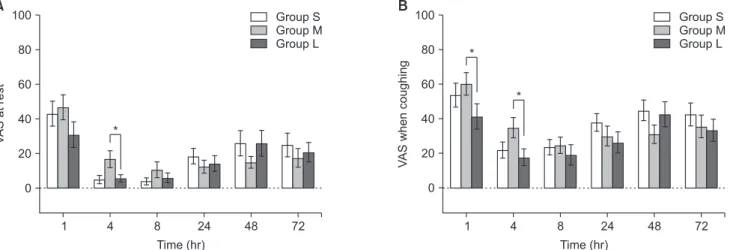
Fig. 2. Visual analog scale of pain (VAS, 0–100 mm) at rest and when coughing. (A) VAS at rest. (B) VAS when coughing. The bar plots with error bars indicate mean values and standard errors. *P < 0.05.
respectively). The amount of crystalloid infused during surgery was the largest in group L (P < 0.001). However, the estimated blood loss (EBL) was not significantly different among the
groups [10].
The VAS scores for postoperative pain during the first 72 hours postoperative are shown in Fig. 2 and the VAS score at Table 3. Opioid consumption in the postoperative period
Parameter Group S (n = 20) Group M (n = 20) Group L (n = 20)
Pvaluea) Intergroup comparisonb)
Mean ± SD SE Mean ± SD SE Mean ± SD SE
IV PCA consumption (mg)c) 0.323
POD 1 27.9 ± 22.4 5.01 38.0 ± 15.5 3.47 25.9 ± 17.4 3.88 L vs. S; 0.745; vs. M, 0.017 POD 2 64.3 ± 37.5 8.39 78.2 ± 28.7 6.42 63.4 ± 33.2 7.43 L vs. S, 0.931; vs. M, 0.120 POD 3 104.4 ± 62.6 13.99 107.3 ± 46.3 10.35 93.9 ± 45.5 10.17 L vs. S, 0.535; vs. M, 0.345
Cumulative opioid consumption (mg)c) 0.978
POD 1 7.3 ± 6.5 1.45 8.0 ± 4.0 0.89 5.3 ± 3.0 0.66 L vs. S, 0.183; vs. M, 0.011
POD 2 11.7 ± 8.8 1.96 11.7 ± 8.6 1.91 12.3 ± 9.9 2.20 L vs. S, 0.828; vs. M, 0.830 POD 3 17.3 ± 16.2 3.62 16.7 ± 14.1 3.14 17.3 ± 17.0 3.78 L vs. S, 0.994; vs. M, 0.899
Rescue opioid administration (n) 0.916
POD 1 0.8 ± 1.1 0.24 1.1 ± 0.8 0.17 0.5 ± 0.6 0.14 L vs. S, 0.187; vs. M, 0.005
POD 2 0.7 ± 0.7 0.15 0.5 ± 0.9 0.20 1.0 ± 1.1 0.25 L vs. S, 0.285; vs. M, 0.144
POD 3 0.8 ± 1.0 0.23 0.7 ± 0.9 0.21 0.6 ± 1.1 0.26 L vs. S, 0.653; vs. M, 0.755
Group S, open living donor hepatectomy (OLDH) with a subcostal incision; Group M, OLDH with an upper midline incision; Group L, purely laparoscopic living donor hepatectomy.
SD, standard deviation; SE, standard error; IV, intravenous; PCA, patientcontrolled analgesia; POD, postoperative day.
a)Pvalue with respect to group during POD 3 using generalized estimating equation. b)Pvalue with respect to group at each time point. c)Morphine equivalent dose.
0 24
IV-PCAconsumption(mg)
Time interval (hr) 120
80 60 40 20 0
Group Group Group S M L
A
100
24 48 48 72 0 24
Cumulativeopioidconsumption(mg)
Time interval (hr) 20
0
Group Group Group S M L
B
24 48 48 72
10
0 24
No.ofadministration
Time interval (hr) 1.5
1.0
0.5
0.0
Group Group Group S M L
C
24 48 48 72
*
*
*
Fig. 3. Opioid consumption during the first 72 hours postoperative. (A) Intravenous patientcontrolled analgesia (IV PCA) consumption (morphine equivalent dose). (B) Cumulative opioid consumption (morphine equivalent dose).
(C) Number of rescue opioid administrations. The bar plots with error bars indicate mean values and standard errors. *P
< 0.05.
each time point is summarized in Table 2. The degree of pain at rest during POD 3 was not significantly different among the 3 groups (P = 0.752). In the point of view of overall patterns, the degree of pain at rest was most severe 1 hour postoperatively and decreased until 8 hours postoperatively, then increased again afterward in all 3 groups. Notable is that the VAS value of the pain at rest 4 hours after surgery was lower in group L (VAS, 5.7) than in group M (VAS, 16.7) (P = 0.035). The degree of pain when coughing during POD 3 did not differ significantly among the 3 groups. The intensity of the pain when coughing was most severe 1 hour postoperatively and decreased until 4 or 8 hours postoperatively, then increased in all 3 groups.
The VAS values of the pain when coughing at 1 and 4 hours postoperative were lower in group L (VAS at 1 hour, 41.5; VAS at 4 hours, 17.8) compared to group M (VAS at 1 hour, 60.5;
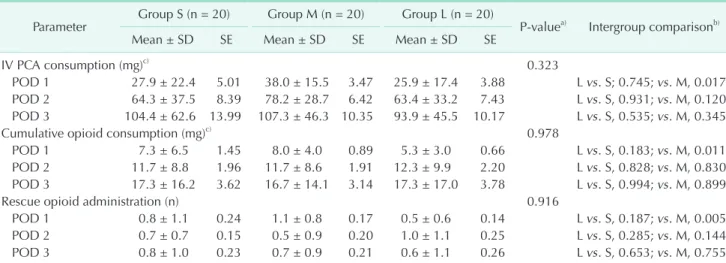
VAS at 4 hours, 35) (P = 0.047, P = 0.021, respectively). IV PCA consumption, cumulative opioid dose, and the number of rescue opioid administrations during the first 3 PODs did not differ significantly among the groups (Table 3 and Fig. 3). In group L, IV PCA consumption at 24 hours was 25.86 mg of morphine equivalent dose (MED), lower than that of group M (38.03 mg
of MED) (P = 0.017). The cumulative opioid consumption at 24 hours postoperative in group L was 5.27 mg of MED, also lower than that of group M (8.01 mg of MED) (P = 0.011).
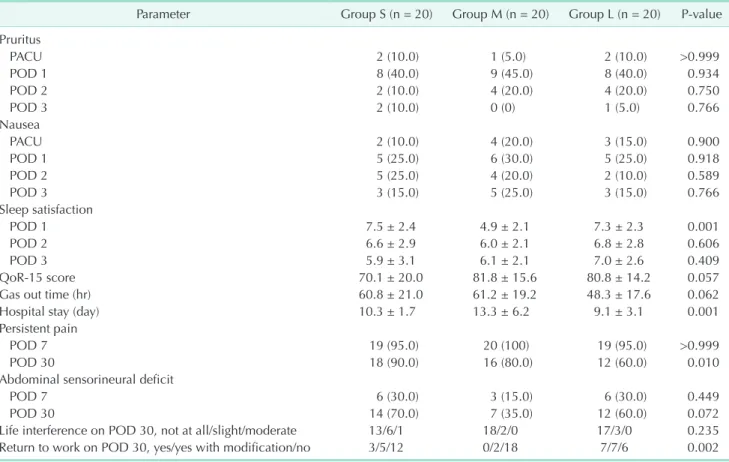
The postoperative outcomes are shown in Table 4. There was no significant difference in the prevalence of nausea and pruritus among the 3 groups. No respiratory depression marked by respiratory rate/minute of <8 during the postoperative periods was reported in all 3 groups. The sleep satisfaction was higher in group L than that in the other 2 groups during the first 3 PODs (P = 0.039). There were no significant differences in QoR-15 scores and gas out time among the groups. However, the mean hospital stay was shorter in group L than in other groups. Persistent postoperative pain and abdominal sensorineural deficit on POD 7 and 30 did not differ among the 3 groups. Donors in group L reported a high-quality postoperative recovery in a telephone interview on POD 30.
More donors returned work in group L than in the other groups.
Overall, 30% of group L, 90% of group M, and 60% of group S could not return to work.
Serial changes in ALT, AST, PT (INR), and TB in the perioperative period are shown in Fig. 4. The postoperative
Table 4. Composite of the postoperative outcomes
Parameter Group S (n = 20) Group M (n = 20) Group L (n = 20) Pvalue Pruritus
PACU 2 (10.0) 1 (5.0) 2 (10.0) >0.999
POD 1 8 (40.0) 9 (45.0) 8 (40.0) 0.934
POD 2 2 (10.0) 4 (20.0) 4 (20.0) 0.750
POD 3 2 (10.0) 0 (0) 1 (5.0) 0.766
Nausea
PACU 2 (10.0) 4 (20.0) 3 (15.0) 0.900
POD 1 5 (25.0) 6 (30.0) 5 (25.0) 0.918
POD 2 5 (25.0) 4 (20.0) 2 (10.0) 0.589
POD 3 3 (15.0) 5 (25.0) 3 (15.0) 0.766
Sleep satisfaction
POD 1 7.5 ± 2.4 4.9 ± 2.1 7.3 ± 2.3 0.001
POD 2 6.6 ± 2.9 6.0 ± 2.1 6.8 ± 2.8 0.606
POD 3 5.9 ± 3.1 6.1 ± 2.1 7.0 ± 2.6 0.409
QoR15 score 70.1 ± 20.0 81.8 ± 15.6 80.8 ± 14.2 0.057
Gas out time (hr) 60.8 ± 21.0 61.2 ± 19.2 48.3 ± 17.6 0.062
Hospital stay (day) 10.3 ± 1.7 13.3 ± 6.2 9.1 ± 3.1 0.001
Persistent pain
POD 7 19 (95.0) 20 (100) 19 (95.0) >0.999
POD 30 18 (90.0) 16 (80.0) 12 (60.0) 0.010
Abdominal sensorineural deficit
POD 7 6 (30.0) 3 (15.0) 6 (30.0) 0.449
POD 30 14 (70.0) 7 (35.0) 12 (60.0) 0.072
Life interference on POD 30, not at all/slight/moderate 13/6/1 18/2/0 17/3/0 0.235
Return to work on POD 30, yes/yes with modification/no 3/5/12 0/2/18 7/7/6 0.002
Values are presented as number of donors (%) or mean ± standard deviation, or number of donors.
Group S, open living donor hepatectomy (OLDH) with a subcostal incision; group M, OLDH with an upper midline incision; group L, laparoscopic living donor hepatectomy.
PACU, postanesthesia care unit; POD, postoperative day; QoR15, quality of recovery15.
trends of these laboratory results were similar among the groups. The mean AST in group L was lower than that of the other groups on POD 3 (vs. group M, P = 0.028; vs. group S, P
= 0.001). The mean PT (INR) of group L was lower immediately postoperatively (vs. group M, P = 0.003; vs. group S, P = 0.027), but no differences were noted at other time points.
There were no significant differences in the incidence of complications among the 3 groups, but serious complications such as bile duct stricture and portal vein injury occurred only in group L. There were no wound problems in group L (Table 5). The cases of readmission were as follows. There was 1 case of wound dehiscence in group S. In group M, 1 donor was readmitted for percutaneous catheter drainage (PCD) placement due to bile leakage. There were 2 cases of readmission in group L;
one for portal vein angioplasty due to portal vein stenosis and another for PCD placement due to intra-abdominal localated fluid.
DISCUSSION
Laparoscopic surgery reduces postoperative pain and produces better cosmetic outcomes; it expedites the postoperative recovery, allowing an early return to daily life. Thus, the laparoscopic approach for liver resection is preferred over laparotomy in many centers. Even in liver donation surgery, it would be desirable to perform the donor hepatectomy laparoscopically because the donor is a healthy person living a normal life [3]. However, even centers skilled in laparoscopic liver resection are often reluctant to implement PLDH due to concerns about complications and safety. To implement laparoscopic hepatectomy for living donors, the surgical team must have extensive experience with both open donor hepatectomy and laparoscopic hepatectomy. Although our surgical team was very skilled in both fields, we had to be cautious when launching PLDH. To ensure donor safety, all donors were evaluated by the multidisciplinary transplant team and met standard tests and refined criteria for liver donation.
Only type 1 portal veins and type 1 bile ducts were originally
Preop
ALT(U/L)
Postoperative day 350
300 250 200 150 100 50 0
Group Group Group S M L
A
C
0 1 2 3 7 30 Preop
AST(U/L)
Postoperative day 350
300 250 200 150 100 50 0
Group Group Group S M L
0 1 2 3 7 30
B
Preop
Totalbilirubin(mg/dL)
Postoperative day 4
3
2
1
0
Group Group Group S M L
0 1 2 3 7 30 Preop
PT(INR)
Postoperative day 2.0
1.5
1.0
0.5
0.0
Group Group Group S M L
0 1 2 3
*
*
*
*
D
Fig. 4. Serial changes in the perioperative ALT, AST, total bilirubin, and PT (INR) levels. The bar plots with error bars indicate mean values and standard errors. Preop, preoperative. *P < 0.05.
accepted [11]. The surgery team expanded their selection criteria for PLDH as their experience increased. Our center has published several reports on our initial experience with PLDH [12-15]. Several studies have compared PLDH and OLDH in terms of postoperative outcomes for donors and recipients [16-18]. Those studies covered data from the initiation of the PLDH in 2013 at our hospital to the establishment of the PLDH program in 2017 or later.
Postoperative pain is an important endpoint for comparing different surgical techniques associated with patient satisfaction and quality of life [19]. In this study, pain relief assessed by the VAS in group L was similar to those of the other groups in the study period. IV PCA consumption, cumulative opioid dose, and the number of rescue opioid administrations during the first 3 PODs were not significantly different. PLDH does not seem to have a beneficial effect on postoperative pain control compared to other surgical techniques, as we had previously expected.
However, based on each time point in detail, the pain score immediately postoperative for group L was lower than that for group M. In addition, IV PCA consumption, cumulative opioid dose, and the number of rescue opioid administrations during the first 24 hours postoperative was lower in group L than in group M. Moreover, considering that sleep satisfaction, which is thought to reflect pain control, was higher in the laparoscopic group than in the other 2 groups during POD 3, postoperative pain at night is estimated to be less severe in the laparoscopic group. In fact, the mean surgical incision length of group L was as long as the mean upper abdominal incision length in
group M. We believe that this difference was due to the tension applied to the surgical site and the incision type. In group M, the abdominal muscles were stretched for the entire operation, which causes abdominal muscle injury and local ischemia.
However, in group L, the abdominal muscles were stretched only briefly during graft extraction, resulting in less muscle injury. Furthermore, for the first 24 hours immediately after surgery, all donors were instructed to take deep breaths and cough actively. In this period, the postoperative pain would be more severe in the donors of group M or S, who had wounds in the upper abdomen. The upper midline incision in particular may be more painful because tension occurs in the left and right directions of the wound during breathing exercises or ambulation. In the upper midline incision, the transverse abdominis muscles are more divided from side to side than in group L and distractive forces impair the abdominal wall.
The decreased diaphragmatic function after major abdominal surgery triggers more postoperative muscular activity of the abdominal wall and could result in greater pain.
Interestingly, we also found that it was difficult to prove that OLDH with an upper midline incision was superior to OLDH with a subcostal incision in terms of postoperative pain and postoperative recovery. It was previously known that OLDH with a midline incision had more favorable outcomes for donors than OLDH with a subcostal incision. However, donors in group M had higher VAS values and greater opioid consumption than those of group S in the present study. In addition, donors in group M had longer hospital stays and were more likely to fail Table 5. Postoperative complications
Variable Group S (n = 20) Group M (n = 20) Group L (n = 20) Pvalue
Complication 9 12 5 0.081
ClavienDindo classification
I 7 7 1
II 0 3 2
IIIa 1 2 2
IIIb 1 0 0
IV 0 0 0
Bile duct stricture 0 0 1 >0.999
IVC thrombus 0 0 1 >0.999
Portal vein injury 0 0 1 >0.999
Bile leakage 1 3 0 0.310
Intraabdominal fluid collection 1 1 1 >0.999
Wound problem 2 3 0 0.353
Postoperative bleeding 1 1 0 >0.999
Delayed ALT, AST recovery 1 3 1 0.603
Other 1 1 0
Readmission 1 1 2 >0.999
Values are presented as number of donors.
Group S, open living donor hepatectomy (OLDH) with a subcostal incision; Group M, OLDH with an upper midline incision; Group L, purely laparoscopic living donor hepatectomy.
IVC, inferior vena cava.
to return to normal life on POD 30 than other donors in the present study. These findings are contrary to those of previous studies [20,21].
Although these preliminary results must be interpreted cautiously because of the small sample size, the present study failed to verify the hypothesis that PLDH will reduce postoperative pain compared to OLDH. A critical factor was considered to have affected the results. In this study, ITM administration was used to control the postoperative pain of donors as a standardized protocol. In a previous study, postoperative pain was the most severe for the first 2 PODs, and the ITM administration used in this protocol had analgesic effects until POD 2 [6]. Because of the excellent postoperative pain relief provided by ITM, there appeared to be no significant differences in pain severity and cumulative opioid consumption during the first 3 PODs. If institutions that did not implement the ITM performed the study in the same manner, it might have yielded different results.
When we planned this study, we thought that the surgical team in our institution was technically skilled at and confident performing PLDH. However, the present study showed that group L still had longer anesthetic and surgical times. This study also did not demonstrate the superiority of PLDH to OLDH (group S, group M) in terms of EBL and complications.
Our study results suggest that our surgical team was still in the learning curve during the study period. The donors in group L correspond to cases between the 43rd and 67th since PLDH was first implemented in our hospital.
In this study, PLDH was inferior to the other surgical techniques in terms of anesthetic time, but demonstrated superior postoperative recovery. Although the difference failed to reach statistical significance, group L showed faster bowel recovery. Donors in group L also exhibited a rapid postoperative recovery evidenced by the shorter hospital length of stay and more frequently return to normal activity by POD 30, which is consistent with previous findings [22-27]. We believe that the differences in postoperative recovery in our study may be attributable to the different surgical techniques, which is more crucial than anesthetic time or surgical time. Use of the laparoscopic approach and Pfannenstiel incision in group L may have resulted in the early bowel recovery and resumption of normal diet after surgery since laparoscopic procedures invoke less manipulation of the gastrointestinal tissue and less postoperative ileus [28]. The resumption of the normal diet and tight control of postoperative pain are important factors in promoting well-being sense and postoperative recovery probably contributed to the shortened hospital stay.
There are a number of limitations to this study. First, it lacked randomization. The surgical techniques were selected according to the surgeon’s discretion and preference, and the donors consented to the technique before surgery. Thus, the
donors were not blinded to the group allocation, which could create potential selection bias. Second, 20 donors in each group may be insufficient to demonstrate the pain relief effect of laparoscopic surgery for liver donation. In this preliminary study, PLDH resulted in a rapid postoperative recovery, but there appeared to be no significant difference in postoperative pain control. A future trial with a larger sample size may verify our hypothesis that PLDH has more favorable outcomes in terms of postoperative pain and rapid recovery. Third, donors who underwent liver donation showed more emotional instability or anxiety during the postoperative period than patients who had undergone other surgeries. For example, donors tended to show anger or depression when the recipients had poor clinical progress or familial support was insufficient. When they were emotionally disturbed, their report of pain severity seemed to be affected. In some cases, donors were more likely to focus on the recipient’s recovery rather than their own during hospitalization. The psychological stress and emotional fluctuations of the donor in the perioperative period may affect the postoperative pain severity and the reliability of the pain and recovery assessment. Future research on the postoperative pain and recovery of the living donors for liver transplantation should be planned with family and psychological factors in mind. Fourth, data were collected until POD 30, which is too early to investigate long-term adverse effects, and future research should include long-term follow-up. Finally, the data about postoperative complications and sequelae at POD 30 was collected on telephone interviews. No sensory test and clinical examination were performed to evaluate sensorineural deficits. The information we obtained was based on donors’
reports and might not be accurate. Thus, inconsistency between actual adverse effects and the donors’ subjective self-reports is possible.
Despite these limitations, the main strength of this study is that a wide range of data was collected prospectively by a clinician not involved in postoperative donor care. Several retrospective studies have assessed postoperative pain and recovery after donor hepatectomy [21,29]. All of our donors received the same standardized postoperative care and analgesia regimen, to eliminate possible confounding variables.
There are no prospective studies comparing PLDH with OLDH focusing on postoperative pain as the primary outcome. Unlike other studies of all PLDH data or of only the initial period after a PLDH launch, this study excluded the first 2 years of the initial period of PLDH use and included specific data from the second-half of the transitional period. Our detailed and practical data about our transitional experience will be a reference for centers that are late to adopt PLDH.
In conclusion, there were no significant differences in postoperative pain severity among the 3 surgical techniques examined in this study. PLDH did not show a positive effect on
postoperative pain compared to OLDH (subcostal incision and midline incision). However, PLDH has the definite advantage over OLDH of a faster recovery including a shortened hospital stay and faster return to normal life. A future larger randomized controlled trial is required to validate our findings.
ACKNOWLEDGEMENTS
Conflict of Interest
No potential conflict of interest relevant to this article was reported.
ORCID iD
Yu Jeong Bang: https://orcid.org/0000-0002-2134-9899 Joo Hyun Jun: https://orcid.org/0000-0002-4082-0404
Mi Sook Gwak: https://orcid.org/0000-0003-1296-1610 Justin Sangwook Ko: https://orcid.org/0000-0003-3155-0550 Jong Man Kim: https://orcid.org/0000-0002-1903-8354 Gyu Seong Choi: https://orcid.org/0000-0003-2545-3105 Jae Won Joh: https://orcid.org/0000-0003-1732-6210 Gaab Soo Kim: https://orcid.org/0000-0002-9383-2652
Author Contribution
Conceptualization: GSK Formal Analysis: YJB Investigation: YJB, JHJ
Methodology: MSG, JSK, JMK, GSC, JWJ Project Administration: YJB, JHJ Writing – Original Draft: YJB, JHJ, GSK Writing – Review & Editing: All authors
REFERENCES
1. Broelsch CE, Burdelski M, Rogiers X, Gundlach M, Knoefel WT, Langwieler T, et al. Living donor for liver transplantation.
Hepatology 1994;20(1 Pt 2):49S-55S.
2. Jurim O, Shackleton CR, McDiarmid SV, Martin P, Shaked A, Millis JM, et al.
Living-donor liver transplantation at UCLA. Am J Surg 1995;169:529-32.
3. Ishizaki M, Kaibori M, Matsui K, Kwon AH. Change in donor quality of life after living donor liver transplantation surgery: a single-institution experience.
Transplant Proc 2012;44:344-6.
4. Rhu J, Kim JM, Choi GS, Kwon CH, Joh JW, Soubrane O. Laparoscopy of hepatocellular carcinoma is helpful in minimizing intra-abdominal adhesion during salvage transplantation. Ann Surg Treat Res 2018;95:258-66.
5. C a r rol l I R , A n g s t M S , C l a rk J D.
Management of perioperative pain in patients chronically consuming opioids.
Reg Anesth Pain Med 2004;29:576-91.
6. Ko JS, Choi SJ, Gwak MS, Kim GS, Ahn HJ, Kim JA, et al. Intrathecal morphine combined with intravenous patient- controlled analgesia is an effective and safe method for immediate postoperative pain control in live liver donors. Liver Transpl 2009;15:381-9.
7. Gordon DB, Stevenson KK, Griffie J, Muchka S, Rapp C, Ford-Roberts K. Opioid equianalgesic calculations. J Palliat Med 1999;2:209-18.
8. Stark PA, Myles PS, Burke JA. Development and psychometric evaluation of a postoperative quality of recovery score:
the QoR-15. Anesthesiology 2013;118:1332- 40.
9. Kleif J, Waage J, Christensen KB, Gögenur I. Systematic review of the QoR-15 score, a patient-reported outcome measure measuring quality of recovery after surgery and anaesthesia. Br J Anaesth 2018;120:28-36.
10. Bang SR, Ahn HJ, Kim GS, Yang M, Gwak MS, Ko JS, et al. Predictors of high intraoperative blood loss derived by simple and objective method in adult living donor liver transplantation.
Transplant Proc 2010;42:4148-50.
11. Takeishi K, Shirabe K, Yoshida Y, Tsutsui Y, Kurihara T, Kimura K, et al. Correlation between portal vein anatomy and bile duct variation in 407 living liver donors.
Am J Transplant 2015;15:155-60.
12. Rhu J, Choi GS, Kwon CH, Kim JM, Joh JW. Learning curve of laparoscopic living donor right hepatectomy. Br J Surg 2020;107:278-88.
13. Rhu J, Choi GS, Kim JM, Joh JW, Kwon CH. Feasibility of total laparoscopic living donor right hepatectomy compared with open surgery: comprehensive review of 100 cases of the initial stage. J Hepatobiliary Pancreat Sci 2020;27:16-25.
14. Kwon CH, Choi GS, Kim JM, Cho CW, Rhu J, Soo Kim G, et al. Laparoscopic donor hepatectomy for adult living donor liver transplantation recipients. Liver Transpl 2018;24:1545-53.
15. Kwon CH, Choi GS, Joh JW. Laparoscopic right hepatectomy for living donor. Curr Opin Organ Transplant 2019;24:167-74.
16. Jeong JS, Wi W, Chung YJ, Kim JM, Choi GS, Kwon CH, et al. Comparison of perioperative outcomes between pure laparoscopic surgery and open right hepatectomy in living donor hepatectomy:
propensity score matching analysis. Sci Rep 2020;10:5314.
17. Park J, Kwon DC, Choi GS, Kim SJ, Lee SK, Kim JM, et al. Safety and risk factors of pure laparoscopic living donor right hepatectomy: comparison to open technique in propensity score-matched analysis. Transplantation 2019;103:e308- 16.
18. Park J, Kwon CH, Choi GS, Lee SK, Kim JM, Oh J, et al. One-year recipient
morbidity of liver transplantation using pure laparoscopic versus open living donor right hepatectomy: propensity score analysis. Liver Transpl 2019;25:1642- 50.
19. Wu CL, Rowlingson AJ, Partin AW, Kalish MA, Courpas GE, Walsh PC, et al. Correlation of postoperative pain to quality of recovery in the immediate postoperative period. Reg Anesth Pain Med 2005;30:516-22.
20. Nagai S, Brown L, Yoshida A, Kim D, Kazimi M, Abouljoud MS. Mini-incision right hepatic lobectomy with or without laparoscopic assistance for living donor hepatectomy. Liver Transpl 2012;18:1188- 97.
21. Demirbas T, Bulutcu F, Dayangac M, Yaprak O, Guler N, Oklu L, et al. Which incision is better for living-donor right hepatectomy? Midline, J-shaped, or Mercedes. Transplant Proc 2013;45:218-21.
22. Liu Q, Liu F, Ding J, Wei Y, Li B. Surgical outcomes and quality of life between laparoscopic and open approach for hepatic hemangioma: a propensity score matching analysis. Medicine (Baltimore) 2019;98:e14485.
23. Buell JF, Thomas MT, Rudich S, Marvin M, Nagubandi R, R avindra K V, et al. Experience with more than 500 minimally invasive hepatic procedures.
Ann Surg 2008;248:475-86.
24. Kim WJ, Kim KH, Kim SH, Kang WH, Lee SG. Laparoscopic versus open liver resection for centrally located hepatocellular carcinoma in patients with cirrhosis: a propensity score-matching analysis. Surg Laparosc Endosc Percutan Tech 2018;28:394-400.
25. Nguyen KT, Gamblin TC, Geller DA. World review of laparoscopic liver resection:
2,804 patients. Ann Surg 2009;250:831-41.
26. Topal B, Fieuws S, Aerts R, Vandeweyer
H, Penninckx F. Laparoscopic versus open liver resection of hepatic neoplasms:
comparative analysis of short-term results. Surg Endosc 2008;22:2208-13.
27. Yoon YI, Kim KH, Kang SH, Kim WJ, Shin MH, Lee SK, et al. Pure laparoscopic versus open right hepatectomy for hepatocellular carcinoma in patients with cirrhosis: a propensity score matched analysis. Ann Surg 2017;265:856-63.
28. A r t i ny a n A , Nu no o - Men s a h J W, Balasubramaniam S, Gauderman J, Essani R, Gonzalez-Ruiz C, et al. Prolonged postoperative ileus: definition, risk factors, and predictors after surgery.
World J Surg 2008;32:1495-500.
29. Kitajima T, Kaido T, Iida T, Seo S, Taura K, Fujimoto Y, et al. Short-term outcomes of laparoscopy-assisted hybrid living donor hepatectomy: a comparison with the conventional open procedure. Surg Endosc 2017;31:5101-10.