A SHEAR BOND STRENGTH OF RESIN CEMENT BONDED TO HUMAN UNCUT ENAMEL, CUT ENAMEL, AND DENTIN IN VITRO
Jong-Yeop Lee, D.D.S., Ph.D.
Chairman, Department of Dentistry, Kangbuk Samsung Hospital, Sungkyunkwan University School of Medicine
Statement of problem. Adhesives in dentistry play a major role in the success of restorative treat- ments. In the treatment of all ceramic restoration it is needed to find the adequate bond strength between enamel and dentin.
Purpose. The purpose of this study was to evaluate shear bond strength of resin cement bonded to extracted human uncut enamel, cut enamel, and dentin in vitro.
Material and methods. Ten freshly extracted anterior teeth without any previous restorative treat- ments were chosen. The extracted teeth were embedded in PMMA cold acrylic in the shape of a cylin- der, 25 mm in diameter by 25 mm in height. The bonding system used was as follow: Uni-Etch (32%
phosphoric acid), One-Step adhesive, Duolink resin cement. The specimens were acid etched and rinsed with water. Two layers of One-Step adhesive were coated with a disposable brush on the uncut enamel. VIP curing light at 500 mV/cm2was used to cure the adhesive. For cut enam- el shear bond test, the specimen used for uncut enamel was further reduced approximately 0.3 ~ 0.5 mm using a laminate preparation diamond bur (0.3 mm in depth). The specimens were subsequently treated with 320-grit SiC paper followed by 600-grit SiC paper and cleaned with distilled water.
The bonding procedure on the cut enamel was same as uncut enamel bonding procedure. For dentin bonding test, the specimen used for cut enamel was further reduced approximately 0.5 mm ~ 1.0 mm using a laminate preparation diamond bur (0.5 mm in depth of diamond cutting). The amount of reduction was evaluated with the silicone mold. The specimens were subsequently treat- ed with 320-grit SiC paper followed by 600-grit silicon carbon paper and cleaned in distilled water. The bonding procedure on the dentin was same as uncut enamel bonding procedure. All samples were mounted and secured on the Ultradent shear bond test sample holder, and Ultradent restricted shear bond testing device was used with Universal Instron machine until fracture.
Analysis of variance (ANOVA) test was performed comparing the result at P<0.05. Multiple com- parison (Tukey) was used to compare each groups.
Result. The result showed that the mean value in shear bond strength of resin cement bonded to uncut enamel, cut enamel and dentin were 27.04 Mpa, 30.25 Mpa and 26.39 Mpa with respect.
Conclusion. Within the limitation of this study, the mean value of the shear bond strength of cut enamel was higher than those of uncut enamel or dentin. However there existed no statistical differences between three different human dentition substrates due to increased adhesive characteristics.
Key Words
Shear bond strength, Resin cement, Uuncut enamel, Cut enamel, Dentin
J Korean Acad Prosthodont : Volume 41, Number 3, 2003
※ This work was supported by Bisco, Inc(USA).
A
dhesives in dentistry play a major role in everyday practice. It enhances the longevity of restorations in a great deal. In the treatment of spaced dentitions, there are several ways of treat- ing the existing space: composite resin restoration, porcelain laminate veneer, partial or full coverage crowns. It has been a standard procedure to re- duce the tooth structure for bonding or cement- ing the fixed prosthesis to the natural dentition.However the most conservative approach would be bonding the prosthesis without any tooth re- duction as long as it does not violate biologic limitations. .
It is very critical to form a strong bond between teeth and restoration with the medium of adhe- sives and cement to achieve successful restorations.
Horn1(1983) proposed etching porcelain lami- nate veneer restoration with either hydrofluoric acid or Stripit solution, and it is a standard pro- tocol to bond etchable porcelains to teeth. Rochette2 first advocate the use of silane as a coupling agent, and Lacy et al3showed that silane treatment increased almost 5 times higher bond strength than that of acid etched porcelain surface.
Ever since Buonocore4advocated the use of etching the tooth in 1955, etching the tooth surface also became a standard procedure in cement- ing dental prosthesis. New findings in adhe- sive dentistry are discovered, and new enhanced cement systems are now on the market.
Nakabayash et al5revealed the formation of hybrid layer of resin-reinforced dentin created by the impregnation of collagen bundles and encap- sulation of hydroxyapatite crystals in vital human dentin. Van Meerbeek et al6confirmed the pres- ence of the resin-dentin interfusion zone as the junc- tion between the deep unaltered dentin structure and the restorative resin. With the discovery of wet bonding theory by Kanca7, the strength of dentin bonding was greatly enhanced. The sixth generation adhesive which is All-in-One bottle
(etching, prime and adhesive agent in one step) is now on the market to reduce clinical time without loosing bonding strength. However, fifth generation adhesive, One-Step (primer and adhesive in one bottle) is used in this study because its use and strength was well known at present.
This study investigated the shear bond strength of human uncut enamel, cut enamel and dentin bonded to resin cement in vitro.
MATERIAL AND METHOD
Ten of recently extracted human permanent anterior teeth without any previous restoration that had been stored in frozen distilled water were used.
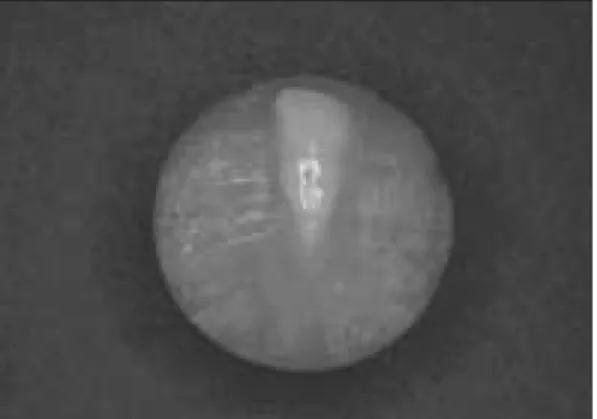
The teeth were embedded in PMMA cold acrylic in the shape of a cylinder (25 mm in diameter by 25 mm in height) (Fig. 1). Three notches were made on the side of PMMA acrylic cylinder before silicone mold was fabricated to evaluate the thickness of enamel and dentin reduction in the future. For uncut enamel sample, the most pos- sible flat surface of enamel on the middle of the tooth was chosen for bonding sites. The bonding system used was as follow; Duolink resin cement, One-Step adhesive, Uni-Etch [Bisco, Schaumburg, USA].
For uncut enamel, the specimens were acid etched with Uni-Etch [Bisco, Schaumburg, USA]
for 15 seconds then rinsed with water for 40 sec- onds. The specimens were then dried with air blow.
Two layers of One-Step adhesive were coated with a disposable brush on the uncut enamel embed- ded in the PMMA, then gentle air was applied to remove any excess. VIP [Bisco, Schaumburg, USA] curing light at 500 mV/cm2was used to poly- merize the adhesive for 10 seconds.
For cut enamel shear bond strength test, the spec- imen used for uncut enamel was further reduced approximately 0.3mm ~0.5 mm using a lami- nate preparation diamond bur (0.3 mm in depth
of diamond cutting) followed by a medium- coarse diamond bur. The specimens were sub- sequently treated with 320-grit SiC paper fol- lowed by 600-grit SiC paper. The specimens were then cleaned with distilled water. The amount of reduction was evaluated with the sil- icone mold, which was fabricated before tooth reduction. The bonding procedure on the cut enamel was same as uncut enamel bonding pro- cedure. For dentin bonding test, the specimen used for cut enamel was further reduced approxi- mately 0.5 ~ 1.0 mm using a 0.5 mm in depth lam- inate diamond preparation bur followed by a medium-coarse diamond bur. The amount of
reduction was evaluated with the silicone mold.
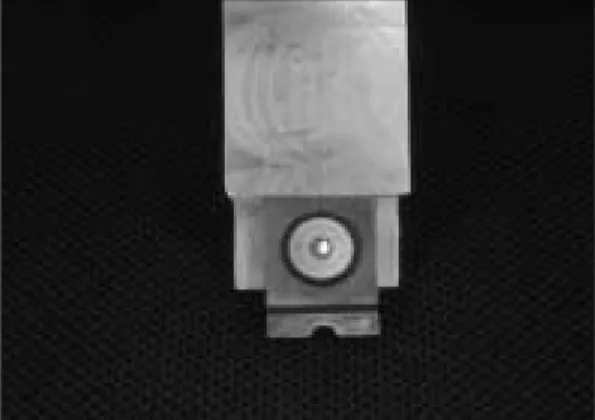
The specimens were subsequently treated with 320- grit SiC sandpaper followed by 600-grit SiC paper, and the specimens were cleaned with distilled water. The bonding procedure on the dentin was same as uncut enamel bonding pro- cedure. All samples were mounted and secured on the Ultradent shear bond test assemble hold- er (Fig. 2-A,B). An Equal amount of base and cat- alyst of Duolink resin cement [Bisco, Schaumburg, USA] were mixed on the paper tab, the mixed resin cements were stored in the gun type cement dis- penser, Centrix. Ultradent plastic hole was filled with the resin cement, and a small portion of light curing composite resin, Bis-Core resin [Bisco, Schaumburg, USA] was placed on the top of the cement to gently adapt the resin cement on the tooth surface. The total width of resin cement rod was 2.39 mm in diameter and less than 3 mm in height. All cements were light cured for 40 sec- onds from the top with VIP [Bisco, Schaumburg, USA] at 500 mV/cm2 . The samples were disas- sembled from Ultradent sample holder then light cured for extra 20 seconds for complete poly- merization. All specimens were immersed in the distilled water at 37℃ for 2 hours and then test- ed to failure an Instron machine. Ultradent shear Fig. 1.Porcelain disc in PMMA
Fig. 2-A.Top view of Ultradent test Fig. 2-B. Side view of test assemble
bond test blade with semi-circular shape (Fig.3) was used at a headspeed of 0.5 mm / min (Fig. 4).
RESULT
The mean and standard deviation were calcu- lated for each group. An analysis of variance (ANOVA) test was used throughout to evaluate differences in shear bond strength of the cement
bonded to the different porcelain surface treatment.
Significance at 95 % was chosen as representative of the result. Multiple comparison (Tukey) was used to compare each group.
The result of the shear bond test is summa- rized in table Ⅰ; the cut enamel test showed the highest mean shear bond strength compared to uncut enamel and dentin tests. However, there existed no statistical significant difference among three groups. Most (96 %) of the fracture took place in the junction between resin cement and enam- el or dentin (adhesive failure).
Fig. 3. Ultradent restricted semicircular shaped blade
(A) (B) (C)
Fig 5.A, Enamel surface without reduction. B, Enamel after reduction with a diamond bur. C, enamel surface after acid etching with 37% phosphoric acid (1000 times magnification)
Fig. 4.Shear bond test assemble
Table Ⅰ. Shear bond strength of enamel and dentin (P<0.05)
Substrate SBS (Mpa) SD
Uncut enamel 27.04 9.26
Cut enamel 30.25 6.47
Dentin 26.39 5.77
DISCUSSION
This study revealed that the shear bond strength of cut enamel bonded to resin cement showed the highest mean value followed by uncut enamel and dentin. Jordan et al8and Peumans et al9rea- soned that the uncut enamel represents lower bond strength compared to cut enamel due to the presence of prismless enamel in the superficial lay- er. Ripa et al.10found out that the prismless lay- er is about 30 um. Bozalis et al.11, however, claimed that there was no difference in bond strength between cut and uncut enamel on primary teeth. Aker et al.12revealed that bonding strength of cut enamel with diamond burs was higher than that of uncut enamel but not with carbide burs. The result of this study reveals that the cut enamel with a diamond bur showed the highest mean shear bond strength.
Etching on the enamel increases surface energy, surface area for bonding, and microscopic irreg- ularity (Fig. 5A, B,C).
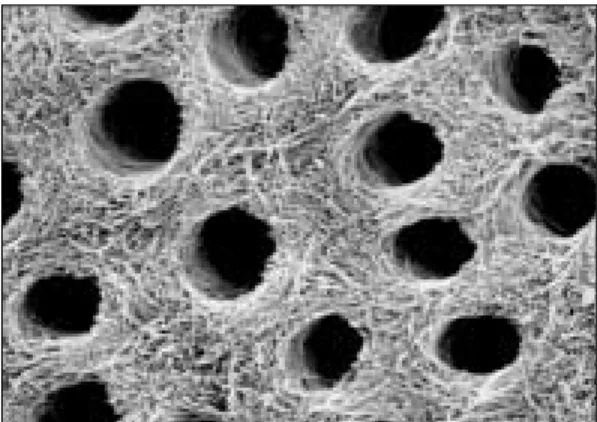
Etching on the dentin removes the smear layers, which are the debris from tooth preparation pro- cedure, and opens dentin tubules for the pene- tration of resin tag (Fig. 6). Barkmeier et al.13 showed that 15 seconds etching with 37% phos-
phoric acid produced same bond effect as 60 seconds etching period.
Dentin without moisture after etching shows col- lapsed collagen fibers that interfere with the penetration of adhesive, therefore dried dentin pre- vents the formation of strong hybrid layer. Wet dentin after acid etching, however provide better bond strength due to enhanced structual retentions (Fig. 7). However Iwami et al.14 showed that the bond strength of enamel was not affected by water on the enamel surface.
The adhesive used in this study was One-Step, which is an acetone based adhesive. In systems with acetone based, it has been reported that bond strength of wet dentin was higher than that of dry dentin13.
The bond strength values in this study in gen- eral were different than that of other investigators15. The reason is that the area of bonding site used in this study was 0.04448 cm2, which is smaller than other investigators bonding areas. The shear bond strength is calculated by the force to break divided by bonding surface area. If the bonding area were smaller, then the bonding strength value would be higher. Pecola16et al also compared shear bond strength of resin bonded to teeth with both tapered knife edge and restricted Ultradent testing device and concluded that Fig. 6.After phosphoric acid etching of dentin and
dried(5000 times magnification)
Fig. 7. Wet dentin after phosphoric acid etching(5000 times magnification)
restricted Ultradent testing devices produced higher shear bond strength. The restricted semi- circular edge of the Ultradent test jig distribute the stress to break the cement rod over a large surface area and thus resist higher level of load. Hara17 studied the effect of crosshead speed on shear bond strength and concluded that the slower the crosshead speed, the lower the shear bond strength. It was difficult to set absolute shear bond strength of resin cement bonded to human den- tition to determine good or bad bonding. All bond- ing tests done in this study seemed to exceed the strength of polymerization shrinkage from resin cement. However, further studies are still need- ed to evaluate the bonding between human den- tition and resin cement.
CONCLUSION
The result of the present study shows that shear bond strength of cut enamel represents the highest mean value followed by cut enamel and dentin. There was no statistically difference in bond strength among cut enamel, uncut enamel and dentin.
REFERENCES
1. Horn, H.R., Porcelain laminate veneers bonded to etched enamel. Dental Clinics of North America, 1983;27:671.
2. Rochette, A.L., A ceramic bonded by etched enam- el and resin for fractured incisors. J Prosthet Dent 1975;33 (3);287~293.
3. Lacy, A.M., Laluz, J., Watanabe, L.G., Dellinges, M., Effect of porcelain surface treatment on the bond to composite . J Prosthet Dent 1988;60:288~91.
4. Buonocore, M.G., A simple method of increas- ing the adhesion of acrylic filling material to enamel surface, J Dent Res 1955;34:849-853.
5. Nakabayashi. N., Ashizawa. M., Nakamura. M., Identification of a resin-dentin hybrid layer in vital human dentin created in vivo: durable bond-
ing to vital dentin. Quintessence Int 1992 Feb;23(2);135-141.
6. Van Meerbeek. B., Dhem. A., Goret-Nicaise. M., Braem. M., Lambrechts. P., VanHerle. G., Comparative SEM and TEM examination of the ul- trastructure of the resin-dentin interdiffusion zone. J Dent Res 1993 Feb;72(2):495-501.
7. Kanca, J.III., Improving bond strength through acid etching of dentin and bonding to wet dentin surface. JADA 1992;123:35-42.
8. Jordan, R.E., Suzuki, M., Gwinnett, A.J., Hunter, J.K., Restoration of fractured and hypoplastic incisors by the acid etch resin technique: A three-year re- port, JADA 1977;95: 795-803.
9. Peumans. M., Van Meerbeek. B., Yoshida. Y., Lambrechts. P., Vanherle. G., Porcelain veneers bonded to tooth structure:an ultra-morphological FE-SEM examination of the adhesive interface.
Dent Material 1999;15:105-119.
10. Ripa, L.W., Gwinnett, A.J.,Buonocore, M.G., The prismless outer layer of deciduous and permanent enamel. Arch Oral Biol ;11;41-48.
11. Bozalis, W.G., Marshal, G.W., Cooley, R.O., Mechanical properties and etching of primary tooth enamel, J Dent Child, 1979;46:43-49.
12. Aker, D.A., Aker, J.R., Sorensen, S.E., Effect of method of tooth enamel preparation on the retentive strength of acid etching composite resin, JADA 1979;99:185-189.
13. Berkmeir, W.W., Shaffer, S.E., Gwinnett, J.A., Effect of 15 vs 60 second enamel acid conditioning on adhesive and morphology. Oper Dent 1986;11:111-116.
14. Iwami, Y., Yamamoto,H., Kawai.K., Effect of enamel and dentin surface wetness on shear bond strength of composite, J Prost Dent 1998;80:20- 26.
15. Stacey G.D., A shear stress analysis of the bonding of porcelain veneers to enamel. J Prosthet Dent 1993;70:395-402.
16. Pecola, Nikole., Yaman, Peter., Dennison, Joseph., Herrero. Alberto., Comparison of shear bond strength relative to two testing device. J Prosthet Dent 2002;88:511~515.
17. Hara A.T., Pimenta, L.A., Rodrigues, L.A., Influence of cross-head speed on resin -dentin shear bond strength. Dent Meter 2001;14:319-23.
Reprint request to:
DR.JONG-YEOPLEE
DEPARTMENT OFDENTISTRY KANGBUKSAMSUNG HOSPITAL SUNGKYUNKWANUNIVERSITYSCHOOL OF MEDICINE 108, PYUNG-DONG,JONGRO-GUSEOUL,KOREA110-746 [email protected]