Journal of the Korean Chemical Society 2012, Vol. 56, No. 4
Printed in the Republic of Korea
http://dx.doi.org/10.5012/jkcs.2012.56.4.464
-464-
Synthesis and Hydroxyl Radicals Scavenging Activity of 2-Pyridine-acetyl- N-trimethyl Chitosan Chloride
Rongchun Li*
Department of Chemistry, Dezhou University, Dezhou 253023, China.
*E-mail: [email protected]
(Received February 6, 2012; Accepted June 13, 2012)
ABSTRACT. A novel chitosan derivative with double quaternary ammonium salt—2-pyridine-acetyl-N-trimethyl chitosan chloride (PATMCS) was synthesized and the antioxidant activity of PATMCS against hydroxyl radicals was assessed. The results indicated that PATMCS had potent hydroxyl scavenging activity. The IC50 of PATMCS was 0.13 mg/mL. PATMCS showed 100% scavenging effect at a dose of 0.8 mg/mL which markedly better than that of N-trimethyl chitosan chloride (TMCS). It was confirmed that quaternary chitosan derivatives showed potent antioxidant activity. PATMCS has double qua- ternary ammonium salt structure in the molecules. Therefore, the antioxidant activity of PATMCS was better than TMCS. The above results are theoretically fundamental for further development and making use of chitosan resources to prepare new anti- oxidants.
Key words: Double quaternary chitosan, Synthesis, Antioxidant activity
INTRODUCTION
Chitosan, the deacetylated derivative of chitin, is the second abundant natural polysaccharide found on the earth next to cellulose. As a natural renewable resource, it has attracted people’s attention for a number of unique properties, such as antimicrobial activity, nontoxicity, bio- degradability, as well as its antioxidant activity.1-3 The quaternization of chitosan gave rise to an important deri- vative of chitosan and its bioactivities had been reported.4,5 Guo’s work had proved that the antioxidant activity of chi- tosan and its derivatives should be related to the different forms of nitrogen atom in the molecules of chitosan, and the QCSs had the best antioxidant activity. The increased activity should be attributed to the positive charge density of the nitrogen atom at C-2 in the molecules of QCSs was strengthened after being quaternized.6 To further investi- gate the relationship between antioxidant activity and the charge density of the cation in QCSs, Liu et al. had intro- duced two more powerful electronegative groups, the -CBr3
and -CCl3 groups into the chitosan and synthesized two new kinds of QCSs (TBEDMCS and TCEDMCS). In the molecules of TBEDMCS and TCEDMCS, the nitrogen atoms at C-2 had the most positive charge density due to the strongest electronegative of their substituted elec- tronegative groups. They exhibited the best antioxidant activity which further demonstrated the relationship between the antioxidant activity and the positive density of the chi-
tosan derivative molecules.7
Based on above mentioned results, in this paper, a novel chitosan derivative with double quaternary ammonium salt — 2-pyridine-acetyl-N-trimethyl chitosan chloride (PATMCS) was synthesized. Among various reactive oxygen species, hydroxyl radicals have the strongest chemical activity, which can damage a wide range of essential biomolecules such as amino acids, proteins, and DNA.8 The antioxidant activity of PATMCS against hydroxyl radicals was assessed. PAT- MCS was expected to have potent activity due to the dou- ble quaternary ammonium salt structure in the molecules.
EXPERIMENTAL
Chitosan was purchased from Qingdao Baicheng Bio- chemical Corp. (China). Its degree of deacetylation was 97%, and the viscosity-average molecular weight was 2.0×10⁵. Sodium iodide (NaI) and iodomethane (CH3I) were purchased from the Sigma–Aldrich Chemical Co.
The other reagents were all analytical grades and were used without further purication. The IR spectra were mea- sured on a Jasco-4100 FT-IR spectrometer with KBr disks.
The 13C NMR spectra were recorded on a Bruker AVIII- 500 NMR spectrometer in D2O solvent.
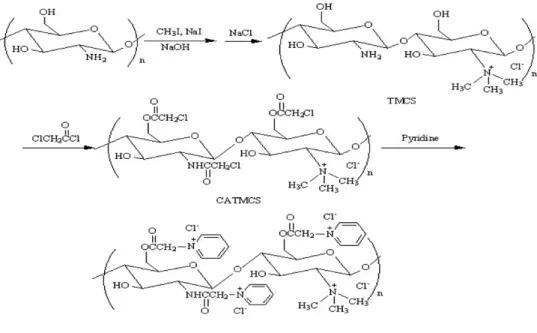
N-trimethyl chitosan chloride (TMCS) was the product of the fourth step prepared according to the method of Snyman via four steps. 9 PATMCS was synthesized as fol- lows: TMCS (0.01 mol) was dispersed in NMP (20 mL)
2012, Vol. 56, No. 4
Synthesis and Hydroxyl Radicals Scavenging Activity of 2-Pyridine-acetyl-N-trimethyl Chitosan Chloride 465
and stirred at room temperature for 2 h, then Chloracetyl chloride (0.02 mol) was added. After stirring for 24 h at room temperature, the solution was precipitated in ether and the precipitate was washed with methanol and ether by turns, the Chloracetyl-N-trimethyl chitosan (CATMCS) was obtained by drying at 40oC in vacuum for 12 h. CAT- MCS (0.3 g) was dissolved in DMSO (20 mL), then pyri- dine (0.5 mL) was added. The solution was stirred for 24 h at 60oC. The product was obtained by precipitation with excess acetone, and the PATMCS was obtained by drying at 40oC in vacuum for 12 h (Scheme 1).
The antioxidant activity was carried out according to Guo.6 The reaction mixture, total volume 4.5 ml, contain- ing the samples of chitosan and its derivatives (chitosan, TMCS, CATMCS and PATMCS), was incubated with EDTA–Fe2+ (220 µM), safranine O (0.23 µM), and H2O2 (60 µM) in potassium phosphate buer (150 mM, pH 7.4) for 30 min at 37oC. The absorbance of the mixture was measured at 520 nm. Hydroxyl radicals bleached the saf- ranine O, so increased absorbance of the reaction mixture indicated increased hydroxyl radicals’ scavenging ability and the capability of scavenging hydroxyl radicals was calculated using the following equation:
Scavengingeffect (%) =
where Ablank520nm was the absorbance of the blank (distilled water instead of the samples), Acontrol520nm is the absor-
bance of the control (distilled water instead of H2O2).
All data are expressed as means ± SD. Data were ana- lyzed by an analysis of variance (P < 0.05) and the means were separated by Student-Newman-Keuls (SNK). The results were processed by the computer programs: Excel and Statistica software (SPSS).
RESULTS AND DISCUSSION
In the FT-IR spectra of chitosan, TMCS, CATMCS and PATMCS (Fig. 1), chitosan was typically characterized by absorption regions as follows:10 the major peaks of chi- tosan at about 898, 1079, 1600 cm-1 belonging to pyranose
Asample520nm–Ablank520nm
( )
Acontrol520nm–Ablank520nm
( )
--- ×100 Scheme 1. Synthetic pathway of PATMCS.
Fig. 1. IR spectra data of chitosan, TMCS, CATMCS and PATMCS.
466 Rongchun Li
Journal of the Korean Chemical Society
ring, glucoside and amine groups, respectively, were iden- tifiable. In the spectrum of TMCS, the characteristic absorption of NH2- at 1600 cm-1 disappeared and a new peak appeared at 1650 cm-1, which was assigned to the quaternary ammonium salt.11 There is a strong new peak at about 1481 cm-1, which was assigned to the characteri- stic absorbance band of the methyl in -N+(CH3)3.12 In the spectrum of CATMCS, new strong peaks at about 1743 cm-1 and 1662 cm-1 appeared which attributed to carbonyl groups C=O of ester group and acylamide respectively.13 The peak at about 787 cm-1 was assigned to C-Cl. After pyridine grafted onto the CATMCS, the characteristic absorbance of C-Cl at about 787 cm-1 disappeared and new peaks at about 1438, 771 and 3027 cm-1 were due to the characteristic absorbance of pyridine appeared in the spectrum of PATMCS.14
The 13C NMR spectrum further confirmed the success preparation of PATMCS (Fig. 2). Except the chitosan backbone peaks, there was strong peak at about 53.9 ppm which attributed to -N+(CH3)3.The peak at about 167.2 ppm was assigned to C=O.13 The peaks at about 145.5, 128.4 and 147.5 ppm were peaks of pyridine.15 At about 38.9 and 58.8 ppm, there were peaks of methylene in -NHCOCH2- and -CH2OCOCH2.16 The spectrum data indicated that PATMCS was obtained.
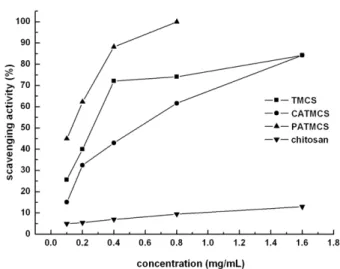
In this paper, the material chitosan was not soluble in water at pH 7. We measured the activity of chitosan by dissolving it in HOAc solution. All the prepared chitosan derivatives were water-soluble. In Fig. 3, we compared the antioxidant activity of chitosan and its derivatives, TMCS, CATMCS and PATMCS. The hydroxyl radicals, generated by the Fenton reaction in this system, were scavenged by chitosan and the derivatives. All the sam- ples exhibited concentration-dependent ·OH elimination effect. All of the three derivatives had better ·OH sca- venging activity than chitosan. CATMCS exhibited worse
·OH scavenging activity than that of TMCS due to the reduced contents of the active hydroxyl and amino groups in the molecule chains.17 PATMCS had the best ·OH sca-
venging activity. The IC50 value, which means the antioxi- dant concentration to reduce the ·OH by 50%, is a good parameter to evaluate the antioxidant ability. The IC50 of TMCS and PATMCS was 0.26 and 0.13 mg/mL, respec- tively. The scavenging effect of PATMCS was 100% at the concentration of 0.8 mg/mL. However, for TMCS, the scavenging effect was merely 84.5% at the concentration of 1.6 mg/mL. Obviously, PATMCS improved the anti- oxidant activity of TMCS greatly.
CONCLUSION
TMCS is a good substance for research of N-substituted quaternary chitosan with good water-solubility, easy-prepara- tion and positive electricity of the molecules. In this paper, TMCS was further modified and a new double quaternary ammonium salt derivative of chitosan, PATMCS, was pre- pared. PATMCS exhibited potent antioxidant activity which may due to its double quaternary ammonium salt structure. The results are theoretical foundation for fur- ther development and making use of chitosan to prepare new antioxidants.
Acknowledgments. This work was supported by key technology research and development programme of Shandong Province (2007GG2QT06020). Thanks for the financial support by the foundation of national natural sci- ence (21046003). Thanks for the financial support by the foundation of national natural science (20774011). Thanks for the financial support by the talent introduction pro- gramme of Dezhou University (402110).
Fig. 2. 13C NMR spectra of PATMCS.
Fig. 3. Scavenging effect of chitosan, TMCS, CATMCS and PATMCS on hydroxyl radicals. Values are means ± SD (n=3).
2012, Vol. 56, No. 4
Synthesis and Hydroxyl Radicals Scavenging Activity of 2-Pyridine-acetyl-N-trimethyl Chitosan Chloride 467
REFERENCES
1. Lim, S. H.; Hudson, S. M. Carbohydr. Res. 2004, 39, 313.
2. Krajewska, B. Sep. Purif. Technol. 2005, 41, 305.
3. Kim, K. W.; Thomas, R. L. Food Chem. 2007, 101, 308.
4. Muzzarelli, R. A. A.; Tanfani, F. Carbohydr. Polym.
1985, 5, 297.
5. Domard, A.; Rinaudo, M.; Terrassin, C. International Jour- nal of Biological Macromolecules 1986, 8, 105.
6. Guo, Z.; Liu, H.; Chen, X.; Ji, X.; Li, P. Bioorg. Med.
Chem. Lett. 2006, 16, 6348.
7. Liu, J.; Sun, H.; Dong, F.; Xue, Q.; Wang, G.; Qin, S.;
Guo, Z. Carbohydr. Polym. 2009,78, 439.
8. Halliwell, B.; Gutteridge, J. M. C. Methods Enzymol. 1990, 86, 1.
9. Snyman, D.; Hanmman, J. H.; Kotze, J. S.; Rollings J. E.;
Kotzé, A. F. Carbohydr. Polym. 2002, 50, 145.
10. Britto, D.; Assis, O. B. G. International Journal of Biolog- ical Macromolecules 2007, 41, 198.
11. Jia, Z.; Shen, D.; Xu, W. Carbohydr. Res. 2001, 333, 1.
12. Liu, Z. R.; Zhao, J. X. Journal of Qingdao University of Science and Technology 2006, 27, 317.
13. Baumann, H.; Faust, V. Carbohydr. Res. 2001, 331, 43.
14. Panicker, C. Y.; Varghese, H. T.; Philip, D.; Nogueira, H.
I. S. Spectrochim. Acta, Part A 2006, 64, 744.
15. Chruszcz, K.; Barañska, M.; Czarniecki, K.; Boduszek, B.; Proniewicz, L. M. J. Mol. Struct. 2003, 648, 215.
16. Heras, A.; Rodríguez, N. M.; Ramos, V. M.; Agullü, E.
Carbohydr. Polym. 2001, 44, 1.
17. Guo, Z.; Xing, R.; Liu, S.; Yu, H.; Wang, P.; Li C.; Li, P.
Bioorg. Med. Chem. Lett. 2005, 15, 4600.