© 2012 Korean Breast Cancer Society. All rights reserved. http://ejbc.kr | pISSN 1738-6756
INTRODUCTION
A family history of cancer is a predisposing factor for other primary cancers. For example, familial breast cancer and hereditary nonpolyposis colorectal cancer are associated with increased risk of pancreatic cancer [1-4]. The positive associa- tion between a family history of pancreatic cancer and risk of lymphoma and ovarian cancer is another example [5]. Since BRCA1 and BRCA2 are involved in pathways that regulate
DNA repair, cell-cycle progression, and apoptosis, mutations of the genes predispose to breast, ovarian, and other primary cancers such as pancreatic, stomach, biliary tract, and prostate cancer [6-9]. Familial cancers other than breast or ovary are also associated with mutations of BRCA1 or BRCA2 [10-12].
BRCA1 or BRCA2 mutations contribute to the earlier onset of breast cancer [13-15]. A higher prevalence of mutation is also observed in patients with a family history of breast or ovarian cancer, male breast cancer, and bilateral breast cancer [16-18]. A comparative study of population differences in the prevalence of BRCA mutation showed nearly identical frequen- cies of deleterious mutation across populations, but deleterious mutations were associated with higher risk of secondary malignancies [19].
Taken together, BRCA mutations influence the development of second primary cancers other than breast or ovary cancer.
This effect was observed in patients with mutations or in family members of probands. The risk factors mentioned above are related to a higher mutation incidence. In Korea, previous
Associations between BRCA Mutations in High-Risk Breast Cancer Patients and Familial Cancers Other than Breast or Ovary
Jae Myoung Noh, Doo Ho Choi, Hyejin Baek1, Seok Jin Nam2, Jeong Eon Lee2, Jong Won Kim3, Chang-Seok Ki3, Won Park, Seung Jae Huh1
Departments of Radiation Oncology, 1Nursing, Breast Cancer Center, 2Surgery, and 3Laboratory Medicine and Genetics, Samsung Medical Center, Sungkyunkwan University School of Medicine, Seoul, Korea
ORIGINAL ARTICLE
Purpose: We investigated the relationship between BRCA mutations and the distribution of familial cancers other than breast or ovary in high-risk breast cancer patients. Methods: Patients with breast cancer who had at least one of the following risk factors were enrolled: reported family history of breast or ovarian cancer;
40 years of age or younger age at diagnosis; bilateral breast cancer; or male gender. Genetic testing for BRCA mutation and questionnaires about personal and family histories of malignancies were performed. Results: Among the 238 eligible patients, 49 (20.6%) patients had BRCA1/2 mutations, which were more frequent in patients with multiple risk factors (p<0.0001). There were 271 members of 156 (65.5%) families who had histories of other primary cancer. The distribution of the families was 119 (63.0%) and 37 (75.5%) in the BRCA-negative and positive group, respectively (p=0.0996). Multiple familial cancers occurred
in 70 families, which were significantly more frequent in BRCA- positive families (p=0.0034). By ordinal logistic regression, the occurrence of multiple familial cancers was associated with BRCA mutations (p=0.0045), not with other risk factors. The most common site of disease was the stomach, which is the most common in nationwide. And the proportional incidence of pancreatic cancer (6.8%) was significantly higher than that of nationwide cancer statistics (2.4%, p=0.0137). Conclusion: BRCA mutations in high-risk breast cancer patients were associated with multiple risk factors and multiple family members with other primary cancers. Genetic counseling based on accurate information should be provided to families with BRCA mutation carriers.
Key Words: Breast neoplasms, BRCA1, BRCA2, Familial cancer
Correspondence: Doo Ho Choi
Department of Radiation Oncology, Samsung Medical Center, Sungkyunkwan University School of Medicine, 81 Irwon-ro, Gangnam-gu, Seoul 135-710, Korea
Tel: +82-2-3410-2644, Fax: +82-2-3410-2619 E-mail: [email protected]
This study was partly supported by Samsung Biomedical Research Institute grant, #SBRI C-B1-132-1, which contributed to genetic testing for BRCA mutations.
Received: February 26, 2012 Accepted: May 28, 2012
Cancer
studies have been confined to show the relationships between BRCA mutation and the risk factors. One study showed a higher risk of secondary malignancies among patients with deleterious mutation [19], but the relationship between BRCA mutation and other primary cancers in family members has not been investigated. In this study, we conducted BRCA genetic testing in breast cancer patients with risk factors for carrying mutations. We then analyzed the relationships between mutations and prevalence of other primary cancers in family members including probands.
METHODS
From April 2008 to May 2011, a total of 272 patients were enrolled at a single institute, the Samsung Medical Center.
Patients with breast cancer who carried at least one of the following risk factors were included: reported family history of breast or ovarian cancer at any age; 40 years or younger at diagnosis; bilateral breast cancer; or male gender. The members of the family included first- and second-degree relatives, first cousins, and the probands themselves. After informed consent was acquired, genetic counseling was primarily focused on personal and family history of all cancers. The familial pedigree was organized from the information by a research nurse. If any member had a history of cancer other than breast or ovary, the family was regarded as positive for other primary cancer.
After excluding 34 patients who refused to participate in the study or provided insufficient information, the number of eligible patients was 238.
BRCA mutation analysis was performed at the Department of Laboratory Medicine and Genetics, Samsung Medical Center. Genomic DNA was extracted and purified from peripheral blood leukocytes. The whole exons and their flank- ing intrinsic sequences of the BRCA1/2 genes were amplified by polymerase chain reaction. The amplified products were directly sequenced and the sequences were compared with reference sequences using Sequencher software (Gene Codes Co., Ann Arbor, USA). The genetic mutations analyzed were confined to deleterious mutations such as frameshift or non- sense mutation in accordance with the breast cancer informa- tion core (BIC) database (http://research.nhgri.nih.gov/bic).
And variants of unknown significance were excluded. Genetic testing of high risk breast cancer patients was approved by the Institutional Review Board of Samsung Medical Center (2010- 09-006-001).
Fisher’s exact or chi-square tests were used to analyze the relationships between the distributions of risk factors and BRCA mutation. These tests were also used to assess the rela- tionships between the family history of other primary cancers
and BRCA mutations. To identify factors associated with family history of other primary cancer, an ordinal logistic regression analysis was applied including BRCA mutations and risk factors for the inclusion criteria. SAS software (SAS 9.1.3; SAS Institute Inc., Cary, USA) was used for statistical analysis.
Probability values less than 0.05 were considered statistically significant.
RESULTS
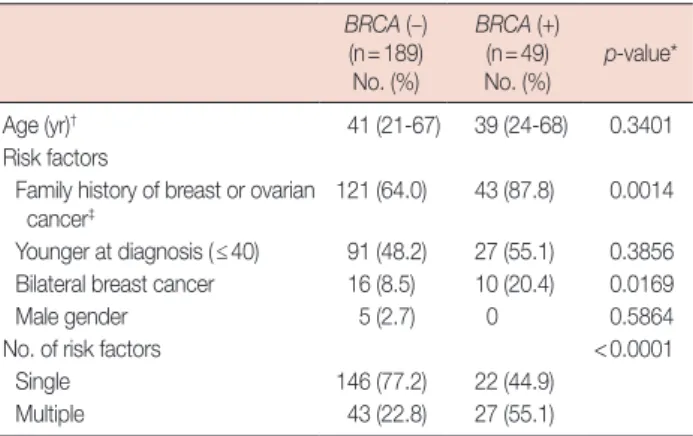
The median age of the 238 eligible patients was 41 years (range, 21-68 years). BRCA mutations were detected in 49 (20.6%) of the patients, while variants of unknown significance were detected in 13 (5.5%) patients. BRCA1 and BRCA2 mutations were detected in 23 (9.7%) and 25 (10.5%) patients, respectively. One patient, the subject of a recent case report, had mutations in both BRCA1 and BRCA2 [20]. The distribu- tions of risk factors according to BRCA mutation status are presented in Table 1. The BRCA-positive group had a higher frequency of family history and bilateral breast cancer. There were 27 (55.1%) patients who had two or more risk factors in the BRCA-positive group, while 43 (22.8%) patients had multiple risk factors in the BRCA-negative group (p<0.0001).
There were 271 members of 156 (65.5%) families who had histories of cancer other than breast or ovary. The familial pedigree of a representative patient who had two risk factors, family history of breast cancer and younger age at diagnosis, is shown in Figure 1. There were two family members who had histories of other cancers, thyroid and uterus. The members with breast or other cancer had BRCA1 mutations revealed by genetic testing. The mother of the sibling also had the mutation.
Table 1. Distributions of age and risk factors according to BRCA muta- tion status
BRCA (−) (n=189)
No. (%)
BRCA (+) (n=49)
No. (%) p-value*
Age (yr)† 41 (21-67) 39 (24-68) 0.3401
Risk factors
Family history of breast or ovarian
cancer‡ 121 (64.0) 43 (87.8) 0.0014
Younger at diagnosis (≤40) 91 (48.2) 27 (55.1) 0.3856 Bilateral breast cancer 16 (8.5) 10 (20.4) 0.0169
Male gender 5 (2.7) 0 0.5864
No. of risk factors <0.0001
Single 146 (77.2) 22 (44.9)
Multiple 43 (22.8) 27 (55.1)
The relationships between the distributions of risk factors and BRCA mutation were examined by chi-square test except for male gender, which by Fisher’s exact test.
*The t-test was applied for comparing the distribution of age; †Median age (range); ‡First- and second-degree relatives, first cousins.
Among the 156 patients with family history of other primary cancer, 37 (23.7%) patients had BRCA mutation. It was detected in 12 (14.6%) of the 82 patients without family history (p=
0.0996). Multiple cases in a single family occurred in 70 families.
Among them, 24 (34.3%) were families of the BRCA-positive patients, which was significantly more frequent than expected by chi-square test (p=0.0996) (Table 2). By ordinal logistic regression, the occurrence of multiple other primary cancers was associated with BRCA mutations, not with other risk factors (Table 3).
The most common site of other primary cancer was the stomach, which corresponds with research findings that stom- ach cancer is the most common cancer in Korea [21]. In the
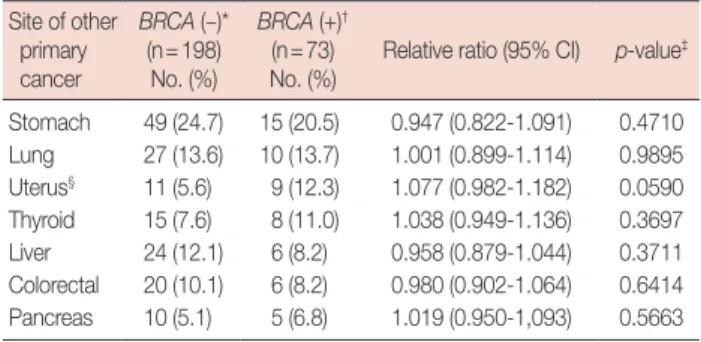
BRCA-positive group, the proportional incidence of uterine cancer was 12.3%, which was relatively higher than that of the BRCA-negative group (5.6%, p=0.0590) (Table 4).
DISCUSSION
In this study, we described the patterns of familial cancers other than breast or ovary of patients with high risk breast cancer. Among the 238 eligible patients, 156 (65.5%) patients had a total of 271 familial cancers. BRCA mutation was detected in 49 (20.6%) patients, which was more prevalent in patients who had family history of other primary cancers (37 patients, 23.7%, p=0.0996). Seventy patients had multiple familial cancers. BRCA mutation was also detected prevalently in patients with multiple familial cancers (24 patients, 34.3%, p=0.0034). Ordinal logistic regression analysis supported the finding that BRCA mutation was significantly associated with Table 2. Distributions of families according to numbers of members
having other primary cancers No. of members having other
primary cancers BRCA (−)
No. (%) BRCA (+)
No. (%) p-value
0 70 (85.4) 12 (14.6)
1 73 (84.9) 13 (15.1) 0.0034*
2 or more 46 (65.7) 24 (34.3)
*Examined by chi-square test.
Breast 35 BRCA1+
Thyroid 46 BRCA1+
Uterus 33 BRCA1+
Breast 37 Breast ?
BRCA1+
BRCA1+
BRCA - BRCA - BRCA -
Breast cancer Other cancer Proband
Figure 1. The familial pedigree of a representative patient with two risk factors. Two family members had histories of cancer other than breast or ovary.
Table 3. Ordinal logistic regression analysis for the distributions of other primary cancers
Response=No. of members having other
primary cancers (0 vs. single vs. multiple) p-value Odds ratio (95% CI) Variables
Family history of breast or ovarian cancer 0.7863 1.096 (0.566-2.120) Younger at diagnosis (≤40) 0.7486 0.908 (0.504-1.635) Bilateral breast cancer 0.9589 1.021 (0.466-2.238)
Male gender 0.3882 2.190 (0.369-12.998)
BRCA mutation 0.0045 2.493 (1.328-4.681)
CI=confidence interval.
Table 4. Distributions of frequently occurring familial cancers of patients according to BRCA mutation
Site of other primary cancer
BRCA (−)*
(n=198) No. (%)
BRCA (+)† (n=73)
No. (%) Relative ratio (95% CI) p-value‡ Stomach 49 (24.7) 15 (20.5) 0.947 (0.822-1.091) 0.4710 Lung 27 (13.6) 10 (13.7) 1.001 (0.899-1.114) 0.9895 Uterus§ 11 (5.6) 9 (12.3) 1.077 (0.982-1.182) 0.0590 Thyroid 15 (7.6) 8 (11.0) 1.038 (0.949-1.136) 0.3697 Liver 24 (12.1) 6 (8.2) 0.958 (0.879-1.044) 0.3711 Colorectal 20 (10.1) 6 (8.2) 0.980 (0.902-1.064) 0.6414 Pancreas 10 (5.1) 5 (6.8) 1.019 (0.950-1,093) 0.5663 CI=confidence interval.
*Remaining 42 cases include head & neck, hematologic, brain, skin, biliary, esophageal, and prostatic cancer; †Remaining 14 cases include esophageal, head & neck, prostatic, brain, hematologic, and biliary cancer; ‡Tested by the Cochran-Mantel-Haenszel test; §Includes body and cervix.
multiple familial cancers (p=0.0045).
The most prevalent other primary cancer was stomach cancer, which is the most common cancer in Korea [21].
According to the cancer statistics of Korea, 15.7% of all cancer was stomach cancer. In this study, stomach cancer accounted for 24.7% and 20.5% of BRCA-negative and positive group, respectively. But the difference of the proportional incidence was not statistically significant. Unlike the Korean characteris- tics, stomach cancer is the fourth most common malignancy in worldwide after lung, breast, and colorectal cancer [22,23].
In contrast, non-melanoma skin cancer which is relatively prevalent in Western families with BRCA mutation was rare in this study [11,24].
Pancreatic cancer showed the most distinctive difference from nationwide statistics. The proportional incidence was 6.8% and 2.4% in this study and nationwide, respectively (p=
0.0137). The risk of pancreatic cancer has been known to be higher among carriers of BRCA mutations [7,8]. And pancreatic cancer has been shown to the third most common cancer associated with BRCA mutation [25]. BRCA mutations as a predisposing factor for the development of pancreatic cancer may have contributed to the results of this study [10,12]. In addition to BRCA mutations, several environmental, biological, and genetic factors might contribute to the distribution of familial cancers. It may be affected in part by the distributions of cancer nationwide, and also expected to be influenced by cancer susceptibility from the BRCA mutation.
In the Korean population, there are several distinctive features in regard to breast cancer. The first is younger age at onset of breast cancer than in other populations [26,27]. However, the incidence of BRCA mutations does not differ from that of other racial groups [19]. Although there had been no known founder mutation, the BRCA2 c.7480C>T mutation (7708C>
T according to the BIC nomenclature) has been suggested as candidate for the founder mutation in Korea [18,28,29]. Several studies have dealt with BRCA mutations in Korean breast cancer patients, but they have been confined to prevalence of BRCA mutations or relationships with risk factors. In high-risk patients, the frequency of BRCA mutations varied from 8.3 to 25% according to the risk factors, which was comparable to that of this study (20.6%) [18,29]. Although the relationship between BRCA mutations and secondary malignancies was previously investigated [19], the relationship between the mutations and familial malignancies has not been studied yet in Korea. Because BRCA1/2 mutation testing in Korean popu- lation is still not common, recruitment of more family members of carriers needs to provide more information about second primary malignancies associated with in family members of BRCA mutation carriers. The Korean Hereditary Breast Can-
cer (KOHBRA) study, a nationwide, multicenter study is expected to provide the answer [29]. In the absence of such information, the results of our study suggest such an association from one of the biggest general hospitals in Korea that has nationwide coverage of patients.
Future directions require a focus on providing optimal genetic counseling and testing for family members. According to the National Comprehensive Cancer Network’s (NCCN) guideline for genetic/familial high-risk assessment: breast and ovarian, genetic counseling is highly recommended when an individual has one or more of the following factors: early age onset breast cancer, triple negative breast cancer, two incidences of breast cancer in a single individual, male breast cancer, and personal/familial history of pancreatic cancer with familial/
personal history of breast and/or ovarian cancer [30]. When the hereditary breast and/or ovarian cancer syndrome testing criteria are met, genetic testing for BRCA1/2 and screening for breast and ovarian cancer should be considered. In addition, a full body skin examination for melanoma and investigational protocols for pancreatic cancer might be considered for other cancer screening. Possible inherited cancer risk to relatives, options for risk assessment, and management should be advised.
In conclusion, BRCA mutations were associated with having multiple risk factors in patients with high risk breast cancer. In the BRCA-positive group, primary cancers of family members were found in pancreas and uterus at higher than nationwide reported incidences. Occurrence of multiple familial cancers was associated with BRCA mutation, and not with other risk factors. Tailored genetic counseling based on precise information should be provided to families with BRCA mutation carriers.
CONFLICT OF INTEREST
The authors declare that they have no conflicts of interest.
REFERENCES
1. Lynch HT, Voorhees GJ, Lanspa SJ, McGreevy PS, Lynch JF. Pancreatic carcinoma and hereditary nonpolyposis colorectal cancer: a family study. Br J Cancer 1985;52:271-3.
2. Tulinius H, Olafsdottir GH, Sigvaldason H, Tryggvadottir L, Bjarnadot- tir K. Neoplastic diseases in families of breast cancer patients. J Med Genet 1994;31:618-21.
3. Silverman DT, Schiffman M, Everhart J, Goldstein A, Lillemoe KD, Swanson GM, et al. Diabetes mellitus, other medical conditions and fa- milial history of cancer as risk factors for pancreatic cancer. Br J Cancer 1999;80:1830-7.
4. Schenk M, Schwartz AG, O’Neal E, Kinnard M, Greenson JK, Fryzek JP, et al. Familial risk of pancreatic cancer. J Natl Cancer Inst 2001;93:
640-4.
5. Cote ML, Schenk M, Schwartz AG, Vigneau FD, Kinnard M, Greenson JK, et al. Risk of other cancers in individuals with a family history of pancreas cancer. J Gastrointest Cancer 2007;38:119-26.
6. Ford D, Easton DF, Bishop DT, Narod SA, Goldgar DE. Risks of cancer in BRCA1-mutation carriers. Breast Cancer Linkage Consortium. Lan- cet 1994;343:692-5.
7. Easton DF. Cancer risks in BRCA2 mutation carriers. The Breast Can- cer Linkage Consortium. J Natl Cancer Inst 1999;91:1310-6.
8. Thompson D, Easton DF. Cancer Incidence in BRCA1 mutation carri- ers. J Natl Cancer Inst 2002;94:1358-65.
9. Friedenson B. BRCA1 and BRCA2 pathways and the risk of cancers other than breast or ovarian. MedGenMed 2005;7:60.
10. Lal G, Liu G, Schmocker B, Kaurah P, Ozcelik H, Narod SA, et al. Inher- ited predisposition to pancreatic adenocarcinoma: role of family history and germ-line p16, BRCA1, and BRCA2 mutations. Cancer Res 2000;
60:409-16.
11. Shih HA, Nathanson KL, Seal S, Collins N, Stratton MR, Rebbeck TR, et al. BRCA1 and BRCA2 mutations in breast cancer families with mul- tiple primary cancers. Clin Cancer Res 2000;6:4259-64.
12. Hahn SA, Greenhalf B, Ellis I, Sina-Frey M, Rieder H, Korte B, et al.
BRCA2 germline mutations in familial pancreatic carcinoma. J Natl Cancer Inst 2003;95:214-21.
13. Miki Y, Swensen J, Shattuck-Eidens D, Futreal PA, Harshman K, Tavti- gian S, et al. A strong candidate for the breast and ovarian cancer sus- ceptibility gene BRCA1. Science 1994;266:66-71.
14. Ford D, Easton DF, Peto J. Estimates of the gene frequency of BRCA1 and its contribution to breast and ovarian cancer incidence. Am J Hum Genet 1995;57:1457-62.
15. Wooster R, Bignell G, Lancaster J, Swift S, Seal S, Mangion J, et al. Iden- tification of the breast cancer susceptibility gene BRCA2. Nature 1995;
378:789-92.
16. Loman N, Johannsson O, Kristoffersson U, Olsson H, Borg A. Family history of breast and ovarian cancers and BRCA1 and BRCA2 muta- tions in a population-based series of early-onset breast cancer. J Natl Cancer Inst 2001;93:1215-23.
17. Frank TS, Deffenbaugh AM, Reid JE, Hulick M, Ward BE, Lingenfelter B, et al. Clinical characteristics of individuals with germline mutations in BRCA1 and BRCA2: analysis of 10,000 individuals. J Clin Oncol 2002;20:1480-90.
18. Ahn SH, Son BH, Yoon KS, Noh DY, Han W, Kim SW, et al. BRCA1 and BRCA2 germline mutations in Korean breast cancer patients at
high risk of carrying mutations. Cancer Lett 2007;245:90-5.
19. Haffty BG, Choi DH, Goyal S, Silber A, Ranieri K, Matloff E, et al. Breast cancer in young women (YBC): prevalence of BRCA1/2 mutations and risk of secondary malignancies across diverse racial groups. Ann Oncol 2009;20:1653-9.
20. Noh JM, Choi DH, Nam SJ, Lee JE, Kim JW, Kim SW, et al. Characteris- tics of double heterozygosity for BRCA1 and BRCA2 germline muta- tions in Korean breast cancer patients. Breast Cancer Res Treat 2012;131:
217-22.
21. Ministry of Health and Welfare. Cancer Incidence in Korea 2008. Min- istry of Health and Welfare; Republic of Korea, 2010.
22. Ferlay J, Shin HR, Bray F, Forman D, Mathers C, Parkin DM. Estimates of worldwide burden of cancer in 2008: GLOBOCAN 2008. Int J Can- cer 2010;127:2893-917.
23. Kamangar F, Dores GM, Anderson WF. Patterns of cancer incidence, mortality, and prevalence across five continents: defining priorities to reduce cancer disparities in different geographic regions of the world. J Clin Oncol 2006;24:2137-50.
24. Ginsburg OM, Kim-Sing C, Foulkes WD, Ghadirian P, Lynch HT, Sun P, et al. BRCA1 and BRCA2 families and the risk of skin cancer. Fam Can- cer 2010;9:489-93.
25. Greer JB, Whitcomb DC. Role of BRCA1 and BRCA2 mutations in pancreatic cancer. Gut 2007;56:601-5.
26. Ahn SH, Yoo KY. Chronological changes of clinical characteristics in 31,115 new breast cancer patients among Koreans during 1996-2004.
Breast Cancer Res Treat 2006;99:209-14.
27. Son BH, Ahn SH, Lee MH, Park SK, Kim SW, Korean Breast Cancer Society. Hereditary breast cancer in Korea: a review of the literature. J Breast Cancer 2008;11:1-9.
28. Seong MW, Cho SI, Noh DY, Han W, Kim SW, Park CM, et al. Compre- hensive mutational analysis of BRCA1/BRCA2 for Korean breast can- cer patients: evidence of a founder mutation. Clin Genet 2009;76:152- 60.
29. Han SA, Park SK, Ahn SH, Lee MH, Noh DY, Kim LS, et al. The Korean Hereditary Breast Cancer (KOHBRA) study: protocols and interim re- port. Clin Oncol (R Coll Radiol) 2011;23:434-44.
30. NCCN Clinical Practice Guidelines in Oncology; Genetic/Familial High-Risk Assessment: Breast and Ovarian - v.1.2011. National Com- prehensive Cancer Network. http://www.nccn.org/professionals/physi- cian_gls/pdf/genetics_screening.pdf. Accessed March 15th, 2012.