http://dx.doi.org/10.3988/jcn.2013.9.1.51 J Clin Neurol 2012;9:51-56
The Effect of Ropinirole on the Quality of Life in Patients
with Restless Legs Syndrome in Korea: An 8-Week, Multicenter, Prospective Study
Yong Won Cho,a,i,* Seung Bong Hong,b,i,* Do Hyung Kim,a,i Ho Won Lee,c,i Eun Yeon Joo,c,i Jee Hyun Kim,d,i Won Chul Shin,e,i Kee Hyung Park,f,i Sun Jung Han,g,i Hyang Woon Leeh,i
aDepartment of Neurology, Dongsan Medical Center, Keimyung University School of Medicine, Daegu, Korea
bDepartment of Neurology, Samsung Medical Center, Sungkyunkwan University School of Medicine, Seoul, Korea
cDepartment of Neurology, Kyungpook National University School of Medicine, Daegu, Korea
dDepartment of Neurology, Dankook University Medical College, Cheonan, Korea
eDepartment of Neurology, Kyung Hee University School of Medicine, Seoul, Korea
fDepartment of Neurology, Gil Medical Center, Gachon University of Medicine and Science, Incheon, Korea
gDepartment of Neurology, Inam Neuroscience Research Center, Sanbon Medical Center, Wonkwang University, Gunpo, Korea
hDepartment of Neurology, Ewha Womans University School of Medicine and Ewha Medical Research Institute, Seoul, Korea
iKorean Sleep Research Society, Seoul, Korea
Received March 11, 2012 Revised May 29, 2012 Accepted May 29, 2012 Correspondence Yong Won Cho, MD Department of Neurology, Dongsan Medical Center, Keimyung University School of Medicine, 56 Dalseong-ro, Jung-gu, Daegu 700-712, Korea Tel +82-53-250-7831 Fax +82-53-250-7840 E-mail [email protected]
Correspondence Ho Won Lee, MD Department of Neurology, Kyungpook National University School of Medicine,
680 Gukchaebosang-ro, Jung-gu, Daegu 700-842, Korea Tel +82-53-420-5768 Fax +82-53-422-4265 E-mail [email protected]
*Two first authors contributed equally to this work.
Background and PurposezzDopamine agonists are first-line drugs for treating the symptoms of restless legs syndrome (RLS). However, few studies have investigated the effect of dopa- mine agonists on the quality of life (QoL) in RLS patients. We conducted a study to determine whether ropinirole exerts positive effects on the QoL in RLS patients and to analyze the under- lying factors.
MethodszzPrimary RLS patients from eight medical centers were recruited in the study. They were evaluated in the baseline phase using various questionnaires including the Korean ver- sions of the International Restless Legs Scale (K-IRLS), RLS QoL questionnaire (K-RLSQoL), and the Short Form 36 Health Survey (SF-36). After taking ropinirole for 8 weeks the same questionnaires were again completed as a re-evaluation. We analyzed the statistical difference using a paired t-test, a Pearson’s correlation, and a stepwise multiple regression in order to identify the factors associated with the QoL change.
ResultszzA total of 107 subjects, including 65 (60.7%) females, completed this study. They were aged 51.68±14.80 years (mean±SD) and had a symptom duration of 8.8±9.0 months. Af- ter treatment with ropinirole, there were significant improvements on the K-RLSQoL, SF-36, and K-IRLS. The Pearson’s correlation analysis showed that the improvement of QoL in RLS patients was significantly correlated with the severity of RLS (r=0.236, p<0.014) at baseline.
ConclusionszzThe results from this study suggest that treatment with ropinirole can improve the QoL in RLS patients. The improvement in the QoL is more related with the improvement
of RLS symptoms. J Clin Neurol 2013;9:51-56
Key Wordszz restless legs syndrome, dopamine agonists, quality of life, sleep.
Open Access
cc This is an Open Access article distributed under the terms of the Creative Commons Attribution Non-Commercial License (http://creativecommons.org/
licenses/by-nc/3.0) which permits unrestricted non-commercial use, distribution, and reproduction in any medium, provided the original work is properly cited.
Introduction
Restless legs syndrome (RLS) is a chronic sensorimotor neu- rological disorder1,2 with a reported prevalence of 3.9-11.5%
in the general population.3-9 It is characterized by leg discom- fort with nocturnal aggravation, and the symptom severity ag- gravates with age.10 Therefore, RLS patients commonly com- plain of both sleep disturbance and somatic symptoms. Due to these clinical characteristics the quality of life (QoL) of RLS patients is worse than that of healthy controls, and even worse than that of patients with chronic medical diseases, such as hy- pertension and type 2 diabetes.3,11
L-dopa has been prescribed for RLS symptoms since Ak- panir reported the effects of L-dopa in RLS.12 However, its strong association with the augmentation of RLS symptoms.13 Thus, there has been an interest in the use of dopamine ago- nists for RLS patients. Ergot-derived dopamine agonists such as pergolide and cabergoline have been shown to improve RLS symptoms,14 but they have potential risks of fibrotic side effects with cardiac valvulopathy.15 The non-ergot-derived dopamine agonists ropinirole and pramipexole are not associated with such complications, which have made them the first-line treat- ment of RLS.16
Ropinirole exhibits a high affinity for D2 and D3 receptors, and controls nigrostriatal and mesolimbic-mesocortical dopa- minergic activity.17 Clinical trials have shown that ropinirole significantly improves symptoms of RLS,18,19 producing scores on the mean International Restless Legs Scale (IRLS) that are 29-37% lower than those in placebo groups, and reducing peri- odic limb movements during sleep relative to baseline or place- bo.20 Furthermore, ropinirole significantly improved the QoL in RLS patients compared to placebos. However, the effects on the QoL in RLS patients have not been fully elucidated, and all of these studies were performed only in Western countries.18-21
The purpose of this study was to elucidate the effect of rop- inirole on the QoL in Korean patients with RLS and the under- lying factors.
Methods
This was a multicenter, national trial lasting 8 weeks that was conducted in eight university hospitals in Korea. We enrolled all consecutive primary RLS patients over 18 years old who consented to participate in the study. RLS was diagnosed by neurologists based on diagnostic standards set by the National Institutes of Health workshop on RLS during face-to-face in- terviews using the validated Korean-language version of the John Hopkins Telephone Diagnostic Questionnaire.1,22 After excluding any mimic diseases through a direct physical exam- ination and laboratory tests, the remaining patients were diag-
nosed with RLS. All patients had a score of at least 15 on the Korean version of the IRLS (K-IRLS) at baseline.23 We exclud- ed other comorbid sleep disorders through analysis of sleep questionnaires, comorbidities to RLS, or secondary RLS ca- used by pregnancy or by other diseases such as chronic kidney disease, peripheral polyneuropathy, and iron-deficiency ane- mia. However, subjects with only peripheral iron deficiency without definite cause were included.
Patients received ropinirole once daily at 2 hours before bed- time, with treatment starting at a dose of 0.25 mg. The dose was then titrated upwards over 4 weeks until they were judged to have reached their optimal dose or until they were receiving the maximum dosage (4.0 mg/day). Down-titration was al- lowed during the titration period if patients experienced ad- verse events. Patients were maintained on a constant dose of ropinirole from weeks 4 to 8. We assessed adverse effects of ropinirole and regularly checked blood pressure, heart rate, and vital signs whenever they visited a clinic.
QoL was evaluated based on two questionnaires: the Kore- an version of the RLS QoL questionnaire (K-RLSQoL) and the Short Form 36 Health Survey (SF-36).22,24 The K-RLSQoL is a validated translated version of the RLS QoL questionnaire.
Scores are from 0 to 100 points, with a lower score indicating a worse QoL. The SF-36 health questionnaire is currently a widely used tool to assess health-related QoL that also has been validated.24 It comprises eight domains: physical function, role limitations due to physical problems, bodily pain, general health, vitality, social functioning, role limitations due to emo- tional problems, and mental health. Scores are from 0 to 100 points, with a lower score indicating a worse QoL. The symp- tom severity was measured using the K-IRLS.23 We also eval- uated the sleep quality and mood based on the Korean version of the Pittsburg Sleep Quality Index (PSQI-K),25 the Insomnia Severity Index, the Korean version of the Epworth Sleepiness Scale,26 the Hospital Anxiety Scale,27 and the Beck Depression Inventory-2 (BDI-2),28 in addition to the demographic vari- ables. Most of the questionnaires used in this study underwent a validation process involving Korean populations, and they were completed at baseline and at week 8. The patients were divided into two groups, responders and nonresponders, based on whether or not the K-IRLS score had decreased at week 8, respectively. During the survey, research coordinators who re- ceived training were available to help subjects who experi- enced difficulty completing the questionnaires. The study was approved by the institutional ethics committee at each univer- sity hospital.
Statistical analysis
Continuous and categorical variables are presented as mean±
SD and frequency values, respectively. The significance of the
QoL and other scale changes between the baseline and after treatment were analyzed using the paired t-test. Correlations between QoL score changes and related factors, such as age, age at symptom onset, symptom duration, RLS severity, sleep quality, insomnia severity, and depression, were assessed us- ing Pearson’s correlation. Stepwise multiple regression analy- sis was used to select the significant predictors for the QoL changes in RLS patients, and at each step independent vari- ables were entered if there were factors significantly correlat- ed with the QoL. Differences in QoL changes between the baseline and after treatment were tested by analysis of covari- ance using baseline scores as covariates. Statistical analyses were performed using the statistical software package SPSS
19.0 for Windows. A probability value of p<0.05 was consid- ered indicative of statistical significance.
Results
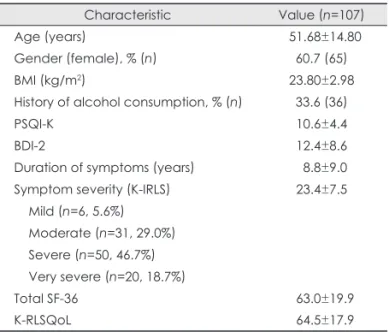
One hundred and seven RLS patients were enrolled; their age was 51.68±14.80 years (range 19-75 years), and 65 (60.7%) were female. The demographic and clinical characteristics of RLS patients are listed in Table 1. The score for RLS symptom severity was 23.4±7.5, and the duration of symptoms was 8.8±
9.0 years. The distribution of RLS symptom severity was as follows: 6 (5.6%) mild, 31 (29.0%) moderate, 50 (46.7%) se- vere, and 20 (18.7%) very severe; age and sex did not differ significantly between these four subgroups. The baseline QoL scores were 64.5±17.9 for K-RLSQoL and 63.0±19.9 for total SF-36 (Table 1).
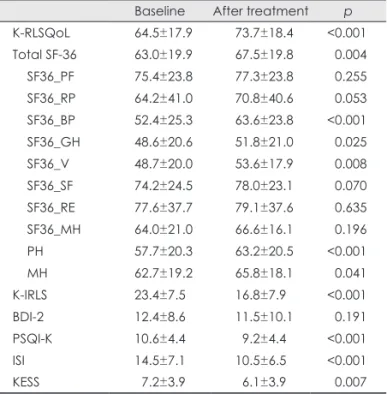
All patients received ropinirole for 4 weeks and maintained a stable dosage for the following 4 weeks. The QoL of RLS patients was significantly improved after 8 weeks of ropinirole treatment, as measured by the K-RLSQoL (73.7±18.4 p≤
0.001) and total SF-36 (67.5±19.8, p=0.004) scores. The indi- vidual domains of the SF-36 indicated significant differences between baseline and after treatment in bodily pain (52.4±
25.3 vs. 63.6±23.8, p≤0.001), general health (48.6±20.6 vs.
51.8±21.0, p=0.025), vitality (48.7±20.0 vs. 53.6±17.9, p=
0.008), physical domains (57.7±20.3 vs. 63.2±20.5, p≤0.001), and mental domains (62.7±19.2 vs. 65.8±18.1, p=0.041) (Fig.
1, Table 2). The K-IRLS score was significantly lower after ropinirole treatment (16.8±7.9) than the baseline (23.4±7.5, p≤
0.001). The scores on the sleep-related scales were also im- proved from baseline to after treatment: PSQI-K (10.6±4.4 vs.
9.2±4.4, p≤0.001), Insomnia Severity Index (14.5±7.1 vs.
10.5±6.5, p≤0.001), and Korean version of the Epworth Sleepiness Scale (7.2±3.9 vs. 6.1±3.9, p=0.007); however, the Table 1. Demographic and clinical characteristics of the restless
legs syndrome (RLS) patients
Characteristic Value (n=107)
Age (years) 51.68±14.80
Gender (female), % (n) 60.7 (65)
BMI (kg/m2) 23.80±2.98
History of alcohol consumption, % (n) 33.6 (36)
PSQI-K 10.6±4.4
BDI-2 12.4±8.6
Duration of symptoms (years) 8.8±9.0
Symptom severity (K-IRLS) 23.4±7.5
Mild (n=6, 5.6%) Moderate (n=31, 29.0%) Severe (n=50, 46.7%) Very severe (n=20, 18.7%)
Total SF-36 63.0±19.9
K-RLSQoL 64.5±17.9
Data are mean±SD values except where stated otherwise.
BDI-2: Beck Depression Inventory-2, BMI: body mass index, K-IRLS:
Korean version of the International Restless Legs Scale, K-RLSQoL:
Korean version of the RLS quality of life questionnaire, PSQI-K: Ko- rean version of the Pittsburg Sleep Quality Index.
Fig. 1. Changes in the quality of life af- ter ropinirole treatment. *p<0.05, **p<
0.01, ***p<0.001. EP: emotional prob- lems, K-RLSQoL: Korean version of the restless legs syndrome quality of life questionnaire, PP: physical problems, SF-: SF-36 subscale, SF-36: Short Form 36 Health Survey.
K-RLSQoL Total SF-36 SF-physical function SF-role limitations due to PP SF-bodily pain SF-general health SF-vitality SF-social functioning SF-role limitations due to EP SF-mental health SF-physical domains SF-mental domains
*** *** *** *
*
**
**
90 80 70 60 50 40 30 20 10 0
Score of instruments
Baseline After treatment
score on the Depression Scale (BDI-2) did not differ after treat- ment (Fig. 2, Table 2). The daily dose of ropinirole at 8 weeks was 0.62±0.43 mg.
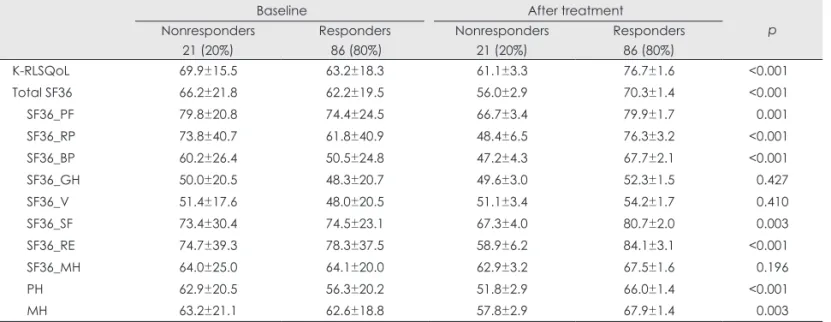
The patients were divided into two groups based on the effi- cacy of ropinirole (responders: n=86, 80%; nonresponders:
n=21, 20%) to determine whether the improved QoL was purely associated with the change in symptom severity or with other treatment effects. The responders showed greater im- provements (p<0.05) on all subscales except general health, vitality, and mental domain than nonresponders (Table 3).
The improvement of QoL in RLS patients was significantly correlated with the severity of RLS (r=0.236, p<0.014) at base- line. A stepwise multiple regression for factors affecting the K-RLSQoL score change was performed using the following independent factors: age, gender, age at symptom onset, symp- tom duration, depression (BDI-2), RLS severity (K-IRLS score), sleep quality (PSQI-K score), and total SF-36. The se- verity of symptoms was found to be significantly associated with the change in K-RLSQoL scores (β=0.586, p=0.017), with RLS patients with more severe RLS symptoms showing greater improvement in QoL after ropinirole treatment.
Adverse events were reported in nine patients (8.3%): dizzi- ness (n=5, 4.6%), nausea (n=1, 0.9%), dry mouth (n=1, 0.9%), fatigue (n=1, 0.9%), and leg edema (n=1, 0.9%). Most of these adverse events were mild to moderate in intensity, and did not cause any patient to withdraw from the study.
Discussion
This study found improvement in the QoL as well as an im- proved symptom severity after short-term ropinirole treatment.
The QoL was improved in terms of both physical and mental health. The QoL of patients with RLS is known to be consid- erably worse than that in healthy controls, and similar to that in patients with chronic medical diseases such as diabetes and Parkinson’s disease.3,11,29 Thus, the positive effect of ropinirole
found in the present study represents further evidence that it is effective in the treatment of RLS. Ropinirole was generally tol- erated well and there were no reported serious adverse events in our study.
The ropinirole-induced changes in the SF-36 scores for bodily pain, general health, and vitality domains indicated that patients using ropinirole experienced improvements in their bodily pain and general health, and had more energy and less fatigue. In particular, the responders showed greater improve- ments in most domains of the SF-36. The improvement of QoL in RLS patients was assessed using both the disease-specific K-RLSQoL and the SF-36. This finding that ropinirole im- proved the QoL of RLS patients was similar to that of a previ- ous study.19 The data presented here support the notion that treatment with ropinirole can lead to improvement in QoL in RLS patients. However, another study found that ropinirole was associated with a greater improvement in QoL when this was assessed using the disease-specific measure (i.e., RLS QoL questionnaire) than with generic measures (SF-36).18 Western studies have produced different findings for QoL after ropini- role treatment when using the SF-36, which could be due to
Fig. 2. Changes in the clinical characteristics after ropinirole treat- ment. BDI-2: Beck Depression Inventory-2, ISI: Insomnia Severity Index, K-IRLS: Korean version of the International Restless Legs Scale, KESS: Korean version of the Epworth Sleepiness Scale, PSQI-K: Korean version of the Pittsburg Sleep Quality Index.
**p<0.01, ***p<0.001.
25 20 15 10 5
0 K-IRLS PSQI-K ISI KESS BDI-2
***
***
***
**
Score of instruments
Baseline After treatment
Table 2. Clinical characteristics at baseline and after 8 weeks of ropinirole treatment
Baseline After treatment p K-RLSQoL 64.5±17.9 73.7±18.4 <0.001 Total SF-36 63.0±19.9 67.5±19.8 0.004 SF36_PF 75.4±23.8 77.3±23.8 0.255 SF36_RP 64.2±41.0 70.8±40.6 0.053 SF36_BP 52.4±25.3 63.6±23.8 <0.001 SF36_GH 48.6±20.6 51.8±21.0 0.025 SF36_V 48.7±20.0 53.6±17.9 0.008 SF36_SF 74.2±24.5 78.0±23.1 0.070 SF36_RE 77.6±37.7 79.1±37.6 0.635 SF36_MH 64.0±21.0 66.6±16.1 0.196 PH 57.7±20.3 63.2±20.5 <0.001
MH 62.7±19.2 65.8±18.1 0.041
K-IRLS 23.4±7.5 16.8±7.9 <0.001
BDI-2 12.4±8.6 11.5±10.1 0.191
PSQI-K 10.6±4.4 9.2±4.4 <0.001
ISI 14.5±7.1 10.5±6.5 <0.001
KESS 7.2±3.9 6.1±3.9 0.007
Data are mean±SD values.
BDI-2: Beck Depression Inventory-2, ISI: Insomnia Severity Index, K-IRLS: Korean version of the International Restless Legs Scale, K-RLSQoL: Korean version of the restless legs syndrome quality of life questionnaire, KESS: Korean version of the Epworth Sleepiness Scale, MH: mental domains, PH: physical domains, PSQI-K: Korean version of the Pittsburg Sleep Quality Index, SF36: Short Form 36 Health Survey, SF36_BP: bodily pain, SF36_
GH: general health, SF36_PF: physical function, SF36_MH: men- tal health, SF36_RE: role limitations due to emotional problems, SF36_RP: role limitations due to physical problems, SF36_SF: so- cial functioning, SF36_V: vitality.
this instrument not fully covering aspects of sleep in RLS pa- tients.
RLS patients complain of both leg discomfort and sleep problems. Ropinirole effectively treats the symptoms of RLS as measured by the K-IRLS, improving sleep quality and re- ducing both sleep disturbance and daytime somnolence. These positive effects of ropinirole on sleep were similar to those found in previous studies,18,30 and should prove beneficial in the management of RLS. However, the improvement of QoL in RLS patients is due to alleviating symptoms of RLS rather than improving sleep quality.
The mean ropinirole daily dosage was 0.62 mg, which is smaller than that found in Western studies (1.5-1.9 mg).18,19 It seems that the symptoms of Korean RLS patients responded well to low-dosage ropinirole. The mean K-IRLS score in the present study was 23 at baseline and 17 after 8 weeks of ropini- role administration, while the mean adjusted change in IRLS scores between baseline and week 12 was -11.2 in a Western study.19 The smaller improvement in the present study could be due to Korean doctors tending to prescribe the drug at a lower dosage; our results cannot be compared directly with those of Western studies due to differences in drug dosage and culture.
The prevalence of depression is higher among RLS patients than controls.31,32 Treating depression in RLS is challenging since some antidepressants reportedly exacerbate or even trig- ger RLS symptoms.31,33 In contrast to a previous study,34 we found that ropinirole did not improve depression as measured by the BDI-2. This discrepancy could be due to that study us- ing a different (immediate-release) ropinirole formula and a longer treatment duration (12 weeks). Therefore, the antide-
pressive effects of ropinirole in RLS patients remain unclear, and so future studies should attempt to clarify the antidepres- sive effects of dopamine agonists such as ropinirole in RLS pa- tients.
Adverse events of ropinirole in the present study were mild- er in severity and had a lower incidence than those in Western studies.18,19,21 This may be related to our mean dosage of ropin- irole being lower than in the other studies. The adverse events were generally consistent with those known for this class of dopamine agonists.
The main weaknesses of our study are that it was not a ran- domized placebo-controlled trial and there was no long-term follow-up. However, it is significant in being a multicenter clinical trial and finding that Korean RLS patients using ropin- irole showed improvement in their QoL as measured by both the K-RLSQoL and the SF-36. Ropinirole appeared to have a positive impact on QoL in our study, but future studies should evaluate long-term changes in larger populations in order to determine whether QoL improvements are sustained or further enhanced and whether high doses affect QoL to a greater de- gree than low doses.
In conclusion, this multicenter trial showed that short-term ropinirole is potentially beneficial for the QoL as well as alle- viating symptom severity in Korean RLS patients.
Conflicts of Interest
The authors have no financial conflicts of interest.
Acknowledgements
This study was supported by a grant from the Korean Sleep Research So- ciety.
Table 3. Changes in quality of life in responder and nonresponder groups
Baseline After treatment
Nonresponders p 21 (20%)
Responders 86 (80%)
Nonresponders 21 (20%)
Responders 86 (80%)
K-RLSQoL 69.9±15.5 63.2±18.3 61.1±3.3 76.7±1.6 <0.001
Total SF36 66.2±21.8 62.2±19.5 56.0±2.9 70.3±1.4 <0.001
SF36_PF 79.8±20.8 74.4±24.5 66.7±3.4 79.9±1.7 0.001
SF36_RP 73.8±40.7 61.8±40.9 48.4±6.5 76.3±3.2 <0.001
SF36_BP 60.2±26.4 50.5±24.8 47.2±4.3 67.7±2.1 <0.001
SF36_GH 50.0±20.5 48.3±20.7 49.6±3.0 52.3±1.5 0.427
SF36_V 51.4±17.6 48.0±20.5 51.1±3.4 54.2±1.7 0.410
SF36_SF 73.4±30.4 74.5±23.1 67.3±4.0 80.7±2.0 0.003
SF36_RE 74.7±39.3 78.3±37.5 58.9±6.2 84.1±3.1 <0.001
SF36_MH 64.0±25.0 64.1±20.0 62.9±3.2 67.5±1.6 0.196
PH 62.9±20.5 56.3±20.2 51.8±2.9 66.0±1.4 <0.001
MH 63.2±21.1 62.6±18.8 57.8±2.9 67.9±1.4 0.003
Baseline data are mean±SD (standard deviation) values, after-treatment data are mean±SE (standard error) values.
K-RLSQoL: Korean version of the restless legs syndrome quality of life questionnaire, MH: mental domains, PH: physical domains, SF36:
Short Form 36 Health Survey, SF36_BP: bodily pain, SF36_GH: general health, SF36_MH: mental health, SF36_PF: physical function, SF36_
RE: role limitations due to emotional problems, SF36_RP: role limitations due to physical problems, SF36_SF: social functioning, SF36_V:
vitality.
REFERENCES
1. Allen RP, Picchietti D, Hening WA, Trenkwalder C, Walters AS, Montplaisi J, et al. Restless legs syndrome: diagnostic criteria, special considerations, and epidemiology. A report from the restless legs syn- drome diagnosis and epidemiology workshop at the National Institutes of Health. Sleep Med 2003;4:101-119.
2. Earley CJ, Silber MH. Restless legs syndrome: understanding its con- sequences and the need for better treatment. Sleep Med 2010;11:807- 3. Allen RP, Walters AS, Montplaisir J, Hening W, Myers A, Bell TJ, et 815.
al. Restless legs syndrome prevalence and impact: REST general pop- ulation study. Arch Intern Med 2005;165:1286-1292.
4. Berger K, Luedemann J, Trenkwalder C, John U, Kessler C. Sex and the risk of restless legs syndrome in the general population. Arch In- tern Med 2004;164:196-202.
5. Bjorvatn B, Leissner L, Ulfberg J, Gyring J, Karlsborg M, Regeur L, et al. Prevalence, severity and risk factors of restless legs syndrome in the general adult population in two Scandinavian countries. Sleep Med 2005;6:307-312.
6. Cho YW, Shin WC, Yun CH, Hong SB, Kim JH, Allen RP, et al. Epi- demiology of restless legs syndrome in Korean adults. Sleep 2008;
31:219-223.
7. Hening W, Walters AS, Allen RP, Montplaisir J, Myers A, Ferini- Strambi L. Impact, diagnosis and treatment of restless legs syndrome (RLS) in a primary care population: the REST (RLS epidemiology, symptoms, and treatment) primary care study. Sleep Med 2004;5:237- 8. Högl B, Kiechl S, Willeit J, Saletu M, Frauscher B, Seppi K, et al. 246.
Restless legs syndrome: a community-based study of prevalence, se- verity, and risk factors. Neurology 2005;64:1920-1924.
9. Tison F, Crochard A, Léger D, Bouée S, Lainey E, El Hasnaoui A. Epi- demiology of restless legs syndrome in French adults: a nationwide survey: the INSTANT Study. Neurology 2005;65:239-246.
10. Allen RP. Controversies and challenges in defining the etiology and pathophysiology of restless legs syndrome. Am J Med 2007;120:S13- 11. Abetz L, Allen R, Follet A, Washburn T, Earley C, Kirsch J, et al. S21.
Evaluating the quality of life of patients with restless legs syndrome.
Clin Ther 2004;26:925-935.
12. Akpinar S. Treatment of restless legs syndrome with levodopa plus benserazide. Arch Neurol 1982;39:739.
13. Allen RP, Earley CJ. Augmentation of the restless legs syndrome with carbidopa/levodopa. Sleep 1996;19:205-213.
14. Trenkwalder C, Hundemer HP, Lledo A, Swieca J, Polo O, Wetter TC, et al. Efficacy of pergolide in treatment of restless legs syndrome: the PEARLS Study. Neurology 2004;62:1391-1397.
15. Andersohn F, Garbe E. Cardiac and noncardiac fibrotic reactions caused by ergot-and nonergot-derived dopamine agonists. Mov Disord 2009;24:129-133.
16. Hornyak M, Trenkwalder C, Kohnen R, Scholz H. Efficacy and safety of dopamine agonists in restless legs syndrome. Sleep Med 2012;13:
228-236.
17. Cheer SM, Bang LM, Keating GM. Ropinirole: for the treatment of restless legs syndrome. CNS Drugs 2004;18:747-754; discussion 755- 18. Trenkwalder C, Garcia-Borreguero D, Montagna P, Lainey E, de 756.
Weerd AW, Tidswell P, et al. Ropinirole in the treatment of restless legs syndrome: results from the TREAT RLS 1 study, a 12 week, ran-
domised, placebo controlled study in 10 European countries. J Neurol Neurosurg Psychiatry 2004;75:92-97.
19. Walters AS, Ondo WG, Dreykluft T, Grunstein R, Lee D, Sethi K, et al. Ropinirole is effective in the treatment of restless legs syndrome.
TREAT RLS 2: a 12-week, double-blind, randomized, parallel-group, placebo-controlled study. Mov Disord 2004;19:1414-1423.
20. Allen R, Becker PM, Bogan R, Schmidt M, Kushida CA, Fry JM, et al. Ropinirole decreases periodic leg movements and improves sleep parameters in patients with restless legs syndrome. Sleep 2004;27:907- 21. Bogan RK, Fry JM, Schmidt MH, Carson SW, Ritchie SY; TREAT 914.
RLS US Study Group. Ropinirole in the treatment of patients with restless legs syndrome: a US-based randomized, double-blind, place- bo-controlled clinical trial. Mayo Clin Proc 2006;81:17-27.
22. Cho YW, Lee MY, Yun CH, Shin WC, Hong SB, Kim JH. The reli- ability and validity of the Korean version of paradigm of questions for epidemiology studies of restless legs syndrome and the Johns Hopkins telephone diagnostic interview form for the restless legs syndrome. J Korean Neurol Assoc 2007;25:494-499.
23. Yang JG, Kim DH, Lee JH, Park KH, Jung KY, Shin WC, et al. The reliability and validity of the Korean versions of the international rest- less legs scale and the restless legs syndrome quality of life question- naire. J Korean Neurol Assoc 2010;28:263-269.
24. Han CW, Lee EJ, Iwaya T, Kataoka H, Kohzuki M. Development of the Korean version of Short-Form 36-Item Health Survey: health relat- ed QOL of healthy elderly people and elderly patients in Korea. To- hoku J Exp Med 2004;203:189-194.
25. Sohn SI, Kim DH, Lee MY, Cho YW. The reliability and validity of the Korean version of the Pittsburgh Sleep Quality Index. Sleep Breath 2012;16:803-812.
26. Cho YW, Lee JH, Son HK, Lee SH, Shin C, Johns MW. The reliabili- ty and validity of the Korean version of the Epworth sleepiness scale.
Sleep Breath 2011;15:377-384.
27. Oh SM, Min KJ, Park DB. A study on the standardization of the hospi- tal anxiety and depression scale for Koreans: a comparison of normal, depressed and anxious groups. J Korean Neuropsychiatr Assoc 1999;
38:289-296.
28. Jo SA, Park MH, Jo I, Ryu SH, Han C. Usefulness of Beck Depression Inventory (BDI) in the Korean elderly population. Int J Geriatr Psy- chiatry 2007;22:218-223.
29. Kushida C, Martin M, Nikam P, Blaisdell B, Wallenstein G, Ferini- Strambi L, et al. Burden of restless legs syndrome on health-related quality of life. Qual Life Res 2007;16:617-624.
30. Bogan RK. Ropinirole treatment for restless legs syndrome. Expert Opin Pharmacother 2008;9:611-623.
31. Picchietti D, Winkelman JW. Restless legs syndrome, periodic limb movements in sleep, and depression. Sleep 2005;28:891-898.
32. Winkelman JW, Finn L, Young T. Prevalence and correlates of restless legs syndrome symptoms in the Wisconsin Sleep Cohort. Sleep Med 2006;7:545-552.
33. Rottach KG, Schaner BM, Kirch MH, Zivotofsky AZ, Teufel LM, Gallwitz T, et al. Restless legs syndrome as side effect of second gen- eration antidepressants. J Psychiatr Res 2008;43:70-75.
34. Benes H, Mattern W, Peglau I, Dreykluft T, Bergmann L, Hansen C, et al. Ropinirole improves depressive symptoms and restless legs syn- drome severity in RLS patients: a multicentre, randomized, placebo- controlled study. J Neurol 2011;258:1046-1054.