Pterional-subolfactory Approach for Treatment of High Positioned Anterior Communicating Artery Aneurysms
Hyool Kim, Tae-sun Kim, Sung-pil Joo, Hyung-sik Moon
Department of Neurosurgery, and Chonnam National University Research Institute of Medical Sciences, Chonnam National University Hwasun Hospital & Medical School, Gwangju, Korea
Objective : The purpose of this study is to compare the surgical out- comes of pterional-subolfactory approach for the high positioned anterior communicating artery (ACoA) aneurysm with the conventional pterional approach.
Methods : Between February 2005 and December 2012, 463 ACoA aneur- ysms were surgically treated in our institution. Forty eight high positioned ACoA aneurysms were treated with pterional-subolfactory or conventional pterional approach. High positioned ACoA aneurysms were defined as aneurysms located higher than 10 mm above the anterior clinoid process.
Pterional-subolfactory approach is a procedure including dissection of ol- factory tract and resection of the gyrus rectus inferior and medial to the olfactory tract. Thirty-four of the 48 cases were treated with pterional-sub- olfactory approach and 14 were treated conventionally.
Results : There were 2 postoperative cerebral infarction with the conven- tional pterional approach, but none with the pterional-subolfactory ap- proach group (p = 0.026). Postoperative digital subtraction angiography revealed significant remnant aneurysm in the conventional pterional ap- proach group. All patients with unruptured aneurysms had good clinical outcomes with Glasgow outcome score of 5. Among ruptured ACoA aneurysm patients, 2 patients with conventional pterional approach had postoperative cerebral infarctions but permanent neurologic deficit was found in only 1 patient. Three patients treated with the pterional-sub- olfactory approach, who had preoperative ruptured aneurysms had poor clinical outcomes. The mean operation time for the conventional pterional approach was 58 minutes longer than for the pterional-subolfactory ap- proach (p = 0.001).
Conclusion : We concluded that pterional-subolfactory approach is highly preferable for cases of high positioned ACoA aneurysm, giving a wide and effective operation view.
J Cerebrovasc Endovasc Neurosurg.
2013 September;15(3):177-183 Received : 10 June 2013
Revised : 11 July 2013 Accepted : 25 August 2013 Correspondence to Tae Sun Kim Department of Neurosurgery, Chonnam National University Hospital, 8 Hak-dong, Dong-gu, Gwangju 501-190, Korea Tel : 82-62-220-6607
Fax : 82-62-224-9865
E-mail : [email protected]
This is an Open Access article distributed under the terms of the Creative Commons Attribution Non- Commercial License (http://creativecommons.org/li- censes/by-nc/3.0) which permits unrestricted non- commercial use, distribution, and reproduction in any medium, provided the original work is properly cited.
Keywords Subolfactory, Anterior communicating aneurysm
INTRODUCTION
Anterior communicating artery (ACoA) is the most common site for intracranial aneurysms as revealed
by landmark clinical studies.4) Despite the high preva- lence of ACoA aneurysms, surgical clipping of ACoA aneurysm can still be challenge to even experienced neurosurgeons because of variable anatomy of the
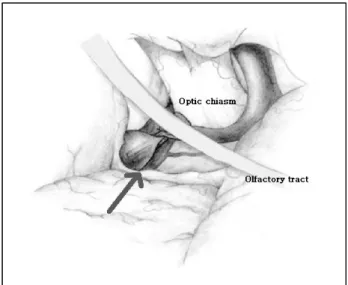
Fig. 1. Schematic drawing of subolfactory approach; dissection of olfactory tract and suck out of rectus gyrus inferomedial of olfactory tract allows no need for retractor and direct visual- ization of high-positioned anterior communicating artery aneur- ysm (Arrow: direction of approach).
ACoA complex and its surrounding structures. The selection of the best surgical approach should include minimum brain retraction, minimum unnecessary op- erative manipulation, familiarity of surgical approach for operator, and easy access to the aneurysm, which depends on location, direction and size. The selection of surgical approach for high-positioned ACoA aneur- ysm can be even more difficult because surgical ob- literation of high-positioned ACoA aneurysm requires higher technical skill and the use of adjunct proce- dures, such as, extended craniotomy, resection of gy- rus rectus, and revascularization techniques. In 1953, Norlen and Barnum first described a transfrontal ap- proach for ACoA aneurysm with partial resection of frontal lobe.5) Kempe and VanderArk published a modified transfrontal approach with limited rectus gyrus resection.3) Nevertheless, a conventional pter- ional approach with resection of rectus gyrus is still used for the surgical obliteration of ACoA aneurysm.
In our institution, we modified procedures from the conventional pterional approach. We dissect the olfac- tory tract and detach from frontal lobe. In this study, the purpose is to evaluate surgical outcome of our pterional-subolfactory approach for the high posi- tioned ACoA aneurysm through comparison with conventional pterional approaches.
MATERIALS AND METHODS
Between February 2005 and December 2012, 463 ACoA aneurysms were surgically treated in our institution. Among them, 48 high positioned anterior communicating aneurysms were treated with pter- ional-subolfactory or conventional pterional approaches.
The pterional-subolfactory approach includes sharp dissection and detachment of olfactory tract to free from brain parenchyme and resection of the gyrus rectus immediately medial and inferior to the olfac- tory tract. Thirty-four of the 48 cases were treated with pterional-subolfactory approach and 14 were treated conventionally. High positioned anterior com- municating artery aneurysms were defined as aneur-
ysms located higher than 10 mm above the anterior clinoid process.
Preoperative radiologic assessment
Preoperative computed tomography angiography (CTA) or digital subtraction angiography (DSA) was per- formed to characterize ACoA aneurysms for all 48 patients. Simple skull anterior-posterior and lateral were checked to identify frontal sinus. The height of aneurysm was measured as height from anterior cli- noid process to neck of aneurysm on maximum in- tensive projection sagittal view of CTA or DSA.
Preoperative subarachnoid hemorrhage and intra- cranial hemorrhage were checked on CT.
Surgical technique
The operation was performed with the patient in a supine position. The head was rotated about 15 de- grees to the opposite side of aneurysm and extended 10 to 20 degrees toward the floor, then was fixed in a sugita 4-pin head frame. We performed the stand- ard pterional approach by drilling the skull base. We dissected the sylvian fissure to identify optic nerve, internal carotid artery (ICA), ipsilateral and con- tralateral A1 segment. After identifying both A1 seg-
Total (N = 48) Approach method
p value
Conventional Subolfactory
Number of patients 14 34
Mean Age 51.07 58.15 0.039
Sex M 8 16
0.752
F 6 18
Height (mm) Mean 12.62 12.74
0.880
Range 10.22–16.13 10.11–17.26
Size (mm) Mean 5.29 6.36
0.068
Range 3–16 3–11
Operation time (Total, N = 48, min)
Mean 318.9 260
< 0.001*
Range 260–450 165–410
Operation time
(SAH, N = 36, min) Mean 318.1 273 0.003*
*p < 0.05. M= male; F= female; SAH= subarachnoid hemorrhage.
Table 1. Demographic characteristics
ments, we deduced the location of aneurysm. In con- ventional pterional approach, we usually elevated the frontal lobe with a retractor over the olfactory tract.
In contrast, the pterional-subolfactory approach sharp- ly dissect the olfactory tract, detaching it from the frontal lobe to free from the brain parenchyma (Fig.
1). We then cauterized the rectus gyrus, immediately medial and inferior of olfactory tract. Using the suc- tion and the bipolar cautery, we resected the rectus gyrus until the medial side pia arachnoid of the gyrus rectus was recognized over the aneurysm and the ip- silateral A1 and A2 segments. After the proper recog- nition of high positioned aneurysm, we safely obli- terated the aneurysm while it was directly visualized.
Outcome assessment
The clinical and radiologic outcomes were evaluated retrospectively according to the following methods.
All patients' charts, medical records and radiologic ex- aminations were reviewed. Postoperative clinical out- comes were measured by means of Glasgow outcome scale (GOS). All the postoperative images were ana- lyzed by neuro-specialized radiologist for post- operative complications, such as hemorrhage, cerebral contusion, remnant aneurysm and venous infarction.
Postoperative complications such as postoperative in-
farction, perforating artery injury, infection and cere- brospinal fluid leakage were checked.
Statistical analysis
Differences between groups were compared for stat- istical significance with a Mann Whitney U-test. Null hypotheses of no difference were rejected if p values were less than 0.05.
RESULTS
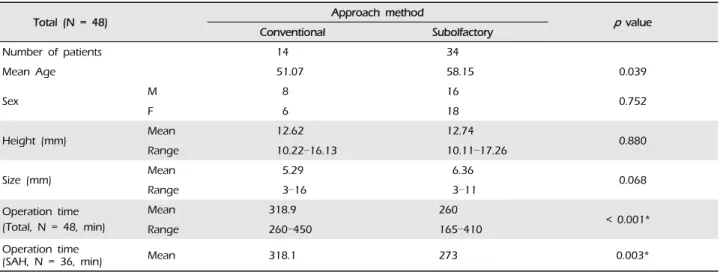
For the 34 cases treated with pterional-subolfactory approach, the mean location of ACoA aneurysm was 12.62 mm (range from 10.22 to 16.13 mm) from the anterior clinoid process. For the 14 cases treated with conventional approaches, the mean location of ACoA aneurysm was 12.74 mm (range from 10.11 to 17.26 mm). Sizes of aneurysms treated with subolfactory approach were varied from 3 mm in diameter to 16 mm (average 5.52 mm in diameter). The average di- ameter of conventionally treated aneurysms was 6.36 mm. The operation duration for conventional pter- ional and pterional-subolfactory approaches were measured, and conventional pterional approach took 58 minutes more than the pterional-subolfactory ap- proach (p = 0.001). Patient characteristics are summar-
Postoperative GOS
1 2 3 4 5
Pre op GradeH-H
0* 1
1
2 1 7
3 1 3
4 1
*Unruptured intracranial aneurysm. GOS= Glasgow outcome scale; op= operation; H-H grade= Hunt-Hess grade.
Table 3. Clinical outcome for conventional pterional approach Subolfactory
(N = 34) Conventional
(N = 14) p value
Postoperative infarction 0 2 0.03*
CSF leakage 0 0 ‐
Wound infection 0 0 ‐
Postoperative ICH 1 0 0.51
*p < 0.05. CSF= cerebro-spinal fluid; ICH= intracerebral hemorrhage.
Table 2. Statistical results of postoperative complications
ized in Table 1.
Clinical and surgical complication
Complications occurred in 2 cases of the conven- tional pterional approach group, and 1 case in pter- ional-subolfactory group. Postoperative cerebral in- farction developed in 2 cases with the conventional pterional approach, but not in the pterional-sub- olfactory approach group (p = 0.026, Table 2). In 1 case, long hours of temporary clip usage resulted in postoperative cerebral infarction on right frontal lobe and permanent neurologic deficit. In the other case, postoperative cerebral infarction due to perforate ar- tery injury developed; however, patient was dis- charged with no remnant neurologic deficit. One case of postoperative intracranial hemorrhage occurred in the pterional-subolfactory approach group, none in the conventional pterional approach group, but the difference was not statistically significant (p = 0.51, Table 2). Cerebro-spinal fluid leakage and postoperative wound infection did not occur in either group.
Radiologic results for remnant aneurysm
Postoperative CTA or DSA was performed to eval-
uate remnant aneurysm for all 48 patients. Surgical clipping was successfully performed in all patients ex- cept for 1 case with the conventional pterional approach. In that case, postoperative DSA revealed severe remnant with flow in aneurysm. We then, un- derwent revision operation for repositioning of clip.
After reposition of clip, DSA was performed, and re- vealed complete obliteration of aneurysm.
Clinical outcome
Clinical outcomes were measured by GOS. In both the conventional pterional and pterional-subolfactory approach groups, all patients with unruptured ACoA aneurysms achieved good clinical outcome with GOS scores of 5. In the pterional-subolfactory group, post- operative CT revealed a cortical hemorrhage in 1 pa- tient, and asymptomatic acute epidural hemorrhage in 1 patient. Cortical hemorrhage developed at the rectus gyrus removal site, and epidural hemorrhage devel- oped at the operative approach side. However, nei- ther patient developed neurological deficit due to hem- orrhage, and the hemorrhages resolved spontaneously.
Among 34 patients with pterional-subolfactory ap-
Postoperative GOS
1 2 3 4 5
Pre op GradeH-H
0† 11
1 2
2 11
3 1 4
4 1* 2 1
5 1*
*Patients refused further treatment, †Unruptured intracranial aneurysm. Abbreviations are same as in Table 3.
Table 4. Clinical outcome for pterional-subolfactory approach
Age Sex Size Height Olfactory N. function
Case 1 60 M 3 12.9 (‐)
Case 2 59 M 3 12.9 (‐)
Case 3 38 M 3 13.7 (‐)
Case 4 62 F 3 13.6 (‐)
Case 5 71 F 7 11.9 (‐)
Case 6 57 F 9 17.2 (‐)
Case 7 50 M 10 11.8 (‐)
Case 8 58 F 16 12.6 (‐)
Case 9 61 F 3.5 14.5 Anosmia (+)
Case 10 76 F 4.6 10.5 (‐)
Case 11 61 M 6.1 13.5 (‐)
ACoA= anterior communicating artery; N= nerve.
Table 5. Olfactory nerve function in unruptured ACoA aneurysm
proach, 23 patients had preoperative subarachnoid hemorrhage, and 20 patients (87%) made a good re- covery (GR) followed by GOS higher than 4. Initial mental state for the other 3 patients was poor. Among them, families of 2 patients refused further treatment after initial operation, and the patients were dis- charged (Table 4).
Conventional pterional approaches were performed for 13 patients with subarachnoid hemorrhage and 1 patient with unruptured high-positioned ACoA aneurysm.
Twelve patients (92.3%) with subarachnoid hemor- rhage achieved good clinical outcome with GOS high- er than 4 (Table 3). Postoperative cerebral infarction was found in 2 cases with ruptured aneurysm.
Olfactory nerve function in unruptured ACoA aneurysm Olfactory function was checked only for patients op- erated with unruptured ACoA aneurysm. Preoperative
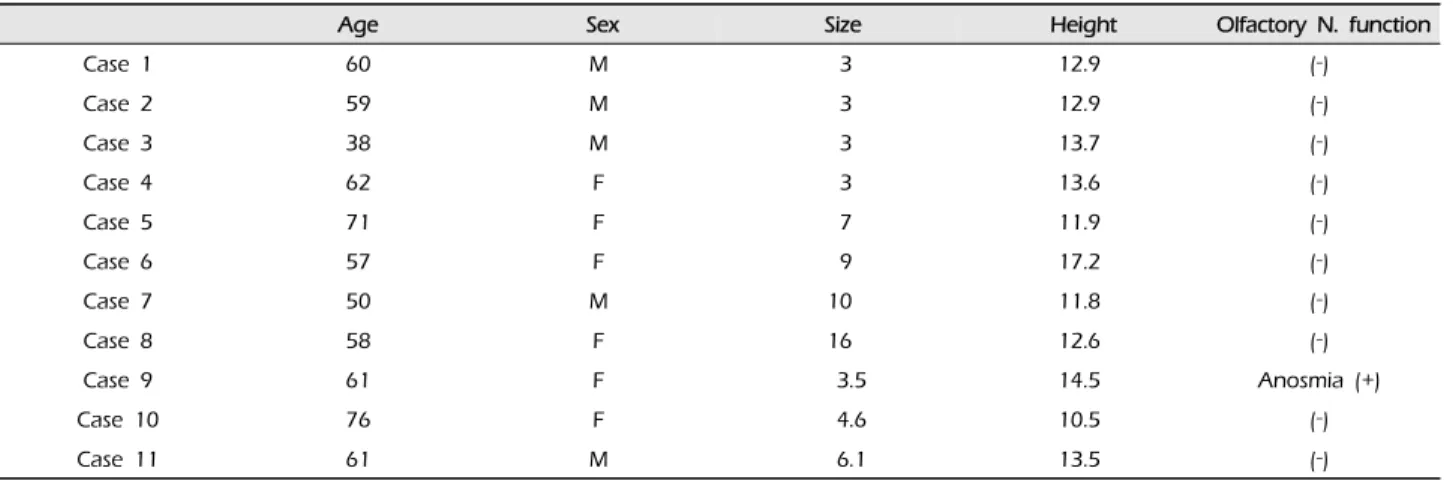
rupture of aneurysm with subarachnoid hemorrhage could alter the mental state of patients, and proper evaluation of surgical related olfactory dysfunction was not possible. Among 34 patients with pter- ional-subolfactory approach, 11 patients were treated for unruptured high positioned ACoA aneurysm. One patient (9.1%) complained of postoperative olfactory dysfunction in follow up (Table 5).
DISCUSSION
A rectus gyrus approach for anterior communicating aneurysm was first described by Kempe et al.3) in 1971. Since then, resection of the rectus gyrus has be- come the world-wide method for proper exposure of an anterior communicating aneurysm. In the standard method, the retractor is repositioned over the medial
A B
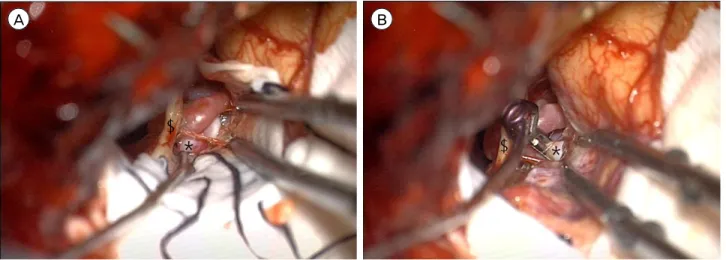
Fig. 2. (A) Operative photo of subolfactory approach: direct visualization of high-positioned anterior communicating artery aneurysm with minimal retraction with no retractor. (B) Operative photo of subolfactory approach: direct visualization of high-positioned ante- rior communicating artery aneurysm with minimal retraction with no retractor (clipped state). $: olfactory nerve, *: anterior communi- cating artery aneurysm.
orbital gyrus just lateral to the olfactory nerve aiming toward the estimated level of the ACoA junction in the interhemispheric fissure. The pia of the gyrus rec- tus, immediately medial and parallel to the olfactory nerve, is cauterized and resected. This standard meth- od provides a proper view of the anterior communi- cating aneurysm. In 1992, Horikoshi et al.2) reported clinical outcomes after rectus gyrus resection during conventional pterional approach. He concluded that resection of rectus gyrus helps to achieve safer aneur- ysm clipping without causing definite neurological se- quelae affecting the postoperative outcome. However, with a highly positioned aneurysm, to retain the proper view of ACoA aneurysm, more retraction and elevation of frontal lobe is required and direct re- traction injuries from the retractor can develop. Our pterional-subolfactory approach is different from the conventional pterional approach with removal of rec- tus gyrus in that we cauterize the pia of the rectus gyrus, immediately medial and inferior of olfactory tract after proper dissection of olfactory tract. In this way, we can preserve the olfactory tract most im- portantly, and achieve proper view and operation field for highly positioned ACoA aneurysm with no direct retraction needed (Fig. 1, 2). Our pterional-sub- olfactory approach requires no retractor to elevate
frontal lobe.
In our study, we achieved good clinical outcome with no surgical related permanent complications in both conventional pterional approach and pter- ional-subolfactory approach group. The pterional-sub- olfactory approach resulted in shorter operation dura- tion, and that difference was statistically significant.
The olfactory dissection procedure might take addi- tional operative time, but makes identification of aneurysmal neck easier for clipping.
In 1972, Pool demonstrated bifrontal craniotomy for ACoA aneurysms. Pool operated upon 60 ruptured ACoA aneurysms using low bifrontal craniotomy.7) He noted good clinical outcomes among good and fair risk group patients with 2.8% mortality and no surgical related complication. However, low bifrontal craniotomy can increase the possibility of post- operative infection due to frontal sinus opening and retraction injuries can develop during an interhemi- spheric approach due to bilateral brain retraction.
Also, most neurovascular surgeons are more familiar with pterional craniotomy than interhemispheric ap- proach with bifrontal craniotomy.
Anosmia is a well-known surgical related complica- tion after ACoA aneurysm surgery. Hiroaki et al.1) performed a comparison study of anosmia after
ACoA aneurysm surgery between the anterior inter- hemispheric and basal interhemispheric approaches in 1995. They reported 31% anosmia after anterior inter- hemispheric approach and 1.9% for basal interhemi- spheric approach. They concluded that frontal lobe depression and elevation during surgery may injure the olfactory nerve. Park et al.6) concluded olfactory dysfunction followed by pterional approach for cere- bral aneurysms in 2009. Their study revealed high risk of olfactory dysfunction after pterional approach for ACoA aneurysm with 14.3% (10 of 70 patients).
They concluded that direct pressure damage to the ol- factory tract by spatula can be the possible reason for olfactory dysfunction. Olfactory dysfunction can pose a higher risk for older patients because of less elastic and more vulnerable olfactory nerves. In our study, we assessed olfactory nerve injury for unruptured aneurysm patients and found 1 case (9.1%, 1 of 11 pa- tients) with pterional-subolfactory approach, very low compared to the literature.
The primary limitations of the present study are the retrospective design and the relatively small number of patients. In addition, olfactory dysfunction outcome was checked only for the unruptured aneurysm group due to preoperative mental status. Subarachnoid hem- orrhage might have affected patient’s preoperative mental status, and proper preoperative olfactory func- tion evaluation was difficult. Also olfactory function of the conventional approach group was excluded in this study due to lack of old medical history. In the future, olfactory dysfunction outcome for both groups should be studied for comparison of both approaches.
CONCLUSION
In this study, we achieved excellent clinical outcome
for both unruptured and ruptured ACoA aneurysms with no surgical related permanent complications ex- cept 1 case of olfactory nerve dysfunction. We con- cluded that pterional-subolfactory approach can be highly preferable for cases of high positioned ACoA aneurysm located higher than 10 mm above anterior clinoid process. Pterional-subolfactory approach can prevent olfactory bulb tearing, resulting in preserva- tion of olfactory tract without any surgical complication.
Also the subolfactory approach can provide wider and effective operation view with minimal retraction of brain. In conclusion, the pterional-subolfactory ap- proach can be an alternative surgical approach for high positioned ACoA aneurysms.
REFERENCES
1. Fujiwara H, Yasui N, Nathal-Vera E, Suzuki A.
Anosmia after anterior communicating artery aneurysm surgery: Comparison between the anterior interhemispheric and basal interhemispheric approaches. Neurosurgery. 1996 Feb;38(2):325-8.
2. Horikoshi T, Nukui H, Mitsuka S, Kaneko M. Partial re- section of the gyrus rectus in pterional approach to an- terior communicating artery aneurysms. Neurol Med Chir (Tokyo). 1992 Mar;32(3):136-9.
3. Kempe LG, VanderArk GD. Anterior communicating ar- tery aneurysms. Gyrus rectus approach. Neurochirurgia (Stuttg) 1971 Mar;14(2):63-70.
4. Locksley HB. Natural history of subarachnoid hemorrhage, intracranial aneurysms and arteriovenous malformations.
Based on 6368 cases in the cooperative study. J Neurosurg.
1966 Aug;25(2):219-39.
5. Norlen G, Barnum AS. Surgical treatment of aneurysms of the anterior communicating artery. J Neurosurg. 1953 Nov;10(6):634-50.
6. Park J, Lee SH, Kang DH, Kim JS. Olfactory dysfunc- tion after ipsilateral and contralateral pterional ap- proaches for cerebral aneurysms. Neurosurgery. 2009 Oct;65(4):727-32; discussion 732.
7. Pool JL. Bifrontal craniotomy for anterior communicating artery aneurysms. J Neurosurg. 1972 Feb;36(2):212-20.