• 검색 결과가 없습니다.

CLINICAL PAIN 103 접수일 : 2014 년 10 월 4 일 , 게재승인일 : 2014 년 12 월 7 일

N/A
N/A
Protected

Academic year: 2021

Share "CLINICAL PAIN 103 접수일 : 2014 년 10 월 4 일 , 게재승인일 : 2014 년 12 월 7 일"

Copied!
4
0
0

로드 중.... (전체 텍스트 보기)

전체 글

(1)

VOL. 13, NO. 2, 2014

CLINICAL PAIN 103 접수일 : 2014 년 10 월 4 일 , 게재승인일 : 2014 년 12 월 7 일

책임저자 : 이상헌 , 서울시 성북구 안암동 5

󰂕 136-705, 고려대학교 안암병원 재활의학과

Tel: 02-920-6471, Fax: 02-929-9951 E-mail: [email protected]

안면신경마비 후 안면연축에 대한 새로운 치료적 접근: 초음파와 근전도 검사의 동시 사용 방법

󰠏 증례 보고 󰠏

고려대학교 안암병원 재활의학과

한아름ㆍ김승민ㆍ이상헌

New Technical Trial to Treatment of Post- Paralytic Facial Synkinesis after Trauma:

Combination Technique with Ultrasono- graphy and Electromyography

󰠏 A Case Report 󰠏

Areum Han, M.D., Seungmin Kim, M.D. and Sangheon Lee, M.D., Ph.D.

Department of Physical Medicine & Rehabilitation, Korea University School of Medicine, Seoul, Korea

During the recovery from the facial muscle paralysis, some patients suffer from post-paralytic facial synkinesis. A 31-year-old woman visited our hospital with a history of hit- ting her left face on the steering wheel and had deep lacer- ations in her mouth from a traffic accident 1 year ago. Four months later, she noticed that her zygomatic area con- tracted spontaneously and left upper lip was drawn up with her left eye blinking. We assumed that the cause of facial asymmetry could be due to facial neuropathy and synkinesis.

And we planned ultrasonography and electromyography guided botulinum toxin injection. One month later, her facial asymmetry was remarkably improved and abnormal synki- netic contractions were disappeared. To the best of our knowledge, this is the first case report of dual device guided botulinum toxin injection for post-paralytic facial synkinesis.

This is more precise and safer procedure than previous methods. (Clinical Pain 2014;13:103-106)

Key Words: Facial palsy, Synkinesis, Botulinum toxins

INTRODUCTION

Facial palsy shows symptoms of facial asymmetry and involuntary movement such as post-paralytic facial synki- nesis (PPFS). These symptoms impair facial expression and appearance. As a result, it can lead to severe functional and psychosocial problems. During the recovery from the com- plete facial palsy, some patients suffer from the remaining symptoms of facial muscle weakness and development of PPFS. PPFS was known as the uncontrolled, involuntary abnormal facial muscle contractions which usually accom- pany purposeful movement of another part of the face.

1,2

Clinically, the most common types of facial synkinesis are involuntary eye closure with mouth movement and con- traction of zygomatic area with voluntary eye closure. There are 3 known mechanisms for PPFS; aberrant regeneration of nerve fibers in the neural repair process, peripheral ephaptic transmissions between regenerating axons and syn- aptic reorganization and hyperexcitability of the facial nerve.

Botulinum toxin A (BTX-A) has been widely used as treatment options of synkinesis for decades after it was used successfully to treat blepharospasm in 1985.

3,4

It is a neurotoxin produced by Clostridium botulinum. It attacks a neuromuscular junction and inhibits release of acetylcholine by preventing vesicles from anchoring to the membrane. As a result, target muscle is chemically denervated and ex- cessive muscle contractions were reduced.

1

But, the effects are temporary and lasting approximately 3 months.

2,5,6

We encountered a patient with facial muscle synkinesis that developed during the recovery from the facial palsy.

And we performed ultrasonography (US) and electro- myography (EMG) guided BTX injections for levator labii and zygomaticus major muscles.

To the best of our knowledge, this is the first case report

(2)

VOL. 13, NO. 2, 2014

CLINICAL PAIN 104

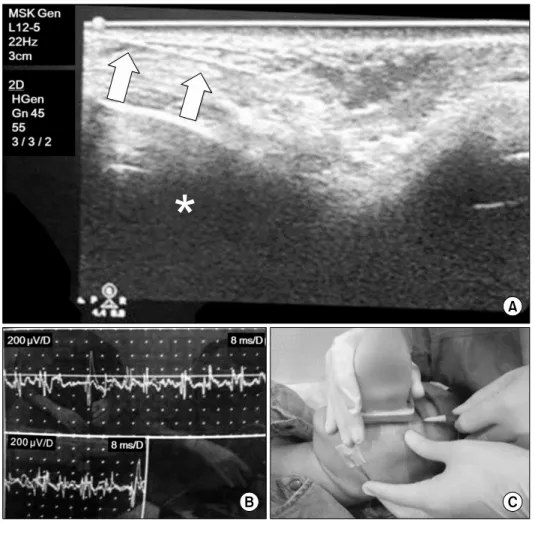
Fig. 2. Dual device (US + EMG) guided botulinum toxin injection.

(A) EMG needle insertion into the left zygomaticus major muscle (*:

zygomatic bone, arrow: EMG nee- dle). (B) Needle EMG findings of the left zygomaticus major muscle with patient’s left eye blinking:

grouped discharge of high fre- quency MUAPs. (C) Dual device guided botulinum toxin injection.

Fig. 1. Synkinesis study with left eye blinking. (A) Left levator labii superioris muscle. (B) Left orbicularis oris muscle: Bursts of MUAPs with high frequency were noted.

of dual device guided BTX injection for PPFS after trauma.

CASE REPORT

A 31-year old woman who complained abnormal con- tractions of left facial muscles visited our hospital. She hit her left face on the steering wheel and had deep laceration

in the mouth from a traffic accident 1 year ago. At that time, she was diagnosed with left facial palsy at a local medical clinic. Left facial palsy was little change for the better. Four months later, she noticed that her left side of the face contracted spontaneously and left upper lip was drawn up with left eye blinking.

In neurological examination, she could wrinkle forehead

(3)

한아름 외 2인: 안면신경마비 후 안면연축에 대한 새로운 치료적 접근: 초음파와 근전도 검사의 동시 사용 방법

CLINICAL PAIN 105 slightly and close eye completely with effort. Her left side

of the mouth was slightly weak with maximum effort (House-Brackmann Grade III). And she suffered from sub- tle synkinetic contractions of left facial muscles in the zy- gomatic area when she blinked her eyes.

An electrophysiological study was performed. Amplitudes of compound motor action potential recorded from the left facial muscles were lower than the right side (amplitude range: 65∼83%). Needle electromyography with left orbi- cularis oculi and orbicularis oris muscles revealed poly- phasic motor unit action potentials (MUAPs) with mini- mally reduced recruitment patterns. And synkinesis study showed bursts of MUAPs with high frequency during her left eye blinking (Fig. 1). These electrodiagnostic findings were compatible with left facial neuropathy and PPFS.

7

In ultrasonographic search, we could confirm that left le- vator labii superioris and zygomaticus major muscles con- tracted spontaneously with blinking her left eye.

8,9

Bilateral facial muscles were symmetric in thickness and size. Since it was difficult to define the muscles through surface anat- omy, US and EMG guided BTX injection for these muscles were done.

10

EMG needle was inserted under the guidance of US into the target muscles which led to the detection of grouped discharge of high frequency MUAPs with her left eye blinking (Fig. 2A, B). We injected 5 units of BTX (Botox, Allergan) in left levator labii superioris muscle (1IU×1 point) and left zygomaticus major muscle (2IU×2 points) (Fig. 2C)

5

.

One month later, she visited our hospital again. Compli- cations after BTX injection, such as erythema or ecchymosis of injected region, facial weakness, were absent. Follow up neurological examination and electrophysiological study were performed. Her facial asymmetry was remarkably im- proved (House-Brackmann Grade I-II) and abnormal synki- netic contractions were disappeared. Three and a half months later, her facial asymmetry was disappeared but, she had a relapse of subtle synkinetic contractions. So we had second injection of zygomaticus major muscle.

DISCUSSION

In 2010, Toffola et al. injected BTX-A for 30 patients with PPFS and noticing a considerable improvement in symptoms. But, there are some limitations in this treatment method. First, the effects of BTX-A alone provide a tempo-

rary symptom relief. So a number of patients need to repeat injections every 3 to 4 months. Second, because many fa- cial muscles overlap each other, it is difficult to inject BTX-A into exact target points with blind or single device guided procedure. And third, if the dosage is not carefully determined, trying to reduce synkinesis might cause increas- ing the facial muscle weakness. Especially, we should give better attention to the injections for zygomaticus major and the levator labii superioris muscles because of the location of these muscles; deepen the nasolabial folds when at rest.

In this case, a patient who complained abnormal con- tractions of left facial muscles after traffic accident was electrophysiologically diagnosed with PPFS. And we con- firmed the spontaneously contractions of her left levator la- bii superioris and zygomaticus major muscles with her left eye blinking by US. However, it was difficult to distinguish real muscle contraction from muscle movement due to ad- jacent muscle contraction through the US. We performed BTX injection in the left levator labii superioris and zy- gomaticus major muscles under the US and additional EMG guidance. One month after the injection, abnormal synkinetic contractions were disappeared. But three and half months after injection, subtle synkinetic contraction of her facial muscles was relapsed. So we performed second injection on her zygomaticus major muscle and we kept un- der follow up. She didn’t encounter any of the complications reported about the treatment with BTX injection. The effects of the treatment were developed about 7 days after the injection. And the average duration of ‘well-being’ without involuntary contraction and with facial symmetry at rest, was about 3 months. This was concurrent with previous studies.

In conclusion, this case shows that US and EMG guided BTX injections are more precise and safer procedure than blind or single device guided procedure in the treatment of PPFS after trauma, especially in case of small and deep fa- cial muscles.

REFERENCES

1. Tan NC, Chan LL, Tan EK. Hemifacial spasm and in- voluntary facial movements. QJM 2002; 95: 493-500 2. Frei K, Truong DD, Dressler D. Botulinum toxin therapy

of hemifacial spasm: comparing different therapeutic

preparations. Eur J Neurol 2006; 13 Suppl 1: 30-35

3. Wabbels B, Jost WH, Roggenkamper P. Difficulties with

(4)

VOL. 13, NO. 2, 2014

CLINICAL PAIN 106

differentiating botulinum toxin treatment effects in essential blepharospasm. J Neural Transm 2011; 118: 925-943 4. Kenney C, Jankovic J. Botulinum toxin in the treatment of

blepharospasm and hemifacial spasm. J Neural Transm 2008; 115: 585-591

5. Marion MH, Sheehy M, Sangla S, Soulayrol S. Dose stand- ardisation of botulinum toxin. J Neurol Neurosurg Psychiatry 1995; 59: 102-103

6. Roob G, Fazekas F, Hartung HP. Peripheral facial palsy:

etiology, diagnosis and treatment. Eur Neurol 1999; 41: 3-9 7. Dumitru D, Amato AA, Zwarts MJ. Electrodiagnostic

medicine. 2nd ed. Philadelphia: Hanley & Belfus; 2002. p.

1524

8. Satiroglu F, Arun T, Isik F. Comparative data on facial morphology and muscle thickness using ultrasonography.

Eur J Orthod 2005; 27: 562-567

9. McAlister RW, Harkness EM, Nicoll JJ. An ultrasound in- vestigation of the lip levator musculature. Eur J Orthod 1998; 20: 713-720

10. Gray H, Standring S, Ellis H, Berkovitz BKB. Gray's anat- omy: the anatomical basis of clinical practice. 39th ed.

Edinburgh; New York: Elsevier Churchill Livingstone;

2005. p. 1627

수치

Fig.  1.  Synkinesis  study  with  left  eye  blinking.  (A)  Left  levator  labii  superioris  muscle

참조

관련 문서