ISSN 2288-0356(Online) Original Article
Efficient Plant Regeneration from Petal Segment of Standard-Type Chrysanthemum
Mahesh Chhetri, Su-Min Jeon, Aung Htay Naing, Chang Kil Kim
*Department of Horticultural Science, College of Agriculture and Life Science, Kyungpook National University, Daegu, 702-701, Korea
Abstract
An efficient plant regeneration protocol is developed for a standard-type chrysanthemum. When petal segments derived from flower buds (4 or 8cm in diameter) were used as the culture material, the highest shoot regeneration frequency (96%) was obtained on a Murashige and Skoog (MS) medium supplemented with 0.5 mg/L IAA, 2 mg/L BA, 3% sucrose, and a 0.8% agar. Pre-culturing the explants under dark conditions for 14 days produced better results for the shoot regeneration frequency than the explants cultured under a continuous 16 h photoperiod (40 μmolm
-2s
-1). The shoot regeneration frequency ranged from 19.0% for the Shinmato cultivar to 89.1% for the Baeksun cultivar. Activated charcoal (0.2%) enhanced the root formation of the regenerated shoots in a hormone-free MS medium. The rooted plantlets were acclimatized and successfully established in a greenhouse.
Keywords:Shoot regeneration, Pre-culture, Shinma, Baeksun, Rooted plantlets
Introduction
1)Chrysanthemums are one of the most important global, top-selling cut flowers, potted plants, or floriculture assets. In breeding programs, desirable traits have been obtained (Himstedt et al. 2001) by traditional breeding (Teixeira da Silva 2004), however such methods are inefficient due to incompatibility, wide crossing, and a narrow gene pool, and are time consuming and expensive (Chung and Park 2005). Instead, agro bacterium-based gene vectors systems have been developed as an alternative technique of traditional breeding system to achieve desirable traits without changing the essential traits. Thus, for more than two decades, in vitro regeneration systems of economically important species have focused on breeding, clonal propagation, germplasm, preservation, and genetic modification or genetic transformation (Jerzy and Zalewska 1996; Zalewaska and Jerzy, 1997; Nahid et al. 2007). Currently, there are several reports on transgenic chrysanthemums carrying a gene for novel color resistance against gray mold and insect resistance (Soh et al. 2009; Teixeira da Sliva 2004; Song et al. 2012).
Notwithstanding, plant regeneration is strongly dependent on biotic and abiotic factors, such as the type and age of the explants, source, genotype, medium composition, growth regulators, environmental stress, gelling agent, dark, light period, sucrose concentration, and their interactions (Vasudevan and Staden, 2011; Garcia et al. 2011; Park et al. 2005; Lim et al. 2012).
The choice of the gelling agent is also very important for in vitro plant regeneration (Debergh, 1983; Pochet et al.1991;
Singha, 1984). The medium must be firm enough to support explants, yet if the rigidity is too high it can prevent adequate contact between the medium and the explants. In addition, the phenomenon known as vitrification is considered a particular agar-related problem (Debergh et al. 1992). Adventitious shoot regeneration from petal explants of chrysanthemums has also been reported (Bush et al. 1976; Park et al. 2005; Nahid et al. 2007; Song et al. 2011). Yet, despite extensive research on plant regeneration of chrysanthemums, there are still many problems. One distinct problem is that the adaptation capacity of one protocol of cultivars is not identical to other cultivars, creating achallenge for breeders to create new cultivars every year to match market trends. Moreover, no detailed information is currently available on media manipulation, explant conditions, and gelling agents for shoot regeneration from petals. Therefore, the present study investigated the conditions for plant regeneration using petal explants from standard-type chrysanthemums. The resulting protocol can be useful for the micropropagation, and genetic transformation of commercially important chrysanthemum cultivars.
Materials and Methods
Materials collection and surface sterilization
Three commercial chrysanthemum cultivars (Baekma, Baeksun, and Shinma) were used in this study. The three cultivars were taken from a commercial farm green house and prepared in
Received: June 4, 2013 / Revised: June 23, 2013 / Accept: June 30, 2013
*
Corresponding Author: Chang-Kil Kim, Tel. 82-53-950-5728, Fax. 82-53-950-5722, Email. [email protected]
©2012 College of Agricultural and Life Science, Kyungpook National University
the green house of Kyungpook National University, Daegu, in the southern part of Korea. The materials were prepared from cuttings and watered regularly. After two months, flower buds were formed and the petals were used as explants for shoot induction. The flower heads were washed under running tap water for 2-3 minutes then dipped in 70% (v/v) ethanol for 30 sec. The surface sterilization was performed using0.5%
NaOCl and 2-3 drops of tween-20 for 15 minutes in a beaker with stirring by a magnetic stirrer, followed by rinsing three to four times with sterile distilled water, transferring to a sterile Petri dish, and drying briefly in a clean bench for 3-5 minutes.
Effect of PGR concentration, combination, and culture conditions
2)After sterilization, the petals were cut on both sides to create about 1cm lengths. The petal explants were then planted on a regeneration medium with the abaxial sides of the petal face down and 0.2-3mm dipping of the basal parts. To study the
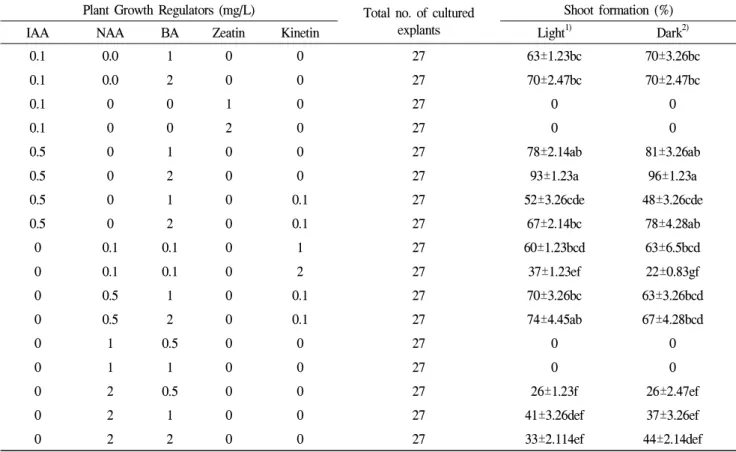
Table 1. Effect of different plant growth regulators (PGRs) and culture conditions on adventitious shoot formation from petal of standard-type chrysanthemum cv. Baeksun.
Plant Growth Regulators (mg/L) Total no. of cultured explants
Shoot formation (%)
IAA NAA BA Zeatin Kinetin Light
1)Dark
2)0.1 0.0 1 0 0 27 63±1.23bc 70±3.26bc
0.1 0.0 2 0 0 27 70±2.47bc 70±2.47bc
0.1 0 0 1 0 27 0 0
0.1 0 0 2 0 27 0 0
0.5 0 1 0 0 27 78±2.14ab 81±3.26ab
0.5 0 2 0 0 27 93±1.23a 96±1.23a
0.5 0 1 0 0.1 27 52±3.26cde 48±3.26cde
0.5 0 2 0 0.1 27 67±2.14bc 78±4.28ab
0 0.1 0.1 0 1 27 60±1.23bcd 63±6.5bcd
0 0.1 0.1 0 2 27 37±1.23ef 22±0.83gf
0 0.5 1 0 0.1 27 70±3.26bc 63±3.26bcd
0 0.5 2 0 0.1 27 74±4.45ab 67±4.28bcd
0 1 0.5 0 0 27 0 0
0 1 1 0 0 27 0 0
0 2 0.5 0 0 27 26±1.23f 26±2.47ef
0 2 1 0 0 27 41±3.26def 37±3.26ef
0 2 2 0 0 27 33±2.114ef 44±2.14def
Means followed by same letter in column are not significantly different (P<0.05) Duncan Multiple Range Test (DMRT) and each value represent mean ± SE.
1)
Explants were cultured 16 h photoperiod with light supplied by cool-white fluorescent lights (intensity 40μmolm
-2s
-1).
2)
Explants were pre-cultured for 14 days under dark conditions and transfer to 16 h photoperiod conditions.
effect of auxins and cytokinins, the cut explants were cultured in Petri dishes containing MS media supplemented with different combinations of plant growth regulators (indole-3-acetic acid, napthalic acetic acid, benzyl adenine, zeatin, and kinetins at different concentrations) (Table 1). 3% sucrose was used as the carbon source and the media were solidified using a 0.8%
agar. The acidity of the culture media was adjusted to 5.8 prior to autoclaving at 121℃ for 16 minutes. For each Petri dish, nine explants were inoculated and three replicates were taken.
To evaluate the effect of lightness and darkness on shoot
induction, 50% of the culture dishes were covered by aluminum
foil and kept under dark conditions for 14 days, while the other
50% were kept under light conditions with a 16 h photoperiod
without any aluminum foil covers. The culture environment
was adjusted to 25±1˚ under 40 μmolm
-2s
-1photosynthetic flux
and 70-80% relative humidity. The effect of the culture media,
cultivars, and their interaction on shoot induction under light
and dark conditions was evaluated after 35 days of culture.
Effect of flower bud size on shoot regeneration
Petals were collected from four sizes of flower head during development. The flowers were collected at 4 different growth sizes i.e. 2-2.5 cm, 4 cm or when only the ray flower was open, 8 cm flower bud size, and 10-12cm or completely opened flower head. The explants were cultured using an MS medium containing 0.5mg/l IAA and 2mg/l BA, 3% sucrose, and 8%
agar with a 16 h photoperiod.
3)Influence of gelling agent and genotype
Petal explants (around 1.5cm) from 4-8 cm flower heads were cultured and tested on different gelling agents (0.8% agar, 0.4%
phytagel, and 0.4% gerlite) using an MS medium (3% w/v, and sucrose) containing 0.5 mg/L IAA and 2 mg/L BA. For a genotype analysis, the petals were collected and cut from three cultivars (Baekma, Shinma, and Baeksun) with a flower bud size between 5-8cm and cultured on an MS medium (3%
w/v, sucrose and 8%, w/v, agar) containing 0.5 mg/L IAA and 2 mg/L BA.
Shoot elongation, rooting, and acclimatization
Adventitious shoots were separated from the explants and transferred to MS media without growth regulators and 2 gm/L activated charcoal media, and cultured at 25℃ under a 16 h photoperiod. After 2 months, the plantlets with vessels were
Figure 1. Plantlet regenerated from in vitro petal culture of Baeksun cultivar, a and b. adventitious shoot bud initiation after 14 days pre-culture in dark conditions and continuous light conditions, c. multiple shoot elongation after 22 days of culture in light conditions, d. multiple shoot formation after 35 days, e. root initiation in activated charcoal media, and f. regenerated plant in green house.
transferred to a greenhouse for acclimatization for 1 week, their roots washed thoroughly in tap water to remove the media, followed by planting in soil pots.
Statistical analysis
The experiments were all carried out using a completely randomized design (CRD). Each experiment was carried out using three experimental units or 3 Petri dishes and nine individual explant Petri dishes. The experimental results were subjected to statistical analysis and the means compared using Duncan’s multiple range test using SAS (statistical analysis system V. 9.3).
Results
Effect of PGR concentration, combination (IAA, NAA, BA, Zeatin, and Kinetin), and culture conditions
Plant regeneration via direct shoot organogenesis was achieved
from the cultured explant petals, as shown in figure 1. The
shoot regeneration of the Baeksun cultivar was assessed under
different light/dark regimes, along with different hormonal
combinations (Table 1), including IAA (0.1 mg/L) with BA(1
and 2 mg/L) and zeatin (1 and 2 mg/L), IAA (0.5 mg/L) with
BA (1 and 2 mg/L), or combined IAA (0.5 mg/L) and BA
(1 and 2 mg/L) with kinetin (0.1 mg/L), and NAA (0.1 and
0.5 mg/L), BA (0.1, 1 and 2 mg/L), with kinetin (1 and 2 mg/L), and NAA (1 and 2 mg/L) with BA (0.5 to 1 and 2 mg/L). The frequency of direct shoot regeneration from the petal explants exposed to light was highest at 93% on a medium containing 0.5 mg/L IAA and 2 mg/L BA, followed by 78%
on a medium containing 0.5 mg/L IAA and 1 mg/L BA (Table 1). However, when using the same hormonal combinations, the frequency of regeneration was slightly increased to 96% when the explants were pre-incubated in the dark for 14 days. The dark-treated explants and induced shoots showed a whitish yellowish color (Figure 1a), whereas the light-treated shoots remained green (Figure 1b). Yet, there was no significant difference in the shoot formation (Table 1). Organogenesis was not severely inhibited by direct exposure to light. In addition, the results showed that the combination of IAA and NAA with BA and Kinetin also produced direct shoots under both culture conditions, yet organogenesis was completely inhibited on zeatin (Table 1). Similarly, the response to a higher concentration of NAA to BA was poor in terms of direct shoot induction, yet a green-colored callus was formed (data not shown here).
Therefore, the results confirmed that direct shoot organogenesis from chrysanthemum petal explants could be improved by manipulating the PGRs and pre-culturing the explants under dark conditions.
4)Effect of flower bud size on shoot formation
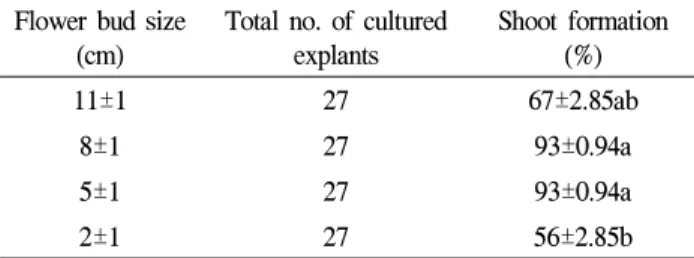
Shoot regeneration was found to be influenced by the petal age or size of the flower bud (Table 3). The highest percent of shoots was regenerated on plants from flower bud sizes of 4 cm and 8cm, whereas the lowest percent of shoots was obtained from flower bud sizes of 2 cm and 11 cm. Therefore, the results showed the importance of the chrysanthemum developmental gradient and explant stage for ensuring efficient shoot regeneration.
Effect of gelling agent
Chrysanthemum shoot regeneration depends on the type of gelling agent (Table 2), and this study evaluated the potential of various commercial gelling agents, namely 0.8% agar, 0.4%
gerlite, and 0.4% phytagel, in the culture media. While shoot organogenesis occurred with all the treatments, the maximum shoot organogenesis (96%) was observed with the 0.8% agar medium, followed by 88% with gerlite, and 68% with phytagel when using petal explants from the Baeksun cultivar. Although gelrite and phytagel provide certain advantages, like a clear gel setting allowing easy observation of the cultures and any possible contamination, the present results showed that a 0.8%
agar was the best for direct shoot organogenesis when using petal explants from a Baeksun cultivar.
Table 2. Effect of gelling agent on adventitious shoot formation from petal of standard-type chrysanthemum cv.
Baeksun.
Gelling agent Total no. of cultured
explants Shoot formation (%)
Agar 27 96±0.94a
Gerlite 27 89±1.42a
Phytagel 27 68±1.42b
Means followed by same letter in column are not significantly different (P<0.05) Duncan Multiple Range Test (DMRT) and each value represent mean ± SE.
Effect of genotype
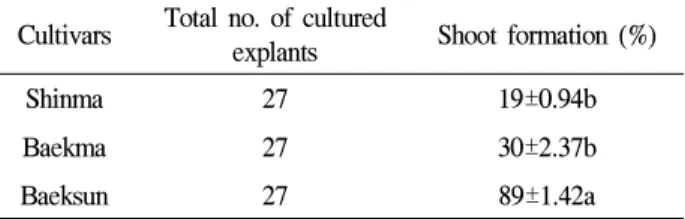
The genotype is a key factor for direct shoot organogenesis of chrysanthemums. The differences in the adventitious shoot formation frequency among the three cultivars were significant, where Baeksun exhibited the highest shoot organogenesis (89%), followed by Baekma and Shinma. Overall, the best adventitious shoots were induced from petal explants from Baeksun in MS media containing 0.5 mg/l IAA and 2 mg/l BA. As the Shinma and Baekma cultivars only showed minimal shoot formation, further research is needed to develop an efficient regeneration protocol for these cultivars.
Rooting and acclimatization
Isolated shoots were transferred to a medium containing activated charcoal for rooting. All the shoots rooted in the activated charcoal media within 2 weeks. The roots were initiated from the shoot base, and well developed shoots with a root system were achieved after 1 month of culture in the charcoal media (Figure 1e). The rooted plantlets were acclimatized for 2 weeks and successfully established in a greenhouse. No
Table 3. Effect of flower bud size on adventitious shoots formation from petal of standard-type chrysanthemum cv.
Baeksun.
Flower bud size
(cm) Total no. of cultured
explants Shoot formation (%)
11±1 27 67±2.85ab
8±1 27 93±0.94a
5±1 27 93±0.94a
2±1 27 56±2.85b
Means followed by same letter in column are not significantly different (P<0.05)
Duncan Multiple Range Test (DMRT) and each value represent mean ± SE.
phenotypic variation was observed among the regenerated plants, which behaved just like the parent plants (Figure 1f).
5)
Discussion
Successful adventitious shoot regeneration was obtained from petals, followed by establishment in a greenhouse (Figure 1), which is preferable to an Agrobacterium- mediated gene transfer system. Petal explants are suited for both adventitious shoot formation and agrobacterium -mediated gene transfer experiments (Song et al. 2011 and 2012). In this study, the plant growth regulators and culture conditions, gelling agents, flower bud size, and cultivars were all tested as critical in developing conditions conducive to efficient plantlet regeneration.
Adventitious shoots were obtained from almost all the medium compositions, yet varied with the medium composition and PGRs. Several previous studies have already reported on regeneration from chrysanthemum petals (Bush et al. 1976;
Nahid et al. 2007; Song et al. 2011). Here, direct shoot regeneration was obtained from petal explants (about 93%) on a medium containing 0.5 mg/L IAA and 2 mg/L BA (Table 1). Thus, a lower concentration of auxins than cytokinins was found to enhance shoot formation, which agrees with the results of Low et al. (1993). However, the regeneration frequency was slightly increased (up to 96%) with14 days under dark conditions (Table 1), which is also similar to The results of Park et al.
(2005). However, the optimum ratio between auxins and cytokinins for chrysanthemum shoot organogenesis remains controversial among researchers. For example, Lu et al. (1990) considered a lower concentration of cytokinins than auxins at 0.5 mg/L BAP and 1.0 mg/l NAA was the most effective for
‘Royal Purple’, while other cultivars showed effective regeneration with higher concentrations of cytokinins than auxins (Ledger et al. 1993) and some cultivars even showed effective regeneration with similar concentrations of auxins and cytokinins (Kaul et al. 1990). Song et al. (2012) reported a IAA, BA and kinetin combination was the best for shoot regeneration from chrysanthemum petal explants. Furthermore, leaf explants need a higher concentration of auxins thanstem explants, as different parts of the plant react differently to PGRs added to the medium (Kaul et al. 1990), indicatingcultivar specificity. Yet, PGRs can be considered mutually dependent, as the physiological properties of cytokinins can be explained based on their biochemical relations with auxins.
The type of gelling agent also affected the shoot formation from the petals (Table 2). The highest shoot induction percent was obtained in the agar medium. Similar results were also reported for shoot organogenesis in the case of sugarcane
(Manchanda and Gosal 2012). However, in other previous studies of shoot regeneration of plant species depending on the gelling agent, genotype, plant species, and explant type, in the case of chrysanthemums, Lim et al. (2012) reported that gerlite was the best gelling agent for shoot formation from the petiole and leaf, while another report considered gerlite better than a plant agar for shoot regeneration from Rubus leaves (Tsay et al. 2006). Some plant species even show no effect on regeneration by a gelling agent, e.g. raspberries (Cousineau and Donnelly 1991). Yet, since some components of gelling agents are toxic to explants, Bornman and Vogelman (1984) reported that the physical state of the medium can affect the diffusion of plant growth regulators and nutrients.
A higher percent of shoots was regenerated on the plants from flower bud sizes of 4 cm and 8 cm among the different flower bud sizes. The development stage of the explants is also critical for inducing somatic embryos and adventitious shoots in a range of plant species (Gilissen et al. 1996). Park et al. (2007) found that the shoot regeneration efficiency was higher when using petals 2-3 days before the ray flower open stage than 7-8 days after the tubular flower stage with the Orlando chrysanthemum cultivar.
Adventitious shoot organogenesis from petals, nodes, segments, protoplasts, and somatic embryos has already been reported with a wide range of responses depending on the variety (Hodson de Jaramillo et al. 2008). This study found significant differences in the shoot formation among the three cultivars (Table 4), which is similar to previous reports on chrysanthemum cultivars (Annadana et al, 2000; Kaul et al. 1990; Prasad et al. 1983;
Sauvadet et al. 1990; Teixeira da Silva. 2004).
Table 4. Effect of cultivars on adventitious shoots formation from petal of standard-type chrysanthemum cv.
Baeksun.
Cultivars Total no. of cultured
explants Shoot formation (%)
Shinma 27 19±0.94b
Baekma 27 30±2.37b
Baeksun 27 89±1.42a
Means followed by same letter in column are not significantly different (P<0.05)
Duncan Multiple Range Test (DMRT) and each value represent mean ± SE
Here, an efficient in vitro regeneration protocol was developed
for Baeksun cultivars using petal explants and an agar medium
supplemented with 0.5 mg/L IAA and 2mg/L BA. The optimum
regeneration of this cultivar was found to depend on the PGR
type and concentration, gelling agent, flower bud size, culture conditions, and cultivar type. As regenerated shoots were developed directly from explants, this protocol can be useful for the micropropagation and genetic transformation of Baeksun cultivars. Since the other cultivars investigated, Shinma and Baekma, showed a poor regeneration potential, further research with a wider range of PGR concentrations is needed to develop an efficient regeneration protocol for these cultivars.
6)