Journal of Information Science Theory and Practice http://dx.doi.org/10.1633/JISTaP.2014.2.1.3
Korea’s STEM Research Analysis Based on Publications in
the Web of Science, 1968-2012
Byungkyu Kim
Information Service Center, Korea Institute of Science and Technology Information, Korea
E-mail: [email protected]
Minho So
Korea Advanced Institute of Science and Technology, Korea
E-mail: [email protected]
Seon-heui Choi*
Information Service Center, Korea Institute of Science and Technology Information, Korea
E-mail: [email protected]
Open Access
Accepted date: March 6, 2014 Received date: November 18, 2013
*Corresponding Author: Seon-heui Choi
Principal researcher Information Service Center
Korea Institute of Science and Technology Information, Korea
E-mail: [email protected]
All JISTaP content is Open Access, meaning it is accessible online to everyone, without fee and authors’ permission. All JISTaP content is published and distributed under the terms of the Creative Commons Attribution License (http:/ creativecommons. org/licenses/by/3.0/). Under this license, authors reserve the copyright for their content; however, they permit anyone to unrestrictedly use, distribute, and reproduce the content in any medium as far as the original authors and source are cited. For any reuse, redistribution, or reproduction of a work, users must clarify the license terms under which the work was produced.
ABSTRACT
Korean researchers’ scientific outputs are increasing rapidly with the growth of both Korea’s economy and in-dustry size. This is the time to analyze the scientific output (STEM area) of Korea over the last 40 years. For this analysis, this study used the SCIE database of Web of Science (WoS), which is a representative global Citation In-dex Service. The objects of analysis are every Korean document published in the SCIE journal, and the research scopes are (1) analysis of citation and subject categories and (2) analysis of co-authorship. Through this study, characteristics such as cited trend and research trend by subject, and the status of collaboration between Korea and other countries including the 50 states of the USA were revealed.
Keywords: Bibliometrics, STEM research, Web of Science, Korea
1. INTRODUCTION
South Korea (hereafter Korea) is one of the coun-tries that has developed swiftly during the last half century. The number of patents and scholarly publi-cations in the Science, Technology, Engineering and
for scientific research because of the fast increase of Korea’s scientific output (Leydesdorff & Zhou, 2005). Therefore, the research-to-analysis of international scholarly publications in Korea overall is important.
Scholarly publications such as journal articles are considered representative research products in most STEM disciplines because scholars in their academic communities accept them as a formal scholarly com-munication channel. These can be used as metric tools of research establishments as well as scholarly communication. The representative method is cita-tion analysis.
Citation analysis is a research method of biblio-metrics, which investigates the relationship between cited and citing documents. Citation analysis has been a research area because of its usefulness of the methodology and result. There have been many ap-plications of citation analysis, such as user studies, history of science studies, communication patterns of scientists, evaluation of scientific influence and productivity, information retrieval, collection de-velopment, studies of document types or use in a field, studies of research trends, and distribution of information resources (Choi, S-K, 1996). In particu-lar, research using citation analysis such as networks among researchers, integration among academic fields, developmental process of academic fields or research trends, and knowledge maps have been productively performed recently (Cho, H-Y, 2010).
Thomson Reuters’ (previously ISI) WoS is the first citation index database for citation analysis and is the most well-known in the world. Thomson Re-uters’ WoS covers a variety of disciplines: Science, Social science, and Arts & Humanities, and supports citation indices such as SCIE, SSCI, and A&H-CI (classified by subject respectively). Nowadays, Scopus of Elsevier and Google Scholar also offer competitive service based citation index databases. Recently, some researchers have tried to compare and analyze these databases (Meho & Yang, 2007). Specifically, Thomson Reuters has improved WoS with the mission, “to maintain a database of world-wide scholarly content that helps researchers find the highest quality literature relevant to their work,” (Saha et al., 2003) and the database is used for much research related citation analysis.
We made a choice to utilize WoS because the
ob-ject of this study is to analyze Korean international scholarly publication produced over the last 40 years. Citation analysis has had limited use in providing basic statistics of citation. However, we focus more on analysis to find out characteristics by subject and co-authorship. Specifically, the objectives of this study are (1) analysis of Korean scholarly publica-tions by citation and subject using the WoS SCIE database, and (2) analysis of co-authorship between Korea and other countries using the WoS SCIE data-base.
2. RELATED LITERATURE
Researchers all around the globe have continued to measure the scientific performance of countries based on the bibliometric method, but now research related to Asian countries has become important (Zhang & Zhang, 1997; Fukui & Rahman, 2002; Abrizah & Wee 2011; Fu & Ho, 2013). The scope of analysis of this research is generally the distribution of scholarly publications, science disciplines, con-tributing institutions, and collaboration. Specifically, (Jeenah & Pouris, 2008; Marshakova-Shaikevich, 2006) Thomson Reuters has published research re-ports about the emerging research front as well as research performance using various measurements, such as the analysis of citation patterns (Thomson Reuters 2008, 2013).
Korean research for the analysis of performance of national scientific output is very similar to that of other countries, but it can be separated into two proaches according to research material. The first ap-proach is to use international scholarly publications as research materials, such as journal publications in WoS or SCOPUS (Kim 2001, 2005; Kim & Noh 2011; NSTC 2011; Kim 2012). The second approach is to utilize national journal publications by national publishers, such as academic societies in various ar-eas (Choi & Kim 2008; Kim & Choi 2008). Recently, researchers have used Korea’s citation index data-bases, such as KSCI, KCI, and KOMCI, and studies for the comparison of these citation indices is being carried out (Yang & Lee, 2012).
using the KSCD (Korea Science Citation Database).1
KSCD was developed in 2001 by KISTI (Korea In-stitute of Science and Technology Information), and it covers high quality journal articles and citation information by Korean publishers. Through this re-search, the characteristics of domestic scholarly pub-lications were revealed, such as publication status by subject, citation trend, and co-authorship between universities or research institutions (Choi & Kim, 2012).
The related research in Korea has limitations in focusing on specific areas of science. National jour-nal publications had limited ajour-nalysis, which made it difficult to discover long term research trends. This study supplements this limitation through us-ing international scholarly publications by Korean researchers during the last 40 years. For the future, utilization of both global citation index databases, such as WoS and SCOPUS, and Korea’s citation in-dex databases, such as KSCD, should be considered to analyze Korea’s scientific performance concretely.
3. DATA COLLECTION AND METHOD
This study focuses on Korean scholarly publica-tions that are indexed by WoS SCIE and uses all types of documents (articles, editorial materials, letters, news items, corrections, notes, and reviews). Other journals’ publications are not considered. In the next study, selection of document types and article types has to be considered, based on related research about document type (van Leeuwen, Thed, & Costas, 2013).
The following steps to retrieve the relevant data were:
(1) Thomson Reuters’ EndNote (version 6) is the software tool for publishing and managing bibliographies, which is used to collect data. (2) Using the search feature, the author address
field (key word “Korea”) was used as the que-ry command and the citation database “WoS Science Citation Index Expanded
(SCI-EX-PANDED)” was selected (May 2013).
(3) The search retrieved a total number of 493,123 records during the time period 1968-2012. For efficiency, searches and downloads were completed by each year, and repeated 45 times (1968-2012). Specifically, we added the new type for extraction as Excel format to output styles of EndNote Software.
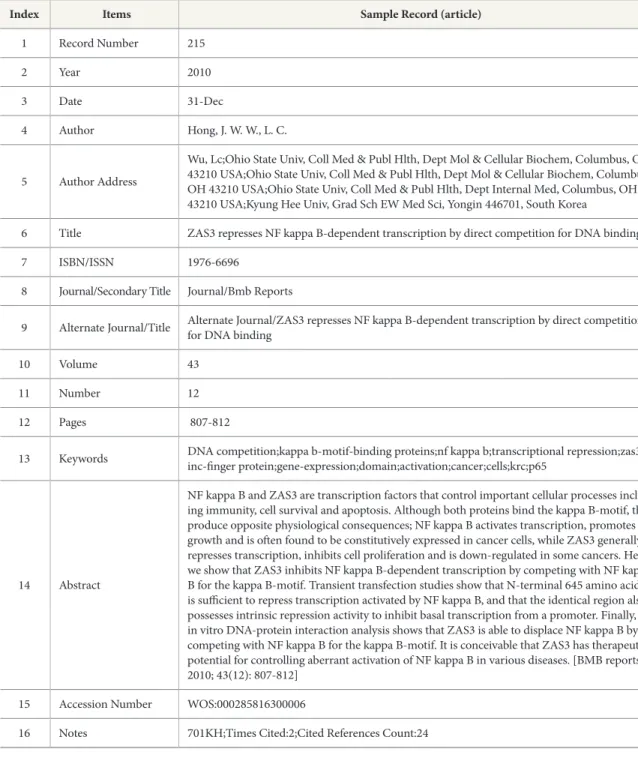
The sample record from the downloaded data is to ascertain the following (See Table 1).
A collected data set was preprocessed to be able to analyze exact detail. For example, the “Author Address” item in Table 1 was split by countries and 50 states in the case of the “USA” to analyze co-au-thorship in Korean STEM research. North Korea’s publications among collected data were very min-imal since there were only 215, so the data was ig-nored in the analysis. Specifically, all of the journals (8,100) which contain collected data were classified by subject categories, such as 176 specific catego-ries of WoS and Leydesdorff’s 14 subject categocatego-ries (Leydesdorff & Rafols, 2009). Microsoft Excel and Tableau Public were utilized as tools for analyzing and drawing charts and maps.
The results of this study are based on only Kore-an scholarly publications that are indexed by WoS SCIE so that the results cannot be interpreted as representative of the complete Korean scientific output.
4. RESULTS
4.1. Analysis of Korean STEM Research by Citation and Subject Categories
The number of publications during the period from 1968 to 1980 is considerably fewer compared to the period after 1980, so that this specific analysis has limitations.
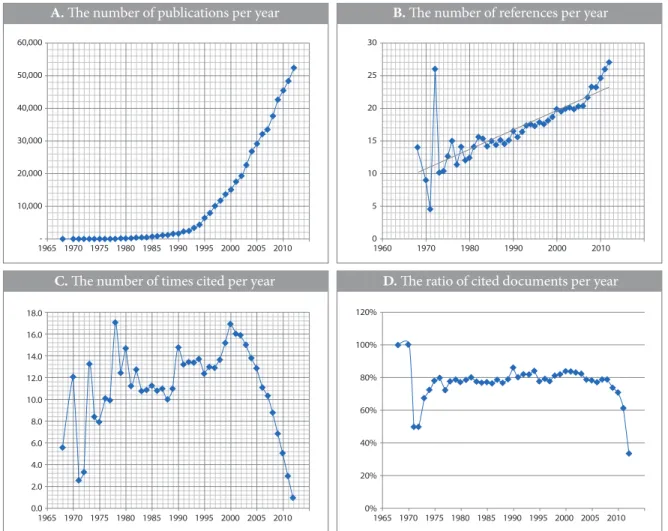
As Fig. 1-A shows, Korean publications during the last 30 years have increased consistently. Specifically, the average rate of increase from 1981 to 2012 is 20%
and the median value is 17%. Also, the average rate of increase of the number of references of Korean publications has increased by 3% so that the average number of references of the year 2012 became 27.1.
The average increase rate of times cited is 23%, but from 2006, it has continued to drop as shown in Fig. 1-C. The citation ages (i.e., immediacy, peak-time, and half-time of citation) is considered the reason
Table 1. Sample data from the downloaded data in SCI Database using EndNote Software
Index Items Sample Record (article)
1 Record Number 215
2 Year 2010
3 Date 31-Dec
4 Author Hong, J. W. W., L. C.
5 Author Address
Wu, Lc;Ohio State Univ, Coll Med & Publ Hlth, Dept Mol & Cellular Biochem, Columbus, OH 43210 USA;Ohio State Univ, Coll Med & Publ Hlth, Dept Mol & Cellular Biochem, Columbus, OH 43210 USA;Ohio State Univ, Coll Med & Publ Hlth, Dept Internal Med, Columbus, OH 43210 USA;Kyung Hee Univ, Grad Sch EW Med Sci, Yongin 446701, South Korea
6 Title ZAS3 represses NF kappa B-dependent transcription by direct competition for DNA binding
7 ISBN/ISSN 1976-6696
8 Journal/Secondary Title Journal/Bmb Reports
9 Alternate Journal/Title Alternate Journal/ZAS3 represses NF kappa B-dependent transcription by direct competition for DNA binding
10 Volume 43
11 Number 12
12 Pages 807-812
13 Keywords DNA competition;kappa b-motif-binding proteins;nf kappa b;transcriptional repression;zas3;z-inc-finger protein;gene-expression;domain;activation;cancer;cells;krc;p65
14 Abstract
NF kappa B and ZAS3 are transcription factors that control important cellular processes includ-ing immunity, cell survival and apoptosis. Although both proteins bind the kappa B-motif, they produce opposite physiological consequences; NF kappa B activates transcription, promotes cell growth and is often found to be constitutively expressed in cancer cells, while ZAS3 generally represses transcription, inhibits cell proliferation and is down-regulated in some cancers. Here, we show that ZAS3 inhibits NF kappa B-dependent transcription by competing with NF kappa B for the kappa B-motif. Transient transfection studies show that N-terminal 645 amino acids is sufficient to repress transcription activated by NF kappa B, and that the identical region also possesses intrinsic repression activity to inhibit basal transcription from a promoter. Finally, in vitro DNA-protein interaction analysis shows that ZAS3 is able to displace NF kappa B by competing with NF kappa B for the kappa B-motif. It is conceivable that ZAS3 has therapeutic potential for controlling aberrant activation of NF kappa B in various diseases. [BMB reports 2010; 43(12): 807-812]
15 Accession Number WOS:000285816300006
for this syndrome. The related research based on KSCD investigated citation ages by discipline (Choi & Kim, 2012). However, the research to reveal the exact reason and meaning has yet to be conducted. The average rate of cited percentage as shown in Fig. 1-D remains around 80%, but went down after the year 2000. The reason for this syndrome is possibly also due to the citation ages.
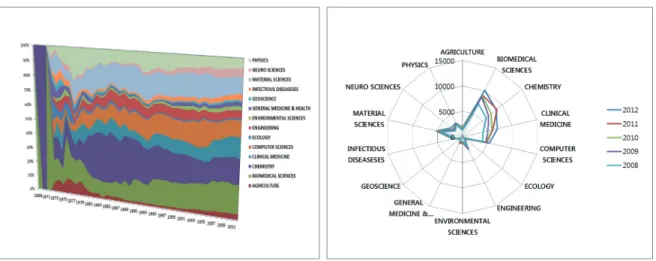
The analysis of Korean publications by subject categories (14 areas) that Leydesdorff suggested is shown in Fig. 2. This shows scientific output was concentrated to some categories like Biomedical Sci-ences 18%, Chemistry 17%, Material SciSci-ences 13%, Computer Sciences 12%, and Clinical Medicine 11%. Among the categories with the largest percentage, Chemistry (30.7%→16.0%) and Material Sciences
(15.3%→13%) have decreased significantly; on the contrary, the categories that have increased percent-age rates are Biomedical Science (11.1%→18.5%), Clinical Medicine (7.7%→10.3%), and Computer Sciences (10.0%→13.2%). Despite sharing a small percentage, the categories that show a large per-centage increase rate during the last 30 years are Neurosciences (0.8%→4.4%, 238%), Infectious Dis-eases (1.3%→2.8%, 152%), Environmental Sciences (1.1%→2.2%, 141%), General Medicine & Health (1.3→2.3%, 137%), and Agriculture (2.2%→3.0%, 133%).
These characteristics discussed above might be related to the distribution by subject of the WoS da-tabase, so additional analysis research is required.
Fig. 1 Basic Status of Citation in Korean STEM Research (1968-2012) A. The number of publications per year
C. The number of times cited per year
B. The number of references per year
D. The ratio of cited documents per year
Correlation between the number of publications and the average number of times cited was not found, as shown in Fig. 3. The categories where the average number of times cited compared to pub-lications are high are: Physics, Infectious diseases, Environment Science, and Geoscience. On the con-trary, the categories where the average of times cited compared to publications are low are: Computer
Sci-ences, Engineering, General Medicine & Health, and Agriculture.
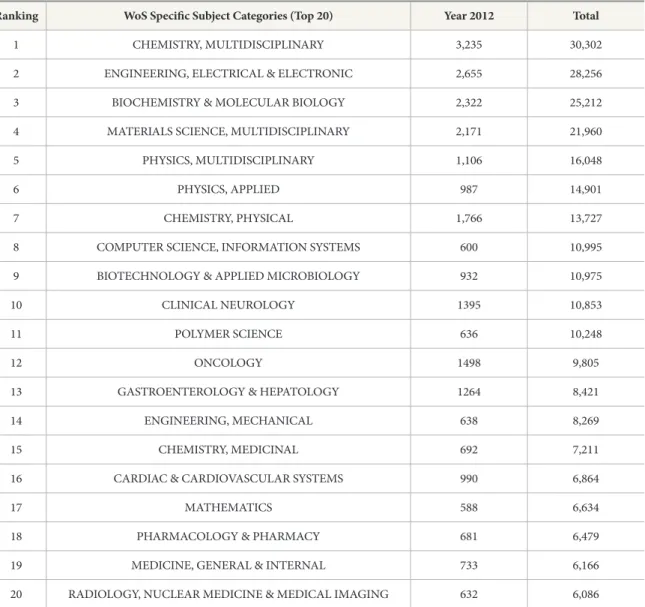
The result of the top 20 sub-categories and the number of publications analyzed by WoS subject cat-egories (176 in STEM areas) is shown in Table 2. Top 5 journals by subjects and publications are described in Appendix A.
Fig. 3 Publications vs. Times Cited by 14 Subject Categories (1968-2012)
BIOMEDIC AL SCIENCES CLINIC AL MEDICINE ENVIR ONMENT AL SCIENCES MATERIAL SCIENCES INFEC TIOUS DISEASESES ENGINEERING EC OLOGY CHEMISTR Y AGRICUL TURE PHYSICS GEOSCIENCE COMPUTER SCIENCES GENER
AL MEDICINE & HEAL TH NEUR O SCIENCES 100,000 10,000 1,000 100 10 1 14.0 12.0 10.0 8.0 6.0 4.0 2.0 -11.5 11.8 9.5 6.2 6.8 11.4 5.7 8.3 7.1 10.5 6.9 10.0 9.5 7.6 The number of document Average number of times cited per document
Table 2. Number of Documents by WoS 176 Categories within Top 20 Categories: Total vs. 2012
Ranking WoS Specific Subject Categories (Top 20) Year 2012 Total
1 CHEMISTRY, MULTIDISCIPLINARY 3,235 30,302
2 ENGINEERING, ELECTRICAL & ELECTRONIC 2,655 28,256
3 BIOCHEMISTRY & MOLECULAR BIOLOGY 2,322 25,212
4 MATERIALS SCIENCE, MULTIDISCIPLINARY 2,171 21,960
5 PHYSICS, MULTIDISCIPLINARY 1,106 16,048
6 PHYSICS, APPLIED 987 14,901
7 CHEMISTRY, PHYSICAL 1,766 13,727
8 COMPUTER SCIENCE, INFORMATION SYSTEMS 600 10,995
9 BIOTECHNOLOGY & APPLIED MICROBIOLOGY 932 10,975
10 CLINICAL NEUROLOGY 1395 10,853
11 POLYMER SCIENCE 636 10,248
12 ONCOLOGY 1498 9,805
13 GASTROENTEROLOGY & HEPATOLOGY 1264 8,421
14 ENGINEERING, MECHANICAL 638 8,269
15 CHEMISTRY, MEDICINAL 692 7,211
16 CARDIAC & CARDIOVASCULAR SYSTEMS 990 6,864
17 MATHEMATICS 588 6,634
18 PHARMACOLOGY & PHARMACY 681 6,479
19 MEDICINE, GENERAL & INTERNAL 733 6,166
20 RADIOLOGY, NUCLEAR MEDICINE & MEDICAL IMAGING 632 6,086
4.2. Analysis of Co-authorship in Korean STEM Research
The number of authors has increased between 1968 and 2012, and the average number of authors per document is 11.4. The result of the analysis for corresponding authors’ nationality is shown in Fig. 4.The percentage of publications with Korean corresponding authors investigated is 87%, which is a much higher rate than the percentage of other nationalities. Because the majority of corresponding authors are Korean, this indicates that Korean re-searchers played a leading role in their publications.
The next highest percentages of corresponding au-thors from other countries are as follows: the USA, Japan, China, and so on. Specifically, the percentage of corresponding authors’ nationality in China has increased recently. This would be related to the increase in China’s publications in the WoS SCIE database to 2nd place (12.09%) in 2012 compared to 6th place (1.4%) in 2003. However, further specific research to find the exact reason is required.
pub-Fig. 4 Percentage of Corresponding Authors by Nationality (1968-2012)
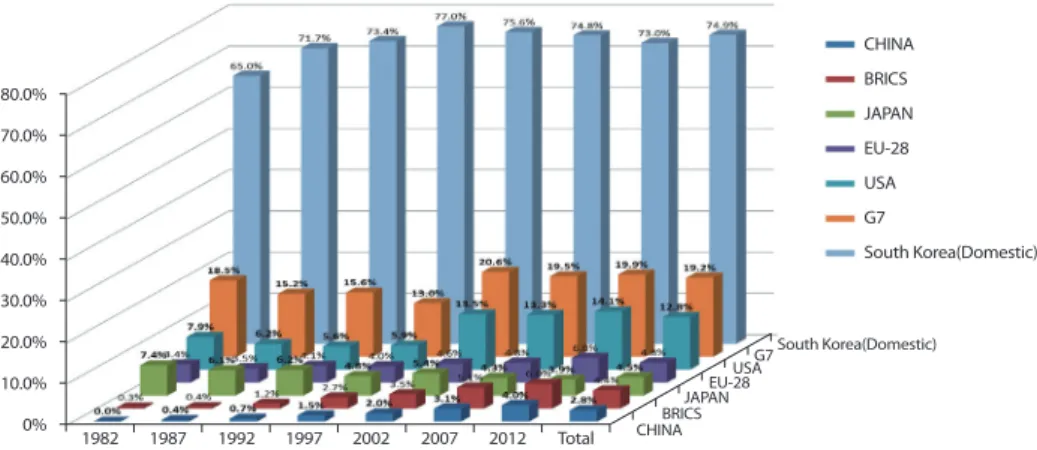
Fig. 5 Percentage of Co-Authorship with Major Countries or a Group of Countries Every 5 Years (1982-2012)
100% 95% 90% 85% 80% 75% 70% 2012 2011 2010 Total 45,062 3,056 692 727 41,652 2,877 601 660 39,447 2,650 618 563 431,129 29,097 8366 4771 Italy Australia France Russia India UK Canada Germany China Japan USA South Korea 1982 1987 1992 1997 2002 2007 2012 Total CHINA BRICSJAPAN EU-28USA G7South Korea(Domestic) CHINA BRICS JAPAN EU-28 USA G7 South Korea(Domestic) 80.0% 70.0% 60.0% 50.0% 40.0% 30.0% 20.0% 10.0% 0%
lications and co-authorship is the highest with G7 countries (USA, UK, France, Germany, Italy, Can-ada); specifically, collaboration research was high among all of the countries. Also, when investigated, it was found that collaborative research (co-author-ship) with BRICs (Brazil, Russia, India, China) coun-tries has also increased rapidly. Furthermore, co-au-thorship has increased between Korea and China consistently, but on the contrary, co-authorship with Japan has continued to decrease. As a result, the ratio of co-authorship has changed. Additional research is required to find the exact reason for this trend.
The result for analysis of co-authorship in schol-arly research between Korea and the 50 states in the USA, and the District of Columbia and Puerto Rico, is shown in Fig. 6. The state in the USA that made
the most research in publications was found to be California (total number of publications: 13,403; 2012 number of publications: 1,810) and other states such as New York, Maryland, Massachusetts, and Texas followed. The duplication which occurs from co-authorship between Korea and one or more states of the USA were not excluded in Fig. 6.
5. DISCUSSION AND CONCLUSION
This study analyzes only those journal publications which researchers consider to be the most representa-tive and trustworthy for analyzing Korean researchers’ scientific output in STEM using bibliometric methods during the last 40 years. Specifically, Thomson Reu-ters’ WoS SCIE database is used for citation analysis and EndNote software is utilized to collect the data set. The objective of the research is first, analysis of citation and subject categories and second, analysis of co-authorship. For this, the collected data was pre-processed to add subject classifications on jour-nals using Leydesdorff and WoS subject categories.
The findings of the study are as follows:
(1) After 1980, the number of Korean researchers’ publications in STEM has increased 20% on average, and the average increase of the num-ber of references was 3%. Also, the average increase in times cited with respect to the es-timation of the quality was 23% and the ratio of cited publications was 80%; however, both these numbers have decreased since 2000. The main cause of this is attributed to the citation ages (i.e., immediacy, peak-time, and half-time of citation), but related research is required to find the exact reason.
(2) The publications were concentrated on dis-ciplines such as Biomedical Sciences (18%),
Chemistry (17%), Material Sciences (13%), Computer Sciences (12%), and Clinical Medi-cine (11%), and this portion shared 70%. (3) After 1980, the discipline with the highest
percent decrease in publications, among other disciplines, was Chemistry (30.7%→16.0%). On the other hand, the discipline with the highest percent increase was Biomedical Sci-ence (11.1%→18.5%).
(4) Correlation between the number of publica-tions and the average of times cited was not found. The category where the average of times cited is high was Chemistry (11.8); on the other hand, the category where the aver-age of times cited is low was Engineering (5.7). (5) The percentage of publications of correspond-ing authors by country was in the followcorrespond-ing order: Korea (87%), USA (7%), Japan, and China, but China overtook Japan during the last two years.
(6) Independent publications by Korean research-ers share 75% and co-authorship is the highest with G7 countries (USA, UK, France, Germa-ny, Italy, Canada); specifically, collaboration research was high among all of the countries. Also, the syndrome known as collaborate research (co-authorship) with BRIC (Brazil, Russia, India, China) countries has rapidly increased. Specifically, co-authorship has
in-Fig. 6 Co-authorship Between Korea and 50 States/Jurisdictions of USA (1968-2012): Total vs. Year 2012
Calif or nia NewY or k M ar yland M assachusetts Te xas Illinois Pennsylv ania M
ichigan Ohio Flor
ida NewJersey Indiana Nor thC ar olina Vir ginia W ashingt on W isc onsin Connec ticut Iow a M innesota Geor gia Tennessee Color ado Louisiana NewM exic o A riz ona Ha w aii Nebr ask a M issour i A labama U tah Rhode Island Distr ic t of C olumbia Kansas Ok lahoma M ississippi SouthC ar olina Or egon Ken tuck y Puer to R ic o D ela w ar e NewHampshir e A rk ansas Idaho Nev ada M aine M on tana W estV irg inia Ver mon t SouthDakota Nor thDakota Wyoming A lask a 12.0% 10.0% 8.0% 6.0% 4.0% 2.0% 0.0%
creased between Korea and China consistent-ly. China’s increase overtook Japan during the past two years.
(7) As a result from the analysis of co-authorship between Korea and 50 states in the USA, the state which made the most research in publi-cations was California (12%).
(8) The categories which are high in the ratio of co-authorship with other countries are Phys-ics (38%), Environment Sciences (38%), Ecol-ogy (49%), and Geoscience(55%). Whereas, the other 10 disciplines share over 70% of the ratio of independent research by Korean re-searchers. Specifically, the category in which the ratio of independent research by Korean researchers is the highest was investigated. For the future, the utilizing of other databases such as KSCD should be considered because this research limited the analysis scope to only the SCIE database. Specifically, as a result from other recent analysis of the composition (rate) by subject between KSCD and SCIE, two compositions were considerably different (Choi & Kim 2013). Therefore, comparison with KSCD is required to analyze Korea’s scientific perfor-mance completely.
REFERENCES
Abrizah, A., & Wee, M.-C. (2011). Malaysia’s Com-puter Science research productivity based on publications in the WoS, 2000-2010. Malaysian Journal of Library & Information Science, 16(1), 109-124.
Bornmann, L., & Daniel, H.-D. (2008). What do ci-tation counts measure? – A review of studies on citing behavior. Journal of Documentation, 64(1), 45-80.
Choi, H.-N., Kim, B.-K., Jung, Y.-I. & Choi, S.-H. (2013). Collnet Journal of Scientometrics and In-formation Management, 7(1), 1-33.
Cho, H.-Y. (2010). A comparative study on research-ers’ language preference for citing documents in different subject fields. Journal of the Korean BIB-LIA Society for Library and Information Science, 21(1), 212-221.
Choi, S.-H., Kim, B.-K., Kang, M.-Y., You, B.-J., Lee, J.,
& Park, J.-W. (2011). A study of citing patterns of Korean scientists on Korean journals. Journal of the Korean Society for information Management, 28(2), 97-115.
Choi, S.-H., & Kim, B.-K. (2013). Study on automatic subject classification of Korean Journals using ci-tation index databases. International Conference on Convergence Content 2013, Japan.
Choi, S.-K. (1996). Comparative study on citation analysis in the field of mechanical engineering in Korea and Japan. Journal of the Korean Society for information Management, 13(2), 121-142. Fu, H.-Z., & Ho, Y.-S. (2013). Independent research
of China in Science Citation Index Expanded during 1980-2011. Journal of Informetrics, 7(1), 210-222.
Fukui, T., & Rahman, M. (2002). Contribution of research in basic and clinical sciences in Japan. Internal Medicine, 41(8), 626–628.
Kim, B.-K., Kang, M.-Y., Choi, S.-H., Kim, S.-Y., You, B.-J. & Shin, J.-D. (2011). Citing behavior of Korean scientists on foreign journals in KSCD. Journal of the Korean Society for information Management, 28(2), 117-133.
Kim, M.-J. (2001). A bibliometric analysis of physics publications in Korea 1994–1998. Scientometrics, 50, 503–521.
Kim, M.-J. (2005). Korean science and international collaboration, 1995–2000. Scientometrics, 63(2), 321–339.
Kim, W.-J., Noh, K.-R., Park, M.-S. & Choi, H.-K. (2011). 2010 SCI analysis research of Korean re-searchers. KISTI Knowledge Report, 16.
Kim, W.-J. (2012). A study on the factors influencing citation speed and citation frequency of scientific articles using bibliometric analysis in South Ko-rea. Journal of the Korean Society for Library and Information Science, 46(4), 285-306.
King, C., & Pendlebury, D.A. (2013). Web of Knowl-edge research fronts 2013: 100 top-ranked specialties in the sciences and social sciences. Thomson Reuters.
Leydesdorff, L., & Zhou, P. (2005). Are the contri-bution of China and Korea upsetting the world system of science? Scientometric, 63(3), 617–630. Leydesdorff, L., & Rafols, I. (2009). A global map
Journal of the American Society for Information Science and Technology, 60(2), 348–362.
National Science & Technology Commission (2011). SCI Analysis Research.
Meho, L. I., & Yang, K. (2007). Impact of data sources on citation counts and rankings of LIS faculty: Web of Science versus Scopus and Google Schol-ar. Journal of the American Society for Informa-tion Science and Technology, 58(13), 2105–2125. Marshakova-Shaikevich, I. (2006). Scientific
collab-oration of new 10 EU countries in the field of social sciences. Information Processing and Man-agement, 42(6), 1592-1598.
Thomson Reuters (2008). A guide to evaluating re-search performance with citation data.
Van Leeuwen, T. N., Costas, R., Calero-Medina, C., & Visser, M. S. (2013). The role of editorial material in bibliometric research performance assess-ments. Scientometrics, 95(2), 817-828.
Yang, K.-D., & Lee, J.-W. (2012). Comparative analy-sis of citation indexes in Korea. Proceedings of the 8th International Conference on WIS (pp. 756-762), Seoul: KISTI.
Appendix A
Top 5 Journals by Subject Categories: 1968-2012 vs. 2012.
Subject
Categories Top 5 Journals by Publications (1968-2012) Top 5 Journals by Publications (2012)
BIOMEDICAL SCIENCES
FASEB JOURNAL PLOS ONE
JOURNAL OF MICROBIOLOGY AND
BIOTECHNOLOGY BIOCHEMICAL AND BIOPHYSICAL RESEARCH COMMUNICATIONS BIOCHEMICAL AND BIOPHYSICAL RESEARCH
COMMUNICATIONS FASEB JOURNAL
MOLECULES AND CELLS ANNALS OF ONCOLOGY
JOURNAL OF BIOLOGICAL CHEMISTRY JOURNAL OF CLINICAL ONCOLOGY
MATERIAL SCIENCES
APPLIED PHYSICS LETTERS APPLIED PHYSICS LETTERS
JAPANESE JOURNAL OF APPLIED PHYSICS JAPANESE JOURNAL OF APPLIED PHYSICS JOURNAL OF APPLIED PHYSICS JOURNAL OF APPLIED PHYSICS
PHYSICAL REVIEW B CURRENT APPLIED PHYSICS
THIN SOLID FILMS JOURNAL OF CERAMIC PROCESSING RESEARCH
COMPUTER SCIENCES
NEURAL INFORMATION PROCESSING, PT 2,
PROCEEDINGS IEICE TRANSACTIONS ON COMMUNICATIONS
ELECTRONICS LETTERS ELECTRONICS LETTERS
IEICE TRANSACTIONS ON COMMUNICATIONS EXPERT SYSTEMS WITH APPLICATIONS IEEE TRANSACTIONS ON MAGNETICS IEEE TRANSACTIONS ON MAGNETICS IEEE TRANSACTIONS ON CONSUMER
ELECTRONICS JOURNAL OF ELECTRICAL ENGINEERING & TECHNOLOGY
CLINICAL MEDICINE
AMERICAN JOURNAL OF CARDIOLOGY JOURNAL OF GASTROENTEROLOGY AND HEPATOLOGY JOURNAL OF DENTAL RESEARCH JOURNAL OF DERMATOLOGY
JOURNAL OF GASTROENTEROLOGY AND
HEPATOLOGY JOURNAL OF THE AMERICAN COLLEGE OF CARDIOLOGY
BLOOD AMERICAN JOURNAL OF CARDIOLOGY
CIRCULATION GASTROINTESTINAL ENDOSCOPY
NEURO SCIENCES
JOURNAL OF KOREAN NEUROSURGICAL
SOCIETY JOURNAL OF KOREAN NEUROSURGICAL SOCIETY
NEUROSCIENCE LETTERS ASIA-PACIFIC PSYCHIATRY
INVESTIGATIVE OPHTHALMOLOGY & VISUAL
SCIENCE EUROPEAN JOURNAL OF NEUROLOGY
EUROPEAN NEUROPSYCHOPHARMACOLOGY NEUROSCIENCE LETTERS
STROKE JOURNAL OF PHYSICAL THERAPY SCIENCE
ECOLOGY
AQUACULTURE JOURNAL OF ASIA-PACIFIC ENTOMOLOGY
JOURNAL OF PHYCOLOGY ENTOMOLOGICAL RESEARCH
JOURNAL OF ASIA-PACIFIC ENTOMOLOGY ZOOTAXA
FISHERIES SCIENCE FISH & SHELLFISH IMMUNOLOGY FISH & SHELLFISH IMMUNOLOGY JOURNAL OF PHYCOLOGY
CHEMISTRY
BULLETIN OF THE KOREAN CHEMICAL SOCIETY BULLETIN OF THE KOREAN CHEMICAL SOCIETY ABSTRACTS OF PAPERS OF THE AMERICAN
CHEMICAL SOCIETY JOURNAL OF NANOSCIENCE AND NANOTECHNOLOGY KOREAN JOURNAL OF CHEMICAL
ENGINEERING JOURNAL OF MATERIALS CHEMISTRY
ARCHIVES OF PHARMACAL RESEARCH CHEMICAL COMMUNICATIONS JOURNAL OF NANOSCIENCE AND
Subject
Categories Top 5 Journals by Publications (1968-2012) Top 5 Journals by Publications (2012)
GEOSCIENCE
JOURNAL OF GEOPHYSICAL RESEARCH JOURNAL OF GEOPHYSICAL RESEARCH
GEOSCIENCES JOURNAL GEOSCIENCES JOURNAL
GEOPHYSICAL RESEARCH LETTERS JOURNAL OF GEOPHYSICAL RESEARCH-ATMOSPHERES JOURNAL OF GEOPHYSICAL
RESEARCH-ATMOSPHERES CLIMATE DYNAMICS
GEOCHIMICA ET COSMOCHIMICA ACTA ASIA-PACIFIC JOURNAL OF ATMOSPHERIC SCIENCES
ENGINEERING
JOURNAL OF MECHANICAL SCIENCE AND
TECHNOLOGY JOURNAL OF MECHANICAL SCIENCE AND TECHNOLOGY KSME INTERNATIONAL JOURNAL INTERNATIONAL JOURNAL OF PRECISION ENGINEERING AND MANUFACTURING INTERNATIONAL JOURNAL OF HEAT AND MASS
TRANSFER INFORMATION-AN INTERNATIONAL INTERDISCIPLINARY JOURNAL JOURNAL OF SOUND AND VIBRATION ABSTRACT AND APPLIED ANALYSIS INTERNATIONAL JOURNAL OF PRECISION
ENGINEERING AND MANUFACTURING INTERNATIONAL JOURNAL OF AUTOMOTIVE TECHNOLOGY
INFECTIOUS DISEASESES
JOURNAL OF MICROBIOLOGY JOURNAL OF BACTERIOLOGY INTERNATIONAL JOURNAL OF SYSTEMATIC
AND EVOLUTIONARY MICROBIOLOGY TRANSPLANTATION PROCEEDINGS TRANSPLANTATION PROCEEDINGS JOURNAL OF IMMUNOLOGY JOURNAL OF ALLERGY AND CLINICAL
IMMUNOLOGY INTERNATIONAL JOURNAL OF SYSTEMATIC AND EVOLUTIONARY MICROBIOLOGY
JOURNAL OF IMMUNOLOGY JOURNAL OF MICROBIOLOGY
ENVIRONMEN-TAL SCIENCES
WATER SCIENCE AND TECHNOLOGY KSCE JOURNAL OF CIVIL ENGINEERING JOURNAL OF HAZARDOUS MATERIALS BIORESOURCE TECHNOLOGY
CHEMOSPHERE JOURNAL OF HAZARDOUS MATERIALS
BIORESOURCE TECHNOLOGY ENVIRONMENTAL SCIENCE & TECHNOLOGY ATMOSPHERIC ENVIRONMENT ATMOSPHERIC ENVIRONMENT
AGRICULTURE
FOOD SCIENCE AND BIOTECHNOLOGY FOOD SCIENCE AND BIOTECHNOLOGY ASIAN-AUSTRALASIAN JOURNAL OF ANIMAL
SCIENCES JOURNAL OF THE KOREAN SOCIETY FOR APPLIED BIOLOGICAL CHEMISTRY JOURNAL OF AGRICULTURAL AND FOOD
CHEMISTRY KOREAN JOURNAL FOR FOOD SCIENCE OF ANIMAL RESOURCES KOREAN JOURNAL OF HORTICULTURAL
SCIENCE & TECHNOLOGY EVIDENCE-BASED COMPLEMENTARY AND ALTERNATIVE MEDICINE KOREAN JOURNAL FOR FOOD SCIENCE OF
ANIMAL RESOURCES KOREAN JOURNAL OF HORTICULTURAL SCIENCE & TECHNOLOGY
PHYSICS
JOURNAL OF THE KOREAN PHYSICAL SOCIETY JOURNAL OF THE KOREAN PHYSICAL SOCIETY
PHYSICAL REVIEW D OPTICS EXPRESS
PHYSICAL REVIEW LETTERS PHYSICAL REVIEW D
PHYSICS LETTERS B PHYSICAL REVIEW LETTERS
OPTICS EXPRESS JOURNAL OF HIGH ENERGY PHYSICS
GENERAL MEDICINE & HEALTH
JOURNAL OF KOREAN MEDICAL SCIENCE JOURNAL OF KOREAN MEDICAL SCIENCE YONSEI MEDICAL JOURNAL YONSEI MEDICAL JOURNAL
JOURNAL OF THE KOREAN MEDICAL
ASSOCIATION JOURNAL OF THE KOREAN MEDICAL ASSOCIATION JOURNAL OF KOREAN ACADEMY OF NURSING JOURNAL OF KOREAN ACADEMY OF NURSING