ISSN 2234-3806 • eISSN 2234-3814
https://doi.org/10.3343/alm.2020.40.3.209
Evaluation of Xpert Carba-R Assay v.2 to Detect Carbapenemase Genes in Two Hospitals in Korea
Jung-Hyun Byun , M.D.1,2, Young Ah Kim , M.D.3, Milee Kim , M.T.1, Bomi Kim , M.T.1, Jun Yong Choi , M.D.4, Yoon Soo Park , M.D.5, and Dongeun Yong , M.D.1
1Department of Laboratory Medicine and Research Institute of Bacterial Resistance, Severance Hospital, Yonsei University College of Medicine, Seoul, Korea;
2Department of Laboratory Medicine, Gyeongsang National University Hospital, Gyeongsang National University College of Medicine, Jinju, Korea;
3Department of Laboratory Medicine, National Health Insurance Service Ilsan Hospital, Goyang, Korea; 4Department of Internal Medicine, Yonsei University College of Medicine, Seoul, Korea; 5Department of Internal Medicine, National Health Insurance Service Ilsan Hospital, Goyang, Korea
Background: As the spread of carbapenemase-producing Enterobacteriaceae poses a critical threat to public health, rapid detection of carbapenemase genes is urgently re- quired for prompt initiation of appropriate antimicrobial therapy and infection control. We evaluated the performance of Xpert Carba-R v.2 (Cepheid, USA) compared with that of culture-based conventional PCR.
Methods: Using the results of 5,479 consecutive clinical rectal swabs, discrepant analysis (enriched culture followed by PCR) was performed for all discordant samples (N=100), which were Carba-R v.2-positive and culture-negative.
Results: Among the samples, 206 carbapenemase genes (3.6%) were detected by Carba- R v.2. The sensitivity and specificity were 95.0% and 98.1%, respectively. The positive predictive value (PPV) and negative predictive value (NPV) were 49.0% and 99.9%, re- spectively. Following discrepant analysis, the PPV increased to 73.5% and the low PPV (8.1%) of the 86 non-KPC improved to 48.8%. Among the 105 discrepancies, NDM was the most frequently observed (N=56), followed by KPC (N=26), VIM (N=10), IMP (N=8), OXA-48 (N=5). The threshold cycle values between discordant vs. concordant and re- solved groups were significantly different (P <0.001).
Conclusions: Carba-R v.2 is a rapid and sensitive method for detecting carbapenemase-en- coding genes compared with culture-based conventional PCR. Most of our discrepant results were non-KPC genes. Thus, the clinical significance of the non-KPC positive cases detected by Carba-R v.2 should be investigated. This assay would be useful for deciding whether to isolate pre-exposed patients in hospital settings, based on the high specificity and NPV.
Key Words: Xpert Carba-R v.2, Performance, Carbapenemase-producing Enterobacteria- ceae, KPC, NDM, Infection control
Received: February 16, 2019 Revision received: August 4, 2019 Accepted: November 22, 2019
Corresponding author: Dongeun Yong, M.D.
Department of Laboratory Medicine and Research Institute of Bacterial Resistance, Severance Hospital, Yonsei University College of Medicine, 50 Yonsei-ro, Seodaemun-gu, Seoul 03722, Korea Tel.: +82-2-2228-2442
Fax: +82-2-364-1583 E-mail: [email protected]
© Korean Society for Laboratory Medicine This is an Open Access article distributed under the terms of the Creative Commons Attribution Non-Commercial License (http://creativecom- mons.org/licenses/by-nc/4.0) which permits unrestricted non-commercial use, distribution, and reproduction in any medium, provided the original work is properly cited.
INTRODUCTION
The global spread of carbapenem-resistant Enterobacteriaceae (CRE) and infections caused by CRE are urgent health issues causing high mortality and morbidity; hence, the WHO has iden- tified CRE as a cause of global concern [1]. Of the carbapenem resistance mechanisms, carbapenemase genes on transmissi-
ble plasmid escalate the probability of dissemination. Patient monitoring and implementation of appropriate isolation mea- sures depending on carbapenemase-producing Enterobacteria- ceae (CPE) isolate colonization or infection status are crucial for preventing the spread of CPE, especially on admission and rapid inter-facility or inter-ward transfer.
CPE detection using the culture-based reference method is
2017-03-16 https://crossmark-cdn.crossref.org/widget/v2.0/logos/CROSSMARK_Color_square.svg
recommended by the US Centers for Disease Control and Pre- vention (CDC) and takes at least 72 hours [2]. A longer turn- around time increases medical expenses, as patients with a high risk of CPE, such as those with pre-exposure, need to be separated. Xpert Carba-R assay v. 2 (Cepheid, Sunnyvale, CA, USA) is a multiplex real-time PCR assay that has been up- graded to detect not only imipenem (IMP)-, Klebsiella pneu- moniae carbapenemase (KPC)-, New Delhi metallo-β-lactamase (NDM)-, Verona integron-mediated metallo-β-lactamase (VIM)-, and oxacillinase (OXA)-48-type, but also OXA-48 variants (OXA- 181 and OXA-232) in less than one hour. Most previous studies have evaluated the Carba-R (both v.1 and v.2) using limited numbers of clinical samples or contrived samples consisting of clearly defined carbapenemase-producing organisms [3-6].
Therefore, we evaluated the performance of the upgraded ver- sion, Carba-R v.2, in a large number of clinical samples from two general hospitals.
MATERIALS AND METHODS
Patients and samplesA total of 5,479 (5,379 from Severance Hospital, Seoul, Korea and 100 from Ilsan Hospital, Goyang, Korea) rectal swab sam-
ples were collected from high-risk patients who were admitted to intensive care units, CPE-exposed patients, or patients who were transferred from long-term care facilities to the two general hospitals from August 2016 to December 2017. We performed both the Carba-R v.2 and culture-based conventional PCR to detect five carbapenemase genes (IMP, KPC, NDM, VIM, and OXA-48) in all samples. Requested assays were consecutively included. Multiple genes in a sample were separately counted in the performance comparison of each carbapenemase gene.
This prospective study was approved by the Institutional Re- view Board of Severance Hospital (4-2016-1124) and Ilsan Hos- pital (NHIC-2017-03-005). Informed consent was waived as this study did not include any personal information of the patients.
Carbapenemase gene detection Xpert Carba-R assay v.2
The assay was conducted according to the manufacturer’s in- structions within one hour of sample reception. The initially sug- gested threshold cycle (Ct) value was ≤38. Assay information, including Ct value of each sample was collected and reviewed to find an optimal Ct value for detecting carbapenemase genes by using receiver operating characteristic (ROC) curve.
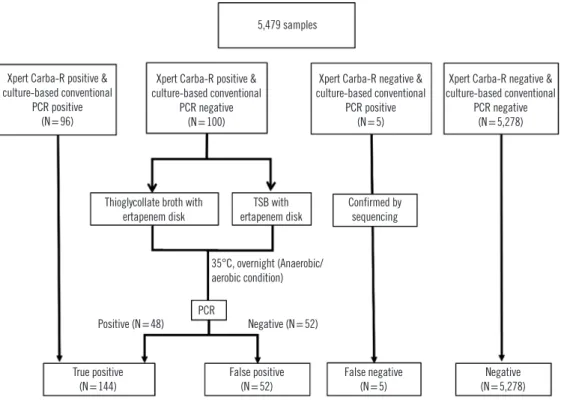
Fig. 1. Study flow chart and discrepant analysis protocol.
Abbreviation: TSB, tryptic soy broth.
5,479 samples
Xpert Carba-R positive &
culture-based conventional PCR positive
(N=96)
Xpert Carba-R positive &
culture-based conventional PCR negative
(N=100)
Xpert Carba-R negative &
culture-based conventional PCR positive
(N=5)
Xpert Carba-R negative &
culture-based conventional PCR negative
(N=5,278)
Thioglycollate broth with
ertapenem disk TSB with
ertapenem disk Confirmed by sequencing
Positive (N=48) PCR Negative (N=52) 35°C, overnight (Anaerobic/
aerobic condition)
True positive (N=144)
False positive (N=52)
False negative (N=5)
Negative (N=5,278)
Culture-based conventional PCR
This method has been considered as the gold standard for de- tecting carbapenemase genes. The culture-based assay recom- mended by the US CDC includes overnight enrichment in 5 mL of trypticase soy broth (TSB; Becton Dickinson Co., Sparks, MD, USA) with a 10 μg ertapenem disk (BBL, Becton Dickinson Co.), followed by overnight subculture on a MacConkey agar plate (Asan Pharmaceutical, Seoul, Korea) [7]. All colonies within the inhibition zone were picked and boiled for 10 min for DNA ex- traction followed by PCR to detect five carbapenemase genes (IMP, KPC, NDM, VIM, and OXA-48), as previously described [8].
Discrepant analysis
We attempted to resolve the discrepant cases as follows (Fig. 1):
For Carba-R v.2 negative but culture-positive cases, the PCR product was confirmed by sequencing using the same primers.
The sequencing was performed by a commercial sequencing service (Macrogen Inc, Seoul, Korea). For culture-negative but Carba-R v.2-positive cases, we conducted an additional assay, referred to as discrepant analysis. To identify aerobic or anaero- bic organisms carrying carbapenemase, remaining samples stored in a refrigerator (at 4°C for three to four days) were cul- tured in TSB and thioglycollate broth. Enriched PCR was per- formed with 20 µL of incubated broth. In cases of negative re- sults, conventional PCR was conducted again after a five-day incubation to detect fastidious bacterial growth. Based on the discrepant analysis results, all samples were divided into three groups: the concordant group, which showed concordant Carba- R v.2 and culture results; the resolved group that initially showed discrepancy between the two assays, which was resolved follow- ing discrepant analysis; and the discordant group, which showed unresolved discrepancies
Statistical analysis
The sensitivity, specificity, positive predictive value (PPV), nega- tive predictive value (NPV) including 95% confidence interval were calculated. The weighted Kappa value was calculated to compare the two assays. The Ct values of the concordant, re- solved, and discordant groups were analyzed using the Kruskal- Wallis test and Mann-Whitney U-test. The median and interquar- tile range (IQR) were derived from the data summary. P values were calculated using Kruskal-Wallis test and designated thresh- old of significance was 0.05. The Ct value of each gene group was analyzed using the Mann-Whitney U-test. ROC curve was also analyzed to calculate optimal cut-off Ct value. Statistical anal- yses were performed using MedCalc Statistical Software version
18 (MedCalc Software Bvba, Ostend, Belgium; http://www.med- calc.org; 2018).
RESULTS
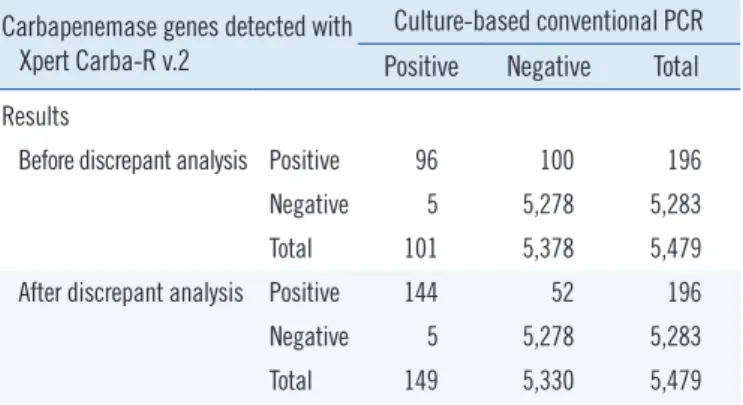
Of 5,479 samples, 206 carbapenemase genes were detected in 196 samples (3.6%) by Carba-R v.2 (Table 1; Fig. 1). Concordant Carba-R v.2 and culture-based conventional PCR results were observed for 96 positive and 5,278 negative samples. In total, 1.8% (100/5,479) of the samples were Carba-R v.2-positive but culture-negative, while <0.1% (5/5,479) of samples were Carba-R v.2 negative but culture-positive. Carba-R v.2-negative, culture- positive cases confirmed by sequencing were considered as false negative. Of the 100 Carba-R v.2-positive but initially culture-neg- ative samples, the presence of carbapenemase genes (KPC [N=18], NDM [N=28], VIM [N=3], IMP [N=2], OXA-48 [N=2];
53 genes in total) was confirmed in 46 samples following anaero- bic culture supplementation and enriched PCR. In contrast, 52 samples remained discordant, as the target carbapenemase genes were not recovered from the broth culture. We observed 10 (0.18%) samples harboring multiple carbapenemase types:
NDM, IMP, and VIM (N=1); KPC and NDM (N=6); KPC and IMP (N=1); NDM and OXA (N=1); and KPC and VIM (N=1).
A total of 653 patients underwent multiple serial assays (two [N=501], three [N=123], four [N=16] five [N=9], six [N=3], and seven assays [N=1]), and 21 patients had a positive result more than once. Of these 21 patients, six patients (one KPC, two VIM, and three NDM) were Carba-R v.2-positive but culture- negative, with high Ct values (median Ct, 37.1); their Carba-R v.2 results converted to negative in subsequent assays.
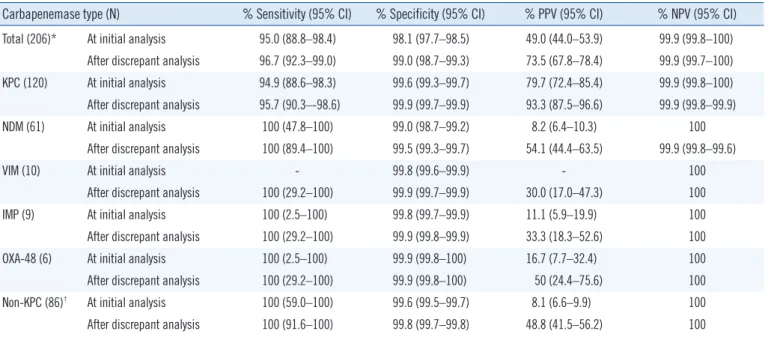
The sensitivity and specificity of the Carba R were 95.0% and 98.1%, respectively (Table 2). The weighted Kappa value was 0.63 (0.57–0.70). Following discrepant analysis, the sensitivity
Table 1. Comparison of overall performance of the Xpert Carba-R v.2 and culture-based PCR method
Carbapenemase genes detected with Xpert Carba-R v.2
Culture-based conventional PCR Positive Negative Total Results
Before discrepant analysis Positive 96 100 196
Negative 5 5,278 5,283
Total 101 5,378 5,479
After discrepant analysis Positive 144 52 196
Negative 5 5,278 5,283
Total 149 5,330 5,479
and specificity improved to 96.7% and 99.0%, respectively (Ta- ble 2). The weighted Kappa value increased to 0.83 (0.79–0.87).
KPC was the most frequently detected gene type (N=120, 58.3%), followed by NDM (N =61, 29.6%), VIM (N =10, 4.9%), IMP (N=9, 4.4%), and OXA-48 (N=6, 2.9%). The performance was fairly variable according to gene type (Table 2). A total of 95 KPC-
harboring microorganisms were recovered from culture. Klebsi- ella pneumoniae was the most common species recovered in culture (85, 89.4%), followed by Escherichia coli (5, 5.3%), Citro- bacter freundii (2, 2.3%), Citrobacter koseri (1, 1.0%), and En- terobacter kobei (1, 1.0%). For NDM, two K. pneumoniae, two Citrobacter amalonaticus, and one E. coli strains were recovered.
Table 2. Sensitivity, specificity, PPV, and NPV according to carbapenemase type with discrepant analysis
Carbapenemase type (N) % Sensitivity (95% CI) % Specificity (95% CI) % PPV (95% CI) % NPV (95% CI) Total (206)* At initial analysis 95.0 (88.8–98.4) 98.1 (97.7–98.5) 49.0 (44.0–53.9) 99.9 (99.8–100)
After discrepant analysis 96.7 (92.3–99.0) 99.0 (98.7–99.3) 73.5 (67.8–78.4) 99.9 (99.7–100) KPC (120) At initial analysis 94.9 (88.6–98.3) 99.6 (99.3–99.7) 79.7 (72.4–85.4) 99.9 (99.8–100) After discrepant analysis 95.7 (90.3–-98.6) 99.9 (99.7–99.9) 93.3 (87.5–96.6) 99.9 (99.8–99.9)
NDM (61) At initial analysis 100 (47.8–100) 99.0 (98.7–99.2) 8.2 (6.4–10.3) 100
After discrepant analysis 100 (89.4–100) 99.5 (99.3–99.7) 54.1 (44.4–63.5) 99.9 (99.8–99.6)
VIM (10) At initial analysis - 99.8 (99.6–99.9) - 100
After discrepant analysis 100 (29.2–100) 99.9 (99.7–99.9) 30.0 (17.0–47.3) 100
IMP (9) At initial analysis 100 (2.5–100) 99.8 (99.7–99.9) 11.1 (5.9–19.9) 100
After discrepant analysis 100 (29.2–100) 99.9 (99.8–99.9) 33.3 (18.3–52.6) 100
OXA-48 (6) At initial analysis 100 (2.5–100) 99.9 (99.8–100) 16.7 (7.7–32.4) 100
After discrepant analysis 100 (29.2–100) 99.9 (99.8–100) 50 (24.4–75.6) 100
Non-KPC (86)† At initial analysis 100 (59.0–100) 99.6 (99.5–99.7) 8.1 (6.6–9.9) 100
After discrepant analysis 100 (91.6–100) 99.8 (99.7–99.8) 48.8 (41.5–56.2) 100
*The number of positive samples was counted; samples harboring multiple genes were counted as one sample.
†Non-KPC includes NDM, VIM, IMP, and OXA-48.
Abbreviations: CI, confidence interval; PPV, positive predictive value; NPV, negative predictive value; KPC, Klebsiella pneumoniae carbapenemase; NDM, New Delhi metallo-β-lactamase; VIM, Verona integron-mediated metallo-β-lactamase; IMP, imipenem; OXA-48, oxacillinase-48.
Fig. 2. Comparison of number, median Ct value and interquartile range in (A) the concordant group at initial assay (25.4, 22.2–30.9), re- solved discrepancy group after discrepant analysis (28.5, 22.3–31.7), and discordant groups (52, 35.0, 31.4–37.7) and (B) the concor- dant (24.4, 22.2–30.1) and discordant (35.5, 29.9–36.0) KPC groups and concordant (32.2, 27.5–34.6) and discordant (34.8, 31.3–36.5) NDM groups.
Abbreviations: Ct, threshold cycle; KPC, Klebsiella pneumoniae carbapenemase; NDM, New Delhi metallo-β-lactamase.
20 14
15
16 17 18 19 20 21 22 23 24 25
45
40
35
30
25
20
15
Concordant (N=101)
Resolved (N=53)
Discordant (n=52)
Ct value
P <0.001 P <0.001 P =0.22
A
21 26
27 28 29
Fig. 2. Comparison of number, median Ct value and interquartile range in (A) the concordant 30
group at initial assay (25.4, 22.2 – 30.9), resolved discrepancy group after discrepant analysis 31
(28.5, 22.3 – 31.7), and discordant groups (52, 35.0, 31.4 – 37.7) and (B) the concordant 32
(24.4, 22.2 – 30.1) and discordant (35.5, 29.9 – 36.0) KPC groups and concordant (32.2, 27.5 33
– 34.6) and discordant (34.8, 31.3 – 36.5) NDM groups.
34
Abbreviations: Ct, threshold cycle; KPC, Klebsiella pneumoniae carbapenemase; NDM, New 35
Delhi metallo-beta-lactamase 36
37
45
40
35
30
25
20
15
KPC concordant (N=96)
KPC discordant (N=7)
NDM concordant (N=5)
NDM discordant (N=28)
Ct value
P =0.003 P =0.265
B
For both IMP and OXA, one K. pneumoniae strain was recovered.
In discrepant cases, NDM was the most frequently observed (Carba-R v.2-positive and culture-negative/total Carba-R v.2-pos- itive, 28/61, 45.9%), followed by KPC (8/120, 1.2%), VIM (7/10, 70%), IMP (6/9, 66.6%), and OXA-48 (3/6, 50%). We catego- rized the samples into three groups: concordant, resolved, and discordant, as described above, with median Ct values of 25.4, 28.5, and 35.0, respectively. The Ct values of the three groups were statistically different (P <0.001), except for the concordant and resolved following discrepant analysis groups (P =0.22; Fig.
1A). According to carbapenemase type, the difference in Ct value was statistically significant for KPC (P =0.003), but not for NDM (P =0.265; Fig. 2B).
ROC curve analysis yielded a Ct value of 28.8 as the optimal cut-off for KPC with 72.5% sensitivity and 87.5% specificity, when the concordant and resolved groups were considered as positive. When this cut-off value was applied to our results, the PPV improved to 82.1%. Satisfactory cut-offs were not derived for the other carbapenemase genes, owing to the limited num- ber of assays
DISCUSSION
The spread of carbapenemase genes poses a public health threat, increasing the need for a rapid molecular method for carbapen- emase gene detection [9]. We prospectively evaluated the per- formance of the newly developed Carba-R v.2 for detection of carbapenemase genes compared with culture-based PCR, us- ing a large number of clinical rectal swab samples. The overall performance of Carba-R v.2 was reliable, except for the PPV;
this could result in unnecessary isolation of patients, causing extra medical resource consumption and patient discomfort.
To achieve effective infection control, PPV, and NPV are im- portant to assess the positive and negative results of each car- bapenemase gene detection assay. The lower PPV of Carba-R v.2-positive, culture-negative cases might be caused by false positive results due to nonspecific binding, lower bacterial load in the samples, reduced bacterial viability owing to inappropri- ate sample collection/transportation, or uncultivable organisms harboring carbapenemase genes [10]. To resolve these issues, we performed discrepant analysis; 48% (48/100) of the Carba- R v.2-positive, culture-negative cases converted to culture-posi- tive. These cases indicate the existence of carbapenemase genes;
however, the carbapenemase gene-harboring organisms were not recovered using the initial culture method. The advantages of the molecular method over culture-based reference methods
in detecting carbapenemase genes are that it is rapid and sen- sitive. Therefore, culture-based conventional PCR should be complemented by a molecular screening assay [11, 12].
Interestingly, the Ct values of the concordant vs. discordant groups and the resolved vs. discordant groups were statistically different (P <0.001), while those of the concordant and resolved groups were not statistically different (P =0.22). The concordant group had the lowest Ct values, and the discordant group had the highest values. This indicates that, although the Carba-R v.2 is not quantitative, the Ct values can be affected by target gene load, bacterial load, variable copy number of the carbapene- mase-carrying plasmid, and the sample amount inoculated into the cartridge [13]. Hence, a low Ct value would be helpful for estimating high carbapenemase gene load; caution is warranted when ruling out carbapenemase genes in cases of discrepant Carba-R v.2 results with a high Ct value, so as to not miss low- level carbapenemase genes, as reported for another real-time PCR evaluation method, Check-Direct CPE (Check-Points, Wa- geningen, the Netherlands) [14]. That study suggested that a modified cut-off Ct value<35 reduced false positives. Based on our KPC data, 28.8 was identified as the optimum cut-off for re- ducing false positives from the culture method following ROC curve analysis, with a sensitivity and specificity of 72.5% and 87.5%, respectively. Satisfactory cut-offs were not derived for the other carbapenemase genes, owing to the limited number of assays. To overcome low PPV, the modified cut-off was ap- plied for the simulation with our results. This could reduce false positives and unnecessary isolation of patients, but nullify higher sensitivity, the most important advantage of the molecular method.
Lau, et al. [15] demonstrated a 10–100-fold higher limit of detection (LOD) for NDM-harboring strains in culture and PCR and for VIM in PCR. We observed different performances ac- cording to carbapenemase gene. The Ct values of the concor- dant and discordant groups for KPC genes (not including re- solved) were statistically significantly different (P =0.003); how- ever, the NDM values were not significant (P =0.265; Fig. 1B).
Based on the association between Ct value and bacterial load- ing, other factors, such as gene copy number, should also be considered.
Previous studies have reported higher performance than our data [4, 9, 10, 16]. Some studies included contrived samples spiked with higher inoculums of previously well-characterized carbapenemase genes [4, 9, 16]. Our study represents clinical practice more accurately, as it was performed with a large num- ber of clinical samples.
Negative conversion of carbapenemase genes in multiple se-
rial assays could be due to bacterial eradication, technical bor- derline or low bacterial loading around the lower LOD, or non- specific false positives. As colonization of carbapenemase gene- harboring organisms has been reported [10], bacterial eradica- tion during the short period of this study is not feasible. Further studies are required to determine whether these discordant re- sults represent a false positive result or a pitfall of the methodol- ogy, which is more sensitive than the culture method. Currently, Carba-R v.2-positive and culture-negative patients are consid- ered negative for carbapenemase genes. In areas of lower prev- alence, the PPV could be lower. Unfortunately, no guideline has been released regarding the use of molecular methods as a ref- erence, even in low prevalence settings [10]. The clinical impact of Carba-R v.2-positive and culture-negative samples should be further clarified. In such cases, we suggest a conservative ap- proach; the patients should be excluded from the carbapene- mase gene cohort, but kept in isolation.
The limitation of this study was that only four carbapenemase genes other than KPC were examined. In addition, since OXA- 48 and its variants are not prevalent at our institutes, the im- provement of Carba-R v.2 could not be assayed. Further studies with genetically diverse strains are warranted.
As most of our discrepant results were non-KPC genes, more caution is needed for patients who are positive for non-KPC genes.
However, Carba-R v.2 would be useful for deciding whether to quarantine pre-exposed patients in hospital settings, owing to the high specificity and NPV. Considering the global increase in CPE, Carba-R v.2 would be helpful for rapid detection of car- bapenemase genes and would also enable more efficient infec- tion control.
ACKNOWLEDGEMENTS
None.
AUTHOR CONTRIBUTIONS
JHB and DY wrote the manuscript. JYC and YSP aided sample collection and interpreting the results. JH B, DY, and YAK planned and carried out the simulations. MK and BK conceived and car- ried out the experiments. All authors provided critical feedback and helped shape the research, analysis, and manuscript.
CONFLICTS OF INTEREST
None.
FUNDING
This work was supported by the Korea Institute of Planning and Evaluation for Technology in Food, Agriculture, Forestry and Fish- eries through the Agricultural Microbiome R&D Program, funded by the Ministry of Agriculture, Food and Rural Affairs (918003- 4); by the Korea Health Technology R&D Project through the KHIDI funded by the Ministry of Health & Welfare, Korea (grant number HI17C180,7); and by the BioNano Health Guard Re- search Center funded by the MSIP of Korea as a Global Frontier Project (H-GUARD_2014M3A6B2060509). This study was also partly supported by Cepheid. The funders had no role in study design, data collection, and interpretation, or in the decision to submit the work for publication.
ORCID
Jung-Hyun Byun https://orcid.org/0000-0001-5909-5807 Young Ah Kim https://orcid.org/0000-0002-9624-0126 Milee Kim https://orcid.org/0000-0002-9121-5810 Bomi Kim https://orcid.org/0000-0003-1613-3417 Jun Yong Choi https://orcid.org/0000-0002-2775-3315 Yoon Soo Park https://orcid.org/0000-0003-4640-9525 Dongeun Yong https://orcid.org/0000-0002-1225-8477
REFERENCES
1. WHO. Global priority list of antibiotic-resistant bacteria to guide research, discovery, and development of new antibiotics. Geneva: World Health Organization, 2017.
2. Landman D, Salvani JK, Bratu S, Quale J. Evaluation of techniques for detection of carbapenem-resistant Klebsiella pneumoniae in stool sur- veillance cultures. J Clin Microbiol 2005;43:5639-41.
3. Kim DK, Kim HS, Pinto N, Jeon J, D’Souza R, Kim MS, et al. Xpert CAR- BA-R assay for the detection of carbapenemase-producing organisms in intensive care unit patients of a Korean tertiary care hospital. Ann Lab Med 2016;36:162-5.
4. Tato M, Ruiz-Garbajosa P, Traczewski M, Dodgson A, McEwan A, Hum- phries R, et al. Multisite evaluation of Cepheid Xpert Carba-R assay for detection of carbapenemase-producing organisms in rectal swabs. J Clin Microbiol 2016;54:1814-9.
5. Dortet L, Fusaro M, Naas T. Improvement of the Xpert Carba-R Kit for the detection of carbapenemase-producing Enterobacteriaceae. Antimi- crob Agents Chmother 2016;60:3832-7.
6. Uwamino Y, Sugita K, Hasegawa N, Nishimura T, Fujiwara H, Iwata S.
Rapid detection and typing of carbapenemase genes from carbapen- em-resistant Enterobacteriaceae isolates collected in a Japanese hospi- tal using the Xpert Carba-R assay. Jpn J Infect Dis 2017;70:124-5.
7. CDC. Laboratory protocol for detection of carbapenem-resistant or car- bapenemase-producing, Klebsiella spp. and E. coli from rectal swabs.
Atlanta: Centers for Disease Control and Prevention, 2009.
8. Ahn S, Sung JY, Kim H, Kim MS, Hwang Y, Jong S, et al. Molecular epi- demiology and characterization of carbapenemase-producing Entero- bacteriaceae isolated at a university hospital in Korea during 4-year pe- riod. Ann Clin Microbiol 2016;19:39-47.
9. Moore NM, Cantón R, Carretto E, Peterson LR, Sautter RL, Traczewski MM, et al. Rapid identification of five classes of carbapenem resistance genes directly from rectal swabs by use of the Xpert Carba-R assay. J Clin Microbiol 2017;55:2268-75.
10. Hoyos-Mallecot Y, Ouzani S, Dortet L, Fortineau N, Naas T. Performance of the Xpert® Carba-R v2 in the daily workflow of a hygiene unit in a coun- try with a low prevalence of carbapenemase-producing Enterobacteria- ceae. Int J Antimicrob Agents 2017;49:774-7.
11. Schechner V, Straus-Robinson K, Schwartz D, Pfeffer I, Tarabeia J, Mos- kovich R, et al. Evaluation of PCR-based testing for surveillance of KPC- producing carbapenem-resistant members of the Enterobacteriaceae family. J Clin Microbiol 2009;47:3261-5.
12. Schwaber MJ, and Carmeli Y. An ongoing national intervention to con- tain the spread of carbapenem-resistant Enterobacteriaceae. Clin Infect
Dis 20132014;58:697-703.
13. Burillo A, Marín M, Cercenado E, Ruiz-Carrascoso G, Pérez-Granda MJ, Oteo J, et al. Evaluation of the Xpert Carba-R (Cepheid) assay using contrived bronchial specimens from patients with suspicion of ventila- tor-associated pneumonia for the detection of prevalent carbapenemas- es. PLoS One 2016;11:e0168473.
14. Otter JA, Dyakova E, Bisnauthsing KN, Querol-Rubiera A, Patel A, Aha- nonu C, et al. Universal hospital admission screening for carbapene- mase-producing organisms in a low-prevalence setting. J Antimicrob Chemother 2016;71:3556-61.
15. Lau AF, Fahle GA, Kemp MA, Jassem AN, Dekker JP, Frank KM. Clini- cal Performance of Check-Direct CPE, a Multiplex PCR for direct detec- tion of bla(KPC), bla(NDM) and/or bla(VIM), and bla(OXA)-48 from peri- rectal swabs. J Clin Microbiol 2015;53:3729-37.
16. Tenover FC, Canton R, Kop J, Chan R, Ryan J, Weir F, et al. Detection of colonization by carbapenemase-producing Gram-negative bacilli in patients by use of the Xpert MDRO assay. J Clin Microbiol 2013;51:
3780-7.