• 검색 결과가 없습니다.

A case of huge retroperitoneal liposarcoma in pregnancySang Eun Oh, Hyun Joo Kim, Suk-Joo Choi, Soo-Young Oh, Cheong-Rae Roh, Jong-Hwa Kim

N/A
N/A
Protected

Academic year: 2022

Share "A case of huge retroperitoneal liposarcoma in pregnancySang Eun Oh, Hyun Joo Kim, Suk-Joo Choi, Soo-Young Oh, Cheong-Rae Roh, Jong-Hwa Kim"

Copied!
4
0
0

로드 중.... (전체 텍스트 보기)

전체 글

(1)

www.ogscience.org 236

Received: 2013.7.4. Revised: 2013.10.28. Accepted: 2013.11.13.

Corresponding author: Jong-Hwa Kim

Department of Obstetrics and Gynecology, Samsung Medical Center, Sungkyunkwan University School of Medicine, 81 Irwon- ro, Gangnam-gu, Seoul 135-710, Korea

Tel: +82-2-3410-3516 Fax: +82-2-3410-0630 E-mail: [email protected]

Articles published in Obstet Gynecol Sci are open-access, distributed under the terms of the Creative Commons Attribution Non-Commercial License (http://creativecommons.

org/licenses/by-nc/3.0/) which permits unrestricted non-commercial use, distribution, and reproduction in any medium, provided the original work is properly cited.

Copyright © 2014 Korean Society of Obstetrics and Gynecology

Introduction

Liposarcoma is one of the most common soft-tissue sarcomas occurring in adults between 40 and 70 years [1,2]. According to the World Health Organization (WHO), histological classification of liposarcoma is divided into five subtypes: well-differentiated, myxoid, round cell, pleomorphic, and de-differentiated [3].

Liposarcoma are usually found at the extremities, retroperi- toneum, spermatic cord, testis, thorax, breast, mediastinum, omentum, mesentery, etc. [1]. Most patients are asymptomatic and sarcomas are usually found incidentally during abdominal exam. When symptoms are present, the palpable mass is most often painless [4]. Therefore, an early detection is often very challenging, especially for pregnant women who already have distended abdomen due to the pregnancy itself.

Complete surgical resection of the tumor is the best choice of treatment, but an individualized approach should be taken, according to gestational age, tumor location, fetus status and the patient’s general condition. The effects of additional che- motherapy or radiotherapy after surgery are still controversial.

In this report, we present a case of a pregnant patient with a retroperitoneal liposarcoma that was treated by two differ- ent surgeries followed by chemo-radiotherapy.

Case report

A 39-year-old woman was referred to our hospital at 28+2

week gestation. During a routine obstetric examination, a palpable pelvic mass was detected. She has history of five miscarriages during 2005 to 2009. She was diagnosed with habitual abortion, but no significant abnormalities were iden- tified for the cause of the recurrent miscarriages. The patient had menarche at the age of 14, after she had regular periods.

Besides that, her past medical history was unremarkable;

however, her grandfather died of stomach cancer, and her fa- ther died of melanoma.

The patient’ body mass index (BMI) was 21.99 before preg- nancy. When she presented to our hospital at 28+2 weeks pregnancy, her BMI was 30.09 with a good nutritional status.

Ultrasonographies of the patient’s utereus showed a live singleton fetus of 27 gestational weeks along with multiple uterine myomas. Both ovaries were grossly normal and in the

A case of huge retroperitoneal liposarcoma in pregnancy

Sang Eun Oh, Hyun Joo Kim, Suk-Joo Choi, Soo-Young Oh, Cheong-Rae Roh, Jong-Hwa Kim

Department of Obstetrics and Gynecology, Samsung Medical Center, Sungkyunkwan University School of Medicine, Seoul, Korea

A 39-year-old woman was referred to our hospital at 28+2 week gestation. Routine obstetric examination revealed a palpable pelvic mass. Initial investigation by magnetic resonance imaging demonstrated a huge solid mass with heterogeneous enhancement that completely filled the right side of the abdomen. She underwent two surgeries: a programmed cesarean section by Department of Obstetrics and Gynecology team and a laparotomy performed by the General Surgery team. Final diagnosis was de-differentiated liposarcoma (French Federation Nationale des Centres de Lutte Contre le Cancer grade 2/3). She has been treated with radiation therapy focusing on high risk area of retroperitoneum followed by adjuvant chemotherapy (doxorubicin and ifosfamide). Below is the full case with literature review.

Keywords: Adjuvant; Chemoradiotherapy; Operation; Pregnancy; Retroperitoneal liposarcoma

Case Report

Obstet Gynecol Sci 2014;57(3):236-239

http://dx.doi.org/10.5468/ogs.2014.57.3.236

pISSN 2287-8572 · eISSN 2287-8580

(2)

www.ogscience.org 237 Sang Eun Oh, et al. Retroperitoneal liposarcoma during pregnancy

retroperitoneal area, there were huge sized heterogeneous cystic solid masses.

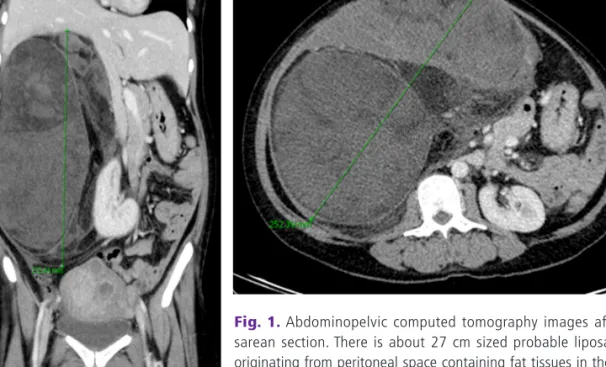
The patient was then submitted to magnetic resonance im- aging that demonstrated a large mass in the right retroperito- neal space. The abdominal-pelvic computed tomography (CT) revealed an approximately 27 cm sized solid mass that com- pletely filled the right side of abdomen. Furthermore, it was compressing the right side kidney medially and looked as if it was extending to the anterior cortex of the kidney. However, there was no evidence of direct invasion to adjacent organ or metastasis (Fig. 1).

Laboratory findings showed mild leukocytosis and mild anemia. And other laboratory analysis revealed normal values of hepatic-renal function, urinalysis and electrolytes. Tumor marker studies showed increased alpha-fetoprotein of 204.3 ng/mL (normal range, 0 to 10), a normal CA-125 of 6.6 U/mL (normal range, 0 to 35), a normal carcinoembryonic antigen of 0.4 ng/mL (normal range, 0 to 7), and a normal CA-19-9 of 0.5 U/mL (normal range, 0 to 35).

At the time of diagnosis, the size of tumor was very large (35×26×17 cm) and it was rapidly enlarging with high chance of being malignant tumor. It was determined that an early removal of the tumor will enhance the safety of the patient as well as the fetus. After a thorough discussion with the General Surgery team for this case, it was decided to per- form the cesarean section and tumor removal at two different

stages to prevent excess blood loss, and for the complete tumor removal. Before the cesarean section, a betametha- sone was given to promote fetal lung maturation. When the patient reached 29 weeks gestation, the patient underwent a programmed cesarean section and delivered a male baby weighing 1,180 g with Apgar scores of 4 and 6, at 1 and 5 minutes, respectively. During operation, left a paratubal cyst was incidentally founded and a left paratubal cystectomy was Fig. 2. Macroscopic findings. Dedifferentiated liposarcoma in ret- roperitoneum. The cut section of the retroperitoneal mass shows a heterogenous multiloculated mass with large portion of hemor- rhage and some necrotic portion (about 60%).

Fig. 1. Abdominopelvic computed tomography images after ce- sarean section. There is about 27 cm sized probable liposarcoma originating from peritoneal space containing fat tissues in them. (A) Sagittal view and (B) coronal view.

A B

(3)

www.ogscience.org 238

Vol. 57, No. 3, 2014

also performed. Her baby was admitted to the neonatal inten- sive care unit for proper management.

After, the patient was transferred to the General Surgery department for the proper treatment of her liposarcoma, and they performed another surgery at 22-days after cesarean sec- tion. The resected solid tumor was 35×26×17 cm in size with an intact capsule. However, there were necrotic tissues as well as dark-red colored hemorrhagic multiseptated cystic mass found inside the tumor. Frozen section showed a carcinoma with atypical cells. Thus mass excision, left nephrectomy, and appendectomy were performed. Final pathology revealed de- differentiated liposarcoma (French Federation Nationale des Centres de Lutte Contre le Cancer grade 2/3) and the tumor was positive for MDM2, CDK4 and Ki-67 (Fig. 2).

The patient was discharged 15 days after surgical treatment without any immediate postoperative complications. Medical oncology was consulted, and additional radiotherapy and che- motherapy were recommended. Thirty days after the second surgery, she underwent thirty sessions of radiation therapy focusing on the high risk area of the retroperitoneum. After- wards an additional chemotherapy with a regimen of doxoru- bicin Ifosfamide (doxorubicin 12.5 mg/m

2

, ifosfamide 2,000 mg/m

2

) was performed from December 2012 to February 2013. The last follow-up abdominal-pelvic CT was performed on February 28, 2013 which showed no evidence of disease.

Thus, she has planned to follow-up after 3 month.

Discussion

Liposarcoma is one of the most common soft-tissue sarcomas that frequently occur between the ages of 40 to 70 years [1,2].

Usually it is located at lower extremities and the retroperito- neum. This tumor’s strongest prognostic factor is the patho- logic grade of its histological subtypes, and its overall survival rate is reported as 23% to 46% [5].

Liposarcoma during pregnancy is extremely rare and often discovered incidentally by abdominal or pelvic ultrasound exam. The most common clinical feature is an asymptomatic palpable mass, which often is hidden and confused by the pregnancy itself [1]. The second most common symptom is pain, such as abdominal pain or pelvic pain [4]. The appropri- ate diagnostic and therapeutic approach to treat liposarcoma during pregnancy has not yet been determined; although, it is generally accepted that complete surgical resection of the

tumor should be performed to increase the cure rate of this disease [6,7].

The prognostic factors are tumor size, location, surgical re- section and histological subtypes. WHO classification divides liposarcomas into five subtypes: well-differentiated, myxoid, round cell, pleomorphic, and de-differentiated [3,8]. Well- differentiated is the most common subgroup that does not exhibit aggressive behavior and recur locally. Myxoid subtype is also a low-grade tumor with no aggressive behavior. Round cell subgroup are known to have intermediate behavior. While pleomorphic and de-differentiated tumors are known to be exceedingly aggressive with higher rates of metastasis and recurrence, and associated with poor prognosis [8].

In our case, the patient was performed cesarean section at 29 weeks gestation, followed by a complete surgical resec- tion that included a left nephrectomy and appendectomy. The histological subtype of this tumor was consistent with de- differentiated liposarcoma located in retroperitoneum with involvement of resection margin. The patient had no immedi- ate postoperative complications and treated with additional chemotherapy at the medical oncology department.

As for the 29 week fetus, he was in the intensive care for 61 days and discharged without any serious complications. He plans to follow-up at Busan Paik Hospital.

Retroperitoneal liposarcomas are extremely rare in pregnan- cy with few cases reported [9,10]. Moreover, they are usually asymptomatic and often discovered only after they get larger in size [11]. Regarding the management of the liposarcomas during pregnancy, both mother and fetus need to be appro- priately treated. Therefore, individualized approach based on the patient’s trimester at the time of diagnosis, the histologi- cal type and grade of the tumor should be considered.

Conflict of interest

No potential conflict of interest relevant to this article was reported.

References

1. Enzinger FM, Weiss SW. Soft tissue tumors. 3rd ed. St Louis: Mosby; 1995.

2. Lopes RI, Machado M, Paz C, Santos AC, Rezende WW.

(4)

www.ogscience.org 239 Sang Eun Oh, et al. Retroperitoneal liposarcoma during pregnancy

Successful outcome of a surgically treated giant retro- peritoneal liposarcoma during pregnancy. Arch Gynecol Obstet 2009;280:1067-9.

3. Fletcher CD, Unni KK, Mertens F; World Health Organi- zation; International Agency for Research on Cancer. Pa- thology and genetics of tumours of soft tissue and bone.

Lyon: IARC Press; 2002.

4. Boulay R, Podczaski E. Ovarian cancer complicating pregnancy. Obstet Gynecol Clin North Am 1998;25:385- 99.

5. Cody HS 3rd, Turnbull AD, Fortner JG, Hajdu SI. The con- tinuing challenge of retroperitoneal sarcomas. Cancer 1981;47:2147-52.

6. Zagars GK, Goswitz MS, Pollack A. Liposarcoma: out- come and prognostic factors following conservation sur- gery and radiation therapy. Int J Radiat Oncol Biol Phys

1996;36:311-9.

7. Matsuda S, Tanaka K, Harimaya K, Matsumoto Y, Sato H, Iwamoto Y. Treatment of myxoid liposarcoma in preg- nancy. Clin Orthop Relat Res 2000;(376):195-9.

8. Dalal KM, Kattan MW, Antonescu CR, Brennan MF, Singer S. Subtype specific prognostic nomogram for pa- tients with primary liposarcoma of the retroperitoneum, extremity, or trunk. Ann Surg 2006;244:381-91.

9. Tebes S, Cardosi R, Hoffman M. Liposarcoma complicat- ing pregnancy. Gynecol Oncol 2001;83:610-2.

10. Jeng CJ, Tzen CY, Huang WC, Yang YC, Shen J, Tzeng CR.

Recurrent retroperitoneal myxoid liposarcoma during pregnancy: a case report and literature review. Int J Gy- necol Cancer 2005;15:1235-8.

11. Lopes RI, Lopes RN, Barbosa Filho CM. Giant retroperi-

toneal liposarcoma. Braz J Urol 2002;28:227-9.

수치

Fig. 1. Abdominopelvic computed tomography images after ce- ce-sarean section. There is about 27 cm sized probable liposarcoma  originating from peritoneal space containing fat tissues in them

참조

관련 문서

Chang Goo Kang, Ah Hyun Park, Jang Ho Ha, Young Soo Kim, Joon-Ho Oh, Jeong Min Park, Soo Mee Kim, Seung-Jae Lee, Seung Hee Lee, and Han Soo Kim(KAERI). Fabrication

Chang Je Park, Kwoen Ho Kang, Sang Ho Na, Young Hee Kim, Ho Jin Ryu, Geun Il Park, and Kee Chan Song (KAERI). Geun-Suk Choi and

Dong Won Lee, Young Dug Bae, Suk Kwon Kim, Hee Yun Shin, Bong Guen Hong, Hyun Kyu Jung, Yang Il Jung, Jeong Yong Park, Byung Kwon Choi, and Yong Hwan Jeong(KAERI). P07B04

P04G02 Design and Fabrication of Irradiation Testing Capsule for Research Reactor Materials Seong Woo Yang, Bong Goo Kim, Seung Jae Park, Man Soon Cho, Kee Nam Choo, Jong Myeong

11:40 Fabrication of Nitride Coated U-Mo Powders for an Advanced Research Reactor Fuel Jae Soon Park, Yong Jin Jeong, Sang Oh Bae, Sun Chil Kwon, Eung Soo Kim, Se Jung Jang,

Sang-Keun Woo, Yong Jin Lee, WonHo Lee, Min Hwan Kim, Ji Ae Park, In Ok Ko, Jin Su Kim, Jong Guk Kim, Young Hoon Ji, Joo Hyun Kang, Gi Jeong Cheon, Chang Woon Choi, Sang Moo

IL Soon Hwang, Myung Hyun Kim, Han Gyu Joo, Kyung Woo Yi, Bong Yoo, Moo Hwan Kim, Seung Rok Oh, Yoon Jae Kim, Jong Gye Shin, Kwang Myung Lee, Jae Yong

At the end of the study, a reevaluation of each study case was performed with the same questionnaire. The result shows there has been a meaningful result in the group