• 검색 결과가 없습니다.

Effectiveness and Safety of Percutaneous Transcatheter Implantation of Pulmonary Arterial Stent in Congenital Heart Disease

N/A
N/A
Protected

Academic year: 2022

Share "Effectiveness and Safety of Percutaneous Transcatheter Implantation of Pulmonary Arterial Stent in Congenital Heart Disease"

Copied!
6
0
0

로드 중.... (전체 텍스트 보기)

전체 글

(1)

Korean Circulation Journal

Introduction

Pulmonary arterial stenosis is a relatively common complication after corrective surgery for congenital heart disease.

1-3)

Branch pul- monary arterial stenosis develops at a high rate after the repair of

Print ISSN 1738-5520 • On-line ISSN 1738-5555

Effectiveness and Safety of Percutaneous Transcatheter

Implantation of Pulmonary Arterial Stent in Congenital Heart Disease

Hong Ki Ko, MD 1 , Young-Hwue Kim, MD 1 , Jeong Jin Yu, MD 1 , Jae-Kon Ko, MD 1 , In-Sook Park, MD 1 , Dong-Man Seo, MD 2 , Tae-Jin Yun, MD 2 , Jeong-Jun Park, MD 2 , and Wan Sook Jang, MS 1

1
Departments of Pediatric Cardiology and

2

Pediatric Cardiac Surgery, Ulsan of Unversity College of Medicine, Asan Medical Center, Seoul, Korea

Background and Objectives: Pulmonary arterial stenosis is a relatively common complication after corrective operation of congenital heart disease. Unilateral stenosis of pulmonary arteries could result in decrease perfusion of affected lung, pulmonary regurgitation, or elevation of right ventricular pressure. Eventually there are increasing risks of right ventricular failure, arrhythmia, or sudden death. How- ever we have limited data of pulmonary arterial stent in paediatric population as the treatment of branch pulmonary stenosis. This study aimed at validating the effectiveness and investigating complications of pulmonary arterial stent implantation in a single institution dur- ing mid-term follow up period.

Subjects and Methods: A total of 42 patients (50 stents) were implanted for treating branch pulmonary arterial stenosis. We used car- diac catheterization for comparing diameter after stent implantation directly and lung perfusion scan indirectly. We also investigated any adverse effect relating the procedure.

Results: Percent stenosis of stenotic lesions were decreased from 54.1±10.7% to 22.8±12.5% (p<0.001) and degree of decrement in af- fected lung perfusion was declined from 22.7±8.0% to 10.3±9.0% (p<0.001) immediately and lasts during mid-term follow up period.

Complication rate relating the procedure was 12% (6 out of 12) and there was no mortality case.

Conclusion: This series showed immediate and short term effectiveness of pulmonary arterial stent in congenital heart defects. We con- cluded that percutaneous transcatheter implantation of pulmonary arterial stent was safe and effective during short and mid-term fol- low up period. (Korean Circ J 2012;42:40-45)

KEY WORDS: Congenital heart disease; Catheterization.

Received: August 5, 2011 Accepted: September 21, 2011

Correspondence: Young-Hwue Kim, MD, Department of Pediatric Cardi- ology, Ulsan of Unversity College of Medicine, Asan Medical Center, 88 Olym- pic-ro 43-gil, Songpa-gu, Seoul 138-736, Korea

Tel: 82-2-3010-3386, Fax: 82-2-473-3725 E-mail: [email protected]

• The authors have no financial conflicts of interest.

This is an Open Access article distributed under the terms of the Creative Commons Attribution Non-Commercial License (http://creativecommons.

org/licenses/by-nc/3.0) which permits unrestricted non-commercial use, distribution, and reproduction in any medium, provided the original work is properly cited.

tetralogy of Fallot among the various congenital heart defects.

4)

Uncorrected unilateral stenosis of pulmonary arteries could result in decreased perfusion of the affected lung, pulmonary regurgitation, or elevation of right ventricular pressure.

5)6)

Treatment should be de- cided by assessing the patient’s hemodynamic status regardless of the development of symptoms, because of the increasing risks of right ventricular failure, arrhythmia, or sudden death.

7)

Improvement of right ventricular systolic function was reported in a swine model using cardiac magnetic resonance imaging (MRI) after relief of ste- nosis of the branch pulmonary artery.

8)

However, there is limited cli- nical data for human species mainly due to the relatively small po- pulation of branch pulmonary artery stenosis patients.

9)

Stent implantation of pulmonary arteries for relief of stenotic le-

sions is still an ‘off-label’ procedure, although it has been a stan-

dardized therapy from the late 1980s.

7)

That is not because of ques-

tions concerning its effectiveness and safety, but because of lack of

interest among government and companies.

10-12)

Although few stud-

(2)

ies had demonstrated a high success rate after 20 years of experi- ence, there has not been any multicenter-randomized controlled study.

9)13)14)

This study aimed at validating the effectiveness and in- vestigating complications of pulmonary arterial stent implantation in a single institution during midterm follow up period.

15)16)

Subjects and Methods

Between January 1999 and May 2010, patients with unilateral or bilateral pulmonary arterial stenosis after corrective surgery for their congenital heart defects were enrolled in the Department of Pedi- atric Cardiology at Asan Medical Center. Only patients who were implanted with pulmonary arterial stents were included. A total of 42 patients (50 stents) were implanted. The ratio of boys to girl was 0.92. At the time of implantation the patient median age was 12 years (range 0.5-31 years), and their median weight was 22 kg (ran- ge 4.8-80.4 kg). Site of lesions were right pulmonary arteries (n=6), left pulmonary arteries (n=28), and bilateral pulmonary arteries (n=8).

Patient medical records were retrospectively reviewed for demo- graphic data such as age, weight, and height at intervention. For assessing the effectiveness data of catheterization, lung perfusion scan, or heart computed tomography (CT) scan and echocardiog- raphy were also collected before and after the intervention. Insti- tutional review board of Asan Medical Centre approved this study and patient consent was waived.

Catheterization

Pressure data and diameter of stenotic lesions were obtained before and after the implantation. Additionally, the percent steno- sis (i.e., ratio of diameter at stenotic lesion to that of normal pul- monary artery at the level of helium) was calculated to compare the results. Indications of pulmonary arterial stent implantation were when lung perfusion ratio of the normal side to affected side was over 2.5 and when the right ventricular systolic pressure was over 50% of systemic systolic blood pressure.

Percutaneous transcatheter implantation of pulmonary arterial stent

Measurement of the diameter of the stenotic lesion and ipsilateral pulmonary artery at the first-branching site helped choose the size and length of stent from angiography of pulmonary arteries with biplane fluoroscopy. Pre-mounted or hand-mounted stent was pl- aced accurately at the stenotic lesion and dilated by inflating the balloon. In case of a hand-mounted stent, we made a so-called sh- oulder of balloon to prevent slippage of the stent during catheter manipulation.

Sometimes balloon angioplasty was tried first and the proximal part of the stent was widened after implantation, making it easier to pass through the stent subsequently. Bilateral stenosis was treat- ed simultaneously by a double wire technique to minimize displace- ment of the stent from the optimal site (Figs. 1 and 2). We used vari- ous type of stents, including Jostent® peripheral (Abbott, Abbott Park, IL, USA), Palmaz® stent; P**4/8/10B/ 14 series, XD (Johnson &

Johnson-Cordis, Bridgewater, NJ, USA), Express® Vascular LD (Bos- ton Scientific, Natick, MA, USA), and Wallflex® vascular stent (Bos- ton Scientific).

Lung perfusion scan

The geometric result of lung perfusion scan before and after im- plantation was investigated and then the decrement of perfusion was calculated by subtracting percent of affected side from that of normal value (left : right, 45% : 55%), which was calculated only in unilateral pulmonary arterial stenosis.

Echocardiography and heart CT scan

The non-invasive methods of echocardiography and heart CT scan were used to supplementing the results of angiography.

Statistical analyses

Data was analyzed using Statistical Package for the Social Sci- ences (SPSS) for Windows, version 12 (SPSS Inc., Chicago, IL, USA).

Descriptive data for continuous variables are presented as mean±

SD. Student’s t-test was used for comparing the results before and after implantation. Pearson correlation coefficient was used to es- timate correlation between percent stenosis and perfusion de- crease. P<0.05 was considered statistically significant.

Results

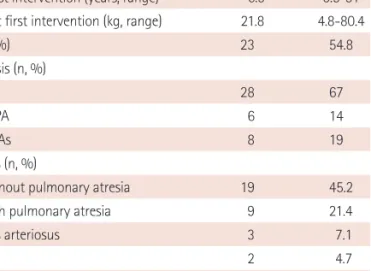
Demographic data of patients are shown in Table 1. Mean diam- eter of the narrowest point on pulmonary arterial stenosis was 6.6 mm and mean percent stenosis was 54%. Patients with tetralogy of Fallot with or without pulmonary atresia were most common, and consisted of part truncus arteriosus and pulmonary atresia with intact ventricular septum in order.

Validation of effectiveness

The diameter of stenotic lesion after stent implantation increased significantly from mean 6.6 mm to mean 12.4 mm and the decre- ment of perfusion changed significantly from 22.7±8.0% to 10.3±

9.0% (p<0.001) (Table 2). Changes of each patient in diameter and

percent stenosis are presented in Fig. 3; an increase in diameter

from 6.6± 2.1 mm to 12.4±3.6 mm, and drop in percent stenosis from

(3)

54.1±10.7% to 22.8±12.5% (p<0.001) were evident. Eight patients (10 stents) had angiography for suspected re-stenosis on follow- up study. Period after first intervention was median 4.5 years, age was median 15 year-old and weight was median 38.2 kilograms.

Among the eight patients, only two patients demonstrated re-ste- nosis to be re-dilated by balloon; the final diameter of these pa- tients was mean 12.8 mm. Change in percent stenosis was 22.7±12.4% after the first intervention to 26.8±14.5% at the sec- ond angiography, indicative of little growth of distal pulmonary

arteries after stent implantation.

Assessment of safety

Overall complication rate related to the procedure was 12%. Th- ere was no mortality, but there were three cases of serious complic- ations. The first was the perforation of a pulmonary artery to be re- paired by stent graft in the implanted stent (Fig. 4A). The second was a hemothorax during the access to the neck vein for the indwelling chest tube. The third was a stent migration to the right ventricle de- stined for surgical removal and repair due to development of ven- tricular tachycardia. Other complications included two cases of stent displacement re-positioned by transcatheter manipulation.

One was repositioned by snaring the migrating stent and the other case positioned the first-implanted stent at the contralateral pul- monary artery because of failure to reposition and to implant an- other stent at the original stenotic lesion. One stent fracture was fo- und during follow-up, requiring the implantation of another stent in the fractured stent (Fig. 4B). Additionally, balloon rupture occurred in two cases during inflation.

Discussion

This study showed that short-term result of pulmonary arterial stent implantation was effective in increasing the diameter and flow of treated pulmonary arteries. Although the long-term result Table 1. Patient characteristics

Age at first intervention (years, range) 6.5 0.5-31 Weight at first intervention (kg, range) 21.8 4.8-80.4

Male (n, %) 23 54.8

PA stenosis (n, %)

Left PA 28 67

Right PA 6 14

Both PAs 8 19

Diagnosis (n, %)

TOF without pulmonary atresia 19 45.2

TOF with pulmonary atresia 9 21.4

Truncus arteriosus 3 7.1

PAIVS 2 4.7

Others 9 21.4

PA: pulmonary ateries, TOF: tetralogy of Fallot, PAIVS: pulmonary atresia with intact ventricular septum

Table 2. Effect of stent implantation

Pre-stent Post-stent p

Minimal PA diameter (mm) 6.6±2.1 12.4±3.60 <0.001

Percent stenosis (%) 54.1±10.7 22.8±12.5 <0.001

Percent of decreased lung perfusion scan results (%) 22.7±8.00 10.3±9.00 <0.001

PA: pulmonary arteries

Fig. 1. Double wire technique in stenosis of both pulmonary arteries. This still frame image shows that two wires were located at both sides of pulmonary arteries for simultaneous ballooning of the stents. A: sit-up view. B: lateral view.

A   B  

(4)

still needs to be clarified, follow-up catheterization showed that rate of re-stenosis and percent stenosis remained relatively low after intervention. However, dilatation over 14 mm, the normal typical pul- monary artery size of an adult, is potentially harmful to the vessel when

using over a 12 Fr sheath for delivering a bulky stent such as the Palmaz® genesis stent (Johnson & Johnson-Cordis, Bridgewater, NJ, USA).

10)11)15)

Presently, there was no instance of mortality and the rate of com-

Fig. 4. Complications of implantation of pulmonary artery stent. A: after implanting stent vascular leakage was noted (left) then it was repaired by Jos- tent® Graft Master. After graft implantation within stent, no leakage was found on angiography (right). B: this showed that stent fracture at proximal part of stent was found during follow-up catheterization for evaluating re-stenosis of left pulmonary artery.

A   B  

Fig. 3. Changes in diameter of pulmonary arterial stenosis and in percent stenosis. This represents increase of diameter in stenotic lesion and decrease of percent stenosis after stent implantation significantly among almost patients.

p<0.001 p<0.053

25.0 20.0 15.0 10.0 5.0 0.0

80 70 60 50 40 30 20 10

PRE POST 0 PRE POST

14 mm

(%)

A   B  

Fig. 2. Extra-balloon widening of proximal stent for easy-approach. This image showed ballooning (A) of proximal part of stent after implantation first,

which made it easier and safer to access distal pulmonary artery next time. Wide opened stent is shown (B).

(5)

plications association with implantation was 12%, similar to the long-term reports of other studies.

9)13)14)16)17)

One study reported their long term result of pulmonary stent experiencing 9.1% of compli- cation rate (six out of 55 stents) including one death related to procedure. The complication rate has decreased with the refine- ment/ development of equipments and skills.

9)13)14)16) 17)

After more than 20 years of pediatric stent implantation, this use of stents has not received Food and Drug Administration approval, which has necessitated the use of peripheral stents intended for adult patients (Jostent®, Genesis®, Wallflex®, and Express® stents).

Additionally, Mega® LD or Maxi® LD stents, which prevent jailing vessel, Double stent® LD stent, which increases flexibility, and cus- tom-built Cheatham-Platinum® (C-P) stent have been used in other countries.

18)

The maximal diameter of a stent is usually larger than recommended in spite of variable shortening in length. For exam- ple, the maximal diameter of the Express® stent is 12 mm and that of the Palmaz genesis® stent is over 20 mm.

The BIB® stent, which is not available in Korea, consists of an in- ner and outer balloon. This stent is useful for severe stenotic lesions of the large pulmonary artery, a location in which the usual balloon cannot resolve the stenosis, necessitating the implantation of a butterfly stent. BIB® has a two-step inflation process in which an inner small balloon relieves severe stenotic lesion first to avoid wrinkling of the stent, which could be a fixed stenosis.

18)

Since we were unable to reach consensus on indication of stent implantation among centers, there are two considerations for the procedure: policy for jailed vessel and treatment time for patient age and physical condition. Treatment timing is changing to reflect device improvements and jailing vessel from stent implantation is contraindicated in our institution. Furthermore, accessibility and di- versity of suitable stents is limited in many center.

19)

Methods for detecting re-stenosis after stent implantation sh- ould be effective and safe. This study used a non-invasive method, lung perfusion scan, which showed a relationship between perfu- sion decrease and percent stenosis. However, patients having fol- low-up catheterization had decreased perfusion ratio but percent stenosis was not appreciably increased. This could be postulated to be due to the persistent increase of pulmonary resistance or diffuse stenosis of distal pulmonary artery without growth after stent im- plantation. Follow-up modalities used in other studies were mostly catheterization, and cardiac MRI. Lung perfusion scan lacks the ab- ility to detect patency of a jailed vessel. However, we did not perform an implant when an adjacent vessel could be jailed if the stent was implanted.

This series showed immediate and short-term effectiveness of pulmonary arterial stent in congenital heart defects, which had a comparable result to surgical correction. However, we were limited

in validating the result of lung perfusion scan compared to data from catheterization because we performed only a limited number of cardiac catheterizations.

We conclude that transcatheter percutaneous implantation of pulmonary artery stent is safe and effective during short- and mid- term follow-up.

REFERENCES

1. Mullins CE, O’Laughlin MP, Vick GW 3rd, et al. Implantation of balloon-expandable intravascular grafts by catheterization in pul- monary arteries and systemic veins. Circulation 1988;77:188-99.

2. Hellenbrand WE. Transcatheter therapy for congenital heart dis- ease. Cardiol Clin 1988;6:421-36.

3. Rath PC, Sukumar IP. Transcatheter therapy for congenital heart disease. J Assoc Physicians India 1986;34:199-201.

4. Chaturvedi RR, Kilner PJ, White PA, Bishop A, Szwarc R, Reding- ton AN. Increased airway pressure and simulated branch pulmo- nary artery stenosis increase pulmonary regurgitation after re- pair of tetralogy of Fallot. Real-time analysis with a conductance catheter technique. Circulation 1997;95:643-9.

5. Fogelman R, Nykanen D, Smallhorn JF, McCrindle BW, Freedom RM, Benson LN. Endovascular stents in the pulmonary circulation:

clinical impact on management and medium-term follow-up.

Circulation 1995;92:881-5.

6. Oyen WJ, van Oort AM, Tanke RB, van Mill GJ, Aengevaeren WR, Corstens FH. Pulmonary perfusion after endovascular stenting of pulmonary artery stenosis. J Nucl Med 1995;36:2006-8.

7. Latson LA. Interventional catheterization for congenital heart disease--limited “surgery” without the chest scar. Clin Pediatr (Ph- ila) 1997;36:125-7.

8. Petit CJ, Gillespie MJ, Harris MA, et al. Relief of branch pulmonary artery stenosis reduces pulmonary valve insufficiency in a swine model. J Thorac Cardiovasc Surg 2009;138:382-9.

9. Law MA, Shamszad P, Nugent AW, et al. Pulmonary artery stents:

long-term follow-up. Catheter Cardiovasc Interv 2010;75:757-64.

10. Recto MR, Elbl F, Austin E. Use of the new IntraStent for treatment of transverse arch hypoplasia/coarctation of the aorta. Catheter Cardiovasc Interv 2001;53:499-503.

11. Rutledge JM, Mullins CE, Nihill MR, Grifka RG, Vincent JA. Initial experience with intratherapeutics Intrastent Doublestrut LD stents in patients with congenital heart defects. Catheter Cardiovasc Interv 2002;56:541-8.

12. Latson LA. Pulmonary artery stents: on target, but still “off label”.

Catheter Cardiovasc Interv 2010;75:765-6.

13. Moszura T, Michalak KW, Dryzek P, Moll JA, Moll J, Sysa A. One

center experience in pulmonary artery stenting without long vas-

(6)

cular sheath. Cardiol J 2010;17:149-56.

14. Tomita H, Nakanishi T, Hamaoka K, Kobayashi T, Ono Y. Stenting in congenital heart disease: medium- and long-term outcomes from the JPIC stent survey. Circ J 2010;74:1676-83.

15. Forbes TJ, Rodriguez-Cruz E, Amin Z, et al. The Genesis stent: a new low-profile stent for use in infants, children, and adults with congenital heart disease. Catheter Cardiovasc Interv 2003;59:

406-14.

16. Breinholt JP, Nugent AW, Law MA, Justino H, Mullins CE, Ing FF.

Stent fractures in congenital heart disease. Catheter Cardiovasc Interv 2008;72:977-82.

17. Ashwath R, Gruenstein D, Siwik E. Percutaneous stent placement in children weighing less than 10 kilograms. Pediatr Cardiol 2008;

29:562-7.

18. Li F, Zhou AQ, Gao W, et al. Therapeutic effect of Cheatham- Platinum stent implantation for vessel stenosis associated with congenital heart disease in children and adolescents. Zhonghua Er Ke Za Zhi 2009;47:255-9.

19. Maglione J, Bergersen L, Lock JE, McElhinney DB. Ultra-high-

pressure balloon angioplasty for treatment of resistant stenoses

within or adjacent to previously implanted pulmonary arterial

stents. Circ Cardiovasc Interv 2009;2:52-8.

수치

Table 2. Effect of stent implantation
Fig. 2. Extra-balloon widening of proximal stent for easy-approach. This image showed ballooning (A) of proximal part of stent after implantation first,  which made it easier and safer to access distal pulmonary artery next time

참조

관련 문서