Efficacy and Safety of Infliximab Therapy and Predictors of Response in Korean Patients
with Crohn’s Disease: A Nationwide, Multicenter Study
Chang Hwan Choi
1*, In Do Song
1*, Young-Ho Kim
2, Ja Seol Koo
3, You Sun Kim
4, Joo Sung Kim
5,
Nayoung Kim
5, Eun Soo Kim
6, Jae Hak Kim
7, Ji Won Kim
5, Tae Oh Kim
4, Hyun Soo Kim
8, Hyo Jong Kim
9, Young Sook Park
10, Dong Il Park
2, Soo Jung Park
11, Hyun Joo Song
12, Sung Jae Shin
13, Suk-Kyun Yang
14, Byong Duk Ye
14, Kang-Moon Lee
15, Bo In Lee
15, Sun-Young Lee
16, Chang Kyun Lee
9, Jong Pil Im
5, Byung Ik Jang
17, Tae Joo Jeon
4, Yu Kyung Cho
15, Sae Kyung Chang
1, Seong Ran Jeon
18, Sung-Ae Jung
19, Yoon Tae Jeen
3, Jae Myung Cha
9, Dong Soo Han
20, Won Ho Kim
11, and the IBD Study Group of the Korean Association for the Study of the Intestinal Diseases
1Department of Internal Medicine, Chung-Ang University College of Medicine, Seoul; 2Department of Internal Medicine, Sungkyunkwan University School of Medicine, Seoul; 3Department of Internal Medicine, Korea University College of Medicine, Seoul; 4Department of Internal Medicine, Inje University College of Medicine, Busan; 5Department of Internal Medicine, Seoul National University College of Medicine, Seoul;
6Department of Internal Medicine, Kyungpook National University Graduate School of Medicine, Daegu; 7Department of Internal Medicine, Dongguk University College of Medicine, Goyang; 8Department of Internal Medicine, Chonnam National University Medical School, Gwangju;
9Department of Internal Medicine, Kyung Hee University College of Medicine, Seoul; 10Department of Internal Medicine, Eulji University College of Medicine, Seoul; 11Department of Internal Medicine, Yonsei University College of Medicine, Seoul; 12Department of Internal Medicine, Jeju National University School of Medicine, Jeju; 13Department of Gastroenterology, Ajou University School of Medicine, Suwon; 14Department of Gastroenterology, University of Ulsan College of Medicine, Seoul; 15Department of Internal Medicine, The Catholic University of Korea College of Medicine, Seoul; 16Department of Internal Medicine, Konkuk University College of Medicine, Seoul; 17Department of Internal Medicine, Yeungnam University College of Medicine, Daegu; 18Department of Internal Medicine, Soonchunhyang University College of Medicine, Seoul;
19Department of Internal Medicine, Ewha Womans University School of Medicine, Seoul; 20Department of Internal Medicine, Hanyang University College of Medicine, Guri, Korea.
Purpose: Infliximab is currently used for the treatment of active Crohn’s disease (CD). We aimed to assess the efficacy and safety of infliximab therapy and to determine the predictors of response in Korean patients with CD.
Materials and Methods: A total of 317 patients who received at least one infliximab infusion for active luminal CD (n=198) and fistulizing CD (n=86) or both (n=33) were reviewed retrospectively in 29 Korean referral centers. Clinical outcomes of induction and maintenance therapy with infliximab, predictors of response, and adverse events were evaluated.
Results: In patients with luminal CD, the rates of clinical response and remission at week 14 were 89.2% and 60.0%, respectively.
Male gender and isolated colonic disease were associated with higher remission rates at week 14. In week-14 responders, the probabilities of sustained response and remission were 96.2% and 93.3% at week 30 and 88.0% and 77.0% at week 54, respectively.
In patients with fistulizing CD, clinical response and remission were observed in 85.0% and 56.2% of patients, respectively, at week 14. In week-14 responders, the probabilities of sustained response and remission were 94.0% and 97.1%, respectively, at both week 30 and week 54. Thirty-nine patients (12.3%) experienced adverse events related to infliximab. Serious adverse events developed in 19 (6.0%) patients including seven cases of active pulmonary tuberculosis.
Conclusion: Infliximab induction and maintenance therapy are effective and well tolerable in Korean patients with luminal and fistulizing CD. However, clinicians must be aware of the risk of rare yet critical adverse events.
Key Words: Crohn’s disease, infliximab, tuberculosis Yonsei Med J 2016 Nov;57(6):1376-1385
http://dx.doi.org/10.3349/ymj.2016.57.6.1376 pISSN: 0513-5796 · eISSN: 1976-2437
Received: August 11, 2015 Revised: March 5, 2016 Accepted: April 12, 2016
Corresponding author: Dr. Won Ho Kim, Department of Internal Medicine, Yonsei University College of Medicine, 50-1 Yonsei-ro, Seodaemun-gu, Seoul 03722, Korea.
Tel: 82-2-2228-1950, Fax: 82-2-393-6884, E-mail: [email protected]
*Chang Hwan Choi and In Do Song contributed equally to this work.
•The authors have no financial conflicts of interest.
© Copyright: Yonsei University College of Medicine 2016
This is an Open Access article distributed under the terms of the Creative Commons Attribution Non-Commercial License (http://creativecommons.org/licenses/by-nc/3.0) which permits unrestricted non-commercial use, distribution, and reproduction in any medium, provided the original work is properly cited.
INTRODUCTION
Crohn’s disease (CD) is a chronic disorder that causes inflam- mation in any location of the gastrointestinal (GI) tract, although it is most commonly in the end of the small bowel and proximal large bowel.1,2 Patients with CD suffer from GI symptoms, such as abdominal pain and diarrhea, as well as disease-related complications, including stricture and fistula.1,2 Fistulas are common manifestations in CD due to its transmural nature. A variety of proteases and matrix metalloproteinases are released by immune activation, and these enzymes provoke tissue de- struction, sinus tract formation, and ultimately penetration into adjacent tissues.3
Conventional medical therapies, such as 5-aminosalicylates, corticosteroids, and immunomodulators (IMMs) are effective in patients with CD; however, many patients continue to suffer from disabling conditions due to insufficient responses or side effects of these drugs.4-6 The introduction of infliximab, an anti- body against tumor necrosis factor (TNF)-α, has greatly im- proved treatment efficacy in patients with CD. Infliximab is a chimeric immunoglobulin G 1 monoclonal antibody that neu- tralizes the biologic activity of TNF-α, which plays a central role in the pathogenesis of CD.7,8 In many studies, infliximab was ef- fective in the induction and maintenance therapy of moderate to severely active CD in patients who had not responded to treat- ments with a corticosteroid or IMMs. In addition, infliximab has been demonstrated to effectively induce and maintain a clinical response in patients with fistulizing CD and to induce mucosal healing in patients with active luminal CD.1,9,10 Treat- ment with infliximab is generally well tolerated. However, inf- liximab infusions can be associated with several adverse events, such as acute and delayed hypersensitivity (serum sickness-like reactions), infusion reactions, infectious complications, and hepatosplenic T-cell lymphomas.11,12
To date, most studies that have evaluated the efficacy and safety of infliximab have been conducted in patients in Western countries who have different genetic, ethnic, and environmen- tal backgrounds from Asian patients.13 There are limited data regarding the efficacy and safety of infliximab for Asian CD pa- tients. Moreover, many of the Western studies were random- ized controlled trials (RCTs) that might not have properly inves- tigated CD patients encountered during routine clinical practice.
In fact, many patients with CD evaluated in an outpatient clinic may not qualify for enrollment in an RCT of biological reagents.14 Use of infliximab is rapidly increasing with the accompanying increasing incidence of CD in Korea, and there is a specific con- cern about reactivation of tuberculosis (TB), as the prevalence of latent and active TB remains high.15,16 Therefore, we aimed to investigate the efficacy and safety of infliximab therapy in Kore- an patients with luminal and/or fistulizing CD and to identify clinical predictors of response to the therapy.
MATERIALS AND METHODS
Patients
This nationwide multicenter study was carried out at 29 referral hospitals in South Korea. We retrospectively reviewed the med- ical records of CD patients with refractory luminal and/or fistu- lizing disease who received at least one infliximab (Remicade®) infusion from 2002 to 2011. At each site, one member of the Ko- rean Association for the Study of Intestinal Diseases was re- sponsible for data collection.
Diagnosis of CD was based on standard clinical, radiologic, endoscopic, and histopathologic criteria which in turn were based on the Lennard-Jones criteria.17 Infliximab therapy was indicated for the treatment of moderate-to-severe luminal and/
or fistulizing CD in patients who had not responded to amino- salicylates, corticosteroids, or IMMs.1,9 All patients received 5 mg/kg infliximab intravenously at weeks 0, 2, and 6 for induc- tion therapy and then every 8 weeks for maintenance therapy if the patients’ symptoms improved with induction therapy. If the response to maintenance therapy using infliximab had been inadequate, the dose was increased to 10 mg/kg.
For all eligible patients, we collected demographic data, base- line characteristics, previous and concomitant treatments, indi- cation for infliximab, dose and number of infusions, clinical outcomes, and adverse events of infliximab treatment, particu- larly those associated with TB. We used the definitions of ste- roid dependency, steroid refractoriness, and immunomodula- tor refractoriness described by the European Crohn’s and Colitis Organization consensus.2 The study protocol was ap- proved by the Institutional Review Boards at all participating sites.
Outcome measures
For the evaluation of disease activity and the response to inflix- imab therapy, Crohn’s Disease Activity Index (CDAI) values were collected at 0, 2, 6, 14, 30, and 54 weeks and at the last fol- low-up visit after the first infusion of infliximab for luminal CD, and the status of fistula was determined at 0, 14, 30, and 54 weeks and at the last follow-up visit for fistulizing CD.
Definitions of clinical response and remission were adopted from the ACCENT-I and II trials.18,19 In luminal CD, clinical re- sponse to treatment was defined as a decrease in CDAI score of 70 points or more from the baseline value and at least a 25% re- duction in the total CDAI score, and complete response (remis- sion) was defined as a CDAI score of less than 150. In fistulizing CD, clinical response to treatment was defined as a decrease of 50% or more in the number of fistulas and draining discharge, and complete response (remission) was defined as a complete closure of fistulas on physical examination and/or imaging studies. An external fistula was considered to be closed if no dis- charge was drained despite gentle finger compression. Patients with partial response were defined as those who had clinical response but did not achieve remission. Initial response and
remission rates were evaluated at 2, 6, and 14 weeks for luminal CD and at 14 weeks for fistulizing CD. The estimated rates of sustained clinical response and remission were determined at weeks 30 and 54 among patients who had clinical response or remission at week 14. Loss of response or remission was de-
fined by a CDAI score or fistula status that did not meet the re- sponse or remission criteria at weeks 30 and 54.
Factors that might affect clinical remission at week 14 and sustained clinical remission at weeks 30 and 54 were evaluated as follows: sex, age at diagnosis, age at first infusion of inflix- imab, time from diagnosis to first infusion, body mass index, smoking, disease location, concomitant medications, and labo- ratory and colonoscopic findings.
Mucosal healing was defined as the absence of mucosal ul- ceration in all segments examined via ileocolonoscopy. Serious adverse events were defined as those that were life threatening, required hospitalization, or led to significant disability or inca- pacity.20
Statistical analysis
All continuous data are expressed as mean±standard deviation.
We used Student’s t-test for continuous variables and the chi- square test for discrete variables. Univariate and multivariate logistic regression analyses were used to identify predictors of complete response at week 14. A Kaplan-Meier analysis was used to estimate sustained response and remission rates at weeks 30 and 54, and a log-rank test was used to identify pre- dictors associated with sustained clinical remission. Patients with sustained clinical response or remission were censored at the last clinical visit. All p values were two-tailed, and p values of <0.05 were considered to be statistically significant. Statistical analyses were performed using SPSS version 18.0 for Windows (SPSS, Inc., Chicago, IL, USA).
RESULTS
Baseline characteristics
A total of 317 CD patients were included in this study, and data were collected from September 2009 through September 2011.
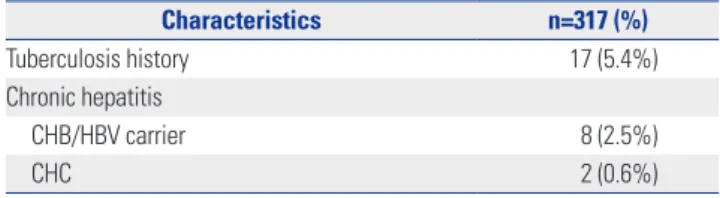
All of the patients received at least one infliximab infusion for the treatment of CD between 2002 and 2011, with a mean fol- low-up of 23.2±18.8 months from the first infusion. Mean ages at diagnosis and at first treatment with infliximab for CD were 25.9±10.2 (range 12–79) and 29.5±10.8 (range 14–79) years, re- spectively. Regarding past medical history, 17 patients had a history of active TB. A tuberculosis skin test (TST), interferon gamma releasing assay (IGRA), or both tests were performed in Table 1. Baseline Characteristics of the Patients
Characteristics n=317 (%)
Sex, male:female 206 (65.0%):111 (35.0%)
Age, mean±SD
Age at diagnosis 25.9±10.2
Age at 1st infliximab treatment 29.5±10.8
Body mass index (kg/m2) 19.1±3.2
Family history of IBD 6 (1.9%)
Disease duration prior to infliximab (yrs), mean±SD 4.1±4.2 Disease type
Active luminal disease 198 (62.5%)
Fistulizing disease 86 (27.1%)
Both 33 (10.4%)
Fistula location in fistulizing CD
Perianal 81 (68.1%)
Enterocutaneous 35 (29.4%)
Entero-enteric 8 (6.7%)
Enterovesical 5 (4.2%)
Rectovaginal 6 (5.0%)
Disease location
Small bowel 50 (15.8%)
Colon 60 (19.0%)
Both 207 (65.3%)
CDAI, mean±SD 279.3±92.0
Laboratory findings
Hemoglobin (g/dL), mean±SD 11.3±1.9
C-reactive protein (mg/dL), mean±SD 6.9±19.5
Albumin (g/dL), mean±SD 3.6±1.6
Previous medication
5-ASA 280 (88.3%)
Antibiotics 185 (58.4%)
Corticosteroid 217 (68.5%)
AZA or 6-MP 243 (76.7%)
Methotrexate 6 (1.9%)
Concomitant medication
5-ASA 247 (77.9%)
Antibiotics 100 (31.5%)
Corticosteroid 94 (29.7%)
AZA or 6-MP 185 (58.4%)
Methotrexate 0 (0%)
Previous segmental resection 166 (52.4%)
Smoking habit
Nonsmokers 257 (81.1%)
Former smokers 25 (7.9%)
Current smokers 18 (5.7%)
Unknown 17 (5.4%)
Table 1. Baseline Characteristics of the Patients (Continued)
Characteristics n=317 (%)
Tuberculosis history 17 (5.4%)
Chronic hepatitis
CHB/HBV carrier 8 (2.5%)
CHC 2 (0.6%)
IBD, inflammatory bowel disease; CD, Crohn’s disease; CDAI, Crohn’s disease activity index; CRP, C-reactive protein; 5-ASA, 5-aminosalicylates; AZA, aza- thioprine; 6-MP, 6-mercaptopurine; CHB, chronic hepatitis B; HBV, hepatitis B virus; CHC, chronic hepatitis C.
183 (57.7%), 100 (31.5%), and 56 (17.7%) patients, respectively, for latent TB infection (LTBI), and positive findings of TST, IGRA, and both tests were observed in 18 (9.8%), 11 (11%), and one (1.8%) patient, respectively. A simple chest X-ray was per- formed in all patients before infliximab infusion, and five pa- tients had TB scar changes. Patients who had at least one posi- tive finding among TB scars on chest X-ray, TST, and IGRA were considered to have LTBI (n=33). Among these 33 patients, 18 patients had received TB prophylaxis. Six patients had a family history of inflammatory bowel disease (CD: 5; ulcerative colitis:
1). In colonoscopic findings, ileocolonic ulcers (excluding aph-
thous ulcers) were observed in 79.7% (192 of 241), and a cobble- stone appearance was observed in 37.3% (90 of 241). The base- line characteristics of the patients are summarized in Table 1.
Infliximab therapy
The indication of infliximab therapy was as follows: 198 patients (62.5%) were treated for active luminal CD, 86 patients (27.1%) for fistulizing CD, and 33 patients (10.4%) for both active lumi- nal and fistulizing CD. Among the patients with active luminal CD, 56 (28.3%) had steroid dependency, 30 (15.2%) had steroid refractoriness, and 98 (49.5%) had IMM refractoriness. Among 119 patients with fistulas, 99 (83.2%) had external fistulas, and 28 (23.5%) had internal fistulas. The median number of inflix- imab infusions was eight, ranging from one to 31. The standard dose of 5 mg/kg infliximab was administered and maintained in most cases. During infliximab therapy, a dose increase was applied in eight patients (2.5%) and an interval decrease in two (0.6%). One hundred thirty-three (42%) patients discontinued therapy due to primary non-response (n=26), loss of response (n=23), intolerable adverse events (n=12), follow-up loss (n=16), economic difficulties (n=12), disease remission (n=27), or other reasons (n=17). A flow chart of the study population for each analysis is presented in Fig. 1.
Efficacy of infliximab in active luminal CD
After the first infusion of infliximab, treatment efficacy was as- sessed in 227 patients at week 2, 206 patients at week 6, and 185 patients at week 14 among the 231 patients who were diag- nosed with luminal CD or both luminal and fistulizing CD. Clini- Fig. 2. Clinical response (complete and partial response) and remission
(complete response) at weeks 2, 6, and 14 in patients with active luminal Crohn’s disease.
100
80
60
40
20
0
Proportion of patients
(%)
At week 14 (n=185)
10.8%
(n=20) 29.2%
(n=54)
60.0%
(n=111)
At week 2 (n=227) 28.2%
(n=64)
32.6%
(n=74)
39.2%
(n=89)
At week 6 (n=206)
14.1%
(n=29) 32.5%
(n=67)
53.4%
(n=110)
Partial response Complete response No response
Fig. 1. Flow chart of study population. CD, Crohn’s disease.
11 were administered infliximab less than 3 times 35 were not assessed at week 14
20 did not have response at week 14 11 did not have response at week 14
165 patients with response at week 14
assessed
62 patients with response at week 14
assessed
Analysis of initial responses at week 14
Analysis of sustained responses at weeks 30 and 54 6 were administered infliximab
less than 3 times 40 were not assessed at week 14 119 patients with
fistulizing CD 317 patients with CD enrolled
231 patients with luminal CD
185 patients
assessed 73 patients
assessed
cal response and remission were observed in 163 (71.8%) and 89 (39.2%) patients at week 2, in 177 (85.9%) and 110 (53.4%) at week 6, and in 165 (89.2%) and 111 (60.0%) at week 14, respec- tively (Fig. 2). CDAI scores at weeks 2, 6, and 14 decreased from the baseline value of 295.0±82.9 to 150.3±72.0, 132.1±70.2, and 134.1±84.1 at each time point, respectively. An analysis to iden- tify factors related to clinical remission at week 2 showed a sig- nificantly higher likelihood of remission in patients whose first infusion of infliximab was less than 3 years from diagnosis than
in those whose first infusion was greater than 3 years (47.1% vs.
30.6%, p=0.011); however, no other factors were associated with the remission rate. There was no factor associated with the re- mission rate at week 6. On analysis of the factors related to clini- cal remission at week 14, male gender and isolated colonic dis- ease were associated with a high remission rate (Table 2). On multivariate logistic regression analysis, male gender [odds ra- tio (OR)=1.99, 95% confidence interval (CI): 1.06–3.73, p=0.032]
and isolated colonic disease (OR=4.96 vs. small bowel disease, 95% CI: 1.68–14.67, p=0.004) were significantly associated with the remission rate. The other factors were not associated with the remission rate at week 14.
Among 165 patients who had a partial or complete response at week 14, the estimated rates of sustained clinical response were 96.2% at week 30 and 88.0% at week 54, respectively, on Kaplan-Meier analysis. In 111 patients with complete response (remission) at week 14, the estimated rates of sustained clinical remission were 93.3% at week 30 and 77.0% at week 54, respec- tively (Fig. 3). Log-rank test results showed that no clinical fac- tors were associated with the remission rate at week 30 as well as at week 54, including sex, time from diagnosis to first infu- sion of infliximab, and concomitant IMM use.
Of 231 patients, 170 received ileocolonoscopy before inflix- imab therapy. Active ulcerations and a cobblestone appearance were found in 141 (82.9%) and 65 (38.2%) patients, respectively.
Among 54 patients who underwent follow-up ileocolonoscopy, mucosal healing was present in 32 (59.3%). The mean interval between the initial and follow-up ileocolonoscopies was 33.7±28.9 (range 2–121 months). There were no clinical factors associated with the mucosal healing rate.
To evaluate the long-term efficacy, we performed a sub- analysis in the 185 patients who were followed-up for 6 months or more. The mean follow-up period was 28.3±18.4 months (range 6–103 months). At the time of the last follow-up, the mean CDAI score was 122.3±84.4 (range 10.6–475). Of the 185 patients, 111 (60.0%) were in remission, 54 (29.2%) had mild disease, and 20 (10.8%) had moderate or severe disease based on CDAI scores. The remission rate was higher in patients with mucosal healing than in those without mucosal healing on the follow-up ileocolonoscopies (78.1% vs. 50.0%, p=0.031).
Efficacy of infliximab in fistulizing CD
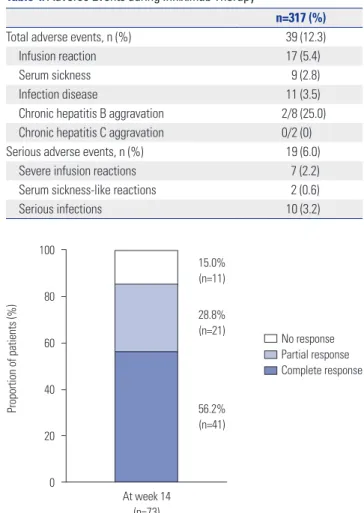
Among the 119 patients who were diagnosed with fistulizing CD or both luminal and fistulizing CD, the efficacy of induction therapy was assessed at week 14 in 73 patients who received three doses of infliximab. Clinical response and remission were observed in 62 (85.0%) and 41 patients (56.2%), respectively (Fig.
4). The clinical response and remission rates tended to be high- er in patients with external fistulas than in those with internal fistulas (87.3% and 58.2% for external fistulas vs. 69.2% and 46.2% for internal fistulas, respectively), and among the patients with external fistulas, these rates tended to be higher in patients with perianal fistulas than in those with enterocutaneous fistu- Table 2. Predictive Factors Related to Clinical Remission at Week 14 in
Luminal Crohn’s Disease
Remission at
week 14 p value
Sex 0.025
Male 78/118 (66.1%)
Female 33/67 (49.3%)
Age at diagnosis (yr) 0.760
≤25 65/110 (59.1%)
>25 46/75 (61.3%)
Age at 1st infliximab treatment (yr) 0.114
≤25 52/78 (66.7%)
>25 59/107 (55.1%)
Time from diagnosis to first infusion (yr) 0.401
≤3 years 58/92 (63%)
>3 years 53/93 (57%)
Body mass index (kg/m2) 0.640
≤20 70/118 (59.3%)
>20 39/62 (62.9%)
Smoking 0.544
Non-smoker 88/149 (59.2%)
Smoker 17/26 (65.4%)
Concomitant use of steroid 0.845
No 78/129 (60.5%)
Yes 33/56 (58.9%)
Concomitant use of AZA/6-MP 0.201
No 42/77 (54.5%)
Yes 69/108 (63.9%)
Hemoglobin (g/dL) 0.391
≤10 35/54 (64.8%)
>10 76/131 (58%)
C-reactive protein (mg/dL) 0.175
≤2 46/82 (56.1%)
>2 50/75 (66.7%)
Disease location 0.009
Small bowel 15/33 (45.5%)
Colon 29/36 (80.6%)
Both 67/116 (57.8%)
Ulcers in ileocolonoscopy at diagnosis 0.129
No 10/20 (50%)
Yes 79/117 (67.5%)
AZA, azathioprine; 6-MP, 6-mercaptopurine.
las (89.6% and 56.3% for perianal fistulas vs. 77.8% and 66.7%
for enterocutaneous fistulas, respectively) without statistical significance. No other clinical factors were associated with the remission rate at week 14 (Table 3).
Among the 62 patients who had a partial or complete re- sponse at week 14, three failed to maintain sustained clinical response at weeks 30 and 54. In 41 patients with complete re- sponse (remission) at week 14, one did not maintain sustained clinical remission at weeks 30 and 54. The estimated rates of sustained clinical response and remission were 94.0% and 97.1%, respectively, at both weeks 30 and 54. The predictive fac- tors for the sustained remission were not analyzed, as only one patient failed to sustain remission at weeks 30 and 54.
To evaluate the long-term efficacy, we performed a sub- analysis in the 104 patients who were followed-up for 6 months or more. The mean follow-up period was 30.3±19.0 months (range 6–103 months). At the time of the last follow-up, the clini- cal response and remission rates were 78.8% (82 of 104) and 54.8% (57 of 104), respectively.
Adverse events
During the follow-up period, 34 patients (10.7%) had new CD- related complications as follows: 27 strictures, three perianal fistulas, three intra-abdominal abscesses accompanying inter- nal fistulas, and one case of intractable GI bleeding. Twenty- seven patients (8.5%) underwent operations as follows: seven anal fistulectomies (or fistulotomies), four seton operations, 15 segmental bowel resections, and one total proctocolectomy and ileostomy.
Overall, 39 patients (12.3%) experienced an adverse event during infliximab therapy (Table 4). All of the adverse events could be directly attributed to infliximab. Two of the eight pa- tients who had chronic hepatitis B or were hepatitis B virus car- riers experienced mild elevation of alanine aminotransferase, although these responses spontaneously improved. Eighteen patients (5.7%) discontinued infliximab due to serious adverse
events: seven cases of severe infusion reactions, two cases of se- rum sickness, two cases of intra-abdominal abscess, and seven cases of active tuberculosis. There were no mortalities in this study.
In terms of tuberculosis, seven cases of active pulmonary TB developed during infliximab therapy. Two of these patients had negative results in both latent TB screening tests (TST and IGRA), and three did not undergo either latent TB test. One pa- tient had a past history of pulmonary TB and scar change on her chest X-ray and received anti-TB prophylaxis for 9 months with isoniazid (INH), with initiation of infliximab after 3 weeks of INH medication. In all seven patients, pulmonary TB was cured with anti-TB medications; however, infliximab treatment was restarted in only one patient who continued infliximab therapy for 28 months without TB reactivation. Detailed infor- mation on patients with active TB is provided in Table 5.
DISCUSSION
This report presents a relatively large-scale Asian study on the efficacy and safety of infliximab therapy for CD. In patients with active luminal CD, clinical response and remission rates were 89.2% and 60.0%, respectively, at week 14. The estimated rates of sustained clinical response and remission were 96.2% and 93.3% at week 30 and 88.0% and 77.0% at week 54, respectively, among the week-14 responders. For fistulizing CD, clinical re- sponse and remission rates were 85.0% and 56.2%, respectively, at week 14, and the clinical responses were maintained in most of the week-14 responders at both weeks 30 and 54. The initial responses of infliximab on fistulizing CD tended to be more ef- fective in patients with external fistulas, more so in those with perianal fistulas than in those with internal fistulas.
The results for the response to induction therapy in our study are comparable to those of previous studies that used inflix- imab, which reported early response rates of 58–96% and re- Fig. 3. (A) Cumulative probabilities of sustained clinical response for week 14 responders and (B) cumulative probabilities of sustained clinical remission for patients in remission at week 14 among patients with active luminal Crohn’s disease.
14 22 30 38 46 54 14 22 30 38 46 54
A B
100
80
60
40
20
0
100
80
60
40
20
0
(weeks) (weeks)
(%) (%)
mission rates of 40–73%.21-25 However, the sustained response and remission rates in patients with luminal CD were slightly higher than those of previous randomized, controlled trials (RCTs) such as the ACCENT-I study, in which the clinical re- sponse and remission rates were 50% and 39% at week 30 and 39% and 30% at week 54, respectively.18 Additionally, the esti- mated response rates of maintenance treatments in patients with fistulizing CD in our study were higher than those in the ACCENT-II study in which the proportions of patients with re- sponse and remission were 46% and 36% at week 54, respec-
tively.19 This disparity in response rates may be explained by differences in the characteristics of the patients (ethnicity, indi- cations for infliximab, disease severity, and extension) or in the study design (RCT or not).
Current treatment goals for CD are changing from the induc- tion of symptomatic remission to the achievement of mucosal healing, as the latter leads to improved long-term clinical out- comes.26,27 Mounting evidence suggests that achieving mucosal healing may change the natural course of the disease by de- creasing the need for surgery and reducing hospitalization rates of CD patients.28 Mucosal healing is now recognized as a new therapeutic goal in CD, at least in clinical trials.29 Consistent with this approach, mucosal healing was associated with a higher long-term remission rate in our study. However, this re- sult must be validated in a future prospective study.
In the analysis of the factors related to clinical remission at week 2 for luminal CD, patients whose first infusion of inflix- imab was less than 3 years from diagnosis had higher remission rates than those whose first infusion occurred more than 3 years after diagnosis. This is compatible with previous reports that have convincingly shown that anti-TNF therapy is more ef- Table 3. Predictive Factors Related to Clinical Remission at Week 14 in
Fistulizing Crohn’s Disease
Remission
at week 14 p value
Sex 0.370
Male 24/46 (52.2%)
Female 17/27 (63.0%)
Age at diagnosis (yr) 0.679
≤25 30/52 (57.7%)
>25 11/21 (52.4%)
Age at 1st infliximab treatment (yr) 0.918
≤25 21/37 (56.8%)
>25 20/36 (55.6%)
Time from diagnosis to first infusion (month) 0.448
≤3 22/42 (52.4%)
>3 19/31 (61.3%)
Body mass index (kg/m2) 0.736
≤20 28/48 (58.3%)
>20 13/24 (54.2%)
Smoking 0.918
Non-smoker 35/61 (57.4%)
Smoker 5/9 (55.6%)
Concomitant use of steroid 0.226
No 31/51 (60.8%)
Yes 10/22 (45.5%)
Concomitant use of AZA/6-MP 0.238
No 17/26 (65.4%)
Yes 24/47 (51.1%)
Concomitant use of antibiotics 0.526
No 21/35 (60.0%)
Yes 20/38 (52.6%)
Hemoglobin (g/dL) 0.891
≤10 10/18 (55.6%)
>10 31/54 (57.4%)
C-reactive protein (mg/dL) 0.980
≤2 21/39 (56.1%)
>2 13/24 (66.7%)
Type of fistula 0.984
Perianal fistula only 27/48 (56.3%)
Others 14/25 (56.0%)
AZA, azathioprine; 6-MP, 6-mercaptopurine.
Table 4. Adverse Events during Infliximab Therapy
n=317 (%)
Total adverse events, n (%) 39 (12.3)
Infusion reaction 17 (5.4)
Serum sickness 9 (2.8)
Infection disease 11 (3.5)
Chronic hepatitis B aggravation 2/8 (25.0) Chronic hepatitis C aggravation 0/2 (0)
Serious adverse events, n (%) 19 (6.0)
Severe infusion reactions 7 (2.2)
Serum sickness-like reactions 2 (0.6)
Serious infections 10 (3.2)
Fig. 4. Clinical response (complete and partial response) and remission (complete response) at week 14 in patients with fistulizing Crohn’s dis- ease.
No response Partial response Complete response
Proportion of patients
(%)
100
80
60
40
20
0
15.0%
(n=11)
28.8%
(n=21)
56.2%
(n=41)
At week 14 (n=73)
fective in patients with a short disease history.30,31 However, the disease duration from diagnosis to first infusion of infliximab was not associated with clinical remission at weeks 6 and 14. In the analysis to identify factors affecting the remission rate at week 14, sex and disease location were significantly associated with the remission rate. However, the disease location was not associated with response rates at weeks 2 and 6. Thus, we can- not confidently suggest the predictive factors for initial response to infliximab due to the inconsistency of the results. A future pro- spective study may confirm the possibility of sex, disease loca- tion, and duration as predictive factors for initial response to in- fliximab in luminal CD.
No factors were associated with the efficacy of maintenance therapy in luminal CD, including sex, disease location, and du- ration. The SONIC trial demonstrated that the combination of infliximab and azathioprine (AZA) was superior to either inflix- imab or AZA alone in patients with active luminal CD naive to IMMs and biologics.32 A large portion of the patients in our study (76.7%) had experienced IMMs before infliximab thera- py; therefore, the response rates did not appear to be different between the combination therapy of infliximab plus AZA and infliximab alone. In addition, patients with high baseline C-re- active protein, those with isolated colonic disease and no previ- ous abdominal surgery, young patients, and nonsmokers have all been suggested to be more likely to respond to anti-TNF therapy.9 However, these factors were not related to the mainte- nance effect of infliximab therapy in our study. Only isolated colonic disease was associated with initial response. These dis- crepancies might also originate from differences in the charac- teristics and ethnicity of the study population or the study de- sign (prospective or retrospective). Factors related to the efficacy of maintenance therapy using infliximab also need to be inves- tigated more in a prospective study.
Induction and maintenance therapy with infliximab was well tolerated in Korean patients with CD. Overall, 39 patients (12.3%) experienced an adverse event during infliximab therapy. As this study was conducted retrospectively, the overall incidence of adverse events, including infusion reactions and infections (not serious) might have been lower than in the ACCENT-I and II trials. However, the reported incidence of serious adverse events was similar to those in previous studies.18,19 In this study,
19 patients (6.0%) had serious adverse events, including seven cases of active pulmonary tuberculosis. Fortunately, there were no mortalities, and all cases of active TB were safely cured with anti-TB medications.
TB is significantly more common in South Korea than in oth- er developed countries. In the USA, the incidence rate of TB was 3.2 per 100000 person-years in 2012 and is currently in de- cline,33 whereas the incidence of TB in the general Korean pop- ulation is 92 per 100000 person-years.34 Moreover, anti-TNF therapy was shown to be associated with a 2.5- to 18-fold in- crease in the incidence of TB infection compared to healthy con- trols, although the actual incidence was not particularly high.34-39 Thus, screening tests to confirm active TB and LTBI prior to starting anti-TNF therapy are essential. According to the Korean guidelines for TB, patients who are to be treated with anti-TNF agents should first be checked regarding their past TB history, contact history with patients with TB, and present suspected symptoms of TB and should have a chest X-ray examination and TB infection tests.34,40 The TB infection tests should be per- formed by using an IGRA alone or both an IGRA and a TST. A TST alone is not recommended for testing TB infection in pa- tients with inflammatory bowel disease, as the use of immuno- suppressive agents may lead to a false negative TST result due to anergy.34,40 In our study, the incidence of active TB was relatively high; moreover, two patients had negative results in TB infection tests (TST and IGRA) and normal chest X-ray results, and anoth- er patient received anti-TB prophylaxis (INH, 9 months) due to LTBI among the seven patients in whom active TB developed.
Thus, a screening test for TB infection using both a TST and an IGRA at one time before starting infliximab may not be suffi- cient to prevent active TB development, particularly in countries with a high prevalence of TB. Physicians should thoroughly re- view patient histories, TST and IGRA results, and chest X-ray findings before commencing anti-TNF therapy for CD, and they should also pay attention to the risk of TB development even if the patients do not have LTBI or have taken treatment for LTBI.
In addition, a substantial portion of TB cases (71%, 5 of 7) oc- curred within 3 months after infliximab initiation. Thus, more attention to TB development may be needed during the early period of infliximab therapy.
A limitation of our study was its retrospective design. More- Table 5. Details of Tuberculosis Infection
No. Patient (age/sex) TB history TST* IGRA Chest PA (X-ray) Prophylaxis IMMs Steroid Interval to active TB (months)
1 26/M No (-) (-) NL ND Yes Yes 30
2 43/M No ND ND NL ND No Yes 3
3 62/M No ND ND NL ND No Yes 2
4 33/M No (-) (-) NL ND Yes No 12
5 43/M No ND (-) NL ND No No 2
6 32/M No ND ND NL ND Yes No 2
7 46/F Yes/lung (-) ND TB scar INH/9 months Yes No 2
TB, tuberculosis; TST, tuberculosis skin test; IGRA, interferon gamma releasing assay; IMM, immunomodulator; NL, normal; ND, not done; INH, isoniazid.
*A purified protein derivative reaction measuring less than 10 mm was considered negative in TST.
over, we did not evaluate trough levels and antibodies to inflix- imab. Nonetheless, this was a relatively large-scale, nationwide, multicenter study to evaluate the efficacy and safety in Korean patients with CD, and it provided baseline data for subsequent well-designed prospective studies.
In conclusion, we have demonstrated the efficacy of inflix- imab in induction and maintenance treatments in Korean pa- tients with luminal and fistulizing CD. Infliximab treatment was safe and well tolerated. However, physicians should always be cautious about the possible adverse effects of infliximab, par- ticularly for TB. Further prospective studies are needed to eval- uate the long-term efficacy and safety of infliximab therapy and to determine the predictors of response in patients with CD.
REFERENCES
1. Lichtenstein GR, Hanauer SB, Sandborn WJ; Practice Parameters Committee of American College of Gastroenterology. Manage- ment of Crohn’s disease in adults. Am J Gastroenterol 2009;104:
465-83.
2. Van Assche G, Dignass A, Panes J, Beaugerie L, Karagiannis J, Allez M, et al. The second European evidence-based consensus on the diagnosis and management of Crohn’s disease: definitions and diagnosis. J Crohns Colitis 2010;4:7-27.
3. Tozer PJ, Whelan K, Phillips RK, Hart AL. Etiology of perianal Crohn’s disease: role of genetic, microbiological, and immunologi- cal factors. Inflamm Bowel Dis 2009;15:1591-8.
4. Ford AC, Kane SV, Khan KJ, Achkar JP, Talley NJ, Marshall JK, et al.
Efficacy of 5-aminosalicylates in Crohn’s disease: systematic review and meta-analysis. Am J Gastroenterol 2011;106:617-29.
5. Khan KJ, Dubinsky MC, Ford AC, Ullman TA, Talley NJ, Moayyedi P. Efficacy of immunosuppressive therapy for inflammatory bow- el disease: a systematic review and meta-analysis. Am J Gastroen- terol 2011;106:630-42.
6. Turner D, Walsh CM, Steinhart AH, Griffiths AM. Response to corticosteroids in severe ulcerative colitis: a systematic review of the literature and a meta-regression. Clin Gastroenterol Hepatol 2007;5:103-10.
7. Knight DM, Trinh H, Le J, Siegel S, Shealy D, McDonough M, et al.
Construction and initial characterization of a mouse-human chi- meric anti-TNF antibody. Mol Immunol 1993;30:1443-53.
8. Plevy SE, Landers CJ, Prehn J, Carramanzana NM, Deem RL, Shealy D, et al. A role for TNF-alpha and mucosal T helper-1 cyto- kines in the pathogenesis of Crohn’s disease. J Immunol 1997;159:
6276-82.
9. D’Haens GR, Panaccione R, Higgins PD, Vermeire S, Gassull M, Chowers Y, et al. The London Position Statement of the World Con- gress of Gastroenterology on Biological Therapy for IBD with the European Crohn’s and Colitis Organization: when to start, when to stop, which drug to choose, and how to predict response? Am J Gastroenterol 2011;106:199-212.
10. Dignass A, Van Assche G, Lindsay JO, Lémann M, Söderholm J, Colombel JF, et al. The second European evidence-based consen- sus on the diagnosis and management of Crohn’s disease: current management. J Crohns Colitis 2010;4:28-62.
11. Hamzaoglu H, Cooper J, Alsahli M, Falchuk KR, Peppercorn MA, Farrell RJ. Safety of infliximab in Crohn’s disease: a large single- center experience. Inflamm Bowel Dis 2010;16:2109-16.
12. Park SK, Ye BD, Lee C, Im JP, Kim YH, Kim SO, et al. Risk and clin- ical characteristics of lymphoma in Korean patients with inflam-
matory bowel diseases: a multicenter study. J Clin Gastroenterol 2015;49:e11-6.
13. Ng SC, Tsoi KK, Kamm MA, Xia B, Wu J, Chan FK, et al. Genetics of inflammatory bowel disease in Asia: systematic review and meta-analysis. Inflamm Bowel Dis 2012;18:1164-76.
14. Ha C, Ullman TA, Siegel CA, Kornbluth A. Patients enrolled in randomized controlled trials do not represent the inflammatory bowel disease patient population. Clin Gastroenterol Hepatol 2012;
10:1002-7.
15. Jo KW, Hong Y, Park JS, Bae IG, Eom JS, Lee SR, et al. Prevalence of latent tuberculosis infection among health care workers in South Korea: a multicenter study. Tuberc Respir Dis (Seoul) 2013;75:18- 24.
16. Lee CH, Jeong YJ, Heo EY, Park JS, Lee JS, Lee BJ, et al. Active pul- monary tuberculosis and latent tuberculosis infection among homeless people in Seoul, South Korea: a cross-sectional study.
BMC Public Health 2013;13:720.
17. Lennard-Jones JE. Classification of inflammatory bowel disease.
Scand J Gastroenterol Suppl 1989;170:2-6.
18. Hanauer SB, Feagan BG, Lichtenstein GR, Mayer LF, Schreiber S, Colombel JF, et al. Maintenance infliximab for Crohn’s disease: the ACCENT I randomised trial. Lancet 2002;359:1541-9.
19. Sands BE, Anderson FH, Bernstein CN, Chey WY, Feagan BG, Fe- dorak RN, et al. Infliximab maintenance therapy for fistulizing Crohn’s disease. N Engl J Med 2004;350:876-85.
20. Maini RN, Breedveld FC, Kalden JR, Smolen JS, Furst D, Weisman MH, et al. Sustained improvement over two years in physical func- tion, structural damage, and signs and symptoms among patients with rheumatoid arthritis treated with infliximab and methotrex- ate. Arthritis Rheum 2004;50:1051-65.
21. Ardizzone S, Colombo E, Maconi G, Bollani S, Manzionna G, Petrone MC, et al. Infliximab in treatment of Crohn’s disease: the Milan ex- perience. Dig Liver Dis 2002;34:411-8.
22. Kim YJ, Kim JW, Lee CK, Park HJ, Shim JJ, Jang JY, et al. [Clinical outcome of treatment with infliximab in Crohn’s disease: a single- center experience]. Korean J Gastroenterol 2013;61:270-8.
23. Orlando A, Colombo E, Kohn A, Biancone L, Rizzello F, Viscido A, et al. Infliximab in the treatment of Crohn’s disease: predictors of response in an Italian multicentric open study. Dig Liver Dis 2005;37:577-83.
24. Present DH, Rutgeerts P, Targan S, Hanauer SB, Mayer L, van Ho- gezand RA, et al. Infliximab for the treatment of fistulas in patients with Crohn’s disease. N Engl J Med 1999;340:1398-405.
25. Targan SR, Hanauer SB, van Deventer SJ, Mayer L, Present DH, Braakman T, et al. A short-term study of chimeric monoclonal anti- body cA2 to tumor necrosis factor alpha for Crohn’s disease.
Crohn’s Disease cA2 Study Group. N Engl J Med 1997;337:1029-35.
26. Bouguen G, Levesque BG, Feagan BG, Kavanaugh A, Peyrin-Bi- roulet L, Colombel JF, et al. Treat to target: a proposed new para- digm for the management of Crohn’s disease. Clin Gastroenterol Hepatol 2015;13:1042-50.e2.
27. D’Haens GR, Sartor RB, Silverberg MS, Petersson J, Rutgeerts P. Fu- ture directions in inflammatory bowel disease management. J Crohns Colitis 2014;8:726-34.
28. Peyrin-Biroulet L, Ferrante M, Magro F, Campbell S, Franchimont D, Fidder H, et al. Results from the 2nd Scientific Workshop of the ECCO. I: Impact of mucosal healing on the course of inflammato- ry bowel disease. J Crohns Colitis 2011;5:477-83.
29. Rutgeerts P, Van Assche G, Sandborn WJ, Wolf DC, Geboes K, Co- lombel JF, et al. Adalimumab induces and maintains mucosal heal- ing in patients with Crohn’s disease: data from the EXTEND trial.
Gastroenterology 2012;142:1102-11.e2.
30. Colombel JF, Sandborn WJ, Rutgeerts P, Enns R, Hanauer SB, Pan-
accione R, et al. Adalimumab for maintenance of clinical response and remission in patients with Crohn’s disease: the CHARM trial.
Gastroenterology 2007;132:52-65.
31. D’Haens G, Baert F, van Assche G, Caenepeel P, Vergauwe P, Tuyn- man H, et al. Early combined immunosuppression or conventional management in patients with newly diagnosed Crohn’s disease:
an open randomised trial. Lancet 2008;371:660-7.
32. Colombel JF, Sandborn WJ, Reinisch W, Mantzaris GJ, Kornbluth A, Rachmilewitz D, et al. Infliximab, azathioprine, or combination therapy for Crohn’s disease. N Engl J Med 2010;362:1383-95.
33. Centers for Disease Control and Prevention (CDC). Trends in tu- berculosis--United States, 2012. MMWR Morb Mortal Wkly Rep 2013;62:201-5.
34. Shim TS. Diagnosis and treatment of latent tuberculosis infection in patients with inflammatory bowel diseases due to initiation of anti-tumor necrosis factor therapy. Intest Res 2014;12:12-9.
35. Dixon WG, Hyrich KL, Watson KD, Lunt M, Galloway J, Ustianows- ki A, et al. Drug-specific risk of tuberculosis in patients with rheu- matoid arthritis treated with anti-TNF therapy: results from the British Society for Rheumatology Biologics Register (BSRBR). Ann Rheum Dis 2010;69:522-8.
36. Lee SK, Kim SY, Kim EY, Jung JY, Park MS, Kim YS, et al. Mycobac- terial infections in patients treated with tumor necrosis factor an- tagonists in South Korea. Lung 2013;191:565-71.
37. Marehbian J, Arrighi HM, Hass S, Tian H, Sandborn WJ. Adverse events associated with common therapy regimens for moderate- to-severe Crohn’s disease. Am J Gastroenterol 2009;104:2524-33.
38. Tubach F, Salmon D, Ravaud P, Allanore Y, Goupille P, Bréban M, et al. Risk of tuberculosis is higher with anti-tumor necrosis factor monoclonal antibody therapy than with soluble tumor necrosis factor receptor therapy: the three-year prospective French Re- search Axed on Tolerance of Biotherapies registry. Arthritis Rheum 2009;60:1884-94.
39. Yoo IK, Choung RS, Hyun JJ, Kim SY, Jung SW, Koo JS, et al. Inci- dences of serious infections and tuberculosis among patients re- ceiving anti-tumor necrosis factor-α therapy. Yonsei Med J 2014;55:
442-8.
40. Joint Committee for the Revision of Korean Guidelines for Tuber- culosis; Korea Centers for Disease Control and Prevention. Kore- an guidelines for tuberculosis. 2nd ed. Cheongju: Korea Centers for Disease Control and Prevention; 2014.