• 검색 결과가 없습니다.

Development and validation of prediction equations for the assessment of muscle or fat mass using anthropometric measurements, serum creatinine level, and lifestyle factors among Korean adults

N/A
N/A
Protected

Academic year: 2022

Share "Development and validation of prediction equations for the assessment of muscle or fat mass using anthropometric measurements, serum creatinine level, and lifestyle factors among Korean adults"

Copied!
11
0
0

로드 중.... (전체 텍스트 보기)

전체 글

(1)

ABSTRACT

BACKGROUND/OBJECTIVES: The measurement of body composition, including muscle and fat mass, remains challenging in large epidemiological studies due to time constraint and cost when using accurate modalities. Therefore, this study aimed to develop and validate prediction equations according to sex to measure lean body mass (LBM), appendicular skeletal muscle mass (ASM), and body fat mass (BFM) using anthropometric measurement, serum creatinine level, and lifestyle factors as independent variables and dual-energy X-ray absorptiometry as the reference method.

SUBJECTS/METHODS: A sample of the Korean general adult population (men: 7,599; women:

10,009) from the Korean National Health and Nutrition Examination Survey 2008–2011 was included in this study. The participants were divided into the derivation and validation groups via a random number generator (with a ratio of 70:30). The prediction equations were developed using a series of multivariable linear regressions and validated using the Bland–

Altman plot and intraclass correlation coefficient (ICC).

RESULTS: The initial and practical equations that included age, height, weight, and waist circumference had a different predictive ability for LBM (men: R

2

= 0.85, standard error of estimate [SEE] = 2.7 kg; women: R

2

= 0.78, SEE = 2.2 kg), ASM (men: R

2

= 0.81, SEE = 1.6 kg;

women: R

2

= 0.71, SEE = 1.2 kg), and BFM (men: R

2

= 0.74, SEE = 2.7 kg; women: R

2

= 0.83, SEE = 2.2 kg) according to sex. Compared with the first prediction equation, the addition of other factors, including serum creatinine level, physical activity, smoking status, and alcohol use, resulted in an R

2

that is higher by 0.01 and SEE that is lower by 0.1.

CONCLUSIONS: All equations had low bias, moderate agreement based on the Bland–Altman plot, and high ICC, and this result showed that these equations can be further applied to other epidemiologic studies.

Keywords: Anthropometry; body composition; dual-energy X-ray absorptiometry;

predictive value of tests; validation study

Original Research

Received: Jan 16, 2020 Revised: May 6, 2020 Accepted: Jun 1, 2020

§

Corresponding Author:

Sang Min Park

Department of Family Medicine and Biomedical Sciences, College of Medicine, Seoul National University, 101 Daehak-ro, Jongno-gu, Seoul 03080, Korea.

Tel. +82-2-2072-3331 Fax. +82-2-766-3276

E-mail. [email protected]

©2021 The Korean Nutrition Society and the Korean Society of Community Nutrition This is an Open Access article distributed under the terms of the Creative Commons Attribution Non-Commercial License (https://

creativecommons.org/licenses/by-nc/4.0/) which permits unrestricted non-commercial use, distribution, and reproduction in any medium, provided the original work is properly cited.

ORCID iDs Gyeongsil Lee

https://orcid.org/0000-0003-1910-9658 Jooyoung Chang

https://orcid.org/0000-0002-8586-0645 Seung-sik Hwang

https://orcid.org/0000-0002-1558-7831 Joung Sik Son

https://orcid.org/0000-0003-2460-3378 Sang Min Park

https://orcid.org/0000-0002-7498-4829

Gyeongsil Lee 1 , Jooyoung Chang 2 , Seung-sik Hwang 3 , Joung Sik Son 1 , and Sang Min Park 1,2§

1

Department of Family Medicine, Seoul National University Hospital, Seoul 03080, Korea

2

Department of Biomedical Sciences, Seoul National University Graduate School, Seoul 03080, Korea

3

Department of Public Health Science, Graduate School of Public Health, Seoul National University, Seoul 08826, Korea

Development and validation of prediction equations for the assessment of muscle or fat mass

using anthropometric measurements,

serum creatinine level, and lifestyle

factors among Korean adults

(2)

Conflict of Interest

The authors declare no potential conflicts of interests.

Author Contributions

Conceptualization: Lee G, Park SM; Data curation: Lee G; Formal analysis: Lee G;

Investigation: Lee G, Son JS; Methodology: Lee G, Chang J, Hwang SS; Project administration:

Park SM; Resources: Lee G; Software: Lee G; Supervision: Park SM; Validation: Chang J, Hwang SS; Visualization: Lee G; Writing - original draft: Lee G; Writing - review &

editing:Lee G, Chang J, Hwang SS, Son JS, Park SM.

INTRODUCTION

Body mass index (BMI) is the most commonly used tool to evaluate obesity in epidemiological research [1,2]. However, some studies have reported that individuals with normal BMI are also at high risk for cardiovascular disease or mortality due to high fat [3-6]. BMI is calculated as weight in kilogram (kg) divided by height in meters squared (m

2

), which is limited in distinguishing each body composition, including lean body mass (LBM) and body fat mass (BFM). The tools used for evaluating body composition include dual-energy X-ray absorptiometry (DXA), bioimpedance analysis, computed tomography (CT) scan, and magnetic resonance imaging (MRI). However, these tools have limitations in terms of high cost and time constraint in epidemiological research. In relation to this reason, efforts have been made to develop prediction equations for LBM and BFM using anthropometric measures.

However, to date, there is no consensus regarding the appropriate prediction equations [7-11]. Most equations were used in small-scale studies and those that rarely include Asians.

Some equations that were previously developed were never validated, and even if they were done, the validation method was incorrect. In addition, to the best of our knowledge, there are no studies that have developed prediction equations with consideration of other factors affecting body composition. Lifestyle factors, such as smoking status, alcohol use, and physical activity, could affect body composition, particularly obesity [1]. Additionally, serum creatinine might predict muscle mass since it is released from the muscle [12]. Therefore, we aimed to develop and validate simple prediction equations for LBM, appendicular skeletal muscle mass (ASM), and BFM using a large sample from the Korean National Health and Nutrition Examination Survey (KNHANES) 2008–2011.

SUBJECTS AND METHODS

Study participants

This current study used data from KNHANES, which is an annual national health survey conducted by the government and the Korea Centers for Disease Control and Prevention.

The participants were selected using a randomized multistage stratified cluster sampling protocol according to the Korean national census data, as described elsewhere [13]. The initial candidates included 28,071 adults aged > 19 years who participated in the survey from 2008 to 2011, as data obtained using DXA were only available during this period. We excluded patients who lacked the following data: DXA data (n = 9,485), anthropometric data (n = 87), including height, weight, or waist circumference (WC) measurements, serum creatinine level (n = 731), and lifestyle factors (n = 160), including physical activity, smoking habit, and alcohol use. The present analysis ultimately included data from 17,608 Korean adults (men:

7,599; women: 10,009).

The Institutional Review Board of the Korea Center for Disease Control and Prevention reviewed and approved the KNHANES (IRB nos. 2008-04EXP-01-C, 2009-01CON-03-2C, 2010-02CON-21, and 2011-02CON-06-C).

Variable measurement

Height, body weight, and WC were assessed by medical staff based on standardized

procedures. BMI was calculated by dividing body weight (kg) by height in meters squared

(m

2

). Fat and lean (fat-free) mass were evaluated using the whole-body DXA (HOLOGIC

(3)

Discovery W Bone Densitometer, Hologic Inc., Bedford, MA, the USA). LBM from all anatomical regions of the skeletal muscle was assessed, and ASM from the combined LBM of the right and left arms and legs was evaluated [14].

Smoking status was used to categorize participants into three groups: never smokers, ex- smokers, and current smokers. Those who currently smoked or had smoked ≥ 100 cigarettes during their lifetime were defined as smokers. Alcohol use was categorized into three groups:

none, moderate, and heavy and heavy alcohol use was defined based 14 drinks and 7 drinks per week for men and women, respectively. The drinks were calculated by multiplying the average drinking frequency per week by the number of drinks per occasion. Physical activity was assessed using the Korean version of the International Physical Activity Questionnaire- short form. We created a composite physical activity based on Metabolic Equivalent Task (MET)-minutes/week (walking: 3.3 METs; moderate physical activity: 4.0 METs; vigorous physical activity: 8.0 METs), which was categorized as follows based on total physical activity metabolic equivalents: low (< 600 METs), moderate (600–2,999 METs), and vigorous (≥ 3,000 METs) [15,16].

Statistical analysis

We conducted this analysis in three steps. First, data were randomly divided into two independent groups, derivation and validation groups (70:30 ratio), in each sex. The general characteristics of the study population were compared using t-test (all continuous variables).

In the second step, using derivation group, we conducted a series of multivariable linear regression to predict each of the DXA-measured LBM, ASM and BFM as a dependent variable in relation to age, anthropometric measures, serum creatinine level, and lifestyle factors as predictor variables. We used height (cm), weight (kg), BMI (kg/m

2

), WC (cm), and serum creatinine level (mg/dL) as continuous variables. Meanwhile, the following lifestyle factors were utilized as categorical variables: physical activity (low, moderate, vigorous), smoking habit (never, ex-smoker, and current smoker), and alcohol use (none, moderate, and heavy alcohol use). Age (years) was additionally used in all models. Forward and backward stepwise regression analysis was performed (a to enter 0.2, a to remove 0.2) using the relevant variables. The coefficient of determination (adjusted R

2

) and standard error of estimate (SEE) were used to compare different models and to determine the most accurate model for prediction. The highest adjusted R

2

value in each set of stepwise regression was used for further investigation. The evaluation of any substantial improvement in the model was performed by carrying out likelihood ratio tests. Lastly, we validated the prediction equations using the Bland–Altman plots and intraclass correlation coefficients (ICCs). The Bland- Altman plot was established to assess visually the agreement, and ICC was used to investigate the correlation between the values calculated using the novel equation and those measured with DXA. All statistical analyses were performed using Stata 16.0 (Stata Corp., College Station, TX, USA). A P-value < 0.05 was considered statistically significant.

RESULTS

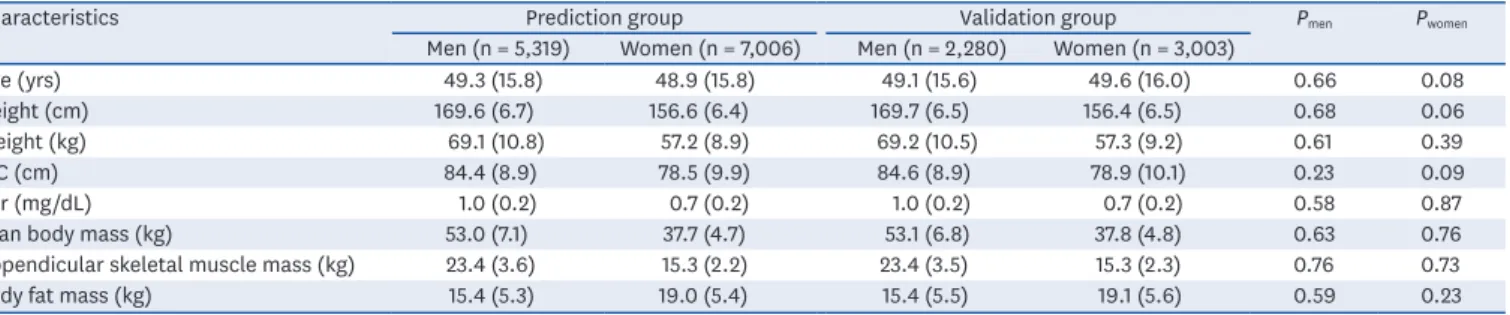
Table 1 shows the baseline characteristics of the study population according to sex in the derivation and validation groups. Each variable was not significant due to random sampling.

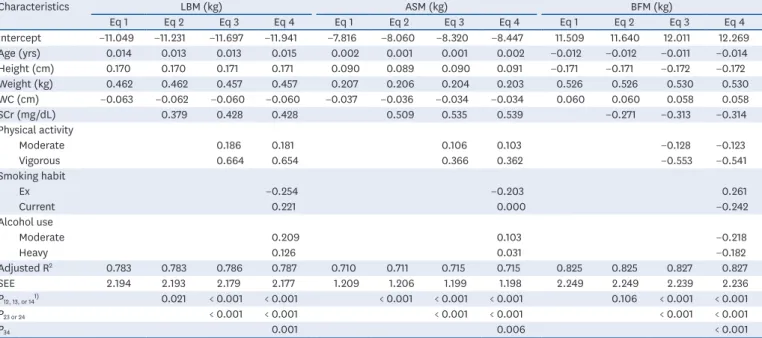
Tables 2 and 3 depict the anthropometric prediction equations for LBM, ASM, and BFM

among men and women. For LBM in men, the R

2

for equation 1, which included age,

height, weight, and WC, was 85.3%. In addition to the dependent variables in equation 4,

(4)

the addition of serum creatinine level, physical activity, smoking habit, and alcohol use to equation 1 significantly increased the adjusted R

2

from 85.3% to 85.8% and decreased the SEE from 2.716 kg to 2.667 kg (P < 0.001). The prediction of ASM and BFM in men had a lower R

2

than LBM. In women, the prediction of BFM had a higher R

2

than LBM (Table 2).

Figs. 1 and 2 show the Bland–Altman plot of LBM, ASM, and BFM in the derivation and validation groups using equation 4 in men and women. These display information about mean differences and agreements. For example, Fig. 1A shows an agreement between LBM and predicted LBM among men in the derivation group. The mean difference was 0.000, implying that the difference between the actual and predicted values by equation 4 was almost zero and suggested a low bias. The limits of agreement were 4.68% outside, meaning that 4.68% of subjects were outside 95% limits of agreement and suggested a moderate agreement. Table 4 depicts the ICC value used to assess the agreement between the novel equation and DXA when utilized in measuring muscle or fat mass. All ICCs were higher than 0.9, which indicated a good agreement between the two methods. In men, the ICCs of Table 1. Baseline characteristics of study population

Characteristics Prediction group Validation group P

men

P

women

Men (n = 5,319) Women (n = 7,006) Men (n = 2,280) Women (n = 3,003)

Age (yrs) 49.3 (15.8) 48.9 (15.8) 49.1 (15.6) 49.6 (16.0) 0.66 0.08

Height (cm) 169.6 (6.7) 156.6 (6.4) 169.7 (6.5) 156.4 (6.5) 0.68 0.06

Weight (kg) 69.1 (10.8) 57.2 (8.9) 69.2 (10.5) 57.3 (9.2) 0.61 0.39

WC (cm) 84.4 (8.9) 78.5 (9.9) 84.6 (8.9) 78.9 (10.1) 0.23 0.09

SCr (mg/dL) 1.0 (0.2) 0.7 (0.2) 1.0 (0.2) 0.7 (0.2) 0.58 0.87

Lean body mass (kg) 53.0 (7.1) 37.7 (4.7) 53.1 (6.8) 37.8 (4.8) 0.63 0.76

Appendicular skeletal muscle mass (kg) 23.4 (3.6) 15.3 (2.2) 23.4 (3.5) 15.3 (2.3) 0.76 0.73

Body fat mass (kg) 15.4 (5.3) 19.0 (5.4) 15.4 (5.5) 19.1 (5.6) 0.59 0.23

Values are mean ± SD.

WC, waist circumference; SCr, serum creatinine.

Table 2. Anthropometric prediction equations for lean body mass, appendicular skeletal muscle mass, and fat mass among men

Characteristics LBM (kg) ASM (kg) BFM (kg)

Eq 1 Eq 2 Eq 3 Eq 4 Eq 1 Eq 2 Eq 3 Eq 4 Eq 1 Eq 2 Eq 3 Eq 4

Intercept 0.711 1.025 −0.172 −0.296 −1.546 −1.475 −2.224 −2.236 −0.450 −0.770 0.374 0.561

Age (yrs) 0.007 0.008 0.007 0.012 −0.012 −0.012 −0.012 −0.011 −0.007 −0.007 −0.006 −0.012

Height (cm) 0.132 0.133 0.136 0.134 0.079 0.079 0.081 0.081 −0.131 −0.131 −0.134 −0.133

Weight (kg) 0.675 0.676 0.670 0.675 0.327 0.327 0.323 0.324 0.311 0.309 0.315 0.310

WC (cm) −0.203 −0.203 −0.196 −0.201 −0.124 −0.124 −0.119 −0.121 0.201 0.201 0.194 0.199

SCr (mg/dL) −0.462 −0.363 −0.249 −0.104 −0.046 −0.008 0.469 0.373 0.253

Physical activity

Moderate 0.272 0.270 0.202 0.200 −0.248 −0.247

Vigorous 0.969 0.924 0.600 0.587 −0.928 −0.878

Smoking habit

Ex −0.559 −0.195 0.708

Current 0.234 −0.016 −0.275

Alcohol use

Moderate −0.046 0.004 0.077

Heavy 0.324 0.151 −0.291

Adjusted R

2

0.853 0.853 0.856 0.858 0.808 0.808 0.812 0.812 0.735 0.735 0.740 0.745

SEE 2.716 2.714 2.687 2.667 1.581 1.581 1.564 1.562 2.748 2.747 2.722 2.695

P

12, 13, or 141)

0.013 < 0.001 < 0.001 0.338 < 0.001 < 0.001 0.013 < 0.001 < 0.001

P

23 or 24

< 0.001 < 0.001 < 0.001 < 0.001 < 0.001 < 0.001

P

34

< 0.001 0.001 < 0.001

LBM, lean body mass; ASM, appendicular skeletal muscle mass; BFM, body fat mass; Eq, equation; WC, waist circumference; SCr, serum creatinine; SEE, standard error of estimate.

1)
P

12, 13, or 14

means the P-value of likelihood ratio tests between equation 1 and equation 2, 3, or 4.

(5)

the muscle mass equations, such as LBM and ASM, were higher than those of the fat mass equations, like BFM. Conversely, in women, the ICCs of muscle mass equations were lower than those of fat mass.

In cases wherein only BMI is available, and height and body weight are not, we developed and validated the LBM, ASM, and BFM indexes of both men and women (Supplementary Tables 1-3). The adjusted R

2

and ICC of the predicted equations of mass indices were generally lower than that of mass. Supplementary Data 1 shows methods for using anthropometric prediction equations for LBM, ASM, and fat mass among adults.

DISCUSSION

The use of predicted equations for body composition has been previously proposed because imaging modalities, including DXA, CT scan, and MRI, cannot be used even if they are clinically important in measuring body composition. We developed and validated prediction Table 3. Anthropometric prediction equations for lean body mass, appendicular skeletal muscle mass, and fat mass among women

Characteristics LBM (kg) ASM (kg) BFM (kg)

Eq 1 Eq 2 Eq 3 Eq 4 Eq 1 Eq 2 Eq 3 Eq 4 Eq 1 Eq 2 Eq 3 Eq 4

Intercept −11.049 −11.231 −11.697 −11.941 −7.816 −8.060 −8.320 −8.447 11.509 11.640 12.011 12.269

Age (yrs) 0.014 0.013 0.013 0.015 0.002 0.001 0.001 0.002 −0.012 −0.012 −0.011 −0.014

Height (cm) 0.170 0.170 0.171 0.171 0.090 0.089 0.090 0.091 −0.171 −0.171 −0.172 −0.172

Weight (kg) 0.462 0.462 0.457 0.457 0.207 0.206 0.204 0.203 0.526 0.526 0.530 0.530

WC (cm) −0.063 −0.062 −0.060 −0.060 −0.037 −0.036 −0.034 −0.034 0.060 0.060 0.058 0.058

SCr (mg/dL) 0.379 0.428 0.428 0.509 0.535 0.539 −0.271 −0.313 −0.314

Physical activity

Moderate 0.186 0.181 0.106 0.103 −0.128 −0.123

Vigorous 0.664 0.654 0.366 0.362 −0.553 −0.541

Smoking habit

Ex −0.254 −0.203 0.261

Current 0.221 0.000 −0.242

Alcohol use

Moderate 0.209 0.103 −0.218

Heavy 0.126 0.031 −0.182

Adjusted R

2

0.783 0.783 0.786 0.787 0.710 0.711 0.715 0.715 0.825 0.825 0.827 0.827

SEE 2.194 2.193 2.179 2.177 1.209 1.206 1.199 1.198 2.249 2.249 2.239 2.236

P

12, 13, or 141)

0.021 < 0.001 < 0.001 < 0.001 < 0.001 < 0.001 0.106 < 0.001 < 0.001

P

23 or 24

< 0.001 < 0.001 < 0.001 < 0.001 < 0.001 < 0.001

P

34

0.001 0.006 < 0.001

LBM, lean body mass; ASM, appendicular skeletal muscle mass; BFM, body fat mass; Eq, equation; WC, waist circumference; SCr, serum creatinine; SEE, standard error of estimate.

1)
P

12, 13, or 14

means the P-value of likelihood ratio tests between equation 1 and equation 2, 3, or 4.

Table 4. Intra-correlation coefficient for agreements of muscle or fat mass between the novel equation and the measured values using dual-energy X-ray absorptiometry

Variables LBM (kg) ASM (kg) BFM (kg)

Eq 1 Eq 2 Eq 3 Eq 4 Eq 1 Eq 2 Eq 3 Eq 4 Eq 1 Eq 2 Eq 3 Eq 4

Men

Derivation group 0.959 0.959 0.960 0.960 0.944 0.944 0.945 0.946 0.917 0.918 0.919 0.921

Validation group 0.952 0.952 0.954 0.954 0.934 0.934 0.936 0.936 0.914 0.914 0.916 0.918

Women

Derivation group 0.935 0.935 0.936 0.937 0.907 0.908 0.909 0.910 0.950 0.950 0.950 0.950

Validation group 0.938 0.938 0.939 0.939 0.912 0.912 0.913 0.913 0.952 0.952 0.953 0.953

LBM, lean body mass; ASM, appendicular skeletal muscle mass; BFM, body fat mass; Eq, equation.

(6)

Difference ( ASM -p ASM )

5 15 25 35 45

Average of ASM and pASM 269/5,319 = 5.06% outside the limits of agreement

Mean difference −0.000 95% limits of agreement (−3.057, 3.057) Averages lie between 10.277 and 40.803

(C)

10

5

0

−5

−10

Agreement between ASM & pASM among men in derivation group

Difference ( ASM -p ASM )

5 15 25 35 45

Average of ASM and pASM 119/2,280 = 5.22% outside the limits of agreement

Mean difference −0.001 95% limits of agreement (−3.167, 3.165) Averages lie between 13.677 and 37.419

(D)

5

0

−5

−10

Agreement between ASM & pASM among men in validation group

Difference ( BFM -p BFM )

0 10 20 30 40 50

Average of BFM and pBFM 269/5,319 = 5.06% outside the limits of agreement

Mean difference −0.000 95% limits of agreement (−5.276, 5.276)

Averages lie between 3.289 and 47.336

(E)

10

0

−10

−20

Agreement between BFM & pBFM among men in derivation group

Difference ( BFM -p BFM )

5 10 20 30 40 50

Average of BFM and pBFM 124/2,280 = 5.44% outside the limits of agreement

Mean difference 0.012 95% limits of agreement (−5.439, 5.462)

Averages lie between 2.736 and 42.567

(F)

10 5 15

0

−5

−10

Agreement between BFM & pBFM among men in validation group

Difference ( LBM -pLBM )

25 35 45 55 65 75 85

Average of LBM and pLBM 249/5,319 = 4.68% outside the limits of agreement

Mean difference −0.000 95% limits of agreement (−5.222, 5.222) Averages lie between 26.465 and 89.081

(A)

20

10

0

−10

−20

Agreement between LBM & pLBM among men in derivation group

Difference ( LBM -pLBM )

25 35 45 55 65 75 85

Average of LBM and pLBM 106/2,280 = 4.65% outside the limits of agreement

Mean difference 0.011 95% limits of agreement (−5.378, 5.401) Averages lie between 33.392 and 81.070

(B)

10

0

−10

−20

Agreement between LBM & pLBM among men in validation group

Fig. 1. Bland–Altman plot of the derivation group (left) and validation group (right) for LBM, ASM, and BFM estimates by dual-energy X-ray absorptiometry and prediction equations among men.

LBM, lean body mass; pLBM, predicted lean body mass; ASM, appendicular skeletal muscle mass; pASM, predicted skeletal muscle mass; BFM, body fat mass;

pBFM, predicted body fat mass.

(7)

Difference ( LBM -p LBM )

20 30 40 50 60 70

Average of LBM and pLBM 363/7,006 = 5.18% outside the limits of agreement

Mean difference −0.000 95% limits of agreement (−4.263, 4.263) Averages lie between 23.821 and 63.699

(A)

15

5 10

0

−5

−10

Agreement between LBM & pLBM among women in derivation group

Difference ( LBM -p LBM )

20 30 40 50 60 70

Average of LBM and pLBM 156/3,003 = 5.19% outside the limits of agreement

Mean difference 0.009 95% limits of agreement (−4.321, 4.339)

(B)

10

0 5

−5

−10

Agreement between LBM & pLBM among women in validation group

Averages lie between 24.853 and 59.213

Difference ( ASM -p ASM )

5 15 25

Average of ASM and p ASM 369/7,006 = 5.27% outside the limits of agreement

Mean difference −0.000 95% limits of agreement (−2.346, 2.346)

Averages lie between 8.871 and 26.459

(C)

5

0

−5

Agreement between ASM & pASM among women in derivation group

Difference ( ASM -p ASM )

5 15 25

Average of ASM and pASM 168/3,003 = 5.59% outside the limits of agreement

Mean difference −0.017 95% limits of agreement (−2.390, 2.355)

Averages lie between 9.694 and 25.144

(D)

5

0

−5

Agreement between ASM & pASM among women in validation group

Difference ( BFM -p BFM )

0 10 20 30 40 50

Average of BFM and pBFM 346/7,006 = 4.94% outside the limits of agreement

Mean difference 0.000 95% limits of agreement (−4.380, 4.380)

Averages lie between 5.179 and 49.990

(E)

10 20

0

−10

−20

Agreement between BFM & pBFM among women in derivation group

Difference ( BFM -p BFM )

0 10 20 30 40 50

Average of BFM and pBFM 156/3,003 = 5.19% outside the limits of agreement

Mean difference −0.001 95% limits of agreement (−4.421, 4.418) Averages lie between 5.438 and 50.437

(F)

10 5 0

−5

−10

Agreement between BFM & pBFM among women in validation group

Fig. 2. Bland–Altman plot of the derivation group (left) and validation group (right) for LBM, ASM, and BFM estimates using dual-energy X-ray absorptiometry and prediction equations among women.

LBM, lean body mass; pLBM, predicted lean body mass; ASM, appendicular skeletal muscle mass; pASM, predicted skeletal muscle mass; BFM, body fat mass;

pBFM, predicted body fat mass.

(8)

equations to assess LBM, ASM, and BFM among men and women using data obtained with DXA as reference. Considering practicality in the epidemiological settings, we considered four equations that use anthropometric measurements, serum creatinine level, and lifestyle factors. Generally, these predict equations had low bias and moderate agreement ability to assess LBM, ASM, and BFM.

Practical and feasible equations for body composition have been developed; however, only few studies have validated the efficacy of these equations. One study presented two equations that can be used to predict LBM based on measurement obtained via MRI using height and skinfold-corrected upper arm, thigh, and calf girths in 244 adults [10]. The Bland–Altman plot had some proportional error. When using predicted equation, women were over- predicted, and men were under-predicted. Thus, we conducted an independent analysis of prediction equations according to sex. Another study has proposed three equations using ASM measured with DXA as reference and height, body weight, WC, and skinfold thickness and circumference, including those of the triceps, thigh, and calf, among 763 Chinese adults; however, no validation results were obtained, which limited its application in other epidemiological studies [11]. A study conducted in India used a large sample for anthropometric prediction; however, the prediction equation used in that study was limited to Asian population [8]. Furthermore, the Bland–Altman plot had a dumbbell shape, which indicated that women had a lower muscle area and men a higher muscle area and would be proposed separately. A previous study has provided robust validation information for prediction equations [7], but it only included a small number of participants from Asia.

A previous study comparable to our study used DXA as a reference tool in 140,965 participants from the general population included in the National Health and Nutrition Examination Survey [9]. The R

2

of LBM and BFM prediction equations based on age, height, weight, and WC ranged from 0.86 to 0.94, and such value was higher than that of our study. Nonetheless, its application to Koreans is limited because the prediction equation was developed based on Western people and some anthropometric values, including circumference of the arm, calf, and thigh (cm) and skinfold-thickness of the triceps and subscapular (mm), are not commonly measured in Korea. Beyond this limitation, there are two statistical limitations to consider: 1) the R

2

value was not adjusted and 2) the validation markers would be inappropriate, although suggest the validation information using obesity- related clinical biomarkers included lipid profiles, insulin level, and inflammation marker level [9]. Since the high Pearson's r correlation coefficient of the prediction equation could not guarantee the low bias or error [17], the Bland–Altman plot and ICC have been used to validate the prediction equation [18]. Using a validation study, we confirmed low bias and moderate agreement with the Bland–Altman plot and high reliability with ICC.

Relating to ICC, prediction equations for muscle were higher in men and for fat mass were higher in women, which was related to gender differences in body composition. The differences in body composition between men and women have been extensively studied – men have more lean mass and women have higher fat mass [19]. In particular, the difference is the highest in abdominal adipose tissue, since women have a higher concentration of body fat in the femoral-gluteal region and BFM [20]. For this reason, we suggest separating the two equations according to sex.

The present study had several limitations. First, some anthropometric values, including arm,

calf, thigh, and hip circumference and skinfold-thickness of the triceps and subscapular,

(9)

were not measured in KNHANES. However, these values are less frequently measured in large cohorts. In addition, we considered other factors that might affect body composition, which include serum creatinine level, physical activity, smoking status, and alcohol use. Second, using the Bland–Altman plot, the agreement of prediction equations to mass as measured using DXA was moderate, not high. However, we confirmed that the prediction equations had low bias, high ICC, high adjusted R

2

, and low SEE, which indicated that these equations can be used in a large cohort. However, caution must be taken when using these prediction equations in a small sample size, or these equations must be used by individuals in the clinical field. Third, because these prediction equations were used in the Korean population, they can be applied to the Asian population; however, caution must be applied when they are used in the Western population.

In conclusion, we developed and validated a series of predict equations for LBM, ASM, and BFM, and their indices using representative national survey. All equations had low bias, moderate agreement based on the Bland–Altman plot, and high ICC, and this result showed that these equations can be further applied to other epidemiologic studies.

ACKNOWLEDGMENTS

We especially thank Kyoung Ae Kong for responding kindly and in detail to the e-mail questions about her research paper on the validation interpretation.

SUPPLEMENTARY MATERIALS

Supplementary Data 1

Method for using anthropometric prediction equations for lean body mass, appendicular skeletal muscle mass, and fat mass among adults

Click here to view

Supplementary Table 1

Anthropometric prediction equations for lean body mass, appendicular skeletal muscle mass, and fat mass in the prediction group among men

Click here to view

Supplementary Table 2

Anthropometric prediction equations for lean body mass, appendicular skeletal muscle mass, and fat mass in the prediction group among women

Click here to view

Supplementary Table 3

Intra-correlation coefficient for agreements of muscle or fat mass between the novel equation and the measured values using DXA

Click here to view

(10)

REFERENCES

1. Gadde KM, Martin CK, Berthoud HR, Heymsfield SB. Obesity: pathophysiology and management. J Am Coll Cardiol 2018;71:69-84.

PUBMED | CROSSREF

2. Heymsfield SB, Wadden TA. Mechanisms, pathophysiology, and management of obesity. N Engl J Med 2017;376:254-66.

PUBMED | CROSSREF

3. Kang S, Kyung C, Park JS, Kim S, Lee SP, Kim MK, Kim HK, Kim KR, Jeon TJ, Ahn CW. Subclinical vascular inflammation in subjects with normal weight obesity and its association with body fat: an 18 F-FDG-PET/CT study. Cardiovasc Diabetol 2014;13:70-70.

PUBMED | CROSSREF

4. Marques-Vidal P, Pécoud A, Hayoz D, Paccaud F, Mooser V, Waeber G, Vollenweider P. Normal weight obesity: relationship with lipids, glycaemic status, liver enzymes and inflammation. Nutr Metab Cardiovasc Dis 2010;20:669-75.

PUBMED | CROSSREF

5. Martinez KE, Tucker LA, Bailey BW, LeCheminant JD. Expanded normal weight obesity and insulin resistance in US adults of the national health and nutrition examination survey. J Diabetes Res 2017;2017:9502643-43.

PUBMED | CROSSREF

6. Romero-Corral A, Somers VK, Sierra-Johnson J, Korenfeld Y, Boarin S, Korinek J, Jensen MD, Parati G, Lopez-Jimenez F. Normal weight obesity: a risk factor for cardiometabolic dysregulation and cardiovascular mortality. Eur Heart J 2010;31:737-46.

PUBMED | CROSSREF

7. Al-Gindan YY, Hankey C, Govan L, Gallagher D, Heymsfield SB, Lean ME. Derivation and validation of simple equations to predict total muscle mass from simple anthropometric and demographic data. Am J Clin Nutr 2014;100:1041-51.

PUBMED | CROSSREF

8. Kulkarni B, Kuper H, Taylor A, Wells JC, Radhakrishna KV, Kinra S, Ben-Shlomo Y, Smith GD, Ebrahim S, Byrne NM, Hills AP. Development and validation of anthropometric prediction equations for estimation of lean body mass and appendicular lean soft tissue in Indian men and women. J Appl Physiol (1985) 2013;115:1156-62.

PUBMED | CROSSREF

9. Lee DH, Keum N, Hu FB, Orav EJ, Rimm EB, Sun Q, Willett WC, Giovannucci EL. Development and validation of anthropometric prediction equations for lean body mass, fat mass and percent fat in adults using the National Health and Nutrition Examination Survey (NHANES) 1999−2006. Br J Nutr 2017;118:858-66.

PUBMED | CROSSREF

10. Lee RC, Wang Z, Heo M, Ross R, Janssen I, Heymsfield SB. Total-body skeletal muscle mass: development and cross-validation of anthropometric prediction models. Am J Clin Nutr 2000;72:796-803.

PUBMED | CROSSREF

11. Wen X, Wang M, Jiang CM, Zhang YM. Anthropometric equation for estimation of appendicular skeletal muscle mass in Chinese adults. Asia Pac J Clin Nutr 2011;20:551-6.

PUBMED

12. Snow RJ, Murphy RM. Factors influencing creatine loading into human skeletal muscle. Exerc Sport Sci Rev 2003;31:154-8.

PUBMED | CROSSREF

13. Kweon S, Kim Y, Jang MJ, Kim Y, Kim K, Choi S, Chun C, Khang YH, Oh K. Data resource profile: the Korea national health and nutrition examination survey (KNHANES). Int J Epidemiol 2014;43:69-77.

PUBMED | CROSSREF

14. Aparisi Gómez MP, Ponti F, Mercatelli D, Gasperini C, Napoli A, Battista G, Cariani S, Marchesini G, Bazzocchi A. Correlation between DXA and laboratory parameters in normal weight, overweight, and obese patients. Nutrition 2019;61:143-50.

PUBMED | CROSSREF

15. Kim DH, Lee EJ, Lee JY, Lee DC. The association and the characteristics of the smoking status and differences in physical activity level in Korean adults: the Sixth Korea National Health and Nutrition Examination Survey (KNHANES VI-1), 2013. Korean J Fam Pract 2015;5 Suppl 2:510-6.

16. Oh JY, Yang YJ, Kim BS, Kang JH. Validity and reliability of Korean Version of International Physical

Activity Questionnaire (IPAQ) short form. J Korean Acad Fam Med 2007;28:532-41.

(11)

17. Bland JM, Altman DG. Statistical methods for assessing agreement between two methods of clinical measurement. Lancet 1986;1:307-10.

PUBMED | CROSSREF

18. Kong KA. Statistical methods: reliability assessment and method comparison. Ewha Med J 2017;40:9-16.

CROSSREF

19. Bredella MA. Sex differences in body composition. Adv Exp Med Biol 2017;1043:9-27.

PUBMED | CROSSREF

20. Lemieux S, Prud'homme D, Bouchard C, Tremblay A, Després JP. Sex differences in the relation of visceral adipose tissue accumulation to total body fatness. Am J Clin Nutr 1993;58:463-7.

PUBMED | CROSSREF

수치

Table 2. Anthropometric prediction equations for lean body mass, appendicular skeletal muscle mass, and fat mass among men
Table 4. Intra-correlation coefficient for agreements of muscle or fat mass between the novel equation and the measured values using dual-energy X-ray  absorptiometry Variables LBM (kg) ASM (kg) BFM (kg) Eq 1 Eq 2 Eq 3 Eq 4 Eq 1 Eq 2 Eq 3 Eq 4 Eq 1 Eq 2 Eq
Fig. 1. Bland–Altman plot of the derivation group (left) and validation group (right) for LBM, ASM, and BFM estimates by dual-energy X-ray absorptiometry and  prediction equations among men
Fig. 2. Bland–Altman plot of the derivation group (left) and validation group (right) for LBM, ASM, and BFM estimates using dual-energy X-ray absorptiometry  and prediction equations among women

참조

관련 문서

In conclusion, Pilates chair exercise is a positive factor in improving skeletal muscle mass among menopausal women's body composition and lower muscles EMG

A study on the relationship between body mass index and the food habits of college students. Keilins respiratory chain concept and its

→ For the turbulent jet motion and heat and mass transport, simulation of turbulence is important.. in the mean-flow equations in a way which close these equations by

• The fundamental relation between the forces acting on a rigid body in plane motion and the acceleration of its mass center and the angular acceleration of the body

 Mass and energy equations cannot be decoupled even for an incompressible flow.  Due to the

• The fundamental relation between the forces acting on a rigid body in plane motion and the acceleration of its mass center and the angular acceleration of the body is

Objective: The purpose of this study is to use it as a basis for the health care guidelines for the muscle mass and cardiovascular disease of Korean population by

- Apply the concept of the control volume to derive equations for the conservation of mass for steady one- and two-dimensional flows.. - Derive the Reynolds transport