https://doi.org/10.20307/nps.2017.23.2.125
125
Anthocyanins from Clitoria ternatea Attenuate Food-Borne Penicillium expansum and its Potential Application as Food Biopreservative
Chean-Ring Leong
1, Muhammad Afif Kamarul Azizi
1, Md Abu Taher
1, Suzana Wahidin
1, Kok-Chang Lee
2, Wen-Nee Tan
3, and Woei-Yenn Tong
1,*
1
Universiti Kuala Lumpur, Malaysian Institute of Chemical and Bioengineering Technology, Lot 1988 Kawasan Perindustrian Bandar Vendor, Taboh Naning, 78000 Alor Gajah, Melaka
2
Universiti Tunku Abdul Rahman, Jalan Universiti, Bandar Barat, 31900 Kampar, Perak, Malaysia
3
School of Distance Education, Universiti Sains Malaysia, 11800 Minden, Penang, Malaysia
Abstract − Clitoria ternatea or Commonly known blue pea, is a perennial climber crop native to Asian countries.
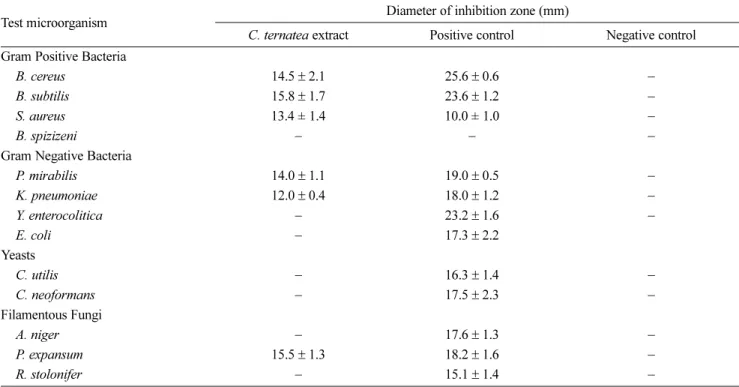
The current study was aimed to evaluate the antimicrobial activity C. ternatea extract on food borne microorganisms and its antifungal effect on Penicillium expansum. The extract showed significant antimicrobial activity against 3 Gram positive bacteria, 2 Gram negative bacteria and 1 filamentous fungus on disc diffusion assay. The extract also showed good biocidal effect on all Gram positive bacteria tested and P. expansum. However, the kill curve analysis revealed that the fungicidal activity of the extract against P. expansum conidia was depend on the concentration of the extract and the time of exposure of the conidia to the extract. The scanning electron micrograph of the extract treated P. expansum culture showed alterations in the morphology of fungal hyphae. The germination of P. expansum conidia was completely inhibited and conidial development was totally suppressed by the extract, suggesting the possible mode of action of anthocyanin. Besides, the extract also exhibited 5.0-log suppression of microbial growth relative to control in the rice model. The results indicate the potential use of the C. ternatea anthocyanin as food biopreservative.
Keywords − Anthocyanin, Antimicrobial activity, Clitoria ternatea, Penicillium expansum
Introduction
Food spoilage is a complex process characterized by any change in a food product that results in the loss of nutritional value, texture, and the flavor of the food.
1Excessive amount of foods are wasted due to the microbial spoilage. The Food and Agriculture Organization of United Nations reported a waste of 1.3 billion tons of food per year due to food spoilage, which cause a major economic loss of USD 750 billion.
2Moreover, food- spoilage microorganisms are always associated with food borne illnesses resulted from the ingestion of bacteria, viruses, fungi or parasites in the contaminated food.
Consumption of toxic chemicals produced by the microbial contaminants may lead to common symptoms such as diarrhea, nauseas and vomiting.
3Despite the improvement of food production with modern technology, food safety is
an increasingly important public health issue. Foodborne outbreaks have accounted 3% of mortality worldwide, which annually cost more than 15.6 billion USD in United States.
4Penicillum expansum is a broad spectrum pathogen on fruits that has been isolated from a wide range of fruits including tomatoes, strawberries, avocados, mangoes and grapes.
5P. expansum accounted for up to 90% postharvest decays in apples and pears, even when the most advanced postharvest technologies are applied.
5It produces high numbers of spores that spread quickly. Furthermore, they are known as producer of patulin, a mycotoxin found in rotting apples. Exposure to this mycotoxin causes adverse health effect to immunological, neurological and gastroin- testinal systems.
6Up to date, there is no effective preventive measures to control postharvest diseases caused by P.
expansum.
Clitoria ternatea or common known as butterfly pea or blue pea, is a perennial climber crop native to Asian countries.
7It is a plant species belonging to the Fabaceae family. It has been used for centuries as a memory
*Author for correspondence
Woei-Yenn Tong, Universiti Kuala Lumpur, Malaysian Institute of
Chemical and Bioengineering Technology, Lot 1988 Kawasan Per-
industrian Bandar Vendor, Taboh Naning, 78000 Alor Gajah, Melaka
Tel: +60-16-482-2046; E-mail: [email protected]
enhancer, nootropic, anti-stress, antidepressant, anticon- vulsant, tranquilizing and sedative agents.
7This edible flower is also used as a natural colorant for the preparation of various delicacies and being eaten as vegetables in South East Asia. C. ternatea is a flower crops that produce pigments that are mostly anthocyanin compounds.
This compound is a main colorant molecule that are derivatives of basic classes such as pelargonidin for orange-red color, cyanidin for red hues and delphinidin for lilac to blue hues.
8The anthocyanin pigment is odorless and nearly flavorless, contributing to taste as a moderately astringent sensation.
9The demands for anthocyanin has been growing steadily in regards of their beneficial health effects and the beautiful colorants to the food processing system. Various groups have also reported the contribution of anthocyanin on treatment of liver dysfunction, hypertension, vision disorders, microbial infections as well as diarrhea.
The current study was aimed to evaluate the antimicrobial activity of C. ternatea extract on food borne microorganisms and its antifungal effect on P. expansum particularly. Besides, the antimicrobial efficiency of the extract was also studied in a food model.
Experimental
Plant materials − The plant samples were collected at Jalan Tengkera (N 2° 12’ 3’’ E 102° 14’ 21’’), Bandaraya Melaka, Malacca, Malaysia. The sample was authenticated by botanist of Universiti Kuala Lumpur. The area of cultivation is free of fungicide and pesticide. The sampling was done by hand picking method and only the flowers with no visible symptoms of any diseases were collected. The collected materials were stored in ziplock plastic bags and process within 24 hours after the collection.
In the laboratory, the samples were cleaned under running tap water. The flowers were dried at 60
oC until constant weight was obtained. The dried flower was ground using a food blender (Wings). The powdered materials were stored in desiccator until further use.
Extraction of anthocyanin − An acidified ethanol was prepared by adding 1 M acetic acid (Acros) to food grade ethanol until pH 4.5 was reached. The anthocyanin content of the samples was extracted by soaking the powdered plant materials in acidified ethanol for 3 days at ratio of 1:20 (w/v). The mixture was stirred from time to time. The extract was then dried under reduced pressure by using a rotatory evaporator at 50
oC to obtain the crude extract paste. The anthocyanin test was conducted by adding the extract to equal volume (v/v) of 2N hydrochloric
acid (Acros) and ammonia solution (Acros). The appearance of blue violet solution indicates positive result for anthocyanin.
10Test microorganisms − The test microorganisms used in this study include 4 Gram positive bacteria (Bacillus cereus, Bacillus subtilis, Staphylococcus aureus, Bacillus spizizenii), 4 Gram negative bacteria (Proteus mirabilis, Klebsiella pneumoniae, Yersinia enterocolitica, Escherichia coli), 2 yeasts (Candida utilis, Cryptococcus neoformans) and 3 filamentous fungi (Aspergillus niger, P. expansum, Rhizopus stolonifer). The microorganisms were previously isolated from contaminated food sample and maintained at Upstream Processing Laboratory, Universiti Kuala Lumpur. The colonies of test microorganisms were suspended in sterile distilled water. For test bacteria and yeasts, the turbidity of the suspensions was adjusted to match McFarland 0.5 standard. For test fungi, the density of the spores was determined with hemocytometer (Neu- bauer) under light microscope. Further dilution with sterile distilled water was performed to adjust the inoculums as recommended by Clinical Laboratory Standard Institute.
11Screening of antimicrobial activity − The antimicrobial activity of the extract was screened by disc diffusion assay.
11The extract was prepared at concentration of 50 mg/ml by dissolving 0.05 g of extract in 1 ml of sterile distilled water. Nutrient agar (Merck) was used for test bacteria whereas potato dextrose agar (Merck) was used for test yeasts and fungi. Then, 100 µl of the microbial inoculum was spread on the agar plate with sterile hockey stick. Sterile paper disc impregnated with 20 µl of extract was placed on the surface of the inoculated medium. The positive control was included by using 20 µg/ml of chloramphenicol (Sigma) for test bacteria and 20 µg/ml of ketoconazole (Fisher) for test yeasts and fungi. Sterile distilled water was used as negative control. The bacteria and yeasts were incubated at 37
oC for 24 hours where fungi were incubated at 30
oC for 72 hours. The test was done in triplicate. After the incubation period, the diameters of the clear zone, including the diameter of the disc were measured to the nearest whole millimeter with a ruler.
Determination of minimal inhibitory concentration −
The minimal inhibitory concentration (MIC) of the extract
was determined via broth microdilution assay in sterile
96-well microtiter plates (Fisher).
12Only test microor-
ganisms that exhibited susceptibility in the screening test
were selected. The microbial inoculum was prepared by
suspending the microbial colonies in double strength
broth media. Double strength Luria broth (LB) (Merck)
was used for all test bacteria whereas RPMI 1640
medium (Sigma) containing 0.2% dextrose buffered with
0.165 M 3-(N-morpholino)propanesulfonic acid (MOPS) to a pH of 7.0 at 25
oC was used for test fungi. The concentration of the extract was prepared at a range from 200 mg/ml to 1.6 mg/ml initially. Then 100 µl of the extract was pipetted into each well. After that, 100 µl of microbial inoculum was added into each well to yield the final concentration of the extract of 100 mg/ml to 0.8 mg/
ml. The sterility control was included with the double strength media and extract at various concentrations.
Next, the growth control was prepared by adding 100 µl of the microbial inoculum and 100 µl of sterile distilled water into each well. The plates were incubated at 30
oC for 72 hours for fungi, and at 37
oC for 24 hours for bacteria. After the incubation, 40 µl of Iodonitrotetrazolium violet (INT) (Sigma) at the concentration of 0.2 mg/ml was added into each well to detect the microbial growth.
The color change of the well was observed after 30 min of incubation. The change in color of the broth from yellow to purple indicates microbial growth.
Determination of minimal lethality concentration − To determine minimal lethality concentration (MLC) of the extract, 100 µL of the sample from each well prepared in previous section was taken and suitably diluted before spreading on agar plates to judge the viability. The viable cell count method was performed. The MLC was recorded as the lowest concentration of extract that resulted in 99.9% growth reduction relative to the control.
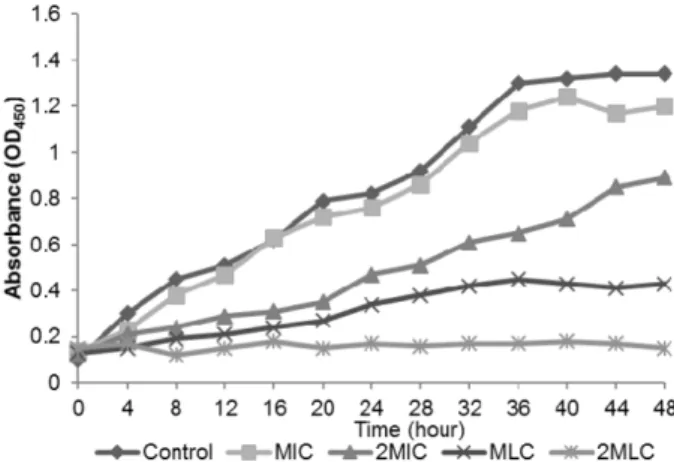
Time kill curve − The kill curve study for P. expansum was performed according to the protocol defined by Dalla Lana et al.
13The extracts were tested at four concen- trations: the MIC susceptibility breakpoint, twice the MIC, MLC and also twice the MLC. The extract was initially prepared at the concentration 10 times higher than the desired concentration. To achieve a final volume of 50 mL in each flask, 1:10 dilution of the extract was performed by the addition of 25 mL of spore suspension with the inoculum size of 1 × 10
5and 20 mL of sterile RPMI 1640 medium (Sigma) containing 0.2% dextrose buffered with 0.165M MOPS to a pH of 7.0 at 25
oC. The flasks were incubated in rotatory shaker for 48 hours at 30
o