INTRODUCTION
Sex hormone-binding globulin (SHBG) is a serum glycopro- tein produced predominantly in hepatocyts.1,2 It controls the transport of sex steroid hormones in the blood circulation to their target tissues.1,3 Many previous studies have revealed that low levels of serum SHBG are associated with metabolic syn- drome, type II diabetes, and cardiovascular disease.4,5 Nonal-
coholic fatty liver disease (NAFLD) grade is also known to be inversely related to serum SHBG levels:6,7 as the grade of he- patic steatosis increases, serum SHBG level decreases.2,7 He- patocytes are the primary sites of SHBG synthesis, and there- fore the synthesis of SHBG could be associated with liver function.1 Various studies have investigated the relationship between SHBG and biomarkers of liver function.8 However, despite several epidemiological studies, it is still controversial as to whether serum alanine aminotransferase (ATL) is asso- ciated with SBHG. Flechtner-Mors, et al.2 found no relation- ship between ALT and SHBG, while Ayala, et al.9 found that SHBG and ALT were inversely related with each other.1 Where- as ALT is known to reflect hepatocellular injury or death, it is still unclear whether ALT, a liver function marker, modulates the relationship between SHBG and hepatic steatosis.10 Fur- thermore, ALT is a predictive marker of insulin resistance11,12 and several studies have suggested that hyperinsulinemia is associated with decreased expression of SHBG.13
Inverse Relationship between Hepatic Steatosis and Alanine Aminotransferase with Sex
Hormone-Binding Globulin in Men
In-Ho Seo1, Hyung-Bin Lee1, Shinhye Kim2,3, Yong-Jae Lee1, and Dong-Hyuk Jung1
1Department of Family Medicine, Yonsei University College of Medicine, Seoul;
2Department of Family Medicine, Seoul National University Hospital, Seoul;
3Department of Medicine, Graduate School, Yonsei University, Seoul, Korea.
Purpose: Sex hormone-binding globulin (SHBG) is a serum glycoprotein produced predominantly in hepatocytes. As such, the synthesis of SHBG could be associated with liver function and metabolic syndrome. Alanine aminotransferase (ALT) levels could reflect hepatocellular injury and insulin resistance; however, the relationship between hepatic steatosis and ALT with SHBG has not been investigated in humans. The objective of this study was to investigate the associations between SHBG and hepatocyte damage among Korean male patients with hepatic steatosis enrolled in a health examination program.
Materials and Methods: We performed a retrospective cross-sectional study with 922 participants who underwent routine health examinations. A total of 922 men with or without hepatic steatosis were divided into three groups. We analyzed the risk of lower serum SHBG levels with or without elevated serum ALT levels using odds ratios with 95% confidence intervals (CIs).
Results: A significantly increased risk of lower serum SHBG level was observed in the group with hepatic steatosis and ALT eleva- tion (95% CI 1.591–4.681).
Conclusion: In men with hepatic steatosis, we found that elevated serum ALT levels were associated with lower serum SHBG levels.
This finding suggests that subjects with both hepatic steatosis and increased ALT should be considered to have low levels of SHBG.
Key Words: Sex hormone-binding globulin, non-alcoholic fatty liver disease, alanine aminotransferase
pISSN: 0513-5796 · eISSN: 1976-2437
Received: September 5, 2016 Revised: February 20, 2017 Accepted: February 24, 2017
Corresponding author: Dr. Dong-Hyuk Jung, Department of Family Medicine, Yonsei University College of Medicine, 50-1 Yonsei-ro, Seodaemun-gu, Seoul 03722, Korea.
Tel: 82-2-2019-2631, Fax: 82-2-3462-8209, E-mail: [email protected]
•The authors have no financial conflicts of interest.
© Copyright: Yonsei University College of Medicine 2017
This is an Open Access article distributed under the terms of the Creative Com- mons Attribution Non-Commercial License (http://creativecommons.org/licenses/
by-nc/4.0) which permits unrestricted non-commercial use, distribution, and repro- duction in any medium, provided the original work is properly cited.
Yonsei Med J 2017 Jul;58(4):731-736 https://doi.org/10.3349/ymj.2017.58.4.731
This study aimed to investigate the association between SHBG and hepatocyte damage represented by ALT among Ko- rean male patients with hepatic steatosis, enrolled in a health examination program.
MATERIALS AND METHODS
Study population
This retrospective study included 2837 men and women aged
>19 years old who visited the Health Promotion Center of Gang- nam Severance Hospital, Yonsei University College of Medi- cine in Seoul, Korea. Subjects underwent routine health exami- nation between January 2007 and July 2010. Of them, all female 1118 subjects were excluded because most female subjects did not undergo tests for serum SHBG level. Also, an additional 478 male subjects were excluded because of missing values.
Subjects who were positive for hepatitis B surface antigen or hepatitis C antibody were also excluded. In addition, we ex- cluded 143 subjects with a history of hepatocellular carcino- ma and 155 subjects with alcohol consumption ≥140 g/week.
Ultimately, a total of 922 men were included in this study.
Measurements
Examinations were performed by medical staff according to a standard protocol. Demographic, anthropometric, and labo- ratory data were gathered for each participant. The participants were asked whether they were undergoing or had recently un- dergone treatment for any disease. If the patient was under treatment, they were questioned for the date of diagnosis and a list of current medications. Trained staff reviewed the com- pleted questionnaires and entered responses into the data- base. Participants were classified as non-smokers, ex-smokers or current smokers. Subjects were categorized by alcohol in- take as a heavy drinker (alcohol ingestion ≥140 g/week) or light drinker (alcohol ingestion <140 g/week). Body weight and height were measured in light indoor clothing and no shoes to the nearest 0.1 kg and 0.1 cm, respectively. Body mass index (BMI) was calculated as the ratio of weight (kg)/height (m2).
Blood pressure measurement was obtained with the partici- pant in the sitting position, after 5 min of rest using an auto- mated device (TM-2665P, A&D Co., LTD., Tokyo, Japan).
The diagnosis of a fatty liver was based on abdominal ultra- sonography with a 3.5-MHz transducer (HDI 5000, Philips, Bothell, WA, USA).14 Ultrasonography was performed by an experienced radiologist. Participants were diagnosed with fat- ty liver if at least two of the following three findings were pres- ent: increased liver echogenicity, deep attenuation, and vas- cular blurring.
Venous blood sampling was performed after a fasting peri- od of 12 h. White blood cell (WBC) counts were quantified by an automated blood cell counter (ADVIA 120, Bayer, Tarrytown, NY, USA). Fasting plasma glucose, total cholesterol, high den-
sity lipoprotein (HDL) cholesterol, triglycerides (TGs), and ALT were measured using a Hitachi7600-110 chemistry autoana- lyzer (Hitachi, Tokyo, Japan). T3, free T4, and SHBG were mea- sured via electrochemiluminescent methods using Modular E170 (Roche Diagnostics, Mannheim, Germany).
Statistical analysis
The distribution of SHBG was markedly skewed and log-trans- formed in the analyses where normality was required. ALT el- evation was defined as ALT ≥40 U/L.15,16 We divided the study participants into tertiles of SHBG levels with cut-points of 28.60 and 48.90 nmol/L, and defined the lowest tertile of SHBG as low SHBG.17
Multivariable logistic regression was used to assess the as- sociation of ALT elevation with risk of low SHBG. We adjusted for age, BMI, systolic blood pressure (SBP), diastolic blood pres- sure (DBP), WBC, glucose, T3, total cholesterol, HDL, and TG.
To investigate the interrelationships among hepatic steatosis, elevated ALT levels, and risk of low SHBG, we divided our par- ticipants into the following three groups: a reference group of participants who had no hepatic steatosis and no ALT eleva- tion, the hepatic steatosis group without ALT elevation, and the hepatic steatosis with ALT elevation group. The effect of inter- actions between hepatic steatosis and ALT on the risk of lower SHBG level was examined by multivariate logistic regression.
Results are expressed as odds ratios (ORs) with 95% confidence intervals (CIs). All analyses were performed using SPSS soft- ware (version 18.0, SPSS Inc., Chicago, IL, USA). All statistical tests were two-sided and significance was determined at a p- value<0.05.
RESULTS
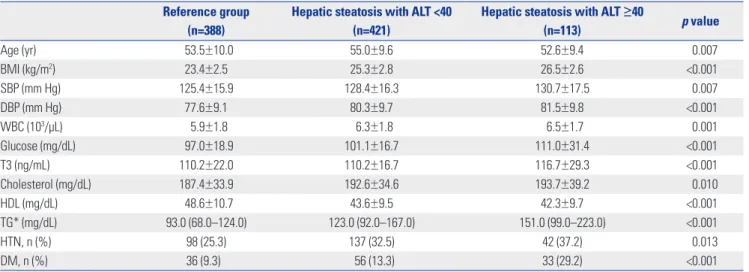
Baseline characteristics of each group are described in Table 1.
In hepatic steatosis with ALT ≥40 group, SHBG was 32.5±13.7, which was significantly lower than that of the reference group (p<0.001). The subjects in the hepatic steatosis with ALT ≥40 group had higher BMI, SBP, DBP, glucose, and TG. They were more likely to have a history of diabetes. The subjects in the he- patic steatosis with ALT ≥40 group were also younger and had lower HDL cholesterol levels.
Table 2 shows the correlation analysis between SHBG and several factors known to be associated with SHBG. BMI, DBP, WBC, glucose, cholesterol, and TG were negatively correlated with SHBG, while age, T3 and HDL were positively associated with SHBG.
Fig. 1 shows the mean values of SHBG for the study popula- tion between the reference group, hepatic steatosis group with- out ALT elevation, and hepatic steatosis with ALT elevation group after adjustment for several factors. In the hepatic ste- atosis with ALT elevation group, the mean SHBG level was low- er than all other groups.
Multivariate logistic regression models were used to evalu- ate the relationship between hepatic steatosis and elevated ALT levels with the risk of low SHBG levels (Table 3). In multi- variable regression analysis model 1, adjusting for age and BMI, the OR for lower SHBG was 3.287 (95% CI 2.007–5.385) in the hepatic steatosis group with ALT ≥40, compared with the reference group. Even after progressive adjustment for several factors that were previously found to be associated with SHBG, the subjects in the hepatic steatosis group with ALT
≥40 were still more likely to have a lower SHBG level (OR:
2.729; 95% CI 1.591–4.681). Before we divided men into three groups, we conducted a logistic regression analysis to confirm if there is an interaction between hepatic steatosis and ALT and the risk of lower SHBG level. We found that there was a significant interaction between hepatic steatosis and ALT in men (p=0.014).
DISCUSSION
In this cross-sectional study, we examined the joint effects of hepatic steatosis and ALT on SHBG concentration. A previous observational study showed that hepatic steatosis was inde- pendently related with a low SHBG level.1 In addition , the se- verity of hepatic steatosis was proportionally correlated with the risk of a low SHBG level.2 A previous study also reported that serum ALT level was inversely associated with SHBG level.3 Taken together, hepatic steatosis and serum ALT may be asso- ciated with a high risk of a low SHBG concentration. However, the joint effect of hepatic steatosis and ALT on serum SHBG level has not been investigated. In multivariate logistic regres- sion analysis, we observed that the hepatic metabolic distur- bance jointly affected low SHBG concentrations independent Table 1. Characteristics of the Study Participants
Reference group (n=388)
Hepatic steatosis with ALT <40 (n=421)
Hepatic steatosis with ALT ≥40
(n=113) p value
Age (yr) 53.5±10.0 55.0±9.6 52.6±9.4 0.007
BMI (kg/m2) 23.4±2.5 25.3±2.8 26.5±2.6 <0.001
SBP (mm Hg) 125.4±15.9 128.4±16.3 130.7±17.5 0.007
DBP (mm Hg) 77.6±9.1 80.3±9.7 81.5±9.8 <0.001
WBC (103/µL) 5.9±1.8 6.3±1.8 6.5±1.7 0.001
Glucose (mg/dL) 97.0±18.9 101.1±16.7 111.0±31.4 <0.001
T3 (ng/mL) 110.2±22.0 110.2±16.7 116.7±29.3 <0.001
Cholesterol (mg/dL) 187.4±33.9 192.6±34.6 193.7±39.2 0.010
HDL (mg/dL) 48.6±10.7 43.6±9.5 42.3±9.7 <0.001
TG* (mg/dL) 93.0 (68.0–124.0) 123.0 (92.0–167.0) 151.0 (99.0–223.0) <0.001
HTN, n (%) 98 (25.3) 137 (32.5) 42 (37.2) 0.013
DM, n (%) 36 (9.3) 56 (13.3) 33 (29.2) <0.001
BMI, body mass index; SBP, systolic blood pressure; DBP, diastolic blood pressure; WBC, white blood cell; HDL, high density lipoprotein; TG, triglyceride; HTN, hypertension; DM, diabetes mellitus; ALT, alanine aminotransferase.
*Data are expressed as the median (25–75%).
Table 2. Correlation between SHBG and Various Parameters
Variables γ p value
Age 0.247 0.000
BMI -0.309 0.000
SBP -0.029 0.368
DBP -0.085 0.009
WBC -0.117 0.000
Glucose -0.090 0.006
T3 0.327 0.000
Cholesterol -0.084 0.010
HDL 0.155 0.000
TG -0.314 0.000
HTN -0.014 0.591
DM -0.052 0.052
SHBG, sex hormone-binding globulin; BMI, body mass index; SBP, systolic blood pressure; DBP, diastolic blood pressure; WBC, white blood cell; HDL, high density lipoprotein; TG, triglyceride; HTN, hypertension; DM, diabetes mellitus.
Fig. 1. Mean value of SHBG for the study population between reference group, hepatic steatosis group with ALT <40, and hepatic steatosis group with ALT ≥40. *p<0.01 by multiple co-variant ANOVA controlling for age, BMI, SBP, DBP, WBC, glucose, T3, cholesterol, HDL, and TG levels. ALT, alanine aminotransferase; SHBG, sex hormone-binding globulin; BMI, body mass index; SBP, systolic blood pressure; DBP, diastolic blood pressure;
WBC, white blood cell; HDL, high density lipoprotein; TG, triglyceride.
60 50 40 30 20 10
0 Reference group 56.9
37.2
*
*
*
32.5
Hepatic steatosis with ALT <40
Hepatic steatosis with ALT ≥40
SHBG (nmol/L)
of BMI and metabolic profiles. This is the first report showing that increased ALT could be marker of low SHBG in patients with hepatic steatosis.
Non-alcoholic fatty liver comprises a spectrum of liver con- dition ranging from simple steatosis to steatohepatitis and cir- rhosis. Although liver biopsy is regarded as the gold standard for the assessment of the severity of fatty liver, it has limited ap- plicability in clinical settings, because of the risk related to the technique and uncertainty of the distribution of fatty infiltra- tion. Previous studies have reported an association between serum ALT and the grade of hepatic steatosis as confirmed by liver biopsy,18 suggesting that patients with fatty liver and higher ALT might be at increased risk for a lower SHBG level com- pared to patients with hepatic steatosis and a lower ALT level.
Regarding these results, severity of hepatic steatosis may be closely associated with lower SHBG levels. Ayala, et al.9 also showed that serum SHBG levels were inversely associated with ALT serum level.
Level of SHBG are used in clinical practice to determine amounts of free estradiol and testosterone. However, recent studies have reported that SHBG levels are altered in several diseases, including obesity, thyroid hormone disorder, poly cystic ovarian syndrome, and Cushing’s disease.1 In addition, several epidemiologic studies have shown that low SHBG levels are associated with a higher risk for developing metabolic syn- drome and type 2 diabetes. Moreover, these relationships are dose-dependent and observed even if the SHBG level are with- in normal range.19,20 Although, the potential roles of SHBG the pathogenesis of the metabolic disease remains to be elucidat- ed, regardless of being within normal range or not, the levels of SHBG have clinical meaning.
There are some potential mechanisms by which elevated ALT levels affect serum SHBG levels. First, hepatocytes are the primary synthesis sites of SHBG, even though SHBG is also expressed in testicular germ cells. Thyroid hormone, insulin, and cytokines regulate the expression SHBG in hepatocytes.1,21 These hormones interact with their receptors and activate vari- ous signal cascades, resulting in alterations of hepatocyte nu- clear factor 4 alpha protein levels, which regulate SHBG expres- sion.1 Also, metabolic syndrome, sex hormone, dietary, and liver fat influence serum SHBG levels. Hua, et al.22 reported that se- rum SHBG level was inversely associated with NAFLD and cor- related with lipid profiles. They observed a negative relation- ship between serum SHBG and TG and a positive relationship between HDL. In a study by Chubb, et al.23 lower SHBG was also
shown to be associated with increased serum levels of smaller, denser low density lipoproteins. The relationship between se- rum SHBG and lipid profiles was discussed in the study of Des- meules, et al.24 focusing on post-heparin hepatic lipase and li- poprotein lipase activity. Previous studies have shown that participants with elevated lipoprotein lipase activity had a low- er TG and higher HDL levels, whereas participants with higher hepatic lipase activity had a lower HDL levels. Desmeules, et al.24 observed a negative relationship between serum SHBG and hepatic lipase activity, where as a positive relationship was found between serum SHBG and lipoprotein lipase activity.
This implied that correlation between lipid profiles and activi- ty of hepatic lipase and lipoprotein lipase could affect serum SHBG levels. In the study by Miksztowicz, et al.25 hepatic li- pase activity was significantly increased in patients with hepat- ic steatosis grade 3, compared to those with grade 1. Serum SHBG levels were associated with the high-grade NAFLD in the study by Shin, et al.7 Correlations of lipid profiles, hepatic lipase, lipoprotein lipase, NAFLD, and SHBG were noted with NAFLD and elevated liver enzymes. In the study by Ekstedt, et al.26 serum ALT levels were elevated in follow-up of NAFLD patients with progressive fibrosis. Second, almost all ALT is found in the cytosol of hepatocytes. ALT activity in the liver is about 3000 times greater than that in the serum. Thus, in cases of hepatocellular injury or death, release of ALT from dam- aged liver cells increases serum ALT levels.27 Therefore, elevat- ed ALT levels could reflect hepatocellular injury or death, and thus could also be associated with a decrease of serum SHBG level. Third, insulin resistance could be another possible mecha- nism explaining this association between ALT and SHBG. Pre- vious study has suggested that an increased ALT level is asso- ciated with insulin resistance.22,28 A recent study proposed that glucose-induced lipogenesis may affect hepatic production of SHBG, and glucose also could directly decrease the expression of SHBG.29 In the present study, we observed an inverse rela- tionship between serum glucose and SHBG concentration.
Therefore, this finding suggested that there could be interac- tions among ALT, glucose and SHBG.
Our study has several limitations. First, it followed a retro- spective cross-sectional method, from which it is difficult to conclude a causal relationship. Therefore, a cause-and-effect relationship among ALT and SHBG cannot be inferred. Sec- ond, although a liver biopsy is the gold standard for the diag- nosis of a hepatic steatosis, a biopsy-proven NAFLD was not assessed in the present study. Despite some limitations, ultra- Table 3. Joint Effects of Hepatic Steatosis and ALT on SHBG in Men
Reference group Odds ratio (95% CI)
Hepatic steatosis with ALT <40 Hepatic steatosis with ALT ≥40
Model I* 1.00 1.860 (1.297–2.667)‡ 3.287 (2.007–5.385)‡
Model II† 1.00 1.587 (1.083–2.325)‡ 2.729 (1.591–4.681)‡
ALT, alanine aminotransferase; SHBG, sex hormone-binding globulin; BMI, body mass index; SBP, systolic blood pressure; DBP, diastolic blood pressure; WBC, white blood cell; HDL, high density lipoprotein; TG, triglyceride; CI, confidence interval.
*Model I: adjusted for age and BMI, †Model II: adjusted for age, BMI, SBP, DBP, WBC, glucose, T3, cholesterol, HDL, and TG levels, ‡p-value<0.01.
sonography is a non-invasive and preferred modality for mass screening for hepatic steatosis with a reasonable sensitivity and specificity. Third, our study did not include sex hormone levels, which is another factor that influences SHBG synthesis.
However, despite with these limitations, the present study in- cludes other meaningful factors, particularly T3 levels which could influence SHBG levels. Fourth, exclusion criteria of this study did not comprise autoimmune hepatitis. However, in Ko- rea, the prevalence of autoimmune hepatitis seems to be lower than that in Western countries.30 Therefore, the effect of this cri- terion might be small in this study.
In male patients with hepatic steatosis, elevated serum ALT levels were associated with lower serum SHBG levels. Further investigation of the association between SHBG and ALT should be pursued in future longitudinal studies.
ACKNOWLEDGEMENTS
The authors would like to thank all of the staff members who were involved in conducting this study.
REFERENCES
1. Simó R, Sáez-López C, Barbosa-Desongles A, Hernández C, Selva DM. Novel insights in SHBG regulation and clinical implications.
Trends Endocrinol Metab 2015;26:376-83.
2. Flechtner-Mors M, Schick A, Oeztuerk S, Haenle MM, Wilhelm M, Koenig W, et al. Associations of fatty liver disease and other factors affecting serum SHBG concentrations: a population based study on 1657 subjects. Horm Metab Res 2014;46:287-93.
3. Rosner W, Hryb DJ, Kahn SM, Nakhla AM, Romas NA. Interactions of sex hormone-binding globulin with target cells. Mol Cell Endo- crinol 2010;316:79-85.
4. Sá EQ, Sá FC, Oliveira KC, Feres F, Verreschi IT. Association be- tween sex hormone-binding globulin (SHBG) and metabolic syn- drome among men. Sao Paulo Med J 2014;132:111-5.
5. Ding EL, Song Y, Manson JE, Hunter DJ, Lee CC, Rifai N, et al. Sex hormone-binding globulin and risk of type 2 diabetes in women and men. N Engl J Med 2009;361:1152-63.
6. Wang Q, Kangas AJ, Soininen P, Tiainen M, Tynkkynen T, Puukka K, et al. Sex hormone-binding globulin associations with circulat- ing lipids and metabolites and the risk for type 2 diabetes: obser- vational and causal effect estimates. Int J Epidemiol 2015;44:623- 37.
7. Shin JY, Kim SK, Lee MY, Kim HS, Ye BI, Shin YG, et al. Serum sex hormone-binding globulin levels are independently associated with nonalcoholic fatty liver disease in people with type 2 diabetes.
Diabetes Res Clin Pract 2011;94:156-62.
8. Haring R, Baumeister SE, Völzke H, Dörr M, Kocher T, Nauck M, et al. Prospective inverse associations of sex hormone concentra- tions in men with biomarkers of inflammation and oxidative stress.
J Androl 2012;33:944-50.
9. Ayala M, Pizarro F, Méndez MA, Arredondo M, Araya M. Copper and liver function indicators vary depending on the female hor- monal cycle and serum hormone binding globulin (SHBG) con- centration in healthy women. Biol Trace Elem Res 2008;121:9-15.
10. Kim WR, Flamm SL, Di Bisceglie AM, Bodenheimer HC; Public Policy Committee of the American Association for the Study of Liv-
er Disease. Serum activity of alanine aminotransferase (ALT) as an indicator of health and disease. Hepatology 2008;47:1363-70.
11. Fraser A, Harris R, Sattar N, Ebrahim S, Davey Smith G, Lawlor DA.
Alanine aminotransferase, gamma-glutamyltransferase, and inci- dent diabetes: the British Women’s Heart and Health Study and meta-analysis. Diabetes Care 2009;32:741-50.
12. Gautier A, Balkau B, Lange C, Tichet J, Bonnet F; DESIR Study Group. Risk factors for incident type 2 diabetes in individuals with a BMI of <27 kg/m2: the role of gamma-glutamyltransferase. Data from an Epidemiological Study on the Insulin Resistance Syndrome (DESIR). Diabetologia 2010;53:247-53.
13. Pugeat M, Nader N, Hogeveen K, Raverot G, Déchaud H, Grenot C.
Sex hormone-binding globulin gene expression in the liver: drugs and the metabolic syndrome. Mol Cell Endocrinol 2010;316:53-9.
14. Burt AD, Lackner C, Tiniakos DG. Diagnosis and assessment of NAFLD: definitions and histopathological classification. Semin Liver Dis 2015;35:207-20.
15. Pratt DS, Kaplan MM. Evaluation of abnormal liver-enzyme results in asymptomatic patients. N Engl J Med 2000;342:1266-71.
16. Zelber-Sagi S, Toker S, Armon G, Melamed S, Berliner S, Shapira I, et al. Elevated alanine aminotransferase independently predicts new onset of depression in employees undergoing health screen- ing examinations. Psychol Med 2013;43:2603-13.
17. Milewicz A, Krzyz˙anowska-S´winiarska B, Miazgowski T, Je¸drzejuk D, Arkowska A, Mieszczanowicz U, et al. The reference values of sex hormones and SHBG serum levels in subjects over 65 years old- The PolSenior Study. Endokrynol Pol 2013;64:82-93.
18. Schindhelm RK, Diamant M, Dekker JM, Tushuizen ME, Teerlink T, Heine RJ. Alanine aminotransferase as a marker of non-alcoholic fatty liver disease in relation to type 2 diabetes mellitus and cardio- vascular disease. Diabetes Metab Res Rev 2006;22:437-43.
19. Chen BH, Brennan K, Goto A, Song Y, Aziz N, You NC, et al. Sex hormone-binding globulin and risk of clinical diabetes in Ameri- can black, Hispanic, and Asian/Pacific Islander postmenopausal women. Clin Chem 2012;58:1457-66.
20. Perry JR, Weedon MN, Langenberg C, Jackson AU, Lyssenko V, Sparsø T, et al. Genetic evidence that raised sex hormone binding globulin (SHBG) levels reduce the risk of type 2 diabetes. Hum Mol Genet 2010;19:535-44.
21. Selva DM, Hammond GL. Thyroid hormones act indirectly to in- crease sex hormone-binding globulin production by liver via he- patocyte nuclear factor-4alpha. J Mol Endocrinol 2009;43:19-27.
22. Hua X, Sun Y, Zhong Y, Feng W, Huang H, Wang W, et al. Low se- rum sex hormone-binding globulin is associated with nonalco- holic fatty liver disease in type 2 diabetic patients. Clin Endocrinol (Oxf) 2014;80:877-83.
23. Chubb SA, Hyde Z, Almeida OP, Flicker L, Norman PE, Jamrozik K, et al. Lower sex hormone-binding globulin is more strongly asso- ciated with metabolic syndrome than lower total testosterone in older men: the Health in Men Study. Eur J Endocrinol 2008;158:
785-92.
24. Desmeules A, Couillard C, Tchernof A, Bergeron J, Rankinen T, Leon AS, et al. Post-heparin lipolytic enzyme activities, sex hor- mones and sex hormone-binding globulin (SHBG) in men and women: The HERITAGE Family Study. Atherosclerosis 2003;171:
343-50.
25. Miksztowicz V, Lucero D, Zago V, Cacciagiú L, Lopez G, Gonzalez Ballerga E, et al. Hepatic lipase activity is increased in non-alco- holic fatty liver disease beyond insulin resistance. Diabetes Metab Res Rev 2012;28:535-41.
26. Ekstedt M, Franzén LE, Mathiesen UL, Thorelius L, Holmqvist M, Bodemar G, et al. Long-term follow-up of patients with NAFLD and elevated liver enzymes. Hepatology 2006;44:865-73.
27. Kim HC, Nam CM, Jee SH, Han KH, Oh DK, Suh I. Normal serum aminotransferase concentration and risk of mortality from liver diseases: prospective cohort study. BMJ 2004;328:983.
28. Li C, Ford ES, Li B, Giles WH, Liu S. Association of testosterone and sex hormone-binding globulin with metabolic syndrome and insu- lin resistance in men. Diabetes Care 2010;33:1618-24.
29. Selva DM, Hogeveen KN, Innis SM, Hammond GL. Monosaccha- ride-induced lipogenesis regulates the human hepatic sex hor- mone-binding globulin gene. J Clin Invest 2007;117:3979-87.
30. Lee YS. Autoimmune hepatitis; recent Korean trend. J Korean Med Assoc 2005;48:456-64.