INTRODUCTION
Atrial fibrillation (AF) is the most common cardiac arrhythmia, occurring in 1–2% of the general population.1,2 AF confers a five-fold risk of stroke, and one in five of all strokes is attributed to this arrhythmia.3 Therefore, the administration of antithrom- botic (antiplatelet or anticoagulant) medication is critical for the prevention of thromboembolic events in patients with AF.
According to recent worldwide data, the number of patients taking antithrombotic medication is expected to rise with an increase in the number of AF patients.4 Although major bleed- ing, including intracranial hemorrhage or gastrointestinal bleed- ing, has been evaluated intensively, minor bleeding events (nui- sance bleedings), including ocular bleeding, have not been well
Antithrombotic Medication and the Risk of Vitreous Hemorrhage in Atrial Fibrillation: Korean National Health Insurance Service National Cohort
Ko Eun Kim
1*, Pil-Sung Yang
2*, Eunsun Jang
3, Sungjin Kim
1, and Boyoung Joung
31Department of Ophthalmology, Nowon Eulji Medical Center, Eulji University, Seoul;
2Department of Cardiology, CHA Bundang Medical Center, CHA University, Seongnam;
3Division of Cardiology, Yonsei University College of Medicine, Seoul, Korea.
Purpose: Antithrombotic therapy could be related with nuisance bleeding. This study investigated whether vitreous hemorrhage (VH) is associated with specific types of antithrombotic medication in patients with atrial fibrillation (AF).
Materials and Methods: In the Korean National Health Insurance Service National Sample Cohort, we identified 9352 antiplatelet/
anticoagulant-treated AF patients. The occurrence of VH was compared between warfarin (n=1493) and a propensity score (PS)- matched antiplatelet group (n=1493) and between warfarin (n=1493) and a PS-matched warfarin+antiplatelet group (n=1493).
Results: The outcomes of VH were lower in the warfarin than in the matched antiplatelet (1.45 vs. 3.72 events/1000 patient-years) and matched warfarin+antiplatelet groups (1.45 vs. 6.87 events/1000 patient-years). Compared with warfarin, the risk of VH in- creased with antiplatelet [adjusted hazard ratio (aHR) 3.90; 95% confidence interval (CI) 1.22–12.4, p=0.022] and warfarin+antiplatelet agents (aHR 4.39, 95% CI 1.74–11.2, p=0.002). Compared with warfarin only, warfarin+antiplatelet agents increased the risk of VH in patients ≥65 years, regardless of gender and hypertension. The risk of VH was significantly higher with dual antiplatelet therapy (aHR: 5.02, 95% CI: 1.56–16.2, p=0.007) or in dual (aHR: 5.02, 95% CI: 1.74–14.5, p=0.003) or triple therapy using warfarin and anti- platelet agents than with warfarin monotherapy (aHR: 6.12, 95% CI: 1.76–21.3, p=0.004).
Conclusion: Dual antiplatelet or triple therapy increased the risk of VH significantly, compared to warfarin monotherapy. Consider- ing the low efficacy of preventing ischemic stroke and high risk of bleeding, dual or triple therapy using warfarin and antiplatelet agents should be avoided to prevent VH in AF patients.
Key Words: Vitreous hemorrhage, antiplatelet, anticoagulant, atrial fibrillation
pISSN: 0513-5796 · eISSN: 1976-2437
Received: September 20, 2018 Revised: November 2, 2018 Accepted: November 19, 2018
Co-corresponding authors: Boyoung Joung, MD, PhD, Division of Cardiology, Severance Hospital, Yonsei University College of Medicine, 50-1 Yonsei-ro, Seo- daemun-gu, Seoul 03722, Korea.
Tel: 82-2-2228-8460, Fax: 82-2-393-2041, E-mail: [email protected] and Sungjin Kim, MD, PhD, Department of Ophthalmology, Nowon Eulji Medical Cen- ter, Eulji Univeristy, 68 Hangeulbiseok-ro, Nowon-gu, Seoul 01830, Korea.
Tel: 82-2-970-8322, Fax: 82-2-970-8003, E-mail: [email protected]
*Ko Eun Kim and Pil-Sung Yang contributed equally to this work.
•The authors have no potential conflicts of interest to disclose.
© Copyright: Yonsei University College of Medicine 2019
This is an Open Access article distributed under the terms of the Creative Com- mons Attribution Non-Commercial License (https://creativecommons.org/licenses/
by-nc/4.0) which permits unrestricted non-commercial use, distribution, and repro- duction in any medium, provided the original work is properly cited.
Yonsei Med J 2019 Jan;60(1):65-72 https://doi.org/10.3349/ymj.2019.60.1.65
investigated. Recently, however, the importance of surveillance and adequate management for nuisance hemorrhagic compli- cations arising from using these medications has been high- lighted.5 Nuisance bleedings is common among patients with AF on oral anticoagulants (OACs). However, nuisance bleed- ings was not associated with a higher risk of major bleeding or stroke/systemic embolism over the next 6 months, suggesting its occurrence should not lead to changes in anticoagulation treatment strategies.
Vitreous hemorrhage (VH) is a potential intraocular hemor- rhagic complication associated with oral antiplatelet or anti- coagulant medication, such as aspirin, clopidogrel bisulfate, and warfarin sodium.6-12 Although VH can be absorbed sponta- neously, it can also result in more serious complications threat- ening vision, such as intraocular pressure increase and prolifer- ative vitreoretinopathy, leading to invasive surgical intervention.
Moreover, many AF patients discontinue antiplatelet or anti- coagulant medication after VH and might experience throm- boembolic events during this period. Therefore, the associa- tion between VH and antiplatelet or anticoagulant medication is important for both ophthalmologists and cardiologists.
Previous clinical studies have reported varying degrees of associations between VH and oral antiplatelet or anticoagulant use.6-12 However, most studies were performed on populations with specific retinal diseases or patients undergoing intraocu- lar interventions. Epidemiological data are limited for general- izing the impact of antiplatelet or anticoagulation medication on VH risk. In this regard, we investigated the effects of anti- platelet and anticoagulation medication on VH development and non-pharmacological risk factors of VH in patients with AF using the Korean National Health Insurance Service (NHIS) database.
MATERIALS AND METHODS
Data source
This study was conducted using the NHIS-National Sample Co- hort (NSC).13 The NHIS database represents the nationwide population of South Korea.1-3 The NHIS is a single insurer man- aged by the Korean government that covers 97% of the entire population; other programs, such the Medical Assistance Pro- gram, cover the remaining 3%. The National Health Insurance Claim database stores data on the entire Korean population, including all demographic and medical information. Based on this database, the NHIS-NSC was created and released in 2014.13 It contains medical claims for 2.2% (n=1025340) of the total Korean population (about 50 million); individuals were ran- domly selected from January 1, 2002. NHIS-NSC data provide information on healthcare utilization based on the National Health Insurance claims from medical institutions to the NHIS for inpatient and outpatient clinic visits.1-3 The database is open to researchers once their study protocol has been approved by
an official review committee. The Institutional Review Board of Severance Hospital at Yonsei University College of Medicine approved our study (4-2014-0996). Since we used anonymous data, the requirement to obtain informed consent was waived.
Study population
The current study included patients aged 19 years or older who were diagnosed with AF from January 2002 to December 2008.
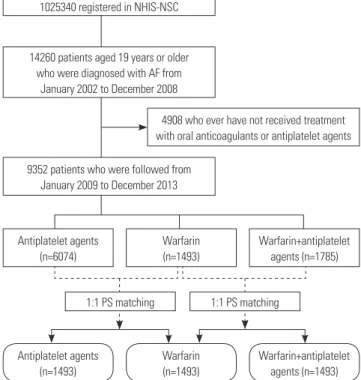
Patients with AF were identified using the International Clas- sification of Disease, Tenth Revision (ICD-10): I480, I481, I482, I484, and I489. AF was validated in previous studies with a posi- tive predictive value of 94.1%.1-3 To ensure diagnostic accuracy, we defined patients with AF only when they had a discharge di- agnosis or were confirmed more than twice in the outpatient department.1-3 We excluded patients without a history of anti- platelet/anticoagulant use before enrollment. Among 9352 pa- tients who were followed from January 2009 to December 2013, we identified 6074 antiplatelet agent-treated patients, 1493 war- farin-treated patients, and 1785 warfarin+antiplatelet agent- treated patients. The occurrence of VH was compared between warfarin (n=1493) and a 1:1 propensity score (PS)-matched an- tiplatelet group (n=1493) and between warfarin (n=1493) and a 1:1 PS-matched warfarin+antiplatelet group (n=1493) (Fig. 1).
We obtained information on selected comorbid conditions from inpatient and outpatient hospital diagnoses. Baseline comorbidities were defined using the medical claims and pre- scription medication prior to the index date. In order to ensure diagnostic accuracy, patients were considered to have comor- bidities when the condition was a discharge diagnosis or was
Fig. 1. Study cohort. NHIS-NSC, National Health Insurance Service-Na- tional Sample Cohort. AF, atrial fibrillation; PS, propensity score.
1025340 registered in NHIS-NSC
Antiplatelet agents (n=6074)
Antiplatelet agents (n=1493)
1:1 PS matching 1:1 PS matching Warfarin
(n=1493)
Warfarin (n=1493)
Warfarin+antiplatelet agents (n=1785)
Warfarin+antiplatelet agents (n=1493) 14260 patients aged 19 years or older
who were diagnosed with AF from January 2002 to December 2008
9352 patients who were followed from January 2009 to December 2013
4908 who ever have not received treatment with oral anticoagulants or antiplatelet agents
confirmed at least twice in an outpatient setting, which was similar to previous studies with NHIS (Supplementary Table 1, only online).14-17 Also CHA2DS2-VASc [congestive heart failure, hypertension, age ≥75 (doubled), diabetes mellitus, prior stroke or transient ischemic attack (TIA) (doubled), vascular disease, age 65 to 74, female] score and HAS-BLED [hyperten- sion, abnormal renal/liver function (1 point each), stroke, bleed- ing history, labile INR (left out because of data are unavailable), elderly (>65 years), concomitant drug (1 point each)] score were evaluated.1
Exposure of antiplatelet and anticoagulation agents The exposure to antiplatelet and anticoagulation agents was identified based on filled antiplatelet or anticoagulant medi- cation prescriptions over the follow-up period between January 2009 and December 2013. We used the most common medi- cations for stroke prevention in patients with AF: aspirin and P2Y12 inhibitors (clopidogrel bisulfate, prasugrel, and ticagre- lor) for antiplatelet medication and warfarin sodium for anti- coagulation medication. The index date was defined as the date of first prescription of antiplatelet, warfarin, and warfarin + an- tiplatelet agents in antiplatelet, warfarin, and warfarin + anti- platelet groups, respectively.
Study outcome
The study outcome was newly developed VH (ICD-10 code H43.1) during the follow-up period between 2009 and 2013. To evaluate the accuracy of our definition of VH, we conducted a validation study with 102 randomly chosen patients with the ICD-10 code H43.1. Fundus photos and ultrasonographic im- ages were reviewed by two ophthalmologists (KEK and SJK).
The patients were deemed to have VH if it was documented by fundus photos and ultrasonography examinations. The posi- tive predictive value was 95.3%. To ensure diagnostic accuracy, we defined patients with VH only when they had a discharge diagnosis or were confirmed more than twice in the outpatient department. The follow-up period was defined as from the in- dex date until the first occurrence of VH or the end date of the study period, whichever came first.
Statistical analysis
The PS method, which simulates the effect of a randomized clinical trial for observational cohort data, was used to study the effects of warfarin on the occurrence of VH in comparison to other groups. PS reflects the predicted probability of treat- ment conditional on selected covariates, including age, sex, baseline comorbidities, and CHA2DS2-VASc and HAS-BELD scores, using logistic regression. The balance of covariates at baseline among the study groups was assessed using the ab- solute standardized mean difference (SMD). An absolute SMD
<0.1 indicates a negligible difference in potential confounders between two study groups.
Incidence rates were estimated using the total number of
study outcomes during the follow-up period divided by person- years at risk. The 95% confidence interval (CI) of incidence rate was estimated using a Poisson distribution.18 The risk of VH for warfarin versus other drugs was obtained using survival analysis: Kaplan-Meier method and log-rank test for univari- ate analysis and Cox proportional hazards regression for mul- tivariate analysis. We adjusted for age, gender, heart failure, hypertension, diabetes, stroke/TIA, previous myocardial in- farction, dyslipidemia, hemorrhagic stroke, valvular heart disease, malignancy, nonsteroidal anti-inflammatory drugs (NSAID), and corticosteroid medications. Statistical analyses were per- formed using Statistical Package for the Social Science version 19.0 for Windows (IBM Corp., Armonk, NY, USA) and MedCalc (v. 12.0; MedCalc Statistical software, Marakierke, Belgium).
Statistical significance was defined as p<0.05.
RESULTS
Study subjects
Before PS matching, the warfarin group was younger, had lower CHA2DS2-VASc score, and had a lower proportion of comor- bidities than other groups (Supplementary Table 2, only online).
After PS matching, both of the two groups were well balanced with the warfarin group for all characteristics (all SMD <0.1). The warfarin group included more patients with valvular heart disease, including mitral stenosis or prosthetic mitral valve, than the other groups (20.4, 1.1, and 7.0%, p<0.001) (Table 1).
Primary study outcomes
The cumulative incidence of VH is shown in Fig. 2. Overall, cu- mulative incidence curves revealed a lower rate of VH with war- farin than in matched antiplatelet (log rank p=0.003) (Fig. 2A) or warfarin+antiplatelet groups (log rank p<0.001) (Fig. 2B).
The cumulative incidence of VH in each group is shown in Sup- plementary Fig. 1 (only online).
The outcomes of VH were lower for warfarin than for matched antiplatelet (1.45 vs. 3.72 events/1000 patient-years) and matched warfarin+antiplatelet groups (1.45 vs. 6.87 events/1000 pa- tient-years). Compared with warfarin, the risk of VH was in- creased with antiplatelet [adjusted hazard ratio (aHR) 3.90;
95% CI 1.22–12.4, p=0.022] and warfarin+antiplatelet agents (aHR 4.39, 95% CI 1.74–11.2, p=0.002) (Table 2).
Similar findings were observed in a sensitivity analysis that compared rates of VH after excluding patients with valvular heart disease. In sensitivity analysis, the outcomes of VH were lower in the warfarin than in the matched antiplatelet (1.79 vs.
5.33 events/1000 patient-years) and matched warfarin + anti- platelet groups (1.79 vs. 7.21 events/1000 patient-years). The risk of VH was lower for warfarin than for antiplatelet (aHR 4.64, 95% CI 1.38–15.5, p=0.013) and warfarin+antiplatelet groups (aHR 4.15, 95% CI 1.57–11.0, p=0.004) (Table 3).
Outcomes according to different medications
Compared with warfarin, the risk of VH was significantly higher in dual antiplatelet therapy using aspirin and P2Y2 inhibitor (1.45 vs. 8.70 events/1000 patient-years; aHR: 5.02, 95% CI:
1.56–16.2, p=0.007), dual therapy using warfarin and aspirin (1.45 vs. 6.82 events/1000 patient-years; aHR: 5.02, 95% CI:
1.74–14.5, p=0.003), and also triple therapy using warfarin, as- pirin, and P2Y2 inhibitor (1.45 vs. 8.91 events/1000 patient- years; aHR: 6.12, 95% CI: 1.76–21.3, p=0.004). However, P2Y2 inhibitor monotherapy or dual therapy using warfarin and P2Y2 inhibitors did not increase the risk of VH (Fig. 3).
Supplementary Fig. 2 (only online) shows the risk of VH ac- Table 1. Characteristics of Warfarin and Propensity Score-Matched Antiplatelet or Warfarin+Antiplatelet-Treated Patients with Atrial Fibrillation
Warfarin
(n=1493)
Antiplatelet (n=1493)
Warfarin+antiplatelet (n=1493)
SMD (warfarin vs.
antiplatelet)
SMD (warfarin vs. warfarin+
antiplatelet)
Age (yr) 67 (56, 73) 66 (56, 74) 67 (57, 74) -0.020 -0.098
Men 782 (52.4) 798 (53.4) 829 (55.5) 0.022 0.063
Congestive heart failure 559 (37.4) 539 (36.1) 516 (34.6) 0.028 0.060
Hypertension 1087 (72.8) 1057 (70.8) 1141 (76.4) 0.045 -0.081
Diabetes mellitus 231 (15.5) 228 (15.3) 289 (19.4) 0.006 -0.097
Ischemic stroke or TIA 333 (23.1) 356 (23.8) 345 (23.1) 0.019 -0.018
Previous MI 113 (7.6) 129 (8.6) 113 (9.8) 0.035 -0.041
PAD 104 (7.0) 104 (7.0) 131 (8.8) 0.049 -0.077
Dyslipidemia 639 (42.8) 626 (41.9) 717 (48.0) 0.018 -0.096
Hemorrhagic stroke 23 (1.5) 14 (0.9) 27 (1.8) 0.049 -0.022
Malignancy 233 (15.6) 215 (14.4) 238 (15.9) 0.032 -0.009
CHA2DS2-VASc score 3.00 (2.00, 4.00) 3.0 (1.0, 4.0) 3.0 (2.0, 5.0) 0.032 -0.067
HAS-BLED score 2.0 (1.0, 3.0) 2.0 (1.0, 3.0) 3.0 (2.0, 3.0) 0.011 -0.091
Propensity score-unmatched variables
Valvular heart disease 305 (20.4) 16 (1.1) 104 (7.0)
NSAID 586 (39.2) 721 (48.3) 676 (45.3)
Steroid 122 (8.2) 148 (9.9) 154 (10.3)
CHA2DS2-VASc, congestive heart failure, hypertension, age of ≥75 years (doubled), diabetes mellitus, prior stroke or TIA (doubled), vascular disease, age of 65 to 74 years, female sex; HAS-BLED, hypertension, abnormal renal/liver function (1 point each), stroke, bleeding history, labile INR (left out because of data are unavailable), elderly (>65 years), concomitant drug (1 point each); MI, myocardial infarction; NSAID, nonsteroidal anti-inflammatory drugs; PAD, peripheral artery disease; TIA, transient ischemic attack; SMD, standardized mean difference.
Values are presented as numbers (%) or medians (interquartile range).
Fig. 2. Cumulative incidence of vitreous hemorrhage (VH). (A) Warfarin vs. antiplatelet agents. (B) Warfarin vs. warfarin+antiplatelet agents.
0.20
0.15
0.10
0.05
0.00
0.20
0.15
0.10
0.05
0.00
0 1 2 3 4 5 0 1 2 3 4 5
Years Years
Number at risk
A 1493 947 701 495 326 76
W 1493 1090 927 774 633 363
Number at risk
W+A 1493 841 464 269 182 86
W 1493 1090 927 774 633 363
Cumulative incidence of VH Cumulative incidence of VH
p=0.003 p<0.001
Antiplatelet agents (A) Warfarin (W)
Warfarin+antiplatelet agents (W+A) Warfarin (W)
A B
VH
No. of patients No. of events /1000 PYs (95% CI) Adjusted HR
(95% CI) p value
Warfarin (W) 1493 7 1.45 (0.63–2.86) 1 -
Aspirin (A) 994 5 2.25 (0.82–4.99) 1.68 (0.47–6.07) 0.427
P2Y2 (C) 140 0 - - -
A+C 359 7 8.70 (3.52–18.1) 5.02 (1.56–16.2) 0.007
W+A 1007 11 6.82 (3.59–11.9) 5.02 (1.74–14.5) 0.003
W+C 161 1 3.16 (0.16–15.6) 1.99 (0.19–21.2) 0.569
W+A+C 325 6 8.91 (3.90–17.6) 6.12 (1.76–21.3) 0.004
cording to warfarin, antiplatelet agents, and warfarin + antiplate- let agents in overall patients.
Outcomes by different subgroups
Compared with warfarin, antiplatelet agents significantly in- creased the risk of VH in patients with hypertension and stroke or TIA (Fig. 4A). The risk of VH was generally increased by warfarin+antiplatelet agents across most subgroups, except younger age, diabetes, heart failure, and previous history of stroke or TIA. The risk of VH was increased in patients equal or older than 65 years, but not in those younger than 65 years (Fig. 4B).
Compared with warfarin, the risk of VH was generally in- creased by dual antiplatelet agents, dual therapy warfarin and
P2Y2 inhibitor, and triple therapy with warfarin, aspirin and P2Y2 inhibitor (Supplementary Fig. 3, only online).
DISCUSSION
The main findings of this study are a lower incidence of VH for warfarin than for antiplatelet or warfarin+antiplatelet treated individuals. Compared with warfarin, the risk of VH was in- creased with antiplatelet and warfarin+antiplatelet agents by 3.9 and 4.39 times, respectively. Second, compared with war- farin monotherapy, warfarin+antiplatelet agents increased the risk of VH in patients equal or more than 65 years, but not in those younger than 65 years. Finally, while combination treatment including aspirin (dual antiplatelet therapy, dual or Table 2. Cox Proportional HR of the Risk of Different Types of Antiplatelet and Anticoagulant Medications for Vitreous Hemorrhage in Patients with Atrial Fibrillation
Warfarin (n=1493) Antiplatelet agents (n=1493) Warfarin+antiplatelet agents (n=1493)
Events 7 12 18
Person years 4844 3230 2619
/1000 PYs (95% CI) 1.45 (0.63–2.86) 3.72 (2.01–6.32) 6.87 (4.20–10.7)
HR (95% CI), p value
Unadjusted 1 (Reference) 5.11 (1.59–16.4), 0.002 5.19 (2.11–12.7), <0.001
Clinical variable-adjusted* 1 (Reference) 3.90 (1.22–12.4), 0.022 4.39 (1.74–11.2), 0.002
CI, confidence interval; HR, hazard ratio; PYs, person years.
*Adjusted by age, gender, heart failure, hypertension, diabetes, stroke/transient ischemic attack, previous myocardial infarction, dyslipidemia, hemorrhagic stroke, valvular heart disease, malignancy, nonsteroidal anti-inflammatory drugs and corticosteroid medications.
Table 3. Cox Proportional HR of the Risk of Different Types of Antiplatelet and Anticoagulant Medications for Vitreous Hemorrhage in Patients with Non-Valvular Atrial Fibrillation
Warfarin (n=1188) Antiplatelet agents (n=1474) Warfarin+antiplatelet agents (n=1389)
Events 6 17 17
Person years 3355 3192 2357
/1000 PYs (95% CI) 1.79 (0.72–3.72) 5.33 (3.20–8.35) 7.21 (4.34–11.31)
HR (95% CI), p value
Unadjusted 1 (Reference) 4.58 (1.37–15.3), 0.013 4.17 (1.62–10.8), 0.003
Clinical variable-adjusted* 1 (Reference) 4.64 (1.38–15.5), 0.013 4.15 (1.57–11.0), 0.004
CI, confidence interval; HR, hazard ratio; PYs, person years.
*Adjusted by age, gender, heart failure, hypertension, diabetes, stroke/transient ischemic attack, previous myocardial infarction, dyslipidemia, hemorrhagic stroke, valvular heart disease, malignancy, nonsteroidal anti-inflammatory drugs and corticosteroid medications.
Fig. 3. Risk of VH according to different warfarin or antiplatelet agent combinations. VH, vitreous hemorrhage; CI, confidence interval; HR, hazard ratio.
0 1 10 20 30
Warfarin+antiplatelet agents Adjusted HR (95% CI) p value
Male 3.93 (1.15–13.3) 0.028
Female 7.06 (1.58–35.1) 0.017
<65 yrs 1.21 (0.32–4.57) 0.779
≥65 yrs 18.5 (3.50–97.7) 0.001
HTN No 21.7 (1.24–382) 0.040
Yes 3.90 (1.38–11.0) 0.010
DM No 5.52 (1.44–21.2) 0.013
Yes 3.08 (0.73–12.8) 0.123
HF No 7.23 (1.97–26.5) 0.003
Yes 2.14 (0.47–9.72) 0.325
Stroke/TIA No 4.94 (1.48–16.5) 0.009
Yes 3.19 (0.64–15.9) 0.157
Antiplatelet agents Adjusted HR (95% CI) p value
Male 4.06 (0.98–16.8) 0.053
Female 3.15 (0.51–19.4) 0.214
<65 yrs 2.19 (0.61–7.85) 0.139
≥65 yrs 1E12 (0–1E32) 0.237
HTN No 2.83 (0.09–86.5) 0.552
Yes 4.85 (1.35–17.5) 0.016
DM No 3.35 (0.58–19.5) 0.179
Yes 4.21 (0.80–22.2) 0.090
HF No 3.78 (0.77–18.4) 0.099
Yes 6.51 (0.95–44.6) 0.057
Stroke/TIA No 2.86 (0.69–11.9) 0.147
Yes 12.8 (1.24–130) 0.032
triple therapy using warfarin and antiplatelet agents) in- creased the risk of VH, that without aspirin (dual therapy us- ing warfarin and P2Y2 inhibitors) did not significantly increase the risk of VH. This finding suggests that a combination of an- tiplatelet and anticoagulation agents should be avoided, espe- cially in older adult patients, and cautiously recommends the use of P2Y2 inhibitor instead of aspirin if combination therapy is needed.
Stroke prevention is the principal management priority in patients with AF. Compared to control or placebo, OAC therapy reduces the risk of stroke by 64% and the risk of death by 26%,19 but also increases bleeding risk, which can be fatal. Despite the positive net clinical benefit of OACs in the majority of pa- tients with AF, between 30% and 50% of patients meeting indi- cations for OACs with AF are not on treatment.20 The OAC rate of total AF in the Korean nationwide cohort remains very low at about 18%, while the usage rate of aspirin exceeds 35%.4,14 The analysis of a prospective multicenter study performed in tertiary hospitals in Korea [COmparison study of Drugs for
symptom control and complication prEvention of Atrial Fibril- lation (CODE-AF) registry] showed the optimistic future of stroke prevention in patients with AF. The current OAC rate of AF patients with high stroke risk (CHA2DS2-VASc score ≥2) was about 83%.21 Bleeding risk is commonly cited as a reason for stopping OAC therapy in high-risk patients.22,23
Nuisance bleeding events (e.g., bruising, epistaxis, intraocu- lar bleeding) are substantially more common than more seri- ous adverse bleeding events.24 As an indicator of bleeding ten- dency, they may influence decisions regarding discontinuation of OAC therapy, especially in older patients.25 Although it is considered a type of nuisance bleeding, intraocular hemor- rhage is important and can lead to vision-threatening situa- tions. The incidence of VH was reported as seven cases per 100000 person-years in the general population.26 However, the incidence of VH in AF patients with antithrombotic medi- cations has not been well identified. While some studies have reported that antiplatelet or anticoagulation medication in- creases the possibility of intraocular hemorrhage,6-8 others Fig. 4. Subpopulation analysis in patients with diverse comorbidities. The point estimates of vitreous hemorrhage risk in group with antiplatelet (A) or warfarin+antiplatelet combination (B) compared with reference (warfarin). HTN, hypertension; DM, diabetes mellitus; HF, heart failure; TIA, transient isch- emic attack; HR, hazard ratio; CI, confidence interval.
0 1 10 20 30 40
0 1 10 20 30 40 A
B
had contrary findings.9-12,27 In this study, while the incidence of VH was 1.45 cases per 1000 person-years in warfarin mono- therapy, it increased to 8.91 cases per 1000 person-years by tri- ple therapy. Dual antiplatelet therapy and dual therapy with as- pirin and P2Y2 inhibitors significantly increased the risk of VH more than warfarin monotherapy. More importantly, aspi- rin monotherapy had an incidence of VH of 2.25 cases per 1000 person-years with the same bleeding risk as warfarin mono- therapy. Therefore, considering the low efficacy of aspirin to prevent stroke and similar risk of bleeding, aspirin should be avoided in AF patients. However, the use of aspirin for stroke pre- vention in AF patients is more than 30% in Korean AF patients.14 Theoretically, triple therapy combining all drugs, including dual antiplatelet therapy and warfarin, may be a reasonable choice as an initial antithrombotic regimen. However, prolonged triple therapy has been shown to be associated with an increased risk of bleeding and even mortality.28,29 Recent well-designed RCTs suggested dual therapy with a single antiplatelet agent and an OAC might be safer and show similar efficacy to triple therapy for preventing ischemic/thromboembolic events.28,30-32 Dual therapy with clopidogrel and OAC was suggested to be a safe initial alternative regimen to triple therapy.30,31 Consistent- ly, this study showed that dual therapy with warfarin and P2Y2 inhibitor did not significantly increase the risk of VH.
Witmer and Cohen7 reported that patients taking aspirin, clopidogrel, or warfarin who developed acute posterior vitreous detachment were more likely to present with VH. Their results showed that the number of eyes with VH was significantly larg- er in patients taking antithrombotic medications than in those not taking them (43% vs. 31%, p=0.034). Interestingly, P2Y2 in- hibitors monotherapy or dual therapy using warfarin and P2Y2 inhibitors did not increase the risk of VH significantly.
Our study also showed that triple therapy increased the risk of VH in older adults equal or older than 65 years, but not in those younger than 65 years. Consistently, Biyik, et al.8 report- ed that warfarin increased the frequency of ocular bleeding in patients with hypertension and older age. In patients who were diagnosed as neovascular age-related macular degeneration (AMD), arterial hypertension was a strong risk factor for large subretinal hemorrhages,33 and antiplatelet or anticoagulant use was significantly associated with retinal or subretinal hem- orrhage only in patients with hypertension.34 Previously, a sig- nificant association was reported between diabetes and hy- pertension with macular hemorrhage (including VH) after intravitreal injection for neovascular AMD.35 Consistently, our findings suggest the importance of cautious monitoring for VH risk in patients with AF on stroke prevention therapy with such clinical characteristics.
Several limitations should be considered when interpreting our results. First, since the present study was a retrospective study using NHIS-NSC database, it had the intrinsic limita- tions as a retrospective study. Second, we tried to determine the incidence of spontaneous VH from antithrombotic medication;
however, the ICD-10 code was not specialized to spontaneous VH. It is possible that the incidence of VH is underestimated in patients who take anti-platelets/anti-coagulants based on da- tabase records, since the clinicians did not mention it in the medical record. However, because VH is a serious disease re- lated with blindness, the possibility of underestimation is rela- tively low. Third, because the reason of discontinuation of an- ti-platelets/anti-coagulants was not available in the database, we could not present the number of patients who stopped tak- ing anti-platelets/anti-coagulants due to VH. Finally, although we used PS matching among groups, uncontrolled covariates may exist. Despite these limitations, the strength of this study is that it included a large, population-based dataset to deter- mine whether VH and the most commonly used antiplatelet and anticoagulation medications were associated.
In conclusion, dual antiplatelet or triple therapy including aspirin appears to increase the risk of VH, compared to warfa- rin monotherapy. This finding suggests that a combination of antiplatelet and anticoagulation agents should be avoided, especially in elderly patients, and recommends the use of P2Y2 inhibitor instead of aspirin if combination therapy is needed.
ACKNOWLEDGEMENTS
This research was supported by a grant from the Korean Health- care technology R&D project funded by the Ministry of Health
& Welfare (HI15C1200).
ORCID iDs
Ko Eun Kim https://orcid.org/0000-0001-5125-7170 Pil-Sung Yang https://orcid.org/0000-0002-6552-1742 Eunsun Jang https://orcid.org/0000-0001-6991-4765 Sungjin Kim https://orcid.org/0000-0003-2474-9430 Boyoung Joung https://orcid.org/0000-0001-9036-7225
REFERENCES
1. Kim D, Yang PS, Jang E, Yu HT, Kim TH, Uhm JS, et al. 10-year na- tionwide trends of the incidence, prevalence, and adverse out- comes of non-valvular atrial fibrillation nationwide health insur- ance data covering the entire Korean population. Am Heart J 2018;
202:20-6.
2. Kim D, Yang PS, Jang E, Yu HT, Kim TH, Uhm JS, et al. Increasing trends in hospital care burden of atrial fibrillation in Korea, 2006 through 2015. Heart 2018;104:2010-7.
3. Kim TH, Yang PS, Uhm JS, Kim JY, Pak HN, Lee MH, et al.
CHA2DS2-VASc score (congestive heart failure, hypertension, age
≥75 [doubled], diabetes mellitus, prior stroke or transient isch- emic attack [doubled], vascular disease, age 65-74, female) for stroke in Asian patients with atrial fibrillation: a Korean nation- wide sample cohort study. Stroke 2017;48:1524-30.
4. Yang PS, Ryu S, Kim D, Jang E, Yu HT, Kim TH, et al. Variations of prevalence and incidence of atrial fibrillation and oral anticoagu- lation rate according to different analysis approaches. Sci Rep 2018;8:6856.
5. O’Brien EC, Holmes DN, Thomas LE, Fonarow GC, Allen LA,
Gersh BJ, et al. Prognostic significance of nuisance bleeding in an- ticoagulated patients with atrial fibrillation. Circulation 2018;138:
889-97.
6. Kiernan DF, Hariprasad SM, Rusu IM, Mehta SV, Mieler WF, Jager RD. Epidemiology of the association between anticoagulants and intraocular hemorrhage in patients with neovascular age-related macular degeneration. Retina 2010;30:1573-8.
7. Witmer MT, Cohen SM. Oral anticoagulation and the risk of vitre- ous hemorrhage and retinal tears in eyes with acute posterior vit- reous detachment. Retina 2013;33:621-6.
8. Biyik I, Mercan I, Ergene O, Oto O. Ocular bleeding related to warfarin anticoagulation in patients with mechanical heart valve and atrial fibrillation. J Int Med Res 2007;35:143-9.
9. Brown JS, Mahmoud TH. Anticoagulation and clinically signifi- cant postoperative vitreous hemorrhage in diabetic vitrectomy.
Retina 2011;31:1983-7.
10. Olson JM, Scott IU, Kerchner DL, Kunselman AR. Association be- tween systemic anticoagulation and rate of intraocular hemor- rhage following intravitreal anti-VEGF therapy for age-related macular degeneration. Ophthalmic Surg Lasers Imaging Retina 2013;44:455-9.
11. Benzimra JD, Johnston RL, Jaycock P, Galloway PH, Lambert G, Chung AK, et al. The Cataract National Dataset electronic multi- centre audit of 55,567 operations: antiplatelet and anticoagulant medications. Eye (Lond) 2009;23:10-6.
12. Katz J, Feldman MA, Bass EB, Lubomski LH, Tielsch JM, Petty BG, et al. Risks and benefits of anticoagulant and antiplatelet medica- tion use before cataract surgery. Ophthalmology 2003;110:1784-8.
13. Lee J, Lee JS, Park SH, Shin SA, Kim K. Cohort Profile: The Nation- al Health Insurance Service-National Sample Cohort (NHIS- NSC), South Korea. Int J Epidemiol 2017;46:e15.
14. Lee H, Kim TH, Baek YS, Uhm JS, Pak HN, Lee MH, et al. The trends of atrial fibrillation-related hospital visit and cost, treat- ment pattern and mortality in Korea: 10-year nationwide sample cohort data. Korean Circ J 2017;47:56-64.
15. Baek YS, Yang PS, Kim TH, Uhm JS, Park J, Pak HN, et al. Associa- tions of abdominal obesity and new-onset atrial fibrillation in the general population. J Am Heart Assoc 2017;6:e004705.
16. Lee HY, Yang PS, Kim TH, Uhm JS, Pak HN, Lee MH, et al. Atrial fibrillation and the risk of myocardial infarction: a nation-wide propensity-matched study. Sci Rep 2017;7:12716.
17. Song S, Yang PS, Kim TH, Uhm JS, Pak HN, Lee MH, et al. Relation of chronic obstructive pulmonary disease to cardiovascular dis- ease in the general population. Am J Cardiol 2017;120:1399-404.
18. Sahai H, Khurshid A. Statistics in epidemiology: methods, tech- niques, and applications. Boca Raton (FL): CRC Press; 1996.
19. Hart RG, Pearce LA, Aguilar MI. Meta-analysis: antithrombotic therapy to prevent stroke in patients who have nonvalvular atrial fibrillation. Ann Intern Med 2007;146:857-67.
20. Ogilvie IM, Newton N, Welner SA, Cowell W, Lip GY. Underuse of oral anticoagulants in atrial fibrillation: a systematic review. Am J Med 2010;123:638-45.
21. Kim H, Kim TH, Cha MJ, Lee JM, Park J, Park JK, et al. A prospec- tive survey of atrial fibrillation management for real-world guide- line adherence: COmparison study of Drugs for symptom control and complication prEvention of Atrial Fibrillation (CODE-AF)
Registry. Korean Circ J 2017;47:877-87.
22. O’Brien EC, Simon DN, Allen LA, Singer DE, Fonarow GC, Kowey PR, et al. Reasons for warfarin discontinuation in the outcomes registry for better informed treatment of atrial fibrillation (ORBIT- AF). Am Heart J 2014;168:487-94.
23. Gumbinger C, Holstein T, Stock C, Rizos T, Horstmann S, Velt- kamp R. Reasons underlying non-adherence to and discontinua- tion of anticoagulation in secondary stroke prevention among patients with atrial fibrillation. Eur Neurol 2015;73:184-91.
24. Altman R, Rivas AJ, Gonzalez CD. Bleeding tendency in dual anti- platelet therapy with aspirin/clopidogrel: rescue of the template bleeding time in a single-center prospective study. Thromb J 2012;
10:3.
25. Rosenman MB, Baker L, Jing Y, Makenbaeva D, Meissner B, Si- mon TA, et al. Why is warfarin underused for stroke prevention in atrial fibrillation? A detailed review of electronic medical records.
Curr Med Res Opin 2012;28:1407-14.
26. Lindgren G, Sjödell L, Lindblom B. A prospective study of dense spontaneous vitreous hemorrhage. Am J Ophthalmol 1995;119:
458-65.
27. Oh J, Smiddy WE, Kim SS. Antiplatelet and anticoagulation thera- py in vitreoretinal surgery. Am J Ophthalmol 2011;151:934-9.
28. Dewilde WJ, Oirbans T, Verheugt FW, Kelder JC, De Smet BJ, Her- rman JP, et al. Use of clopidogrel with or without aspirin in patients taking oral anticoagulant therapy and undergoing percutaneous coronary intervention: an open-label, randomised, controlled trial.
Lancet 2013;381:1107-15.
29. Rubboli A, Faxon DP, Juhani Airaksinen KE, Schlitt A, Marín F, Bhatt DL, et al. The optimal management of patients on oral anti- coagulation undergoing coronary artery stenting. The 10th anni- versary overview. Thromb Haemost 2014;112:1080-7.
30. Cannon CP, Bhatt DL, Oldgren J, Lip GYH, Ellis SG, Kimura T, et al. Dual antithrombotic therapy with dabigatran after PCI in atrial fibrillation. N Engl J Med 2017;377:1513-24.
31. Gibson CM, Mehran R, Bode C, Halperin J, Verheugt FW, Wild- goose P, et al. Prevention of bleeding in patients with atrial fibril- lation undergoing PCI. N Engl J Med 2016;375:2423-34.
32. Golwala HB, Cannon CP, Steg PG, Doros G, Qamar A, Ellis SG, et al. Safety and efficacy of dual vs. triple antithrombotic therapy in patients with atrial fibrillation following percutaneous coronary intervention: a systematic review and meta-analysis of random- ized clinical trials. Eur Heart J 2018;39:1726-35a.
33. Kuhli-Hattenbach C, Fischer IB, Schalnus R, Hattenbach LO.
Subretinal hemorrhages associated with age-related macular de- generation in patients receiving anticoagulation or antiplatelet therapy. Am J Ophthalmol 2010;149:316-21.
34. Ying GS, Maguire MG, Daniel E, Grunwald JE, Ahmed O, Martin DF; Comparison of Age-Related Macular Degeneration Treat- ments Trials Research Group. Association between antiplatelet or anticoagulant drugs and retinal or subretinal hemorrhage in the comparison of age-related macular degeneration treatments tri- als. Ophthalmology 2016;123:352-60.
35. Moon SW, Oh J, Yu HG, Cho HY, Song SJ. Incidence and risk fac- tors for macular hemorrhage following intravitreal ranibizumab injection for neovascular age-related macular degeneration. J Ocul Pharmacol Ther 2013;29:556-9.