ongestive heart failure (CHF) is one of the most common causes of hospitalization resulting in high morbidity and mortality. Especially in dilated car- diomyopathy (DCM) with left ventricular (LV) systolic dysfunction, diastolic function also would decrease more frequently, and therefore the assessment of diastolic func- tion should be included as an adjunct to standard evaluation in order to provide appropriate management. Both clinical factors such as age, hypertension and diabetes, and echo- cardiographic factors including ejection fraction (EF) and pulmonary vein flow or mitral inflow pattern have been con- sidered as conventional risk factors for predicting the prog- nosis of DCM.1–5
Among many echocardiographic factors, left atrial (LA) size has believed to have been correlated with LV filling pressure, has predicted cardiovascular (CV) adverse events in mild to moderate CHF, and the additional prognostic value of LA enlargement has also been observed particularly in elderly patients.6–8As well as LA size, tissue Doppler im-
age (TDI) has been applied for further evaluation of regional myocardial function and ventricular longitudinal contractility.9The ratio of peak early diastolic mitral inflow to mitral annular velocity (E/E’) could add independent and incremental prognostic information in CHF for adverse events, in addition to providing LV filling pressures.10,11 Likewise, a biochemical variable such as the N-terminal Pro B-type natriuretic peptide (NT-ProBNP) level was recognized and suggested to be included in guidelines or strategies for the diagnosis and treatment of CHF.12,13Thus, the prognostic impact of NT-ProBNP on adverse cardiac events in CHF has been investigated recently.14–16
Although both the E/E’ ratio and NT-ProBNP have been suggested as factors for predicting LV filling pressure, poor correlations between these 2 markers might exist under specific conditions, for example, with or without cardiac diseases and high or low pulmonary capillary wedge pres- sure, when compared with the invasive measurement of LV filling pressure.17Currently, the incremental value of echo- cardiographic and biochemical variables to conventional risk factors for predicting adverse outcomes of severely decreased LV systolic function still remains unclear. Most importantly, there are limited data on the prognostic power of these variables in non-ischemic DCM, whereas most studies about CHF focused on either ischemic or mixed ischemic and non-ischemic LV dysfunction.
We therefore investigated the incremental prognostic power of LA size, E/E’ ratio and NT-ProBNP, and to what extent the prognosis of advanced LV dysfunction would be
(Received January 7, 2008; revised manuscript received April 28, 2008; accepted May 21, 2008; released online August 27, 2008) Division of Cardiology, Department of Internal Medicine, Keimyung University Dongsan Medical Center, Daegu, Korea
Mailing address: Hyungseop Kim, MD, Division of Cardiology, De- partment of Internal Medicine, Keimyung University Dongsan Medi- cal Center, 194, Dongsan-dong, Jung-gu, Daegu, Korea. E-mail:
All rights are reserved to the Japanese Circulation Society. For per- missions, please e-mail: [email protected]
Prognostic Implications of the NT-ProBNP Level and Left Atrial Size in Non-Ischemic
Dilated Cardiomyopathy
Hyungseop Kim, MD; Yun-Kyeong Cho, MD; Dong-Hwan Jun, MD;
Chang-Wook Nam, MD; Seong-Wook Han, MD; Seung-Ho Hur, MD;
Yoon-Nyun Kim, MD; Kwon-Bae Kim, MD
Background The ratio of peak early diastolic mitral inflow to annular velocity (E/E’) and left atrial size could provide prognosis on congestive heart failure (CHF). N-terminal Pro B-type natriuretic peptide (NT-ProBNP) has also been useful for predicting adverse cardiac events. However, it is not clear how these parameters com- pare with conventional risk factors. Thus, we investigated whether E/E’, left atrial dimension index (LADI) and NT-ProBNP would predict adverse events and add incremental value to conventional risk factors, even in non- ischemic advanced dilated cardiomyopathy (DCM).
Methods and Results Both NT-ProBNP and echocardiography were evaluated in 105 patients. The cardiac events were defined as the composite of cardiac death and re-admission for CHF. At follow up, cardiac events occurred in 24 patients who had high NT-ProBNP and showed higher LADI and E/E’. In multivariate analysis, both NT-ProBNP and LADI, but not E/E’, remained as independent predictors; patients with both increased LADI and NT-ProBNP had a 27-fold higher risk of cardiac events than those without any risk factors (p=0.003).
Moreover, LADI and NT-ProBNP showed a better incremental prognostic value over conventional risk factors (global chi-square increase from 7 to 17 to 49, p=0.003, p<0.001, respectively).
Conclusions Both NT-ProBNP and LADI might have the most predictable power, particularly in non- ischemic advanced DCM. (Circ J 2008; 72: 1658 – 1665)
Key Words: Dilated cardiomyopathy; Left atrial dimension index; N-terminal Pro B-type natriuretic peptide;
Tissue Doppler image
C
dependent on these 3 variables in subjects with non- ischemic DCM.
Methods
Subjects
We recruited patients with CHF symptoms who were re- ferred to our CV center between April 2004 and December 2005. Inclusion criteria for non-ischemic DCM patients in the present study were: (1) an LVEF <45% without region- al wall-motion abnormalities; (2) a LV diastolic dimension of >55 mm; (3) symptoms or signs of CHF according to Framingham criteria; and (4) absence of significant coro- nary artery stenosis on angiography. All patients underwent angiography to rule out an ischemic cause of CHF. Exclu- sion criteria included chronic renal dysfunction, severe lung disease, ischemic or valvular heart disease and non-sinus rhythm. Thus, a total of 105 patients (65 males, mean age:
61±15 years old) with non-ischemic DCM were enrolled.
At the time of study enrollment, they did not show hemo- dynamic compromise and all patients received regular follow up at the outpatient clinic. The study protocol was approved by the Ethics Committee of the hospital and written informed consent was obtained from each patient.
Echocardiography
Comprehensive echocardiography was performed in all subjects, using a Vivid 7 digital ultrasound system (GE VingMed Ultrasound, Horten, Norway), and echocardio- graphic images were obtained in the standard parasternal and apical views. LV dimension and wall thickness as well as LA dimension (LAD) were measured according to the re- commendations of the American Society of Echocardiogra- phy. LVEF was measured by modified biplane Simpson’s method from apical 4- and 2-chamber views. The LAD index (LADI) was obtained by calculating LAD-to-body surface area. Mitral inflow velocity was derived from pulsed wave Doppler in the apical 4-chamber view; early trans- mitral inflow (E) velocity, its decelerating time (DT), late transmitral flow (A) velocity, and the isovolumic relaxation time were assessed. By using TDI, systolic (S’), early dias- tolic (E’) and late diastolic (A’) mitral annular velocity were obtained at the septal mitral annulus level in the apical 4-chamber view and the E/E’ ratio was derived.
Serologic Measurements
Peripheral venous blood samples for NT-ProBNP were obtained immediately after the echocardiographic study.
Blood samples were collected in EDTA-containing tubes and centrifuged within 1 h. The NT-ProBNP level was mea- sured using an electrochemiluminescence immunoassay on a Modular analytics E170 (Roche Diagnostics) and the ana- lytic range of NT-ProBNP extended from 5 to 35,000 pg/ml.
The following conventional parameters were also mea- sured: lipid level, serum creatinine, C-reactive protein, troponin-I and hemoglobin. Glomerular filtration rate was estimated using the Modification of Diet in Renal Disease (MDRD) Study equation as follows: 186.3× (serum creati- nine)–1.154× age–0.203× (0.742 if female).18
Follow-up
At study entry, a thorough medical history was recorded for all patients. The data obtained included: age, sex, and assessment of risk factors. The clinical risk factors such as hypertension, diabetes, smoking or previous stroke were in-
vestigated; information was acquired from medical records, directly from patients, or both.
The development of recurrent clinical events was defined as the composite of cardiac death and rehospitalization for worsening of CHF. Patients were followed up for a mean duration of 574±150 days. The follow up was performed by reviewing the medical records in the outpatient clinic and/or by telephone interviews.
Statistics Analysis
The data analyses were performed with the Statistical Package for Social Science (SPSS for windows 12.0, SPSS Inc, Cary, NC, USA) software. The baseline demographic and laboratory information is presented as mean ± standard deviation for the continuous variables and frequencies for the discrete variables. The categorical variables were ana- lyzed using a chi-square test and the continuous variables were analyzed using an unpaired t-test. The NT-ProBNP was log-transformed to reduce the effect of extreme values because the relationship between the NT-ProBNP level and the end-point was not of a linear nature. Therefore, NT- ProBNP was logarithmically transformed before entering the analysis in order to perform the multiple analyses, which required a normal distribution. A receiver-operating char- acteristics (ROC) curve analysis was used to determine the cut-off values for the E/E’ ratio, LADI and NT-ProBNP in terms of prediction for cardiac adverse events during the follow-up period. Univariate and multivariate Cox regres- sion analyses were used to evaluate the prognostic value of the parameters, and was also performed using conventional risk factors, E/E’ ratio, LADI and NT-ProBNP, so that sequential models were developed to examine the incre- mental prognostic value. The incremental values of E/E’
ratio, LADI and NT-ProBNP over conventional risk factors were assessed by a modified stepwise process in 3 model- ing steps in the same order as in a clinical practice. The incremental factors added to the model at each step were considered significant when the difference in log-likeli- hood associated with each model corresponded to p<0.05.
In addition, cardiac event-free survival was determined according to the Kaplan – Meier method. The p values were 2-sided, and p<0.05 was considered to be significant.
Results
Subjects
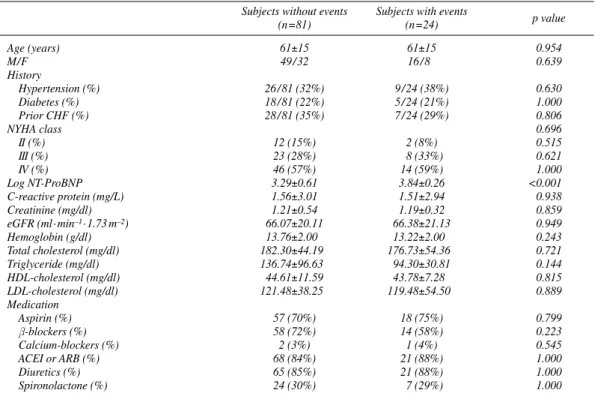
The baseline characteristics of the study subjects are showed in Table 1. Among the 105 patients referred, 24 patients (23%) had adverse cardiac events during follow-up periods. Five patients (21%) died and all 5 deaths had a cardiac origin cause. Nineteen (79%) had recurrent CHF leading to re-admission to hospital. The patients with car- diac events were found to have a significantly higher value of log NT-ProBNP, compared to those without events.
However, there were no differences in age, diabetes and hypertension, and there were also no significant differences in the treatment with medication and laboratory results such as lipid profile between the 2 groups.
Echocardiography Study
Among the conventional echocardiographic parameters, an increased LADI was noted in those with cardiac events (Table 2). Regarding the Doppler study for mitral inflow, in those patients with cardiac events, it showed the restrictive filling pattern, which was demonstrated by increased E-
velocity, decreased A-velocity, shortened DT and a typical E/A ratio of more than 1.5. However, the TDI revealed that the S’, E’ and A’ were not significantly decreased, while the E/E’ ratio was higher in the cardiac event group.
Prognosis of DCM
The univariate and multivariate predictors of cardiac events are listed in Table 3. After all, the variables showing the significant predicting value for the adverse outcomes on univariate Cox regression analysis were entered into a for-
Subjects without events Subjects with events p value
(n=81) (n=24)
Age (years) 61±15 61±15 0.954
M/F 49 / 32 16 / 8 0.639
History
Hypertension (%) 26 / 81 (32%) 9 / 24 (38%) 0.630
Diabetes (%) 18 / 81 (22%) 5 / 24 (21%) 1.000
Prior CHF (%) 28 / 81 (35%) 7 / 24 (29%) 0.806
NYHA class 0.696
II (%) 12 (15%) 2 (8%) 0.515
III (%) 23 (28%) 8 (33%) 0.621
IV (%) 46 (57%) 14 (59%) 1.000
Log NT-ProBNP 3.29±0.61 3.84±0.26 <0.001
C-reactive protein (mg/L) 1.56±3.01 1.51±2.94 0.938
Creatinine (mg/dl) 1.21±0.54 1.19±0.32 0.859
eGFR (ml · min–1· 1.73 m–2) 66.07±20.11 66.38±21.13 0.949
Hemoglobin (g/dl) 13.76±2.00 13.22±2.00 0.243
Total cholesterol (mg/dl) 182.30±44.19 176.73±54.36 0.721
Triglyceride (mg/dl) 136.74±96.63 94.30±30.81 0.144
HDL-cholesterol (mg/dl) 44.61±11.59 43.78±7.28 0.815
LDL-cholesterol (mg/dl) 121.48±38.25 119.48±54.50 0.889
Medication
Aspirin (%) 57 (70%) 18 (75%) 0.799
β-blockers (%) 58 (72%) 14 (58%) 0.223
Calcium-blockers (%) 2 (3%) 1 (4%) 0.545
ACEI or ARB (%) 68 (84%) 21 (88%) 1.000
Diuretics (%) 65 (85%) 21 (88%) 1.000
Spironolactone (%) 24 (30%) 7 (29%) 1.000
Table 1 Baseline Characteristics of the Study Subjects According to the Cardiovascular Events
CHF, congestive heart failure; NYHA, New York Heart Association; NT-ProBNP, N-terminal Pro B-type natriuretic peptide; eGFR, glomerular filtration rate; HDL, high-density lipoprotein; LDL, low-density lipoprotein; ACEI, angiotensin-converting enzyme inhibi- tor; ARB, angiotensin receptor blocker.
Subjects without events Subjects with events
p value
(n=81) (n=24)
LV structures
LVPWD (cm) 0.93±0.20 0.91±0.37 0.641
IVSD (cm) 0.88±0.20 0.86±0.28 0.808
LVEDD (cm) 6.48±0.74 6.79±0.62 0.143
LVESD (cm) 5.50±0.92 5.75±0.64 0.133
LVEDV (ml) 150.13±51.14 158.41±41.17 0.572
LVESV (ml) 125.45±42.54 130.06±31.43 0.386
LVMI (g/m2) 160.62±42.03 176.55±58.94 0.350
LADI (cm/m2) 2.77±0.47 3.10±0.54 0.004
LV ejection fraction (%) 27.69±6.94 25.67±7.00 0.214
Mitral inflow study
Mitral E wave (cm/s) 71.81±24.53 83.13±19.80 0.041
Mitral A wave (cm/s) 75.71±28.14 63.50±36.23 0.128
E/A ratio 1.11±0.73 1.86±1.45 0.047
DT (ms) 186.25±71.33 155.78±49.59 0.026
Isovolumic relaxation time (ms) 118.14±33.38 108.91±42.75 0.287
Tissue Doppler velocity
S’ (cm/s) 4.27±1.44 3.96±1.07 0.332
E’ (cm/s) 4.48±1.48 4.78±1.81 0.411
A’ (cm/s) 5.55±1.68 4.89±1.71 0.146
E/E’ ratio 17.19±7.75 21.01±7.69 0.036
Table 2 Echocardiographic Parameters of the Patients According to the Cardiovascular Events
LV, left ventricular; LVPWD, LV posterior wall dimension; IVSD, interventricular septal dimension; LVEDD, LV end-diastolic dimension; LVESD, LV end-systolic dimension; LVEDV, LV end-diastolic volume; LVESV, LV end-systolic volume; LVMI, LV mass index; LADI, left atrial dimension index; E, early transmitral inflow; A, late transmitral inflow; DT, decelerating time; S’, systolic mitral annular velocity; E’, early diastolic mitral annular velocity; A’, late diastolic mitral annular velocity; E/E’ ratio, ratio of peak early diastolic mitral inflow to annular velocity.
ward multivariate analysis, and LADI and log NT-ProBNP still remained as independent predictors. In terms of the relationship between the E/E’ ratio and the NT-ProBNP level, NT-ProBNP was elevated gradually in slow incre- ments when the level of the E/E’ ratio was less than 22, whereas it rapidly increased in steep increments when the level of the E/E’ ratio was greater than 22 (Fig 1).
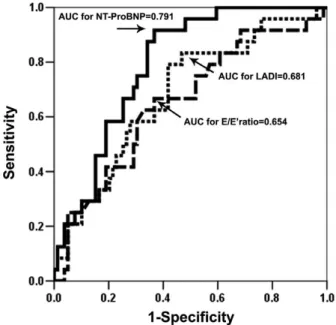
Fig 2 shows the area under the ROC curves for LADI and NT-ProBNP, for the prediction of cardiac events (0.681:
Univariate HR (95%CI) p value Multivariate HR (95%CI) p value
LADI 3.985 (1.780–8.922) 0.001 3.332 (1.356–8.185) 0.009
DT 0.994 (0.987–1.001) 0.096 1.003 (0.990–1.016) 0.656
Mitral E wave 1.017 (1.000–1.034) 0.044 1.005 (0.971–1.040) 0.768
E/A ratio 1.671 (1.185–2.355) 0.003 1.401 (0.796–2.467) 0.242
E/E’ ratio 3.665 (1.549–8.669) 0.003 0.973 (0.899–1.053) 0.494
Log NT-ProBNP 11.104 (3.419–36.057) <0.001 8.304 (1.795–38.412) 0.007 Table 3 Results of Cox-Hazard Univariate and Multivariate Predictors of Outcomes
HR, hazard ratio; CI, confidence interval. Other abbreviations see in Tables 1,2.
Fig 1. Level of N-terminal Pro B-type natriuretic peptide (NT- ProBNP) according to the quartile ratio of peak early diastolic mitral inflow to annular velocity (E/E’ ratio).
Fig 2. Receiver-operating characteristics (ROC) curves of N-termi- nal Pro B-type natriuretic peptide (NT-ProBNP), left atrial dimension index (LADI) and the ratio of peak early diastolic mitral inflow to annular velocity (E/E’ ratio) against the adverse cardiovascular events in 105 patients with dilated cardiomyopathy.
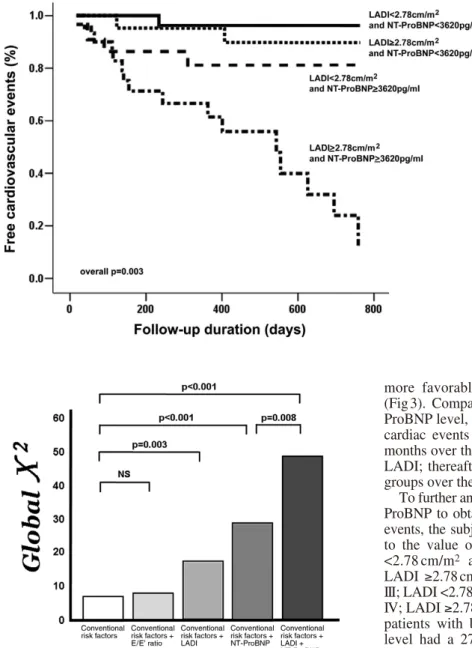
Fig 3. Event-free Kaplan – Meier curves for subgroups according to the level of N-terminal Pro B-type natriuretic peptide (NT-ProBNP) (Upper) and left atrial dimension index (LADI) (Lower).
95% confidence interval (CI), 0.562–0.801 for LADI;
0.791: 95% CI, 0.703–0.878 for NT-ProBNP). However, the area under the ROC curves for the E/E’ ratio (0.654:
95% CI, 0.528–0.780) was smaller than that for LADI or NT-ProBNP. The optimal values of LADI and NT-ProBNP for predicting cardiac events were defined as the concentra- tion with the largest sum of sensitivity plus specificity for each of the curves. As such, for LADI, the optimal level was 2.78 cm/m2, while for NT-ProBNP, the optimal concentra- tion was 3,620 pg/ml. The sensitivity and specificity in pa- tients with a LADI at 2.78 cm/m2were 79.2% and 58.2%, respectively, while the sensitivity and specificity of cardiac events in patients with a serum level of NT-ProBNP at 3,620 pg/ml were 91.7% and 63.3%, respectively.
By using these cut-off levels for NT-ProBNP and LADI, the patients who had a level of NT-ProBNP less than 3,620 pg/ml and a LADI less than 2.78 cm/m2 showed a
more favorable prognosis during the follow-up period (Fig 3). Compared with the event-free curve for the NT- ProBNP level, there was no difference in the occurrence of cardiac events between the 2 groups within the initial 3 months over the course of the study period in the curve for LADI; thereafter it was markedly different between the 2 groups over the rest of the follow-up period.
To further analyze the prognostic power of LADI and NT- ProBNP to obtain useful information on predicting cardiac events, the subjects were classified into 4 groups according to the value of LADI and NT-ProBNP: group I; LADI
<2.78 cm/m2 and NT-ProBNP <3,620 pg/ml, group II;
LADI ≥2.78 cm/m2 and NT-ProBNP <3,620 pg/ml, group III; LADI <2.78 cm/m2and NT-ProBNP ≥3,620 pg/ml, group IV; LADI ≥2.78 cm/m2and NT-ProBNP ≥3,620 pg/ml. The patients with both an increased LADI and NT-ProBNP level had a 27-fold higher risk of experiencing cardiac events than those patients with no risk factors (hazard ratio 27.2, 95% CI 3.2–233.7, p=0.003) (Fig 4). Moreover, with respect to the incremental value, in the global chi-square analysis showing improvement with an increment of 10 by adding LADI and of 32 by adding NT-ProBNP in sequence, the value of both LADI and NT-ProBNP added the incre- mental prognostic value to conventional risk factors such as age, hypertension and diabetes. In contrast, the E/E’ ratio alone did not have the incremental power over the conven- tional risk factors; it was suggested that both the LADI and NT-ProBNP level could be related to CV prognosis more than the E/E’ ratio (Fig 5).
Discussion
While most of the previous studies focused on either ischemic or mixed ischemic and non-ischemic LV function, the present study excluded the ischemic etiologies of CHF.
There were few and limited data for the incremental value of the E/E’ ratio and LA size compared to NT-ProBNP in non-ischemic heart diseases. Thus, we extended these echo- cardiographic parameters in the current study because the role of these parameters for predicting the adverse of a car- diac event, particularly in non-ischemic DCM with advanced
Fig 4. Event free Kaplan – Meier curves for subgroups stratified by both combina- tion of N-terminal Pro B-type natriuretic peptide (NT-ProBNP) and left atrial dimen- sion index (LADI).
Fig 5. Incremental prognostic values of the ratio of peak early dias- tolic mitral inflow to annular velocity (E/E’ ratio), left atrial dimen- sion index (LADI) and N-terminal Pro B-type natriuretic peptide (NT-ProBNP) to the conventional risk factors.
LV dysfunction, seems unclear. To the best of our knowl- edge, this is the first study that has examined the prognostic power of the NT-ProBNP level and echocardiographic fac- tors in non-ischemic DCM patients.
As expected, the lower EF and S’ in TDI, reflecting LV systolic dysfunction, were not important contributors to adverse events in DCM. Diastolic echoparameters such as mitral E and the E/A ratio were significantly different between the 2 groups because both systolic and diastolic dysfunction would co-exist in the majority of patients with CHF. Along with those parameters, the E/E’ ratio was also increased in patients who experienced cardiac events, which had been reported to represent the LV end-diastolic pres- sure and to predict further CV events. And also, the more enlarged LAD and higher LADI in the event group could support the additional evidence of the diastolic functional role in addition to the LV end-diastolic pressure, because LAD or LADI had a good correlation with diastolic dys- function over a long-term duration in previous studies.19,20
With those echocardiographic parameters, NT-ProBNP was significantly higher in the cardiac event group, as was also evidenced by a recent study.21NT-ProBNP is a neuro- hormone, which is released mainly from ventricular myo- cytes and has been used as a marker of LV dysfunction. The degree of its elevation in the CV diseases shows a some- what different level according to the types of heart diseases, as was influenced by many other factors. Some studies revealed that combined systolic and diastolic dysfunction, or diastolic dysfunction would like to show a better correla- tion with NT-ProBNP than only systolic dysfunction.22,23 Moreover, this variable heterogeneity of the NT-ProBNP level in patients with systolic CHF would seem to reflect the severity of diastolic abnormality, right ventricular func- tion and mitral regurgitation in addition to LVEF, age and renal function.24,25Interestingly, another recent report has demonstrated that the NT-ProBNP level was shown to cor- relate closely with LV end-diastolic wall stress more than any other echocardiographic or hemodynamic factors, in- cluding LV end-diastolic filling pressure in DCM or CHF.26 Thus, it might suggest that the usefulness of the NT- ProBNP level in predicting morbidity and mortality ac- curately in CHF might be explained by the link with LV end-diastolic wall stress, which is one of the primary deter- minants of myocardial oxygen consumption.27In the present study, for the relationship between NT-ProBNP level and TDI in only non-ischemic DCM, TDI components of mitral annulus velocity, which is mainly relevant to ischemia or infarction, had less considerable influence on the prognosis of non-ischemic DCM. The lack of predictability of TDI leads to the suggestion that TDI would reflect primarily sys- tolic dysfunction caused by ischemic heart diseases rather than non-ischemic diseases, although there would be a sig- nificant correlation or inter-relationship between systolic (S’) and diastolic (E’ and A’) TDI of mitral annulus caused by the close physiologic interaction between systolic short- ening and diastolic lengthening.28,29Similarly, in a previous study,21with regards to comparing the prognostic impact of echocardiographic factors against NT-ProBNP in CHF with systolic dysfunction, although it was not all the non- ischemic etiology of CHF, the NT-ProBNP level provided the most informative predictor of outcome by multivariate analysis more than the E/E’ ratio or restrictive filling pat- terns.
In this study, in terms of the prognosis of long-term dura- tion, LADI and NT-ProBNP, with the E/E’ ratio as an excep-
tion, were independent factors, even after adjusting for other parameters in the Cox-hazard analysis. Furthermore, on Kaplan – Meier analysis, the adverse cardiac events occurred much more in the patients with higher LADI (≥2.78 cm/m2) and/or increased NT-ProBNP (≥3,620 pg/ml), both of which were suggested to be informative factors for predict- ing for prognosis. However, based on the results of this study, it seems that the role of LADI and NT-ProBNP on prognosis during the follow up period provided different results. The power of LADI for predicting cardiac events in the early course of disorder was lower at this stage rather than later in the course, as was shown in Fig 3. In contrast, the NT-ProBNP level showed more a favorable discriminat- ing power for prognosis over the entire period, even in the early course. The slow and incomplete ventricular filling with increased chamber stiffness is believed to cause the alteration of LV diastolic mechanics leading into LA en- largement, which has been considered as chronic LA dys- function.19However, LA enlargement correlates well with the duration or severity of diastolic heart failure.30 More- over, acute changes of LV function could easily affect the elevation of the NT-ProBNP level rather than LA function or volume, the changes of which would require chronic adaptation, resulting in the remodeling of LA. Thus, it was speculated that the LAD or LADI might contribute inde- pendently to the adverse prognosis and worsening of CHF, particularly in the late course, although current available data rarely specifically report on the potential roles of those risk factors regarding prediction for prognosis.
On the contrary to LADI and NT-ProBNP, the E/E’ ratio could not have sufficient power for predicting cardiac adverse events, even although it reached significance in the univariate analysis. Actually, in advanced LV systolic dys- function, the TDI of mitral annulus velocity was much re- duced and was within a narrow range under 5–6 cm/s, and the E/E’ ratio, per se, would correlate with the LV end- diastolic pressure, not with systolic or diastolic function.
In addition, the TDI-derived E’ and A’ velocity or the E/E’
ratio are relatively load-independent measures of diastolic function, and preferably correlate well with systolic func- tion such as LVEF and tau,17,31,32although they have been validated as an accurate, non-invasive index of LV filling pressure. Thus, in non-ischemic DCM with the same severi- ty of systolic EF or TDI-S’, diastolic TDI-components are not markedly important in the prognosis for tissue Doppler velocity, as they would not provide useful information on the natural course of DCM. Therefore, this narrow range of TDI would result in its less significance in the severely decreased systolic function, and adding the E/E’ ratio to conventional risk factors could not significantly increase the incremental predictive power. In addition, a modest increase of LV filling pressure of less than 22, assessed by the E/E’ ratio, would fail to demonstrate the severity of an increased of NT-ProBNP. Thus, NT-ProBNP would not be correlated in proportion to the E/E’ ratio and the steep up- rise of the NT-ProBNP level could not be explained by the increased E/E’ ratio alone. Although the E/E’ ratio might be a useful parameter in patients with CHF symptoms, it has much more limited value than LADI and NT-ProBNP in providing the incremental value to conventional risk factors in patients with advanced DCM. Our results are in agreement with previous findings, as the NT-ProBNP level was demonstrated to represent the severity and prognosis of CHF including diastolic and/or systolic components rather than be associated with LV filling pressure, compared with
TDI.17Therefore, LADI and NT-ProBNP would be the most significant predictable factors over other factors including the E/E’ ratio in patients who have non-ischemic, advanced DCM and would become an indicator of global cardiac function.
However, our study has some limitations. The invasive hemodynamic parameters could not be obtained in this study. The assessment of diastolic function would require the invasive catheterization of LV to obtain pressure- volume curves, because the elevated E/E’ ratio might not be equal to the diastolic dysfunction but might mean only a high LV end-diastolic pressure. Indeed, the whole defini- tion of diastolic dysfunction based on echocardiography is difficult and there is no ideal method to evaluate diastolic function accurately. However, the non-invasive parameters such as the E/E’ ratio or mitral inflow by using echocardio- graphy have been currently recognized as useful markers for diastolic dysfunction.33A further limitation is that the TDI for only septal mitral annular velocity was measured, and thus, mean values of other sites could not be obtained.
Taken together, the strain or strain rate was not studied.
However, there is no general consensus about the appropri- ate sites for mitral annular tissue velocity, as was reported by previous studies31,34,35and thus, a variety of sites have been used to study TDI analysis. However, medial TDI is less affected by the translational movement of the heart and is easy to obtain for appropriate Doppler beam alignment, although the TDI from the lateral mitral annulus is higher than the TDI from the medial mitral annulus. These were supported by previously published studies demonstrating that septal TDI would correlate well with LA size or volume, and provide better diagnostic utility.36,37Therefore, in non-ischemic DCM, not coronary artery diseases, septal TDI might be enough to represent mitral annular motion.
In conclusion, we have shown that further risk stratifica- tion could be demonstrable by assessing both the LADI and NT-ProBNP levels simultaneously. The current study on advanced DCM provides a strong rationale for the evalua- tion of LADI and NT-ProBNP than the E/E’ ratio, although the E/E’ ratio would be a useful prognostic factor for rec- ognising further CV events in the advanced LV dysfunction of non-ischemic DCM. When these 2 factors are combined for the prediction of prognosis, the subjects could be more easily stratified even in the early course, whereas a lower power of the E/E’ ratio for prognosis was noted in the pres- ent study. Therefore, NT-ProBNP could be used comple- mentary to LADI in DCM, as it is rapid and easy to obtain these binary risk factors.
References
1. Coughlin SS, Tefft MC, Rice JC, Gerone JL, Baughman KL. Epi- demiology of idiopathic dilated cardiomyopathy in the elderly:
Pooled results from two case-control studies. Am J Epidemiol 1996;
143: 881 – 888.
2. de Carvalho Frimm C, Soufen HN, Koike MK, Pereira VF, Curi M.
The long-term outcome of patients with hypertensive cardiomyopa- thy. J Hum Hypertens 2005; 19: 393 – 400.
3. Dini FL, Dell’Anna R, Micheli A, Michelassi C, Rovai D. Impact of blunted pulmonary venous flow on the outcome of patients with left ventricular systolic dysfunction secondary to either ischemic or idio- pathic dilated cardiomyopathy. Am J Cardiol 2000; 85: 1455 – 1460.
4. Hofmann T, Meinertz T, Kasper W, Geibel A, Zehender M, Hohnloser S, et al. Mode of death in idiopathic dilated cardiomyopathy: A multi- variate analysis of prognostic determinants. Am Heart J 1988; 116:
1455 – 1463.
5. Sugrue DD, Rodeheffer RJ, Codd MB, Ballard DJ, Fuster V, Gersh BJ. The clinical course of idiopathic dilated cardiomyopathy: A popu-
lation-based study. Ann Intern Med 1992; 117: 117 – 123.
6. Appleton CP, Galloway JM, Gonzalez MS, Gaballa M, Basnight MA.
Estimation of left ventricular filling pressures using two-dimensional and Doppler echocardiography in adult patients with cardiac disease:
Additional value of analyzing left atrial size, left atrial ejection frac- tion and the difference in duration of pulmonary venous and mitral flow velocity at atrial contraction. J Am Coll Cardiol 1993; 22:
1972 – 1982.
7. Bettencourt P, Ferreira A, Dias P, Pimenta J, Frioes F, Martins L, et al. Predictors of prognosis in patients with stable mild to moderate heart failure. J Card Fail 2000; 6: 306 – 313.
8. Dini FL, Cortigiani L, Baldini U, Boni A, Nuti R, Barsotti L, et al.
Prognostic value of left atrial enlargement in patients with idiopathic dilated cardiomyopathy and ischemic cardiomyopathy. Am J Cardiol 2002; 89: 518 – 523.
9. Hatle L, Sutherland GR. Regional myocardial function--a new approach. Eur Heart J 2000; 21: 1337 – 1357.
10. Wang M, Yip GW, Wang AY, Zhang Y, Ho PY, Tse MK, et al. Peak early diastolic mitral annulus velocity by tissue Doppler imaging adds independent and incremental prognostic value. J Am Coll Cardiol 2003; 41: 820 – 826.
11. Hillis GS, Moller JE, Pellikka PA, Gersh BJ, Wright RS, Ommen SR, et al. Noninvasive estimation of left ventricular filling pressure by E/E’ is a powerful predictor of survival after acute myocardial infarction. J Am Coll Cardiol 2004; 43: 360 – 367.
12. Liu P, Arnold JM, Belenkie I, Demers C, Dorian P, Gianetti N, et al.
The 2002/3 Canadian Cardiovascular Society consensus guideline update for the diagnosis and management of heart failure. Can J Cardiol 2003; 19: 347 – 356.
13. Swedberg K, Cleland J, Dargie H, Drexler H, Follath F, Komajda M, et al. Guidelines for the diagnosis and treatment of chronic heart fail- ure: Executive summary (update 2005): The Task Force for the Di- agnosis and Treatment of Chronic Heart Failure of the European Society of Cardiology. Eur Heart J 2005; 26: 1115 – 1140.
14. Gardner RS, Ozalp F, Murday AJ, Robb SD, McDonagh TA. N-ter- minal pro-brain natriuretic peptide: A new gold standard in predict- ing mortality in patients with advanced heart failure. Eur Heart J 2003; 24: 1735 – 1743.
15. Groenning BA, Raymond I, Hildebrandt PR, Nilsson JC, Baumann M, Pedersen F. Diagnostic and prognostic evaluation of left ventricu- lar systolic heart failure by plasma N-terminal pro-brain natriuretic peptide concentrations in a large sample of the general population.
Heart 2004; 90: 297 – 303.
16. Hartmann F, Packer M, Coats AJ, Fowler MB, Krum H, Mohacsi P, et al. Prognostic impact of plasma N-terminal pro-brain natriuretic peptide in severe chronic congestive heart failure: A substudy of the Carvedilol Prospective Randomized Cumulative Survival (COPER- NICUS) trial. Circulation 2004; 110: 1780 – 1786.
17. Dokainish H, Zoghbi WA, Lakkis NM, Al-Bakshy F, Dhir M, Quinones MA, et al. Optimal noninvasive assessment of left ventricu- lar filling pressures: A comparison of tissue Doppler echocardiogra- phy and B-type natriuretic peptide in patients with pulmonary artery catheters. Circulation 2004; 109: 2432 – 2439.
18. National Kidney Foundation. K/DOQI clinical practice guidelines for chronic kidney disease: Evaluation, and stratification. Am J Kidney Dis 2002; 39: S1 – S266.
19. Douglas PS. The left atrium: A biomarker of chronic diastolic dys- function and cardiovascular disease risk. J Am Coll Cardiol 2003;
42: 1206 – 1207.
20. Pritchett AM, Jacobsen SJ, Mahoney DW, Rodeheffer RJ, Bailey KR, Redfield MM. Left atrial volume as an index of left atrial size: A population-based study. J Am Coll Cardiol 2003; 41: 1036 – 1043.
21. Bruch C, Rothenburger M, Gotzmann M, Sindermann J, Scheld HH, Breithardt G, et al. Risk stratification in chronic heart failure: Inde- pendent and incremental prognostic value of echocardiography and brain natriuretic peptide and its N-terminal fragment. J Am Soc Echocardiogr 2006; 19: 522 – 528.
22. Elnoamany MF, Abdelhameed AK. Mitral annular motion as a surro- gate for left ventricular function: Correlation with brain natriuretic peptide levels. Eur J Echocardiogr 2006; 7: 187 – 198.
23. Mak GS, DeMaria A, Clopton P, Maisel AS. Utility of B-natriuretic peptide in the evaluation of left ventricular diastolic function: Com- parison with tissue Doppler imaging recordings. Am Heart J 2004;
148: 895 – 902.
24. Troughton RW, Prior DL, Pereira JJ, Martin M, Fogarty A, Morehead A, et al. Plasma B-type natriuretic peptide levels in systolic heart fail- ure: Importance of left ventricular diastolic function and right ven- tricular systolic function. J Am Coll Cardiol 2004; 43: 416 – 422.
25. Nakao S, Goda A, Yuba M, Otsuka M, Matsumoto M, Yoshida C, et al. Characterization of left ventricular filling abnormalities and its
relation to elevated plasma brain natriuretic peptide level in acute to chronic diastolic heart failure. Circ J 2007; 71: 1412 – 1417.
26. Iwanaga Y, Nishi I, Furuichi S, Noguchi T, Sase K, Kihara Y, et al.
B-type natriuretic peptide strongly reflects diastolic wall stress in patients with chronic heart failure. J Am Coll Cardiol 2006; 47: 742 – 748.
27. Yin FC. Ventricular wall stress. Circ Res 1981; 49: 829 – 842.
28. Nikitin NP, Loh PH, Silva R, Ghosh J, Khaleva OY, Goode K, et al.
Prognostic value of systolic mitral annular velocity measured with Doppler tissue imaging in patients with chronic heart failure caused by left ventricular systolic dysfunction. Heart 2006; 92: 775 – 779.
29. Tanaka H, Kawai H, Tatsumi K, Kataoka T, Onishi T, Nose T, et al.
Relationship between regional and global left ventricular systolic and diastolic function in patients with coronary artery disease assessed by strain rate imaging. Circ J 2007; 71: 517 – 523.
30. Tsang TS, Barnes ME, Gersh BJ, Bailey KR, Seward JB. Left atrial volume as a morphophysiologic expression of left ventricular dias- tolic dysfunction and relation to cardiovascular risk burden. Am J Cardiol 2002; 90: 1284 – 1289.
31. Nagueh SF, Middleton KJ, Kopelen HA, Zoghbi WA, Quinones MA.
Doppler tissue imaging: A noninvasive technique for evaluation of left ventricular relaxation and estimation of filling pressures. J Am Coll Cardiol 1997; 30: 1527 – 1533.
32. Nagueh SF, Sun H, Kopelen HA, Middleton KJ, Khoury DS. Hemo- dynamic determinants of the mitral annulus velocities by tissue
Doppler. J Am Coll Cardiol 2001; 37: 278 – 285.
33. Paulus WJ, Tschope C, Sanderson JE, Rusconi C, Flachskampf FA, Rademakers FE, et al. How to diagnose diastolic heart failure: A con- sensus statement on the diagnosis of heart failure with normal left ventricular ejection by the Heart Failure and Echocardiography Asso- ciations of the European Society of Cardiology. Eur Heart J 2007;
28: 2539 – 2550.
34. Ommen SR, Nishimura RA, Appleton CP, Miller FA, Oh JK, Redfield MM, et al. Clinical utility of Doppler echocardiography and tissue Doppler imaging in the estimation of left ventricular filling pressures:
A comparative simultaneous Doppler-catheterization study. Circula- tion 2000; 102: 1788 – 1794.
35. Palecek T, Linhart A. Comparison of early diastolic annular velocities measured at various sites of mitral annulus in detection of mild to moderate left ventricular diastolic dysfunction. Heart Vessels 2007;
22: 67 – 72.
36. Srivastava PM, Burrell LM, Calafiore P. Lateral vs medial mitral annular tissue Doppler in the echocardiographic assessment of dias- tolic function and filling pressures: Which should we use? Eur J Echocardiogr 2005; 6: 97 – 106.
37. Park H, Naik S, Aronow W, Visintainer P, Das M, McClung J, et al.
Differences of lateral and septal mitral annulus velocity by tissue Doppler imaging in the evaluation of left ventricular diastolic func- tion. Am J Cardiol 2006; 98: 970 – 972.