고분자유기응집제 (Polyacrylamide)를 활용한 농경지 사면 토양유실 저감 효과 분석
Polyacrylamide, Its Beneficial Application of Soil Erosion Control from Sloped Agricultural Fields 김민영
*,†・ 최용훈*・ 이상봉**・ 김현정*・ 김승희*・ 김영진*
・ 김현정*・ 김승희*・ 김영진*
・ 김영진*
Minyoung Kim ・ Yonghun Choi ・ Sangbong Lee ・ Hyunjeong Kim ・ Seounghee Kim ・ Youngjin Kim
Abstract
This study conducted a series of field experiments using soil conditioners, Polyacrylamide(PAM) and gypsum, to evaluate their effects in reducing sediment loss and surface runoff. In addition, the correction factors (K-alpha) for the erodibility factor (K) were determined to reflect the effects of PAM and PAM+gypsum in applying the USLE equation. Experimental erosion plots individually sized 10 m2 (5 m long, 2 m wide and 1 m deep) have different slopes (10, 20 and 30%). Erosion plots were prepared for one control (C; no PAM and gypsum) and two treatments (P; PAM 20 kg/ha, PG; PAM 20 kg/ha+ gypsum 3,000 kg/ha). The amounts of soil eroded and runoff were continuously monitored from July 1st to Oct. 31st in 2010 and compared to each other. The amount of sediment loss from a control plot was 399.2 ton/ha and the relative reduction of sediment loss were 11.4% and 33.4% for PAM-treated and PAM+gypsum treated plots, respectively. This study also determined the K-alpha factors in the USLE equation to account for the erosion control effectiveness of PAM and gypsum application. The K-alpha factors were calculated as 0.92 for PAM-treated plot and 0.69 for PAM+gypsum-treated plot. The findings of this study revealed that soil conditioners (PAM and gypsum) could play a significant role in controlling soil erosion. In addition, the modified USLE equation using the K-alpha could provide valuable information to make better decision on establishment of best management practice for soil erosion control in agriculture.
Keywords: Polyacrylamide, PAM, Sediment loss, runoff, USLE
*
Agricultural Safety Engineering, Department of Agricultural Engineering, National Academy of Agricultural Science, Rural Development Administration
**
Planning & Coordination Division, National Academy of Agricultural Science, Rural Development Administration
† Corresponding author
Tel.:+82-63-238-4156 Fax: +82-63-238-4145 E-mail:[email protected]
Received: June 24, 2015 Revised: September 9, 2015 Accepted: September 21, 2015
Ⅰ. 서 론
우리나라는 기후변화에 따른 강우패턴의 변화로 비점오염 물질의 유출이 증가하고 있으며, 점오염원 위주의 수질개선 사업은 하천의 목표 수질을 달성하는데 한계가 있다고 보고 하며, 2020년도 하천 BOD 비점오염부하율은 72.1 %에 달할 것으로 환경부는 전망하고 있다 (Koo et al., 2015). 주요 비점 오염원 중에서 농업지역의 비점오염은 비료사용에 따른 영양 물질 배출, 경사 농경지의 토양유실 등이 문제가 된다. 특히 농 업지역의 토양유실은 산림과 초지에 비하여 높으며 (Boardman et al., 1990), 식생피복이 없는 나지상태의 토양 또는 농업활 동으로 교란된 토양으로 인해 토양유실은 더욱 증가된다.
농업지역의 토양유실을 방지하기 위하여 개비온 옹벽, 배
수로, 침사지, 우회수로, 사면보호공 등의 비점오염 저감시설 을 설치해오고 있다 (Shin et al., 2010). 이와 같이 구조적 방법 을 이용한 저감시설보다 오염발생원을 관리하는 방법이 토양 유실 및 영양물질 유출저감에 더 큰 효과가 있다는 연구결과 가 보고되었다 (Rita et al., 2003). 우리나라에서도 지표피복, 보전경운 등과 같은 발생원 관리에 관한 연구가 활발히 수행되 고 있다 (Shin et al., 2013a; Shin et al., 2012; Shin et al., 2011;
Won et al., 2013b Won et al., 2012; Won et al., 2011). 이러한 오염발생원 관리방법과 함께 토양개량제인 Polyacrylamide (PAM)와 인산석고 (gypsum)를 이용하여 토양 물리성을 향 상시켜 토양유실을 저감하는 연구가 이루어졌다 (Choi et al., 2009; Shin et al., 2013b; Won et al., 2013a).
본 연구에서 사용된 PAM은 일반적으로 수처리 과정에 사 용되는 보조응집제로 사용되어 왔다. 하지만 적용 분야는 상 하수도 처리공정 뿐만 아니라 식품가공 및 포장분야였으나, 최근 농업분야에까지 확대되었다. 토양표면의 구조를 보호 하고, 침투성이 좋은 구조를 지속시킴으로써 경사 농경지나 절토 및 성토 사면의 토양유실을 방지하는 효과는 기존 연구 를 통해 구명된 바 있다 (Flanagan, 1997). 또한 PAM은 태양 광선 및 토양미생물에 의해 자연적으로 생분해되며, 독성이 없는 친환경 자재인 것으로 보고되고 있다 (Sojka et al., 1998). 석고 (gypsum)는 점토의 분산 및 피막 형성 감소에 효
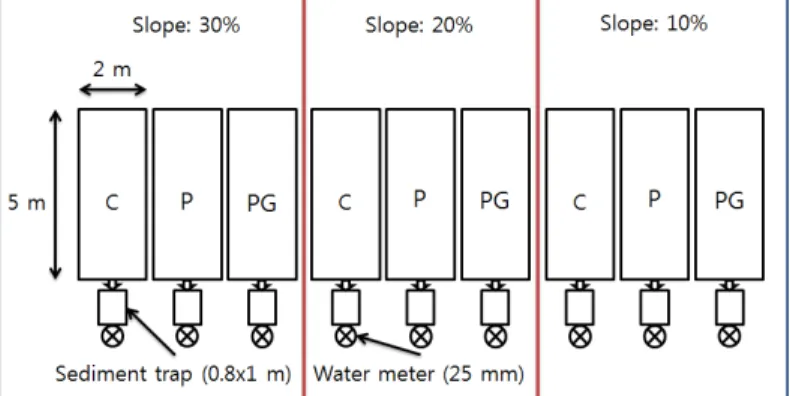
Fig. 1 Description of experimental plots
과적이며, 유출수 및 토양유실을 억제하는데 또한 사용되기도 했다 (Keren and Shainberg, 1981).
우리나라의 PAM과 gypsum을 이용한 토양유실 저감 효과 분석 연구는 아직 초기단계이며, 정확한 적용분야 및 효과를 분석하기 위해서는 다양한 조건에서 실험한 많은 자료의 수 집이 필요하다. 따라서 본 연구에서는 경사진 농경지에서 발 생할 수 있는 토양유실량을 측정하고, 토양개량제 종류 (PAM, gypsum)에 따른 토양유실 저감 효과를 분석하고, 경사도에 따라 토양유실 저감 효과가 변화하는지 확인하였다. 그리고 토양개량제 사용이 범용토양유실공식 (Universal soil loss equation, USLE)의 토양침식인자 (K)를 변화시킬 수 있다고 판단되어 토양개량제 사용에 따른 USLE K의 보정계수 (K-alpha)를 산정하였다.
Ⅱ. 연구방법
1. 시험포 조성 및 시험처리
본 연구에서는 기타 요인 (볏짚, 부직포, 작물 등에 의한 지 표피복)을 제외한 토양개량제 사용에 따른 토양유실 저감효 과만을 분석하기 위해 나지상태에서 실험을 실시하였다. 시 험포의 크기는 폭 2 m와 길이 5 m (면적 10 m2)이며, 10 %, 20
% 그리고 30 %의 경사가 되도록 조성하였다 (Fig. 1). 시험포 의 테두리는 콘크리트 벽체 (깊이 1 m)로 조성하여 외부에서 강우유출수가 유입되는 것과 시험포에서 발생한 유출수가 외 부로 유출되는 것을 방지하였다. 시험포의 유출부에는 토사 를 포집 할 수 있는 침사구 (0.8 × 1.0 m)를 조성하였고, 유출 량 측정을 위한 25 mm 수도미터를 침사구 하단에 설치하였 다. 유출량은 강우가 발생하면 조사하였고, 침사구에 쌓인 토 사는 연구기간이 종료된 후 전체 퇴적량을 측정하였다. 강우 량은 시험포에서 약 0.7 km 떨어진 수원 기상대의 자료를 활
용하였다.
시험포는 대조구인 무처리 (Control, C)와 두 가지 처리구 인 PAM 20 kg/ha (P), PAM 20 kg/ha+ gypsum 3,000 kg/ha (PG)로 마련하였다. 본 연구에 사용된 PAM은 음이온의 합성 폴리머로 기본적인 높은 분자량 (10∼15 million g/mol)을 가 지며, 구체적인 특성은 다음과 같다: 무색 (하얀색) 분말형태, 입경 1000 μm, 부피밀도 0.8 g/cm, pH (25°C 1 % 수용액의 경우) 5.5, 점성 (25°C 0.5 % 수용액의 경우) 50 cp, 상대점성 (25°C 0.5 % 수용액의 경우) 4.1 (Kim et al., 2013).
2. 분석 방법
대조구와 처리구의 강우유출량과 토양유실량을 비교하여, 토양개량제의 강우유출 및 토사유출 저감효과를 평가하였다.
강우 유출량 비교는 무처리구와 처리구의 발생량을 수치 비 교하였고, 토양유실량 비교는 수치 비교와 USLE 공식을 이 용한 산정치와 비교 평가하였다. USLE는 Wischmeier와 Smith (1978)에 의하여 개발된 연간 단위면적에서 발생하는 평균 토양유실량을 예측하는 공식으로 토양유실량 A (ton/ha/
year)는 R (rainfall and runoff factor, 강우인자) × K (soil erodibility factor, 토양침식인자) × LS (topographic factor, 지형인자) × C (cover and management factor, 작물피복인 자) × P (support conservation practice factor, 경작관리인자) 로 나타낸다.
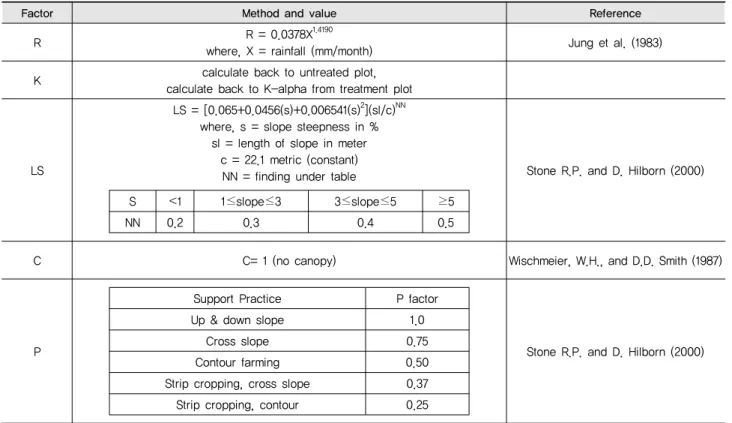
USLE를 이용한 평가는 무처리구에서 발생한 토양유실량을 기준으로 USLE R, K, LS, C 그리고 P를 설정하였다. USLE R값은 Jung et al. (1983)이 제시한 월강수량을 이용한 USLE R값 산정공식을 사용하였고, USLE LS값은 Stone & Hilborn (2012)에서 제시된 공식을 사용하였다. USLE C는 작물 및 피복효과가 없기 때문에 no canopy 값인 1을 적용하였고, USLE P도 특별한 관리를 하지 않았기 때문에 최댓값인 1을 적용하 였다. USLE K는 무처리구의 토양유실량을 이용하여 역산하
Table 1 Method and value for estimating the USLE factors
Factor Method and value Reference
R R = 0.0378X
1.4190where, X = rainfall (mm/month) Jung et al. (1983)
K calculate back to untreated plot,
calculate back to K-alpha from treatment plot
LS
LS = [0.065+0.0456(s)+0.006541(s)
2](sl/c)
NNwhere, s = slope steepness in %
sl = length of slope in meter c = 22.1 metric (constant)
NN = finding under table
S <1 1≤slope≤3 3≤slope≤5 ≥5
NN 0.2 0.3 0.4 0.5
Stone R.P. and D. Hilborn (2000)
C C= 1 (no canopy) Wischmeier, W.H., and D.D. Smith (1987)
P
Support Practice P factor
Up & down slope 1.0
Cross slope 0.75
Contour farming 0.50
Strip cropping, cross slope 0.37 Strip cropping, contour 0.25
Stone R.P. and D. Hilborn (2000)
Fig. 2 Response of runoff depth with a change of slope and treatment type
였다 (Table 1).
무처리구를 이용하여 산정된 USLE R, LS, C 그리고 P 인 자를 처리구에 다시 적용하여 PAM 사용에 의하여 변화되는 토양침식인자 K를 재산정하였다. 이 과정에서 PAM을 사용 하였을 때 변화되는 토양침식인자를 반영하기 위한 USLE K 값은 기존의 USLE K값에 보정계수를 곱하는 형식으로 표현 하였다. 본 연구에서 USLE K의 보정계수는 K-alpha로 명명 하였고, 0보다 크고 1보다 작은 상수로 정의하였다.
Ⅲ. 연구결과
1. 강우유출
관측기간 (2010년 7월 1일∼10월 31일)동안 발생한 강우 량은 총 954 mm이며, 무처리 시험포에서 평균 564 mm의 유 출이 발생하였다. 무처리 시험포에 비하여 PAM을 적용한 시 험포의 유출이 31.8 %, PAM과 gypsum을 함께 사용한 시험 포의 유출이 35.6 % 감소하는 것으로 분석되었다. PAM과 gypsum을 함께 사용하는 것이 PAM만 사용하는 것보다 3.8 % 의 유출이 더 감소하였으나, gypsum의 사용에 의한 유출 감 소 효과는 비교적 작은 것으로 판단되었다 (Fig. 2). 경사도에 따른 유출률을 살펴보면, 무처리 시험포에서 경사도가 증가
할수록 유출률이 증가하는 경향이 뚜렷하게 나타났다. 하지 만 PAM과 PAM+gypsum을 살포한 시험포에서는 경사도가 증가해도 유출률 증가가 뚜렷하게 나타나지 않았다. 유출률 증가 경향을 분석하기 위해 회귀곡선의 기울기를 산정하여 비교하였다. 무처리 시험포, PAM 시험포 그리고 PAM+gypsum 시험포의 회귀곡선 기울기는 7.9, 1.1 그리고 3.8로써 PAM 사용에 따라 기울기가 51∼86 %정도 완화됨을 알 수 있었다.
이는 달리 말해, PAM을 사용하게 되면 경사도가 증가함에 따라 증가되는 강우유출수 발생량을 감소시키는 역할을 한
Fig. 3 Runoff rates and their regression curves depending upon
slopes and treatment types Fig. 4 Response of sediment loss with a change of slope and treatment type
Table 2
Calculation of the K factor by comparing sediment loss observed and estimated using the USLE equationSlope R K LS C P Amount of sediment loss (ton/ha)
USLE-Estimated Observed
10% 417 0.117 0.559 1 1 27 51
20% 417 0.117 1.709 1 1 83 92
30% 417 0.117 3.482 1 1 169 156
다고 해석할 수 있다 (Fig. 3). 그러나 PAM 사용과 유출량의 변화에 대해서는 많은 연구자들이 다른 결과를 제시하고 있 다. 유출량이 감소한다고 보고된 연구 (Bjorneberg et al., 2003; Flanagan et al., 2003), 반대로 유출량이 증가한다는 보고된 연구 (Huang 1995; Fox et al., 1997; Fox and Bryan, 1999), 그리고 변화가 없다고 보고된 연구 (Lal, 1976; Mah et al., 1992; Lee et al., 2011) 등 다양한 결과가 보고되었으며, 이는 사용한 PAM의 종류와 PAM을 적용한 시험구 (포장)의 토성 및 지형적 요인 등 많은 변수들이 작용했기 때문이라 판 단된다.
2. 토양유실량
가. 토양개량제의 토양유실 저감 효과 평가
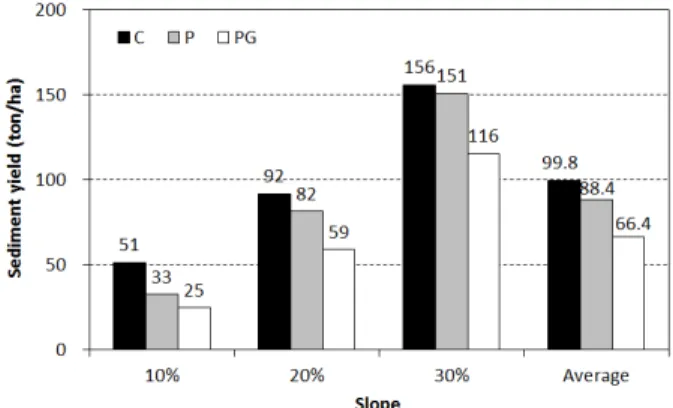
관측기간 (2010년 7월 1일∼10월 31일)동안 강우유출수 와 함께 유실된 무처리구 시험포의 총량은 399.2 ton/ha로 나 타났다. PAM을 처리한 시험포에서 발생한 총 토양유실량은 353.6 ton/ha로 무처리구와 비교하여 11.4 % 적은 것으로 나 타났고, PAM과 gypsum을 함께 처리한 시험포의 총 토양유 실량은 265.8 ton/ha로 33.4 % 낮은 것으로 조사되었다.
PAM을 단독으로 살포하는 것보다 gypsum과 함께 살포하는 것이 토양유실 방지에 더 좋은 효과가 있는 것으로 나타났다 (Fig. 4). 이러한 연구결과는 기존 연구결과와 일관되는 것으 로 나타났다. Jian et al. (2003)에 의하면 PAM 20 kg/ha와
gypsum 4,000 kg/ha를 혼합할 경우 토양유실이 약 30 %가 저감되었고, Bradford et al. (1987)은 토양의 전해질을 높일 수 있는 gypsum을 PAM과 함께 사용하면 토양유실 방지효 과가 향상된다고 보고한 바 있다.
나. USLE 공식을 이용한 토양유실 저감 효과 평가 무처리 시험포를 기준으로 하여 USLE R, LS, C, P값을 결 정하였다. USLE R, LS, C, P값을 결정한 뒤 관측기간 동안 경 사도에 따른 토양유실 관측값과 USLE 산정값 사이의 회귀 곡선의 기울기가 1이 되도록 USLE K값을 시행착오법으로 보정하였다. 시행착오법으로 보정된 K값은 0.117로 나타났 다. 본 연구에서 무처리 시험포에 적용한 USLE 인자와 USEL 산정값은 Table 2와 같다.
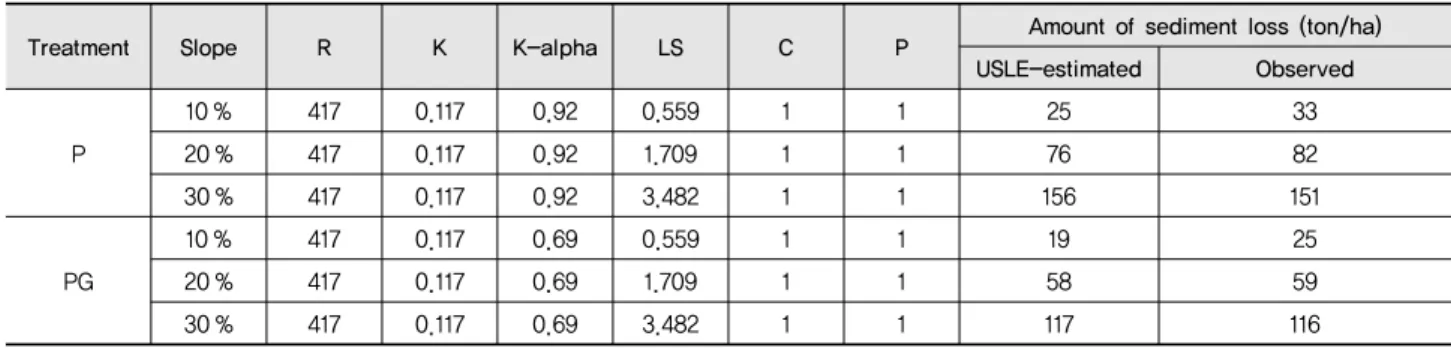
무처리구 시험포를 기준으로 산정된 USLE K값을 대입하 여 토양개량제 사용으로 인하여 변화하는 USLE K의 보정계 수 K-alpha를 추정하였다. 관측기간 동안 경사도에 따른 토양 유실 관측값과 USLE 산정값 사이의 회귀 곡선의 기울기가 1 이 되도록 K-alpha값을 시행착오법으로 계산하였다. 시행착 오법으로 계산된 K-alpha값은 PAM을 사용한 시험포에서 0.92, PAM과 gypsum을 함께 사용한 시험포에서 0.69로 나 타났다 (Table 3). 이는 PAM만을 사용할 때 8 %, PAM과 gypsum을 사용할 때 31 %의 토양유실 저감효과가 있는 것으로 해석할 수 있으며, PAM을 단독으로 사용하는 것보다 gypsum
Table 3
Calculation of the K-alpha factor by comparing sediment loss observed and estimated using the USLE equationTreatment Slope R K K-alpha LS C P Amount of sediment loss (ton/ha)
USLE-estimated Observed
P
10 % 417 0.117 0.92 0.559 1 1 25 33
20 % 417 0.117 0.92 1.709 1 1 76 82
30 % 417 0.117 0.92 3.482 1 1 156 151
PG
10 % 417 0.117 0.69 0.559 1 1 19 25
20 % 417 0.117 0.69 1.709 1 1 58 59
30 % 417 0.117 0.69 3.482 1 1 117 116
을 함께 사용하는 것이 토양유실 저감에 더 좋은 효과를 주는 것으로 나타났다.
Ⅳ. 요약 및 결론
본 연구에서는 기존의 구조적인 토양유실저감기법이 아닌 비구조적, 친환경 토양개량제를 통해 토양유실발생원을 제 어하고자 하였다. 두 가지 형태의 토양개량제 (PAM, gypsum) 사용에 따른 효과뿐만 아니라 사용포장의 조건 (경사 10 %, 20 %, 30 %) 또한 고려하여 토양유실저감 효과를 정량화 하 였다. 무처리 시험포에 비하여 PAM과 PAM+gypsum을 살 포한 시험포의 유출이 31.8 %와 35.6 % 감소하였고, 토양유 실량은 11.4 %와 33.4 % 낮은 것으로 조사되었다. PAM과 PAM+gypsum을 살포한 시험포를 비교하면 gypsum을 추가 적으로 사용해도 유출량 감소 효과는 크지 않았다. 반면 토양 유실 저감효과는 22 % 더 효과적인 것으로 나타났다. PAM과 PAM+gypsum의 토양유실 저감효과를 USLE를 이용하여 정 량화하여 USLE K 보정계수로 도출하였으며, K-alpha는 PAM 을 사용한 시험포에서 0.92, PAM과 gypsum을 함께 사용한 시험포에서 0.69로 산정되었다. 토양개량제를 첨가하는 방법 은 토양유실량을 저감하는 효과적인 방법으로 많은 연구자들 에 의하여 지속적으로 그 효과가 규명되고 있다. 이러한 저감 효과를 범용적으로 사용하기 위해서는 일정한 계수 또는 모 델링 변수 등으로 변환하는 것이 필요하며, 본 연구에서는 USLE K 보정계수로 저감 효과를 표현하였다. 본 연구의 결 과는 향후 모델링을 이용한 토양유실 평가에 유용한 자료로 활용될 수 있는 것으로 기대된다.
REFERENCES