—239—
INTRODUCTION
The subfamily Sebastinae, which is one of the seven subfamilies in the family Scorpaenidae, comprises 7 gen- era and approximately 133 species. However, definitions and relationships of taxonomic groups in the Scorpaenidae are controversial (Nelson, 2006). Recently, following the work of several previous authors (e.g., Ishida, 1994;
Imamura and Yabe, 2002), Nakabo and Kai (2013) rede- fined the order Scorpaeniformes as the suborder Scor- paenoidei, belonging to the order Perciformes; In addi- tion, they upgraded the subfamily Sebatinae to the family Sebastidae. However, thus far, taxonomic relationships in the Scorpaenidae have followed those proposed by Kim et al. (2005), based on studies of Korean faunas.
The genus Hozukius Matsubara, 1934, which lives in deep water on rocky or seamounts in the Northwest Pacif- ic, comprises two rare species, Hozukius emblemarnius (Jordan and Starks, 1904) and Hozukius guyotensis Bar- sukov and Fedorov, 1975. Studies on Hozukius have shown that Sebasticus triacanthus Fowler, 1938, is a junior synonym of H. emblemarinus (Ishida and Amaoka, 1986) and that the genus is more closely related to Sebastes than to Sebastiscus (Kai et al., 2003).
Recently, a single specimen resembling Sebastes was collected by bottom trawl (depth, 142~145 m) from coas- tal waters off Ulsan, Korea. However, the specimen was identified as a rare occurrence of H. emblemarinus, on the basis of morphological characters such as large eye size, deep body, the presence of three spines below the eye, and the truncate shape of the caudal fin. Until now, H. emblemarinus has been considered as endemic to Japan. Therefore, we describe the first record of H. emble- marinus in Korea, thus expanding its geographic distri- bution.
The bottom temperature and at the location of the sam- pling site of the H. emblemarinus specimen were mea- sured using CTD (SBE 9, Seabird, USA). Counts and measurements follow those of Nakabo (2002a) and Hubbs and Lagler (2004). Each body part was measured to the nearest 0.1 mm using digital Vernier calipers. Pored scales along the lateral line were counted by stereomicro- scope. The specimen was deposited at the Fisheries Re- sources Laboratory, East Sea Fisheries Research Institute (ESFRI), Korea.
Genus Hozukius Matsubara, 1934 (New Korean name: Keun-nun-bol-rak-sok) Hozukius Matsubara, 1934: 199 (type species: Helicolenus
emblemarius Jordan and Starks, 1904).
First Record of Hozukius emblemarinus (Scorpaeniformes:
Scorpaenidae) from the East Sea, Korea
By Jeong-Ho Park, Byoung-Sun Yoon, Myoung Ho Sohn, Young-Min Choi
1and Jin-Koo Kim
2,*
Fisheries Resources and Environment Division, East Sea Fisheries Research Institute, NFRDI, Haean-ro 1194, Gangneung, Gangwon-do 210-861, Korea
1Fisheries Resources and Environment Division, West Sea Fisheries Research Institute, NFRDI, Seonnyeobawi-ro 14, Jug-gu, Incheon 400-420, Korea
2Department of Marine Biology, Pukyong National University, Yongso-ro 45, Nam-gu, Busan 608-737, Korea
ABSTRACT A single specimen (196.4 mm standard length) of the scorpaenid Hozukius emblemarinus was collected by a bottom trawl from the coastal waters off Ulsan, East Sea, Southern Korea. The spec- imen is characterized by a deep oblong body, three spines on the lower margin of the eye, a dorsal fin with 12 spines, a head mostly covered with various sizes of scales, and a truncate posterior margin of the caudal fin. This is the first record of H. emblemarinus in Korea; we therefore add the species to the Korean fish fauna and propose the new Korean name, “Dong-hae-keun-nun-bol-rak” for this species.
Key words : Scorpaenidae, Hozukius emblemarinus, new Korean record, Ulsan, East Sea
*Corresponding author: Jin-Koo Kim Tel: 82-51-629-5927 Fax: 82-51-629-5931, E-mail: [email protected]
KOREAN JOURNAL OF ICHTHYOLOGY, Vol. 26, No. 3, 239-242, September 2014 ISSN: 1225-8598 (Print), 2288-3371 (Online)
Received: September 2, 2014 Revised: September 11, 2014 Accepted: September 23, 2014
http://www.fishkorea.or.kr
240 Jeong-Ho Park, Byoung-Sun Yoon, Myoung Ho Sohn, Young-Min Choi and Jin-Koo Kim
Fig. 1.Hozukius emblemarinus, ESFRI 1423, 196.4 mm SL, Ulsan, East Sea, Korea.
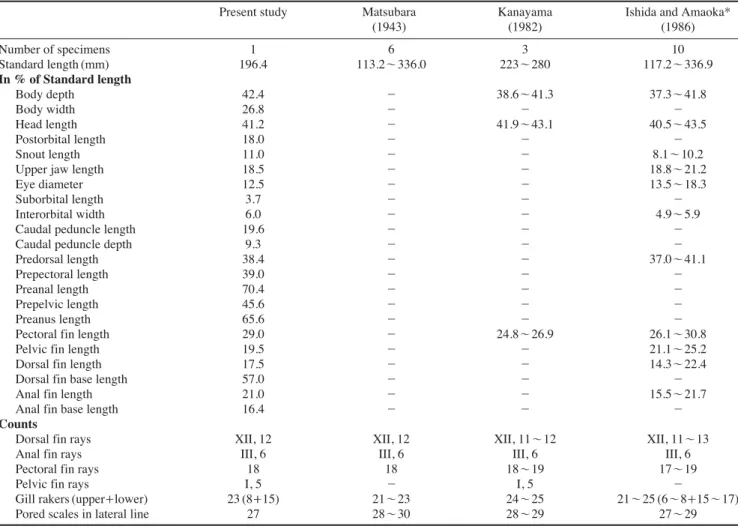
Table 1.Comparison of meristic and morphometric characters of Hozukius emblemarinus
Present study Matsubara Kanayama Ishida and Amaoka*
(1943) (1982) (1986)
Number of specimens 1 6 3 10
Standard length (mm) 196.4 113.2~336.0 223~280 117.2~336.9
In % of Standard length
Body depth 42.4 - 38.6~41.3 37.3~41.8
Body width 26.8 - - -
Head length 41.2 - 41.9~43.1 40.5~43.5
Postorbital length 18.0 - - -
Snout length 11.0 - - 8.1~10.2
Upper jaw length 18.5 - - 18.8~21.2
Eye diameter 12.5 - - 13.5~18.3
Suborbital length 3.7 - - -
Interorbital width 6.0 - - 4.9~5.9
Caudal peduncle length 19.6 - - -
Caudal peduncle depth 9.3 - - -
Predorsal length 38.4 - - 37.0~41.1
Prepectoral length 39.0 - - -
Preanal length 70.4 - - -
Prepelvic length 45.6 - - -
Preanus length 65.6 - - -
Pectoral fin length 29.0 - 24.8~26.9 26.1~30.8
Pelvic fin length 19.5 - - 21.1~25.2
Dorsal fin length 17.5 - - 14.3~22.4
Dorsal fin base length 57.0 - - -
Anal fin length 21.0 - - 15.5~21.7
Anal fin base length 16.4 - - -
Counts
Dorsal fin rays XII, 12 XII, 12 XII, 11~12 XII, 11~13
Anal fin rays III, 6 III, 6 III, 6 III, 6
Pectoral fin rays 18 18 18~19 17~19
Pelvic fin rays I, 5 - I, 5 -
Gill rakers (upper++lower) 23 (8++15) 21~23 24~25 21~25 (6~8++15~17)
Pored scales in lateral line 27 28~30 28~29 27~29
*including type specimens
Deep body; three spines on lower margin of eye; dorsal fin with 12 spines; caudal fin truncate (Nakabo and Kai, 2013).
Houkius emblemarinus (Jordan & Starks, 1904) (New Korean name: Dong-hae-keun-nun-bol-rak)
(Fig. 1; Table 1)
Helicolenus emblemarius Jordan and Starks, 1904: 129, fig. 9 (type locality: Misaki, Japan).
Sebastiscus triacanthus Fowler, 1938: 53, fig. 20 (Japan).
Houzkius emblemarinus: Matsubara, 1943: 263, figs. 87, 88 (Japan); Kanayama in Okamura et al., 1982: 271, fig. 188 (southern Japan); Amaoka in Masuda et al., 1984: 313, pl. 279-F (Iwate and southern to Kyushu, Japan); Ishida and Amaoka, 1986: 323, fig. 2 (Japan);
Nakabo in Nakabo, 2002b: 586 (key, description, Japan);
Kai et al., 2003: 241 (Japan); Shinohara et al., 2011:
42 (Hyogo, Japan); Nakabo and Kai in Nakabo, 2013:
671 (Japan).
Material examined. ESFRI 1423, one specimen, 196.4 mm in standard length (SL), 35�19.36′N, 129�44.52′E 35�17.07′N, 129�44.52′E, Ulsan, East Sea, 142~145 m depth, 9 September 2013, R/V Tamgu-20, bottom trawl, 2.72�C, 34.08 psu, collected by J.H. Park.
Description. D. XII, 12; A. III, 6; P1. 18; P2. I, 5; GR.
8++15; Pored scales on lateral line 27. Meristic and mor- phometric characters are shown in Table 1. Body deep and oblong, tapering posterorly; many sharp spines on head; three triangle spines on lower margin of eye; eye large and protruding; snout short, posterior margin of upper jaw reaching to below of the middle of eye; small teeth on jaws and vomer; gill slit broad and extending to ventral; every spines at fin strong; notch between spine and rays part at dorsal fin, 4th spine the longest; posterior margin of pectoral fin rounded with upper unbranched rays 2, middle branched rays 7 and lower unbranched rays 9; all rays at dorsal, pelvic and anal fins branched;
posterior margin of pectoral fin reaching to the origin of anal fin; posterior margin of pelvic extend to anus; anus located just before origin of anal fin; lateral line curved;
posterior margin of caudal fin truncate; whole head cov- ered with various sizes of scales, opercle’s scales lager than them cheek’s them.
Color of specimen. When fresh, body and fins overall bright red; pupil dark black. After fixation, body uni- formly light brown, opercle black, brown dot dorsally, margin of membrane at spine part of dorsal fin black.
Distribution. Ulsan, East Sea, southern Korea at 142
~145 m depth (present study) and Japan at 250~900 m (Nakabo, 2002; Shinohara et al., 2011; Nakabo, 2013).
Remarks. The present specimen was identified as Hozukius emblemarnius (Jordan and Starks, 1904) on the basis of a deep body, three spines located below the eye, most of the head covered with scales, 12 dorsal fin spines,
and truncate caudal fin (Nakabo and Kai, 2013). The spe- cies is readily distinguished from H. guyotensis Barsukov and Fedorov, 1975, by scales on the snout, maxilla, and lower jaw (present in the former vs. absent in the latter) and its geographic distribution (Japan in the former vs.
Emperor Seamounts, Northwest Pacific, in the latter).
Meristic and morphometric characters of the present spec- imen agree well with those of previous descriptions of H. emblemarinus (Table 1).
H. emblemarinus is known to occur in relatively deep water on rocky beds, at depth of 250~900 m; however, our specimen was collected in shallow water, at a depth of approximately 140 m. We herein propose the new Korean name, “Dong-hae-keun-nun-bol-rak” for this species.
ACKNOWLEDGMENTS
This study was funded by a grant from National Fish- eries Research and Development Institute (NFRDI) (No:
RP-2014-FR-021), Korea.
REFERENCES
Amaoka, K. 1984. Family Scorpaenidae. In: Masuda, H. et al. (eds.), The fishes of the Japanese archipelago.
Tokai Univ. Press, Tokyo, pp. 309-318.
Barsukov, V.V. and V.V. Fedorov. 1975. Species of the genus Hozukius (Scorpaenidae, Sebastinae) from the guyots of the Hawaiian Submarine Ridge. J. Ichthyol., 15:
869-876.
Fowler, H.W. 1938. Descriptions of new fishes obtained by the United States Bureau of Fisheries steamer Alba- tross, chiefly in Philippine seas and adjacent waters.
Proc. U.S. Natl. Mus., 85: 31-135.
Hubbs, C.L. and K.F. Lagler. 2004. Fishes of the great lakes region, revised ed. Michigan Univ. Press, Ann Arbor, 332pp.
Imamura, H. and M. Yabe. 2002. Demise of the Scorpaeni- formes (Actinopterygii: Percomorpha): an alternative phylogenetic hypothesis. Bull. Fish. Sci. Hokkaido Univ., 53: 107-128.
Ishida, M. 1994. Phylogeny of the suborder Scorpaenoidei (Pisces: Scorpaeniformes). Bull. Nansei Natl. Fish.
Res. Inst., 27: 1-112.
Ishida, M. and K. Amaoka. 1986. Sebastiscus triacanthus Fowler a junior synonym of Hozukius emblemarius (Jordan et Starks). Jap. J. Ichthyol., 33: 323-325.
Jordan, D.S. and E.C. Starks. 1904. A review of the scorpae- noid fishes of Japan. Proc. U.S. Natl. Mus., 27: 91- 175, pls. 1-2.
First Record of Hozukius emblemarinus from Korea 241
Kai, Y., K. Nakayama and T. Nakabo. 2003. Molecular phylo- genetic perpective on speciation in the genus Sebastes (Scorpaenidae) from the Northwest Pacific and the position of Sebastes within the subfamily Sebastinae.
Ichthyol. Res., 50: 239-244. DOI 10.1007/s10228- 003-0163-9.
Kanayama, T. 1982. Fishes of the Kyushu-Palau Ridge and Tosa Bay. In: Okamura, O., K. Amaoka and F. Mitani (eds.), The intensive research of unexploited fishery resources on continental slopes. Japan Fisheries Re- source Conservation Association, Tokyo, pp. 270-271, 393.
Kim, I.S., Y. Choi, C.L. Lee, Y.J. Lee, B.J. Kim and J.H. Kim.
2005. Illustrated book of Korean fishes. Kyo-Hak Publishing Co, Seoul, 615pp. (in Korean)
Matsubara, K. 1934. Studies on the scorpaenoid fishes of Japan. I. Descriptions of one new genus and five new species. J. Imp. Fish. Inst. Tokyo, 30: 199-210. (in Japanese)
Matsubara, K. 1943. Studies on the scorpaenoid fishes of
Japan. Anatomy, phylogeny and taxonomy (II). Trans.
Sigenkagaku Kenkyusyo, 2: 147-486, pls. 1-4. (in Japanese)
Nakabo, T. 2002a. Introduction of Ichthyology. In: Nakabo, T. (ed.), Fishes of Japan with pictorial keys to the species, English ed. Tokai Univ. Press, Tokyo, pp.
xxi-xlii.
Nakabo, T. 2002b. Family Scorpaenidae. In: Nakabo, T. (ed.), Fishes of Japan with pictorial keys to the species, English ed. Tokai Univ. Press, Tokyo, pp. 565-595.
Nakabo, T. and Y. Kai. 2013. Family Sebastidae. In: Nakabo, T. (ed.), Fishes of Japan with pictorial keys to the species, 3rd ed. Tokai Univ. Press, Kanagawa, pp.
668-681. (in Japanese)
Nelson, J.S. 2006. Fishes of the world, 4th ed. John Wiley and Sons Inc., Hoboken, New Jersey, 601pp.
Shinohara, G., A.M. Shirai, M.V. Nazarkin and M. Yabe.
2011. Preliminary list of the deep-sea fishes of the Sea of Japan. Bull. Natl. Mus. Nat. Sci. (Ser. A), 37:
35-62.
242 Jeong-Ho Park, Byoung-Sun Yoon, Myoung Ho Sohn, Young-Min Choi and Jin-Koo Kim
한국산 양볼락과(Scorpaenidae) 어류 1 미기록종, Hozukius emblemarinus
박정호∙윤병선∙손명호∙최영민1∙김진구2
국립수산과학원 동해수산연구소, 1국립수산과학원 서해수산연구소
2부경대학교 자원생물학과
요 약 :쏨뱅이목 양볼락과에 속하는 Hozukius emblemarinus 1개체(표준체장 196.4 mm)가 울산 연안에서 저 층 트롤로 채집되었다. 본 개체는 체고가 높은 난형이고 눈 하단에 3개의 가시가 있으며, 등지느러미 극조가 12 개, 두부 대부분이 다양한 크기의 비늘로 덮여 있으며 꼬리지느러미 후단부가 직선형인 것이 특징이다. 우리나라 에서 처음 보고되는 본 종의 국명으로 “동해큰눈볼락”을 제안한다.
찾아보기 낱말 :양볼락과, 큰눈볼락속, 동해큰눈볼락, 미기록종, 울산, 동해