유기 수경재배 시 천연배지 조성에 의한 명월초 생육 및 항산화 활성*
1)
이규회
****․이성희
**․김주형
**․박재호
***Growth and Antioxidant Activity of Gynura procumbens by Natural Media Composition in Hydroponic Cultivation Using
Organic Nutrient Solution
Lee, Kyu-Hoi․Lee, Sung-Hee․Kim, Ju Hyoung․Park, Jae-Ho
Gynura procumbens (Family Asteraceae) is a medicinal plant commonly found in tropical Asia countries such as China, Thailand, Indonesia, Malaysia, and Vietnam.
Traditionally, it is widely used in many different countries for the treatment of a wide variety of health ailments such as kidney discomfort, rheumatism, diabetes mellitus, constipation, and hypertension. The objective of this study was to select the natural growth media for hydroponic cultivation of Gynura procumbens. The commercially available thirty four different organic nutrient solutions were analyzed for growing Gynura procumbens. After analysis, two organic nutrient solution were selected, mixed (pH 5.5~6.5 / EC 0.5~1.0 ds/m) and then used as organic fertilizers.
Thirty day old seedlings were planted and the environmental conditions of the rhizosphere were also examined to select the natural media composition. The minimum temperature of rhizosphere by type of natural media was highest in cocopeat media and lowest in perlite media. Furthermore, plant growth was examined from 50 days old seedlings, and vermiculite was observed to be most effective and perlite was the least effective component as natural media. The total polyphenol content of the studied plant material was also higher in vermiculite in comparison to other growth media. The Gynura procumbens yields were also higher in vermiculite in comparison to other growth media. Thus, vermiculite can be used to improve Gynura procumbens plant growth as a natural growth media.
Key words : gynura procumbens, natural media, organic agriculture, organic nutrient solution
****
본 연구는 농촌진흥청 지역특화작목기술개발사업(과제번호 : PJ01361402)의 지원으로 수행되었음.
****
충청북도농업기술원 유기농업연구소
****
중원대학교 제약공학과
****
Corresponding author, 충청북도농업기술원 유기농업연구소([email protected])
Ⅰ. 서 론
최근 소비자들의 소득수준 향상과 로하스 및 웰빙에 대한 관심이 높아지면서 유기농산 물에 대한 관심도 증가하고 있다. 유기농산물은 화학비료와 농약 등 합성 화학물질은 일체 사용하지 않고 유기물과 자연광물, 미생물 등으로 제조된 자재만을 사용하여 생산한 농산 물로 소비자들에게 안전농산물로 인정되어 각광을 받고 있다. 이러한 건강 및 안전먹거리 에 대한 소비자들의 바람은 건강식품, 기능성 식품 등의 요구로 이어지게 되어 새로운 기 능성식물에 대한 유기재배 면적 또한 증가되고 있는 실정이다.
명월초(Gynura procumbens)는 남부아시아, 인도네시아와 태국, 말레이시아가 원산지인 국 화과의 식물로 줄기는 3~6 m까지 뻗으며, 잎은 난형으로 둘레에 파상의 거치 있고, 줄기 를 잘라 심으면 쉽게 번식한다(Wiart, 2001). 이 식물은 일반적으로 말레이시아에서는 ‘sam- bungnyawa’라 불리우고, 중국에서는 ‘bai bing ca’로 알려져 있으며, 주로 주식인 밥과 함께 쌈으로 즐겨 먹었는데(Rosidah et al., 2008), 동남아시아에서 건강기능 식품 및 약용으로 이 용되는 식물이다(Perry, 1980).
우리나라에서는 예로부터 제주도에서 자생하는 식물이었지만 최근에 와서야 전국적으로 재배가 늘어나고 있는 추세이다. 명월초는 황산화물질과 게르마늄 등 26종의 천연 유기질 성분을 함유하고 있어 비만예방에 좋고 피부미용에 탁월한 효과가 있으며(Jeon and Kwon, 2014; Kwon et al., 2015), 고혈압, 항산화, 고지혈증 개선과 간독성 해독 등의 효능이 보고되 고 있다(Kim et al., 2003). 또한 높은 free radical 소거능을 갖고 있으며, 모세혈관을 튼튼하 게 만들어 주어 항염증, 당뇨, 혈관투과성 강화, 혈소판 안정화 등의 기능을 가지고 있다 (Kamalakkannan et al., 2006). 이와 같이, 명월초의 기능성이 알려지면서 유기재배 농가를 대상으로 수요가 증가하고 있으나, 비싼 묘목 가격과 재배방법이 표준화되어 있지 않아 소 득작목화하기 어려운 실정이다.
수경재배는 토양 없이 일정한 영양분을 공급하여 작물을 생산하는 시스템으로, 일정 규 모 시설 내에서 안정수확이 가능하고 연작장해 없이 균일하게 작물을 생산 할 수 있다는 특징이 있다. 국내 수경재배는 1900년대부터 국가의 시설지원 사업과, 청정 원예작물에 대 한 소비자의 소비욕구가 늘어가면서 급증하였다. 최근에는 양액재배 시 생산물의 품질을 높이려는 연구와 친환경적인 방식으로 전환 연구가 많이 진행되고 있다(Yu and Bae, 2005).
친환경 농산물 생산 시 잡초관리(41%), 병해충관리(40.6%), 토양관리(12.0%) 등에서 어려움 을 겪고 있으며, 수경재배는 이러한 어려움을 해결하는 효율적인 재배방법이다.
따라서, 본 연구는 노지재배의 단점을 보완할 수 있는 수경재배 기술의 일환으로 명월초 유기 수경재배 시 천연배지 종류가 생육에 미치는 영향을 조사하여 최적의 천연배지를 선 발하고자 수행하였다.
Ⅱ. 재료 및 방법
1. 시험 처리본 실험은 충청북도농업기술원 유기농업연구소 시험연구포장에서 수행하였으며, 시험에 사용된 명월초(Gynura procumbens)는 서울특별시 가락농수산물종합도매시장에서 구입하여 사용하였다. 명월초는 삽목 30일 후 생육이 우수한 묘를 선발하여 30×30 ㎝로 4월 25일 정 식하였으며 묘소질은 Table 1과 같다. 실험에 사용한 유기양액은 생육증진용 유기농자재로 등록된 시판자재 34종을 성분 분석한 후 2종을 혼합하여 사용하였으며, Kim 등(2007)의 방 법을 참고하여 pH 5.5~6.5, EC 0.5~1.0 ds/m로 5월 20일부터 1일 1회, 회 당 50 L씩 점적관 수(Ø13 ㎜, Nam Kyung Co.)를 이용하여 처리하였다.
Table 1. Planting date and seeding quality of Gynura procumbens
Planting Date Plant height (mm)
Number of leaf (ea)
Leaf height (mm)
Leaf width (mm)
Root height (cm)
4. 25. 15.3 2.7 32.0 14.4 15.8
2. 천연배지 화학성 분석 및 생육 조사
천연배지 화학성 분석을 위해 pH와 EC (Electrical conductivity)는 상토제조 후 1 : 5 (상토 :증류수 ; v/v)로 희석한 후 그 추출용액의 pH와 EC를 각각 Orion Star A211와 Orion Versa Star (Thermo Scientific, USA)로 측정하였다. 유기물 및 총 질소 함량은 Vario MAX Cube (Elementar, Germany)를 사용하여 측정하였고 유효인산 함량은 UV-Vis Spectrophotometer Cary 300 (Agilent, USA)으로, 양이온 분석은 ICP-OES 5100 (Agilent, USA)을 사용하였다.
기타 성분분석 및 명월초 생육 조사는 농업과학기술 연구조사 분석기준(RDA, 2012)에 준 하였다.
3. 항산화 활성 측정
1) 총 페놀 함량 분석
총 페놀 함량은 Folin-Denis (1995)의 방법을 참고하여 측정하였다. 건조시료 1 g에 1%
Acetic acid/diethyl ether 100 ml를 혼합하여 5분간 추출 후 상등액을 제거하였다. 잔여물과 70% Acetone을 혼합하여 50 ml를 만든 후 2시간 동안 교반 추출하였다. 상등액을 filter
paper로 걸러낸 후, 70% Acetone으로 50 ml 정용하였다. 추출물 50 µl와 증류수 950 ㎕, Folin 500 ㎕를 혼합한 후, 20% Sodium carbonate 2.5 ml 넣고 40분간 실온에서 반응시켰다.
반응물을 흔들지 않고 맑은 액체를 UV/Visible spectrophotometer (Human Cop, Xma-3000PC) 을 이용하여 725 nm에서 흡광도를 측정하였다. Standard는 Tannic acid으로 정량 직선방정 식을 사용하였다.
2) ABTS 라디칼 소거활성
ABTS 라디칼 소거 활성 능력은 Van den Berg 등(1999)의 방법을 참고하여 측정하였다.
ABTS solution은 7 mM 3-ethylbenzthiazoline-6-sulfonic acid (2,2’azino-bis)와 2.45 mM potas- sium persulfate를 혼합하여 24시간동안 ABTS+을 형성시킨 후 증류수를 이용하여 734 nm에 서 흡광도 값이 0.7이 되게 희석하였다. 각 농도별 추출물 40 ㎕에 ABTS solution을 760 ㎕ 씩 각각 첨가한 후 20분간 37℃에서 반응시킨 후 UV/Visible spectrophotometer (Human Cop, Xma-3000PC)을 이용하여 734 nm에서 흡광도를 측정하였다. 시료처리에 의한 소거활성률 은 DMSO 처리 대조구와 비교하여 계산하였고, 추출물의 소거 활성은 다음 식으로 %를 구 하였다.
소거활성(%) = {1 - (추출물 첨가구의 흡광도 / 추출물 무첨가구의 흡광도)} × 100
3) DPPH 라디칼 소거활성
DPPH를 이용한 전자 공여능은 Bondet 등(1997)의 방법을 참고하여 측정하였다. DPPH solution은 300 µM 1,1-diphenyl-2-picryl hydrazyl (DPPH)를 515 nm에서 흡광도 값이 1.0이 되 도록 Ethanol을 이용하여 희석 준비하였다. 각 농도별 추출물 40 ㎕에 DPPH solution 760 ㎕ 를 첨가한 후 20분 간 37℃에서 반응시켜 UV/Visible spectrophotometer (Human Cop, Xma- 3000PC)을 이용하여 515 nm에서 흡광도를 측정하였다. 시료처리에 의한 소거활성률은 DMSO 처리 대조구와 비교하여 계산하였고, 추출물의 소거활성은 다음 식으로 %를 구 하였다.
소거활성(%) = {1 - (추출물 첨가구의 흡광도/추출물 무첨가구의 흡광도)} × 100
4. 통계 분석
처리간 통계분석은 SPSS 23.0 프로그램을 이용하여 처리간 유의성 5% 수준에서 각각 Duncan’s multiple range test로 검정하였다.
Ⅲ. 결과 및 고찰
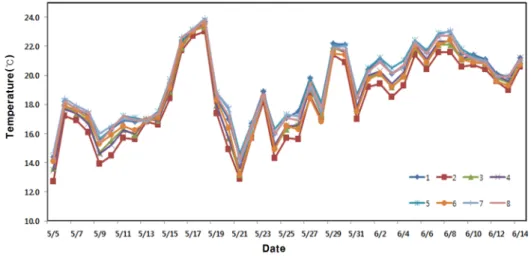
1. 천연배지 조성에 따른 근권 환경명월초 정식 후 천연배지 조성에 따른 5월~6월 중순까지의 근권 최저온도는 Fig. 1과 같 다. 조사 기간 동안 코코피트가 포함된 배지의 최저온도가 다른 배지에 비해 높은 경향을 나타내었다. 상대적으로, 펄라이트가 포함된 배지의 최저온도가 다른 배지에 비해 낮은 경 향을 나타내었으며, 펄라이트를 단독으로 사용한 배지의 최저온도가 가장 낮게 나타났다.
혼합배지를 제외한 단용 배지별 최저온도는 코코피트 배지가 가장 높게 나타났으며, 그 다 음이 버미큘라이트 배지, 펄라이트 배지가 가장 낮은 최저온도를 나타내었다.
Fig. 1. Minimum temperature of rhizosphere by type of natural media.
* 1. Cocopeat, 2. Perlite, 3. Vermiculite, 4. Vermiculite : Perlite(1:1), 5. Cocopeat : Vermiculite : Perlite(2:1:1), 6. Cocopeat : Perlite(1:1), 7. Cocopeat : Perlite(2:1), 8. Cocopeat : Perlite(4:1)
2. 명월초 재배전․후의 천연배지별 화학성
명월초 재배 전과 후의 천연배지 조성에 따른 화학성은 Table 2와 같다. 명월초 재배전 천연배지별 pH는 6.4~8.7로 버미큘라이트 > 코코피트 > 펄라이트 순 나타났으며, 혼합배지 의 pH는 7.0~7.7로 나타났다. 일반적으로 육묘용 배지의 적정수준(Wilson, 1986)으로 제시되 고 있는 pH 5.0~6.5 보다 높은 경향을 나타내었다. 특히 버미큘라이트 단독배지는 pH가 8.7 로 가장 높게 나타났다. EC는 0.1~0.9 ds m-1로 나타났으며, 코코피트 배지가 가장 높게 나
타났다. 유기물은 0.9~578.9 g kg-1 범위로 코코피트는 유기물함량이 높게 나타났으며, 버미 큘라이트와 펄라이트는 유기물함량이 낮게 나타났다. 유효인산은 0.1~15.6 mg kg-1 범위로 코코피트는 유효인산 함량이 높게 나타났으며, 버미큘라이트와 펄라이트는 유효인산 함량 이 낮게 나타났다. 양이온 치환용량은 K 0.1~1.6 cmol kg-1, Ca 1.2~5.9 cmol kg-1, Mg 0.0~
1.7 cmol kg-1, Na 0.2~1.7 cmol kg-1로 나타났다. 명월초 재배후의 천연배지별 pH는 6.2~8.3 으로 배지조성별로 재배 전에 비해 낮아지는 경향을 나타내었으며, EC는 1.1~4.8로 재배 전 배지에 비해 높아지는 경향을 나타내었으며, 버미큘라이트 배지에서 가장 높은 수치를 나 타내었다. 명월초 재배후의 유기물 함량은 10.7~594.6 g kg-1 범위로 코코피트 : 펄라이트 (2:1) 혼합배지를 제외한 나머지 처리 모두에서 재배 전에 비해 다소 증가하는 경향을 나타
Treatment
ZpH (1:5)
EC
y(ds m
-1)
OM
x(g kg
-1)
P
2O
5(mg kg
-1)
Ex. cations (cmol kg
-1)
K Ca Mg Na
Before
1 7.0 c 0.9 a 578.9 a 15.6 a 0.1 c 5.9 a 1.1 b 0.4 cd
2 6.4 d 0.1 c 0.9 d 0.9 d 0.1 c 3.1 b 1.2 b 0.3 de
3 8.7 a 0.2 c 1.2 d 0.1 d 1.4 b 1.2 c 1.6 a 1.4 b
4 7.7 b 0.1 c 1.6 d 0.9 d 1.6 a 1.2 c 1.7 a 1.7 a
5 7.1 c 0.5 b 260.3 c 3.7 c 1.3 b 1.2 c 0.0 c 1.4 b
6 7.2 c 0.7 b 238.1 c 7.3 b 0.1 c 5.9 a 1.2 b 0.4 cd
7 7.0 c 0.9 a 407.6 b 13.7 a 0.1 c 5.8 a 1.2 b 0.5 c
8 7.1 c 0.7 b 372.0 b 8.2 b 0.1 c 5.9 a 1.1 b 0.2 e
After
1 6.5 d 1.7 de 594.6 a 1.8 e 0.3 de 4.5 c 0.6 d 10.3 c 2 6.8 c 1.5 ef 14.0 e 0.9 f 0.5 cd 8.1 a 1.5 ab 19.1 a
3 8.3 a 4.8 a 10.7 e 7.3 b 0.7 c 1.8 d 1.6 a 3.0 d
4 7.1 b 2.4 c 12.2 e 4.6 c 1.3 b 1.1 d 0.3 d 1.3 e
5 6.2 e 3.4 b 367.2 c 8.2 a 0.2 e 1.1 d 1.7 a 2.4 d
6 6.6 c 1.1 f 374.5 c 3.7 c 2.2 a 1.7 d 1.2 bc 1.3 e 7 6.4 de 2.5 c 297.6 d 4.6 c 0.5 c 8.8 a 1.0 c 16.1 b 8 6.2 e 2.0 d 459.3 b 2.7 d 0.3 de 5.7 b 1.9 a 10.6 c
z1. Cocopeat, 2. Perlite, 3. Vermiculite, 4. Vermiculite : Perlite (1:1), 5. Cocopeat : Vermiculite : Perlite (2:1:1), 6. Cocopeat : Perlite (1:1), 7. Cocopeat : Perlite (2:1), 8. Cocopeat : Perlite (4:1)
yEC = Electrical conductivity
xOM = Organic matter
Table 2. Chemical properties of natural media in before and after cultivation of Gynura procumbens
내었다. 양이온 치환용량은 K, Ca, Mg는 재배전과 유사한 경향을 나타내었으며, Na는 버미 큘라이트 : 펄라이트(1:1) 혼합배지를 제외한 나머지 처리 모두에서 재배 전에 비해 증가하 는 경향을 나타내었다.
3. 천연배지 조성에 따른 명월초 생육특성
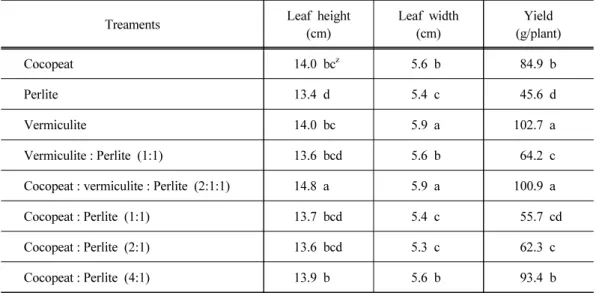
명월초 정식 후 50일의 천연배지 조성에 따른 초기 생육특성은 Table 3과 같다. 초장, 엽 수, 엽장, 엽폭은 버미큘라이트 배지에서 가장 우수하게 나타났으며, 경경은 버미큘라이트 배지와 코코피트 : 펄라이트(4:1) 혼합배지가 가장 우수하게 나타났다. 펄라이트 배지는 초 장, 엽수, 엽폭이 가장 작게 조사되었다. 천연배지 조성별 명월초의 상품성 및 수량은 Table 4와 같다. 엽장은 코코피트 : 버미큘라이트 : 펄라이트(2:1:1) 혼합배지가 가장 우수하게 나타 났으며, 엽폭은 버미큘라이트 배지와 코코피트 : 버미큘라이트 : 펄라이트(2:1:1) 혼합배지가 가장 우수하게 나타났다. 수확량도 버미큘라이트 배지와 코코피트 : 버미큘라이트 : 펄라이 트(2:1:1) 혼합배지가 가장 우수하게 나타났다.
Treaments
ZPlant height (cm)
Stem diameter (mm)
Number of leaf (ea)
Leaf height (cm)
Leaf width (cm)
1 14.3 cd
y6.0 b 13.1 bc 10.1 b 4.7 bc
2 11.2 e 5.1 cd 12.5 cd 8.4 c 3.9 d
3 17.0 a 6.2 ab 15.5 a 12.0 a 5.6 a
4 14.2 cd 5.4 c 13.5 bc 10.0 b 4.8 bc
5 15.4 bc 5.9 b 14.1 b 10.7 b 5.0 b
6 12.0 e 4.5 e 12.2 d 7.5 d 3.6 d
7 13.5 d 5.0 de 12.9 bc 8.5 c 3.6 d
8 15.7 b 6.5 a 13.7 b 10.2 b 4.6 c
Z1. Cocopeat, 2. Perlite, 3. Vermiculite, 4. Vermiculite : Perlite (1:1),
5. Cocopeat : Vermiculite : Perlite (2:1:1), 6. Cocopeat : Perlite (1:1),
7. Cocopeat : Perlite (2:1), 8. Cocopeat : Perlite (4:1)
yMean separation within columns by Duncan’s multiple range test at P = 0.05
Table 3. Early growth of Gynura procumbens by natural media types
Table 4. Quality and quantity of Gynura procumbens by natural media types
Treaments Leaf height
(cm)
Leaf width (cm)
Yield (g/plant)
Cocopeat 14.0 bc
z5.6 b 84.9 b
Perlite 13.4 d 5.4 c 45.6 d
Vermiculite 14.0 bc 5.9 a 102.7 a
Vermiculite : Perlite (1:1) 13.6 bcd 5.6 b 64.2 c
Cocopeat : vermiculite : Perlite (2:1:1) 14.8 a 5.9 a 100.9 a
Cocopeat : Perlite (1:1) 13.7 bcd 5.4 c 55.7 cd
Cocopeat : Perlite (2:1) 13.6 bcd 5.3 c 62.3 c
Cocopeat : Perlite (4:1) 13.9 b 5.6 b 93.4 b
ZMean separation within columns by Duncan’s multiple range test at P = 0.05
4. 천연배지 조성에 따른 명월초 항산화 활성
1) 총 폴리페놀(Total polyphenol compounds) 함량
명월초 항산화활성 측정을 위해 생 엽을 분리한 후 처리 당 평균 797.3 g으로 시험을 실 시하여 -20℃에서 동결건조하였다. 엽 건조중량은 72.6 g으로 건조율은 9.1%로써 실험에 사 용된 명월초의 수분함량은 평균 90.9%이었으며, 엽 내 에탄올추출액의 수율은 17.2%이었다.
명월초 천연배지 조성에 따른 명월초의 총 폴리페놀함량은 Fig. 2와 같다. 총 폴리페놀의 함량은 버미큘라이트 배지에서 1.45 mg g-1으로 가장 높게 나타났으며, 코코피트 : 펄라이트 (4:1) 혼합배지에서 0.18 mg g-1로 가장 낮게 나타났다. 총 폴리페놀은 식물에 널리 분포하 는 다양한 화합물그룹으로 간단한 저분자로는 phenolic acid, ployphenol, phenylpropanoid, flavonoid들이 있으며, 고분자로는 lignin, melanin, tannin들이 있다. 이들은 항산화효과 뿐만 아니라 항박테리아, 항염, 항알러지, 항균 등 다양한 생리활성을 나타낸다. 식물계에 널리 분포되어 있는 페놀계 화합물은 식물의 2차 대사산물의 하나로서 다양한 구조와 분자량을 가지며, phenolic hydroxyl기를 가지고 있기 때문에 단백질 등의 거대분자들과 결합하는 성 질이 있어 항산화, 항균활성 등과 같은 여러 생리기능을 가진다고 보고되어 있다(Choi et al., 2003).
Fig. 2. Phenolic compounds of Gynura procumbens by natural media types.
* 1. Cocopeat, 2. Perlite, 3. Vermiculite, 4. Vermiculite : Perlite(1:1), 5. Cocopeat : Vermiculite : Perlite (2:1:1), 6. Cocopeat : Perlite (1:1), 7. Cocopeat : Perlite (2:1), 8. Cocopeat:Perlite (4:1)
* DW = Dry weight
2) ABTS radical 및 DPPH radical 소거기능
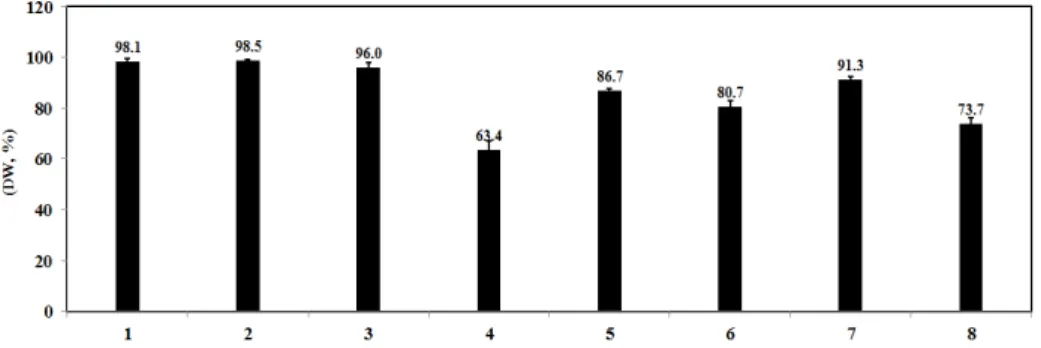
천연배지 조성에 따른 명월초의 ABTS 소거기능은 Fig. 3과 같다. 시료농도 2.5%에서 펄 라이트 배지가 98.5%, 코코피트 배지가 98.1%, 버미큘라이트 배지가 96.0% 로 나타났으며, 버미큘라이트 : 펄라이트(1:1) 혼합배지가 63.4%로 가장 낮게 나타났다. 전자공여능의 DPPH 소거기능을 살펴본 결과 Fig. 4에서 보여 지는 것과 같이 시료농도 2.5%에서 펄라이트 배지 가 79.8%, 버미큘라이트 배지가 77.5%, 코코피트 배지가 69.1%로 나타났으며, 버미큘라이 트 : 펄라이트(1:1) 혼합배지가 17.5%로 가장 낮게 나타났다.
Fig. 3. ABTS radical scavenging activity of Gynura procumbens by natural media types.
* 1. Cocopeat, 2. Perlite, 3. Vermiculite, 4. Vermiculite : Perlite (1:1), 5. Cocopeat : Vermiculite : Perlite (2:1:1), 6. Cocopeat : Perlite (1:1), 7. Cocopeat : Perlite (2:1), 8. Cocopeat : Perlite (4:1)
* DW = Dry weight
Fig. 4. DPPH radical scavenging activity of Gynura procumbens by natural media types.
* 1. Cocopeat, 2. Perlite, 3. Vermiculite, 4. Vermiculite : Perlite (1:1), 5. Cocopeat : Vermiculite : Perlite (2:1:1), 6. Cocopeat:Perlite (1:1), 7. Cocopeat : Perlite (2:1), 8. Cocopeat : Perlite (4:1)
* DW = Dry weight
Ⅳ. 적 요
본 연구는 2018년 충북 괴산군 유기농업연구소에서 노지재배의 단점을 보완할 수 있는 수경재배 기술의 일환으로 명월초 유기 수경재배 시 천연배지 종류가 생육에 미치는 영향 을 조사하여 최적의 천연배지를 선발하고자 수행하였다. 실험에 사용한 유기양액은 생육증 진용 유기농자재로 등록된 시판자재 34종을 성분 분석한 후 2종을 혼합하여 사용하였으며, pH 5.5~6.5, EC 0.5~1.0 ds/m로 5월 20일부터 1일 1회, 회 당 50 L씩 점적관수(Ø13 ㎜, Nam Kyung Co.)를 이용하여 처리하였다. 명월초 정식 후 5월~6월 중순까지 배지별 근권의 최저 온도는 코코피트가 포함된 배지의 최저온도가 다른 배지에 비해 높은 경향을 나타내었으 며, 상대적으로 펄라이트가 포함된 배지의 최저온도가 다른 배지에 비해 낮은 경향을 나타 내었다. 혼합배지를 제외한 단용 배지별 최저온도는 코코피트 배지가 가장 높게 나타났으 며, 그 다음이 버미큘라이트 배지, 펄라이트 배지가 가장 낮게 나타났다. 명월초 정식 후 50 일의 천연배지 조성에 따른 초기 생육특성(초장, 엽수, 엽장, 엽폭)은 버미큘라이트 배지에 서 가장 우수하게 나타났다. 천연배지 조성별 명월초 수량은 버미큘라이트 배지와 코코피 트 : 버미큘라이트 : 펄라이트(2:1:1) 혼합배지가 가장 우수하게 나타났다. 주요 항산화 성분 인 총 폴리페놀의 함량은 버미큘라이트 배지에서 1.45 mg g-1으로 가장 높게 나타났다. 따 라서, 천연배지 조성에 따른 명월초 생육, 수량 및 총 폴리페놀 함량 등을 비교했을 때 버 미큘라이트 단용 배지가 유기 수경재배 시 천연배지로 적합할 것으로 판단된다.
[Submitted, April. 8, 2019 ; Revised, August. 6, 2019 ; Accepted, August. 15, 2019]
참 고 문 헌
1. AOAC. Official Methods of Analysis. 1995. 14th ed. Association of Official Analytical Chemists, Washington DC. 8-35.
2. Bondet, V., W. Brand Williams, and C. Berset. 1997. Kinetics and mechanisms of antioxi- dant activity using the DPPH free radical method. Lebensm. Wiss. U-Technol. 30: 609-615.
3. Choi, Y. M., M. H. Kim, J. J. Shin, J. M. Pack, and J. S. Lee. 2003. The antioxidant activities of the some commercal teas. J. Kor. Soc. Food Sci. Nutr. 32: 723-727.
4. Jeon, H. J. and H. J. Kwon. 2014. Antioxidant effects and functional evaluation of Gynura Procumbens. extract as collaboration material for cosmetics and functional food. Kor. J.
Aesthet. Cosmetol. 12(4): 499-507.
5. Kamalakkannan, N. and P. Stanely Mainzen Prince. 2006. Rutin improves the antioxidant status in streptozotocin-induced diabetic rat tissues. Mol. Cell. Biochem. 293: 211-219.
6. Kim, H. Y., Y. K. Park, T. S. Kim, and M. Kang. H. 2003. The effects of green vegetable juice (Angelica keiskei) supplementation on plasma lipids and antioxidant status in smokers.
Korean J. Nutr. 36: 933-941.
7. Kim, H. G., J. Y. Cho, S. O. Yu, S. Y. Yang, J. G. Kang, and B. G. Heo. 2007. Effect of the mixing ratio of the different substrates and the concentration of fertigation in nutrient solution on the growth of tomato plug seedlings. J. Bio-Env. con. 16(2): 108-114.
8. Kwon, H. J., J. K. Min, and H. J. Jeon. 2015. Evaluations of anti-melanogenesis activity and the moisturizing effect of Gynura Procumbens. Kor. J. Aesthet. Cosmetol. 13(5): 637-644.
9. Perry, L. M. 1980. Medicinal Plants of East and Southeast Asia: Attributed Properties and Uses. The MIT Press.
10. [RDA] Rural Development Administration. 2012. Standard research and analysis of agricul- tural science. 1-1136.
11. Rosidah. M. Yam, A. Sadikun, and M. Asmawi. 2008. Antioxidant potential of Gynura Procumbens. Pharm. Biol. 46: 616-625
12. Van den Berg, R., G. R. Haenen, H. Van den Berg, and A. Bast. 1999. Applicability of an improved Trolox equivalent antioxidant capacity (TEAC) assay for evaluation of antioxidant capacity measurements of mixtures. Food Chem. 66: 511-517.
13. Wiart C. 2001. Medicinal plants of southeast asia. Pelanduk Pubns Sdn Bhd.
14. Wilson, G. C. S. 1986. Analysis of substrate. Acta Horticulturae 178 : 155-160.
15. Yu, S. O. and J. H. Bae. 2005. Development of Optimal Nutrient Solution of Tomato (Lycoper- cicon esculentum Mill.) in a Closed Soilless Culture System. J. Bio-Env. con. 14(3): 203-211.