• 검색 결과가 없습니다.

Impacts of Cropping Systems on the Distribution of Soil Microorganisms in Mid-mountainous Paddy

N/A
N/A
Protected

Academic year: 2021

Share "Impacts of Cropping Systems on the Distribution of Soil Microorganisms in Mid-mountainous Paddy"

Copied!
9
0
0

로드 중.... (전체 텍스트 보기)

전체 글

(1)

Impacts of Cropping Systems on the Distribution of Soil Microorganisms in Mid-mountainous Paddy

Ui-Gum Kang*, Woon-Chul Shin, Jong-Seo Choi, Yong-Bok Lee

1

, and Young-Han Lee

2

National Institute of Crop Science, RDA, Wanju 55365, Korea

1

Agricultural and Life Science, Gyeongsang National University, Jinju 52828, Korea

2

Gyeongsangnam-do Agricultural Research and Extension Services, Jinju 52733, Korea

(Received: August 5 2016, Revised: September 2 2016, Accepted: October 11 2016)

Soil microbes are widely well known to play an important role for sustainable agriculture in terms of crop healthy cultivation and environmental conservation. In this context, the distributional characteristics of soil microbes according to cropping systems were investigated under rice (R)-rice (R), rice (R)-barley (B)-rice (R), and soybean (S)-barley (B)-soybean (S) cropping condition to get basic informations for sustainable agriculture, where barley was grown for winter, in mid-mountainous loam paddy located at the altitude of 285 m above sea level in Sangju area from 2014 to 2015. Estimating from microbial communities by fatty acid methyl ester (FAME) method, a total biomass of bacteria, actinomycetes, and fungi in R-B-R plot was 37% and 40% higher than that in S-B-S and R-R plots, respectively (p < 0.05). In especial, bacteria and fungi were more in R-B-R plot than those in any other ones. B. japonicum, AMF, and mesophilic Bacillus sp. were also greater in S-B-S plot than those. In the community distribution, however, bacteria and actinomycetes showed comparatively high values in S-B-S plot relative to either R-R or R-B-R plot including rice, in which fungi outstanding. In the correlation between microbial biomass and soil properties changed by the cropping, bacteria was positively correlated with C:N ratio; actinomycetes with exchangeable Ca; fungi with available P

2

O

5

(p < 0.05). While these microbes showed negative response to water stable aggregates of soil.

Key words: Microbial distribution, Cropping system, Rice, Soybean, Barley

Microbial biomass, on the basis of fatty acid contents, as affected by cropping systems in mid-mountainous paddy soils from 2014 to 2015

.

Cropping records T-FA Bact. G(-) G(+) Acti. Fun. AMF G(-)/G(+) F/B

--- nmol g

-1

---

Rice 352

d‡

194

d

162

d

50

e

17

d

31

c

5

e

3.2 0.16

Soybean 271

e

142

e

111

e

41

f

16

d

26

d

7

d

2.7 0.18

Rice-Barley 395

c

225

c

186

c

61

c

16

d

40

b

8

d

3.1 0.18

Soybean-Barley 347

d

206

cd

177

cd

56

d

15

d

24

d

11

c

3.2 0.12

Rice-Rice 489

b

280

b

222

b

80

b

25

c

32

c

8

d

2.8 0.11

R-Barley-R 668

a

377

a

301

a

107

a

33

a

49

a

17

b

2.8 0.13

S-Barley-S 476

b

296

b

224

b

78

b

27

b

30

c

27

a

2.9 0.10

T-FA, total fatty acid from FAME; Bact., total bacteria; G(-), gram-negative bacteria; G(+), gram-positive bacteria;

Act., actinomycetes; Fun., fungi; AMF, arbuscular mycorrhizal fungi; R, Rice; S, Soybean.

Numbers followed by the same letter within a column are not significantly different (Duncan test, p < 0.05).

z1)

*Corresponding author: Phone: +82545345249, Fax: +82545347773, E-mail: [email protected]

§

Acknowledgement: This research was supported by Rural Development Administration (Project No. PJ010164032015), Republic of Korea.

(2)

Introduction

고대로부터 시작된 윤작은 토양의 비옥도를 높이고 병해 충과 잡초의 발생을 줄이기 위한 수단으로서 저투입 농업기 술의 하나로 간주 된다 (Kang, 2007; Leteinturier et al., 2006; White, 1970). 그러나 산업의 발달과 함께 화학비료와 합성농약을 이용한 농업의 생산성이 ‘녹색혁명’이라는 이름 으로 크게 향상된 이후, 단순한 윤작중심의 농업방식은 전근 대적인 농업기술로 인식되는 경향이다 (Klinkenborg, 2012).

그렇지만 화학비료와 합성농약에 의존한 대량생산 위주의 농업은 환경오염을 가중시키고 농산물의 안전성을 위협하고 있어, 그 해결책으로 토양의 건전성 (Parr et al., 1992) 관리 를 기본으로 하는 작부체계 중심의 지속가능한 저투입형 농 업으로의 방향전환이 모색되고 있다 (Dias et al., 2014; Wang et al., 2010). 이러한 작부체계를 통한 토양의 건전성 관리는 곧 토양 내 양분의 유효화와 물리성의 개선, 병해 경감 등의 직‧간접작용으로 작물의 성장을 돕는 유용미생물 관리로 집 약될 수 있다 (Beare et al., 1995; Dias et al., 2014; Ellouze et al., 2014; van der Heijden et al., 1998). 그리고 경작지 미생물의 분포와 활동은 재배작물 (Baon et al., 1993; Kim and Lee, 1992; Nelson et al., 2008)을 비롯한 경지이용형태 (He et al., 2012; Kang et al., 1997), 유기물 및 비료의 사용 정도 (Lee et al., 2006; Muthukumarasamy et al., 2007)와 이에 따른 토양의 물리화학적 특성 (Gupta and Germida, 1988; Lee et al., 2011; Lee and Ha, 2011) 등에 따라 변화무 쌍한 것으로 알려져 있다. 이렇게 볼 때, 우리나라 식량증산 과 지속가능한 농업생산의 한 방안으로 알려진 논 작부 다양 화 (Kim et al., 2015)는 단순한 경지이용률의 향상 못지않게 토양미생물의 다양한 농업적 역할을 기대할 수 있는 방향으 로 추진되어야 할 것이다.

이러한 측면에서 본 연구에서는 여름이 짧은 중산간지에 서의 논농업 발전을 위한 토양관리의 기초자료를 얻고자, 논 토양에서 벼, 콩과 겨울작물인 보리를 이용한 이모작 작부처 리가 토양미생물의 분포에 미치는 영향을 분석하였다.

Materials and Methods

시험지 개황 시험지는 해발 285 m의 경북 상주시 화서 면에 자리한 국립식량과학원 상주출장소 논토양으로서, 오 래 전에 석회암지대의 흙이 유입된 까닭에 칼슘함량이 일반 농경지보다 배량 가까이 높았다. 시험은 배수가 잘 안 되는 논흙을 2014년 3월에 5 cm 높이로 객토한 뒤 2015년까지 2년 동안 벼-벼, 벼-보리-벼, 콩-보리-콩 작부형태로 해당 작 물을 18 m × 15 m 크기의 시험구에 단구제로 재배하였다. 재 배작물은 수확한 뒤 볏짚만 해당 시험구에 되돌려 넣었고 콩 대와 보릿짚은 모두 시험구 밖으로 들어내었다. 시험토양의

토성은 양토였으며, 시험 전 토양의 pH (1:5)는 7.1, 유기물 함량은 26 g kg

-1

이었다. 시험기간의 기온은 2014년의 경우 평균 11.0℃로써 월평균 –3.9℃ (12월)~23.6℃ (7월)의 분포 를 보였고, 2015년은 평균 11.5℃로 월평균 –2.0℃ (1월)~

23.7℃ (8월) 범위로 분포하였다. 그리고 강우량은 2014년에 총 934.5 mm로써 5.0 (2월)~213 mm (8월)의 분포를, 2015년 은 총 663.0 mm로 0.0 mm (11월)∼146.5 mm (10월)의 분포 를 각각 보였다.

재배품종 및 시비 재배된 벼 품종은 조생종 ‘설레미’, 콩은 올콩인 ‘참올’, 보리는 사료용 ‘유호’였다. 2014년도 벼 이앙은 6월 10일에 하였고 콩 파종은 6월 13일에 하였다. 뒷 그루작물인 보리는 10월 10일에 파종하였다. 2015년도에는 벼 이앙과 콩 파종을 모두 6월 10일에 하였고 보리 파종은 10 월 7일에 하였다. 작물재배를 위한 시비는 농촌진흥청 국립 식량과학원 표준재배법에 (NICS, 2010) 준했는데, 질소 (N)- 인산 (P

2

O

5

)-칼리 (K

2

O)의 시비량은 벼의 경우 각각 9-4.5-5.7 kg 10a

-1

, 콩은 3-3-3.4 kg 10a

-1

, 보리는 11.8-7.4-7.4 kg 10a

-1

을 기준으로 하여서 토양진단 시비하였다. 다만 벼-보 리-벼 작부의 보리 재배구는 파종직전에 퇴비를 10a 당 1톤 시용하였다.

토양 물리화학성 분석 토양의 물리화학성 분석용 시

료는 시험1년차 여름작물인 벼, 콩 재배지, 겨울작물인 보리 재배지 (1년차 작부 기준으로 벼-보리, 콩-보리), 그리고 2 년차의 여름작물인 벼, 콩 재배지 (1, 2년차 작부 기준으로 벼 -벼, 벼-보리-벼, 콩-보리-콩)의 15 cm 깊이 표토를 사용 하였다. 시료채취는 벼와 콩 재배지의 경우는 작물을 수확한 뒤에 각 3반복으로 채취하였고 보리 재배지는 수확 10일 전 에 3반복으로 채취하였다. 채취한 시료는 농촌진흥청 국립식 량과학원 식량작물환경 분석법 핸드북 (NICS, 2014)에 준하 여 조제한 뒤 분석에 사용하였다.

토양 미생물 분석 및 Bradyrhizobium japonicum의

질소고정 잠재능 평가 미생물 분석용 토양시료는 물리

화학성 분석을 위한 토양시료를 채취할 때 같이 채취하여 사

용하였다. 먼저 미생물의 군집구조 분석은 냉동보관한 토양

시료를 Fatty acid methyl ester (FAME)법으로 실시하였는

데 (Lee et al., 2011; Schutter and Dick, 2000), 토양 미생물

의 세포벽 지방산을 Fatty acid methyl ester (FAME)법으로

추출한 다음, 이들 지방산을 표준지방산인 internal standard

19:0을 이용해서 GC Aiilent 6890N (Agilent Technilogies,

USA)과 HP-ULTRA 2 capillary column (25 mm × 0.2 mm ×

0.33 μ m film thickness, Agilent Technologies, USA)으로

분석하였다. 이렇게 분석한 지방산은 MIDI software program

package (MIDI, Inc., Newark, DE)를 이용하여 총 세균과

(3)

Table 1. Microbial biomass, on the basis of fatty acid contents, as affected by cropping systems in mid-mountainous paddy soils

.

Cropping records T-FA Bact. G(-) G(+) Acti. Fun. AMF G(-)/G(+) F/B

--- nmol g

-1

---

Rice 352

d‡

194

d

162

d

50

e

17

d

31

c

5

e

3.2 0.16

Soybean 271

e

142

e

111

e

41

f

16

d

26

d

7

d

2.7 0.18

Rice-Barley 395

c

225

c

186

c

61

c

16

d

40

b

8

d

3.1 0.18

Soybean-Barley 347

d

206

cd

177

cd

56

d

15

d

24

d

11

c

3.2 0.12

Rice-Rice 489

b

280

b

222

b

80

b

25

c

32

c

8

d

2.8 0.11

R-Barley-R 668

a

377

a

301

a

107

a

33

a

49

a

17

b

2.8 0.13

S-Barley-S 476

b

296

b

224

b

78

b

27

b

30

c

27

a

2.9 0.10

T-FA, total fatty acid from FAME ; Bact., total bacteria; G(-), gram-negative bacteria; G(+), gram-positive bacteria; Act., actinomycetes; Fun., fungi; AMF, arbuscular mycorrhizal fungi; R, Rice; S, Soybean.

Numbers followed by the same letter within a column are not significantly different (Duncan test, p < 0.05).

Gram음성 세균, Gram양성 세균, 방선균, 사상균, 균근균 (Arbuscular mycorrhizal fungi, AMF) 각각의 군집으로 분 류하였으며 (Frostegard et al., 1993; Hamel et al., 2006;

Zelles, 1999), 이를 근거로 미생물의 군집별 지방산함량을 미생물의 군집량으로 간주하고 전체 미생물의 지방산, 즉 총 FAME 함량에 대한 특정 미생물 군집의 지방산 비율을 군집 분포비율로 정리하였다. 그리고 세균 가운데 식물의 성장을 촉진시키는 것으로 알려진 중온성 Bacillus sp.와 형광성 Pseudomonas sp.의 (Kang et al., 2006) 서식밀도는 토양 시료를 냉장보관하면서 전자는 YG배지를, 후자는 형광성 Pseudomonas 전용배지 (KH

2

PO

4

1.0 g, MgSO

4

‧ 7H

2

O 0.5 g, KCl 0.2 g, NaNO

3

5.0 g, Deoxycholic acid ‧ Na 1.0 g, Betaine 5.0 g, 한천 15.0 g, 증류수 1000 ml, pH 7.2~7.4)를 사용하 여 분석하였다 (RDA, 2010). 콩뿌리에서 공중질소를 고정하 는 근류균 Bradyrhizobium japonicum의 서식밀도는 Kang et al. (1991)의 방법에 따라 무균상태에서 발아시킨 ‘참올’콩 의 유묘를 무질소양액을 담은 ‘growth pouch’에 1주씩 치상 한 다음, 토양시료를 멸균증류수로 10배부터 10

6

배까지 희석 한 토양현탁액을 1 ml씩 4반복으로 접종하여 4주간 재배한 후 뿌리혹이 형성된 ‘growth pouch’의 개수로서 최확치법으 로 조사하였다 (Vincent, 1970). 한편 B. japonicum의 질소고 정 잠재능 분석은 Kang et al. (1991)의 방법에 준했는데, 먼 저 질석을 충진한 1 L 들이 광구병에 무균상태로 발아시킨

‘참올’콩 유묘 2주를 치상한 다음 멸균증류수로 10배 희석한 토양현탁액을 1 ml씩 4반복으로 접종하여서 무질소양액으로 6주간 재배한 후 지상부를 수확하였다. 수확한 콩 지상부는 말려서 건물무게를 잰 후 토양현탁액 대신 멸균증류수만 접 종해서 무질소양액으로 재배한 콩의 지상부 건물무게를 뺀 값을 토양현탁액 형태로 접종된 콩 근류균의 질소고정 잠재 능으로 간주해서 작부처리 간에 비교평가하였다.

통계분석 SAS 프로그램 9.1.3 버전 (2006)으로 작부처 리구 성적의 상관분석과 분산분석 그리고 다변량 주성분 분

석을 하였다. 단, 주성분 분석에 이용된 토양미생물의 군집 성적은 총 FAME량에 대한 특정 미생물 군집의 지방산 함량 비율 (%) 값으로 하였다.

Results

토양 내 미생물 군집량 중산간지 논에서 2년간 작부

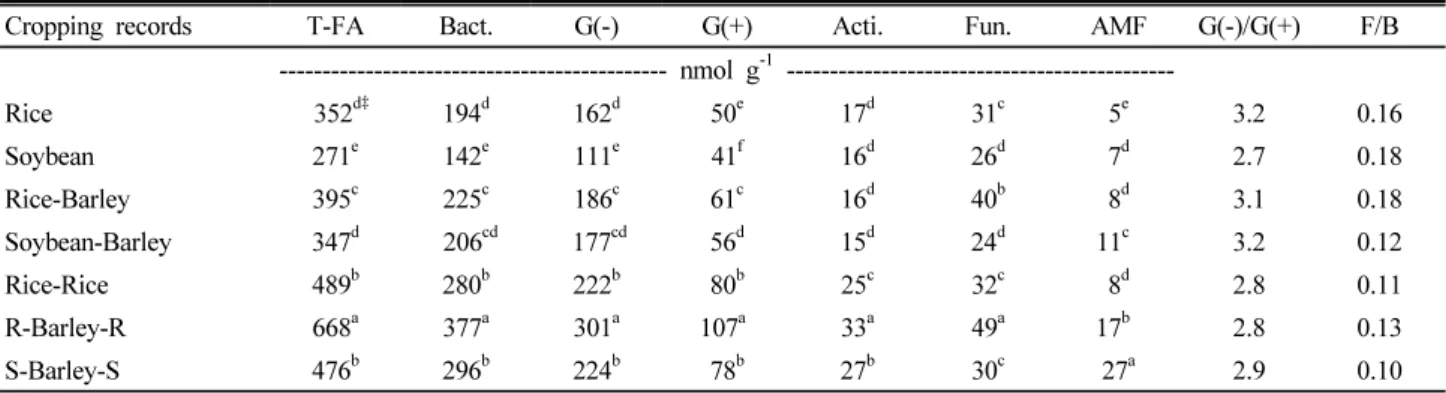
를 달리했을 때 토양의 미생물 군집량을 지방산 조성에 근거 하여 분석한 결과는 Table 1과 같았다. FAME profile을 분석 한 결과, 총 FAME 함량과 총 세균, Gram음성 세균, Gram양 성 세균, 방선균, 사상균 군집의 량은 전체 시험구 중에서 시 험 2년차의 벼-보리-벼 재배지에서 가장 높았다 (P < 0.05).

시험기간 총 FAME 함량은 1년차에는 271 nmol g

-1

(콩 재배 지)~352 nmol g

-1

(벼 재배지) 이었던 것이 겨울작물로 보리 를 재배한 뒤 347 nmol g

-1

(콩-보리)~395 nmol g

-1

(벼-보 리) 으로 증가하였고, 2년차 여름작물을 재배한 다음에는 476 nmol g

-1

(콩-보리-콩)~668 nmol g

-1

(벼-보리-벼) 까지 크 게 증가한 경향이었다. 특히 벼-보리-벼 재배지에서는 벼 연작지에 비해 37% 더 높았다 (P < 0.05). 이를 미생물의 군 집종류별로 보면, 총 세균과 사상균은 총 FAME 함량과 마찬 가지로 시험 1년차에 콩보다 벼 재배지에서 높았는데 보리를 재배한 이후에도 같은 경향으로 나타났다. 그러나 방선균은 벼, 콩, 벼-보리, 콩-보리 재배지 간에 유의적인 차이가 없 었지만 시험 2년차에는 벼-보리-벼 > 콩-보리-콩 > 벼-벼 재배지 순으로 높았다 (P < 0.05). 세균 중에서 근류균 B.

japonicum의 서식밀도는 (Table 3) 시험 1년차 벼 중심의 벼,

벼-보리 재배지보다 콩 중심의 콩, 콩-보리 재배지에서 50

배 이상 더 높았다. 중온성 Bacillus sp.의 밀도는 (Fig. 1) 시

험 1년차의 벼와 콩 재배지 간에 유의적인 차이가 없었지만

보리를 재배한 다음부터는 콩 중심의 콩-보리와 콩-보리-

콩 재배지가 벼 중심의 벼-벼 재배지나 벼-보리-벼 재배지

보다 유의적으로 높았다 (P < 0.05). 그러나 콩-보리 재배지

와 콩-보리-콩 재배지, 벼-벼 재배지, 벼-보리-벼 재배지

(4)

Fig. 1. The populations of Bacillus sp. and Pseudomonas sp. as affected by cropping systems in mid-mountainous paddy soils

.

R, Rice; S, Soybean; B, Barley.

Numbers followed by the same letter within a column are not significantly different (Duncan test, p < 0.05).

Table 2. Microbial communities as affected by cropping systems in mid-mountainous paddy soils

.

Cropping records Bact. G(-) G(+) Acti. Fun. AMF

--- % ---

Rice 55.1 46.0 14.2 4.8 8.8 1.4

Soybean 52.4 41.0 15.2 5.9 9.6 2.6

Rice-Barley 57.0 47.1 15.4 4.1 10.1 2.0

Soybean-Barley 59.4 51.0 16.1 4.3 6.9 3.2

Rice-Rice 57.3 45.4 16.4 5.1 6.5 1.6

R-Barley-R 56.4 45.1 16.0 4.9 7.3 2.5

S-Barley-S 62.2 47.1 16.4 5.7 6.3 5.7

See footnotes to Table 1.

간에는 모두 유의성이 없었다. Pseudomonas sp.의 서식밀도 는 작부처리 간에 뚜렷한 경향이 없었다. 한편 Gram음성 세 균은 Gram양성 세균보다 3배가량 높으면서 작부처리별로는 총 세균과 같이 콩보다 벼 중심의 작부토양에서 더 높은 경향 이었다. 사상균 가운데 균근균 AMF는 B. japonicum의 서식 밀도와 마찬가지로 콩 중심의 작부 토양에 높았는데, 특히 보 리를 재배한 다음에 콩을 재배한 콩-보리-콩 재배지에서 벼- 보리-벼 재배지보다 1.6배가량 더 높게 나타났다 (Table 1).

토양미생물의 군집분포 비율 토양 미생물의 군집별

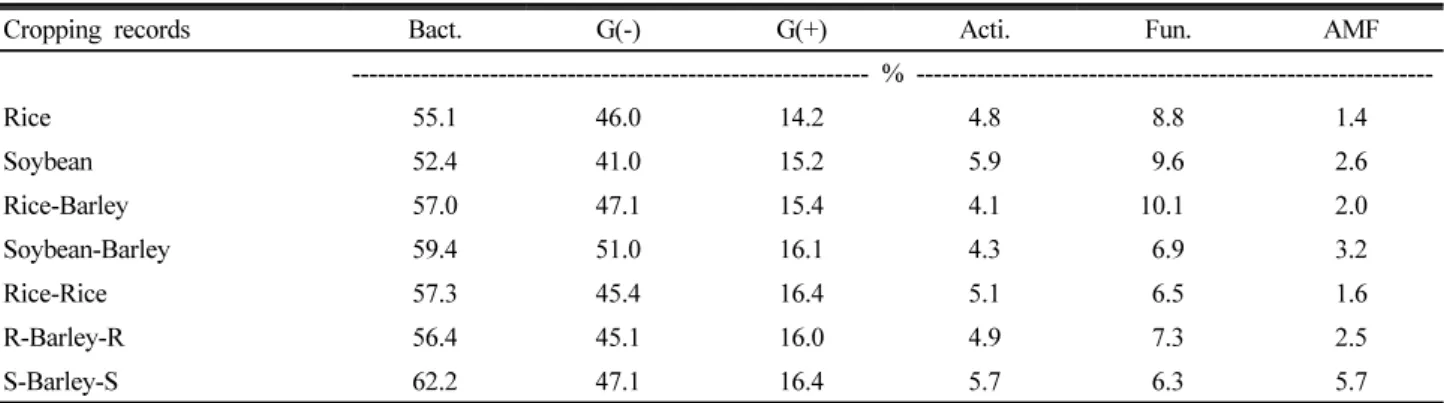
분포비율은 Table 2와 같았는데, 시험 1년차 여름작물 재배 토양에서는 총 세균과 Gram음성 세균만이 콩 재배지보다 벼 재배지에서 높은 군집비율을 보였고 방선균과 사상균은 이 와 반대로 콩 재배지에서 더 높았다. 이러한 세균의 군집비율 양상은 시험 1년차 겨울의 보리 재배와 2년차 여름작물 재배 를 거치면서 콩 중심의 콩-보리 (59.2%)와 콩-보리-콩 재배 지 (62.2%)가 벼 중심의 벼-보리와 벼-벼, 벼-보리-벼 재배 지에서보다 2% 이상 더 높은 것으로 바뀌었다. 이 같은 경향

은 Gram음성 세균과 Gram양성 세균, 방선균의 군집분포비 율에서도 마찬가지였다. 그러나 사상균 군집은 콩보다 벼가 들어간 작부토양에서 높게 나타났지만, 사상균에 속하는 균 근균 AMF는 콩이 들어간 작부토양에서 더 높았다. 특히 AMF 는 보리에 이어서 콩을 심은 콩-보리-콩 재배지에서 벼-보 리-벼 재배지보다 배 이상 높은 5.6%의 군집비율을 나타내 었다. 결과적으로 미생물의 군집은 2년간의 작부처리를 거치 면서 사상균의 군집비율만 콩보다 벼 중심의 작부에서 높게 나타났고 나머지 세균과 방선균 그리고 사상균의 일종인 AMF 의 군집비율은 콩 중심의 작부에서 더 높은 경향을 보였다.

Bradyrhizobium japonicum의 질소고정 잠재능 작

부시험 1년차에 벼, 콩의 재배에 이어서 겨울에 보리를 재배

했을 때, 토양 내 근류균 B. japonicum이 보여준 질소고정 잠

재능은 Table 3과 같았다. 접종제 토양에 함유된 B. japonicum

에 의한 ‘참올’콩의 건물생산량은 B. japonicum의 서식밀도

가 가장 높은 콩-보리 재배토양에서 가장 높았고 다음으로는

1년차 콩 재배토양에서 높았다 (P < 0.05).

(5)

Table 3. Symbiotic potentials of Bradyrhizobium japonicum populations in a 10-fold-diluted(10

-1

) whole soil inoculum as affected by cropping systems on G. max cv. Chamol

.

Cropping records No. of rhizobia Soybean shoot dry wt.

cells g plant

-1

Rice 0.6

d‡

1.9

ab

Soybean 17

b

2.3

ab

Rice-Barley 10

c

1.8

b

Soybean-Barley 580

a

2.5

a

Soybean plants were cultivated in jars contained with vermiculite for 6 weeks.

Numbers followed by the same letter within a column are not significantly different (Duncan test, p < 0.05)

Table 4. Soil chemical and physical properties as affected by cropping systems in mid-mountainous paddy soils

.

Cropping records pH O.M. C:N Av. P

2

O

5

Exch. Cations Bulk

density

Water stable aggregate

K Ca Mg

(1:5) g kg

-1

ratio mg kg

-1

--- cmol

c

kg

-1

--- g cm

-3

%

Rice 6.8

bc

25

a

7.4

d

99

c

0.9

ns

11.1

cd

3.1

bcd

1.34

bc

51.3

b

Soybean 7.1

ab

20

c

6.2

e

58

e

0.9

ns

11.4

bcd

3.2

abc

1.55

a

48.6

b

Rice-Barley 7.0

abc

27

a

9.2

c

134

a

1.0

ns

11.5

bcd

3.4

ab

1.13

d

50.8

b

Soybean-Barley 6.9

bc

21

bc

10.2

b

79

d

0.9

ns

10.4

d

3.0

cd

1.26

ab

56.7

a

Rice-Rice 6.7

c

24

ab

12.7

a

96

c

0.9

ns

11.9

bc

2.8

d

1.54

a

29.1

d

R-Barley-R 7.1

ab

21

bc

12.4

a

115

b

0.9

ns

12.4

b

2.9

cd

1.48

a

43.7

c

S-Barley-S 7.3

a

15

d

10.5

b

80

d

1.1

ns

13.5

a

3.5

a

1.42

ab

27.4

d

See footnotes to Table 1.

토양 화학성과 물리성 변화 처리에 따른 토양의 화

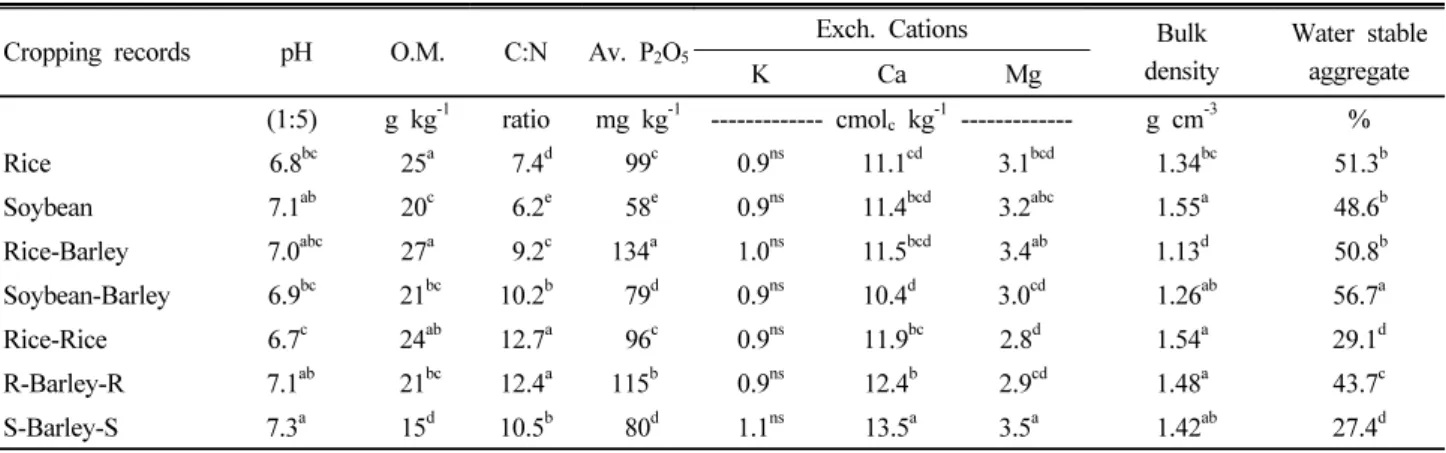
학성과 물리성은 Table 4와 같았다. pH는 벼-벼 처리구가 다 른 처리구보다 0.1~0.5 정도 낮았다. 유기물함량은 벼 중심 의 작부토양이 콩 중심의 작부토양보다 높았는데, 특히 보리 재배를 위해 퇴비를 넣은 벼-보리 재배지에서 가장 높은 27 g kg

-1

을 나타내었다. 반면에 콩-보리-콩 재배지에서는 가 장 낮은 15 g kg

-1

이었다. 토양의 C:N율은 여름작물 재배 1년 차에 7.4 (벼 재배지) 이하로 낮았던 것이 2년차에는 10.5 (콩- 보리-콩 재배지) 이상으로 높았다. 작부토양별로는 보리재 배 직후에만 콩-보리 재배지가 벼-보리 재배지보다 높은 C:N율을 보인 것을 제외하고는 벼 재배지가 콩 재배지보다 높았다 (P < 0.05). 유효인산 또한 유기물과 마찬가지로 콩보 다 벼 재배지에서, 콩-보리보다 벼-보리 재배지에서 그리고 콩-보리-콩보다 벼-보리-벼 재배지에서 각각 더 높았다.

치환성 칼슘, 마그네슘은 콩-보리-콩 재배지가 다른 처리토 양보다 높은 편이었다. 토양의 물리성에 있어서 용적밀도는 시험 1년차에만 콩 재배지가 벼 재배지보다 높았고, 시험 2년 차에 여름작물을 재배한 뒤에는 벼가 들어간 벼 중심의 작부 토양이 콩 중심의 작부토양보다 높은 편이었다. 그리고 토양 의 내수성 입단율은 시험 1년차에 벼와 콩 재배지 간에는 유

의적인 차이가 없었지만 겨울에 보리를 재배한 직후에는 콩- 보리 재배지가 벼-보리 재배지보다 유의적으로 높았고, 시 험 2년차 여름작물을 재배한 토양에서는 벼-보리-벼 재배지 가 벼-벼 재배지나 콩-보리-콩 재배지보다 더 높았다 (P <

0.05).

Discussion

일반적으로 토양 미생물의 군집형성에는 재배작물 (Germida and Siciliano, 2001; Kim and Lee. 1992; Kulmatiski and Beard, 2008), 토양수분 (Konopka and Turco, 1991; Sun et al., 2011), 토양이화학성 (He et al., 2012; Joa et al., 2012;

Kieft et al., 1995; Lee et al., 2011) 등이 복합적으로 영향을

끼치는 것으로 알려져 있는데, 본 시험 2년 동안의 벼-벼, 벼

-보리-벼, 콩-보리-콩 작부처리에서 나타난 토양미생물 군

집량에 (Table 1) 대한 토양화학성의 (Table 4) 영향을 보면,

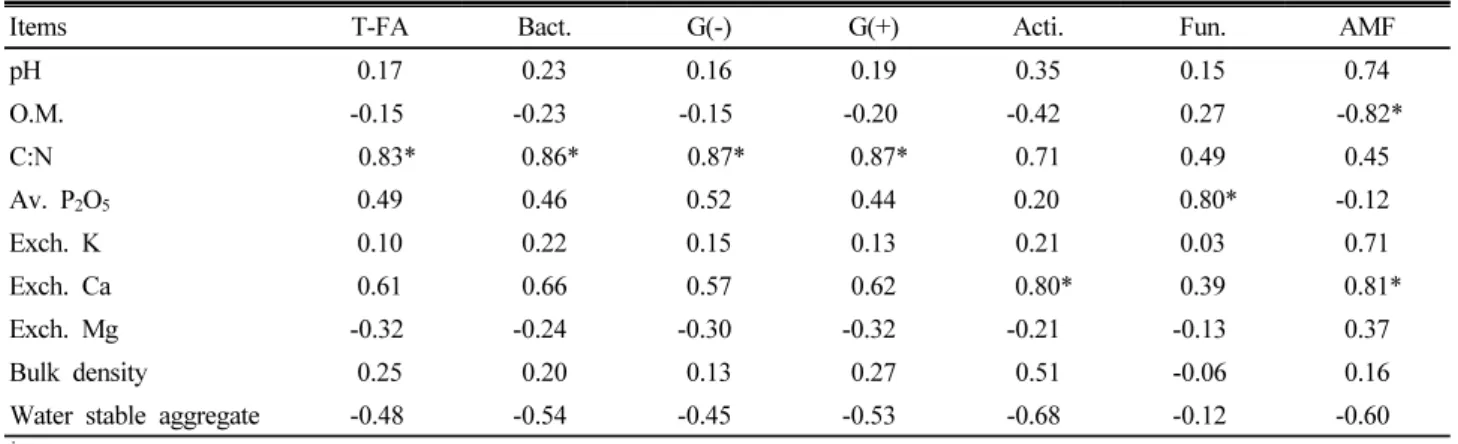
Table 5에서와 같이 총 FAME 함량과 세균은 C:N율과 정의

상관관계를 보였다 (P < 0.05). 그 외 방선균과 균근균 AMF

는 치환성 칼슘의 함량과, 사상균은 유효인산 함량과 각각 정

의 상관관계를 보였다 (P < 0.05). 특히 사상균을 제외한 조

사 미생물은 모두 유기물 함량과 유의성은 없지만 부의 상관

관계를 나타낸 것이 특징이었다. 토양유기물은 토양의 질

(quality)에 큰 영향을 끼치면서 (Herrick and Wander, 1997)

미생물의 생존활동에 필요한 에너지원으로 중요한데 (He et

al., 2012; Kieft et al., 1995; Kim and Lee. 1992; Lee et al.,

2011), 조사된 미생물이 이와 다른 경향을 보인 것은 재배작

물과 함께 토양수분이나 온도와 같은 여러 가지 논‧밭 조건의

작부토양 환경이 미생물활동에 있어서의 유기물의 영향을

상쇄했기 때문이 아닌가 생각되었다 (Kulmatiski and Beard,

2008; Fontaine et al., 2007; Sun et al., 2011; Lee et al.,

2011). 실제로 매년 볏짚을 넣어 준 담수상태의 벼 연작지가

시험 2년차 콩-보리-콩 재배지보다 유기물함량이 높았음에

도 총 FAME 함량은 이와 비슷한 수준을 보였다 (Table 4). 이

(6)

Table 5. The correlation coefficients between soil microbial biomass and soil physicochemical properties as affected by cropping systems in mid-mountainous paddy soils

. (n= 21)

Items T-FA Bact. G(-) G(+) Acti. Fun. AMF

pH 0.17 0.23 0.16 0.19 0.35 0.15 0.74

O.M. -0.15 -0.23 -0.15 -0.20 -0.42 0.27 -0.82*

C:N 0.83* 0.86* 0.87* 0.87* 0.71 0.49 0.45

Av. P

2

O

5

0.49 0.46 0.52 0.44 0.20 0.80* -0.12

Exch. K 0.10 0.22 0.15 0.13 0.21 0.03 0.71

Exch. Ca 0.61 0.66 0.57 0.62 0.80* 0.39 0.81*

Exch. Mg -0.32 -0.24 -0.30 -0.32 -0.21 -0.13 0.37

Bulk density 0.25 0.20 0.13 0.27 0.51 -0.06 0.16

Water stable aggregate -0.48 -0.54 -0.45 -0.53 -0.68 -0.12 -0.60

See footnotes to Table 1.

*Significant at 5% probability level by DMRT.

Fig. 2. Principal component analyses for microbial communities and soil physicochemical properties as affected by cropping systems in mid-mountainous paddy soils.

The variance explained by each principal component (PC) axis is shown in parentheses. PC analysis shows loading values for the individual microbial biomarkers. The bars represent one standard deviation of the mean. Means by the same letter within a column are not significantly different at 0.05 probability level according to Duncan’s multiple range test.

R, Rice; S, Soyben; B, Barley.

같은 결과는 콩 재배지에서 콩과 공생관계를 갖는 질소고정 근류균 B. japonicum과 (Kang et al., 1997) 난용성 양분을 식물에 공급하는 균근균 AMF (Table 1) (Kang et al., 2012), 일부 식물성장을 촉진시키는 것으로 알려진 중온성 Bacillus sp. (Fig. 1) (Kang et al., 2006) 등의 증식영향도 작용했을 것으로 생각되었다 (Germida and Siciliano, 2001; Kulmatiski and Beard, 2008). 그리고 미생물 군집량은 작부토양의 유기 물 함량과는 부의 상관을 보였지만 C:N율과는 정의 상관계 수 값을 나타내었는데, 이는 유기물의 경향과 반대로 C:N율 이 시험 1년차에 6.2 (콩 재배지)∼7.4 (벼 재배지) 범위였던 것이 – 작부가 진행되면서 토양환경의 변화 등의 영향으로 (Cameron et al., 2013; Fontaine et al., 2007) 질소 축적량 이 시험 1년차보다 0.07% 이상 줄어든 - 2년차에 10.5 (콩- 보리-콩 재배지)∼12.7 (벼-벼 재배지) 수준으로 올라감으 로써 (Table 4) 미생물 증식이 더 많이 이루어졌기 때문이라 해석되었다 (USDA, 2011). 한편, 토양물리성과 관련해서는 비교적 습한 환경을 좋아하는 일반 사상균을 제외한 세균과 방선균, 균근균 AMF가 용적밀도와 정의 상관계수 값을 보였 다. 토양의 수분보유에 유리한 내수성 입단율과는 조사된 모 든 미생물이 부의 상관을 보였는데, 그 중에서는 사상균이 가 장 높은 상관계수 값을 보인 것으로 나타나 Cosentino et al.

(2006)의 보고와 일치하였다. Nelson et al. (2008)은 밀 재배 지에서의 토양미생물 군집은 밀 품종에 따라 달랐으며 미생 물 군집과 밀의 제빵관련 품질과의 상관관계는 관행재배지 보다 유기재배지에서 더 높았다고 하였다. 본 시험에서는 벼, 콩이라는 재배작물의 종류에 따라 미생물 군집이 다른 것 으로 관찰되어 (Table 1) 저투입농업 측면에서 재배작물을 이 용한 미생물 군집의 개선과 이용이 가능할 것으로 믿어졌다 (Grayston et al., 1998). 그리고 시험 2년차 작부토양에서는 총 FAME 함량에서 차지하는 세균, 방선균의 분포비율이 이 들의 토양내 함량 순위와 다르게 콩-보리-콩 작부의 콩재배 지가 벼-벼나 벼-보리-벼 작부의 벼재지보다 높게 나타났

는데 (Table 2), 이는 밭작물인 콩이 균근균 AMF뿐만 아니라

세균, 방선균의 군집분포에도 벼보다 좋은 영향을 끼침을 뜻

하는 것으로 해석되었다 (Germida and Siciliano, 2001; Sun

et al., 2011). 이러한 결과는 작부체계별 토양미생물 군집과

토양의 내수성입단율, 유기물, 치환성 칼슘 함량의 주성분

분석에서도 확인할 수 있었다 (Fig. 2). 주성분 분석에서는

제1주성분이 44.2%, 제2주성분이 27.9%로 시험년차별 작부

를 5개 그룹으로 구분하면서 전체 72.1%의 자료를 설명해 주

(7)

었는데, 제1주성분에서 콩-보리-콩 작부토양은 벼-벼, 벼- 보리-벼 작부토양과 유의적인 차이를 나타내었다 (p <

0.05). 제1주성분에 가장 높은 기여를 한 것은 균근균 AMF 군집이었고 다음으로는 치환성 칼슘, 총 세균, Gram양성 세 균 등이었다. 그리고 제2주성분에서는 Gram음성 세균과 방 선균이 영향을 끼치면서 콩-보리 재배지가 콩 재배지와 유의 적인 차이를 보였고, 이들 두 처리는 또 벼 재배지와 차이를 보였다. Lee et al. (2011)는 경남지역의 평야지 벼논 가운데 pH가 6.1이고 유기물함량이 32 g kg

-1

인 양토 논에 분포한 미 생물의 총 FAME량이 505 nmol g

-1

이었다고 보고하였는데, 같은 토성이면서 지난 27년간의 년 평균기온이 10.5℃이고 유기물 함량이 26 g kg

-1

인 경북지역 중산간의 본 시험지 벼 연작구에서는 (해발 285m, ~2015년 벼 재배) 미생물의 총 FAME량이 이보다 낮은 489 nmol g

-1

을 보였다. 그러나 작부 체계로서 벼에 이어 겨울에 보리를 재배하고 이어서 벼를 다 시 재배한 결과 총 FAME량이 경남지역의 양토 논보다 높은 668 nmol g

-1

을 나타내었다 (Table 1). 이는 기상이나 토질이 미생물의 서식에 다소 불리하더라도 다모작을 통해서 미생 물체량을 늘릴 수 있고, 나아가서는 Grayston et al. (1998)의 보고처럼 미생물 군집의 다양화도 기대할 수 있는 것으로 생 각되었다.

토양미생물의 농업적 순기능은 식물의 성장을 촉진시키고 (Antunes et al., 2012; Kang et al., 2006) 토양 내 난용성 양 분을 유효화하며 (Park et al., 1999; Rengel and Marschner, 2005) 식물의 뿌리발달과 미소동물의 서식에 좋은 토양구조 를 만들어 줄뿐만 아니라 (Cosentino et al., 2006; Ellouze et al., 2014), 미생물 상호간의 포식작용과 길항작용을 통해서 작물의 병원균 피해를 줄여주는 (Casida, 1992; Lawrence and Casida, 1986) 등 광범위한 것으로 알려져 있다. 그리고 논토 양에서의 작부체계를 통한 논· 밭 윤환이용은 토양미생물의 군집형성에 긍정적인 영향을 줄뿐만 아니라, 작물의 생산성 도 향상시키는 것으로 알려져 있는데 (Cosentino et al., 2006;

Dias et al., 2015; Park et al., 1993), 본 시험에서도 벼-보 리-벼 재배를 했을 때 벼 수량이 벼 연작에 비해 14% 증수됨 이 확인되었다 (자료 미발표). 콩 또한 논토양에서 콩만 재배 했을 때보다 콩-보리를 이모작 했을 때 공중질소를 고정하는 B. japonicum의 서식밀도가 높고 콩 생육도 더 좋은 것으로 관찰되었다 (Table 3). 이렇게 볼 때 논토양에 밭작물이 들어 가는 작부체계는 농업환경을 보전하고 농작물의 생산성 증 대에 기여할 수 있는 토양미생물의 순기능 향상에도 바람직 할 것으로 생각되었다.

Conclusion

해발 285 m의 중산간지 논토양에서 벼 연작, 벼-보리-벼, 콩-보리-콩의 작부체계에 따른 토양미생물의 분포특성을

조사한 결과는 다음과 같았다. 미생물의 지방산 조성에 기반 한 세균과 방선균, 사상균 군집의 총 FAME 함량은 벼-보리 -벼 재배지가 콩-보리-콩 재배지와 벼 연작지보다 각각 37%와 40% 더 많았다 (p < 0.05). 작부처리별로 볼 때 벼-보 리-벼 재배지는 총 세균과 방선균, 사상균 함량이, 콩-보리 -콩 재배지에서는 근류균 Bradyrhizobium japonicum과 균 근균 Arbuscular mycorrhizal fungi, 중온성 Bacillus sp.의 밀도가 다른 처리구보다 유의적으로 높았다 (p < 0.05). 그러 나 총 FAME 함량 대비 세균과 방선균 군집의 분포비율은 벼 보다 콩 중심의 콩-보리-콩 작부토양에서 더 높았다. 사상 균은 반대로 벼 중심의 작부토양에서 높았는데 그 중에서는 벼-보리-벼 재배지가 벼-벼 재배지보다 더 높았다. 그리고 세균의 량은 토양의 C:N율, 방선균의 량은 칼슘, 사상균의 량은 유효인산과 각각 정의 상관관계를 보였으나 (p < 0.05), 조사된 모든 미생물군집이 내수성입단율과 부의 상관을 나 타내었다.

References

Antunes, P.M., P. Franken, D. Schwarz, M.C. Rillig, M. Cosme, M. Scott, and M.M. Hart. 2012. Linking soil biodiversity and human health; do arbuscular mycorrhizal fungi contribute to food nutrition? p. 153-172. In D. Wall, R.D. Bardgett, V.

Behan-Pelletier, J.E. Herrick, T.H. Jones, K. Ritz et al. (ed.) Soil Ecology and Ecosystem Services. Oxford University Press, Oxford.

Baon, J.B., S.E. Smith, and A.M. Alston. 1993. Mycorrhizal responses of barley cultivars differing in P efficiency. Plant and Soil 157(1):97-105.

Beare, M.H., D.C. Coleman, D.A. Crossley Jr., P.F. hendrix, and E.P. Odum. 1995. A hierarchical approach to evaluating the significance of soil biodiversity to biogeochemical cycling.

Plant and Soil 170:5-22.

Cameron, K.C., H.J. Di, and J.L. Moir. 2013. Nitrogen losses from the soil/plant system : a review. Ann. Appl. Biol. 162:145-173.

Casida, Jr, L.E. 1992. Competitive ability and survival in soil of Pseudomonas strain 679-2, a dominant, nonobligate bacterial predator of bacteria. Appl. Environ. Microbiol. 58:32-37.

Cosentino, D., C. Chenu, and Y.L. Bissonnais. 2006. Aggregate stability and microbial community dynamics under drying- wetting cycles in a silt loam soil. Soil Biol. Biochem. 38:

2053-2062.

Dias, T., A. Dukes, and P.M. Antunes. 2015. Accounting forsoil biotic effects on soil health and crop productivity in the design of crop ratations. J. Sci. Food Agric. 95:447-454.

Ellouze, W., A.E. Taheri, L.D. Bainard, C. Yang, N. Bazghaleh,

A. Navarro-Borrell, K. Hanson, and C. Hamel. 2014. Soil

fungal resources in annual cropping systems and their potential

for management. BioMed Research International 2014, Article

ID531824, 15pages.

(8)

Fontaine, S., S. Barot, P. Bare, N. Bdioui, B. Mary, and C.

Rumpel. 2007. Stability of organic carbon in deep soil layers controlled by fresh carbon supply. Nature 450:277-280.

Frostegard, A., A. Tunlid, and E. Baath. 1993. Phospholipid fatty acid composition, biomass, and activity of microbial communities from two soil types experimentally exposed to different heavy metals. Appl. Environ. Microbiol. 59(11):3605-3617.

Germida, J.J. and S.D. Siciliano. 2001. Taxonomic diversity of bacteria associated with the roots of modern, recent and ancient wheat cultivars. Biol. Fertil. Soils 33:410-415.

Grayston, S.J., S. Wang, C.D. Campbell, and A.C. Edwards. 1998.

Selective influence of plant species on microbial diversity in the rhizosphere. Soil Biol. Biochem. 30(3):369-378.

Gupta, V.V.S.R. and J.J. Germida. 1988. Distribution of microbial biomass and its activity in different soil aggregate size classes as affected by cultivation. Soil Biol. Biochem. 20(6):777-786.

Hamel, C., K. Hanson, F. Selles, A.F. Cruz, R. Lemke, B.

McConkey, and R. Zenrner. 2006. Seasonal and long-term resource-related variations in soil microbial communities in wheat-based rotations of the Canadian prairie. Soil Biol.

Biochem. 38:2104-2116.

He, X.Y., Y.R. Su, Y.M. Liang, X.B. Chen, H.H. Zhu, and K.L.

Wang. 2012. Land reclamation and short-term cultivation change soil microbial communities and bacterial metabolic profiles. J. Sci. Food Agric. 92(5):1103-1111.

Herrick, J.E. and M. Wander. 1997. Relationship between soil organic carbon and soil quality in cropped and rangeland soils;

the importance of distribution, composition, and soil biological activity. p. 405-425. In R. Lal, J.M. Kimble, R.F. Follett, B.A.

stewart (ed.) Soil Processes and the Carbon Cycle. CRC Press, Boca Raton.

Joa, J.H., D.G. Moon, S.W. Koh, and H.N. Hyun. 2012. Effect of temperature condition on nitrogen mineralization and soil microbial community shift in volcanic ash soil. Korean J. Soil Sci. Fert. 45(4):467-474.

Kang, U.G. 2007. Enhancement of soil productivity by soybean cultivation. Korea Soybean Digest 24(1):1-13.

Kang, U.G., H.M. Park, J.S.Lee, J.Y. Ko, Y.H. Lee, W.T. Jeon, M.T. Kim, and J.H. Joa. 2012. Dual inoculation response of soybean with rhizobium and mycorrhiza. Korean J. Soil Sci.

Fert. 45(3):325-331.

Kang, U.G., K.D. Park, C.Y. Park, I.S. Son, and D.W. Lee. 2006.

Development of the utilization model of plant growth- promoting rhizobacteria for low input of chemical fertilizer. p.

624-637. In year 2006 research report of Yeongnam Agricultural Research Institute, RDA, Suwon, Korea.

Kang, U.G., P. Somasegaran, H.J. Hoben, and B.B. Bohlool.

1991. Symbiotic potential, competitiveness, and serological properties of Bradyrhizobium japonicum indigenous to Korean soils. Appl. Environ. Microbiol. 57:1038-1045.

Kang, U.G., C.Y. Park, M.T. Youn, S.U. Choi, and H.S. Ha.

1997. Relatedness of naturalized Bradyrhizobium japonicum

populations with soil physico-chemical characteristics as affected by paddy-upland rotation. J. Korean Agric. Chem.

Biotech. 40(5):438-441.

Kieft, T.L., J.K. Fredrickson, J.P. McKinley, B.N. Bjornstad, S.A. Rawson, T.J. Phelps, F.J. Brockman, and S.M. Pfiffner.

1995. Microbiological comparison within and across contiguous lacustrine, paleosol, and fluvial subsurface sediments. Appl.

Environ. Microbiol. 61:749-757.

Kim, H.S., G.S. Chae, S.E. Yoon, and Y.S. Lee. 2015. A study on improving dry-field farming competitiveness in response to the expansion of market opening(Year 1 of 3). Krei research report R760. ISBN 978-89-6013-821-6 93520.

Kim, S.H. and S.K. Lee. 1992. Role of crops and residues, and fertilization to changes of microbial population, soil chemical properties and plant growth. I. Microbial population in the habitat. J. Korean Soc. Soil Sci. Fert. 25(4):370-377.

Klinkenborg, V. 2012. Did farmers of the past knoe more than we do? New York Times: Sunday Review.

Konopka, A. and R. Turco. 1991. Biodegradation of organic compounds in vadose zone and aquifer sediments. Appl. Environ.

Microbiol. 57:2260-2268.

Kulmatiski, A. and K.H. Beard. 2008. Decoupling plant-growth from land-use legacies in soil microbial communities. Soil Biol. Biochem. 40:1059-1068.

Lawrence, R. Zeph and L.E. Casida, Jr. 1986. Gram-negative versus gram-positive(Actinomycete) nonpbligte bacterial predators of bacteria in soil. Appl. Environ. Microbiol. 52:819-823.

Lee, G.S., J.C. Lee, U.G. Kang, C.Y. Park, and C.J. Kim. 2006.

Fluctuation of rhizosphere microflora in paddy rice by long-term fertilization. J. Korean Soc. Appl. Biol. Chem. 49(3):175-179.

Lee, Y.H., B.K. Ahn, S.T. Lee, M.A. Shin, E.S. Kim W.D. Song, and Y.K. Sonn. 2011. Impacts of soil texture on microbial community from paddy soils in Gyeongnam province. Korean J. Soil Sci. Fert. 44(6):1176-1180.

Lee, Y.H. and S.K. Ha. 2011. Impacts of chemical properties on microbial population from upland soils in Gyeongnam province.

Korean J. Soil Sci. Fert. 44(2):242-247.

Leteinturier, B., J.L. Herman; F. de Lonueville, L. Quintin, and R. Oger. 2006. Adaptation of a crop sequence indicator based on a land parcel management system. Agric. Ecosyst. Environ.

112:324-334.

Muthukumarasamy, R., U.G. Kang, K.D. Park, W.T. Jeon, C.Y.

Park, Y.S. Cho, S.W. Kwon, J. Song, D.H. Roh, and G. Revathi.

2007. Enumeration, isolation and identification of diazotrophs from wetland rice varieties grown with long-term application of N and compost and their short-term inoculation effect on rice plants. J. Appl. Microbiol. 102:981-991.

Nelson, A., B. Frick, J. Clapperton, S. Quideau, and D. Spaner.

2008. Does wheat cultivar choice affect crop quality and soil

microbial communities in cropping systems? Available on line

at : 16

th

IFOAM Organic World Congress, Modena, Italy. June

16-20, 2008 Archieved at http://orgprints.org/view/projects/

(9)

conference.html.

NICS (National Institute of Crop Science). 2010. Practical research plan for 2010. National Institute of Crop Science, Suwon, Korea.

NICS (National Institute of Crop Science). 2014. An analysis handbook for the environment of staple crop. National Institute of Crop Science, Suwon, Korea.

Park, C.Y., U.G. Kang, G.S. Hwang, and Y.T. Jung. 1993.

Changes of crop yields according to cropping systems and fertilizing levels in paddy-upland rotation soils. RDA J. Agri.

Sci. 35(1)(S & F):281-288.

Park, H.M., H.W. Kang, U.G. Kang, K.B. Park, S.S. Lee, and S.D. Song. 1999. Effects of arbuscular mycorrhiza inoculation and phosphorus application on early growth of hot pepper (Capsicum annum L.). Korean J. Soil Sci. Fert. 32(1):68-75.

Parr, J.F., R.I. Papendick, S.B. Hornick, and R.E. Meyer. 1992.

Soil Quality: attributes and relationship to alternative and sustainable agriculture. Am. J. Altern Agric. 7:5-11.

Rengel, Z. and P. Marschner. 2005. Nutrient availability and management in the rhizosphere; exploiting genotypic difference.

New Phytol. 168:305-312.

RDA (Rural Deveopment Administration). 2010. Soil microorganism workshop. Rural Deveopment Administration, Suwon, Korea.

SAS. 2006. SAS enterprise guide Version 4.1. SAS Inst., Cary, NC.

Schutter, M.E. and R.P. Dick. 2000. Comparison of fatty acid methyl ester (FAME) methods for characterizing microbial communities. Soil Sci. Soc. Am. J. 64:1659-1668.

Sun, B., Z.X. Dong, X.X. Zhang, Y. Li, H. Cao, and Z.L. Cui.

2011. Rice to vegetables: Short- versus long-term impact of land-use change on the indigenous soil microbial community.

Microb. Ecol. 62:474-485.

USDA NRCS. 2011. Carbon to nitrogen ratios in cropping systems. http://www.nrcs.usda.gov/wps/PA_NRCSConsumption/

download?cid=nrcs142p2_052823&ext=pdf. Assessed in June 2016.

van der Heijden, M.G.A., J.N. Klironomos, M. Ursic, P. Moutoglis, R. Streitwolf-Engel, T. Boller, A. Wiemken, and I.R. Sanders.

1998. Mycorrhizal fungal diversity determines plant biodiversity, ecosystem variability and productivity. Nature 396:69-72.

Vincent, J.M. 1970. A manual for the practical study of root nodule-bacteria. Blackwell Scientific Publication, Oxford.

Wang, Q., Y. Li., and A. Alva. 2010. Cropping systems to improve carbon sequestration for mitigation of climate change. J. Environ.

Protec. 1:207-215.

White, H. 1970. Fallowing, crop rotation and crop yields in Roman times. Agric Hist 44:281-290.

Zelles, L. 1999. Fatty acid patterns of phospholipids and

lipopolysaccharides in the characterization of microbial

communities in soil: a review. Biol. Fertil. Soils 29:111-129.

수치

Table 1. Microbial biomass, on the basis of fatty acid contents, as affected by cropping systems in mid-mountainous paddy soils †
Table 2. Microbial communities as affected by cropping systems in mid-mountainous paddy soils † .
Table 4. Soil chemical and physical properties as affected by cropping systems in mid-mountainous paddy soils † .
Table 5. The correlation coefficients between soil microbial biomass and soil physicochemical properties as affected by cropping  systems in mid-mountainous paddy soils †

참조

관련 문서

The physicochemical properties of soil and the yield and quality of rice (Oryza sativa L. Sailmi) were assessed using Italian ryegrass (Lolium multiflorum Lam.