Korean J. Soil Sci. Fert.
44(2), 303-305 (2011)Effect of Soil Organic Matter Content and Nutrition Elements on Yield of Potato
Young Bae Park* and Jae-Seung Noh
National Institute of Horticultural and Herbal Science, RDA, Suwon 440-706, Korea
A study of different levels of Nutrition Elements and the chemical properties of the soil was conducted to determine the yield performance of potato. Application of sulfur, potassium, and Magnesium significantly affected final height, dry matter content, and crispiness of potato. The final pH, organo-nitrogen, phosphorus, potassium, and magnesium content in the soil were significantly affected by S-K-Mg application.
Key words: Soil Organic Matter, Nutrition Elements, Potato Yield
Received : December 29. 2010 Accepted : March 1. 2011
*Corresponding author : Phone: +82312403648
E-mail: [email protected]
Introduction
Potato (solanum tuberosum) is one of the leading root crops as one of the most common sources of carbo- hydrates, protein, minerals, vitamin, and small amount of calcium. Continuous cultivation of this crop, however has led to serious fertility depletion due soil erosion, leaching and volatilization among others. Proper plant nutrition is the key to high-yielding and high quality potatoes especially for processing. S-K-Mg is produced to replace the continuous loss of sulfur and magnesium, which are not replaced by today’s high analysis fertilizer (Hyllton, 1999; Lindhauer, 1985; Mengel, 1997). The study was concerned mainly in determining the effects of S-K-Mg on the yield and chipping quality of potato.
Materials and Methods
PO3 variety were used selected with different fertilizer sources such as urea (16-20-0), Triple 14, S-K-Mg (21- 21-11) as well as application insecticides and fungicides during the experiments. Soil samples were collected from the sampling sites for initial analysis of pH, OM, N, P, K and Mg (Table 1). The experiment was laid out in Randomized Complete Block Design (RCBD) with three replications. All cultural practices such as watering, spraying, weed control and others were strictly
implemented.
Results and Discussion
In table 2, the yield results were shown. Potatoes applied with different rates of S-K-Mg showed no significant differences on the final height of plants. It was observed that S-P-Mg application enhanced plant growth of potato. This is due to sulfur present in S- K-Mg, which is highly soluble. This element aids initial growth, and helps sustain vigorous growth throughout the growing period. On the other hand, magnesium increased chlorophyll production, phosphorus absorption and stimulated plant growth, resulting in that taller plants were obtained compared to the control and farmer ’ s practice.
The combined effects of sulfurous and magnesium lead to faster growth.
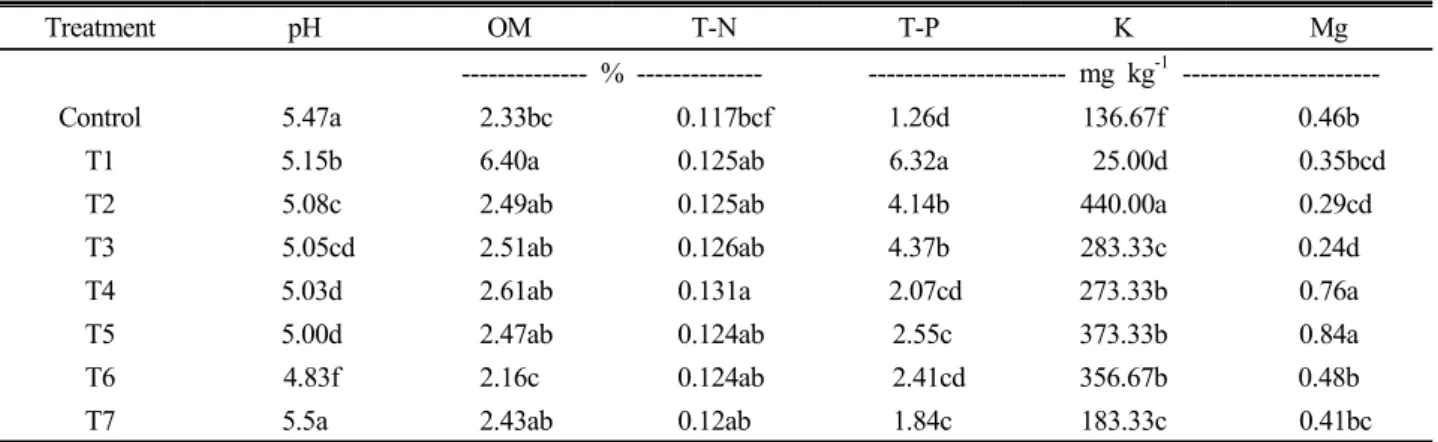
Table 3 shows the chemical properties of soils after harvest. Application of S-K-Mg at higher level (200 kg ha
-1) significantly lowered the final pH of the soil.
This attributed to the 21% sulfur content of the S-P- Mg, that is a significant decrease in acidity can be observed through the use of sulfur containing fertilizers.
For organic matter content of the soil after harvest, there were significant increases on the final OM contents of the Soil except for the soil applied with 200 kg ha
-1S- K-Mg alone and the control. Statistical analysis revealed that the application of different rates of S-K-Mg have significantly affected N content for the respective treatment plots (Table 3). For P content in soils after
Note
Young Bae Park et al.
304
Table 1. Treatments to investigate the potato yield.
Treatment S-K-Mg N-P
2O
5-K
2O Chicken dung
Control - - -
T1 140 140-140-140 5
T2 200 140-140-0 5
T3 50 140-140-0 5
T4 100 - 5
T5 150 - 5
T6 200 - 5
T7 200 - 0
Table 2. Treatments to investigate the potato yield.
Treatment Height Yield Tuber yield
Dry matter Marketable Non-marketable
cm Ton ha
-1--- Ton ha
-1--- %
Control 39.85ba
†5.94da 2.25c 0.72aba 19.24abd
T1 58.80a 12.80ab 5.90a 0.50abc 17.35b
T2 67.87a 12.80ab 5.63ab 0.78a 16.63b
T3 68.27a 13.00ab 5.87a 0.63abc 16.58b
T4 61.53a 13.60a 6.30a 0.52abc 17.65ab
T5 64.53a 11.10bc 5.38ab 0.50abc 16.67ab
T6 69.00a 12.80ab 6.33a 0.08c 17.18b
T7 62.87a 9.60c 4.63b 0.17bc 20.17a
†