Copyright ⓒ 2014, The Microbiological Society of Korea
Bacillus amyloliquefaciens 분리균의 Mannanase 생산성과 효소특성
윤기홍
우송대학교 바이오식품과학전공
Production and Properties of Mannanase by a Bacillus amyloliquefaciens Isolate
Ki-Hong Yoon
Food Science and Biotechnology Major, Woosong University, Daejeon 300-718, Republic of Korea (Received March 17, 2014 / Accepted April 17, 2014)
In the acidic LB plate, a bacterial strain was isolated from homemade soybean paste as a producer of the extracellular mannanase. The isolate YB-1402, which was a Gram-positive rod-shaped bacterium with spore, has been identified as Bacillus amyloliquefaciens on the basis of its 16S rDNA sequence and biochemical properties.
Maximum mannanase productivity of the isolate YB-1402 was reached approximately 150 U/ml in LB broth supplemented with konjac (3.0%). The molecular mass of YB-1402 mannanase was estimated to approximately 38.0 kDa by zymogram of the culture filtrate on SDS-PAGE. The mannanase of culture filtrate was the most active at 55℃ and pH 5.5. The mannanase activity was completely maintained after pre-incubation at pH 3.0 to 10.0 for 1 h.
The predominant products resulting from the mannanase hydrolysis were mannose, mannobiose and mannotriose for LBG or mannooligosaccharides. The enzyme could hydrolyze mannooligosaccharides larger than mannobiose.
Keywords: Bacillus amyloliquefaciens, mannanase, productivity, property
*For correspondence. E-mail: [email protected]; Tel.: +82-42-630-9742;
Fax: +82-42-636-2676
Mannan 다당류에 속하는 glucomannan, galactomannan과 galactoglucomannan은 mannose 잔기끼리 β-1,4 결합을 하거나 mannose와 glucose간에 β-1,4 결합을 한 형태의 기본 골격을 가 지며 acetyl이나 galactose 잔기가 mannose 잔기와 측쇄결합을 하고 있다. 이들과 같은 이형다당류는 식물 세포벽의 hemicelluloses, 식물의 종자와 덩이줄기에 존재하며, mannose 잔기간 결합으로 만 구성된 동형 다당류인 mannan은 상아야자 열매에 존재한다.
Mannan 종류에 따라 차이는 있지만, mannan 다당류의 분해 에는 β-mannanase (mannanase), β-mannosidase, β-glucosidase, acetylmannan esterase, α-galactosidase와 같은 여러 종류의 효 소가 관여한다. 이들 중 mannanase는 mannose간의 β-1,4- mannosyl 결합을 무작위적으로 분해하여 mannooligosaccharides (MOS)로 전환시키며 mannan의 분해에 가장 중요한 역할을 하 는 효소로 펄프와 제지 표백, 세제, 바이오매스 자원의 당화, 사료 품질 개선, 커피추출물의 점도 감소 등의 기능이 있어 산업적으로 유용성이 높다(Dhawan and Kaur, 2007). 최근에는 glucomannan
이나 galactomannan을 mannanase로 분해하여 생성된 MOS가 장내 유익한 미생물의 성장을 촉진하거나(Srivastava and Kapoor, 2014) 장관의 치료효과를 보이는 것으로 알려져(Zhang et al., 2014) MOS의 효능과 생산에 대한 연구가 활발히 진행되고 있다.
Mannanase는 미생물뿐 아니라 동물과 식물에서도 발견되었 으며 대부분이 glycosyl hydrolase (GH) family 5와 GH26에 속 하는 효소로 활성 domain 만으로 구성된 것과 부가적으로 carbohydrate binding domain을 비롯한 여러 개의 기능영역으로 이루어진 것이 있다(Yoon and Lim, 2007). Mannanase를 생산 하는 곰팡이로는 Aspergillus, Trichoderma와 Penicillium 속 균 주들이 대부분을 차지하는데 비해 세균성 mannanase는 좀 더 다 양한 균종으로부터 보고되었다.
콩은 다량의 galactomannan을 함유하고 있어 콩 발효 식품에 는 mannanase를 생산하는 미생물이 존재할 가능성이 높다. 콩 발효식품은 우리나라뿐 아니라 인도, 일본, 중국, 인도네시아, 태 국, 필리핀 등의 아시아 지역에서 주로 제조되고 있는데, mannanase를 생산하는 Bacillus속 미생물이 된장(Oh et al., 2002)과 태국의 Tua-nao (Wongputtisin et al., 2012)에서 분리 된 바 있다. 본 연구에서는 된장으로부터 mannanase를 생산하는
내산성 Bacillus속 균주를 분리하고 mannanase 생산성과 특성 을 조사하였다.
재료 및 방법
Mannanase를 생산하는 내산성 Bacillus의 탐색
가정에서 제조된 된장을 수집하여 0.85% NaCl 용액에 현탁 한 후 pH를 4.5로 조절한 LB 평판배지(yeast extract, 5 g;
tryptone, 10 g; NaCl, 5 g; agar, 15 g; water, 1 L)에 도말하여 37℃에서 24시간 배양한 후 형성된 콜로니를 분리하였다. 분리 균을 locust bean gum (LBG)이 0.5% 첨가된 중성의 LB 평판배 지에 접종하여 하룻밤 배양한 후 congo red 용액(0.2%)으로 염 색하여 LBG 분해환을 생성하는 미생물을 선발하였다.
분리균의 동정
분리균의 형태적 특성을 관찰하기 위해서는 그람염색과 포자 염색을 실시하였으며, 배양 균체 현탁액을 API 20E와 API 50 CHB kits (bioMéreux, France)에 제조사의 지침을 따라 접종하 고 37℃에서 배양하면서 1일과 2일째 탄수화물 이용능과 효소 활성을 각각 관찰하였다. 분리균의 16S rRNA 유전자 염기서열 을 분석하기 위해서 분리균의 총 염색체 DNA를 주형으로 하고, 세균의 16S rRNA 유전자의 보존적 지역의 염기서열을 5′
-AGAGTTTGATCCTGGCTCAG-3′ (E. coli 16S rRNA 유전 자 염기서열 8–27), 5′-GGTTACCTTGTTACGACTT-3′ (E.
coli 16S rRNA 유전자 염기서열 1492–1510)을 primers로 사용 하여 중합효소 연쇄반응(PCR)을 실시함으로써 얻은 PCR 산물 을 정제하여 그 염기서열을 결정하였다.
Mannanase 조효소액 제조
B. amyloliquefaciens YB-1402를 LB 배지에 접종하여 37℃
에서 하룻밤 진탕 배양한 후 3.0% konjac이 첨가된 LB 배지에 1% (v/v)가 되도록 접종하여 24시간 동안 진탕배양하였다. 배양 액을 원심분리하여 얻은 배양상등액을 ammonium sulfate (30–
75%)로 처리한 후, 12,000 rpm에서 30분 동안 원심분리하고 침 전물을 취하여 10 mM citrate 완충액(pH 5.5)에 현탁하고 동일 한 완충용액으로 투석하였다. 투석된 단백질 용액을 원심분리하 고 침전물을 제거한 후 mannanase 조효소액으로 사용하였다.
효소 활성 측정
Mannanase 활성은 LBG를 기질로 하여 효소 반응 후에 유리 된 환원당을 3,5-dinitrosalicylic acid (DNS) 방법(Miller et al., 1960)으로 다음과 같이 정량 함으로써 측정하였다. 증류수에 현 탁 시킨 1% (w/v) LBG 용액 0.5 ml와 200 mM citrate 완충액 (pH 5.5) 0.25 ml를 조효소액 0.25 ml와 혼합하여 50℃에서 15 분 동안 반응시켰다. DNS 용액 3 ml를 첨가하여 반응을 정지시 키고 끓는 물에서 5분 동안 방치하여 발색시킨 후 540 nm에서 흡광도를 측정하였다. Mannose를 표준시료로 사용하여 동일조 건에서 발색시켜 조사한 흡광도와 비교함으로써 유리된 환원당 의 양을 결정하였다. 효소 활성도 1.0 unit는 위의 조건에서 1분
동안 LBG로부터 1 μmol의 mannose에 상응하는 환원당을 생성 하는 효소의 양으로 정의하였다.
활성염색
조효소액을 SDS-PAGE한 후 polyacrylamide gel에서 SDS를 제거하기 위해 25% isopropanol을 포함한 50 mM sodium phosphate 완충액(pH 6.0)으로 세척한 후 isopropanol을 첨가하 지 않은 동일완충액에서 15‒30분간 방치하였다. Polyacrylamide gel을 꺼내어 동일한 완충액에 0.2% LBG와 1.5% agar를 녹여 제조한 gel을 중층하여 비닐로 봉입하고 50℃에서 4시간 반응시 킨 후 중층한 gel을 congo red로 염색하여 분해된 부분을 관찰하 였으며 polyacrylamide gel은 Coomassie brilliant blue 용액으로 염색하여 단백질을 관찰하였다.
반응산물 분석
LBG (0.5%) 또는 MOS (0.5%)와 20 mM citrate 완충액(pH 5.5)을 함유한 반응액에 과량의 효소를 첨가하여 45℃에서 5시 간 반응한 후 반응액을 95℃에서 3분 동안 열 처리하였다. 이를 원심분리하여 단백질 침전물을 제거하고 상등액을 적정량 취해 n-propanol, nitromethane과 증류수[7 : 1 : 2, (v/v)] 혼합용액을 전개용액으로 하여 silica gel-precoated thin layer plate (Merck Kiesegel, No. 5748)에서 박층 크로마토그래피를 수행하였다.
전개된 물질을 발색시키기 위해서는 9 ml ethanol, 0.5 ml p-anisaldehyde, 0.5 ml sulfuric acid와 glacial acetic acid 몇 방 울을 혼합한 발색제 용액을 뿌린 후, 120℃에서 10분간 방치하 였다.
결과 및 고찰
Mannanase를 생산하는 내산성 Bacillus의 특성
Mannanase의 산업적 용도를 고려하여 내열성, 호알칼리성, 내산성과 같은 특성을 갖는 mannanase를 생산하는 균이 탐색되 고 있다(Vijayalaxmi et al., 2013). 가정에서 제조된 된장으로부 터 mannanase를 생산하는 여러 종류의 B. subtilis가 분리된 바 있는데 이들은 중성 배지에서 분리된 균주이다(Oh et al., 2002).
중성 배지에서 분리된 B. subtilis WL-3이 생산하는 mannanase 도 산성에서 안정성이 우수하여 사료첨가용 효소로 활용하는데 유리한 특성을 가지고 있지만(Yoon et al., 2008), 내산성이 더욱 우수한 효소를 탐색하기 위해 된장으로부터 산성 배지에서 성장 하는 균을 분리하고 이들 중 mannanase를 생산하는 균을 선발하 였다. 이를 위해 가정에서 제조된 된장 10점을 0.85% NaCl 용액 에 각각 현탁한 후 pH를 4.5로 조절한 LB 평판배지에 직접 도말 하여 24시간 배양한 후 형성된 콜로니를 분리하였다. 분리균 중 에서 LBG의 분해능이 우수한 균주를 1주 선발하고 이를 YB- 1402로 명명하였다.
분리균 YB-1402는 포자를 형성하는 그람양성 간균으로 확인 되어, API 50 CHB와 20E kit를 사용하여 생화학적 특성을 조사 한 결과 β-galactosidase, gelatinase, oxidase 활성능이나 acetoin 생성능을 보였고, nitrate 환원능, indole 생성능, citrate 이용능,
Additional carbon sources (0.5%) Mannanase productivity (U/ml) Additional amount (%) of konjac Mannanase productivity (U/ml)
None 0.5 0.1 31.9
Glucose 0.7 0.3 63.8
Xylose 0.6 0.5 74.3
α-Cellulose 2.3 0.7 90.1
Locust bean gum 40.3 1.0 120.9
Guar gum 14.5 1.5 133.2
Konjac 72.1 2.0 142.9
Palm kernel meal 20.3 2.5 148.4
Wheat bran 0.9 3.0 152.7
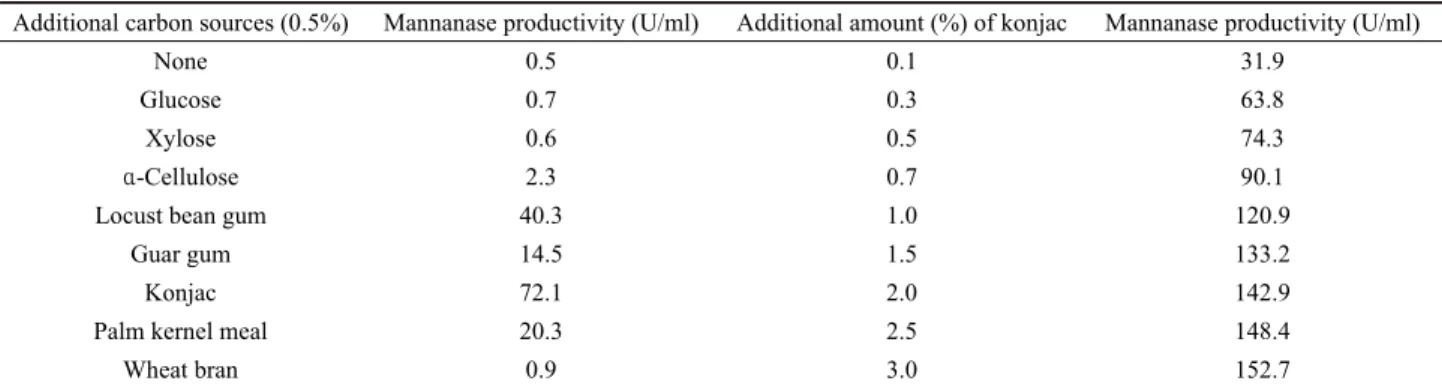
Table 1. Effects of additional carbon sources on the mannanase production of B. amyloliquefaciens YB-1402
Culture time(h)
0 5 10 15 20 25 30 35 40
Cell Growth (OD600)
0 1 2 3 4 5
Mannanase productivity (U/ml)
0 20 40 60 80 100 120 140 160 180
Fig. 1. Production of mannanase by B. amyloliquefaciens YB-1402 and its growth. The isolate was grown respectively in LB broth supplemented with or without konjac (3%) for mannanase production. Cell growth (closed circles) and mannanase productivity (closed triangles) were observed in the media without additional carbon sources. Culture medium containing additional carbon source was used for enzyme production (open circles). Enzyme activities in the culture filtrates were determined in the reaction condition of pH 5.5 and 50℃. Each curve represents the average of three independent experiments.
황화수소 생성능이나 arginine dehydrolase, lysine decarboxylase, urease, ornithine decarboxylase, tryptophane deaminase 등의 활성이 없었다. 당 이용능을 비롯한 생화학적 특성에 따르면 분 리균은 B. subtilis 및 B. amyloliquefaciens와 유사도가 93%로 가장 높게 나타났으며 lactose의 이용능에는 차이가 있는 것으로 확인되었다. 생화학적 특성에서 분리균이 B. subtilis와 B.
amyloliquefaciens에 모두 동일한 수준으로 유사도를 보이므로 16S rRNA 유전자를 PCR로 증폭한 후 1,496 bp 크기의 염기서 열을 결정하고(GenBank accession no. KJ57221) 이를 미국 NCBI의 BLAST 검색방법으로 16S rDNA database와 비교하였 다. 그 결과 B. amyloliquefaciens FZB42 (NR_075005)와 가장 유사도가 높았으며 4개 염기가 달랐고 B. subtilis 168 (NR_
102783)과는 7개 염기가 다른 것으로 확인되어 분리균은 B.
amyloliquefaciens와 유사도가 가장 높은 것으로 판단된다. 또한 가정식 된장에서 mannanase 생산균으로 분리된 B. subtilis WL-3 (AY601723)과 3개 B. subtilis WL-7 (AY601722)과는 7개 염기가 각각 다른 것으로 나타났다.
한편 초기 pH를 4.0과 4.5로 조절한 LB 액상배지에 접종하여 37℃에서 16시간 동안 진탕 배양한 결과 pH 4.0 배지에서는 성 장하지 못하였으며, pH 4.5 배지에서는 B. subtilis 168은 전혀 성장하지 못한데 비해 분리균 YB-1402는 배양초기에는 성장이 느렸으나 배양시간이 오래될수록 급격한 성장도를 보였다(결과 미제시).
부가탄소원에 따른 효소 생산성
Mannanase를 비롯한 cellulase 및 xylanase와 같은 비전분성 다당류의 가수분해 효소는 배지성분에 따라 효소 생산량에 차이 가 크며 대부분 해당효소에 의해 분해될 수 있는 물질이 배지에 첨가될 경우 효소 생산성이 증가되는 것으로 보고되었다. 특히 mannanase는 생산균에 따라 차이는 있지만 LBG, konjac, guar gum과 같이 mannan 다당류를 함유한 물질에 의해 생산성이 급 격하게 증가되는 경우가 많다. 그러므로 부가 탄소원이 분리균 YB-1402의 mannanase 생산성에 미치는 영향을 조사하기 위해 여러종류의 탄수화물을 0.5% (w/v)가 되도록 각각 첨가한 LB 배지에 접종하고 배양온도를 37℃로 하여 24시간 진탕 배양한 후 배양상등액에 존재하는 mannanase 활성을 조사하였다.
Table 1에 보인 바와 같이 mannan 다당류를 함유한 LBG, guar
gum, konjac과 palm kernel meal이 각기 첨가된 배지에서 mannanase의 생산성이 크게 증가되었으며 단당류나 cellulose, 밀기울 등에 의해서는 효소 생산성이 특별하게 증가하지 않았 다. 특히 glucomannan을 포함하는 konjac이 galactomannan을 포함하는 LBG 또는 guar gum보다 mannanase 생산성을 더 증 가시키는 것으로 확인되었다.
Konjac의 함량이 3%까지 되도록 첨가량을 달리하여 효소 생 산성을 조사한 결과 konjac의 첨가량이 1% 이내의 범위에서는 첨가량에 따른 효소 생산성의 증가 정도가 크게 일어났으며, 2%
이상에서는 효소 생산성 증가량이 크지는 않았지만 3%까지 증 가하였다. 이와 같이 LBG 또는 komjac을 첨가한 배지에서 mannanase의 생산성이 급격하게 증가된 Bacillus 속 균주로는
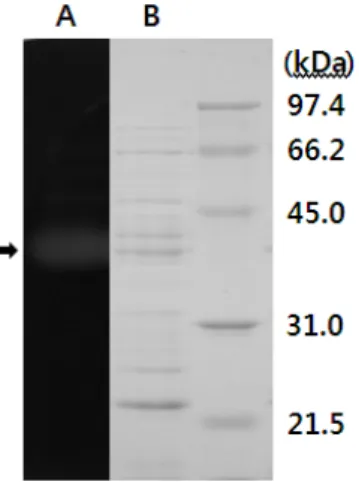
Fig. 2. Zymogram (A) and SDS-PAGE (B) of the crude enzyme produced by B. amyloliquefaciens YB-1402. After SDS-PAGE of the concentrated culture filtrate of isolate YB-1402 grown in LB broth containing konjac, protein exhibiting mannanase activity, which was indicated with arrow, was analyzed by activity staining with LBG as substrates. Molecular size is shown in kilodaltons to the right side of the gel.
pH
2 4 6 8 10 12
Relative activity (%)
0 20 40 60 80 100
Fig. 3. pH optimum and pH stability of the crude enzyme. Buffers (50 mM) used were as follows: sodium citrate (pH 3–6), sodium phosphate (pH 6–8), Tris (pH 8–9), KCl-borate (pH 9–10), sodium carbonate (pH 10–11), and sodium phosphate/NaOH (pH 11–12).
Mannanase activity (closed symbols) was assayed at pH 4–8 with constant temperature of 50℃. pH Stability (open symbols) was determined by measuring the residual activities after pre-incubations for 1 h in various pHs at 4°C. Each curve represents the average of three independent experiments.
B. subtilis WL-3과 B. subtilis BS5 등이 보고된 바 있다(Oh et al., 2002; Huang et al., 2012). 한편 B. subtilis 168은 밀기울과 palm kernel meal (El-Helow et al., 1997), B. halodurans PPKS-2는 copra meal (Vijayalaxmi et al., 2013), Bacillus sp.
CFR1601는 녹두껍질(Srivastava and Kapoor, 2014)과 같은 농 산부산물이 첨가된 배지에서 mannanase 생산성이 증가된 것으 로 알려졌다.
배양시간에 따른 mannanase 생산성을 조사하기 위해 konjac (3%)를 첨가하거나 첨가하지 않은 LB 배지에서 36시간 동안 배 양하면서 mannanase 생산성과 성장도를 조사한 결과 konjac을 첨가하지 않은 LB 배지에서 6시간 배양 후에 균의 성장이 최대 에 이르렀으나 효소 생산성은 1 U/ml 미만으로 매우 낮았다.
Konjac을 첨가한 배지에서는 배양시간이 6시간 되었을 때 mannanase 생산성이 약간 증가한 상태이지만, 9시간 되었을 때 효소 생산성의 급격한 증가를 보였으며 배양시간 24시간 이후에 는 약 150 U/ml 수준의 최대 생산성을 보였고 36시간까지 생산 성이 유지되었다(Fig. 1). 배양초기에는 mannanase 생산성이 낮 은데 9시간 정도에서 급격히 효소 생산량이 증가한 것은 배양 초 기에 소량 생산된 mannanase에 의해 배지에 첨가된 konjac이 분 해되어 MOS가 생성되고 이것이 mannanase 유전자의 발현을 유도하는 것으로 추정된다. 한편 유전자 재조합 균주를 이용하 여 mannanase의 생산균주를 개발하고자 하는 시도로써 B.
subtilis 168 재조합 균주로부터 B. subtilis WL-3의 mannanase 가 450 U/ml (Yoon and Lim, 2007), Pichia pastoris 재조합 균 주로부터 Bacillus sp. N16-5의 mannanase가 6,336 U/ml 수준 으로 생산된 바 있다(Zhu et al., 2011).
배양상등액을 ammonium sulfate로 처리하여 제조한 조효소 액을 사용하여 mannanase 효소의 활성밴드를 관찰하고자 SDS-PAGE를 수행한 후 활성염색을 실시하였다. 그 결과 Fig. 2
에 보인 바와 같이 분자량이 약 38.0 kDa 정도로 추정되는 mannanase 활성 단백질이 관찰되었으며 이는 B. subtilis BCC41051 (Summpunn et al., 2011)과 B. subtilis WL-3 (Oh et al., 2002)의 mannanase 분자량과 유사하고 SDS-PAGE에서 분자량이 22 kDa인 B.
halodurans PPKS-2 (Vijayalaxmi et al., 2013)와는 큰 차이가 있음을 알 수 있다.
효소 반응특성
조효소액을 사용하여 반응 pH와 온도가 효소활성에 미치는 영향을 조사하기 위해 반응온도를 50℃로 고정하고 여러 pH에 서 mannanase 활성을 측정한 결과 pH 5.5에서 최대 활성을 보였 으며 pH 4.5‒7.0 범위에서 최대활성의 70% 이상의 활성을 나타 냈다(Fig. 3). 또한 반응액의 pH를 5.5로 하고 30‒65℃ 범위의 온도에서 효소활성을 조사한 결과 55℃에서 가장 활성이 높았 다(Fig. 4). Bacillus 속 유래의 mannanase는 다수가 반응온도 50℃‒70℃, 반응 pH 5.0‒7.0의 범위에서 최대활성을 보이는 것 으로 보고되었으며 YB-1402의 mannanase도 이들과 유사한 것 을 알 수 있다. 반면에 B. subtilis BS5 (Huang et al., 2012)와 B.
subtilis G1 (Vu et al., 2012)의 mannanase는 최적 반응온도가 각각 32℃와 45℃이며, B. halodurans PPKS-2의 효소는 최적 반응 pH가 11인 것으로 보고되었다(Vijayalaxmi et al., 2013).
pH에 대한 안정성을 조사하기 위해 효소액의 pH를 3‒12로 하여 4℃에서 1시간 동안 방치한 후 잔존 효소활성을 측정한 결 과 pH 3‒10에서는 효소활성이 100% 유지되었고 pH 11 이상에 서는 실활이 일어나기 시작하여 pH 11과 12에서 잔존활성이 각 각 88%와 50%로 나타났다(Fig. 3). 이로 보아 분리균 YB-1402
Temperature (OC)
30 40 50 60 70
Relative activity (%)
0 20 40 60 80 100
Fig. 4. Temperature optimum and thermostability of the crude enzyme. The enzyme reaction was performed at various temperatures (closed symbols) for 15 min in 50 mM sodium citrate buffer (pH 5.5). Thermostability (open symbols) was determined by measuring the residual activities after pre-incubation for 1 h at different temperatures. Each curve represents the average of three independent experiments.
Fig. 5. Thin-layer chromatogram of hydrolysis products of β -1,4-linked MOS and LBG galactomannan with crude enzyme. The reaction mixtures containing the crude enzyme and MOS or LBG in 20 mM sodium citrate buffer (pH 5.5) were incubated for 4 h at 50℃. M1 to M6 represent mannose to mannohexaose. L stands for LBG, and MO indicates the standard MOS including mannose (M1), mannobiose (M2), mannotriose (M3), mannotetraose (M4), mannopentaose (M5) and mannohexaose (M6). E, crude enzyme.
가 생산하는 mannanase는 pH 4‒9의 범위내에서 안정한 것으로 알려진 B. subtilis B23 (Zhou et al., 2013), B. subtilis G1 (Vu et al., 2012)의 mannanase 보다 넓은 pH 범위에서 안정성이 있으 며, 특히 산성 조건에서 매우 안정성이 높은 것으로 판단되므로 사료산업에 활용 가능성이 높다고 하겠다. 한편 B. subtilis BCC41051의 mannanase는 pH 5‒11.5에서 안정하여 알칼리 조 건에서 안정성이 우수하며(Summpunn et al., 2011), 곰팡이인 Thielavia arenaria XZ7의 효소는 YB-1402와 유사하게 pH 3‒
10 범위에서 안정하다고 보고되었다(Lu et al., 2013).
Mannanase의 열안정성을 조사하기 위해 조효소액을 30‒65℃
범위의 온도에서 각각 1시간 방치한 후에 잔존활성을 측정하였 다. 그 결과 50℃ 이하에서는 효소가 실활되지 않았으나, 55℃
에서는 약 20% 정도가 실활되었고 60℃에서는 급격히 실활되 었다(Fig. 4). 이로 보아 YB-1402의 mannanase는 50℃ 이하에 서 안정한 B. subtilis G1의 효소와 유사하지만(Vu et al., 2012), 60℃에서 2시간 방치하였을 때도 거의 실활되지 않는 B. subtilis WL-3의 효소에 비해 열안정성이 낮았다(Yoon et al., 2008).
MOS와 galactomannan의 최종 가수분해 산물
Mannanase에 의한 가수분해 산물을 조사하기 위해 중합도가 2~6인 MOS, LBG와 guar gum을 기질로 하여 효소 반응을 실시 한 후 가수분해 산물을 TLC로 분석한 결과 Fig. 5에 나타낸 바 와 같이 mannobiose는 가수분해 되지 않았으며 이보다 중합도 가 큰 MOS는 가수분해 되어 최종 산물로 mannotriose와 mannobiose가 다량 생성되었으며, mannose도 소량 생성되었다.
또한 mannotriose는 이보다 중합도가 큰 MOS에 비해 가수분해 정도가 미약한 것으로 확인되었다. 대부분의 mannanase는 중합도 가 큰 MOS를 잘 분해하는데 mannotriose의 분해능에는 차이가 있다. B. subtilis WL-3 (Yoon et al., 2008)과 Bifidobacterium adolescentis (Kulcinskaya et al., 2013) 유래의 효소는 YB-1402 의 mannanase와 같이 mannotriose 이상의 중합도를 갖는 MOS를 분해하지만, B. subtilis WY34 (Jiang et al., 2006)과 Rhizomucor miehei (Katrolia et al., 2013)의 효소는 mannotriose는 분해하지 못하고 mannotetraose 이상의 중합도를 갖는 MOS를 분해하는 것으로 보고되었다.
LBG를 mannanase로 가수분해하였을 때도 mannotriose와 mannobiose가 다량 생성되고 이에 비해 mannose는 소량 생성 되었다. 그러나 guar gum에 대한 분해능은 약하여 TLC로는 최 종 분해산물이 관찰되기 어려웠다(결과 미제시). 한편 Bacillus sp. CFR1601의 mannanase로 guar gum을 분해하였을 때 유산 균의 생육을 촉진하는 이당류와 사당류가 주된 산물로 생성되었 으며(Srivastava and Kapoor, 2014), Rhizomucor miehei의 mannanase는 LBG와 konjac을 분해하여 주된 산물로 mannobiose 와 mannotriose를 생성한다고 보고되었다(Katrolia et al., 2013).
상기의 결과들로 볼 때 pH가 산성으로 조절된 배지를 사용하 여 된장으로부터 분리된 B. amyloliquefaciens YB-1402 유래의 mannanase는 반응온도와 pH 및 기질에 대한 분해산물 등이 Bacillus 속 균주 유래의 mannanases와 유사하였지만, 산성 pH 에서 안정성은 더 우수한 것으로 확인되었으므로 장류 발효미생 물을 탐색할 때 배양조건을 달리한다면 우수한 특성을 갖는 다 양한 미생물의 분리가 가능할 것으로 판단된다.
적 요
된장으로부터 mannanase 생산균으로 산성 배지에서 분리된 YB-1402는 그람양성 간균으로 포자를 형성하며, 16S rDNA 염 기서열과 생화학적 성질이 Bacillus amyloliquefaciens와 가장 높은 유사도를 보였다. 분리균 YB-1402는 konjac을 3% 첨가한
LB 액체배지에서 약 150 U/ml의 최대 mannanase 생산성을 보 였다. 분리균의 배양상등액을 사용하여 SDS-PAGE 활성염색을 실시한 결과 분자량이 약 38 kDa로 추정되는 한 종류의 mannanase만이 관찰되었으며, 55℃와 pH 5.5 반응조건에서 mannanase의 최대활성을 보였다. 특히 mannanase는 pH 3.0-10 의 범위에서 1시간 방치하였을 때 실활되지 않은 특성을 지니고 있었다. Locust bean gum과 mannooligosaccharides를 mannanase 로 분해하였을 때 mannose, mannobiose와 mannotriose가 최종 분해산물로 관찰되었으며 mannotriose 이상의 중합도를 갖는 mannooligosaccharides를 분해하는 것으로 확인되었다.
References
Dhawan, S. and Kaur, J. 2007. Microbial mannanases: an overview of production and applications. Crit. Res. Biotechnol. 27, 197–216.
El-Helow, E.R., Sabry, S.A., and Khattab, A.A. 1997. Production of β -mannanase by B. subtilis from agro-industrial by-products:
screening and optimization. Antonie van Leeuwenhoek 71, 189–193.
Huang, J.L., Bao, L.X., Zou, H.Y., Che, S.G., and Wang, G.X. 2012.
High-level production of a cold-active B-mannanase from Bacillus subtilis BS5 and its molecular cloning and expression. Mol. Gen.
Mikrobiol. Virusol. 4, 14–17.
Jiang, Z., Wei, Y., Li, D., Li, L., Chai, P., and Kusakabe, I. 2006.
High-level production, purification and characterization of a thermostable β-mannanase from the newly isolated Bacillus subtilis WY34. Carbohydr. Polym. 66, 68–96.
Katrolia, P., Yan, Q., Zhang, P., Zhou, P., Yang, S., and Jiang, Z. 2013.
Gene cloning and enzymatic characterization of an alkali-tolerant endo-1,4-β-mannanase from Rhizomucor miehei. J. Agric. Food Chem. 61, 394–401.
Kulcinskaja, E., Rosengren, A., Ibrahim, R., Kolenova, K., and Stalbrand, H. 2013. Expression and characterization of a Bifidobacterium adolescentis β-mannanase carrying mannan- binding and cell association motifs. Appl. Environ. Microbiol. 79, 133–140.
Lu, H., Zhang, H., Shi, P., Luo, H., Wang, Y., Yang, P., and Yao, B. 2013.
A family 5 β-mannanase from the thermophilic fungus Thielavia arenaria XZ7 with typical thermophilic enzyme features. Appl.
Microbiol. Biotechnol. 97, 8121–8128.
Miller, M.L., Blum, R., Glennon, W.E., and Burton, A.L. 1960.
Measurement of carboxymethylcellulase activity. Anal. Biochem.
2, 127–132.
Oh, Y.P., Lee, J.M., Cho, K.H., and Yoon, K.H. 2002. Isolation and enzyme production of a mannanase-producing strain, Bacillus sp.
WL-3. Kor. J. Microbiol. Biotechnol. 30, 247–252.
Srivastava, P.K. and Kapoor, M. 2014. Cost-effective endo-mannanase from Bacillus sp. CFR1601 and its application in generation of oligosaccharides from guar gum and as detergent additive. Prep.
Biochem. Biotechnol. 44, 392–417.
Summpunn, P., Chaijan, S., Isarangkul, D., Wiyakrutta, S., and Meevootisom, V. 2011. Characterization, gene cloning, and heterologous expression of β-mannanase from a thermophilic Bacillus subtilis. J. Microbiol. 49, 86–93.
Vijayalaxmi, S., Prakash, P., Jayalakshmi, S.K., Mulimani, V.H., and Sreeramulu, K. 2013. Production of extremely alkaliphilic, halotolerent, detergent, and thermostable mannanase by the free and immobilized cells of Bacillus halodurans PPKS-2. Purification and characterization. Appl. Biochem. Biotechnol. 171, 382–395.
Vu, T.T., Quyen, D.T., Dao, T.T., and Nguyen Sle, T. 2012. Cloning, high-level expression, purification, and properties of a novel endo-β -1,4-mannanase from Bacillus subtilis G1 in Pichia pastoris. J.
Microbiol. Biotechnol. 22, 331–338.
Wongputtisin, P., Khanongnuch, C., Khongbantad, W., Niamsup, P., and Lumyong, S. 2012. Screening and selection of Bacillus spp. for fermented corticate soybean meal production. J. Appl. Microbiol.
113, 798–806.
Yoon, K.H., Chung, S., and Lim, B.L. 2008. Characterization of the Bacillus subtilis WL-3 mannanase from a recombinant Escherichia coli. J. Microbiol. 46, 344–349.
Yoon, K.H. and Lim, B.L. 2007. Cloning and strong expression of a Bacillus subtilis WL-3 mannanase gene in B. subtilis. J. Microbiol.
Biotechnol. 17, 1688–1694.
Zhang, C., Chen, J.D., and Yang, F.Q. 2014. Konjac glucomannan, a promising polysaccharide for OCDDS. Carbohydr. Polym. 104, 175 –181.
Zhou, H., Yang, Y., Nie, X., Yang, W., and Wu, Y. 2013. Comparison of expression systems for the extracellular production of mannanase Man23 originated from Bacillus subtilis B23. Microb. Cell Fact. 12, 78.
Zhu, T., You, L., Gong, F., Xie, M., Xue, Y., Li, Y., and Ma, Y. 2011.
Combinatorial strategy of sorbitol feeding and low-temperature induction leads to high-level production of alkaline β-mannanase in Pichia pastoris. Enzyme Microb. Technol. 49, 407–412.