• 검색 결과가 없습니다.

A Review of the Master Plan for Four Major Rivers Restoration Project

N/A
N/A
Protected

Academic year: 2021

Share "A Review of the Master Plan for Four Major Rivers Restoration Project"

Copied!
7
0
0

로드 중.... (전체 텍스트 보기)

전체 글

(1)

A Review of the Master Plan for Four Major Rivers Restoration Project

Chang-Kun Park

Department of Civil Engineering, Kwandong University, Republic of Korea (Manuscript received 25 October 2009; accepted 26 November 2009)

Abstract

Lately the master plan for the Four Major Rivers Restoration Project has been released by the Ministry of Land and Maritime Affairs and relevant ministries. According to the master plan compared with the interim report made on 15 December 2008, the number of weirs for irrigation has increased from 5 to 16, the amount of dredging has increased from 220 million cubic metres to 570 million cubic metres, and the total cost estimated has increased from 14 trillion won to 22 trillion won.

A critical review of the master plan by some research group will be summarized focused upon budget, objectives, securing water resource, dredging, and flood control etc. After various experts’ forums and field surveys, it is concluded that the government should implement a joint-research program on assessing the impact of the project together with experts and citizens’

groups as co-partners, in order to truly save or restore the four major rivers.

Keywords : Four Major Rivers Restoration Project, Weir, Dredging, Joint-research

Corresponding Author: Chang-Kun Park, Department of Civil Engineering, Kwandong University, Republic of Korea E-mail: [email protected]

연구논문

I. Introduction

An intermediate outline of the ‘4 major rivers restoration project’, selected as the first core pro- ject of the green new deal policy1), was released on April 27, 2009, by Ministry of Land, Transport and Maritime Affairs and Ministry of Environment(2009) as a report data form.

According to this data, under the objective of recreating the territory through ‘the four rivers restoration project’, ①securing water ②flood con-

trol ③improvement of water quality and ecology restoration ④creating complex space for local res- idences ⑤river centered area growth, these five were chosen as key subjects.

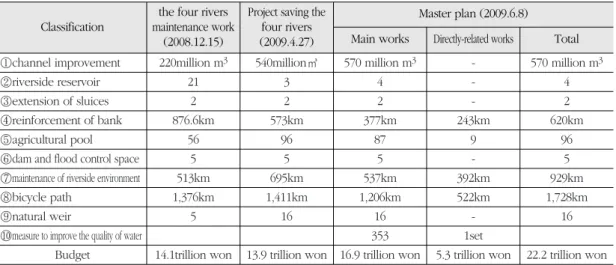
A comparison between details of ‘the four rivers maintenance work’ in 2008 with ‘project saving the four rivers’ is seen in Fig. 1 below2)

1) Green New Deal Policy is not exactly ‘New Deal Policy’.

American New Deal Policy focused on promotion of welfare, green new deal does not at all (Hong, 2009).

2) ‘The four rivers restoration project’ could be interpreted as

(2)

(Park, 2009). The dredging under the name of

‘Channel improvement’ was planned to be done 570 million m

3

which 2.5 times more than that of 2008. The number of ‘riverside reservoirs’, which are usually a water-friendly space playing a role as a wet land, and slow down the stream tem- porarily during flood, was greatly decreased from 21 to 3. Also, the number of weir, the deci- sive factor of carrying out the ‘Pan Korea Waterway project’, increased from 5 to 16

3)

(Ministry of Land, Transport and Marine affairs, 2009.6.8).

The four major rivers restoration project enforced by government, as the core of nation’s green development, aims at securing sufficient water, flood control, water purification, regional developments, etc. However, the protection of environment, one of the two main pillars of green development: environmental protection and economic growth, is turned out to be ignored(Yoon, 2009; Ministry of Knowledge Economy, 2008).

Especially, in case of the Nakdong River, 8 weirs will be installed and 440 million cubic meters be dredged to secure water and to control

floods. The essential function of a weir is main- taining the water level which is far from flood control. Furthermore, installing weirs actually deteriorates the water quality, and results in unrecoverable destruction of ecosystem. So there is no rational relationship between installing weirs and water purification. In addition, weirs will be installed in the main stream of the Nakdong River to secure one billion cubic meters water. However, when it is considered that there would be surplus of 11 million cubic meters water in 2012, there is no clear explanation about how the water will be used.

The areas restricting the water supply are all mountainous areas, farm villages or seaside areas

badly extended ‘the four rivers maintenance work’. Actually, maintenance work of the four rivers had been almost finished, 97%, in 2006 (Park, 2006). In this situation, forcing to do the maintenance work is incomprehensible. For this reason, a criticism that this project, which could be accepted as ‘project killing the four rivers’, is wasting people’s precious money on construction workers was raised.

3) On June 21, Daily Chosun newspaper published that there would be 20 weirs. Even in a master plan, four weirs were hidden. Two of them, Hahwei weir and Gudam weir, are to be constructed in the Nakdong river which are considered to have a deadly influence on Hahwei village and a Pyoungsan lecture hall. In this article, the project was assessed on the assumption of that 16 weirs would be constructed.

Fig. 1. Comparison of ‘the four rivers restoration project’ with ‘the four rivers maintenance work’

Classification the four rivers Project saving theMaster plan (2009.6.8) maintenance work four rivers

(2008.12.15) (2009.4.27) Main works Directly-related works Total

①channel improvement 220million m3 540million㎥ 570 million m3 - 570 million m3

②riverside reservoir 21 3 4 - 4

③extension of sluices 2 2 2 - 2

④reinforcement of bank 876.6km 573km 377km 243km 620km

⑤agricultural pool 56 96 87 9 96

⑥dam and flood control space 5 5 5 - 5

⑦maintenance of riverside environment 513km 695km 537km 392km 929km

⑧bicycle path 1,376km 1,411km 1,206km 522km 1,728km

⑨natural weir 5 16 16 - 16

⑩measure to improve the quality of water 353 1set

Budget 14.1trillion won 13.9 trillion won 16.9 trillion won 5.3 trillion won 22.2 trillion won
the four rivers Project saving the Master plan (2009.6.8)

Classification maintenance work four rivers

(2008.12.15) (2009.4.27) Main works Directly-related works Total

(3)

(Park, 2006). So, securing water from main stream located at low region is irrelevant.

Nevertheless, installing 16 weirs and dredging 570 million cubic meters at the four rivers restoration project looks like a rough sketch or the first step of “Pan Korea Grand Waterway”.

Therefore, if the government want truly to save rivers, installing weirs and dredging work have to be excluded from the four rivers project. This would satisfy green development which is a sub- ordinate concept of sustainable development.

II. Review of the Four Major Rivers Restoration Project

Upon reviewing the plan, several following problems have been noted, and the government will need to reconsider the plan and to suggest more reasonable plan.

1. Budget Change: from 13.9 trillion won to 22.2 trillion won

According to the interim report made on 27 April 2009, the budget was estimated at 13.9 tril- lion won. However the budget has increased to 22.2 trillion won in the master plan, which makes a distinction between ‘main projects’ and ‘directly related projects’. The budget of 16.9 trillion won and 5.3 trillion won was respectively allocated to each other. The increase of 8.3 trillion won (60%) has been decided in a month. The project insuffi- ciently prepared state-led could result in unex- pected problems. When unexpected serious prob- lems happen, the astronomical expenditure invested, the irreversible environmental damages, and the cost associated with social conflicts, will become the heavy burden to the tax payers. It is imperative to reach social consensus on saving

the rivers, by releasing relevant information to the public and by carrying out a joint research program where stakeholders are able to partic- ipate in a meaningful way.

2. If sluice gates get installed at the eight weirs in the Nakdong River, the whole project becomes a Nakdong Canal

The plan to install 16 weirs with certain depths in the river system could be thought as a

‘sectional canal’. When this project is completed and it can be judged relatively economically viable to install sluice gates to the reservoirs, the project will become that for a canal. Therefore, this project aimed at “restoring the four major rivers” is really the first step of constructing a canal. In case of the Nakdong River, if 8 reser- voirs are installed and sluice gates are construct- ed at the Nakdong estuary, 9 ‘sectional canals’

are completed with an average depth of 6 metres. The total length of the sectional canals is predicted to be around 30 km (Gyeong-in canal, for example, is about 18 km long).

The Gyeong-in canal project gives us a good example where the government has achieved the ultimate objective step by step with a completely different project in the beginning. The drain was constructed to prevent floods and this example could make a logic that a little more work would turn it into a Gyeong-in canal. When the “saving the Nakdong River” project gets completed, it will end up with a similar product, 9 sectional canals with only sluice gates away from a canal.

3. Water Resource Secure of the Nakdong River

According to the Long-term Master Plan for

Water Resources established under the Rivers Act

in 2006, Korea will have a surplus of 11 million

cubic meters of water in the Nakdong Basin in

(4)

2011. Despite this, the government plans to develop 1 billion cubic meters of water in the Nakdong region by insisting that the region suf- fers from a “permanent deficit of water” and

“the lack of the water for environmental improvement”. The environmental improvement water is referred to as the water that is put into rivers to maintain the functions of riverine ecosystems. In case of the Nakdong River, the demand for utility water in 2011 is estimated at 9.7 billion cubic meters, the environmental improvement water is calculated to be 2.2 billion cubic meters which is around 23% of the utility water. In other words, we get a surplus 11 mil- lion cubic meters of water. If we lack any water, it will be the environmental improvement water.

In the worst case scenario, we have 2.2 billion cubic meters of potable water already secured.

Furthermore, the Long-term Master Plan for Water Resources states that we will only experi- ence water shortage of 140 million cubic meters in 2016. The government’s plan is to secure water by installing weirs along the mainstream and it is based on that the Nakdong River lacks water.

Unless further mitigation actions are taken up, the quality of water secured by constructing weirs will be aggravated than before.

Unfortunately, there is not easy to find such cases in the world where weirs are installed along the mainstream of a river in an attempt to secure more water. It is therefore imperative to reconsider the plan that has not yet been proven effective.

4. Dredging 440 million cubic meters from the Nakdong River

In case of the Nakdong River, the amount of dredging to be done amounts to 440 million cubic metres. This equates to dredging the

riverbed along 323 km with a width of 135 m and a depth of 10 m. In such a case, the riverine ecosystems will be destroyed to an extent that is irreversible, and a serious lack of potable water will cause a crisis due to the pollution caused by dredging during the two years of construction work. Taking into account of the fact that the rate of sediment yield at the Andong Dam is 109 m

3

/km

2

/yr as reported in the 2007 survey, its sediment yield is 23,817 km

2

x 15 years = 39 mil- lion m

3

. Therefore, 440 million cubic meters of sediment is equal to the amount of sand dis- charged from the Nakdong basin during 170 years. It is practically impossible to dredge 440 million cubic meters of sand within two years even if all the dredging equipments in Korea are mobilised. Furthermore, it is difficult to secure a yard to stock up the dredged sand. Also it will be necessary to check the safety issues related to bridges from such mass-scale dredging opera- tions. The government need to clearly explain why the cost of dredging amounts to 4 trillion won while the government has argued previous- ly, during the Pan Korean Grand Waterway con- troversy, that it can generate an income of 8 tril- lion won from dredging 800 million tonnes of sand. Moreover, the government has stated that in the case of the Nakdong River, further 440 millions cubic meters need to be dredged for the purposes of flood prevention and water resources security as “the effectiveness of preventing floods across the Nakdong River has been limited, because riverbeds have been sectionally lowered, because of the dredging of 200 million cubic meters of sand that has so far been done.”

However, the Board of Audit and Inspection has

assessed and reported in 2007 that most of the

Nakdong river beds have been lowered due to

(5)

dredging activities hence increasing the effective- ness of flood control. It has been therefore sug- gested to revise the Master Plan for the Nakdong River Basin. Furthermore, the claim that more water resources can be secured at the same time as preventing floods by installing weirs is inher- ently contradictory in itself. In other words, it does not seem to secure water effectively if water is drained from weirs to prevent floods, while the risk of flooding will be increased if more water is stored in weirs to secure water.

5. Investing in tributaries must be given a priority than in the mainstream for flood control and water quality improvement

The government claims that “if tributaries are worked on first without repairing the main- stream, the risk of flooding will be increased.” As of 2007, over 97% of rivers have been worked on and tributaries remain at a rate of 84%. It is inef- ficient and ineffective to invest on the main- stream for the purpose of controlling flood, tak- ing into account that most damage from flooding occur not around mainstream but around tribu- taries. Working on tributaries to reduce the possi- bility of flooding will reduce the frequency of flooding not only in tributaries but in the main- stream as well. In principle, an integrated man- agement approach by integrating both tributaries and the mainstream towards flood control is the right approach which should be chosen.

Nonetheless, a separate plan will be established for tributaries up until 2010.

6. Flood control policy paradigm has evolved from embankment works and dam

construction to creating wetlands and flood plain restoration

The government insists that dredging will con-

trol water depth through forecast on flooding.

Dredging cannot be a new paradigm, and weirs can actually increase the risk of flooding if man- aged incorrectly. The new paradigm of flood con- trol as adopted by Europe, the US, and Japan is based on securing enough riverine spaces. In other words, this “new approach” involves restoring flood plains, and maintaining them as natural wetlands which provide biodiversity, and utilising it as a slow-water zone in case a big flood occurs. Such approach can reduces the risk of flooding and refilling ground water through wetlands, thereby recreating a healthy water cycling system. In the case of the Nakdong River, 90% of wetland has been developed to the crop land, so it has good conditions for securing reser- voirs around the river and restoring flood plains.

7. It is necessary to go through open and practical consultative process

The Master Plan for Four Major Rivers

Restoration Project was announced on 6 Jun and

the work will begin in two phases from the sec-

ond half of 2009 (October/November) and the

first half of 2010 (February/March). The informa-

tion on the government’s drafting process of the

plan is not easily available. The Korea Institute of

Construction Technology (KICT) which has draft-

ed the plan is the state research institute which

researched and devised the canal plan. Despite

these facts, the government has announced that it

has held open discussions at the local level, pub-

lic hearings, and expert consultative forums in

the past one month. The government has to fully

reflect the opinions of citizens’ groups who

oppose the plan. It is imperative to prepare a

master plan in a forum where all the stakehold-

ers participates.

(6)

8. SEA and EIA before launching the project

The master plan states that the construction work will commence in the second half of 2009.

Given the short time available from now and then, a variety of assessments such as a prior environmental review system (PERS), environ- mental impact assessment and cultural heritage survey can not be successfully implemented for the assessments themself. In particular, the impact of man-made structures on the riverine ecosystems will need to be carefully assessed.

Despite this, conducting the prior environmental review system for 4 to 5 months could result in the insufficient impact assessment of the project.

9. Problem of expanding 96 reservoirs for agricultural irrigation to secure 240 million cubic meters of water

The government has put forward a plan to expand 96 reservoirs for agricultural irrigation among some 18,000 of them, in an attempt to secure additional 240 million cubic meters of water. However, according to the 10-year Plan being drafted by the Ministry of Agriculture, there has not been a complete analysis on the demand and supply of water for agricultural irri- gation. This plan lays out constructing reservoirs for agricultural irrigation with insufficient analy- sis on water supply and demand. Further, if tak- ing into account the fact that the demand for irri- gation water for agriculture is concentrated dur- ing certain months of the year whereas the gen- eral water usage by household is constant throughout the year, the analysis of water demand and supply for agriculture needs to be done separately from the general water usage.

However, the government has not so far differen- tiated the two usages, so it is currently impossi- ble to tell if agricultural water is in short supply

or not. Taking into account the reported fact that the regions which lack water supply for agricul- ture are the Yeongsan and Seomjin River Basins, according to the Long-term Master Plan for Water Resources (2006), the efforts to develop agricultural water should be concentrated on those regions.

III. Concluding Remark

Based upon the above issues, are required the following three action plans in response to the government’s the Four Major Rivers Restoration Project.

Firstly, there should be done a sincere discus- sion with the members of the National Assembly on the problems that are associated with the Four Major Rivers Restoration Project.

It will be launched an investigation on the state-led projects together with national assembly members at the Special Committee on Budget and Accounts and the Strategy and Finance Committee. It is committed to institutionalise measures to watch over the state-led projects which incur a large amount spending.

Secondly, the most urgent problem is that of potable water from the Nakdong River. We will provide solutions after visiting the field and talk- ing with local residents.

The “Research Unit for Living Rivers” and citi- zens’ groups will conduct a survey on the Nakdong River and uncover how the drinking water problem will worsen if the government’s project does get executed. There are some heads of the local governments who are supportive of the government’s plan, so the policy discussion forums will be held at those localities for debate.

It is necessary to discuss with those candidates

(7)

running for the local election next year in June.

Thirdly, the government need to change the nature of the project which is currently a phase- one project for a canal to that which truly saves ecological characters of the river basins.

The overseas scholars and experts from the UK, Germany, the US, Japan, etc who have par- ticipated in the international symposium on river- ine ecosystems restoration (27 May 2009) have unanimously stated that the Four Major Rivers Restoration Project could result in some environ- mentally serious problems, and could not con- tribute for flood prevention, but would increase the risk and the scale of damage. They insisted that installing dams (weirs) and dredging river beds along the mainstream could inevitably result in serious ecological problems. They have put forward the ecological restoration of the catchment and tributaries as alternative measures.

Such measures are less costly and long-term, and could introduce more employment opportunities.

* This is the revision of the paper from Vietnamese and Korean Experiences in Environmental Impact Assessment (EIA) and Strategic Environmental Assessment (SEA) which was published in the Vietnam0Korea Workshop on August 21, 2009.

References

Press release of the Prime minister’s office, 2008.9.17, ‘Strategy of propulsive green growth and reducing carbon’

Ministry of Land, Transport and Marine affairs, Promotion headquarters of ‘Recovering 4 stream’, 2009.4.27, ‘Interim report of mas-

ter plan of 4 river restoration project’

Ministry of Land, Transport and Marine affairs, 2009.6.8, ‘Master plan of 4 major rivers restoration project’

News release of ‘Ministry of Land, Transport and Marine affairs’ (2009.4.27)

Park, Chang-Kun, 2006.9.29, ‘The cause of flood damage and new paradigm of flood con- trol policy’, Let’s sever vicious circle, Heemang-moeul, pp.24-26

Park, Chang-Kun, 2009, Cross canal to river of life, Environment and Life 2009, Spring (59), pp.110-126

Yoon Sun Jin, 2009.2.9, ‘What are the problem of coal yard, green growth paradigm and the plan of reduction of carbon?’ Is it Green growth or grey growth?, Conference of Environment and sociology· Research laboratory of Environment and Justice

Daily Chosun, 2009.4.22, ‘Instructing weirs can make water quality contaminated’, Journalist Park Eunho.

Hong, Seongtae, 2009, ‘Grey destruction, Grey deal’, Sponsorship at Conference of Environment and sociology·Research laboratory of Environment and Justice, Debate - Is it green develop or grey destruction, 9

th

February 2009, Naru the space of civil at Ma po.

Ministry of Knowledge Economy, 2008, ‘Strategy of Green growth with Knowledge and Innovation.’

최종원고채택 09. 12. 05

수치

Fig. 1.  Comparison of ‘the four rivers restoration project’ with ‘the four rivers maintenance work’

참조

관련 문서

The people in charge of a research project involving human subjects is the applicant for ethics review, and the following materials shall be submitted to the Institutional

The language of the journey is used as indicative of the reality that transformation and achievement of equality and justice are actually a process not necessarily a once

1 John Owen, Justification by Faith Alone, in The Works of John Owen, ed. John Bolt, trans. Scott Clark, "Do This and Live: Christ's Active Obedience as the

The purpose of this study is to examine the service quality of a tennis court which is one of public sport facilities and analyze a difference in

A Study on the Development of Ship’s Ballast Water A Study on the Development of Ship’s Ballast Water A Study on the Development of Ship’s Ballast Water A Study on the

– Treat wastewater before it is discharged to maintain the water quality of the natural waters for the benefit of humans and aquatic ecosystem. • Wastewater management goal

In nuclear power plants, the water level is maintained by controlling the water supply when the steam generator's water level deviation occurs. During

– Example, for a desert project, the engineer might have to go as high as 6% above the optimum water content as a target for all water application calculations so that