www.earticle.net
이유자돈 사료 내 Sodium Nitrite and Probiotics 첨가 수준에 따른 사양성적, 면역 반응, 장 내 미생물 및 융모 성상에 미치는 영향
문준영1# · 최요한3# · 하상훈1 · Joseph Moturi1 · Tajudeen Habeeb1 · 김조은3* · 김진수2*
강원대학교 바이오헬스융합학과 대학원생1, 교수2; 농촌진흥청 국립축산과학원 양돈과 연구원3
Effects of Sodium Nitrite and Probiotics Level on the Growth Performance, Immune Response, Intestinal Microflora and Morphology
in Weanling Pigs
Jun-Young Mun1#, Yo-Han Choi3#, Sang-Hun Ha1, Joseph Moturi1, Habeeb Tajudeen1, Jo-Eun Kim3*
and Jin-Soo Kim2*
1Graduate Students, 2Professor, Department of Bio-Health Convergence, Kangwon National University, Chuncheon 24341, Korea
3Researcher, Swine Science Division, National Institute of Animal Science, R.D.A.
ABSTRACT1)
This study investigated various levels of sodium nitrite and probiotics (SNPro) combination as an alternative to zinc oxide on the growth performance, immune response, intestinal microflora, and morphology of weaned pigs. One hundred and ninety-two weaned pigs (Landrace×Yorkshire ×Duroc) with an average body weight of 6.51±0.15kg were randomly assigned to four treatments(n=6) on the basis of their initial body weight. Experimental period was divided into phase 1 and 2 (each 14 days). The dietary treatments were: 1) Basal diet (control), 2) SNPro1 (control+0.01% SNPro), 3) SNPro2 (control+0.02% SNPro), 4) SNPro3 (control+0.03% SNPro). The average daily gain when SNPro was added to the diet was 288, 309, 319, 324 g in phase 1, 355, 387, 410, 407 g in phase 2 and 321, 348, 364, 366 g in the overall. The concentration of interleukin-8 and interleukin-10 in serum when SNPro was added to the diet were 15, 13.5, 13, 12.8 ng/ml and 165, 162, 155, 145 ng/ml (p<0.05) but toll-like receptor 4 and immunoglobulin G levels in serum were no significantly different. The colonization of Escherichia coli in the ileum and Salmonella spp.
in the caecum were significantly decreased as SNPro level increased (p<0.05). However, the population of Lactobacillus spp. did not differ among the groups. Although villus height and villus height to crypt depth ratio were not significantly affected by the treatments, crypt depth in the jejunum was 599, 586, 615, 599 ㎛ as SNPro level increased (p<0.05). In conclusion, SNPro had beneficial effects on growth performance, immune response, intestinal microflora and morphology weaned pigs. Therefore, SNPro not only can be considered as an alternative for the pharmacological level of zinc oxide in weaning pigs but also ideal dietary SNPro level was 0.02%.
(Key words: Sodium Nitrite, Probiotics, Weaning pigs, Growth Performance)
* Corresponding author: Jin Soo Kim, Department of Bio-Health Convergence, College of Biomedical Science, Kangwon university, Chuncheon 24341, Korea. Tel: +82-33-250-8614, E-mail: [email protected], Jo Eun Kim, Swine Science Division, National Institute of Animal Science, R.D.A., Korea. Tel: +82-41-580-3454, E-mail: [email protected]
This is an Open Access article distributed under the terms of the Creative Commons Attribution Non-Commercial License (http://creativecommons.org/licenses/by-nc-nd/3.0/deed.ko), which permits unrestricted non-commercial use, distribution, and reproduction in any medium, provided the original work is properly cited. The moral rights of the named author(s) have been asserted.
[Provider:earticle] Download by IP 118.70.52.165 at Monday, December 20, 2021 7:44 PM
www.earticle.net
Ⅰ. 서론
돼지에게 있어 이유는 거식증과 낮은 증체, 장 내 미생 물 불균형, 설사를 야기하는 것으로 알려져 있다(Poulsen, 1995; Hojberg et al., 2005). 이를 해결하기 위해 산화아연 을 약리학적 수준으로 첨가하고 있으며, 주요 효과로는 면역력, 항산화 능력, 장 내 미생물 균총, 단쇄지방산 조성 개선 등이 있다(Poulsen, 1995; Shen et al., 2014; Janczyk et al., 2015). 그러나, 섭취한 대부분의 산화아연이 체내에 서 이온화되지 못하기 때문에 분으로 배출되어 환경오염 을 유발하는 것으로 알려져 있다(Case와 Carlson, 2002).
이런 문제가 대두됨에 따라 유럽에서는 사료 내 약리학적 목적의 산화아연 사용이 2022년 6월 1일 이후부터 금지될 예정이며, 이와 관련된 대체 방안 연구들이 수행되어 오 고 있다(European Medicines Agency, 2016; Long et al., 2017; Lynegaard et al., 2021).
아질산 나트륨(sodium nitrite, NaNO2)에 들어 있는 아 질산염(nitrite, NO2-)은 질소 고정 과정에서 질소 순환에 의해 자연적으로 형성되며 이후 주요 식물 영양소이자 성 분인 질산염(nitrate, NO3-)으로 전환된다. 사료 내 아질산 염과 질산염은 산화질소(nitric oxide, NO)의 전구체로 알 려져 있다(Lundberg and Govoni, 2004). 산화질소는 체내 혈압조절과 신경전달, 면역과정의 항상성 유지에 중요한 역할을 한다. 특히, 산화질소는 미생물 감염을 막는 방어 기전에 필수적인 내인성 물질로 알려져 있다(Bogdan, 2001). 산화질소는 모돈의 혈관 확장을 유도하여 태아가 혈류를 통해 영양소와 수분을 제공받는데 중요한 역할을 한다(Lundberg and Govoni, 2004; Webb et al., 2008;
Bird et al., 2003). 하지만, 과도한 아질산 첨가는 돼지에 서 상대적으로 낮은 아질산 분해효소 활성으로 인해 청색 증을 유발할 수 있다(Cockburn et al., 2013). 생균제는 비 병원성 유기물질이며 충분한 양 급여 시, 장 건강을 증진 시킨다(Reid et al., 2003). 기존 연구들에서 생균제가 돼지
에게 미치는 긍정적인 효과들이 보고되었으며
(Balasubramanian et al., 2018; Nguyen et al., 2019; Yan and Kim, 2015), 이유자돈에게 생균제를 급여하면 사양성 적 개선, 면역 반응 촉진, 유해균 억제의 효과가 보고되었 다(Lan et al., 2017; Zhao and Kim, 2015).
사료 내 아질산 나트륨은 이유자돈에서 산화아연을 대 체할 수 있는 제제로 사용할 수 있으나 이유자돈에게 미 치는 영향과 첨가 기준에 대한 연구가 부족한 실정이며 생균제 첨가에 따른 안전성에 대한 과학적인 검증이 필요 하나 아질산 나트륨과 생균제 합제에 대한 연구는 전무하 다. 따라서, 본 연구는 이유자돈 사료 내 아질산 나트륨과
생균제 합제(sodium nitrite and probiotics, SNPro)의 적 정 첨가 수준을 구명하고자 SNPro 첨가 수준이 이유자돈 의 사양성적, 면역 반응, 장 내 미생물 및 융모 성상에 미 치는 영향에 대하여 알아보고자 실시하였다.
Ⅱ. 재료 및 방법
1. 공시동물 및 실험설계
본 연구는 강원대학교 동물실험윤리위원회의 승인 (KW-2109913-2)을 받아, 한돈농업법인의 돼지 사육시설에 서 수행하였다.
배합사료 원료로서 SNPro이 이유자돈(Landrace×
Yorkshire×Duroc, 21±2일령, 6.51±0.15kg)에게 미치는 영 향을 평가하기 위해 192두를 공시하여 개시체중에 따라 4 주간 실시하였다. 시험 처리구는 T1(basal diet), T2(T1+0.01% SNPro), T3(T1+0.02% SNPro), T4(T1+0.03%
SNPro)로 4처리 6반복 반복 당 8두를 완전임의 배치하였 다. 본 시험에서 사용한 첨가제는 아질산 나트륨, Enterococcus faecium 1.0×10⁶CFU/g, Bacillus subtilis 1.0×10⁶CFU/g, Saccharomyces cerevisiae 1.0×10⁶CFU/g를 함유하였다.
2. 실험사료와 사양관리
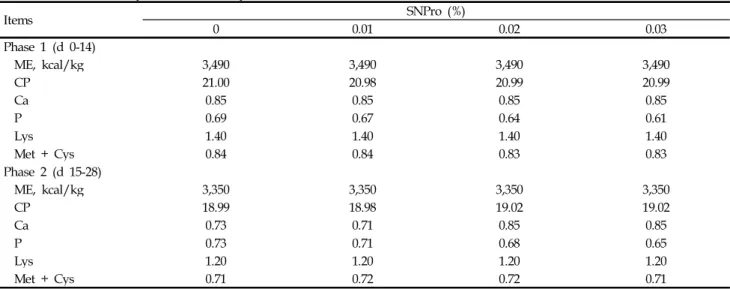
실험사료는 NRC(2012)에 제시된 영양소 요구량을 충족 하도록 배합하였으며, Table 1에 화학적 조성을 나타내었 다. 실험사료는 가루형태로써 물과 함께 자유롭게 채식할 수 있도록 하였다. 실험기간동안 백신을 제외한 약품은 일체 사용하지 않았다.
3. 조사항목
(1) 사양성적
실험을 개시하여 실험 사료를 급여한 후 종료되는 시점 (28일)에 측정한 체중을 통해 일당증체량(ADG, average daily gain)을 산출하였다. 총 사료섭취량은 실험 종료 시 점에 남은 사료량의 무게를 측정하여 산출하였다. 산출된 증체량, 사료섭취량은 실험일수로 나누어 일당증체량과 일당사료섭취량(average daily feed intake, ADFI)를 계산 하였고 위 두 가지를 이용해 사료요구율(feed conversion ratio, FCR)을 산출하였다.
[Provider:earticle] Download by IP 118.70.52.165 at Monday, December 20, 2021 7:44 PM
www.earticle.net
Table 1. Chemical composition of the experimental diet*
Items SNPro (%)
0 0.01 0.02 0.03
Phase 1 (d 0-14)
ME, kcal/kg 3,490 3,490 3,490 3,490
CP 21.00 20.98 20.99 20.99
Ca 0.85 0.85 0.85 0.85
P 0.69 0.67 0.64 0.61
Lys 1.40 1.40 1.40 1.40
Met + Cys 0.84 0.84 0.83 0.83
Phase 2 (d 15-28)
ME, kcal/kg 3,350 3,350 3,350 3,350
CP 18.99 18.98 19.02 19.02
Ca 0.73 0.71 0.85 0.85
P 0.73 0.71 0.68 0.65
Lys 1.20 1.20 1.20 1.20
Met + Cys 0.71 0.72 0.72 0.71
*SNPro, sodium nitrite and probiotics; ME, metabolizable energy; CP, crude protein; Ca, calcium; P, phosphorus; Lys, lysine;
Met, methionine; Cys, cysteine
(2) 면역 반응
혈액 내 cytokine 분비량을 측정하기 위하여 porcine kit(BD biosciences, USA)를 이용하였다. Capture antibody(anti procine IL-8, IL-10, IgG, TLR-4)를 희석하 기 위해 coating buffer(0.1M carbonate, pH 9.5)를 이용한 후, 96 well microplate에 100㎕씩 분주한 후 4℃ 온도에 서 12시간 반응시킨 후 96 well microplate에 들어있는 coating buffer를 없애고 wash buffer(0.05% Tween20, PBS)를 이용해 3회 세척한다. blocking buffer(1% BSA, PBS) 200㎕씩 분주하고 상온에서 1~2시간 동안 방치시킨 후 3회 세척하였다. Sample diluent solution(1% BSA, 0.05% Tween 20, PBS)으로 혈청을 희석하여 200㎕씩 분 주하고 실온에서 2~4시간 동안 반응시킨 후 다시 4회 세 척하였다. 이어서 working detector(detection antibody+Avidin-HRP) 100㎕를 분주하고 빛이 들어오지 않는 암전된 곳에서 30분 동안 반응시켰다. 반응을 정지 시키기 위해 2N H2SO4를 넣은 후, microplate reader(Benchmarkplus, Bio-Rad Laboratories, USA)를 이 용하여 450nm에서 흡광도를 측정하고 표준곡선을 작성하 여 함량을 구하였다.
(3) 장 내 미생물
장 내 미생물은 Kim 등(2017)의 분석 방법을 기반으로 하여 채취한 내용물은 아이스박스에 밀봉하여 즉시 실험 실로 옮겨 분석하였다. 장 내 미생물 검사는 맹장 내용물 5g씩 45ml 희석액을 균질화시켜 현탁액을 제조하고 peptone과 L-cysteine·HCl을 각각 0.5%, 0.05%씩 첨가한 희석액을 제조하여 사용하였다. 제조된 현탁액 1ml는 희
석액 9ml에 연속 희석하였다. 희석 중 공기 유입을 방지 하기 위하여 파라핀 오일로 희석액 표면을 코팅하였고 실 험은 질소가스로 충진하며 진행하였다. 연속 희석된 희석 액 중 적절한 농도를 골라 1ml를 한천배지에 도말하고 배 양하였다.
(4) 장 내 융모 성상
소장 내 융모 성상을 관찰하기 위하여 처리 별 6두(총 24두)씩 실험 종료 시 도살한 후 회장말단부로부터 상단 15cm 부위를 잘라내어 식염수로 깨끗하게 세척한 후 formalin 용액(10% 농도)에 넣어 전자현미경으로 측정할 때까지 상온 보관하였다.
소장 내 융모 성상을 관찰하기 위하여 10% formalin 용 액에 보관되어 있던 회장말단부를 paraffin으로 단단히 고 정시킨 후 절단하여(6㎛ 크기) azure A와 eosine으로 염색 하였다. 염색한 시료는 40배 배율에서 전자현미경으로 측 정하였다(Cera et al., 1988). 융모 높이와 융와 깊이의 비 율은 두 수치를 나누어 산출하였다.
(5) 통계 분석
본 실험에서 얻은 자료에 대한 통계 분석은 SAS 9.3(2012) 프로그램의 general linear model(GLM)을 이용 하여 SNPro 첨가수준에 대한 linear와 quadratic 효과를 조사하였다. 사양성적 실험단위는 돈방으로 설정하였고, 면역반응, 장 내 미생물 및 융모 성상은 처리구별 6두씩 개체 단위로 설정하였다. 통계 유의적 차이는 유의 수준 은 p-value가 0.05 이하에서 인정하였다.
[Provider:earticle] Download by IP 118.70.52.165 at Monday, December 20, 2021 7:44 PM
www.earticle.net
Ⅲ. 결과 및 고찰
1. 사양성적
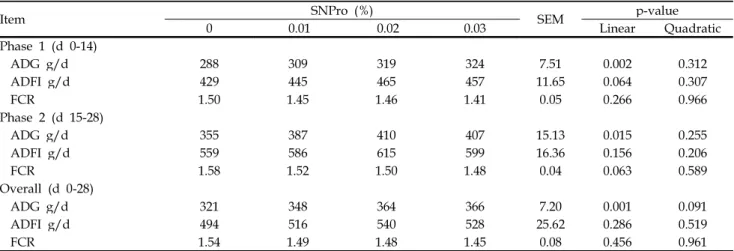
사료 내 SNPro의 첨가 수준에 따른 이유자돈의 사양성 적은 Table 1과 같다. SNPro의 첨가 수준에 의해 Phase 1 과 2, Overall의 일당증체량(ADG)은 SNPro 첨가 수준이 증가함에 따라 유의적으로 증가하는 것으로 나타났다 (p<0.05). 일당사료섭취량(ADFI)과 사료요구율(FCR)은 SNPro 첨가 수준에 따른 유의적인 차이가 나타나지 않았 다(p>0.05).
사료원료로써 아질산 나트륨을 통한 산화질소 급여에 대한 연구결과는 매우 부족한 실정이며, 대부분은 연구는 L-arginine을 통한 산화질소 급여에 대한 연구가 이루어졌 다(Garbossa et al., 2015; Li et al. 2015; Hu et al., 2017).
이유자돈 사료 내 L-arginine 수준 별 첨가 시 일당증체량 이 개선된다고 보고되었으며(Tan et al., 2009; Wu et al., 2009), 이는 본 실험결과와 일치하는 것으로 나타났다. 본 실험 결과 SNPro 0.03% 첨가가 이유자돈 성장에 긍정적 인 영향을 나타내며, 산화아연 대체제로써 활용이 가능한 것으로 판단된다.
2. 면역 반응
사료 내 SNPro의 첨가 수준에 따른 이유자돈의 면역 반응은 Fig. 1과 같다. IL-8과 IL-10은 SNPro 첨가 수준이 증가할수록 유의적으로 감소하였으며(p<0.05), TLR4와 IgG는 첨가 수준에 따른 유의적인 차이가 나타나지 않았 다(p>0.05).
돼지는 이유 후 짧은 시간 내에 전염증성 사이토카인 유 전자 발현이 증가하는 것으로 알려져 있다(Pié et al., 2004; Hu et al., 2013; Ji et al., 2017). 높은 염증 수치는 림프구에서 사이토카인의 분비를 증가시킨다고 보고되었 으며(Manzano et al., 2002), 이러한 사이토카인은 면역체 계의 구성요소로써 매우 중요한 것으로 알려져 있다 (Escobar et al., 2004; Li et al., 2007). 체내에서 IL-8은 염 증 부위에 작용하며 중성구를 활성화하며, IL-10은 면역체 계를 활성화하고 항체 매개 반응을 일으킨다(Evoy et al., 1998; Bauer et al., 2006). 본 실험 결과 SNPro 0.03% 첨 가가 이유자돈 면역 반응에 긍정적인 영향을 나타내며, 산화아연 대체제로써 활용이 가능한 것으로 판단된다.
3. 장 내 미생물
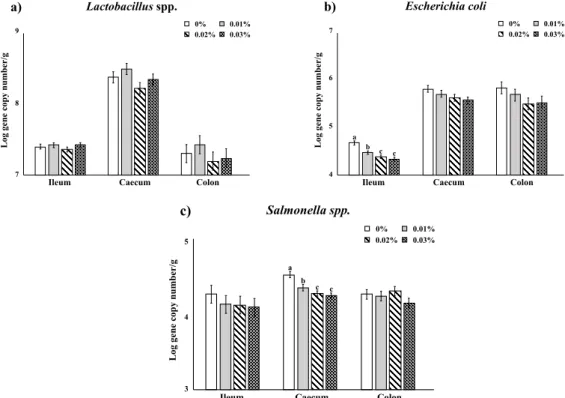
사료 내 SNPro의 첨가 수준에 따른 장 내 미생물에 미 치는 영향은 Fig. 2와 같다. 이유자돈의 회장과 맹장, 결장 내 Lactobacillus spp.는 사료 내 SNPro의 첨가 수준에 따 라 유의적인 차이가 나타나지 않았다(p>0.05). 이유자돈의 맹장과 결장 내 Escherichia coli는 사료 내 SNPro 첨가 수 준에 따라 유의적인 차이는 나타나지 않았으나(p>0.05), 회장 내 Escherichia coli는 사료 내 SNPro 첨가 수준이 증 가함에 따라 유의적으로 감소하였다(p<0.05). 이유자돈 회 장과 결장 내 Salmonella spp.는 사료 내 SNPro 첨가 수준 에 따라 유의적인 차이가 나타나지 않았으나(p>0.05), 맹 장 내 Salmonella spp.는 사료 내 SNPro 첨가 수준이 증가 함에 따라 유의적으로 감소하였다(p<0.05).
장 내 미생물 또는 미생물 총은 돼지의 영양과 생리, 면 역 기능을 유지하는데 중요한 역할을 한다고 알려져 있다 (Lee and Mazmanian, 2010; Brestoff and Artis, 2013). 장
Table 1. Effects of dietary supplementation of SNPro on growth performance of weaned pigs1)
Item SNPro (%) SEM p-value
0 0.01 0.02 0.03 Linear Quadratic
Phase 1 (d 0-14)
ADG g/d 288 309 319 324 7.51 0.002 0.312
ADFI g/d 429 445 465 457 11.65 0.064 0.307
FCR 1.50 1.45 1.46 1.41 0.05 0.266 0.966
Phase 2 (d 15-28)
ADG g/d 355 387 410 407 15.13 0.015 0.255
ADFI g/d 559 586 615 599 16.36 0.156 0.206
FCR 1.58 1.52 1.50 1.48 0.04 0.063 0.589
Overall (d 0-28)
ADG g/d 321 348 364 366 7.20 0.001 0.091
ADFI g/d 494 516 540 528 25.62 0.286 0.519
FCR 1.54 1.49 1.48 1.45 0.08 0.456 0.961
SEM, standard error of mean
1)Data represent means based on six replicates per treatment
[Provider:earticle] Download by IP 118.70.52.165 at Monday, December 20, 2021 7:44 PM
www.earticle.net
IL-8 (ng/ml)
0.01% 0.02% 0.03%
0%
a) IL-8 16 15 14 13 12 11 10
SNPro a
b
c c
IL-10 (ng/ml)
0.01% 0.02% 0.03%
0%
IL-10
b)
175 170 165 160 155 150 145
SNPro a
a
b
c
140
TLR4
0.01% 0.02% 0.03%
0%
c)
TLR4 54
SNPro 3
IgG (ng/ml)
0.01% 0.02% 0.03%
0%
d)
IgGSNPro 18
20 22 24 26 28
Fig. 1. Effects of dietary supplementation of SNPro on immune response of weaned pigs. Letters on the top of left corner of plots represents: a, IL-8. b, IL-10. c, TRL-4. d, IgG. Error bars were represented standard error of means. Linear effects were found at IL-8 and IL-10 (p<0.05). Data represent means based on six replicates per treatment
Log gene copy number/g
Caecum Colon
Ileum 8
7 9
a) Lactobacillus spp.
0%
0.02%
0.01%
0.03%
Log gene copy number/g
Caecum Colon
Ileum 6
4 7
b) Escherichia coli
0%
0.02%
0.01%
0.03%
5 a
b c c
Log gene copy number/g
Caecum Colon
Ileum 3
5
c) Salmonella spp.
0%
0.02%
0.01%
0.03%
4
a b c c
Fig. 2. Effects of dietary supplementation of SNPro on bacterial number g (log gene copy number/g) in the digesta of the different part of digestive. Letters on the top of left corner of plots represents: a, Lactobacillus spp.. b, Escherichia coli. c, Salmonella spp.. Error bars were represented standard error of means. Linear effects (p<0.05) were found at Escherichia coli in ileum and at Salmonellaspp. in caecum. Data represent means based on six replicates per treatment
[Provider:earticle] Download by IP 118.70.52.165 at Monday, December 20, 2021 7:44 PM
www.earticle.net
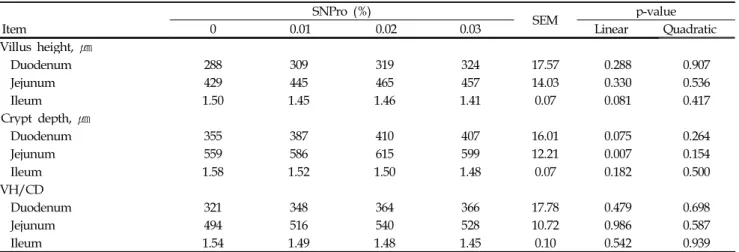
Table 2. Effects of dietary supplementation of SNPro on small intestinal morphology in weaned pigs1) Item
SNPro (%) SEM p-value
0 0.01 0.02 0.03 Linear Quadratic
Villus height, ㎛
Duodenum 288 309 319 324 17.57 0.288 0.907
Jejunum 429 445 465 457 14.03 0.330 0.536
Ileum 1.50 1.45 1.46 1.41 0.07 0.081 0.417
Crypt depth, ㎛
Duodenum 355 387 410 407 16.01 0.075 0.264
Jejunum 559 586 615 599 12.21 0.007 0.154
Ileum 1.58 1.52 1.50 1.48 0.07 0.182 0.500
VH/CD
Duodenum 321 348 364 366 17.78 0.479 0.698
Jejunum 494 516 540 528 10.72 0.986 0.587
Ileum 1.54 1.49 1.48 1.45 0.10 0.542 0.939
SEM, standard error of mean
1)Data represent means based on six replicates per treatment
내 미생물 총의 불균형으로 인해 질병에 감염될 확률은 급 격히 높아진다. 이유자돈 사료 내 복합 생균제 급여 시 유 해균이 감소한 연구결과가 보고되었으며(Balasubramanian et al., 2016; Nguyen et al., 2019), 이는 본 실험결과와 일 치하는 것으로 나타났다. 본 실험 결과 SNPro 0.03% 첨가 가 이유자돈 소장 내 유해균 억제에 긍정적인 영향을 나 타내며, 산화아연 대체제로써 활용이 가능한 것으로 판단 된다.
4. 장 내 융모 성상
사료 내 SNPro의 첨가 수준에 따른 장관 융모 성상은 Table 2와 같다. 사료 내 SNPro의 첨가 수준이 증가함에 따라 이유자돈 공장의 융와 깊이에 영향을 미치는 것으로 조사되었으나 융모 형태 및 융모 높이와 융와 깊이에는 효과가 없는 것으로 나타났다.
이유자돈 십이지장, 공장 및 회장 융모의 길이는 사료 내 SNPro 첨가 수준이 증가함에 따라 유의적인 차이가 나타나지 않았다(p>0.05). 이유자돈 공장 융와 깊이는 SNPro 첨가 수준이 증가함에 따라 유의적으로 깊게 나타 났으나(p<0.05), 십이지장과 회장에서는 유의적인 차이가 나타나지 않았다(p>0.05). 이유자돈 십이지장과 공장, 회 장 융모 길이와 융와 깊이 비율에서는 유의적인 차이가 나타나지 않았다(p>0.05).
이유 스트레스는 장 위축과 기능 장애를 유발하기 때문 에 융모 길이와 융와 깊이는 매우 중요하다(Hampson, 1986; Gu et al., 2002; Wang et al., 2009). 이유자돈 사료 내 L-arginine 급여 시 공장 융와 깊이가 유의적으로 나타 났다고 보고되었다(Wu et al., 2010). 이는 본 실험결과와
일치하는 것으로 나타났다. 하지만, Yoon 등(2020)의 연구 결과에서는 L-arginine 첨가에 따른 변화는 발견되지 않았 다. 본 실험 결과 SNPro 0.03% 첨가가 이유자돈 소장 내 융모 성상에 긍정적인 영향을 나타내며, 산화아연 대체제 로써 활용이 가능한 것으로 판단된다.
Ⅳ. 요약
본 실험은 이유자돈 사료 내 산화아연 대체제로써 아질 산 나트륨과 생균제(sodium nitrite and probiotics, SNPro)의 첨가 수준에 따른 사양성적, 면역 반응, 장 내 미생물 및 융모 성상을 평가하여 사료 내 SNPro의 적정 첨가 수준을 구명하기 위해 실시하였다. 본 시험을 위해 체중이 6.51±0.15kg인 총 192 두의 이유자돈(Landrace×
Yorkshire×Duroc)을 공시하여 4처리 6반복, 반복 당 8두 씩 완전임의 배치하였다. 시험 기간은 Phase 1과 2로 나 누어 진행하였다(각 14일). 시험 처리구는 1) Basal diet(control), 2) SNPro1(control+0.01% SNPro), 3) SNPro2(control+0.02% SNPro), 4) SNPro3(control+0.03%
SNPro)로 구성하였다. 일당증체량(ADG)은 SNPro 첨가 수준(0%, 0.01%, 0.02%, 0.03%)에 따라 phase 1에서는 288, 309, 319, 324g phase 2에서는 355, 387, 410, 407g overall에서는 321, 348, 364, 366g 으로 나타났다(p<0.05).
면역반응은 SNPro 첨가 수준에 따라 IL-8은 15, 13.5, 13, 12.8 ng/ml과 IL-10은 165, 162, 155, 145 ng/ml으로 감소 하였으나(p< 0.05), TLR4와 IgG는 첨가 수준에 따른 유의 적인 차이가 나타나지 않았다. 회장 내 Escherichia coli와
[Provider:earticle] Download by IP 118.70.52.165 at Monday, December 20, 2021 7:44 PM
www.earticle.net
맹장 내 Salmonella spp.는 사료 내 SNPro 첨가 수준이 증 가함에 따라 유의적으로 감소하였다(p<0.05). 그러나, 사 료 내 SNPro 첨가 수준이 Lactobacillus spp.에는 효과가 없는 것으로 나타났다. 장 내 융모 성상에서는 사료 내 SNPro의 첨가 수준에 따라 이유자돈 공장의 융와 깊이가 599, 586, 615, 599 ㎛인 것으로 조사되었으나(p<0.05), 융 모 높이와 융모 높이/융와 깊이 비율에는 효과가 없는 것 으로 나타났다. 본 연구결과를 요약하면, 사료 내 SNPro 첨가는 이유자돈의 성장과 면역 반응, 장 내 미생물 및 융 모 성상에 긍정적인 효과를 미쳤다. 또한 본 연구에서는 첨가 수준이 0.02%에서 효과가 가장 우수한 것으로 나타 났으며, 이는 이유자돈 사양성적 개선 및 산화아연 대체 제로써 우수한 효과를 나타내는 것으로 보여진다.
사사
본 논문은 농촌진흥청 연구사업(세부과제번호:PJ014796) 의 지원 및 2021년도 농촌진흥청 국립축산과학원 전문연 구원 과정 지원사업에 의해 이루어진 것임
Ⅴ. 참고문헌
1. AOAC. 2007. Official Methods of Analysis. 18th Edition, Association of Official Analytical Chemists, Gaithersburg.
2. Bogdan, C. 2001. Nitric oxide and the immune response. Nat. Immunol. 2:907–916.
3. Bird, I. M., Zhang, L. and Magness, R. R. 2003.
Possible mechanisms underlying pregnancy-induced changes in uterine artery endothelial function. Am. J.
Phys. Reg. Integrative and Comparative Physiology.
284:R245–R258.
4. Bauer, E., Williams, B. A., Smidt, H., Verstegen, M.
W. and Mosenthin, R. 2006. Influence of the gastrointestinal microbiota on development of the immune system in young animals. Curr. Iss. Intest.
Micro. 7(2):35-52.
5. Brestoff, J. R. and Artis, D. 2013. Commensal bacteria at the interface of host metabolism and the immune system. Nat. Immunol. 14(7):676-684.
6. Balasubramanian, B., Li, T. and Kim, I. H. 2016.
Effects of supplementing growing-finishing pig diets with Bacillus spp. probiotic on growth performance and meat-carcass grade quality traits. Braz. J. Ani.
Sci. 45:93-100.
7. Balasubramanian, B., Lee, S. I. and Kim, I. H. 2018.
Inclusion of dietary multi-species probiotic on growth performance, nutrient digestibility, meat quality traits, fecal microbiota and diarrhea score in growing–
finishing pigs. Ital. J. Ani. Sci. 17(1):100–106.
8. Case, C. L. and Carlson, M. S. 2002. Effect of feeding organic and inorganic sources of additional zinc on growth performance and zinc balance in nursery pigs. J. Ani. Sci. 80(7):1917-1924.
9. Cockburn, A., Brambilla, G., Fernández, M. L., Arcella, D., Bordajandi, L. R., Cottrill, B., Peteghem, C. and Dorne, J. L. 2013. Nitrite in feed: from animal health to human health. Toxicol. Appl. Pharmacol.
270(3):209-217.
10. Evoy, D., Lieberman, M. D., Fahey III, T. J. and Daly, J. M. 1998. Immunonutrition: the role of arginine. Nutr. 14(7-8):611-617.
11. Escobar, J., Van Alstine, W. G., Baker, D. H. and Johnson, R. W. 2004. Decreased protein accretion in pigs with viral and bacterial pneumonia is associated with increased myostatin expression in muscle. J. Nutr. 134(11):3047-3053.
12. European Centre for Disease Prevention and Control (ECDC), European Food Safety Authority (EFSA) and European Medicines Agency (EMA). 2017.
ECDC/EFSA/EMA second joint report on the integrated analysis of the consumption of antimicrobial agents and occurrence of antimicrobial resistance in bacteria from humans and food‐
producing animals: Joint Interagency Antimicrobial Consumption and Resistance Analysis (JIACRA) Report. EFSA Journal, 15(7):e04872.
13. Gu, X., Li, D. and She, R. 2002. Effect of weaning on small intestinal structure and function in the piglet. Arch. Ani. Nutr. 56(4):275-286.
14. Garbossa, C. A. P., Júnior, F. C., Silveira, H., Faria, P. B., Schinckel, A. P., Abreu, M. L. T. and Cantarelli, V. S. 2015. Effects of ractopamine and arginine dietary supplementation for sows on growth performance and carcass quality of their progenies. J. Ani. Sci. 93(6):2872-2884.
[Provider:earticle] Download by IP 118.70.52.165 at Monday, December 20, 2021 7:44 PM
www.earticle.net
15. Hampson, D. J. 1986. Alterations in piglet small intestinal structure at weaning. Res. Vet. Sci. 40(1):
32-40.
16. Højberg, O., Canibe, N., Poulsen, H. D., Hedemann, M. S. and Jensen, B. B. 2005. Influence of dietary zinc oxide and copper sulfate on the gastrointestinal ecosystem in newly weaned piglets. Appl. Environ.
Microbiol. 71(5):2267-2277.
17. Hu, C. H., Xiao, K., Luan, Z. S. and Song, J. 2013.
Early weaning increases intestinal permeability, alters expression of cytokine and tight junction proteins, and activates mitogen-activated protein kinases in pigs. J. Ani. Sci. 91(3):1094-1101.
18. Hu, C. J., Jiang, Q. Y., Zhang, T., Yin, Y. L., Li, F.
N., Deng, J. P., Wu, G. Y. and Kong, X. F. 2017.
Dietary supplementation with arginine and glutamic acid modifies growth performance, carcass traits, and meat quality in growing-finishing pigs. J. Ani.
Sci. 95(6):2680-2689.
19. Janczyk, P., Büsing, K., Dobenecker, B., Nöckler, K.
and Zeyner, A. 2015. Effect of high dietary zinc oxide on the caecal and faecal short‐chain fatty acids and tissue zinc and copper concentration in pigs is reversible after withdrawal of the high zinc oxide from the diet. J. Ani. Physiol. Ani. Nutr. 99:13-22.
20. Ji, Y., Wu, Z., Dai, Z., Wang, X., Li, J., Wang, B.
and Wu, G. 2017. Fetal and neonatal programming of postnatal growth and feed efficiency in swine. J.
Ani. Sci. Biotechnol. 8(1):1-15.
21. Kim, S., Kim, H., Yim, Y. S., Ha, S., Atarashi, K., Tan, T. G., Longman, R. S., Honda, K., Littman, D.
R., Choi, G. B. and Huh, J. R. 2017. Maternal gut bacteria promote neurodevelopmental abnormalities in mouse offspring. Nat. 549(7673):528-532.
22. Lundberg, J. O. and Govoni, M. 2004. Inorganic nitrate is a possible source for systemic generation of nitric oxide. Free. Radical. Biol. Med. 37:395–400.
23. Li, P., Yin, Y. L., Li, D., Kim, S. W. and Wu, G.
2007. Amino acids and immune function. Br. J.
Nutr. 98(2):237-252.
24. Lee, Y. K. and Mazmanian, S. K. 2010. Has the microbiota played a critical role in the evolution of the adaptive immune system?. Sci. 330(6012):1768- 1773.
25. Li, J., Xia, H., Yao, W., Wang, T., Li, J., Piao, X.,
Thacker, P., Wu, G. and Wang, F. 2015. Effects of arginine supplementation during early gestation(day 1 to 30) on litter size and plasma metabolites in gilts and sows. J. Ani. Sci. 93(11):5291-5303.
26. Lan, R., Tran, H. and Kim, I. 2017. Effects of probiotic supplementation in different nutrient density diets on growth performance, nutrient digestibility, blood profiles, fecal microflora and noxious gas emission in weaning pig. J. Sci. Food.
Agric. 97(4):1335–1341.
27. Lynegaard, J. C., Kjeldsen, N. J., Bache, J. K., Weber, N. R., Hansen, C. F., Nielsen, J. P. and Amdi, C.
2021. Low protein diets without medicinal zinc oxide for weaned pigs reduced diarrhoea treatments and average daily gain. Ani. 15(1):100075.
28. Manzano, M., Abadía-Molina, A. C., García-Olivares, E., Gil, A. and Rueda, R. 2002. Absolute counts and distribution of lymphocyte subsets in small intestine of BALB/c mice change during weaning. J. Nutr.
132(9):2757-2762.
29. NRC(National Research Council). 2012. Nutrient requirements of swine. 11th revised edition.
National Academy Press, Washington, DC, USA.
30. Nguyen, D. H., Nyachoti, C. M. and Kim, I. H.
2019. Evaluation of effect of probiotics mixture supplementation on growth performance, nutrient digestibility, faecal bacterial enumeration, and noxious gas emission in weaning pigs. Ital. J. Ani.
Sci. 18(1):466-473.
31. Poulsen, H. D. 1995. Zinc oxide for weanling piglets. Acta. Agric. Scand. Sect. A. 45(3):159-167.
32. Pié, S., Lallès, J. P., Blazy, F., Laffitte, J., Sève, B.
and Oswald, I. P. 2004. Weaning is associated with an upregulation of expression of inflammatory cytokines in the intestine of piglets. J. Nutr.
134(3):641-647.
33. Reid, G., Jass, J., Sebulsky, M. T. and McCormick, J.
K. 2003. Potential uses of probiotics in clinical practice. Clin. Microbiol. Rev. 16(4):658–672.
34. Shen, J., Chen, Y., Wang, Z., Zhou, A., He, M., Mao, L., Zou, H., Peng, Q., Xue, B., Wang, L., Zhang, X., Wu, S. and Lv, Y. 2014. Coated zinc oxide improves intestinal immunity function and regulates microbiota composition in weaned piglets.
Br. J. Nutr. 111(12):2123-2134.
[Provider:earticle] Download by IP 118.70.52.165 at Monday, December 20, 2021 7:44 PM
www.earticle.net
35. Shi, H., Kim, J. K. and Kim, I. H. 2019. Effects of dietary l-arginine on growth performance, nutrient digestibility, gas emission, and meat quality in finishing pigs. Ani. Feed. Sci. Technol. 253:93-100.
36. Tan, B., Li, X. G., Kong, X., Huang, R., Ruan, Z., Yao, K., Deng, Z., Xie, M., Shinzato, I., Yin, Y. and Wu, G. 2009. Dietary L-arginine supplementation enhances the immune status in early-weaned piglets.
Amino acids, 37(2):323-331.
37. Webb, A. J., Patel, N., Loukogeorgakis, S., Okorie, M., Aboud, Z., Misra, S., Rashid, R., Miall, P., Deanfield, J., Benjamin, N., MacAllister., R., Hobbs, A. J. and Ahluwalia, A. 2008. Acute blood pressure lowering, vasoprotective, and antiplatelet properties of dietary nitrate via bioconversion to nitrite.
Hypertension 51:784–790.
38. Wang, X., Ou, D., Yin, J., Wu, G. and Wang, J.
2009. Proteomic analysis reveals altered expression of proteins related to glutathione metabolism and apoptosis in the small intestine of zinc oxide- supplemented piglets. Amino acids. 37(1):209-218.
39. Wu, X., Ruan, Z., Gao, Y., Yin, Y., Zhou, X., Wang, L., Geng, M., Hou, Y. and Wu, G. 2010. Dietary
supplementation with L-arginine or N-carbamylglutamate enhances intestinal growth and heat shock protein-70 expression in weanling pigs fed a corn-and soybean meal-based diet. Amino acids, 39(3):831-839.
40. Yan, L. and Kim, I. H. 2011. The apparent total tract digestibility, apparent ileal digestibility and faecal noxious gas content of growing pigs fed probiotics in diets. Wayamba J. Ani. Sci. 3:121–123.
41. Yoon, S. Y., Sa, S. J., Cho, E. S., Ko, H. S., Choi, J.
W. and Kim, J. S. 2020. Effects of zinc oxide and arginine on the intestinal microbiota and immune status of weaned pigs subjected to high ambient temperature. Ani. 10(9):1537.
42. Zhao, P. Y. and Kim, I. H. 2015. Effect of direct-fed microbial on growth performance, nutrient digestibility, fecal noxious gas emission, fecal microbial flora and diarrhea score in weanling pigs. Ani. Feed. Sci.
Technol. 200:86–92.
(Received 12 August 2021, Revised 27 September 2021, Accepted 28 September 2021)
[Provider:earticle] Download by IP 118.70.52.165 at Monday, December 20, 2021 7:44 PM