Vol. 2, No. 2, pp.9-15, May 31, 2016. pISSN 2384-0358, eISSN 2384-0366
. INTRODUCTION
Ⅰ
Recently as medical facilities have experience highly technological improvement as many people are now requesting more variety of problems to the hospital. Reducing of hospital days increases more variety diseases and unpredictable problems with legal, professional educational. Therefore Nursing clients have became people with variety of back grounds such as socially, culturally, and religiously. Nursing students are people who will be caring the people of variety
of differences in social status, culture, and the religion back ground. Therefore Nurses are required to have critical thinking includes exploration, adaptation, analysis, synthesis, and evaluation (Simpson & Courtney. 2002).
These clients are needed to have whole person, artistic and scientific care service it will be composed to rational thinking, adaptation, analysis, synthesis and evaluation like a critical thinking(Schank 1990). The purpose of education is to have rational thinking to students (Dewey. 1933), And Improving critical thinking in education is very important
*정회원 창원문성대학교 간호학과,
접수일자: 2016년 월3 11 ,일 수정완료일자: 2016년 월3 17일 게재확정일자: 2016년 월3 30일
Received: 11 March, 2016 / Revised: 17 March, 2016 Accepted: 30 March, 2016
*Corresponding Author: [email protected] Dept.: Nursing, Changwon Moonsung University http://dx.doi.org/10.17703/JCCT.2016.2.2.9
JCCT 2016-5-2
비판적 사고 성향과 기초간호과학 간의 관계
The Relationship between Critical Thinking Disposition and Basic Nursing Science
Abstract Objectives : The purpose of this study to investigate the Critical Thinking disposition in Nursing College students and related to ability of basic nursing science. Methods : Data were collected from 36 students who were students belong to one of province University. The instrument used in this study was California Critical Thinking Disposition Inventory(CCTDI) by Facione & Facione. The instrument was composed of 7 sub-items, truth-seeking, analyticity, systematicity, open-mindness, critical thinking, self-confidence, inquisitiveness, and maturity. The data were analyzed by descriptive statistics, t-test, ANOVA, Pearson Correlations with SPSS 12.0. Results : The result of this study were as follow; The average of total score in critical thinking disposition was 44.8, which means middle level(below 40: low, above 50: high level). Maturity was the highest while open-mindness was the lowest with an average score 5.01. There was significant difference between critical thinking and basic nursing science grade while there was no difference between age, gender, and religion. There was strongly relation between critical thinking disposition and basic nursing science(F=2.84, p=.01). Conclusion : According to the results of this study, nursing curriculum should be considered critical thinking disposition.
Key Words :Criical thinking disposition, Basic nursing science.
(McPeck. 1981).
Therefore It is required to have critical thinking such as exploration, adaptation, analysis, synthesis, and evaluation in nursing area as a essential composition (Simpson &
Courtney. 2002).
Critical thinking is mainly focused on self controlling judgement in both officially and personally and using of self-disposition, and habits (Facione. Facione. & Sanchez.
1994). American Psychological Association have concluded the critical thinking by having a research project in 1990.
Critical thinker is 'someone who has habits of many inquisitiveness, informative, logical, flexible, open mind, and fairly evaluate things. So they think repeatedly, interpretive on issues, and prioritizes complicated problem, as well as who can seek appropriate information and establish rational standard, and exploration(APA. 1990). In 1990, The U.S.
have started to insert critical thinking in nursing area, NLN(National League for Nursing) have suggested the critical thinking as a evaluating of nursing school and chose it to be the goal of nursing education. Also NLM focused on New Nurses who have just completed regular basic education course to use their knowledge in complicate and fast changing clinical situations (Haffer & Raingruber.
1998). National League for Nursing Accrediting Commission (NLNAC, 2002) considered research relate to critical thinking to develop and promote for students based on effect of nursing education.
Critical thinking is composed of 7 sub-items, truth-seeking, analyticity, systematicity, open-mindness, critical thinking self-confidence, inquisitiveness, and maturity. First, Truth-seeking is seeking the best knowledge from the given environment. Even though the result comes out differently from self intention, try to have honest and objective attitude.
It is willingness to correct own viewpoint honestly when the change is required. Second, Open-mindness is perception of self bias possibility. It can respect other's opinion with an open mind. Third, Analyticity is intended to care potential trouble, predict the possible result, reasonable judgement, and respect the evidence. Fourth, Systematicity is disposition to explore things deeply, systematically, and orderly.
As the definition of critical thinking was developing differently, there were agreements finally in U.S and Canada through Delphi Project for 2 years. Delphi Project was started by American Philosophical Association(APA) and it was composed of 46 experts. Facione, Facione&
Giancarion(1996) had defined that critical thinking is self adjustable conclusion and it is cognitive engine, which can elicit the problem solving as well as decision making through Delphi Project. Fifth, Critical thinking self-confidence is belief of own inference processing. Who have critical thinking self-confidence think they are thought believable man by others. Therefore they think that those who believe them will expect making reasonable decision by them. Sixth, Inquisitiveness is intellectual curiosity. Who have curiosity are being in many information, wanting to know what is going on. Seventh, Maturity is self-examination judgement. This is cautious approach through the several judgement rather than comes to a conclusion(Facione et al, 1996). When we looked at these research, there was no relation between critical thinking ability and educational effects but it is still important in educational goal in the U.S. as well as it is processing variety of attempts to increase the critical thinking (Chen &
Lin. 2003: Fakude & Bruce 2003: Kamin. O'Sullivan.
Deterding & Younger. 2003: Profetto-Mcgrath. 2003:
Seymour. Kinn & Sutherland. 2003: Zimmermann. 2003).
In our country, We also study critical thinking in nursing schools and there are "Statistically evaluate the ability of critical thinking for seniors of nursing school (Shin, 1996, 1998), Studies of critical thinking predisposition and nursing implement (Hwang, 1998), Studies of critical thinking predisposition and description of nursing school seniors (Jung, 2001). But these studies were only tested to nurses who have finished nursing studies or seniors in nursing schools, So which shows the deficiency for freshmen in nursing schools.
According to the reasons above, Our study is to evaluate the critical thinking for freshmen and provide them a basic information of critical thinking and longitudinal study follow up. Further more this study also improving the nursing educational process and specific research purposes
Vol. 2, No. 2, pp.9-15, May 31, 2016. pISSN 2384-0358, eISSN 2384-0366
were ; 1) to examine the general critical thinking predisposition for Nursing freshmen 2) To examine the critical thinking according to general characteristics 3) To examine the sub-critical thinking predisposition according to general characteristics 4) To examine co-relation between the sub-critical thinking predisposition 5) To serve basic data for longitudinal study.
.
Ⅱ METHODS
1. Research Design
This study is a descriptive survey that identifies one of the nursing college freshmen's critical thinking predisposition and relation to baility of basic nursing science learning and general characteristics which will be using further longitudinal study as going on a next grade in comparing it two years through nursing education.
2. Definition of Terms
Critical thinking predisposition is defined as individual disposition or habit to solve the problem and decision making in personal or professional work(Facione. N. C., Facione. P. A & Sanchez. 1994). In this study, we have used translated by Hwang(1998) California Critical Thinking Disposition Inventory(CCTDI) originally invented by Facione & Facione(1992). This instrument is showing that as the score gets higher it proves that the test takers have higher critical thinking.
3. Subjects and Data collection procedures
The study was conducted by using a whole sampling method for freshmen from one of the nursing colleges. The subjects had 36 students who completed a structured questionnaire(CCTDI) by self report in this study.
The subjects were explained verbally by researcher about the aims of the study and anonymity was guaranteed.
Self-administered questionnaires were collected right after the respondents completed by researcher. Data were collected from the 3rd of March and 2nd of Dec, 2015.
Withdrawal and response rate were 100% for the study.
4. Instrument
The Critical thinking predisposition was measured by California Critical Thinking Disposition Inventory(CCTDI) (Facione & Facione, 1992), which is a self reporting scale and it provides a quantitative score of perceived subjective critical thinking level. This scale, translated into Korean by Hwang(1998), consists of 50 items and 7 sub-items such as truth-seeking(8 items), analyticity(5 items), systematicity (7 items). open-mindness(5 items), critical thinking self-confidence(9 items), inquisitiveness(10 items), maturity ( 6 items).
This tool has appropriate composition defined by Delphi Project and reliability was Cronbach's ⍺= .90 at development time. This tool's reliability was also proven as Cronbach' alpha .847 by Hwang(1998) and reconfirmed as .842 in this study.
The each item score range was 1 to 6, 6 points Likert scale, strongly agree: 6 points, very agree: 5 points, some agree: 4, some disagree: 3, very disagree: 2, extremely disagree: 1. As the score of CCTDI gets higher it means students have higher critical thinking. It can be described that average over 50 means strong critical thinking and less than 40 means weak.
5. Data analysis
Data were analyzed using SPSS program. The general characteristics, nursing freshmen's critical thinking, critical thinking according to general characteristics, and sub-items critical thinking according to general characteristics were analyzed using descriptive statics. T-test and ANOVA analyzed the difference of critical thinking according to general characteristics. Pearson Correlations analyzed the ability of basic nursing science according to critical thinking disposition. Cronbach's alpha coefficients were calculated for instrument's reliability.
.
Ⅲ RESULT
1. General characteristics
The average age of the subjects were 19.05 years. For the gender of subject, there were more female students, that is
88.89% of subjects were female, comparing to 13.88% who were male students.
In religion, Non religious students were 77.78%, Christians 13.89%, Buddhists 5.55%, and Catholics 2.78%
in order (Table 1).
Table 1. General characteristics (n=36)
2. Critical Thinking
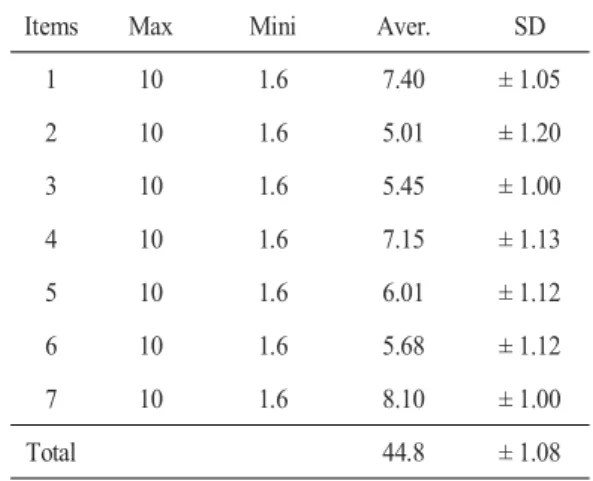
Critical thinking subjects of our study have done 50 questionaries 6 likerts each and highest point you can get per parts are 10 points, maximum of 70 points. Result have come out to be average of critical thinking was 3.89(If you calculate with 44.8: 10 points), Which shows from table 2, that subjects (freshman) are showing to have middle range of critical thinking predisposition.
Looking at the average of each parts, it shows that 'truth seeking' 4.44 (If you calculate with 7.4:10points), 'open mindness' 3.01(5.01), 'analysis 3.2(5.45), 'sysmaticity 4.29(7.15), 'critical thinking self-confidence 3.61(6.01), 'inquisiveness 3.41(5.68), 'maturity 4.86(8.1). As you can see the highest critical thinking disposition of subjects (freshman of nursing students) was the 'truth seeking', and 'open mindness' have showed to be the lowest. Subjects showed to be the highest in maturity but lowest in open mindness.
According to this analysis, 'open mindness' showed the lowest point because, people in a nursing area have low understanding with other people, They have to think differently since they are facing other human being. Also means developing cognitive maturity.
Table 2. Critical thinking predisposition (n=36)
3. Critical Thinking according to general characteristics There was no significant critical thinking according to general characteristics(Table 3).
Table 3. Critical thinking according to general characteristics (n=36)
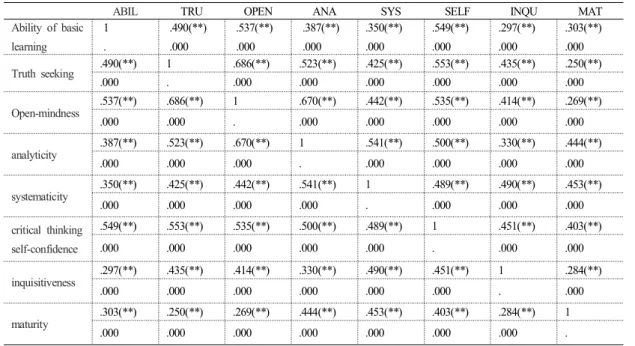
4. Critical Thinking according to ability of basic nursing science learning
There was strongly significant difference between critical thinking and ability of basic nursing science learning (Table 4)
IⅤ. CONCLUSION
This research was undertaken to examine the nursing freshmen's critical thinking predisposition and to survey the difference between critical thinking and ability of basic Items Categories Freq.
(person)
Perc.
(%)
Age 19 34 94.44
20 2 5.56
Gender Male 5 13.88
Female 31 86.12
Religion
non 28 77.78
Christian 5 13.89
Buddhism 2 5.55
Catholic 1 2.78
Items Max Mini Aver. SD
1 10 1.6 7.40 ± 1.05
2 10 1.6 5.01 ± 1.20
3 10 1.6 5.45 ± 1.00
4 10 1.6 7.15 ± 1.13
5 10 1.6 6.01 ± 1.12
6 10 1.6 5.68 ± 1.12
7 10 1.6 8.10 ± 1.00
Total 44.8 ± 1.08
Char. Class. Freq. Mean SD F P
Age 19 34 3.87 .34
.98 .37
20 2 3.95 .44
Gender Male 5 3.95 .45
.81 .36
Female 31 3.88 .36
Religion
non 28 3.89 .38
1.55 .18 Christian 5 3.91 .33
Buddhism 2 3.81 .35
Catholic 1 3.90 .30
Vol. 2, No. 2, pp.9-15, May 31, 2016. pISSN 2384-0358, eISSN 2384-0366
nursing science learning. Also it was implemented to serve longitudinal study data in the future when they are going to next grade through the regular nursing education program.
Futhermore it can be helpful in nursing practice development as examining the relationship between critical thinking and nursing regular program.
Subjects were all freshmen(36) from one of nursing schools in G do G gun and data collection dates are from 3rd of March and 2nd of Dec, 2010
Instrument that has been used for this research was California Critical Thinking Disposition Inventory(CCTDI) translated by Hwang (1998) and proven to be reliable according to (Cronbach's⍺= .847), But this was originally invented by Facione & Facione(1994b). Original CCTDI's reliability was Cronbach's ⍺=.91 and this study's was Cronbach's ⍺= .842. Questionnaire was made up of 53 questions containing 3 general characteristic questions, and 50 critical thinking predispositions. And critical thinking disposition part divided into 7 sub-items, 8 questions of truth seeking, 5 of open-mindness, 5 of anaylsis, 7 of systematicity, 9 of critical thinking self-confidence, 10 of inquisiveness, and 6 of maturity questions. It has 6 Likert scale meaning, 6 points for strongly agree, 5 for very agree, 4 for some agree, 3 for some disagree, 2 for strongly disagree, 1 for absolutely disagree. Therefore as the points gets higher it means the person has a high critical thinking disposition. The collected date had been treated by SPSS program. Subjects' general characteristic had been calculated by existing number and percentage, and critical thinking disposition had been calculated into mean, and SD. The difference between general characteristic and critical thinking disposition was tested by t-test, ANOVA and Pearson Correlation.
The result from this study are as follow. In Subjects general characteristic, Subjects for this study's average age was 19.05, the genders were 13.88% of male and 88.89%
of female, and the religion difference were, 77.78% of None, 13.89% Christians, 5.55% of Buddhism, 2.78% of Catholics. In Critical thinking disposition, The mean of critical thinking disposition was 3.89(If you calculated with 44.8: 10 points), In each parts' mean were 'truth seeking'
4.44(7.40), 'open-mindness' 3.01(5.01), 'anaylsis' 3.2(5.45), 'systematicity' 4.29(7.15), 'critical thinking self-confidence' 3.6(6.01), 'inquisiveness' 3.41(5.68), 'maturity' 4.86(8.1).
The difference between general characteristics such as Age, gender, religion and critical thinking disposition difference did not show significance statistically, But when we checked critical thinking disposition relate to ability of basic nursing learning, there were significant difference.
V. RECOMMENDATION
In nursing educational aspect, It is needed to have a effective teaching method to improve critical thinking disposition of nursing students to get more improve the effective nursing knowledge, it is also needed to have educational curriculum and teaching method to improve both nursing knowledge and critical thinking disposition , and critical thinking disposition should be one of essential consisting factor.
In nursing research aspect, when nursing students goes on a next grade should continue the critical thinking disposition to compare with their old mind and present one as they go furthermore, Objective measure instrument should be invented rather than having self-reporting instrument, and nursing students' are need to have thinking ability practice as well as critical thinking disposition practice.
References
[1] McGregor K, Arbisi-Kelm T, Eden N. The encoding of word forms into memory may be challenging for college students with developmental language impairment. Int J Speech Lang Pathol. 12:1-15. 2016.
[2] Nelson KV, Smith AP. Occupational stress, coping and mental health in Jamaican police officers. Occup Med (Lond). Apr 30. 2016.
[3] Kiani F, Balouchi A, Shahsavani A. Glob J Health Sci.
2;8(9):55883. Investigation of Nursing Students' Verbal
Communication Quality during Patients' Education in Zahedan Hospitals: Southeast of Iran. 2016.
[4] Renschler L, Rhodes D, Cox C. Effect of interprofessional clinical education programme length on students' attitudes towards teamwork. J Interprof Care. 30(3):338-46. 2016.
[5] E.Y, Cho, J.A, Kim, J.Y, Kim, H.J, Kim, E.S, La, H.S, Lee .Relationship between strss, self-efficacy and resilience among nursing students. . JCCT. Vol 2(1) pp 35-43. 2016
[6] I.S, Lee, A study about outfit satisfaction, self-esteem, depression and job stress for nursing students. Journal of the Korean Data Analysis Society. Vol. 13(5), pp.
2487-2500. 2011.
[7] H.S, Park, Y.J, Bae, S.Y, Jeong. A Study on Self-esteem, Self-efficacy, Coping Methods, and the Academic and Job-seeking Stress of Nursing Students.
Journal of Psychiatric Nursing science. Vol. 11(4). pp.
621-631. 2002.
[8] Mwale OG, Kalawa R. Factors affecting acquisition of psychomotor clinical skills by student nurses and midwives in CHAM Nursing Colleges in Malawi: A qualitative exploratory study. BMC Nurs. 4(15)30.
2016.
[9] Choi YJ. Undergraduate Students' Experiences of an Integrated Psychiatric Nursing Curriculum in Korea.
Issues Ment Health Nurs. 4:1-6. 2016.
[10] Eslami Akbar R, Elahi N, Mohammadi E, Fallahi Khoshknab M. What Strategies Do the Nurses Apply to Cope With Job Stress?: A Qualitative Study. Glob J Health Sci. 2015.
[11] Korean Emotional Laborers' Job Stressors and Relievers: Focus on Work Conditions and Emotional Labor Properties. Lee G. Saf Health Work.
6(4):338-44. 2015.
[12] Koinis A, Giannou V, Drantaki V, Angelaina S, Stratou E, Saridi M. The Impact of Healthcare Workers Job Environment on Their Mental-emotional Health. Coping Strategies: The Case of a Local General Hospital. Health Psychol Res. 2015.
[13] Akgumus G, Shah D, Higgs L, Valverde K.
Professional Issues of International Genetic Counseling Students Educated in the United States. J Genet Couns.
2016
[14] Fan Y, Zheng Q, Liu S, Li Q. Construction of a new model of job engagement, psychological empowerment and perceived work environment among Chinese registered nurses at four large university hospitals:
implications for nurse managers seeking to enhance nursing retention and quality of care. J Nurs Manag.
2016.
Vol. 2, No. 2, pp.9-15, May 31, 2016. pISSN 2384-0358, eISSN 2384-0366
Table 4. Critical thinking according to Ability of Basic Nursing Science learning
** Correlation is significant at the 0.01 level
ABIL TRU OPEN ANA SYS SELF INQU MAT
Ability of basic learning
1 .
.490(**) .000
.537(**) .000
.387(**) .000
.350(**) .000
.549(**) .000
.297(**) .000
.303(**) .000
Truth seeking .490(**) 1 .686(**) .523(**) .425(**) .553(**) .435(**) .250(**)
.000 . .000 .000 .000 .000 .000 .000
Open-mindness .537(**) .686(**) 1 .670(**) .442(**) .535(**) .414(**) .269(**)
.000 .000 . .000 .000 .000 .000 .000
analyticity .387(**) .523(**) .670(**) 1 .541(**) .500(**) .330(**) .444(**)
.000 .000 .000 . .000 .000 .000 .000
systematicity .350(**) .425(**) .442(**) .541(**) 1 .489(**) .490(**) .453(**)
.000 .000 .000 .000 . .000 .000 .000
critical thinking self-confidence
.549(**) .553(**) .535(**) .500(**) .489(**) 1 .451(**) .403(**)
.000 .000 .000 .000 .000 . .000 .000
inquisitiveness .297(**) .435(**) .414(**) .330(**) .490(**) .451(**) 1 .284(**)
.000 .000 .000 .000 .000 .000 . .000
maturity .303(**) .250(**) .269(**) .444(**) .453(**) .403(**) .284(**) 1
.000 .000 .000 .000 .000 .000 .000 .