협력통신 환경에서의 새로운 간섭제거 기법
김윤현*, 박영식**, 신동수***, 황유민**, 김진영**, 노정규****
Novel Interference Cancellation Scheme in Cooperation Communication Environment
Yoon Hyun Kim*, Young Sik Park**, Dong Soo Shin***, Yu Min Hwang**, Jin Young Kim**, and Jung Kyu Rho****
요 약
본 논문에서 우리는 다수의 사용자가 존재하는 협력통신 환경에서 있어서 적용 가능한 새로운 간섭제거 기법을 제안하고 그 성능을 분석하였다. Source, Destination, Relay로 이루어진 협력통신시스템에서, 각 환경을 구성하는 ad-hoc 그룹은 인접한 그룹에서 전달 된 다른 간섭 데이터로 인해 본래 데이터의 급격한 품질저하가 발생한다. 따라서 본 논문은 인접 ad-hoc 그룹간의 간섭효과를 줄이 기 위해 제로 포싱과 최소 평균 자승 오차 해법을 이용해 간섭의 크기를 저하시킨다. 이후, 순차적 간섭 제거 기법을 접목해 최종 데이터를 산출해내는 간접제거 시스템을 제안하고 제안한 시스템에 대한 성능을 모의실험을 통해 나타내었다. 본 논문 결과를 이용 하여 다양한 ad-hoc 그룹 환경에서 신호의 독립성을 보장받는 협력통신시스템의 구현을 기대한다.
Key Words : Cooperative Wireless communication Systems, interference cancellation scheme, ad-hoc networks, interference management, bit error probability
ABSTRACT
In this paper, we propose and analyze a novel interference cancellation scheme in cooperation communication environment in which a large number of users exist. In cooperative communication system consisting a source, destination, and relay, ad-hoc groups undergo a rapid degradation because of interference data form adjacent ad-hoc groups. To solve these problems, we propose Zero Forcing (FC) and Minimum Mean Square Error (MMSE) and make a dent in the magnitude of interference. Finally, we can obtain orignal data using Successive Interference Cancellation (SIC). The performance of proposed scheme is analyzed in terms of a bit error probability. The results of the paper can be applied to design of various ad-hoc networks for cooperation communication systems.
이 논문은 2014년도 정부(미래창조과학부)의 재원으로 한국연구재단의 지원을 받아 수행된 연구임(2014R1A5A1011478).
*한국인터넷진흥원([email protected]), **광운대학교 유비쿼터스 통신 연구실([email protected], [email protected], [email protected]),
***방위사업청 육군 중령 ([email protected]), ****서경대학교 컴퓨터과학과([email protected])(교신 저자) 접수일자 : 2014년 8월 31일, 수정완료일자 : 2014년 9월 4일, 최종게재확정일자 : 2014년 9월 11일
I. Introduction
Cooperative wireless communication systems can be used various environment, which it is difficult to construct infrastructures, such as shadowing areas, disaster areas, war area, and so on. The cooperative wireless communication system selects multiple relays to improve transmission performance. However, if several cooperative wireless communication systems coexist in constrained regions, this cause performance degradation by interferences. Interferences are one the most severe
obstacles on pursuing high performance wireless networks. If multiple communication sources attempt to be active simultaneously in proximity, reach communication may interfere others [1]. In cooperative wireless communication, a received signal at each receiver is a mixed one from multiple signal sources. The cancellation of a few interferers by each relay is shown to increase the network capacity dramatically. This being so, many interference cancellation techniques, which have mainly focused on the interference among relays, have been designed. To improve these problems, we propose ZF and
MMSE SIC schemes for the cooperative communication system without interference.
This paper is organized as follows: In Section II, a general cooperative wireless communication system is described. In Section III, we introduce a novel interference cancellation scheme in cooperative wireless relay systems.
Finally, in Section IV, some conclusions and applications are drawn.
Ⅱ. Cooperative Wireless Communication Systems
One of the critical challenging issues in wireless communication systems is the random variation in signal power due to multi-path propagation and shadowing etc.
So, multi-path propagation and shadowing effect will degrade the system performance severely. To solve this problem, a new communication technology called
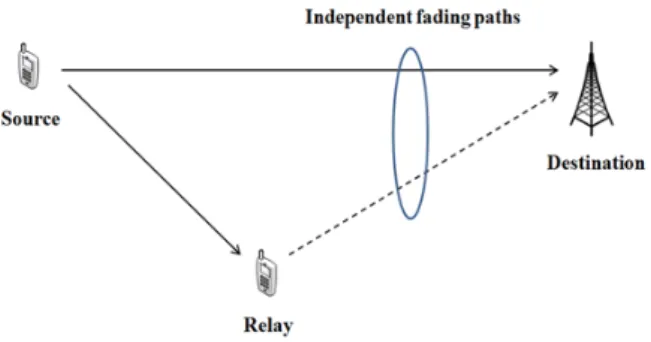
“cooperative” which is to utilize the diversity that can be provided by two or more statistically independent paths as shown Figure 1 has been presented in many research fields.
Now, we introduce brief history background of cooperative communication system as in [2]. The basic idea about the cooperative communication was presented by Cover and EI Gamal in [3], and they analyzed the information theoretical properties of the relay channel consisting of a source, a destination, and a relay. It was assumed that all nodes operate in the same band, so there is a broadcast channel between the source and the relay, and there is a multiple access channel between the relay and the destination as shown in Figure 2. Many ideas that appeared later in the cooperation literatures were first exposited in [4].
Cooperative communication is defined as a specific communication methodology that it can transmit signal through the multi-path channels from the communication node over 2 units which have equivalent function, and then the signal must be transmitted to the destination through at least one path, and finally, the destination can combine and estimate the signal using the direct path and relay path [5].
Fig. 1. Basic concept of cooperative communication.
Fig. 2. Relay channel model.
IEEE 802.16j has interest in cooperative communication using relay station, and they define that communication scheme as “cooperative relay communication systems”.
For example, in the simple relay communication systems, the signal is only relayed from the relay to the destination through one or many relays at the uplink or downlink when there is no link between mobile station (MS) and base station (BS). On the other hand, in the cooperative relay, signal is transmitted to the destination through a lot of paths which is composed by cooperation of relays.
Thus, cooperative relay communication systems can improve the system reliability with diversity gain, and can improve the bandwidth efficiency with spatial multiplexing gain [6].
Combination of cooperative relay communication and tactical communication based on ad-hoc networks has some specific advantages as follow. Tactical communication systems based on ad-hoc networks face significant design challenges to achieve the desired performance and coverage range due to limitations on the transmit power level. One method for overcoming these problems is adopting analog repeaters. But the repeaters amplify both wanted and unwanted signals so their application is confined to specific cases. Especially, analogue repeater is very vulnerable to the jamming signals from the enemy forces. The other way is the employment of multiple-input multiple-output (MIMO)
technology in to the tactical ad-hoc network systems. The tactical ad-hoc network systems with MIMO technology can effectively exploit the available spatial and frequency diversities. Then, the system performance and coverage range can be significantly improved. However, it is not easy to apply MIMO technology to the tactical ad-hoc network systems because multiple antennas need to be installed to the transmitter, receiver, or both and there are size, cost, or hardware limitations. One possible way to solve this problem and to benefit from the performance enhancement introduced by MIMO systems is through the use of cooperative communications in the tactical ad-hoc network systems. In the cooperative communication network, all users or nodes help each other to send signals to the destination cooperatively. Multiple copies of the transmitted signals due to the cooperation among users result in a cooperative diversity, which can significantly improve the system performance and robustness.
Ⅲ. Proposed System model
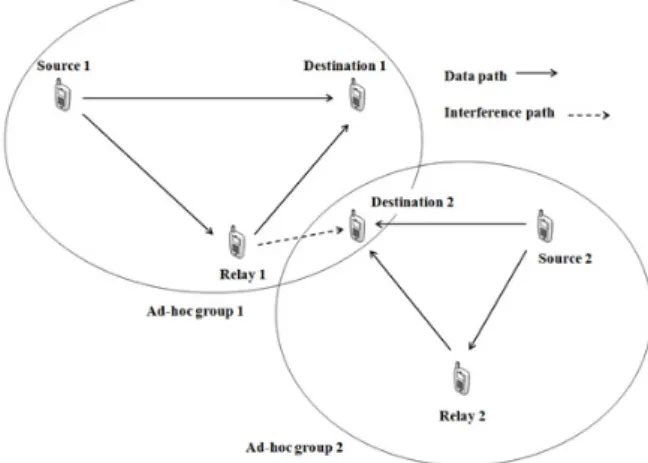
The simple interference scenario in cooperative wireless relay system based on tactical ad-hoc networks is illustrated in Figure 3. This scenario shows 6 fundamental operating entities consisting of two sources, S1 and S2 two relays, R1 and R2, and two destinations, D1 and D2.
It is assumed that the transmission paths between elements are independent. S1 and S2 transmit two kinds of signals and through the adjacent frequency band.
and need to be transmitted to D1 and D2, respectively. R1 and R2 are in the coverage of S1. R1 and R2 is used for D1 and D2, respectively. Each relay distinguishes and rejects the interfering signal from the
Fig. 3. Interference scenario
received signals and retransmits the estimated signal to the destinations.
Hence, the estimated signals by R1 and R2 are and
, respectively. The coverage ranges of R1 and R2 overlap each other in some places, where there are D1.
Therefore, D2 receives and D1 receives both and
. At D2, is the unwanted signal and is the wanted signal.
In order to reject the interference, we consider the ZF linear detector, which satisfies the condition shown below.
, (1)
where is the ZF decoding matrix,
∙ denotes Hermitian transpose,
is the channel matrix and I is the identity matrix. Given the received signal Y, the receiver can obtain the estimated signal by using the ZF equalization, which is given by
(2)
where is an estimate matrix of the transmitted signal. If the determinant of H is not zero so that there exists the inverse matrix of H, the decoding matrix can be expressed as
(3)
And after ZF decoding the estimated signal can be expressed as
(4)
(5)
The ZF algorithm is ideal when the channel is noiseless.
However, when the channel is noisy, the ZF algorithm will amplify the noise greatly where the channel has small magnitude in the attempt to invert the channel completely.
And we employ the MMSE algorithm in order to minimize the power of the noise component, which is given by
∥∥
(6)
where is the MMSE decoding matrix and
∥∙∥ represents the Frobenius norm. With orthogonality principle, the following result is obtained.
where is the 2x2 zero matrix. By using (5-6) and (5-7), the decoding matrix can be expressed as
(8)
where is signal-to-noise ratio (SNR) and I is the identity matrix. The MMSE algorithm can be used to reject the interference with varying the decoding matrix in accordance with SNR. Besides, it prevents the noise component from being amplified.
We can achieve additional diversity gain by adopting interference cancellation technique after linear equalization.
If the ZF or MMSE decoding process is completed, interference can be perfectly cancelled by employing SIC scheme. In conventional SIC, estimated signal whose effect needs to be eliminated from the received signals is selected randomly. By the way, if the early decision is wrong and errors occur, the next decision also can be wrong.
In order to solve error propagation problem, ordered successive interference cancellation (OSIC) scheme is adopted. In order to make the decision, we find out the transmitted signal which comes at higher signal to interference plus noise ratio (SINR) at the receiver, and decode the selected signal. Then, the effect of the decoded signal is removed from the received signal. And this procedure is repeated until the last one signal remains.
Performing SIC with optimal ordering ensures that the reliability of the signal which is decoded first is guaranteed to have a lower error probability than the other signal. This results in lowering the chances of incorrect decisions resulting in erroneous interference cancellation.
Hence SIC with optimal ordering gives lower error rate than conventional SIC.
Ⅳ. Simulation Results
In this section, the performance of the proposed interference cancellation scheme is simulated. The performance is evaluated in terms of the bit error probability. In the simulation, interference cancellation
performance of ZF SIC scheme is compared with that of MMSE SIC. Also, the performance of conventional SIC scheme is compared with that of SIC with optimal ordering. In order to analyze the interference cancellation performance in the case of adopting a channel coding scheme, the convolutional code with code rate 1/2 is employed. BPSK signal is utilized. And the wireless channel is modeled as a flat fading Rayleigh multipath channel. The perfect channel estimation is assumed.
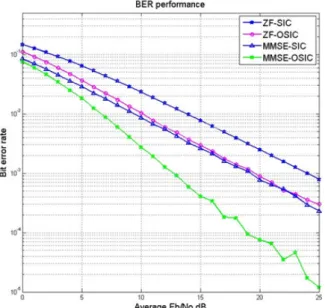
Figure 4 shows the bit error probability versus SNR performance for the cooperative communication system employing ZF and MMSE SIC schemes with optimal ordering. As expected, interference cancellation performance of MMSE SIC is around 3 dB better than that of ZF SIC for bit error probability of . This is because MMSE scheme constrains noise amplification.
Also, it can be demonstrated that SIC with optimal ordering scheme offers considering gains as SNR increases compared with SIC. Therefore, it is confirmed that MMSE SIC with optimal ordering is very effective in order to cancel adjacent channel interference for the cooperative communication system.
Figure 5 presents bit error probability versus SNR performance for the proposed cooperative communication system employing ZF and MMSE SIC schemes with optimal ordering and convolutional coding. We can demonstrate that, in the case of applying convolutional coding, employment of MMSE SIC is more efficient to reject adjacent channel interference than that of ZF SIC.
And compared to ZF SIC case, ZF SIC with optimal ordering results in around 1 dB of improvement for bit error probability of . On the other hand, there is seldom performance difference between MMSE SIC and MMSE SIC with optimal ordering cases. Also, it can be demonstrated that the convolutional coding offers considerable coding gains as SNR increases compared with the uncoded case. It is because errors occurred by noise and interference can be detected and corrected with the channel coding. Therefore, it can be certified that MMSE SIC with optimal ordering and channel coding is very powerful for rejecting the effect of adjacent channel interference in the cooperative communication system.
Ⅴ. Conclusions
In this paper, we analyzed and simulated a novel (7)
interference cancellation scheme which are suitable for cooperative wireless communication systems. From the simulation results, the proposed interference cancellation scheme shows that very efficient in terms of many technical points.
Fig. 4. Bit error probability versus SNR employing ZF and MMSE SIC schemes with optimal ordering.
Fig. 5. Bit error probability versus employing ZF and MMSE SIC schemes with optimal ordering and convolutional coding.
Moreover, MMSE SIC with optimal ordering shows the highest performance for adjacent channel interference. The results of this paper can be applicable to design of various applications to many devices for ad-hoc networks.
참 고 문 헌
[1] C. G. Kim, K. T. Kang, and J. S. Ma, “Adaptive Interference Cancellation : Cancellation Performance vs. Computational Overhead,”in Proc. ICCCN ‘08, St. Thomas, US Virgin Islands, Aug. 2008, pp. 1-6.
[2] A. Nosratinia, A. Hedayat, “Cooperative communication in wireless networks,” IEEE Commun, Mag., pp. 74-80, Oct.
2004.
[3] T. M. Cover and A. A. E. Gamal, “Capacity Theorems for the Relay Channel,” IEEE Trans. Info. Theory, vol. 25, no.
5, Sept. 1979, pp. 572–584.
[4] J. N. Laneman, G. W. Wornell, and D. N. C. Tse, “An Efficient Protocol for Realizing Cooperative Diversity in Wireless Networks,” in Proc. IEEE ISIT, Washington, DC, June 2001, p. 294.
[5] J. Aspnes, T. Eren, D. K. Goldenberg, A. S. Morse, W.
Whiteley, Y. R. Yang, B. D. O. Anderson and P. N.
Belhumeur, "A Theory of Network Localization," IEEE Trans. Mobile Computing, vol. 5, no. 12, pp. 1663-1678, Dec.
2006.
[6] F. Barsi, A. A. Bertossi, C. Lavault, A. Navarra, S. Olariu, M. C. Rinotti and V. Ravelomanana, "Efficient Location Training Protocols for Heterogeneous Sensor and Actor Networks," IEEE Trans. Mobile Computing, vol. 10, no. 3, pp. 377-391, Mar. 2011.
저자
김 윤 현(Yoon Hyun Kim) 정회원
․2008년 2월:광운대학교 전파공학과 석사
․2013년 2월:광운대학교 전파공학과 박사
․2013년 3월 : 한국인터넷진흥원 주임 연구원
<관심분야> : 군 통신, 협력통신, 인지무선통신, 5G
박 영 식(Young Sik Park) 준회원
․2013년 2월:광운대학교 전파공학과 졸업
․2013년 3월~현재:광운대학교 전파 공학과 석사과정
<관심분야> : 위치공학, 가시광 통신, 협력통신
신 동 수(Dong Soo Shin)
․2005년 2월:충북대학교 공학 석사
․2007년 국무총리 표창(국가안전보장 기여)
․ 2009년 광운대학교 방위사업학과 박사 수료
․2006년 ~ 현재 : 방위사업청 육군 중령 <관심분야> : 재해재난 및 군 이동통신, 디지털통신
황 유 민(Yu Min Hwang) 준회원
․2012년 2월:광운대학교 전파공학과 졸업
․2012년 3월 ~ 현재:광운대학교 전파 공학과 석박통합과정
<관심분야> : 5G, 재난 통신, WPAN, 협력통신
김 진 영(Jin Young Kim) 종신회원
․1998년 2월:서울대학교 전자공학과 공학박사
․2001년 2월:SK텔레콤 네트웍 연구소 책임연구원
․2001년 3월 ~ 현재:광운대학교 전자 융합공학과 교수
<관심분야> 다지털통신, WPAN, UWB, 부호화, 인지무선통 신, 5G 이동통신
노 정 규(Jung Kyu Rho)
․1991년 : 서울대학교 계산통계학과 이 학사
․1993년 : 서울대학교 전산과학과 이학 석사
․1999년 : 서울대학교 전산과학과 이학 박사
․1999년 ~ 2002년 : 삼성전자 통신연구소 책임연구원
․2002년 ~ 2005년 : 서경대학교 컴퓨터과학과 전임강사
․2006년 ~ 현재 : 서경대학교 컴퓨터과학과 조교수 <관심분야> : 분산시스템, 방송/통신 데이터처리, 시뮬레이션