• 검색 결과가 없습니다.

Analysis of Safety Management Condition & Accident Type in Domestic and Foreign Laboratory

N/A
N/A
Protected

Academic year: 2021

Share "Analysis of Safety Management Condition & Accident Type in Domestic and Foreign Laboratory"

Copied!
13
0
0

로드 중.... (전체 텍스트 보기)

전체 글

(1)

JESK http://jesk.or.kr eISSN:2093-8462

Analysis of Safety Management Condition & Accident Type in Domestic and Foreign Laboratory

Nam Joon Cho

1,2

, Yong Gu Ji

3

1

Research Environment Safety Division, Ministry of Science, ICT and Future Planning, 13809

2

Graduate Program in Technology Policy, Yonsei University, 03722

3

Department of Information and Industrial Engineering, Yonsei University, 03722

Corresponding Author Yong Gu Ji

Department of Information and Industrial Engineering, Yonsei University, 03722 Mobile : +82-10-9058-9810

Email : [email protected]

Received : March 04, 2016 Revised : March 09, 2016 Accepted : April 22, 2016

Objective: The aim of this study is to identify the domestic and foreign laboratory safety management system and to suggest domestic laboratory safety management policy priority.

Background: Various types of accidents are occurred in research laboratories according to a variety of laboratory safety risks. However, there are only lists of incidents without any precise accident analysis.

Method: We analyzed statistically the survey on current status of laboratory safety management of universities, research institutes, and industrial research institutions carried out by Ministry of Science, ICT and Future Planning in Korea. We also investigated laboratory safety management systems and safety organization carried out mainly in overseas countries such as USA, Japan, Switzerland and France. In addition, we analyze the UCLA College laboratory explosion occurred in the US in 2010.

Results: More than 75 percent of 2015 domestic laboratory accidents were occurred in the field of operation management and chemistry research. Also, approximately 55%

of accidents took place due to careless use mechanical instruments & dangerous chemicals. In addition, common difficulties of lab safety act applicable organizations are overlapping and comprehensive application of legal requirements.

Conclusion: There is a need for laboratory safety professional organizations. Also, the high frequency of use of hazardous substances in the high-risk, such as the chemical field must be strengthened the laboratory safety management. In addition, it is needed to minimize the problems of the research organizations through close cooperation between related ministries and government support policy such as professional development program.

Application: The result of this analysis might help to present a differentiated safety management policy and advanced safety management system in laboratory.

Keywords: Laboratory safety, Safety management, Accident analysis, University lab safety

Copyright@2016 by Ergonomics Society of Korea. All right reserved.

ccThis is an open-access article distributed under the terms of the Creative Commons Attribution Non-Commercial License (http://

creativecommons.org/licenses/by-nc/3.0/), which permits unrestricted non-commercial use, distribution, and reproduction in any medium, provided the original work is properly cited.

1. Introduction

R&D cost in science and technology area has increased from 47,923,900 million

Korean won in 2011, 53,368,000 million Korean won in 2012 and 57,037,500 million

Korean won in 2013 with increasing R&D manpower (MSIP, 2013). And R&D activities

(2)

became to be advanced and diversified due to high tech area research, integration and fusion and intensification of cooperation between industry, academy and research. As such many risky experimental tools and devices, new chemicals in the lab are handled, it causes potential risk factors chemically, physically, biologically, mechanically, electrically and radiologically. As research experiment contents and methods are more and more complicated and diversified, safety accidents in laboratory are diverse from large scale human injuries to minor safety accidents. Accidents in universities and research institutes causes not only physical and property damage but also loss of human resources responsible for the tomorrow of science and technology. Accordingly, the Ministry of Science, ICT and Future Planning has amended and revised Act on the Establishment of safe laboratory environment (hereinafter referred to as the "Act") (2015) which was originally enacted in 2005 to reflect reality. And, it regulates to perform periodic safety check and precision accident analysis in the event of using dangerous and hazardous materials together with inspection of sequence and cause of accident by the accident task force if necessary. Besides, the Enforcement decree of the act on the establishment of safe laboratory environment (2015) makes it compulsory to subscribe insurance for suitable compensation and to take safety education at certain hours per year. In addition, continual field inspection is taken (300 spots in 2015 and 400 spots to be in 2016) and penalty is imposed if any violation is found. Status inspection and lab safety information network to whole laboratories are performed every other year to gather data on safety management and problems. As shown in the "domestic and overseas research and laboratory accident cases" by the environment safety center in Seoul National University performed as policy project in 2008 by the Ministry of Education, Science and Technology, it contains simple list of cases and examples of incidents but lacks in precision accident analysis to prevent same incidents and to protect researching personnel.

The aim of this study is to analyze domestic and foreign laboratory safety management system and to analyze cause of incidents by selecting domestic and overseas accidents cases in order to suggest domestic laboratory safety management reinforcement and to prevent similar accidents in laboratories.

2. Method

To figure out domestic and overseas safety management status, the study analyzed laboratory distribution ratio per research

area, recognition of laboratory safety act, designation of safety and environment manager in laboratory, composition of safety

management committee in laboratory, preparation of laboratory safety management regulation and subscription of insurance

based on laboratory safety status survey data (MaeKyung Safety and Environment Institute, 2014) to 395 universities (100% on

university level), 240 research institutions (98% of target institutions) and 965 industrial research institutions (23% of target

institutions) out of total applicable organizations of the Act. It also described cause of enactment of the Act, discussions between

the national assembly and relevant administrative authorities on safety and education (Ministry of Labor, Ministry of Education and

Ministry of Environment), and obligations and responsibilities of safety management applicable organizations (president of university,

director of lab., professor, lead researcher and safety manager). The study also investigated laboratory safety management systems

and safety organization, applicable organizations of performing safety management works and integrated management of EHS

(Environment, Health & Safety) carried out mainly in overseas countries such as USA, Japan, Switzerland and France. In addition,

the study analyzed domestic laboratory accidents in the recent 5 years (2011~2015) with total number of accidents, human and

property damage, number of accidents by institution (university, research institution and industrial research institutions) and number

of accident per safety management areas (STEPI, 2015). And, the study analyzed the Texas Tech University laboratory explosion

occurred in the US in 2010 to analyze sequence and cause of accident and to figure out problems. As an excellent overseas case,

the study examined safety management activity and safety manual of UCLA in the US.

(3)

3. Analysis of Safety Management Condition in Domestic and Foreign Laboratory 3.1 Analysis of safety management condition in domestic laboratory

3.1.1 Statistics of implementation of the Act

As of the end of 2014, the target institutions of the Act were 4,779 including universities (359), research institutions (245), industrial research institutions (4,175) (Table 1). The number of target laboratories under the Act was 76,399 including universities (41,592), research institutions (8,424) and industrial research institutions (26,383) (Table 1). The number of researchers was 1,218,942 including universities (992,751), research institutions (36,062) and industrial research institutions (190,129) (Table 1).

In 2014, lab safety and environment survey, by area of research in science and technology, chemistry / chemical engineering was the largest with 22.6%, followed by biology / microbiology (17.3%), electric / electronic (15.6%), machinery / physics (15.1%). For university, biology / microbiology and chemistry / chemical engineering accounted for 19%, followed by machinery / physics and electric/electronic with 16%. For research institutions, chemistry / chemical engineering was the largest with 39.4% followed by biology/microbiology, machinery / physics and electric / electronic. For industrial research institutions, chemistry / chemical engineering was the largest with 22.3% followed by electric / electronic and machinery / physics.

As for recognition of the Act, 66.7% and 64.2% of directors of university and research institutions respectively answered positively, but 31.8% of directors of industrial research institutions answered positively, which shows that promotion on legal and system to industrial research institutions is urgent.

As for appointment of lab safety manager, 98.5% of university and 63.1% of research institutions and 44.4% of industrial research institutions appointed one, and 0.3% of university 22.8% of research institutions 22.8% and 26% of industrial research institutions outsourced it. And, while 49.0% of research institutions appointed lab safety manager according to the Act, but 36.1% was appointed according to the occupational safety and health act (safety manager). While 10.3% of industrial research institutions appointed according to the Act, 59.7% was appointed by the occupational safety and health act, which is far higher than other institutions.

As for composition of the lab safety management committee (hereinafter referred to as 'committee'), 88.9% of university had it which is far higher than that of research institutions and industrial research institutions. 46.5% of research institutions and 14.5%

Table 1. Classification of lab safety act applicable organizations (MaeKyung S&E I, 2014)

Classification University

Research institution Industrial research

institution Total 2∼3 year 4-year

No. of institution 359 245 4,175 4,779

No. of lab 41,592 8,424 26,383

*

76,399

No. of researcher 992,751 36,062 190,129

**

1,218,942

*Result of survey on 965 industrial research institutions (23%), which is applied pro-rata to 6,098 labs

**Total number of researchers reported to Korea industrial technology promotion association in 4,175 industrial research

institutions

(4)

of industrial research institutions had committee for operation. While industrial research institutions can replace it to occupational safety and health committee (Occupational safety and health Act, 2015), it seems not to be sufficiently reflected in the survey.

And, as for university, college (85%) had lower rate than universities (89.3%) and technical universities (100%). As for research institutions, government research institutions had the lowest percent (15%).

As for preparation of lab safety management regulation, 96% of university prepared, but only 53% of research institutions and 29% of industrial research institutions prepared which is relatively low. And, as for posting and display of safety management regulation, over 90% answered positively, but 27% of research institutions and 16% of industrial research institutions displayed it in "all labs" or "partial display".

As for insurance, 95% of university had insurance, but 68.9% of research institutions had it. Reason for not subscribing insurance was lack of budget with 2.1% and other reasons with 11.2%. 59.6% of industrial research institutions had insurance and reasons of not subscribing insurance were lack of budget with 6.5% and other with 11.2%.

As a result, as for difficulties in observance of the Act, excessive burden was the highest at university followed by comprehensive application of law and lack of dedicated dept. For research institutions, it was comprehensive application of law, overlap with other laws and lack of interest in education. As for industrial research institutions, it was overlap with other laws and comprehensive application of law. Common difficulties in observance of the Act include 'comprehensive application of law' and 'overlap with other law'.

As for necessary government support for safety management, university answered support for dedicated staff, support for safety management budget, realization of law execution and operation, standardization of safety standard and reinforcement of education and support from the highest order. Research institutions answered support for dedicated staff, support for safety management budget, realization of law and execution and operation, reinforcement of education and support and support for safety facility and equipment from the highest order. Industrial research institutions answered reinforcement of education and support, realization of law execution and operation and support for safety management budget from the highest order. Common answers include support for dedicated staff, support for safety management budget and realization of law and execution and operation.

3.1.2 Domestic safety management system and problems

In September 1999, 3 doctoral students died at the lab accident of dept. of atom, nuclear engineering lab in Seoul National University and 1 doctoral student at the accident of Aviation Space Lab in KAIST in May 2003. Because of such accidents, it was proposed to develop safety management to researchers from the government level. Accordingly, the discussion on the enactment of Act on the Establishment of safe laboratory environment began. In January 2005, the relevant ministries (Ministry of Science and Technology, Ministry of Education and Ministry of Labor) agreed to develop an act to university and graduate students, specially appointed researchers and internship researches who were not the applicable organizations to the occupational safety and health act by minimizing overlap of works between ministries. On March 2, 2005 at the 252nd provisional session of the National Assembly, the Act on the Establishment of safe laboratory environment was reviewed and passed for safe environment of lab. After 7 times of partial amendment it has been operated with 4 chapters with 25 articles (MSIP, 2016).

The Ministry of Science, ICT and Future Planning is in charge of policy on domestic lab safety management and partial duties

(field inspection and safety education) are authorized to external institution (national research safety management under the Korea

Research Institute of Bioscience and Biotechnology as of 2016). It has two regional safety support center (central research safety

support center and capital area research safety support center) are introduced for direct management on labs of university, research

institutions and industrial research institutions.

(5)

The applicable organizations of lab safety management include government authority, safety management assignment institution, director of research, director of lab, lab safety manager and researchers. The Ministry of Science, ICT and Future Planning is responsible for operation of legal system and safety management planning and supervision. Field inspection and education of researchers are performed by the above authorized institutions and regional safety support center. Directors of the research is liable to keep safety and to prevent accident. Director of each lab is responsible for research activities and complicated dangerous elements related to research activities. Lab safety manager is responsible for assisting the director of research in technical issues on lab safety and instruct lab safety manager.

But, safety manager has concurrent duties in most institutions and person engaging in other areas may serve lab safety manager.

Thus, work faithfulness and specialty of safety management is not sufficient. And, they used to have lack of professional knowledge to recognize dangerous elements in lab activities and also there is insufficient human organization to manage large applicable organizations on safety management (STEPI, 2015).

3.2 Analysis of safety management condition in foreign laboratory

3.2.1 Exclusive organization system in lab safety management (US, Switzerland, France)

In the US, lab safety was managed according to the occupational safety and health act and responsibilities are divided. Top 30 research universities have internal lab safety and health dept., and its name include words of health and safety. As for Harvard University, secretariat, dean or vice president is responsible for lab safety management in terms of law, regulation and policy.

Under their supervision, each collage operates safety management committee focusing on EHS (Environmental Health and Safety) program inside the university. As for Illinois University, principal investigator of the project takes full responsibility and safety and health manger gives an advice on safety (MEST et al., 2008).

In Switzerland (Zurich Institute of Technology and Lausanne University), lab safety management dept. is installed under the president that directly manages and operates safety manager.

In France, as for Paris 6th University, lab unit is formed under the safety manager inside the university and each unit has sub-safety manager. Safety manager is responsible for safety management of university from collecting data (risk analysis), to education and disposal of medical waste.

3.2.2 Applicable organizations of lab safety management (Japan)

Safety management implementation, management and technical instruction are divided for systematic implementation of work.

As for Tokyo University, safety management dept. develops plan and environmental safety research center performs technical instruction and research. President supervises safety management and safety and health control dept. plans and performs safety management. The Committee of Management for Safety and Health develops and plans lab safety management policy, coordination between divisions and development of specific safety measure. The Coordinating Committee of Management for Safety and Health is in charge of lab safety and health management works. Environmental safety research management center is engaged in employee education, technical guidance, environment and safety and health management and individual and joint researches.

3.2.3 Integrated management of EHS (Environment, Health, Safety)

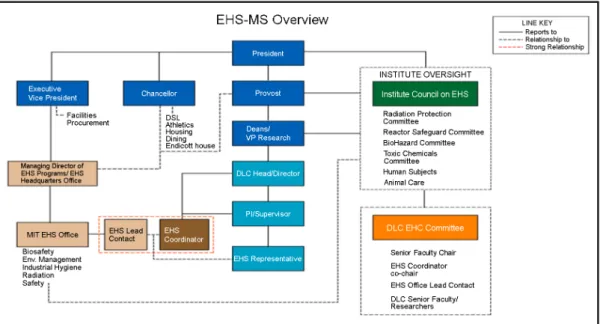
Overseas prominent universities such as Chicago State University, Minnesota University, MIT, Tokyo University has integrated

management system of EHS. The US University Safety Association operates EHS integrated system after renaming to Safety, Health

(6)

and Environment Management Association in 1995. Figure 1 is EHS system of MIT, US.

3.2.4 Safety management through independent safety management policy (US, Japan)

Outstanding research universities in the US and Japan has independent safety management policy for safety management. For Harvard University, the University Environmental Health and Safety Policy Committee provides policy guideline on environment, safety regulation of university and prepares annual environment, safety and health program and risk effect report to be submitted to the vice president. And, the environment, the health, safety manager and administrative staff and institution manager develops own safety management. Minnesota University prepares lab safety plan and distributes it to each college and necessary dept.

Directors of lab safety management is responsible for education and for check of its progress.

Institutional environment, safety and health management centers such as Tokyo University's environment and safety research center, Kyoto University's environment preservation center, Osaka University's environment safety and health management center make effort to develop independent policy.

3.2.5 Dangerous elements and risk information management cases (Switzerland, Japan)

Lausanne University in Switzerland updates lab risk information displayed in the front of each lab for information sharing on accident, and safety division which is direct supervision under the president gathers data and share them in the internet. Osaka University develops Osaka University Chemical Communication System (OCCS) to manage chemicals at the central management system. The Osaka University Environment and Safety Research Management Center records incoming and release of chemicals and each user in the lab checks amount through OCCS terminal installed in each lab. Among chemicals for a year, chemicals of more than 1,000kg are reported to the government according to the Pollutant Release and Transfer Register for sustainable management of chemical factors among dangerous elements.

Figure 1. U.S. MIT Environment-Health-Safety Management System (MSIP, 2013)

(7)

3.2.6 Lab accident report system (Japan)

For Lab accident report system in Japan, it is reported to the head of dept. of the research lab. in event of incident, and the head report to safety and health management dept. together with the notice to police station and fire station. Then, it is notified to labor standard supervisor and head of the safety and health management dept. and received instruction on the action measure against accident which is delivered to the university. Director of safety and health management dept. report the accident to the president besides instruction of action. As soon as it is reported, the university president appoints the emergency task force director so that the action may be notified to the police station and fire station specifically. In Tokyo University, it is designed to report any lab accidents regardless of its significance to the university online system.

4. Analysis of Accident Type in Domestic and Foreign Laboratory 4.1 Analysis of accident type in domestic laboratory

The number of lab accidents for the last 5 years (2011~2015) was 749. 42 more accidents occurred in 2015 than in 2011.

According to Table 2 "Accident-related indicators of lab safety act applicable organizations", the number of human damages for the last 5 years was 828 from light injury to serious injury and property damage costed 1,387,792 thousand won, accident investigation team operation with 43 cases and penalty with 51 cases. From 2013 onward, penalty on the breach of the act was imposed to reinforce the intention of law implementation by the government.

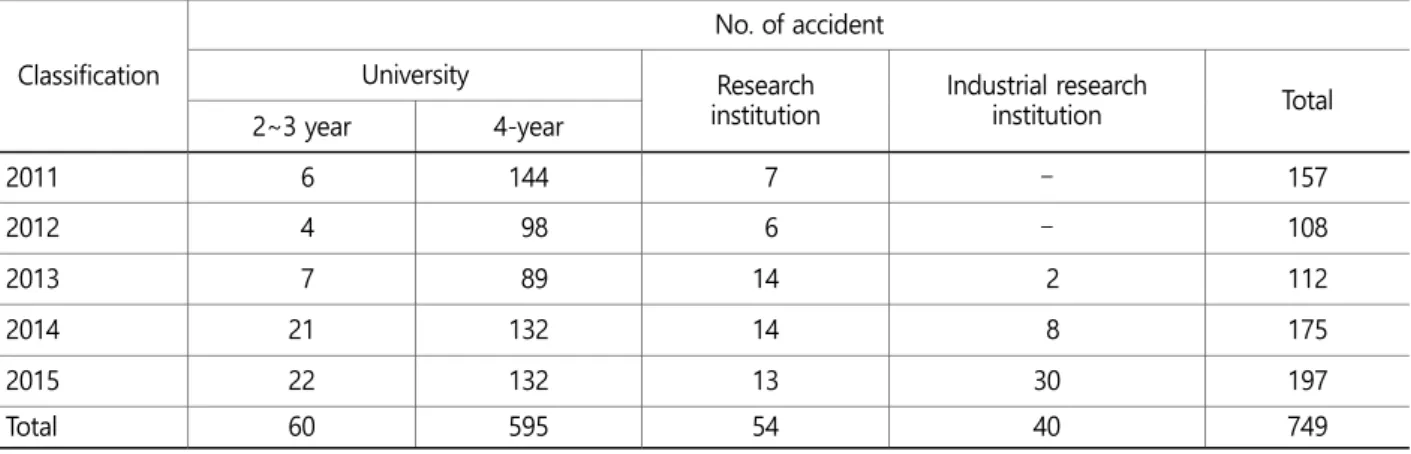
Table 3 shows the number of accident per applicable organizations. the number of accident of university was far higher with 655 than research institutions with 54 and industrial research institutions with 40. The reason why university has far higher rate is because the government preemptively applied the Act to university. It seems to be mainly caused by improvement of law by safety manager and researcher through implementation check of the Act, safety education, promotion. At the initial stage of the execution of the Act, the government started to apply the Act to universities with lack of safety facility and education due to lack of safety budget. Research institutions and industrial research institutions executed safety management according to the occupational safety and health act (under the ministry of employment and labor) and it has relatively higher safety management (MaeKyung Safety and Environment Institute, 2012).

When lab safety accident in 2015 was analyzed, it was 197 cases with 247 human damage and 54,488 thousand won of property Table 2. Accident-related indicators of lab safety act applicable organizations

(Unit: Case, Person, 1,000 won) Classification No. of accident Human damage Property damage Accident investigation team Penalty

2011 157 156 45,300 2 -

2012 108 101 197,932 3 -

2013 112 128 294,660 17 19

2014 175 196 795,412 16 17

2015 197 247 54,488 5 15

Total 749 828 1,387,792 43 51

(8)

damage. Table 4 is the classification of accident by lab safety act application organizations, it was the larges with work management (55.8%) followed by chemistry (20.8%), machinery (12.2%), electricity (5.6%), biology (4.1%) and facility safety (1.5%). Work management accounts for 56%, which demonstrates preventive action from human error as most accidents occurred by the unstable action of researchers.

As for type of accident by collage and technical university, work management was 18 followed by machinery with 3, which shows most accidents take place during practice. Thus, it is necessary to provide safety prevention education and to evaluate risk on the practice procedure.

Table 3. Accidents by lab safety act applicable organizations

(Unit: number) Classification

No. of accident

University Research

institution Industrial research

institution Total

2∼3 year 4-year

2011 6 144 7 - 157

2012 4 98 6 - 108

2013 7 89 14 2 112

2014 21 132 14 8 175

2015 22 132 13 30 197

Total 60 595 54 40 749

Table 4. Classification of accidents by lab safety act applicable organizations in 2015 Classification Chemistry Electricity Work

management Biology Machinery Facility safety Total

University 31 10 71 4 9 1 126

College 1 13 2 16

Technical university 5 1 6

KAIST 2 2

UNIST 2 2

GIST 1 1 2

Industrial research institutions 2 1 17 9 1 30

Government (Research) 2 1 1 1 5

Private (Research) 1 1 2

Specific (Research) 1 1

Nationa (Research) 1 3 4

Public (Research) 1 1

Total 41 11 110 8 24 3 197

(9)

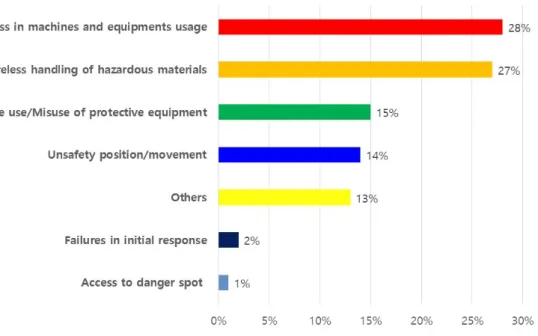
As for cause of safety accident, as shown in Figure 2, negligency of machinery use and careless use of dangerous chemicals accounted for 55, which needs to develop management method (Negligency of machinery use, careless use of dangerous chemicals, Non-use. misuse of protective gear, Unstable position/ action, Other, Insufficient initial response, Access to hazardous place).

4.2 Analysis of accident type in U.S. Texas Tech University laboratory 4.2.1 Accident sequence

On January 7, 2010 there was a huge accident in Texas Tech University (hereinafter referred to as Texas Tech) where 1 graduate student out of 2 suffered serious injury during the nickel hydrazine perchlorate synthetic chemistry test. Even though it was related to hazard, there was no safety system or procedure to discuss it with lab director in advance, and wearing goggles were not obligatory, but optional in the lab. After the explosion, universities participating in the "recognition of threat related to explosion and regional resolution" conducted voluntary suspension of studies at the explosive material research progress lab. The suspension continued when independent committee composed with experts of hazardous materials examined operating procedure and safety instruction of labs.

4.2.2 Analysis of accident

The US chemistry safety committee found through record, interview and post-accident observation that there was no clear duty and role of safety management organization in Texas Tech and research expense support institution, lab safety regulation and manual had problems. That is to say, Texas Tech failed to evaluate physical harm and risk in the study effectively, and was insufficient in safety management supervision and liability. They did not document previous accidents officially which made it difficult to learn from past experiences. Table 5 shows problems.

Figure 2. Causes of accidents in laboratory in 2015

※ Unstable position/ action is mainly caused by narrow research space, unnecessary experiment device display

(10)

4.3 Analysis of safety management in U.S. UCLA laboratory

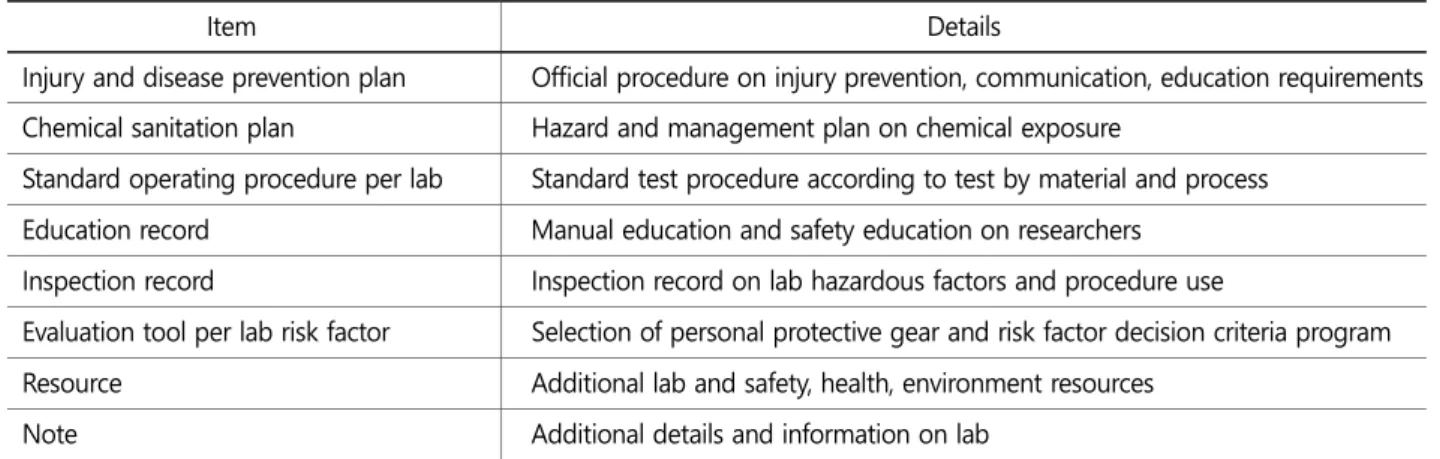
UCLA remarks in Policy 811 (Environmental Health & Safety, see related website) that it is important to achieve university's target to prevent occupational injury, disease, environmental accident and property loss and damage (UCLA Policy 811) (Table 6). This means they comply with the California Code of Regulation section 5191 (Occupational Exposure to Hazardous Chemicals in Laboratories, see related website) and all other applicable health, safety and environment protection law, regulation and requirements.

If suitable attention and upright code of conduct are paid in the lab, lab research related risk can be reduced or removed. For more effective management and reduction of such risk, the UCLA safety manual includes safety lab development, use of personal protective gear, first-aid and suitable method on chemical material storage and disposal together with minimization of risk and response in event of accident.

Table 5. Problems derived through analysis of Texas Tech accidents

No. Problems derived

1 Lack of effective control and evaluation on physical risk related to studies on explosive material

2 While lab safety management program was developed on job exposure of dangerous chemical material according to Lab standard of OSHA, it was not on physical risk by chemical material but on health risk caused by exposure to chemical material

3 Lack of comprehensive risk evaluation guideline for lab

4 Non-implementation of documentation of previous lab accidents and precision analysis to prevent recurrence 5 The U.S. Department of Homeland Security pointed out that there was no specific safety regulation on research

performance at Texas Tech

6 Negligence of research director, safety management dept., and university administration

Table 6. Lab safety manual in UCLA

Item Details

Injury and disease prevention plan Official procedure on injury prevention, communication, education requirements Chemical sanitation plan Hazard and management plan on chemical exposure

Standard operating procedure per lab Standard test procedure according to test by material and process Education record Manual education and safety education on researchers

Inspection record Inspection record on lab hazardous factors and procedure use

Evaluation tool per lab risk factor Selection of personal protective gear and risk factor decision criteria program Resource Additional lab and safety, health, environment resources

Note Additional details and information on lab

(11)

5. Conclusion

The study was conducted to examine domestic safety management and lab safety management system of overseas countries in order to set domestic lab safety management policy direction. It analyzed lab accident cases of domestic and overseas universities and research institutions. As a result, the following conclusions were derived.

a. As a result of domestic lab accident analysis, accidents caused by careless use of mechanical instruments and careless use of dangerous chemicals accounted for 55%. Most was caused by negligence of researchers. Therefore, it is necessary to develop guideline on machinery/ equipment use together with human behavior and psychology analysis.

b. Common difficulties of lab safety act applicable organizations are overlapping and comprehensive application of legal requirements. Thus, it is necessary for the Ministry of Science, ICT and Future Planning to minimize overlapping through advanced discussion on legal application requirement, field inspection and data request with relevant authorities such as the Ministry of Employment and Labor, Ministry of Environment and the Ministry of Education. Furthermore it is necessary to expand business size of the applicable organizations for safety management together with professional organization for comprehensive planning and evaluation.

c. More than 75 percent of 2015 domestic laboratory accidents were occurred in the field of operation management and chemistry research. According to the accident report of US Texas Tech and UCLA lab safety manual, safety requirements on dangerous chemical are important. Thus, it is necessary to evaluate pre-hazards risk analysis and to provide safety education in advance.

d. Many overseas countries (US, Switzerland, France, Japan etc.) has professional safety management organizations in research institutions to perform safety management works systematically. To the contrary, domestic institutions had lower percentage of professional organization with lack of role and scope of safety management. In particular, compared with university and research institutions, the recognition of the Act by industrial research institutions was apparently low and the implementation of legal requirements such as preparation of safety management regulation and subscription of insurance were relatively low.

Therefore, it is necessary to actualize law, system and regulation on the whole applicable organizations by strengthening safety management focusing on industrial research institutions.

The following policy directions may be suggested based on the above conclusions.

Firstly, it is necessary to develop a professional lab safety management organization.

In case of other ministry such as the Ministry of Employment and Labor, they have professional organizations such as the Occupational Safety Health Agency for professional and comprehensive safety management. In doing so, they could secure professional capacity and safety accident reduction. To the contrary, while materials handled in the lab are more complicated and diversified along with rapid changing research trend in the safety area, it is necessary to develop professional technology and infrastructure because the supervising institution on safety management was changed. In the first place, it needs to prepare legal ground to develop a professional organization in the Act and to develop lab safety professional organization by expanding human resources and budget.

Secondly, it is necessary to reinforce safety management on lab where hazardous substance is frequently used such as chemical

areas.

(12)

As a result of accident statistics analysis, chemical and biological labs had higher ratio of accidents compared with other areas with more damage than others. Thus, there has been ongoing opinion to reinforce safety management on highly dangerous labs.

To solve such problems, it is required to expand inspection on highly dangerous area, customized professional education program and development of professional personnel in safety management.

Thirdly, it is required to make close cooperation and joint development of professionals between government ministries and to provide policy supports to minimize difficulties in the research field.

Currently, labs are subject to more than 30 safety related laws including the Act, the occupational safety and health act, the chemical material control act and the waste control act. Accordingly, it is necessary to activate research activities by reducing difficulties and burdens of field. For this purpose, joint inspection with other ministries and exclusion of overlapping regulation must be continually promoted. To make professional and systematic lab safety environment management, it is also necessary to design professional development plan such as lab safety license and installation of exclusive safety management dept. together with incentive to highly motivated organizations on lab safety management.

Fourthly, it is necessary to reinforce safety management to industrial research institutions.

While industrial research institutions have a strong awareness to be subject to the occupational safety and health act, they had lack of awareness to be lab safety act applicable organizations. The government also applied the Act to universities in the first place, and policy promotion (PR and education) to industrial research institutions was lack. It is necessary to reinforce presentation on the Act, field inspection and guidance and safety education for industrial research institutions in order to expand the scope of application of the Act.

Finally, there is a need to develop a system of field oriented safety management implementation by autonomous and active detection of hazardous factors beyond existing government centered safety management paradigm.

Considering complicated and rapidly changing scientific and technical research activities, it is necessary to develop a plan and research management process in order to discover hazardous factors and to figure out and manage hazards directly and positively by researchers. So far, the focus was given to research environment such as causes of fire or explosion in lab. But, it is necessary to consider risk management on researchers and research environment together in order to develop safety management level and actual accident response system.

References

Act on the Establishment of safe laboratory environment, Act No. 12873, (2015.7.1)

Enforcement decree of the act on the establishment of safe laboratory environment, Presidential Decree No. 26438, (2015.7.29.) MaeKyung Safety and Environment Institute (2012), A Survey on current status of laboratory safety management .

MaeKyung Safety and Environment Institute (2014), A Survey on current status of laboratory safety management .

MEST (Ministry of Education, Science and Technology), IEPS (Institute of Environmental Protection & Safety in SNU) (2008), A

collection of Accident type in domestic and foreign laboratory .

(13)

MSIP (Ministry of Science, ICT and Future Planning), KISTEP (Korea Institute of Science & Technology Evaluation and Planning) (2013), Survey of Research and Development in Korea .

MSIP (Ministry of Science, ICT and Future Planning) (2013), A study on laboratory pre-hazards risk analysis and institutionalization .

MSIP (Ministry of Science, ICT and Future Planning), Support Center for Metropolitan Research Safety (2016), An explanation guide book on law of laboratory safety .

Occupational Safety and Health Act, Act No. 11862, (2015.1.1)

STEPI (Science and Technology Policy Institute) (2015), Research on institutional improvement of laboratory safety . UCLA Policy 811 (Environmental Health & Safety), http://www.adminpolicies.ucla.edu/app/Default.aspx?&id=811

Author listings

Nam Joon Cho: [email protected]

Highest degree: B.A. in Mechanical Engineering, Yonsei University

Position title: General Manager, Ministry of Science, ICT and Future Planning Areas of interest: Technology Policy, Lab Safety

Yong Gu Ji: [email protected]

Highest degree: PhD, Industrial Engineering, Purdue University

Position title: Professor, Department of Information and Industrial Engineering, Yonsei University

Areas of interest: Usability, Health Care, Accessibility, and Elderly in HCI

수치

Table 1. Classification of lab safety act applicable organizations (MaeKyung S&E I, 2014)
Figure 1. U.S. MIT Environment-Health-Safety Management System (MSIP, 2013)
Table 3 shows the number of accident per applicable organizations. the number of accident of university was far higher with  655 than research institutions with 54 and industrial research institutions with 40
Table 4. Classification of accidents by lab safety act applicable organizations in 2015 Classification  Chemistry  Electricity Work
+3

참조

관련 문서

To conduct systematic safety management activities, they have to prepare safety work plans, and keep safety work log to practice as planned, In addition,

Incheon’s Disaster Safety Policy.. 05 Disaster Management System Introduction of Incheon.. General Status

RWC (Restricted Work Case): Injuries by which workers are reassigned to other duties or cannot perform the full range of normal duties MTC (Medical Treatment Case):

RWC (Restricted Work Case): Injuries by which workers are reassigned to other duties or cannot perform the full range of normal duties MTC (Medical Treatment Case):

– Organizational support for safety education (e.g. orientation, training, workshops, etc.) for all level of project members – Regular safety meetings and daily toolbox

And the objective of radiation safety control is to ensure radiation safety by limiting the probability of stochastic effects below the acceptable ALARA

In this way, it need to investigate and research the risk element for the safety of marine traffic to prevent marine pollution, life and property resulted from marine

The purpose of this study is to examine a scheme for growth, management rationalization and reform measure of domestic coastal shipping companies, and Ihope that this will be