서 언
곰취(Ligularia fischeri (Ledeb.) Turcz.)는 쌈용과 삶아서 나물로 무쳐 먹거나 장아찌와 말려서 두었다 먹는 묵나물로 이 용하고 있다. 곰취는 각종 영양소와 생리활성 물질을 많이 함유 하고 있다(Cho and Kim, 2005). 한의학에서는 뿌리를 호로칠 (葫蘆七)이라 하여 요통, 관절통, 타박상과 고혈압, 간장병, 천 식, 황달 등에 사용하여 왔다(Lee, 2006). 또한 곰취는 항염증과 활성산소 제거(Ham et al., 1998)와 각종 암세포의 증식을 억제 하고 혈소판 응집도 억제하는 효과가 있다고 알려져 있다(Bae et al., 2009). 특히, 곰취 추출물에는 많은 생리활성 물질을 포
함하고 있어 항산화 활성이 높은 것으로 밝힌 바 있다(Kim et al., 2010). 그리고 혈압을 낮추며 멜라닌 생성을 억제해 기미, 검버섯 발생을 줄여주는 것으로 밝혀졌다(Yeon et al., 2012).
곰취 신품종 ‘쌈마니’, ‘곰마니’, ‘다목이’의 경우 6월 상순 이후 에 수확시 BHA (butylated hydroxy anisole) 보다 항산화 활성 이 더욱 높았다(Suh et al., 2015) 그리고 Nam et al. (2017)은 곰취 열수 추출물을 가지고 항산화력 및 세포를 이용해 in vitro 실험을 실시한 결과 항산화력이 매우 우수할 뿐만 아니라 항염 증효과도 뛰어나게 나타났다고 밝힌 바 있다.
국내에서 많이 재배되고 있는 곰취 종류인 ‘곤달비’ 종은 6-7 월에 흰가루병이 대량 발생하여 잎이 타거나 말라 고사하거나 약해져서 다음해에 수량이 떨어지는 원인이 된다. 또한 곰취를 연작하면 생리장해 및 병해로 인해서 수량이 급감하는 문제도
내병 다수성 곰취 신품종 ‘그린베어’ 육성
서종택
1
*, 유동림2
, 김기덕2
, 이종남1
, 손황배2
, 남정환2
, 김수정2
, 홍수영1
, 김율호1
1
국립식량과학원 고령지농업연구소 연구관,
2연구사,
Breeding of ‘Greenbear’ for New Cultivar of Gomchwi with Disease Resistant and High Yield
Jong Taek Suh
1
*, Dong Lim Yoo2
, Ki Deog Kim2
, Jong Nam Lee1
, Hwang Bae Sohn2
, Jeong Hwoan Nam2
, Su Jeong Kim2
, Su Young Hong1
and Yul Ho Kim1
1
Senior Researcher and
2Researcher, Highland Agricultural Research Institute, National Institute of Crop Science, RDA, Pyeongchang 25342, Korea
Abstract - ‘Gondalbi’ (Ligularia stenocephala (Maxim.) Matsum. & Koidz.) is the most cultivated Gomchwi species because of higher yield and low in aromatic flavor and bitter taste, But ‘Gondalbi’ is susceptible to powdery mildew disease and leaf shriveling after harvest in Summer. To improve powdery mildew disease resistance and post-harvest leaf shriveling problem in ‘Gondalbi’, ‘Handeari-gomchwi’ resistant to powdery mildew disease and having higher yield potential used as a paternal trait donor. Powdery mildew disease resistance and post-harvest leaf shriveling as well as agronomic performance of a new variety, ‘Greenbear’ were tested under field and green house conditions in Pyungchang, Korea from 2007 to 2016.
Expression of both maternal and paternal characteristics in ‘Greenbear’ including purple colored petiole ears, glossy leaf and paternal, petiole trichome, absent at the back of a leaf were confirmed. Plant size and flowering time of ‘Greenbear’
were similar to check line, ‘Gommany’, while leaf number per plant and yield were higher in ‘Greenbear’. ‘Greenbear’ has thinner leaves (0.66㎜) compared to ‘Gommany (0.69 ㎜)’, and hardness appeared slightly higher in ‘Greenbear(25.1 ㎏/
㎠)’. The resistance to powdery mildew disease of the ‘Greenbear’ variety was slightly lower than that of the ‘Gommany’
variety, but somewhat showed high resistance.
Key words –
Crossing, Flowering time, Leaf petiole, Plant height, Powdery mildew disease, Selection
*교신저자: E-mail [email protected] Tel. +82-33-330-1800
Original Research Article
발생되고 있다. 따라서 농가에서는 연작장해와 흰가루병에 강 하고 수량도 많은 내병 다수성 품종에 대한 요구도가 높다. 그래 서 흰가루병에 강하면서 생육이 왕성한 한대리곰취(Ligularia fischeri var. spiciformis Nakai)와 일반 곰취를 교배하여 흰가 루병에 저항성이면서 수량이 높은 품종을 육성하고자 하였다.
그 결과 ‘곰마니(Suh et al., 2016)’, ‘다목이(Suh et al., 2017)’,
‘쌈마니’(Suh et al., 2018)와 ‘수마니(Suh et al., 2020)’ 품종을 육성하였다.
재료 및 방법
육성경위
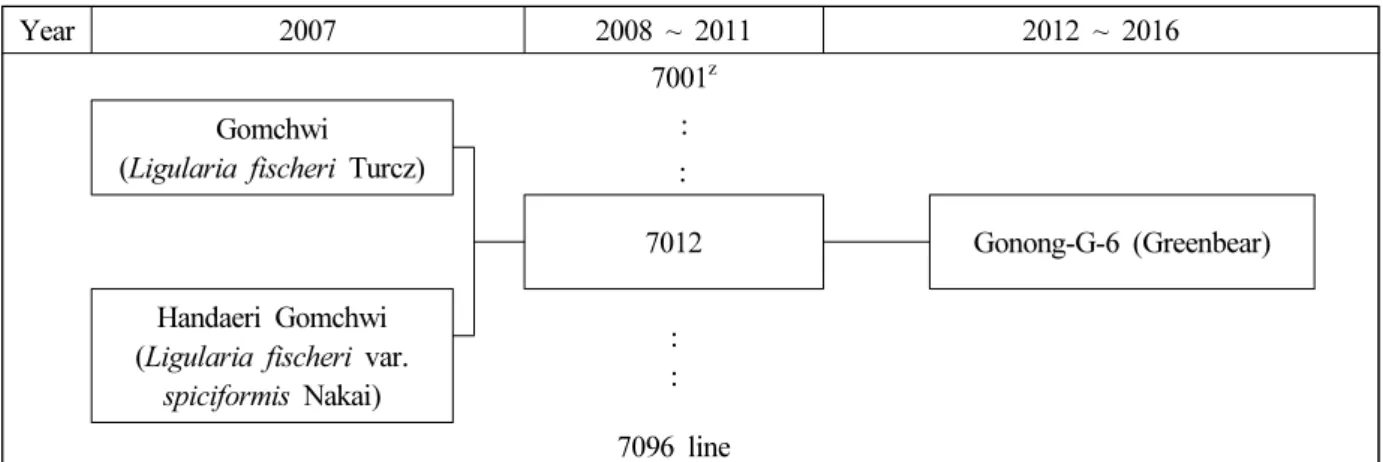
‘그린베어’ 품종은 곰취을 모본으로 하고, 내병 다수성인 한 대리곰취를 부본으로 하여 교배하였다. 2007년 8월에서 9월까 지 고령지농업연구소 하우스내에서 인공 교배를 하여 종자를 얻었으며, F1 종자는2008년 3월에 파종하여 육묘 후 5월 중순경 포장에 정식하였으며 점적관수를 설치하여 물 관리하였다. 2년 차인 2009년부터 2011년까지 생육 및 수량 특성을 조사하여 앞 서 개발된 ‘곰마니’ 품종보다 우수한 7012번 개체를 선발하였 다. 선발된 개체는 2012년부터 2016년까지 노지포장에서 증식
하면서 고농G-6호로 계통명을 붙였으며, 동시에 2016년까지 생육 및 수량 특성을 검정하였다(Fig. 1). ‘그린베어’ 품종은 2015년부터 2016년까지 2년간 특성을 검정하여 최종적으로 수 량이 많고 흰가루병에 저항성을 가진 품종으로 선발되었다 (Fig. 1).
생육특성
‘그린베어’ 품종의 생육 및 수량 특성은 농촌진흥청 농사시험 연구조사기준(RDA, 1995)과 국립종자원의 곰취 특성조사 요령 (Bae et al., 2008)에 준하여 조사였다. ‘그린베어’ 품종의 잎줄 기 특성은 엽병귀의 색, 엽병의 털 유무, 잎뒷면의 털 유무, 잎뒷 면의 광택 유무, 그리고 엽맥의 밀도는 1-5 등급으로 나누어 조 사하였다(Table 1, Fig. 2). 그리고 생육특성은 초장, 엽장, 엽 폭, 엽병장을 조사하였다(Table 2). 개화 및 수량 특성은 추대 기, 개화기, 주당 엽수, 주당 수량을 조사하였다(Table 3). 그리 고 품질을 결정하는 엽의 경도는 잎 10장을 겹쳐서 경도계 (Zwick Roell, model: Z0.5TS)에 올려 놓고 측정하였으며, 엽 의 두께는 디지털 켈리퍼(Mitutoyo, Japan)를 이용하여 측정하 였다.
Year 2007 2008 ~ 2011 2012 ~ 2016
7001z Gomchwi
(Ligularia fischeri Turcz)
: :
7012 Gonong-G-6 (Greenbear) Handaeri Gomchwi
(Ligularia fischeri var.
spiciformis Nakai)
: : 7096 line
Procedure: Artificial cross, Selection, Multiplication, Characteristic survey, Evaluation of characteristics Fig. 1. Pedigree diagram of the new Gomchwi variety, ‘Greenbear’. zSelection line.
Table 1. The morphological characteristics of ‘Greenbear’ and ‘Gommany’ varietiesp
Cultivar Petiole ear color Petiole trichome Trichome of leaf back Gloss of leaf back Leaf vein densityz Greenbear Purple Nonexistent Nonexistent Existent 3z
Gommany Dark purple Existent Existent Nonexistent 5
zLeaf vein density: 1. Very wide, 2. Wide, 3. Normal, 4. Narrow, 5. Very narrow.
흰가루병 저항성
흰가루병 저항성은 흰가루병 발생 시기에 육안으로 검정을 하였다. 저항성 정도는 전혀 발생하지 않은 것을 9, 거의 발생하 지 않으나 흰가루병 포자가 완전히 하얗게 전개되지 않고 약간 오거나 자국만 검게 남는 정도를 7, 30% 정도 발생한 것을 5, 50% 정도 발생한 것을 3, 흰가루병 포자가 전체적으로 하얗게 발생한 정도를 1로 판정하였다.
결과 및 고찰
주요 특성
‘그린베어’ 품종의 육성 목적은 앞서 육성된 품종 중 ‘곰마니’
품종보다 생육특성은 유사하면서 흰가루병에 내병성이고 수량 성이 높은 품종을 선발하고자 하였다. 그래서 흰가루병에 강한
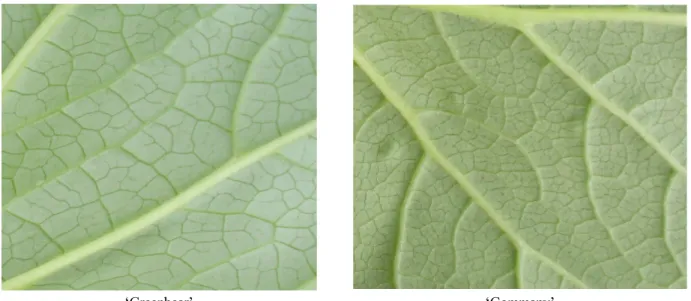
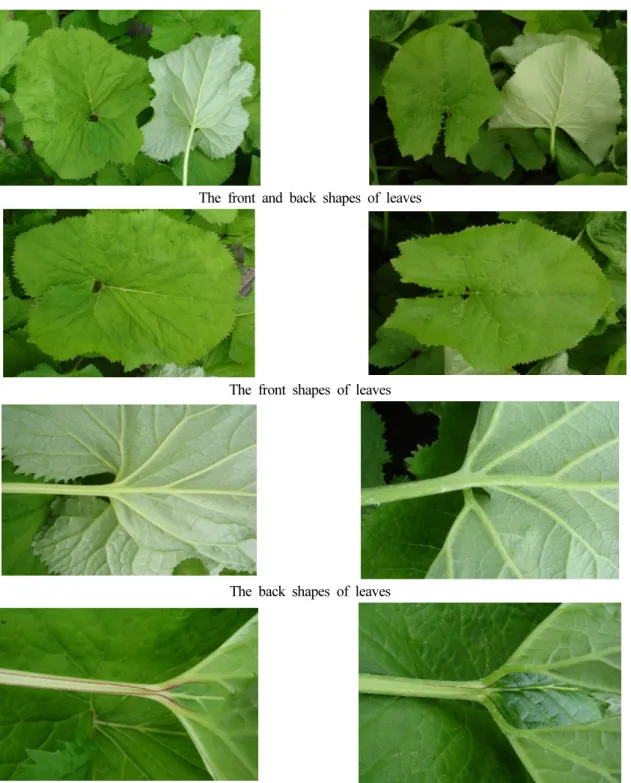
‘곰마니’ 품종을 대조품종으로 선정하여 생육특성을 비교하였 다. ‘그린베어’ 품종의 엽 특성을 Table 1과 Fig. 3에서 보면 엽병 귀의 색은 ‘곰마니’ 품종이 진자주색인데 비해 자주색을 띤다. 엽
‘Greenbear’ ‘Gommany’
Fig. 2. Comparison of leaf vein density of ‘Greenbear’ and ‘Gommany’ varieties.
Table 2. The growth characteristics of ‘Greenbear’ and ‘Gommany’ varieties Cultivars Plant height
(㎝) Leaf length
(㎝) Leaf width
(㎝) Petiole length (㎝)
Greenbear 67.3 16.3 20.4 39.1
Gommany 82.8 16.2 21.2 31.4
LSD .05z 9.5 N.S N.S 3.6
zLeast significant difference at P = 0.05., N.S: Non-significant.
Table 3. The flower and yield characteristics of ‘Greenbear’ and ‘Gommany’ varieties Cultivars Bolting time
(Month. Day) Flowering time
(Month. Day) No. of leaves
per plant Yields per plant (g)
Greenbear Aug. 7 Sept. 6 176.3 1,936
Gommany Aug. 6 Sept. 10 138.8 1,575
LSD .05z - - 24.3 128
zLeast significant difference at P = 0.05.
병에 털은 ‘곰마니’ 품종은 있는데 비해 ‘그린베어’ 품종은 없다.
또한 잎 뒷면에 털은 ‘곰마니’ 품종은 있는데 ‘그린베어’ 품종은 없다. 그러나 잎 뒷면의 광택은 ‘곰마니’ 품종은 없으나 ‘그린베
어’ 품종은 있다. 엽맥 밀도는 ‘곰마니’ 품종이 3 등급인 것에 비 하여 ‘그린베어’ 품종은 2등급으로 조금 넓은 편으로 잎이 ‘곰마 니’ 품종보다 조금 더 부드럽다는 것 알 수 있다(Fig. 2). 또한 ‘그 The front and back shapes of leaves
The front shapes of leaves
The back shapes of leaves
The color of petiole and petiole ear
‘Greenbear’ ‘Gommany’
Fig. 3. The leaf shapes and characteristics on ‘Greenbear’ and ‘Gommany’ varieties.
린베어’ 품종의 생육 특성을 Table 2에서 보면 초장이 67.3 ㎝, 엽장 16.3 ㎝, 엽폭 20.4 ㎝, 엽병장은 39.1 ㎝로 ‘곰마니’ 품종의 초장 82.8 ㎝, 엽장 16.2 ㎝, 엽폭 21.2 ㎝, 엽병장 31.4 ㎝ 보다 초장과 엽병장은 작으나 엽장, 엽폭은 유사하게 나타났다. 개화 기 및 수량 특성을 Table 3에서 보면 추대기는 ‘곰마니’ 품종은 8월 6일이었고 ‘그린베어’ 품종은 8월 7일로 유사하였다. 개화기 는 ‘곰마니’ 품종이 9월 10일이고 ‘그린베어’ 품종은 9월 6일로 큰 차이 없는 것으로 나타났다. 엽수는 주당 176매로 ‘곰마니’ 품 종 139개보다 37매가 더 많게 나타났으며 통계적인 유의성도 인 정되었다. 주당 수량 역시 1,936 g으로 ‘곰마니’ 품종 1,575 g보 다 23%정도 더 많게 나타났으며 통계적인 유의성도 인정되었다.
이는 Suh et al. (2016, 2017)이 보고한 ‘곤달비’ 종 수량보다는 143% 증수하였고, ‘다목이’ 품종보다는 2.3% 많은 것으로 나타 났다. 잎의 경도는 25.1 ㎏/㎠로 ‘곰마니’ 품종 24.3 ㎏/㎠ 보다 약간 높게 나타났으나 통계적인 유의성이 없게 나타나 2품종이
유사한 것으로 생각된다, 잎의 두께 역시 0.66 ㎜로 ‘곰마니’ 품 종 0.69 ㎜보다 약간 낮게 나타났으나 통계적인 유의성은 없게 나타나 2품종이 유사한 것으로 생각된다. 이는 Suh et al. (2016, 2017, 2018)이 보고한 ‘곰마니’, ‘다목이’, ‘쌈마니’ 품종은 ‘곤달 비’ 품종보다 경도는 높고 두께도 두껍게 나타났다고 보고 한바 있으며, ‘다목이’ 품종보다는 경도가 낮고 두께도 얇은 것으로 나 타났다(Suh et al., 2017). ‘그린베어’ 품종은 흰가루병 육안검정 에서 저항성 정도(1-9)은 7을 보여 높은 저항성을 보였다(Table 4, Fig. 4). 이는 Suh et al. (2016, 2017, 2018, 2020)의 보고에 따르면 ‘곰마니’, ‘다목이’와 ‘수마니’ 품종은 강한 저항성을 보 였고, ‘쌈마니’ 품종은 흰가루병에 중도저항성을 보였다고 하였 는데 ‘그린베어’ 품종은 ‘쌈마니’ 품종보다는 약간 높은 저항성 을 가지는 것으로 판단된다.
이상의 결과를 종합해 보면 ‘그린베어’ 품종은 생육적으로는
‘곰마니’ 품종보다 약간 작은 편이나 엽장과 엽폭은 유사하였으
Table 4. The leaf characteristics and resistance to powdery mildew disease of ‘Greenbear’ and ‘Gommany’ varieties
Cultivars Leaf hardness (㎏/㎠) Leaf thickness (㎜) Powdery mildew disease resistancez
Greenbear 25.1 0.66 7x
Gommany 24.3 0.69 9
LSD .05y N.S N.S -
zResistance to powdery mildew disease was determined through a visual test.
yLeast significant difference at P = 0.05., N.S: Non-significant.
xResistance degree of powdery mildew disease: 1; High Susceptibility, 3; Susceptibility, 5; Moderate resistance 7;
Resistance, 9; High resistance.
‘Greenbear’ ‘Gommany’
Fig. 4. Comparison of disease symptom to powdery mildew disease of ‘Greenbear’ and ‘Gommany’ varieties.
며 주당 엽수와 수량이 높고 엽 두께는 얇고 경도가 약간 높아 품질은 좋은 편이며 흰가루병에는 저항성을 보이는 품종이다.
재배상 유의점
‘그린베어’ 품종은 밑거름으로 비료와 퇴비를 충분히 살포하 고 매년 퇴비를 웃거름으로 살포하고 수확 후에는 자주 추비를 해 주어야 한다. 또한 점적관수시설을 설치하여 주기적으로 관 수를 해주는 것이 좋다. 토양살충제를 경운하기전에 살포하고 개화기에 살충제를 살포하여 지제부를 가해하는 해충을 방제해 주어야 한다. 고랭지 재배시 기온 분포를 보면 7-8월에 최고 온 도가 27℃이고, 평균온도가 20℃ 내외로 곰취 생육에는 적당한 기온이었다(Fig. 5). 여름철에는 35% 정도의 차광망을 씌워 재 배를 하고 해발 400 m 이상의 서늘한 지역에서 재배할 것을 권 장한다.
유용성
2017년 4월 3일 종자산업법에 의거 산림청 산림품종관리센 터에 품종보호를 출원하였다. 이후 2018-2019년도까지 재배 심사를 거친 다음 2020년 5월 13일에 ‘그린베어’ 라는 품종명으 로 품종보호권이 등록(품종보호 제220호)되었다. 곰취 묘를 조 직배양으로 급속 증식하여 농가에 조기 보급할 예정이다.
적 요
‘그린베어(Greenbear)’ 품종은 곰취를 모본으로 하고 한대리 곰취를 부본으로 해서 교배 육종을 하였다. 2007년부터 2016년 까지 국립식량과학원 고령지농업연구소 하우스 및 노지에서 생
육 및 수량 특성을 조사하고 선발을 수행하였다. ‘그린베어’ 품 종에 있어서 엽병귀 색은 자주색이고 엽병에 털이 없다. 그리고 잎 뒷면에 털이 없어 광택이 있다. 엽맥 밀도는 2등급으로 아주 넓은 편이다. 생육 특성은 초장이 67.3 ㎝, 엽장 16.3 ㎝, 엽폭 20.4 ㎝, 엽병장은 39.1 ㎝ 였다. 식물체 크기는 ‘곰마니’ 품종보 다 전체적으로 작은 것으로 나타났다. 추대기는 8월 7일이었고, 개화기는 9월 6일로 ‘곰마니’ 품종과 유사하였다. 엽수는 주당 176매로 ‘곰마니’ 품종 139매 보다 37매나 많았다. 그리고 주당 수량도 1,936 g으로 ‘곰마니’ 품종 1,575 g보다 23%정도 더 많았 다. 잎의 경도는 25.1 ㎏/㎠, 잎의 두께는 0.66 ㎜로 ‘곰마니’ 품 종과 유사한 것으로 나타났다. ‘그린베어’ 품종의 흰가루병 저 항성은 ‘곰마니’ 품종보다는 약간 낮지만 어느정도 높은 저항성 을 보였다.
사 사
본 논문은 농촌진흥청 연구사업(세부과제번호 PJ00868901) 의 지원에 의해 이루어진 것임.
Conflicts of Interest
The authors declare that they have no conflict of interest.
References