- 354 -
인공지능신경회로망을 이용한 태양광 예측
장펑밍*, 조경희*, 임진택*, 최재석*, 이영미**, 이광연***
경상대학교*, 에코브레인**, Baylor 대학교***
A Study on Solar Radiation Prediction using Artificial Neural Network
Fengming Zhang*,Kyeonghee Cho*, Jintaek Lim*, Jaeseok Choi*, Youngmi Lee** and Kwang Y. Lee***
Gyengsang National University*, Ecobrain**, Baylor University***
Abstract - Renewable energy resources such as wind, wave, solar, micro hydro, tidal and biomass etc. are becoming importance stage by stage because of considering effect of the environment. Solar energy is one of the most successful sources of renewable energy for the production of electrical energy following solar energy. And, the solar/photovoltaic cell generators depend on the solar radiation, which is a random variable so this poses difficulty in the system scheduling and energy dispatching, as the schedule of the photovoltaic cell generators availability is not known in advance. This paper proposes to use the two-layered artificial neural networks for predicting the actual solar radiation from the previous values of the same variable.
1. Introduction
The utilization of renewable resources has received considerable attention in recent years[1],[2]. This is due to the fact that these non-conventional energy units are environmentally friendly. And it has been proved that solar energy is the fast growing and successful energy source of all available sources of renewable energy with high capacities following solar energy. Generation costs of Solar Cell Generator(SCG) or Photovoltaic Generator(PVG) will become competitive with the conventional energy source under environmental constraint in near future. However, Predicting short term solar radiation, therefore, is essential in order to assess the economics and reliability by using solar energy as an alternative source of energy, mainly for electrical power generation. The values of these relationship parameters are obtained from a nearest weather station and are used to train various forms of neural networks. The trained model of neural networks is validated using a similar set of data. The model is then used to predict the solar radiation, using the same meteorological information.
This paper reports an ANN model for short term solar radiation prediction, which uses back propagation algorithm. In this paper, an ANN modeled solar radiation(SR) prediction program was developed to simulate solar radiation of a site using that of another station, for each pair of stations and each combination between them. This paper is focused on a study for solar radiation prediction for reliability evaluation of power system considering photovoltaic cell generators eventually.
2. The Back Propagation Artificial Neural Network
2.1 ANN Modeling
A neural network is a computational structure which resembles a biological neuron. It can be defined as a
“massively parallel distributed processor made up of simple processing units, which has a natural propensity for storing experimental knowledge and making it available for use”. It resembles the human brain in two respects:
1) Knowledge is acquired by the network from its environment through a learning process.
2) Interneuron connection strengths, also known as synaptic weights, are used to store the acquired knowledge.
From this model the interval activity of the neuron can be shown to be:
1
p
k k j j
j
v w x
=
= ∑ (1)
The output of the neuron, yk, would therefore be the out come of some activation function on the value of vk.
2.2 Activation and Performance Functions
The Fig. 1 shows the structure of the curve traced by a sigmoid function, which is used in this study.
Φ( )v =1 /(1 exp(+ −av)) (2) Where, ‘a’ is the slope parameter of the sigmoid function.
<Figure 1> Sigmoid function
The mean square error (MSE) differences between observed and estimated values were used to evaluate the performance of the neural networks during the training phase. MSE were computed by (3)
2 1
1 N ( t t)
i
M SE y d
N =
= ∑ − (3)
Where, dt is the original time series, yt is the predicted time series and N is the number of patterns.
3. The Back Propagation Algorithm
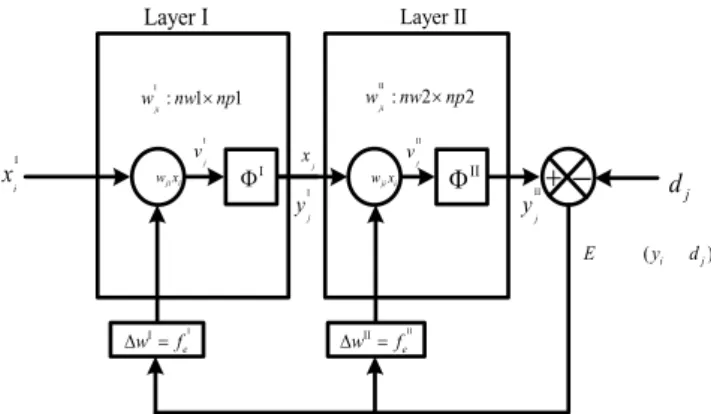
The back propagation algorithm is used in layered feed-forward ANN. This means that the artificial neurons are organized in layers, and send their signals “forward”, and then the errors are propagated backwards. The back propagation algorithm uses supervised learning
Fig. 2 shows two-layer ANN model with the back propagation used in this study.
Phase I: Training Phase
· Step 1. Initialize the weights using random number
· Step 2. Propagate the inputs forward
· Step 3. Back propagate
· Step 4. Terminating condition Phase II: Prediction Phase 2011년도 대한전기학회 하계학술대회 논문집 2011. 7. 20 - 22
- 355 -
−
+
vjΙ
ΦΙ
yjΙ
xj vΙΙj
ΦΙΙ
yjΙΙ
xiΙ
: 1 1 w nw npΙji ×
Layer Ι Layer ΙΙ
wΙ feΙ
Δ =
dj
wΙΙ feΙΙ
Δ = : 2 2 w nwjiΙΙ ×np
w xji i
w xji i
(i j)2
E y d
<Figure 2> Two-Layers ANN model with back propagation
4. Methodology for Solar Ration Prediction
Accuracy of prediction depends on how is the ANN trained and correlation value and relationship between the wanted target time(year, month and day etc.) (dmk) and known year data(xmj), in Fig. 2.
Method I: method using cross correlation of solar radiation between year-A and previous year-B. It is useful for long(yearly) or mid-term(monthly) prediction.
Method II: ANN model using relationship between SR of previous day and SR before previous day. It is useful for short-term(daily) prediction.
5. Case study
5.1 Mid-term Prediction (Monthly SR Prediction):
Method I
ANN model using relationship between SR of wanted month in previous year and SR at same month in before previous year is useful for long-term and mid-term prediction. It is called method I in this paper. The solar radiation of May, 2010 at Jinju was predicted using SR data of four years of May, 2006 through May, 2009 at Jinju city using method I.
Table 1 shows the cross correlation of solar radiation between year-A and year-B. The correlation is relatively high and good prediction is expected.
<Table 1> Cross correlation of solar radiation between year-A and year-B
Cross correlation of solar radiation Year A Year B Correlation Time Lag
2006.05 2007.05 0.73023 0
2007.05 2008.05 0.77663 -72
2008.05 2009.05 0.75847 -24
2009.05 2010.05 0.81699 48
Fig. 3 shows the predicted and actual SR on May 2010 using proposed method I.
0 1 2 3 4 5
1 101 201 301 401 501 601 701
Time[hour]
Solar radiation[MJ/m2]
Actual values Predicted values
<Figure 3> The actual and predicted values on May 2010
Fig. 4 shows the error solar radiation considering bias on May, 2010 at Jinju city. This errors are differences between actual and predicted SRs.
-5 -4 -3 -2 -1 0 1 2 3 4 5
1 101 201 301 401 501 601 701
Time[hour]
Solar radiation[MJ/m2]
Error solar radiation
<Figure 4> The error solar radiation at considering bias on May, 2010
Fig. 5 shows the maximum of standard deviation according to iteration. Where, each iteration means 31 times iterations actually. Therefore standard deviation of the error function in this case study was converged at 744 iterations.
0.52 0.54 0.56 0.58 0.60 0.62 0.64
1 11 21 31 41 51 61 71
Iteration Number(31)
SDmax [m/sec]
SD max
<Figure 5> Maximum of standard deviation according to iteration
The predicted data and actual data of probability distribution factor[pdf] of solar radiation on May 2010 is shown in Fig. 6.
0 0.1 0.2 0.3 0.4 0.5
0 100 200 300 400 500 600 700 800 900
Solar radiation [W/m2]
Probability [PU]
2010.05 Actual values 2010.05 Predicted values
<Figure 6> The PDF of solar radiation on May 2010 Fig. 7 and Fig. 8 show solar radiation of the best and the worst prediction days respectively.
- 356 -
0 1 2 3 4
1 3 5 7 9 11 13 15 17 19 21 23
Time [hour]
Solar radiation [MJ/m2]
2010.05.31 Actual values 2010.05.31 Predicted values
<Figure 7> The actual and predicted SR on May 31, 2010. (Best prediction day)using method I
0 1 2 3 4
1 3 5 7 9 11 13 15 17 19 21 23
Time [hour]
Solar radiation [MJ/m2]
2010.05.16 Actual values 2010.05.16 Predicted values
<Figure 8> The actual and predicted SR on May 16, 2010 (Worst prediction day)using method I 5.2 Short-term Prediction(Daily SR Prediction):
Method II
Table 2 shows daily cross correlation of solar radiation between day-A and day-B on May. 2010. The correlation is very high. Therefore, the good prediction for daily prediction using method II, which is ANN model using relationship between SR of previous day and SR before previous day will be expected.
<Table 2> Cross correlation of solar radiation between day-A and day-B
Cross correlation of solar radiation
May-A May-B Correlation Time Lag
2010.05.01 2010.05.02 0.89597 0
2010.05.02 2010.05.03 0.88771 0
2010.05.03 2010.05.04 0.98991 0
2010.05.04 2010.05.05 0.94830 0
2010.05.05 2010.05.06 0.92141 1
2010.05.06 2010.05.07 0.87616 -1
Average 0.91991 0
Fig. 9 and Fig. 10 using method II are compared with Fig.
7 and Fig. 8 using method I respectively.
0 1 2 3 4
1 3 5 7 9 11 13 15 17 19 21 23
Time[hour]
Solar radiation [MJ/m2]
2010.05.31 Actual values 2010.05.31 Predicted values
<Figure 9> The actual and predicted SR on May 31, 2010 using method II
0 1 2 3 4
1 3 5 7 9 11 13 15 17 19 21 23
Time[hour]
Solar radiation [MJ/m2]
2010.05.16 Actual values 2010.05.16 Predicted values
<Figure 10> The actual and predicted SR on May 14, 2010 using method II
6. Conclusion
This paper proposed the methods predicting solar radiation using artificial neural network for probabilistic reliability evaluation of photovoltaic cell generators. It is useful method when the IPPs(Independent Power Plants) may want to construct its future photovoltaic cell generators at specific area. We got the results that the solar radiation at solar cell generators has a tight relationship with previous actual data of solar radiation at measuring station shown in case study.
References
1. Nick Jenkins, Ron Allan, Peter Crossley, David Kirschen and Goran Strbac: EMBEDDED GENERATION, 2000, PP.31-38.
2. Mukund R. Patel: Wind and Solar Power Systems, CRCpress, 1999, pp.125-145.
3. M. K. C. Marwali, H. Ma, S. M. Shahidehpour, and K. H.
Abdul-Rahman, "Short-term generation scheduling in photovoltaic-utility grid with battery storage" IEEE Trans.
Power Syst., vol. 13, no.3, pp. 1057–1062, Aug. 1998.
4. Ruey-Hsun Liang, and Jian-Hao Liao, "A Fuzzy - Optimization Approach for Generation Scheduling With Wind and Solar Energy Systems" IEEE Trans. Power Syst., vol. 22, no. 4, pp. 1665-1674, Nov. 2007.
5. Liang Wu, Jeongje Park, Jaeseok Choi, A Basic Study on the Probabilistic Reliability Evaluation of Power System considering WTG, KIEE May 2008, pp.149-152.