인공신경망 기반 호텔 부도예측모형 개발
1 )최 성 주*, 이 상 원**
A Development of Hotel Bankruptcy Prediction Model on Artificial Neural Network
Sung-Ju Choi *, Sang-Won Lee**
요 약
본 논문에서는 호텔경영을 위한 인공신경망 기반의 부도예측 모형을 개발한다. 부도예측 모형은 호텔에서 관리 하는 사업장의 사업성과 이터를 바탕으로 부도 가능성을 평가하여 호텔 전체사업의 부도를 예측하는 특징을 가진 다. 부도예측을 위한 전통적인 통계기법은 다변량 판별분석이나 로짓분석 등이 있는데, 본연구는 이들보다 우수한 예측정확성을 갖는 인공신경망 기법을 이용해서 연구를 진행하였다. 이를 위해 우선 우수기업 100개와 도산기업 100개를 선정하여 전체 실험데이터를 구성하고, 뉴로쉘이라는 인공신경망 도구를 이용하여 부도예측모형을 구성하 였다. 본 모형 설계와 실험은 서비스드 레지던스 호텔에서 관리하는 각 브랜치의 부도예측과 재무건전성을 판단하 기에 효율성이 높아 호텔 경영의 의사결정에 많은 도움이 될 것이다.
▸Keywords : 인공신경망, 부도예측, 호텔경영
Abstract
This paper develops a bankruptcy prediction model on an Artificial Neural Network for hotel management. A bankruptcy prediction model has a specific feature to predict a bankruptcy of the whole hotel business after evaluate bankruptcy possibility on the basis of business performance data of each branch. here are many traditional statistical models for bankruptcy prediction such as Multivariate Discriminant Analysis or Logit Analysis. However, we chose Artificial Neural Network because the method has accuracy rates of prediction better than those of other methods. We first selected 100 good enterprises and 100 bankrupt enterprises as experimental data and set up a bankruptcy prediction model by use of a tool for Artificial Neural Network, NeuroShell. The model and its experiments, which
∙제1저자 : 최성주 ∙교신저자 : 이상원
∙투고일 : 2014. 9. 26, 심사일 : 2014. 10. 8, 게재확정일 : 2014. 10. 18.
* 원광대학교 대학원 정보관리학과(Dept. of Information Management, Graduate School of Wonkwang University)
** 원광대학교 정보전자상거래학부(Div. of Information and Electronic Commerce, Wonkwang University)
※ This paper was supported by Wonkwang University in 2013.
demonstrated high efficiency, can certainly provide great help in decision making in the field of hotel management and in deciding on the bankruptcy or financial solidity of each branch of serviced residence hotel.
▸Keywords : Artificial Neural Network, Bankcupty Prediction, Hotel Management
I. INTRODUCTION
There have been many vigorous studies on bankruptcy prediction not only in the field of accounting but also in other fields such as production, sales, asset management, and so on.
Especially, the model of bankruptcy prediction is a representative of decision making or decision support in management. Studies on bankruptcy prediction have been actively performed in business sectors of franchises or subsidiaries. However, although there is a need to administrate branches in managing hotels, there has been little research on bankruptcy prediction for hotels. In the case of a hotel brank admonition with a large amount of initial amount, it is of key importance to retrieve the initial investment or make a profit. The investment retrieval aside, bankruptcy will certainly and seriously hurt management. If a hotel executive can determine a signal of impending bankruptcy for his/her hotel branch, the signal would provide very important help to the hotel management. And, the signal would certainly be a very critical tool for decision making in managing hotel branches.
The techniques of traditional studies are as follows. Since a study by Fitzpatrick [1], various bankruptcy prediction models have been performed by many researchers [2-14]. The list of models is as follows: Artificial Neural Network, Bayesian, Case Based Inference, Discriminant Analysis, Expert Systems, Financial Statement Analysis, Fuzzy,
Genetic Algorithms, Hybrid Neural Network, Inductive Learning, Lambda Index, Logit Analysis, Multivariate Discriminant Analysis, Principal Component Analysis, Probit Analysis, Probabilistic Artificial Neural Network, Profile Analysis, and Rough Set Theory [22-23]. In the meantime, research on bankruptcy prediction is a representative model for classification forecasting in the field of business administration. Research was started by Fitzpatrick in 1930 and has been performed since then in the field of finance and accounting. Since the late 1980s, research on bankruptcy prediction has adopted various techniques of artificial intelligence such as Artificial Neural Networks, Inductive Learning, Case Based Learning, Genetic Algorithms, and so on. We above all designed a model to develop a bankruptcy prediction model on artificial neural networks for serviced residences of The Ascott Limited. However, most of these enterprises have been analyzed on the basis of the linear data model, with its attendant low accuracy rate. So, we now propose a new model for bankruptcy prediction on the basis of a non-linear model with a high accuracy rate. For our model, constructed on the basis of the artificial neural network technique, we will design several experiments using business cases of 200 enterprises.
We propose a model for bankruptcy prediction
with a high rate of forecasting accuracy,on the basis
of the artificial neural network technique. To verify
the model, we perform several experiments using
business data from 200 enterprises. In chapter 2, we
present results of research in fields related to
artificial neural networks. We attempt to understand the concepts of data analysis (initial data analysis), artificial intelligence with its various functions, and artificial neural network as a special related technique. In chapter 3, we also present research on serviced stays such as those at serviced residences or apartment hotels and famous serviced stay facility, The Ascott Limited. In chapter 4, we establish a bankruptcy prediction model. The chapter is composed of two parts: one attempts to model bankruptcy prediction; the other provides the results of experiments using the models. For the design of the model, we select a tool, NeuroShell, for artificial neural networks, and establish bankruptcy prediction models. And then, for the experiment, we use data from 100 failed enterprises that went into bankruptcy between 2007 and 2009 as well as 100 successful enterprises that were not subject to bankruptcy. While using NeuroShell on the Artificial Neural Network, we allocated the 200 enterprises into 100 examples for training, 50 examples for testing, and 50 examples for verification. In the last chapter, we make conclusions by explaining both our research contributions and limitations, with a consideration of further studies.
II. RELATED WORKS
1. Artificial Neural Networks
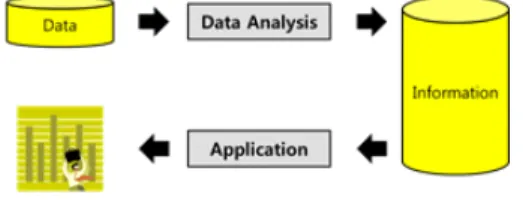
All enterprises use their data by extracting useful, meaningful, and valuable information from that data according to their management goals (Figure 1). Of course, the primary management goal is to make a profit. In extracting, manipulating, and analyzing data, managers adopt various techniques;
this is called Data Analysis. In the meantime, Artificial Neural Networks (ANN) [15-18] is a field of Artificial Intelligence (AI) [15-18] that is used for data analysis. The basic techniques are as follows;
Initial Data Analysis (Quality of Data, Quality of
Measurements, Initial Transformations, Implementation, Characteristics of Data Sample, Final Stage of the Initial Data Analysis, Analysis, Nonlinear Analysis), Main Data Analysis (Exploratory and Confirmatory Approaches, Stability of Results, Statistical Methods), Artificial Intelligence (Deduction, Reasoning, Problem solving, Knowledge Representation, Planning, Learning, Natural Language Processing, Perception, Motion and Manipulation, Social Intelligence, Creativity, General Intelligence), and so on.
Fig. 1. System Architecture
2. Hotel Management
Our research subject of hotel bankruptcy is a famous venue for serviced stays, The Ascott Limited.
The Ascott Limited is a Singapore company that has grown to be the world’s largest international serviced residence owner-operator. It has over 23,000 operating serviced residence units in key cities in the Asia Pacific, European, and Gulf regions, as well as over 10,000 units that are under development, making a total of more than 33,000 units in over 200 properties. The company operates three brands: Ascott, Citadines, and Somerset. Its portfolio spans 82 cities across 20 countries, 21 of which are new cities in Ascott’s portfolio where its serviced residences are being developed. Ascott’s properties can be found in cities including London, Paris, Brussels, Berlin, and Barcelona in Europe;
Singapore, Bangkok, Hanoi, Kuala Lumpur, Tokyo, Seoul, Shanghai, Beijing, and Hong Kong in Asia;
Melbourne and Perth in Australia, Bangalore and
Chennai in India, as well as Dubai, Doha, and
Manama in the Gulf region.
Ascott, a wholly-owned subsidiary of CapitaLand Limited, pioneered Asia Pacific’s first international-class serviced residence with the opening of The Ascott Singapore in 1984. In 2006, it established the world’s first Pan-Asian serviced residence real estate investment trust, Ascott Residence Trust. Today, the company boasts a 30-year industry track record and award-winning serviced residence brands that enjoy recognition worldwide.
Ascott’s achievements have been recognized internationally. Recent awards include World Travel Awards 2013 for ‘World’s Leading Serviced Apartment Brand’ and ‘Leading Serviced Apartment Brand’ in Asia and Europe, DestinAsian Readers’
Choice Awards 2013 for ‘Best Serviced Apartment/Residence Operator’, Business Traveller Asia-Pacific Awards 2013 for ‘Best Serviced Residence Brand’ and ‘Best Serviced Residence’, Business Traveller China Awards 2013 for ‘Best Serviced Residence Brand’, Business Traveller UK Awards 2013 for ‘Best Serviced Apartment Company’
and TTG China Travel Awards 2013 for ‘Best Serviced Residence Operator in China’.
Ascott’s parent company, CapitaLand Limited, is one of Asia’s largest real estate companies.
Headquartered and listed in Singapore, the company’s businesses in real estate and real estate fund management are focused on its core markets of Singapore and China. CapitaLand’s diversified real estate portfolio primarily includes homes, offices, shopping malls, serviced residences, and mixed developments. The company also has one of the largest real estate fund management businesses with assets located in Asia. CapitaLand leverages its significant asset base, real estate domain knowledge, product design and development capabilities, and active capital management.
III. BANKRUPTCY PREDICTION MODEL
1. Modeling of Bankruptcy Prediction Model
Research on bankruptcy prediction has developed a representative model for classification forecasting in the field of business administration. Research was started by Fitzpatrick in 1930 and has been performed in the fields of finance and accounting.
Since the late 1980s, research on bankruptcy prediction has adopted various techniques of artificial intelligence such as Artificial Neural Networks, Inductive Learning, Case Based Learning, Genetic Algorithms, and so on. We above all designed a model to develop a bankruptcy prediction model using an artificial neural network for the serviced residence The Ascott Limited.
1.1 Selecting a Tool for Modeling
For the design of the bankruptcy prediction model, we used a famous tool, NeuroShell, designed by the Ward Systems Group, Inc. NeuroShell is a legacy neural network product targeted at computer science instructors and students. It contains classic algorithms and architectures popular with graduate school professors and computer science students.
NeuroShell combines powerful neural network architectures, a Microsoft® Windows icon driven user interface, sophisticated utilities, and popular options to give users the ultimate neural network experimental environment. It is recommended for academic users only, or those users who are concerned with classic neural network paradigms like back-propagation. With our interest in solving real problems, we considered some functions such as the NeuroShell Predictor, NeuroShell Classifier, or the NeuroShell Trader.
1.2 Design of Bankruptcy Prediction Model
Since the research of Fitzpatrick [1], various
bankruptcy prediction models have been performed by many researchers [2-14]. The models are summarized as follows (Table 1); Artificial Neural Network, Bayesian, Case Based Inference, Discriminant Analysis, Expert Systems, Financial Statement Analysis, Fuzzy, Genetic Algorithms, Hybrid Neural Network, Inductive Learning, Lambda Index, Logit Analysis, Multivariate Discriminant Analysis, Principal Component Analysis, Probit Analysis, Probabilistic Artificial Neural Network, Profile Analysis, and Rough Set Theory.
Table 1. Researches on Bankruptcy Prediction
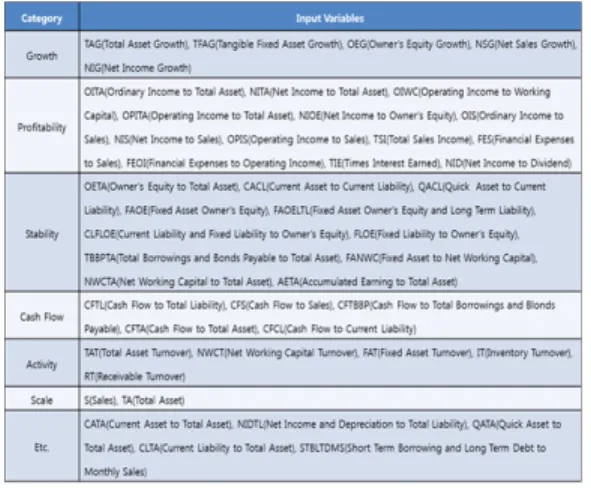
Since Beaver’s research in 1966, traditional studies have adopted many input variables from financial statements. After getting many input variables, researchers decreased the number of input variables. The considered variables that were composed of seven categories [9][12][19-21]. The seven categories are growth, profitability, stability, cash flow, activity, scale, and etc., as follows (Table 2). The category of Growth includes variables such as TAG (Total Asset Growth), TFAG (Tangible Fixed Asset Growth), OEG (Owner’s Equity Growth), NSG (Net Sales Growth), and NIG (Net Income Growth). The category of Profitability includes variables such as OITA (Ordinary Income to
Total Asset), NITA (Net Income to Total Asset), OIWC (Operating Income to Working Capital), OPITA (Operating Income to Total Asset), and NIOE (Net Income to Owner’s Equity), OIS (Ordinary Income to Sales), NIS (Net Income to Sales), OPIS (Operating Income to Sales), TSI (Total Sales Income), FES (Financial Expenses to Sales), FEOI (Financial Expenses to Operating Income), TIE (Times Interest Earned), and NID (Net Income to Dividend). The category of Stability includes variables such as OETA (Owner’s Equity to Total Asset), CACL (Current Asset to Current Liability), QACL (Quick Asset to Current Liability), FAOE (Fixed Asset Owner’s Equity), FAOELTL (Fixed Asset Owner’s Equity and Long Term Liability), CLFLOE (Current Liability and Fixed Liability to Owner’s Equity), FLOE (Fixed Liability to Owner’s Equity), TBBPTA (Total Borrowings and Bonds Payable to Total Asset), FANWC (Fixed Asset to Net Working Capital), NWCTA (Net Working Capital to Total Asset), and AETA (Accumulated Earning to Total Asset). The category of Cash Flow includes variables such as CFTL (Cash Flow to Total Liability), CFS (Cash Flow to Sales), CFTBBP (Cash Flow to Total Borrowings and Blonds Payable), CFTA (Cash Flow to Total Asset), and CFCL (Cash Flow to Current Liability). The category of Activity includes variables such as TAT (Total Asset Turnover), NWCT (Net Working Capital Turnover), FAT (Fixed Asset Turnover), IT (Inventory Turnover), and RT (Receivable Turnover). The category of Scale includes variables such as S (Sales) and TA (Total Asset). And, the category of Etc. includes variables such as CATA (Current Asset to Total Asset), NIDTL (Net Income and Depreciation to Total Liability), QATA (Quick Asset to Total Asset), CLTA (Current Liability to Total Asset), and STBLTDMS (Short Term Borrowing and Long Term Debt to Monthly Sales).
To design the bankruptcy prediction model, we
will collect data for training, testing, and
verification using NeuroShell. Then, we will make
four models to select input variables for each group.
The selected variables of each model will be used for the experiments. The accuracy rates of each model will be mutually compared and the best model will be chosen.
Table 2. Input Variables of Bankruptcy Prediction
2. Experiment of Bankruptcy Prediction Model
An experiment utilizing our bankruptcy prediction model is performed in two phases: developing experimental models and analyzing their results.
2.1 Preprocessing for Experiment
For the experiment, this research used data from 100 failed enterprises that went bankrupt between 2007 and 2009 as well as 100 successful enterprises that did not fall into bankruptcy. Using NeuroShell on the Artificial Neural Network, we allocated 200 enterprises into 100 examples for training, 50 examples for testing, and 50 examples for verification.
Through the use of input variables for bankruptcy prediction, shown in Table 4-2, we chose four model groups in order to select input variables for our experiment. The four groups are Group-A for Univariate Analysis, Group-B for Logit Analysis, Group C for Multivariate Discriminant Analysis, and Group D for Artificial Neural Network (Table 3).
Group A collected input variables by performing Univariate Analysis on the basis of a t-test and selecting 8 variables with top significant level.
Group B collected 8 input variables by performing Logit Analysis on the basis of an optional variable-selection method. Group C collected 8 input variables by performing Multivariate Discriminant Analysis on the basis of an optional variable-selection method. Group D collected 8 input variables by performing Artificial Neural Network on NeuroShell. Group A includes OETA (Owner’s Equity to Total Asset), FES (Financial Expenses to Sales), OITA (Ordinary Income to Total Asset), NIOE (Net Income to Owner’s Equity), QACL (Quick Asset to Current Liability), NWCTA (Net Working Capital to Total Asset), CATA (Current Asset to Total Asset), and CLTA (Current Liability to Total Asset). Group B includes NIS (Net Income to Sales), OPIS (Operating Income to Sales), OIS (Ordinary Income to Sales), TSI (Total Sales Income), QACL (Quick Asset to Current Liability), NWCTA (Net Working Capital to Total Asset), CATA (Current Asset to Total Asset), and CLTA (Current Liability to Total Asset). Group C includes CFTBBP (Cash Flow to Total Borrowings and Bonds Payable), NIDTL (Net Income and Depreciation to Total Liability), FLOE (Fixed Liability to Owner’s Equity), TIE (Times Interest Earned), QACL (Quick Asset to Current Liability), NWCTA (Net Working Capital to Total Asset), CATA (Current Asset to Total Asset), and CLTA (Current Liability to Total Asset). Group D includes FES (Financial Expenses to Sales), FEOI (Financial Expenses to Operating Income), OEG (Owner’s Equity Growth), OPIS (Operating Income to Sales), TAT (Total Asset Turnover), CATA (Current Asset to Total Asset), NIDTL (Net Income and Depreciation to Total Liability), and QATA (Quick Asset to Total Asset).
For reference, let us go through the methods,
including Univariate Analysis, Logit Analysis, and
Multivariate Discriminant Analysis, and Artificial
Neural Network.
Table 3. Models and Variables
2.2 Experimental Analysis
After preprocessing for experiments, we performed experiments with the above input variables for each group, Group A, Group B, Group C, and Group D, in NeuroShell. In order to increase the reliability of the experiment, we measured the accuracy rates of bankruptcy 10 times and calculated the average values of each group. The resultant rates of accuracy for each model are as shown in the following table (Table 4).
Most accuracy rates were high, with values of more than 80%. The accuracy rates for bankruptcy in Group A were 79.2% for training of the data, 78.2% for of the testing data, and 79.1% for verification of the data. The accuracy rates for bankruptcy in Group B were 83.5% for training of the data, 83.3% for testing of the data, and 83.2%
for verification of the data. The accuracy rates for bankruptcy in Group C were 84.5% for training of the data, 84.1% for the testing of the data, and 81.5% for the verification of the data. The accuracy rates for bankruptcy in Group D were 87.2% for training of the data, 88.3% for testing of the data, and 84.1% for verification of the data.
Consequently, the highest accuracy rate of the four groups was found in Group D for the Artificial Neural Network. So, we found that the model for the Artificial Neural Network has a higher degree of efficiency than that of the other methods.
Table 4. Accuracy Rates for Each Model
IV. CONCLUSIONS
Prediction of bankruptcy is a very important factor to be considered in business administration for every enterprise. There have been many vigorous studies on bankruptcy prediction not only in the field of accounting but also in other fields such as production, sales, asset management, and so on.
Especially, the model of bankruptcy prediction is a representative of decision making or decision support in management. There have been many traditional studies on bankruptcy prediction for enterprises on the basis of data. For this reason, we have proposed a new model for bankruptcy prediction on the basis of a non-linear model with high accuracy rate. For our model, formed on the basis of the artificial neural network technique, we designed several experiments using business cases of 200 enterprises; we found that the model, on the basis of the artificial neural network, has a more accurate rate of bankruptcy prediction than do other models using other techniques.
The data we used were extracted and collected
from the databases of general enterprises, not
hotels. So, the experimental results do not reflect
the conditions and characteristics f the hotel
industry. In addition, we considered only financial
indices. We took in to account several input
variables of the seven categories, such as growth,
profitability, stability, cash flow, activity, scale, and
etc. We chose (1) TAG, TFAG, OEG, NSG, and NIG
for the category of Growth, (2) OITA, NITA, OIWC,
OPITA, NIOE, OIS, NIS, OPIS, TSI, FES, FEOI,
TIE, and NID for the category of Profitability, (3)
OETA, CACL, QACL, FAOE, FAOELTL, CLFLOE,
FLOE, TBBPTA, FANWC, NWCTA, and AETA for
the category of Stability, (4) CFTL, CFS, CFTBBP,
CFTA, and CFCL for the category of Cash Flow, (5)
TAT, NWCT, FAT, IT, and RT for the category of
Activity, (6) S and TA for the category of Scale, and
(7) CATA, NIDTL, QATA, CLTA, and STBLTDMS
for the category of Etc. However, we were able to consider other non-financial indices for more accurate prediction of bankruptcy.
And, it is not easy to prepare independent financial statements for each branch. A financial statement (or financial report) is defined as a formal record of the financial activities of a business, person, or other entity. At present, favorable conditions and environment of hotels have not been created for independent financial statements. But, further studies should prepare for independent financial statements for each branch of each hotel in order to increase the prediction accuracy for bankruptcy with a full consideration of the assets, liabilities, equity, income, expenses, cash flow, and so on. There would some organizational resistance in any implementation of independent financial statements in hotels.
참고문헌
[1] D. Fletcher and E. Goss, “A comparison of the ratios of successful industrial enterprises with those of failed companies,” The Certified Public Account, Vol. 2, June, 1932.
[2] R. F. Smith and A. H. Winakor, “Change in the financial structure of unsuccessful industrial corporations,” Bureau of Business Research of University of Illinois, January, 1935.
[3] C. L. Merwin, “Financial small corporations in five manufacturing industries 1926-1936,”
National Bureau of Research, Vol. 105, January, 1942.
[4] W. Beaver, “Financial ratios as predictors of failure- empirical research in accounting;
selected studies,” Journal of Accounting Research, Vol. 5, pp. 71-111, January, 1966.
[5] E. I. Altman, “Financial ratios, discriminant analysis and the prediction of corporate bankruptcy,” The Journal of Finance, Vol. 3, pp.
589-609, September, 1968.
[6] G. A. Hanweak, “Predicting bank failure,”
Research Papers in Banking and Economics, Financial Studies, Section, FRB, Vol. 11, November, 1977.
[7] D. Martin, “Early warning of bank failure: a logit regression approach,” Journal of Banking and Finance, Vol. 1, pp. 249-276, January, 1977.
[8] W. B. Johnson, “The corss-sectional stability of financial ration patterns,” Journal of Financeial and Quantitative Analysis, Vol. 14, pp.
1035-1048, January, 1979.
[9] I. G. Dambolena and S. I. Khoury, “Ratio stability and corporate failure,” Journal of Finance, Vol. 35, No.4, pp. 1017-1026, December, 1980.
[10] J. Ohlson, “Financial ratios and the probabilistic prediction of bankruptcy,” Journal of Accounting Research, Vol. 1, pp. 109-131, March, 1980.
[11] G. W. Emery and K. O. Cogger, Journal of Accounting Research, Vol. 20, No. 2, June, 1982.
[12] M. J. Gombola and J. E. Ketz, “Financial ratio patterns in retail and manufacturing organizations,” Financial Management, Vol. 2, pp. 45-56, June, 1983.
[13] K. Takahashi, Y. Takahashi and K. Watase,
“Corporate bankruptcy prediction in Japan,”
Journal of Banking and Finance, Vol. 2, pp.
229-247, June, 1984.
[14] M. E. Zmijewski, “Methodological issues related to the estimation of financial distress prediction models,” Journal of Accounting Research, Vol.
22, pp. 59-82, January, 1984.
[15] K. C. Laudon and C. G. Traver, Management Information Systems, Prentice-Hall, 2014.
[16] E. Turban, J. E. Aronson and T-P. Liang, Decision Support Systems & Intelligent Systems, Pearson, 2010.
[17] E. Turban and D. King, Electronic Commerce, Pearson, 2013.
[18] E. Turban, L. Volonino and G. R. Wood,
Information Technology for Management,
Pearson, 2014.
[19] R. Elam, “The effect of lease data on the predictive ability of financial ratios,” The Accounting Review, Vol. 50, pp. 24-43, January, 1975.
[20] G. Foster, “Quarterly accounting data: time -series properties and predictive- ability results,” The Accounting Review, Vol. 1, pp.
1-21, January, 1977.
[21] C. L. Norton and R. E. Smith, “A comparison of general price level and historical cost financial statements in the prediction of bankruptcy,”
The Accounting Review, Vol. 1, pp. 72-87, January, 1979.
[22] S. Jung, Y. Heo, H. Jo, J. Kim and S. Choi,
“Fuzzy Theory and Bayesian Update-Based Traffic Prediction and Optimal Path Planning for Car Navigation System using Historical Driving Information,” Journal of the Korea Society of Computer and Information, Vol. 14, No. 11, pp. 159-167, November, 2009.
[23] Y. Cho, S. Moon and K. Ryu, “Clustering Analysis by Customer Feature based on SOM for Predicting Purchase Pattern in Recommendation System,” Journal of the Korea Society of Computer and Information, Vol. 19, No. 2, pp. 193-200, February, 2009.
저 자 소 개 최 성 주 2014: 원광대학교
정보관리학과 정보관리학석사 현 재: 원광대학교
정보관리학과 석사과정 관심분야: 호텔경영 Email : [email protected]
이 상 원
2009: 한국과학기술원 경영공학과 공학박사 현 재: 원광대학교
정보전자상거래학부 교수 관심분야: 경영공학
Email : [email protected]