* This study was supported by a 2015 Research Grant from Kangwon National University.
접수일자 : 2018년 08월 09일 수정일자 : 2018년 10월 26일
심사완료일 : 2018년 10월 26일
교신저자 : 손해경, e-mail : [email protected]
학령전기 아동 성장발달의 PBL 모듈 개발
Development of a Problem-Based Learning Module for Preschoolers’ Growth &
Development
이명남*, 손해경**
강원대학교 간호학과*, 성신여자대학교 간호학과**
Myung-Nam Lee([email protected])*, Hae Kyoung Son([email protected])**
요약
문제중심학습(PBL)은 간호 임상실습 시 간호 지식, 기술과 태도를 통합하는 학습자 중심의 교육이다.
본 연구는 간호학 교과과정 가운데 학령전기 아동 성장발달의 PBL 모듈을 적용하기 위한 사전 연구이다.
이에 본 양적연구는 PBL 모듈을 Dick과 Carye의 프로그램 개발 과정(계획, 개발, 적용, 평가 단계)에 따라 개발하였고 2학년 간호대학생을 대상으로 구조화된 설문지를 활용하여 그 효과를 평가하였다. PBL 모듈 은 각 팀 당 4-5명의 학생이 약 40분 정도 참여하였다. 수집된 자료는 기술통계, t-test, 내용분석을 하였다.
그 결과 간호대학생의 메타인지 수준이 유의하게 증가하였고, 팀 효능감은 모듈 참여 전후로 유의한 차이 가 없었으며, 사후 학습만족도가 높은 수준으로 나타났다. 간호대학생은 PBL 모듈 참여 후 학령전기 아동 성장발달에 관한 지식 및 문제해결능력을 습득하였고 PBL 참여 시 팀워크에 대해 만족한다고 응답하였다.
따라서 본 연구 결과는 간호 교과과정 내 PBL 모듈의 적용을 고려하기 위한 근거 자료를 제공하였다.
■ 중심어 :∣교육∣간호∣문제중심학습∣학생∣메타인지∣
Abstract
Problem-Based Learning (PBL) is a student-centered pedagogy that integrates nursing knowledge, skills, and attitudes into clinical nursing practice. This pilot aims to apply a PBL module on preschoolers’ growth and development in the nursing curriculum. This quantitative study was performed to develop a PBL module following Dick and Carye’s program development process (planning, development, application, and evaluation phases), and to evaluate its effects using structured questionnaires among sophomore nursing students. These students formed teams of four or five people each and spent 40 minutes participating in the PBL module. Data were analyzed using descriptive statistics, t-tests, and content analysis. Metacognition level increased significantly. There was no significant difference in team efficacy between pre-test and post-test. Post-test learning satisfaction was high. Students reported obtaining knowledge and problem-solving ability with respect to preschoolers’ growth and development and were satisfied with teamwork. This finding offers fundamental knowledge concerning the application of a PBL module in nursing curricula.
■ keyword :∣Education∣Nursing∣Problem-Based Learning∣Students∣Metacognition∣
I. INTRODUCTION
1. Background
Recently, it has become increasingly necessary to apply various education methods so that nursing education can reflect rapidly changing needs in clinical practice[1]. Existing methods, which are based on teaching or lecturing, are evolving into methods that allow students to take the lead in solving problems or tasks related to clinical nursing practice[2]. In addition, nurses are required to have high level cognitive abilities including problem solving, creativity, critical thinking, and judgement as core competencies to solve a variety of problems occurring in a nursing situation[3].
Since nurses are required to collect accurate information in various unpredictable clinical situations and provide nursing based on this information, nursing students need to develop the ability to proactively solve problems and perform their role right from the time they start nursing education[1][4].
Above all, Problem-Based Learning (PBL) is a student-centered pedagogy that integrates nursing knowledge, skills, and attitudes into clinical nursing practice and enhances a high level of thinking and practical coping ability[4-6]. In other words, PBL is a learning method that minimizes a tutor’s instructions or lectures in solving a learning task and allows learners to solve problems themselves based on their thinking through group presentations and discussions[6].
Since PBL was introduced, many studies in the field of nursing have combined PBL with nursing education; PBL has demonstrated a variety of positive effects, including critical thinking, class satisfaction, learning attitude and motivation, problem-solving processes and problem-solving ability, self-directed learning ability, self-efficacy, and metacognition[1][7-9].
Recently, using an educational method that combines PBL and simulation-based learning, studies have attempted to develop a nursing module and test its effects [7][8][10]. Nevertheless, there are few studies that have developed and tested PBL in children’s general growth and development, more specifically preschoolers’ growth and development.
The preschool period has an important effect on one’s lifetime health, as it not only affects the whole body’s motor ability, but also develops key organs and tissues inside the body and determines a person’s basic attributes with enhanced language ability and intelligence; it can be regarded as a period when human behavior is formed[11]. The ability to identify general growth and development characteristics of preschoolers in such an important period and analyze a nursing intervention required for these with self-directed problem-solving ability is a much-needed competency for nurses who care for children. Accordingly, a study is needed that applies PBL to preschoolers’ growth and development, by developing a PBL module that integrates nursing knowledge, skills, and attitudes, based on learners’
self-directed participation, and evaluates its effects.
In terms of strategic aspects of the problem-solving process, metacognition has been identified as a key element closely related to self-directed problem-solving ability[12]. Metacognition refers to an individual’s ability to control and regulate knowledge activity after identifying one’s level of knowledge in the learning process; it means that a learner recognizes the thinking process of oneself and others, and controls it by planning, checking, evaluating and organizing the whole problem-solving process[1][13]. Metacognition has a decisive effect on the academic achievement of learners and can be improved through learning or training[14]. Nursing educators should consider strategies for nursing
students in the curriculum, so that students can be able to apply and activate metacognition proactively in learning. Accordingly, metacognition is an essential element of PBL, which is based on learners’
self-directed participation.
In addition, considering that PBL is usually provided in a small group of 8 to 10 students, it is very useful for predicting performance for group activity along with individual learners[6][10]. Team efficacy is a shared belief among team members about the combined ability to organize and execute actions needed to achieve team goals[15]. Team efficacy is an extended concept of Bandura’s[15]
individual-level self-efficacy, and is an important predictive factor for team performance in determining the role and effort of an individual within the team[10][14]. This study identified team efficacy, a variable that has a direct effect on team performance in achieving team goals, in the collective and cognitive evaluation of team members following a PBL module.
Furthermore, an individual learner’s learning satisfaction is also an important factor, which can identify the attitude of learners in terms of focus and performance in learning. Learning satisfaction is widely used as an indicator to judge the learning outcomes of learners and should be identified in applying new ways of learning, such as the development and application of s PBL module in this study[16]. Considering this study was to develop and apply the PBL module for preschoolers’ growth and development, it was required to objectively evaluate individual learners and reflect feedback through content analysis. Accordingly, the purpose of this study was to develop a PBL module related to preschoolers’ growth and development for nursing students, and to evaluate metacognition, team efficacy, and learning satisfaction as its effects.
2. Aim
This study aimed to develop a module for preschoolers’ growth and development, which applies PBL to nursing students, and to test its effects.
Specific aims are:
First, to develop the PBL module related to preschoolers’ growth and development.
Second, to test the effects on metacognition, team efficacy, and learning satisfaction in a class applying the PBL module.
Ⅱ. METHODS
1. Study design
This pilot applied a one group pre-test and post-test experimental design to evaluate a PBL module for nursing students attending a pediatric nursing class.
2. Sample and setting
The subjects were sophomore nursing students attending a pediatric nursing class in the Department of Nursing, in one University in Korea. This was because preschoolers’ growth and development are covered in a pediatric nursing class, and this study targeted students who had no prior experience of PBL. The number of subjects was determined to be at least 64, based on a significance level of .05, a statistical power of .80, and an effect size of .30 using the G*Power 3.1 program. This study considered a drop-out rate of 10% and data from 72 students in total were collected; after excluding two participants whose responses in the post-test questionnaire were missing, the data from 70 subjects in total were analyzed.
3. Development of the module
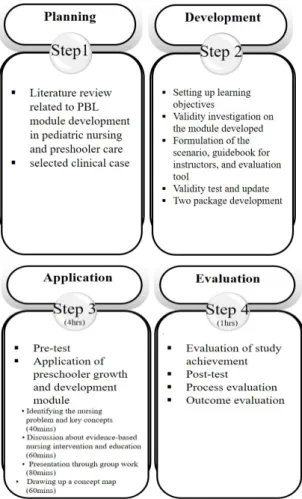
The development of the module proceeded in the order of planning, development, application, and evaluation phases in accordance with Dick and Carye’s[17] program development process[Fig. 1].
Fig. 1. Development process of a PBL module
3.1 Planning phase
Researchers identified the need for development and application of the PBL module by recent feedback from tutors and nursing students as the target population after a pediatric nursing class. Prior to the development process of the PBL module, researchers analyzed whether the university had an appropriate
environment for implementation of PBL. According to the planning phase, data for contents of the module were collected through applicable textbooks and literature review related to preschooler nursing to develop a PBL module in pediatric nursing, and clinical cases that subjects could encounter in person were selected.
3.2 Development phase
In the development phase, learning objectives were set for preschooler nursing to establish a scenario, and this scenario was drawn up based on the clinical cases selected. The learning objectives and topics of the module were determined to be understanding the growth and development process of preschoolers and acquiring the required nursing knowledge and skills based on the developmental stage classification criteria of pediatric nursing in a national exam for a registered nurse: neonatal, infant, toddler, preschooler, school-going, and adolescence. Learning objectives of the scenario were to: explain the characteristics of preschoolers’ growth and development; list nursing problems that can occur in relation to preschoolers’
growth and development; apply the nursing process to solve nursing problems related to preschoolers’
growth and development; explain vaccination required in the preschool period; perform a health assessment to see the level of preschoolers’ growth and development;
explain family nursing to improve health in the preschool period; explain that the sociocultural environment has an effect on child health; understand the importance of teamwork through cooperation with colleagues; collect and categorize learning materials systematically; apply critical thinking to a scenario situation; solve the scenario situation and then reflect on it; and reflect critically on how to solve one’s problem based on the ordinary problem-solving process and universal knowledge.
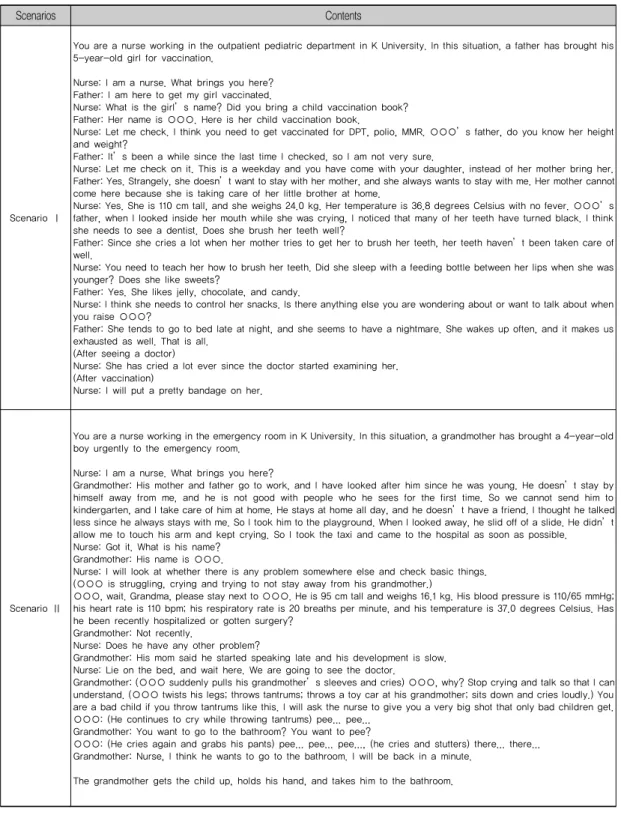
Scenarios Contents
Scenario Ⅰ
You are a nurse working in the outpatient pediatric department in K University. In this situation, a father has brought his 5-year-old girl for vaccination.
Nurse: I am a nurse. What brings you here?
Father: I am here to get my girl vaccinated.
Nurse: What is the girl’s name? Did you bring a child vaccination book?
Father: Her name is ○○○. Here is her child vaccination book.
Nurse: Let me check. I think you need to get vaccinated for DPT, polio, MMR. ○○○’s father, do you know her height and weight?
Father: It’s been a while since the last time I checked, so I am not very sure.
Nurse: Let me check on it. This is a weekday and you have come with your daughter, instead of her mother bring her.
Father: Yes. Strangely, she doesn’t want to stay with her mother, and she always wants to stay with me. Her mother cannot come here because she is taking care of her little brother at home.
Nurse: Yes. She is 110 cm tall, and she weighs 24.0 kg. Her temperature is 36.8 degrees Celsius with no fever. ○○○’s father, when l looked inside her mouth while she was crying, I noticed that many of her teeth have turned black. I think she needs to see a dentist. Does she brush her teeth well?
Father: Since she cries a lot when her mother tries to get her to brush her teeth, her teeth haven’t been taken care of well.
Nurse: You need to teach her how to brush her teeth. Did she sleep with a feeding bottle between her lips when she was younger? Does she like sweets?
Father: Yes. She likes jelly, chocolate, and candy.
Nurse: I think she needs to control her snacks. Is there anything else you are wondering about or want to talk about when you raise ○○○?
Father: She tends to go to bed late at night, and she seems to have a nightmare. She wakes up often, and it makes us exhausted as well. That is all.
(After seeing a doctor)
Nurse: She has cried a lot ever since the doctor started examining her.
(After vaccination)
Nurse: I will put a pretty bandage on her.
Scenario Ⅱ
You are a nurse working in the emergency room in K University. In this situation, a grandmother has brought a 4-year-old boy urgently to the emergency room.
Nurse: I am a nurse. What brings you here?
Grandmother: His mother and father go to work, and I have looked after him since he was young. He doesn’t stay by himself away from me, and he is not good with people who he sees for the first time. So we cannot send him to kindergarten, and I take care of him at home. He stays at home all day, and he doesn’t have a friend. I thought he talked less since he always stays with me. So I took him to the playground. When I looked away, he slid off of a slide. He didn’t allow me to touch his arm and kept crying. So I took the taxi and came to the hospital as soon as possible.
Nurse: Got it. What is his name?
Grandmother: His name is ○○○.
Nurse: I will look at whether there is any problem somewhere else and check basic things.
(○○○ is struggling, crying and trying to not stay away from his grandmother.)
○○○, wait. Grandma, please stay next to ○○○. He is 95 cm tall and weighs 16.1 kg. His blood pressure is 110/65 mmHg;
his heart rate is 110 bpm; his respiratory rate is 20 breaths per minute, and his temperature is 37.0 degrees Celsius. Has he been recently hospitalized or gotten surgery?
Grandmother: Not recently.
Nurse: Does he have any other problem?
Grandmother: His mom said he started speaking late and his development is slow.
Nurse: Lie on the bed, and wait here. We are going to see the doctor.
Grandmother: (○○○ suddenly pulls his grandmother’s sleeves and cries) ○○○, why? Stop crying and talk so that I can understand. (○○○ twists his legs; throws tantrums; throws a toy car at his grandmother; sits down and cries loudly.) You are a bad child if you throw tantrums like this. I will ask the nurse to give you a very big shot that only bad children get.
○○○: (He continues to cry while throwing tantrums) pee... pee...
Grandmother: You want to go to the bathroom? You want to pee?
○○○: (He cries again and grabs his pants) pee... pee... pee..., (he cries and stutters) there... there...
Grandmother: Nurse, I think he wants to go to the bathroom. I will be back in a minute.
The grandmother gets the child up, holds his hand, and takes him to the bathroom.
Table 1. Contents of Scenario I and Scenario Ⅱ
The module in this study was developed in two scenarios so that it could cover all topics related to the learning objectives. Scenario I was a situation where a father and a 5-year-old girl visited the Department of Pediatrics as an outpatient for the girl’s vaccination, and was found to have health problems related to psychosexual development, sleep disorder and fear, dental health and obesity, and vaccinations. Scenario II was a situation where a 4-year-old boy visited the emergency room with his grandmother following an injury and was found to have health problems related to stuttering and language delay, aggression, accidental injuries, and urination habits[Table 1].
The scenario was revised and updated for practicality and accuracy by two professors in pediatric nursing, and one nurse with more than five years of nursing experience in the Department of Pediatrics and more than 20 years of clinical practice.
Two scenarios were finally developed for preschooler nursing, with a content validity index of above 80%.
To apply the PBL module, a guidebook for instructors and evaluation tools were also established.
3.3 Application phase
Before nursing students participated in the PBL module, they filled out questionnaires about metacognition and team efficacy. Four or five students formed one team regardless of general features such as gender and age. Nursing students were randomly allocated to perform Scenario Ⅰ or Scenario Ⅱ through lot-drawing. Each team checked the nursing problems and key concepts presented in the module for 40 minutes, discussed evidence-based nursing intervention and education for 60 minutes, and then gave a presentation for 80 minutes. In addition, each group drew up a concept map based on the key concepts derived for 60 minutes. Nine teams
participated in Scenario Ⅰ while eight teams took part in Scenario Ⅱ; each team then completed the module over a 4 hour period.
3.4 Evaluation phase
After participating in the module, nursing students filled out a post-test questionnaire about metacognition, team efficacy, and learning satisfaction, and kept a personal reflective journal for the report. It took about an hour to write the report. Content analysis was used for evaluating nursing students’ feedback through structured questionnaires by labeling (or coding) of data and categorizing schema. Content analysis is a research method for the objective, systematic and quantitative description of the manifest content[18][19]. Two tutors evaluated each team’s achievement according to learning objectives regarding: whether major nursing problems were presented in the report or concept map, whether symptoms related to major nursing problems were presented, whether a nursing intervention was presented to solve major nursing problems, whether the relationship between key and related concepts was developed logically, and whether the content was summarized and organized sufficiently. The validity of these items was tested by an expert group. Each question was evaluated on a scale from “very bad (1 point)” to “very good (4 points)”, with a total score of 20 points. To ensure that both tutors maintained objectivity and consistency in their evaluations, each item was appraised individually in the same time period without allowing them to interact with each other. The PBL module was revised to reflect the evaluation after the PBL class.
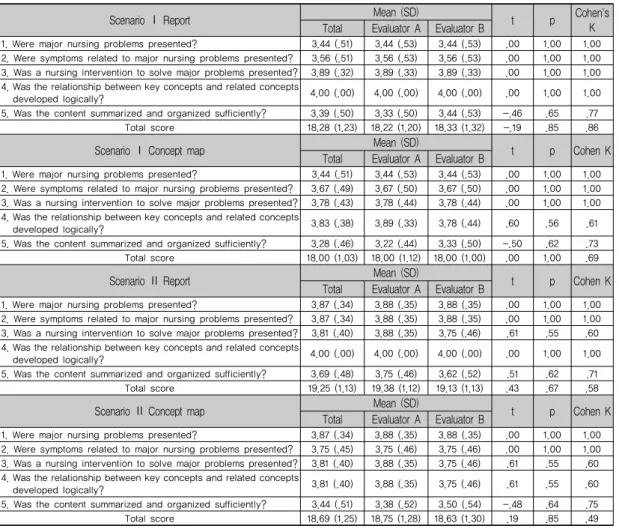
Interrater reliability was examined to evaluate the PBL group’s activity[Table 2]. The report of Scenario I scored an average of 18.28±1.23 points out of 20 and the concept map an average of 18.00±1.03 points. In
Scenario Ⅰ Report Mean (SD)
t p Cohen`s
Total Evaluator A Evaluator B K
1. Were major nursing problems presented? 3.44 (.51) 3.44 (.53) 3.44 (.53) .00 1.00 1.00 2. Were symptoms related to major nursing problems presented? 3.56 (.51) 3.56 (.53) 3.56 (.53) .00 1.00 1.00 3. Was a nursing intervention to solve major problems presented? 3.89 (.32) 3.89 (.33) 3.89 (.33) .00 1.00 1.00 4. Was the relationship between key concepts and related concepts
developed logically? 4.00 (.00) 4.00 (.00) 4.00 (.00) .00 1.00 1.00
5. Was the content summarized and organized sufficiently? 3.39 (.50) 3.33 (.50) 3.44 (.53) -.46 .65 .77
Total score 18.28 (1.23) 18.22 (1.20) 18.33 (1.32) -.19 .85 .86
Scenario Ⅰ Concept map Mean (SD)
t p Cohen K
Total Evaluator A Evaluator B
1. Were major nursing problems presented? 3.44 (.51) 3.44 (.53) 3.44 (.53) .00 1.00 1.00 2. Were symptoms related to major nursing problems presented? 3.67 (.49) 3.67 (.50) 3.67 (.50) .00 1.00 1.00 3. Was a nursing intervention to solve major problems presented? 3.78 (.43) 3.78 (.44) 3.78 (.44) .00 1.00 1.00 4. Was the relationship between key concepts and related concepts
developed logically? 3.83 (.38) 3.89 (.33) 3.78 (.44) .60 .56 .61
5. Was the content summarized and organized sufficiently? 3.28 (.46) 3.22 (.44) 3.33 (.50) -.50 .62 .73
Total score 18.00 (1.03) 18.00 (1.12) 18.00 (1.00) .00 1.00 .69
Scenario Ⅱ Report Mean (SD)
t p Cohen K
Total Evaluator A Evaluator B
1. Were major nursing problems presented? 3.87 (.34) 3.88 (.35) 3.88 (.35) .00 1.00 1.00 2. Were symptoms related to major nursing problems presented? 3.87 (.34) 3.88 (.35) 3.88 (.35) .00 1.00 1.00 3. Was a nursing intervention to solve major problems presented? 3.81 (.40) 3.88 (.35) 3.75 (.46) .61 .55 .60 4. Was the relationship between key concepts and related concepts
developed logically? 4.00 (.00) 4.00 (.00) 4.00 (.00) .00 1.00 1.00
5. Was the content summarized and organized sufficiently? 3.69 (.48) 3.75 (.46) 3.62 (.52) .51 .62 .71
Total score 19.25 (1.13) 19.38 (1.12) 19.13 (1.13) .43 .67 .58
Scenario Ⅱ Concept map Mean (SD)
t p Cohen K
Total Evaluator A Evaluator B
1. Were major nursing problems presented? 3.87 (.34) 3.88 (.35) 3.88 (.35) .00 1.00 1.00 2. Were symptoms related to major nursing problems presented? 3.75 (.45) 3.75 (.46) 3.75 (.46) .00 1.00 1.00 3. Was a nursing intervention to solve major problems presented? 3.81 (.40) 3.88 (.35) 3.75 (.46) .61 .55 .60 4. Was the relationship between key concepts and related concepts
developed logically? 3.81 (.40) 3.88 (.35) 3.75 (.46) .61 .55 .60
5. Was the content summarized and organized sufficiently? 3.44 (.51) 3.38 (.52) 3.50 (.54) -.48 .64 .75
Total score 18.69 (1.25) 18.75 (1.28) 18.63 (1.30) .19 .85 .49
Table 2. Group Activity Evaluation after Problem-based Learning (N=70) Scenario II, the report was scored an average of
19.25±1.13 points and the concept map an average of 18.69±1.25 points; its average scores were relatively higher. According to Fleiss[20], interrater reliability is excellent if it is above .75, fair to good if it is .40 to .75, and poor if it is below .40. On all items, it was .40 or higher; in other words fair or better.
4. Measurements
4.1 MetacognitionA metacognition questionnaire developed by Klein[21] and adapted by Shin[22] was revised
accordingly and used as an assessment for this study.
This tool consists of three areas (cognitive strategy, planning, and self-checking) and has 15 questions in total. It is based on a 4-point Likert scale, where each question is scored from “strongly agree” (4 points) to
“not at all” (1 point); a higher score means higher metacognitive ability. Cronbach’s α was .81 in Shin’s[22] study, and .91 in this study.
4.2 Team efficacy
Team efficacy was measured using a tool developed by Marshall[23] and revised by Kwon[24].
This tool consists of eight questions in total, each of which is based on a 5-point Likert scale, with 5 points being “strongly agree” and 1 point being “not at all,” a higher score means higher team efficacy.
Cronbach’s α was .97 in Kwon’s[24] study, and .95 in this study.
4.3 Learning satisfaction
Learning satisfaction was measured using a revised version of a learning-satisfaction tool for nursing students developed by Yoo[25]. This was measured after completion of the PBL module. This tool consists of 24 questions in total and is based on a 5-point Likert scale; a higher score means a higher level of learning satisfaction. Cronbach’s α was .94 in Yoo’s[25] study, and it was .96 in this study.
5. Data collection
Data for this study was collected in the College of Nursing in K University from December 13 to 23, 2016 after obtaining approval from the Institutional Review Board of K University (KWNUIRB-2016-11- 005). The researcher provided a copy of research participation instructions to the subjects and explained the study in detail, after which the subjects participated only if they voluntarily agreed. All subjects were completed informed consent prior to their participation in this study. In addition, because the subjects were students, we fully explained beforehand that there was no academic advantage from participating in this study or disadvantage from rejection or drop-out; the questionnaire was collected by a trained research assistant so that the subject’s identity was not revealed. Subjects completed the questionnaire for 10 minutes. The researcher provided monetary rewards to all subjects.
6. Data analysis
Data collected in this study was analyzed by descriptive statistics, the intraclass correlation coefficient, and the one sample t-test using the SPSS WIN 23.0 program; interrater reliability was calculated by Cohen’s Kappa coefficient. Furthermore, content analysis was performed on the personal reflective journal reports after the PBL class.
Ⅲ. RESULTS
1. General characteristics
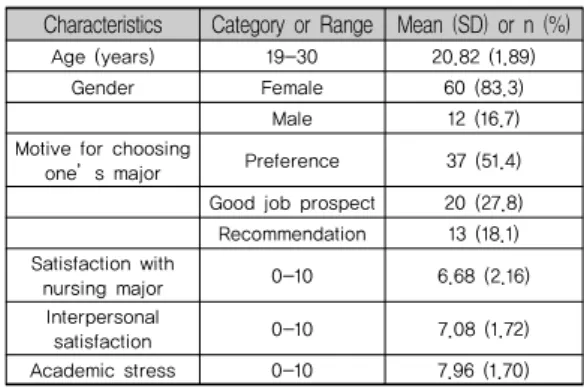
There were 70 subjects who completed the study.
Their average age was 21 years, and 60 (83.3%) subjects were female. The most cited reason to major in nursing was personal preference for 37 students (51.4%), while the level of satisfaction with nursing was 6.68 points out of 10. Interpersonal satisfaction was 7.08 points; however academic stress over nursing was high at 7.96 points[Table 3].
Characteristics Category or Range Mean (SD) or n (%)
Age (years) 19-30 20.82 (1.89)
Gender Female 60 (83.3)
Male 12 (16.7)
Motive for choosing
one’s major Preference 37 (51.4)
Good job prospect 20 (27.8) Recommendation 13 (18.1) Satisfaction with
nursing major 0-10 6.68 (2.16)
Interpersonal
satisfaction 0-10 7.08 (1.72)
Academic stress 0-10 7.96 (1.70)
Table 3. General Demographic Characteristics in Nursing Students (N=70)
2. Effects of the PBL module
To evaluate the effects of the PBL module, pre-test average values were set as test values and the
Question Category Frequency (%)
What did you learn from this learning that applied the PBL
module? (n=72)
Enhanced understanding of the nursing process to solve nursing problems (identifying nursing
problems, providing a nursing intervention, etc.) 17 (23.6)
Understanding of preschoolers’ characteristics (body measurement, standard growth curve,
vaccination, sociality, etc.) 43 (59.7)
Understanding of methodology when approaching nursing problems (concept map, etc.) 5 (6.9)
Teamwork 4 (5.6)
Confidence in solving nursing problems 2 (2.8)
Conceptual understanding of PBL 1 (1.4)
What was difficult in this learning that applied the PBL
module? (n=23)
Difficulty with applying the nursing process to solve nursing problems 14 (61.0) Lack of knowledge about the key characteristics of preschoolers 4 (17.4)
Lack of confidence in solving nursing problems 2 (8.7)
Lack of teamwork 1 (4.3)
Lack of understanding in terms of methodology when approaching nursing problems (concept map, etc.) 1 (4.3)
Lack of conceptual understanding of PBL 1 (4.3)
What was most satisfactory in this learning that applied
the PBL module?
(n=53)
Teamwork 25 (47.2)
Discuss theoretical evidence to solve nursing problems 12 (22.6)
Improve critical thinking 4 (7.5)
Improve the performance of the nursing process 9 (17.0)
Improve problem-solving ability 3 (5.7)
What did you want to improve in this learning that applied
the PBL module?
(n=39)
Provide enough time for problem-solving 16 (41.0)
Improve task performance through teamwork 9 (23.1)
Need in-depth feedback about PBL and the nursing process 6 (15.4)
Reflect fully on theoretical evidence to solve nursing problems 4 (10.3)
Improve the performance of the nursing process 3 (7.7)
Improve confidence through the approach to nursing problems and cases, which is highly applicable
to clinical practice 1 (2.6)
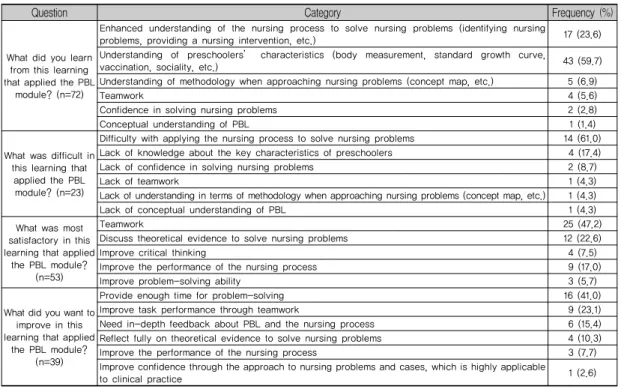
Table 5. Content Analysis of Personal Reflective Reports (Multiple Choices) averages were compared using a one sample
t-test[Table 4]. After setting the pre-test average of 44.21 as the test value, the analysis revealed that metacognition scores increased significantly; t=2.71 (p=.01). After setting the pre-test average of 30.71 as the test value, the analysis revealed that, though the post-test team efficacy score increased compared to the pre-test one, this increase was not significant, with t=1.38 (p=.17). Moreover, post-test learning satisfaction was found to be 94.67±13.92 points on a scale of 24 to 120.
Variable Pre-test Mean (SD)
Post-test
Mean (SD) t p
Metacognition 44.21 (4.94) 46.10 (5.85) 2.71 .01 Team efficacy 30.71 (5.84) 31.76 (6.35) 1.38 .17
Learning
satisfaction 94.67 (13.92)
Table 4. Comparison of Changes in Metacognition, Team Efficacy, and Learning Satisfaction before and after PBL module (N=70)
3. Contents on feedback of the PBL module
The following are the results of a content analysis on a personal reflective journal report as the feedback of nursing students after participating in the PBL module[Table 5]. In terms of lessons learned from the PBL module, an increased understanding of preschoolers’characteristics, more specifically their body measurement, standard growth curve, vaccination, and sociality, accounted for the most frequency with 43 subjects (59.7%). While 17 subjects (23.6%) said that this learning allowed them to understand the nursing process to identify problems and solve them using nursing interventions, 14 subjects (61.0%) responded that it was difficult to do so in this learning. With respect to what was most satisfactory in performing this learning, 25 subjects (47.2%) answered teamwork, followed by the discussion on theoretical evidence to solve nursing problems (n=12, 22.6%), and improvement in the performance level of
the nursing process (n=9, 17.0%). About the things to be improved for this learning in the future, 16 subjects (41.0%) said enough time needs to be provided to solve a problem. The PBL module was revised to reflect contents of feedback as the evaluation phase of this module. Some details of the revision are as follows: Before participating in the PBL module, tutors assess knowledge about the nursing process to solve nursing problems as well as assess key characteristics of preschoolers through multiple choice and short answer item quizzes.
Thereafter, tutors should provide targeted learners with information relating to PBL for preliminary understanding. It is beneficial to gain time for problem-solving and conceptual understanding of PBL. Tutors provide in-depth feedback about PBL and the nursing process after PBL in a pediatric nursing class.
Ⅳ. DISCUSSION
This study used a one group pre-test and post-test design to develop a PBL module related to preschoolers’ growth and development and to examine its effects. The findings of this study, raised some important points for discussion.
First, after applying the PBL module, nursing students’ level of metacognition level increased significantly. This finding is consistent with that of previous studies where PBL increased metacognition more effectively than an existing lecture-oriented class[1][12]. It seems that the students were able to share learning outcomes and think deeply through presentations or group discussions, as PBL is a process where the learner takes the lead, sets learning objectives, and solves problems themselves[4][6].
Furthermore, according to previous studies, students
with a higher level of metacognition improved their problem-solving ability during PBL as metacognition is correlated to problem-solving ability[1][12][26][27].
In this regard, the finding of this study that metacognition improved implies that PBL should be used when educating nursing students about preschoolers’ growth and development in the future.
In addition, while team efficacy did not show statistically significant differences in this study following the application of the PBL-based module, post-test team efficacy increased compared to pretest scores, and the students responded that they were the most satisfied with teamwork. Effective group learning resulting from PBL facilitates not only the knowledge acquisition of individual learners but also teamwork, cooperation, and respect for colleagues’
views[6]. In general, when team members aim higher in their learning goals, and there is shared trust in a team’s learning ability, it has a positive effect on team efficacy. Given the effect that team efficacy has on team performance, it is believed that team efficacy could provide important evidence as the mediator of nursing performance. This is because it is directly related to not only nursing students’ performance but also that of nursing teams.
Finally, after applying the PBL module related to preschoolers’ normal growth and development, it was found that nursing students’ average learning satisfaction was somewhat higher at 94.67 on a scale of 24 to 120. In previous studies, nursing students’
learning satisfaction was higher during PBL than a traditional education program, and PBL increased students’ interest in knowledge and learning[28][29].
More importantly, given that PBL is not tutor-oriented but learner-oriented, it would be meaningful to examine learner-focused results such as learning satisfaction and reflective feedback in the future[30]. However, since a post-test measurement
was performed due to the design of this study, we propose exploring a strategy to increase learners’
learning satisfaction through repeated studies. Since there was a significant difference in the learner’s satisfaction according to the content expertise[30], it is also suggested that future studies should be repeated for diverse key nursing problems in preschoolers’ general growth and development with consideration for the tutor’s role as content expert in PBL.
As demonstrated from the results of the content analysis on feedback from nursing students, they achieved their learning goals of identifying nursing problems related to preschoolers’ growth and development through discussion of evidence, understanding the nursing process, and solving nursing problems. More notably, they showed teamwork in solving nursing problems during PBL.
However, more understanding and preparation seems to be needed in terms of the PBL methodology, such as the PBL teaching method and concept map. This would help to improve nursing students’ performance in nursing and solving nursing problems as required.
This study is significant as it developed a PBL module based on accessible cases that were applied to nursing education. However, we would like to present the following limitations and suggestions based on this study’s findings. First, as this study involved collection of data from sophomore nursing students in a single university, we suggest that a future study consider students’ various personal backgrounds, including regional characteristics and cultural differences, the influence of tutors as facilitators, and the factors influencing team efficacy and learning satisfaction, and apply them to the PBL curriculum.
Second, as this study applied a one group pre-test and post-test experimental design to evaluate a PBL module and exogenous variables was not controlled, it should be careful to generalize from these findings.
Ⅴ. CONCLUSION
This study has provided evidence for the use of PBL in the nursing curriculum by developing a PBL module for preschoolers’ general growth and development and testing its effects. The developed PBL modules are expected to help students to solve tasks or problems in a self-directed way based on actual situations or cases, to acquire and retain professional knowledge in the long term, and to promote learning transfer.
참 고 문 헌
[1] Y. Y. Hwang, C. S. Park, and M. S. Chu,
“Correlations among meta cognition, critical thinking and self-efficacy of nursing students studying through problem based learning (PBL),” Journal of Korean Academy of Community Health Nursing, Vol.18, No.1, pp.146-155, 2007.
[2] Y. S. Roh, E. N. Ryoo, D. W. Choi, S. S. Baek, and S. S. Kim, “A survey of student perceptions, academic achievement, and satisfaction of team-based learning in a nursing course,” The Journal of Korean Academic Society of Nursing Education, Vol.18, No.2, pp.239-247, 2012.
[3] J. M. Lee, S. H. Yoon, and H. S. You,
“Identifying predictability of team efficacy, metacognition on PBL (Problem-Based Learning) outcomes,” Asian Journal of Education, Vol.13, No.1, pp.105-123, 2012.
[4] C. Ozturk, G. K. Muslu, and A. Dicle, “A comparison of problem-based and traditional education on nursing students’ critical thinking dispositions,” Nurse Education Today, Vol.28, No.5, pp.627-632, 2008.
[5] T. Fujikura, T. Takeshita, H. Homma, K.
Adachi, K. Miyake, M. Kudo, T. Takizawa, H.
Nagayama, and K. Hirakawa, “Team-based learning using an audience response system: a possible new strategy for interactive medical education,” Journal of Nippon Medical School, Vol.80, No.1, pp.63-69, 2013.
[6] D. F. Wood, “ABC of learning and teaching in medicine: problem based learning,” British Medical Journal, Vol.326, No.7384, pp.328-330, 2003.
[7] Y. J. Son and Y. A. Song, “Effects of simulation and problem-based learning courses on student critical thinking, problem solving abilities and learning,” The Journal of Korean Academic Society of Nursing Education, Vol.18, No.1, pp.43-52, 2012.
[8] Y. A. Song, “Effect of simulation-based practice by applying problem based learning on problem solving process, self-confidence in clinical performance and nursing competence,” Korean Society of Women Health Nursing, Vol.20, No.4, pp.246-254, 2014.
[9] M. R. Yoo, Y. J. Choi, and M. S. Kang, “The Effects of PBL (Problem-Based Learning) on the self-directed learning, critical thinking disposition, and problem solving process of nursing students,” The Korean Journal of Fundamentals of Nursing, Vol.16, No.1, pp.46-55, 2009.
[10] H. R. Kim, E. Y. Choi, and H. Y. Kang,
“Simulation module development and team competency evaluation,” Journal of Korean Academy of Fundamentals of Nursing, Vol.18, No.3, pp.392-400, 2011.
[11] H. S. Kim, C. Y. Lee, T. H. Lee, and O. K.
Ham, “Health problems and health behaviors of preschoolers,” Journal of Korean Academy of
Nursing, Vol.34, No.1, pp.182-190, 2004.
[12] H. Choi, “The effects of PBL (Problem-Based Learning) on the metacognition, critical thinking, and problem solving process of nursing students,” Journal of Korean Academy of Nursing, Vol.34, No.5, pp.712-721, 2004.
[13] L. Baker and A. L. Brown, Metacognitive skills of reading, Longman, 1984.
[14] J. E. Lee, “Meta-cognition brain mechanism and direction and method of education,”
Asia-pacific of Multimedia Services Convergnet with Art, Humanities, and Sociology, Vol.8, No.8, pp.443-450, 2018.
[15] A. Bandura, Self-efficacy: The exercise of control, Freeman, 1997.
[16] M. K. Cho and M. Y. Kim, “Effects of self-directed learning readiness, teacher-student interaction, and academic achievement on core competency, learner motivation, and learner satisfaction in nursing students,” Journal of the Korea Academia-Industrial cooperation Society, Vol.19, No.3, pp.161-170, 2018.
[17] W. Dick, “The Dick and Carey model: will it survive the decade?,” Educational Technology Research and Development, Vol.44, No.3, pp.55-63, 1996.
[18] B. L. Berelson, Content nalysis in communications research, New York, Free press, 1952.
[19] K. Krippendorff, Content nalysis: an introduction to its methodology, Thousand Oaks, California, Sage, 2004.
[20] J. L. Fleiss, “Measuring nominal scale agreement among many raters,” Psychological Bulletin, Vol.76, No.5, pp.378-382, 1971.
[21] D. C. D. Klein, The effects of self-monitoring and multifile context instruction on knowledge representation and transfer among middle school students, National Center for Research
on Evaluation, Standards, and Student Testing, University of California, 1998.
[22] S. G. Shin, Effects of mathematical achievement and meta-cognitive skills on mathematics problem solving the web based, self-directed learning environment, Korea National University of Education, Master’s Thesis, 1999.
[23] L. C. Marshall, The relationship between efficacy, teamwork, effort and patient satisfaction, University of Southern California, Doctoral Dissertation, 2003.
[24] E. M. Kwon, The correlation among team efficacy, interpersonal understanding, proactivity in problem solving and team performance, Ewha Womans University, Master’s Thesis, 2010.
[25] M. S. Yoo, “Development of standardized patient managed instruction for a fundamentals of nursing course,” The Journal of Korean Academic Society of Nursing Education, Vol.7, No.1, pp.94-112, 2001.
[26] E. J. Barrow, G. Lyte, and T. Butterworth, “An evaluation of problem-based learning in a nursing theory and practice module,” Nurse Education in Practice, Vol.2, No.1, pp.55-62, 2002.
[27] M. Cooke and K. Moyle, “Students’ evaluation of problem-based learning,” Nurse Education Today, Vol.22, No.4, pp.330-339, 2002.
[28] S. Y. Hwang and M. J. Kim, “A comparison of problem-based learning and lecture-based learning in an adult health nursing course,”
Nurse Education Today, Vol.26, No.4, pp.315-321, 2005.
[29] J. Strobel and A. Van Barneveld, “When is PBL more effective? A meta-synthesis of meta-analyses comparing PBL to conventional classrooms,” The Interdisciplinary Journal of
Problem-based Learning, Vol.3, No.1, pp.44-58, 2009.
[30] S. J. Kim, “Tutors’ content expertise and experience on student satisfaction in problem-based learning nursing curriculum,”
The Journal of the Korea Contents Association, Vol.18, No.7, pp.551-559, 2018.
저 자 소 개
이 명 남(Myung-Nam Lee) 정회원
▪2007년 2월 : 삼육대학교 간호학 과(간호학석사)
▪2014년 8월 : 연세대학교 일반대 학원(간호학박사)
▪2015년 3월 ~ 현재 : 강원대학교 간호학과 조교수
<관심분야> : 아동청소년 간호학, 간호교육, 호스피스
손 해 경(Hae Kyoung Son) 정회원
▪2012년 2월 : 차의과학대학교 일 반대학원(간호학석사)
▪2016년 8월 : 연세대학교 일반대 학원(간호학박사)
▪2017년 3월 ~ 현재 : 성신여자대 학교 간호학과 조교수
<관심분야> : 간호교육, 아동간호, 만성질환, 가족관 리