ORIGINAL ARTICLE
고추의 비가림재배 시 온도와 토양수분 환경이 생육 및 수량에 미치는 영향
이희주 이상규* 최장선 김준혁 김성겸 장윤아 이상중
농촌진흥청 국립원예특작과학원 채소과
Influence of Air Temperature and Soil Moisture Conditions on the Growth and Yield of Hot Pepper under a Plastic Tunnel Culture
Hee Ju Lee, Sang Gyu Lee*, Chang Sun Choi, Jun Hyeok Kim, Sung Kyeom Kim, Yun Ah Jang, Sang Jung Lee
Vegetable Research Division, National Institute of Horticultural and Herbal Sciences, Wanju 565- 852, Korea
Abstract
This study was conducted to determine the effects of high temperature and deficit irrigation on growth and yield of hot pepper. Hot pepper was subjected to four irrigation treatments: fully irrigation (FI), 10, 20, and 30 days deficit irrigation (DI) combination with high temperature treatment. Control plants were grown natural environment and conventional culture methods. The plant height treated with high temperature was significantly higher than that of control plant. At FI combination with high temperature treatment, growth parameters such as stem diameter, leaf area, fresh and dry weight were the greatest.
The yield was the greatest (2,036 kg/10a) under control, DI combination with high temperature treatment decreased by approximately 42% compare with FI combination with high temperature treatment. The number of abnormal fruits was approximately 38/plant under control, which was the smallest and that of 30 days DI combination with high temperature was higher 3.3 times compare with control. Flower abscission and calcium deficiency induced by DI treatments, especially those physiological disorder promoted by increasing DI treatments period. Results indicated that yield of hot pepper reduced by DI treatments, these results suggest that the growers should irrigate to proper soil moisture for preventing reduction of total fruit yield.
Key words : Abnormal fruit, Drought, Heat Stress, Photosynthesis, Tunnel Culture, Yield
1)1. 서론
우리나라에서 고추(Capsicum annuum L.)는 김치의 양념재료로 사용되며, 국민 1인당 연간 소비량이 5.7 kg(AFRA, 2014)으로 주요한 채소 작물이다. 고추의 수
급이 불안정하면 국민의 소비자 물가에 영향을 미칠 수 있어 매년 안정적인 공급이 필요한 작물이다. 기후변화 가 농업에 미치는 영향은 작목별 및 지역별로 대단히 상 이할 것으로 예측되고 있다. 기후변화와 이상기상으로 인하여 전 세계 농산물 총생산량에 영향을 미치고 이로
Received 16 February, 2015; Revised 27 March, 2015;
Accepted 30 March, 2015
*Corresponding author : Sang Gyu Lee, Vegetable Research Division, National Institute of Horticultural and Herbal Sciences, Wanju 565- 852, Korea
Phone: +82-63-238-6660 E-mail: [email protected]
ⓒ The Korean Environmental Sciences Society. All rights reserved.
This is an Open-Access article distributed under the terms of the Creative Commons Attribution Non-Commercial License (http://
creativecommons.org/licenses/by-nc/3.0) which permits unrestricted non-commercial use, distribution, and reproduction in any medium, provided the original work is properly cited.
인하여 소비구조를 바꾸게 되며 국가별 부의 분배에도 영향을 미칠 것으로 예측된다(권과 이, 2013). 고추는 주 로 여름철 노지에서 재배 생산되고 있기 때문에 강우, 진 딧물 및 병해 등의 피해로 인하여 안정 생산에 어려움을 겪고 있다. 특히, 지구 온난화에 의해 집중호우, 가뭄, 건 조 등(Menzel, 2000; Tao 등, 2006; Kim 등, 2013) 잦 은 이상기상 현상이 최근 발생하여 노지 재배의 안정적 인 생산을 위협하고 있다. 그래서 여름철 안정적인 고추 생산을 위하여 비가림재배 시설과 재배기술을 국가 정책 적으로 보급하고 있으나 비가림 시설 내 고온에 의한 줄 기 도장 등의 문제로 농가보급에 어려움이 있다.
고추의 경우, 광합성에 적합한 온도는 25~30 로 다 른 채소작물에 비해서 비교적 높은 편이고, 생육에 적합 한 온도는 24 범위이다(Lee 등, 2008). 고추재배 시 25 에 비해서 20 이하의 저온조건이 지속되면 생육 이 지연되며 낙화가 많아져 수량이 떨어지며(Lee 등, 2013; Lee 등, 2015), 또한 30 이상의 고온에서도 생 육이 지연되며 화분의 임성이 떨어진다(Khah와 Passam, 1992; Erickson과 Markhart, 2002; Pagamas와 Nawata, 2008). 그리고 Gajanayake 등(2011)은 고온 및 저온에 강한 품종을 선발하여 내재해성 품종을 육성하는데 기초 자료로 활용하고자 넓은 온도 실험 조건에서(10~45 ) 다양한 고추 유전자원들의 화분발아력 검증을 하였다.
또한, 고추의 생장과 과실의 발달에 있어서 적절한 토양 의 수분조건도 중요한 요인이다. 정상적인 토양 수분에 비해 포장의 토양 수분이 50% 정도로 떨어지면 고추의 수확량은 60% 감소한다(Ahmed 등, 2014). 토양의 수 분 부족은 염류 농도를 상대적으로 증가시키며 수분 및 염류 스트레스를 받은 고추의 뿌리는 생장이 저해되고 잎의 크기가 줄어든다(De Pascale 등, 2003). 최근에는 이상 온도에 따른 고추의 생리적인 피해를 해석하고 이 를 줄이기 위한 화학 처리제 기술을 개발하였다(서 등, 2014). 특히, 우리나라 여름철 비가림재배시 온도는 40 이상의 고온 그리고 토양의 수분이 부족되기 쉽기 때문 에 생육이 떨어지고, 낙화가 많아지며 시들음 증상을 유 발하는 등 수확량 감소의 원인이 될 수 있다. 본 연구의 목적은 고추 비가림 재배시설에서 고온기의 관수 처리가 고추의 생장과 수량에 미치는 영향을 구명하는 것이다.
또한, 고추 수량 감소를 줄이기 위한 비가림재배에서 적 절한 관수 시기 및 여름철 온도 환경 관리에 대한 가이드
를 제시하는 것이다.
2. 재료 및 방법
공시품종은‘슈퍼마니따’(Nongwoo Bio co., Korea) 고추를 105공 플러그 트레이(범농, 35 mL/공)에 시판용 경량상토인 바이오 상토1호(Hungnong seed co., Korea) 를 채우고 2014년 2월 11일 국립원예특작과학원 채소과 온실(36o 43 N, 128o 07 E)에 파종하였다. 포트에서 60일 간 육묘 후 비가림 시설에 이랑(폭 150 cm)에 흑색 PE 비닐로 멀칭한 후 주간거리를 35 cm로 하여 두 줄로 정식하였다. 정식 후 비가림 시설의 온도는 각각 적온 (25 ) 및 고온(35 ) 조건으로 설정하여 실험하기 위해 측면의 자동 개폐와 전면과 후면의 배기팬을 달아 강제 환기되도록 하여 온도 관리를 하였다. 토양의 수분함량 은 30%를 유지하기 위하여 육안으로 토양을 관찰하여 건조하면 5~7일에 1~2시간 동안 점적 관수하여 관리하 였다. 본 실험은 고추 뿌리의 활착이 완료 되었다고 판단 된 정식 후 25일부터 고온 및 관수 처리를 시작하였다.
관수 제어 처리는 비가림 시설 내 자동 관수장치를 설치하 여 무단수(FI; Fully irrigation treatment)구, DI(Deficit irrigation treatment)-10, DI-20 및 DI-30일간 단수 처 리를 하였다. 생육조사는 정식 후 100일에 처리구별로 3 주씩 초장, 엽수, 엽면적, 생체중 및 건물중을 측정하였 고, 엽록소 측정기(SPAD 502, Minolta Camera Co., Ltd., Osaka, Japan)로 SPAD 값을 측정하였다. 광합성 특성은 광합성 측정기(LI-6400XT, LI-COR Inc., NE, USA)를 사용하여 처리별 3반복으로 조사하였다. 광합성 측정시 동화상의 온도는 25 또는 35 , 습도는 60%, CO2 농도는 400 mmol/mol-1, 광량은 1,000 mmol/m-2/s-1 으로 하였다. 홍고추는 정식 후 85일 이후부터 매주 수확 하여 수량을 조사하였다. 고온 및 토양 건조에 따른 생리 장해 발생은 달관 조사하였다. 비가림 시설 내 환경은(온 도와 토양수분함량)은 데이터 로거(Watchdog data logger, Spectrum technology, Inc., USA)에 저장하였 다. 실험구는 완전임의배치 3반복으로 배치하였다. 통계 분석은 SAS 프로그램(SAS 9.2, SAS Institute Inc., USA)을 이용하여 각 처리구별 생장 및 수량 차이에 대 해 Duncan 다중 검정을 하였다.
Treatment
Plant height (cm/plant)
Stem diameter (㎜/plant)
Chlorophyll (SPAD)
Leaf area (㎠/plant)
Fresh weight (g/plant) Dry weight (g/plant)
Leaf Stem Root Leaf Stem Root
Control 227.1 cz 21.0 b 70.7 ab 18,478 b 475 b 673 c 46.6 b 92 b 168 c 11.6 b
High temp.
FIy 249.1 ab 24.2 a 67.8 bc 31,122 a 751 a 1,113 a 67.1 a 124 a 254 a 14.9 a DIx (10 days) 251.8 a 21.1 b 67.4 c 21,679 b 530 b 870 b 35.3 86 b 190 bc 8.7 c DI (20 days) 249.6 ab 20.9 b 72.4 a 23,507 b 588 b 932 b 49.2 107 ab 207 b 12.1 b DI (30 days) 240.0 b 20.8 b 68.2 bc 22,670 b 578 b 906 b 53.9 b 101 b 202 bc 12.1 b
ZMean separation within columns by Duncan’s multiple range test, P=0.05.
yFI: Fully irrigation treatment.
xDI: Deficit irrigation treatment.
Table 1. Growth of hot pepper as affected by high temperature combination with deficit irrigation treatments at 100 days after transplanting
Time (hour/minute)
00:00 04:00 08:00 12:00 16:00 20:00 00:00
Air temperature (oC)
0 10 20 30 40 50 60
Control
High temperature treatment
A
Time (hour:minute)
00:00 04:00 08:00 12:00 16:00 20:00 00:00
Soil moisture content (%)
0 10 20 30 40 50
Fully irrigation 10 days defict irrigation 20 days deficit irrigation 30 days deficit irrigation
B
Fig. 1. Daily changes in (a) air temperature and (b) soil moisture content in a plastic tunnel.
3. 결과 및 고찰
비가림 시설 내 고온(35 )처리구의 일일 최고 온도 와 주간 평균 온도는 각각 41.7 및 32.2 였고, 대조구 (적온, 25 )는 각각 30.3 및 24.4 였다(Fig. 1(A)).
관수 처리한 FI구의 일평균 토양 수분함량은 30% 이상 으로 유지되었으며, 단수 DI-10일 처리구와 DI-20일 처 리구의 일평균 토양 수분함량은 15~20%였고, 단수 DI-30일 처리구의 일평균 토양 수분함량은 10% 이하로 나타났다(Fig. 1(B)).
초장은 고온 처리구가 대조구보다 컸으며, 관수 결핍 일수가 증가할수록 초장이 작아졌다(Table 1). 경경, 엽 면적, 생체중 및 건물중은 고온과 충분히 관수한 조합 처 리구에서 가장 컸다. 고추 잎의 SPAD 값 범위는 67-72
였으며, 고온의 20일 관수결핍 처리와 대조구가 SPAD 값이 높았다. 관수 결핍에 의해 고추의 초장, 경경, 측지 발생 수, 엽면적, 생체중과 건물중이 감소한다는 결과와 유사하였다(Ahmed 등, 2014). 그리고 24일간 관수 결 핍 처리를 한 고추의 엽면적이 충분히 관수한 처리구에 비해 60%정도 였고, 이는 30일 관수 결핍 처리한 실험구 의 고추 엽면적이 대조구에 비해 68% 정도 였던 본 연구 결과와 일치하였다(Anjum 등, 2012).
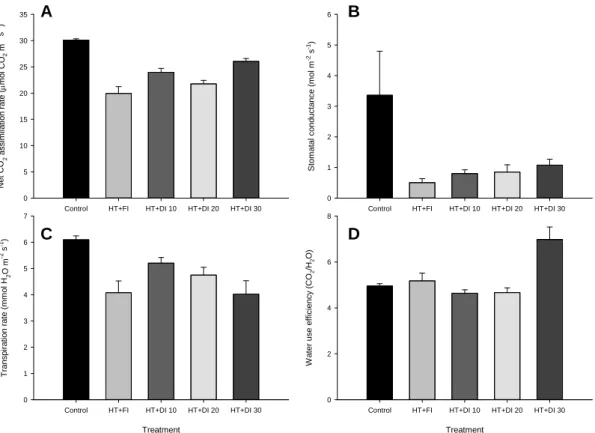
대조구 고추의 순광합성 속도, 기공전도도 및 증산 속 도는 각각 30.2 μmol CO2/m-2/s-1, 3.4 mol/m-2/s-1 및 6.1 mmol H2O/m-2/s-1로 처리구들 중 가장 높았으나 수 분 이용 효율은 고온과 관수 결핍 30일 조합 처리구가 7.0로 가장 높았다(Fig. 2). 기공전도도가 낮은 것은 부 분적으로 기공들이 닫히는 것이고 이로 인하여 증산 속
Treatment
Control HT+FI HT+DI 10 HT+DI 20 HT+DI 30 Transpiration rate (mmol H2O m-2 s-1)
0 1 2 3 4 5 6
7 Control HT+FI HT+DI 10 HT+DI 20 HT+DI 30
Stomatal conductance (mol m-2 s-1)
0 1 2 3 4 5 6
Control HT+FI HT+DI 10 HT+DI 20 HT+DI 30 Net CO2 assimilation rate (mol CO2 m-2 s-1)
0 5 10 15 20 25 30 35
Treatment
Control HT+FI HT+DI 10 HT+DI 20 HT+DI 30 Water use efficiency (CO2/H2O)
0 2 4 6 8
A B
C D
Fig. 2. Comparison of (A) CO2 assimilation rate, (B) stomatal conductance, (C) transpiration rate, (D) water use efficiency of hot pepper as affected by high temperature combination with deficit irrigation treatment. Water use efficiency was calculated by CO2 assimilation rate per transpiration rate (CO2/H2O).
도가 감소하는 것이 수분이용 효율을 증대시키는 원인이 었다(Bravdo, 2005). Campos 등(2009)은 토마토의 토 양 수분 결핍 처리 후 광합성 특성을 조사하였다. 대조구 (관수를 충분히 한 처리구)가 증산과 기공전도도가 가장 높았으나 수분 이용 효율은 관수 결핍처리구가 유의하게 높았고 특히, 관수 결핍의 강도가 강한 처리구가 가장 높 아 본 연구의 결과와 일치하였다.
고온과 충분히 관수한 조합 처리구의 고추 절간장은 10.7 cm였고 고온과 단수 조합 처리구는 9.4~9.9 cm로 다른 처리구에 비해 작았다(Table 2). 고온과 충분히 관 수한 조합 처리구의 홍고추 과장은 19.3 cm로 가장 컸으 며, 관수 결핍 기간이 증가할수록 작아졌다. 홍고추의 과 중은 고온과 충분히 관수한 처리구가 28.7 g으로 가장 컸으며, 나머지 처리구는 19.6~22.9 g으로 유의차가 없 었다. 고온 스트레스는 고추 생육기간 동안 과실의 생장
과 발달에도 영향을 미친다. 생육 기간 동안 고온 스트레 스를 받은 고추 과실은 길이와 폭이 정상적으로 온도 관 리한 고추의 과실에 비해 50% 정도 감소되었다(Pagamas 와 Nawata, 2008). 그러나 본 연구의 결과에서와 같이 고온에 충분한 관수를 한다면 과실의 생장이 지연되지 않고 정상적으로 발달할 수 있음을 확인하였다. 고추는 수분 결핍에 민감한 작물로 관수 결핍 기간이 길어질수록 고추의 영양생장과 과실의 생장은 감소하였다(Correia 등, 2001; Cabuslay 등, 2002). 세포의 발생 및 신장에 수 분의 역할이 중요하게 관여하고 있는데, 관수 결핍시 세 포내 수분 결핍으로 이어져 잎, 과실 등의 작물 기관의 발 달 등을 저해하였다(Tadesse, 1997; Sayyari와 Ghanbari, 2012). 이러한 원인으로 본 연구에서도 관수 결핍 기간 이 증가할수록 고추의 과실의 생장이 저해되었고 과중도 감소하였다.
Treatments
Fresh fruit yieldz (g/plant)
Total fruit yieldy (kg/10a) Early period of harvesting Middle period of harvesting
Control 133.0 ax 690.0 a 2,036
High temp.
FIw(0 days) 144.3 a 414.5 b 1,944
DIv(10 days) 108.3 ab 341.5 c 1,357
DI(20 days) 69.3 b 237.7 d 1,125
DI(30 days) 66.2 b 289.8 cd 1,435
zEarly period and middle period of harvesting were July and August, respectively.
yTotal fruit yield of hot pepper was calculated by harvesting during June to October.
xMean separation within columns by Duncan’s multiple range test, P=0.05.
wFI: Fully irrigation treatment.
vDI: Deficit irrigation treatment.
Table 3. The number of harvested fruit and yields as affected by high temperature combination with deficit irrigation treatments
Treatments Node length
(cm/plant)
Fruits of hot pepper Length
(cm)
Diameter (mm)
Average fresh weight (g/plant)
Control 10.21 abZ 16.17 c 18.32 b 22.30 b
High temp.
FIy(0 days) 10.69 a 19.29 a 19.49 ab 28.69 a
DIx(10 days) 9.41 b 18.20 b 21.28 a 22.89 b
DI(20 days) 9.88 ab 16.61 c 16.00 c 20.03 b
DI(30 days) 9.73 b 15.77 c 15.75 c 19.58 b
ZMean separation within columns by Duncan’s multiple range test, P=0.05.
yFI: Fully irrigation treatment.
xDI: Deficit irrigation treatment.
Table 2. Characteristics of hot pepper as affected by high temperature combination with deficit irrigation treatments at 85 days after transplanting
대조구, 고온에 충분히 관수한 FI처리구 및 DI-10일 간 관수 결핍 처리구의 초기 수확량은 각각 133.0, 144.3 및 108.3 g/plant였고, 이들 처리 평균간 유의차는 없었 으나 다른 두 처리구(DI-20일 및 DI-30일 관수 결핍 처 리구)에 비하여 통계적으로 유의하게 높았다(Table 3).
수확 중반기도 초기 수확량의 결과와 유사하였다. 총 수 확량에 있어서도 대조구가 2,036 kg/10a로 가장 많았으 며, 고온과 충분히 관수한 처리구는 1,944 kg/10a였고, 고온과 20일 관수 결핍 처리구가 1,125 kg/10a로 처리 구들 중 가장 낮았다. Abayomi 등 (2012)은 토양의 수 분 함수량이 감소할수록 고추의 상품과 수와 중량이 감
소하였다는 보고를 하였고 이는 본 연구 결과와 유사하 였다. 그리고 심한 관수 결핍처리구에서 고추의 고형 단 백질의 함량은 늘어나지만 수량은 감소하였다는 결과와 도 일치 하였다(Anjum 등, 2012).
처리별 고추의 비정상과 발생정도를 조사한 결과는 Table 4와 같다. 비정상과는 석회결핍증을 포함한 병과 가 가장 많았다. 비정상과 발생은 대조구가 37.6개(347 g) 발생되었고, 고온과 충분히 관수한 조합 FI처리구에 서는 41.1개(317 g)가 발생되어 다른 관수 결핍 처리구 보다 적게 발생되었다. 고온과 DI-30일 관수 결핍 처리 구는 127.3개(1,060 g)가 발생되어 비정상과가 가장 많
Treatments
Infected fruits Fruit cracking Malformded fruits Total Number of
fruitsz (/plant)
Fresh weight (g/plant)
Number of fruits (/plant)
Fresh weight (g/plant)
Number of fruits (/plant)
Fresh weight (g/plant)
Number of fruits (/plant)
Fresh weight (g/plant)
Control 37.2 345.1 0.33 1.5 0.07 1.2 37.6 347
High temp.
FIy(0 days) 37.8 272.2 2.56 32.8 0.78 12.8 41.1 317
DIx(10 days) 60.4 483.8 2.33 23.3 4.44 48.5 67.1 555
DI(20 days) 101.5 851.4 1.44 10.0 9.78 92.2 112.7 953
DI(30 days) 109.8 909.9 0.56 3.1 16.89 147.3 127.3 1,060
zNumber of fruits and fresh weigh of hot pepper represented in average of 9 plants.
yFI: Fully irrigation treatment.
xDI: Deficit irrigation treatment.
Fig. 3. The fallen flower and calcium deficiency of hot pepper. (A) Fallen flower, (B) symptoms of calcium deficiency and (C) symptoms inside fruit of calcium deficiency under high temperature combination with 30 days deficit treatment.
Table 4. The abnormal fruit of hot pepper as affected by high temperature combination with deficit irrigation treatments
이 발생되었고, 대조구와 고온의 충분히 관수한 조합 FI 처리구 대비 기형과수는 3.3배 증가하였다. 고온과 관수 결핍 조합 처리에 따른 피해 양상은 생장점 위조 증상을 보였으나 회복되었으며 대조구에 비해서 낙과(Fig.
3(A))와 석회결핍과(Fig. 3(B) 및 (C)) 발생률이 높았 으며, 고온구의 관수 결핍처리 기간이 길수록 석회결핍 과와 병과 발생이 많았다. 고온과 가뭄 기간이 길어지 면 석회결핍 증상 등 비정상과 발생이 많아진다는 결과 (Spears 등, 1997; Cross 등, 2003; Pagamas와 Nawata, 2008)와 본 연구 결과는 유사하였다. 그리고 고추의 화 분 발아력과 화분관 신장력은 정상과와 비정상과를 결정 짓는 주요한 요인 중 하나이다. 30 이상 고온에서 고추 의 화분 발아력과 화분관 신장력은 감소하며, 특히 35 이상의 고온에서는 더욱 급속히 감소한다고 하였다 (Gajanayake 등, 2011). 본 연구에서 고온 처리구의 최 고 온도가 40 정도로 고추의 화분 발아력과 화분관 신
장을 억제할 수 있는 조건 이였으며, 이로 인하여 낙과 등 의 비정상과 발생이 증가하였다고 판단할 수 있었다.
4. 결론
고추의 초장은 대조구에 비해 고온 처리구가 컸으며, 경경, 엽면적, 생체중 및 건물중은 고온에서 충분히 관수 한 FI처리구가 가장 컸다. 대조구의 수량은 2,036 kg/
10a로 처리구들 중 가장 많았다. 고온에서 충분히 관수 한 FI처리구가 1,944 kg/10a로 대조구와 유사하였고, 20 일 관수결핍 처리구가 1,125 kg/10a로 대조구 대비 약 42% 수준이었다. 기형과수는 대조구가 약 38 개/주로 가 장 적었고 30일 관수 결핍 처리구는 약 127 개/주로 대조 구 대비 3.3배 증가하였다. 관수 결핍 처리시 고추의 낙 화와 석회결핍과 발생이 많았고, 특히 고온조건에서 관 수 결핍 처리기간이 길수록 병과 발생이 많아졌다. 따라
서 고추의 경우 온도가 높고 가뭄이 30일 이상 지속된다 면 안정적인 수량 확보를 위하여 관수를 할 수 있도록 사 전 조치가 필요할 것으로 판단된다.
감사의 글
본 논문은 농촌진흥청 연구사업(세부과제번호: PJ010 13602)의 지원에 의해 이루어진 것입니다.
REFERENCE