열수추출 과정에서 삽주, 백출(큰꽃삽주), 북창출 배합이 감초 성분의 추출률에 미치는 영향
김정훈1,2,#,*
1 : 부산대학교 한의학전문대학원 약물의학부, 2 : 부산대학교 한의과학연구소 한의약물기반연구센터
Chemical influences of the rhizomes of
Atractylodes japonica
,A. macrocephala
, or A. chinensis on the extraction efficiencies of chemical compounds in the rootsand rhizomes of
Glycyrrhiza uralensis
during hot-water extractionJung-Hoon Kim
1,2,#,*1 : Division of Pharmacology, School of Korean Medicine, Pusan National University, 50612, Republic of Korea 2 : KM Medicinal Material-based Research Center, Pusan National University, 50612, Republic of Korea
ABSTRACT
Objectives : When herbal medicines are extracted together, they may interact with each other, leading to change of chemical characteristics. This study aimed to evaluate the influence of
Atractylodesrhizomes (
Atractylodes japonica,
A. macrocephala, and
A. chinensis) on the chemical features of the roots and rhizomes of
Glycyrrhiza uralensis, which is are commonly combined with herbal medicines in many herbal formulae, when they are co-decocted.
Methods : Liquiritin apioside, liquiritin, ononin, and glycyrrhizin levels of
G. uralensisin hot-water extracts prepared by the combination of
Atractylodesrhizomes with various weight ratios (
G. uralensis:
Atractylodesrhizomes = 10:0, 10:5, 10:10, and 10:20) and extraction times (60, 90, and 120 min) were quantified using a HPLC-diode array detector and compared by statistical analysis.
Results : The concentrations of liquiritin apioside, liquiritin, ononin, and glycyrrhizin from
G. uralensisroots and rhizomes mostly reduced when co-extracted with
Atractylodesrhizomes, and the addition of
A. chinensismost reduced their contents between
Atractylodescombination groups.
A. japonicaand
A. macrocephalarhizomes also showed differences of liquiritin and glycyrrhizin levels at 10 g and 20 g groups of Atractylodes rhizomes. Extraction times also affected the concentrations of liquiritin, ononin, and glycyrrhizin mostly during 60 and 90 min.
Conclusions :
Atractylodesrhizomes might alter the chemical characteristics of
G. uralensiswhen these herbs are co-decocted. This study provides the understanding of the chemical interactions of herbal medicines during the extraction in hot water.
1)
Key words :
Atractylodes japonica,
A. macrocephala,
A. chinensis,
Glycyrrhiza uralensis, chemical interaction, hot-water extraction
I. Introduction
The compositional principle of herbal formulae usually begins with the combination of herbal medicines
containing various active constituents and interactions between these herbs may determine their therapeutic effects. The extraction efficiencies of herbal medicines are largely determined by the amounts of compounds
*#Corresponding and First author : Jung-Hoon Kim. Division of Pharmacology, School of Korean Medicine, Pusan National University, Yangsan, 50612, Republic of Korea
·Tel : +82-51-510-8456 ·E-mail : [email protected]
·Received : 16 Aug 2019 ·Revised : 10 Sep 2019 ·Accepted : 25 Sep 2019
extracted from herbs under specific conditions, and herbal combinations generally change compound extraction efficiencies
1–3).
The rhizomes of
Atractylodes japonicaKoidz. ex Kitam.,
A. macrocephalaKoidz., and
A. chinensis(Bunge) Koidz. are used as traditional gastrointestinal medicines and belong to different medicinal application categories: the rhizomes of
A. chinensisare used as
‘Changchul’; those of
A. macrocephalaas ‘Baekchul’;
and those of
A. japonicaas ‘Changchul’ or ‘Baekchul’
4–6). The roots and rhizomes of
Glycyrrhiza uralensisFisch. are commonly used as an essential element to prepare herbal formulas or are used alone to treat diverse diseases.
Atractylodesrhizomes can be complexed with various herbal medicines for different medicinal applications, but different species of the
Atractylodesgenus are commonly used in combination with
G. uralensis7–9).
Accordingly, interactions between different species of the genus
Atractylodesand
G. uralensismight crucially influence the therapeutic effect of herbal formulae because the chemical constituents of
Atractylodesrhizomes exhibit species-specific differences
10,11). Therefore, it might be an interesting question whether combinations of different
Atractylodesspecies could differentially affect chemical characteristics of
G. uralensisprepared by
co-decoction. However, few studies have addressed the effect of combination treatments based on these types of herbal medicines
12).
Therefore, in the present study, the combined effects of three species of
Atractylodes, that is,
A. japonica,
A. macrocephala, or
A. chinensison the extraction efficiencies of four marker compounds (liquiritin apioside, liquiritin, ononin, and glycyrrhizin), which were generally selected for the markers
13,14), in
G.uralensis
roots and rhizomes were compared in hot-water extraction.
II. Materials and Methods
1. Chemicals and reagents
Acetonitrile, methanol and water were purchased from J.T. Baker Inc. (HPLC grade; Phillipsburg, NJ, USA). Trifluoroacetic acid and liquiritin were purchased from Sigma-Aldrich (St Louis, MO, USA). Liquiritin apioside was purchased from Chengdu Biopurify Phytochemicals Ltd. (Chengdu, Sichuan, China). Ononin and glycyrrhizin were purchased from ChemFace (Wuhan, Hubei, China). All marker compounds had purities of ≥ 98% The chemical structures of all marker compound and IS are shown in Figure 1.
Fig. 1. Chemical structures of the marker compounds. 1, Liquiritin apioside; 2, liquiritin; 3, ononin; 4, glycyrrhizin.
Dried rhizomes of
Atractylodes japonicaKoidz. ex Kitam.,
A. macrocephalaKoidz., and
A. chinensis(Bunge) Koidz. and dried roots and rhizomes of
G.uralensis
Fisch. were purchased from Kwangmyungdang Medicinal Herbs (Ulsan, Korea) and these herbs
were authenticated by the author (J.-H. Kim).
Voucher specimens (2018–PNUKM–AJ01, –AM01, –AC01,
and –GU01) have been deposited at the School of
Korean Medicine, Pusan National University.
2. Sample preparation
Combinations of
G. uralensis(10 g) and
A. japonica,
A. macrocephala, or
A. chinensisrhizomes (the 5, 10, and 20 g groups, respectively) were extracted with 500 ㎖ of distilled water (
w/v) at 100 ℃ for 120 min using a heat-reflux extractor.
In addition,
G. uralensis(10 g) and each of the three
Atractylodesspecies (10 g) were extracted as mentioned above, but with different extraction times (the 60, 90, and 120 min groups, respectively).
Hot-water extracts were transferred to volumetric flasks and made up to 500 ㎖ with distilled water, and filtered through 0.2 ㎛ syringe filters (BioFact, Daejeon, Korea). Filtrates (200 ㎕) were then prepared for HPLC analysis by adding HPLC grade water (800 ㎕) to make a final solution.
3. HPLC analytical conditions
An Agilent 1260 liquid chromatography system (Agilent Technologies, Palo Alto, CA, USA) equipped with an autosampler, degasser, quaternary solvent pump, and diode array detector was used for the quantitative analysis. Data were processed using Chemstation software (Agilent Technologies Inc., USA).
Four marker compounds, liquiritin apioside, liquiritin, ononin, and glycyrrhizin, were separated on a Capcell Pak Mg II C
18column(4.6 ㎜ × 250 ㎜, 5 ㎛ ; Shiseido, Tokyo, Japan) at 35℃ using flow rate of 1 ㎖/min and an injection volume of 10 ㎕. The mobile phase consisted of water containing 0.1% TFA (solvent A) and acetonitrile (solvent B). Elution was conducted using a gradient elution program as follows: 15%
(B) for 0–3 min, 15–40% (B) for 3–35 min, 40% (B) for 1 min, 40–80% (B) for 36–42 min, 80% (B) for 1 min, and then re-equilibrated to 15% (B) until the end of the analysis. The diode-array detector was set at ultraviolet wavelengths of 250 and 275 ㎚.
4. Validation of the HPLC method
The four marker compounds were accurately weighed and dissolved in methanol at 1000 ㎍/㎖ to make stock solutions, and then serially diluted to produce working solutions of different concentrations.
Working solutions were injected into the HPLC to construct calibration curves. The linearities of calibration curves were evaluated using correlation coefficients (
r2). LOD and LOQ were defined as signal-to-noise (S/N) ratio of 3 and 10, respectively.
The precisions were determined by analyzing low, medium, and high concentrations of the above- mentioned working solutions three times within a day (intraday precision) and over three consecutive days (interday precision). Precisions are represented as relative standard deviations (RSDs), where RSD (%)
= [(standard deviation / mean)×100].
The accuracy of the HPLC method was determined by testing the recoveries of three known amounts of the six marker compounds (low, medium, and high concentrations) added to sample solutions. Recovery was calculated as follows: Recovery (%) = [(detected concentration – initial concentration) / spiked concentration] × 100.
5. Statistical analysis
Multiple comparisons of different contents of liquiritin apioside, liquiritin, ononin, and glycyrrhizin in hot-water extracts were performed using Tukey’s test. Regression coefficients and correlations of determination (R
2) were calculated using regression analysis. Difference were considered significant for
pvalues of < 0.05,
p< 0.01, or
p< 0.001, as indicated.
Multiple comparison and regression analyses were performed using open- source software R (v. 3.5.2;
The R Foundation for Statistical Computing).
III. Results
1. Optimization of analytical conditions
Column, mobile phase modifier, and UV detector wavelength were optimized for HPLC analysis of the four marker compounds in the hot-water extracts of
G. uralensisroots and rhizomes. Separation of four marker compounds in
G. uralensisextract was performed on a C
18–coated silica column (Capcell Pak Mg II; 4.6 ㎜ × 250 ㎜, 5 ㎛; Shiseido). Mobile phase acidification can increase affinity between a stationary phase and compounds by suppressing the ionizations of acidic compounds, and hence can improve peak shape. Thus, trifluoroacetic acid was added in water at 0.1%
v/vfor gradient elution, as previously described
15,16). The UV wavelengths chosen were 250 ㎚ for ononin and glycyrrhizin and 275 ㎚ for liquiritin apioside and liquiritin (Figure 2).
2. Validation of analytical methods
The correlation coefficients of the calibration curves
of marker compounds were ≥ 0.9999 within the
linear range. LODs and LOQs ranges were 0.04–0.19
㎍/㎖ and 0.13–0.62 μg/mL, respectively (Table 1).
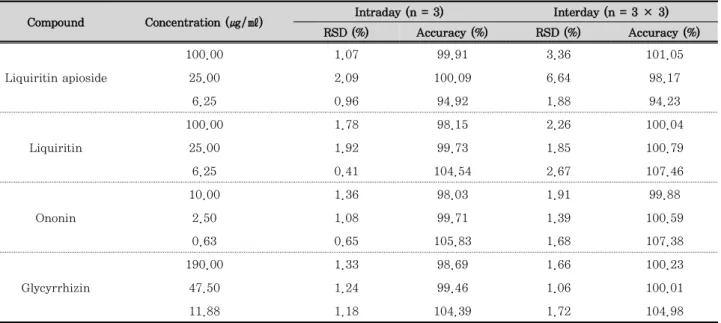
The intra- and inter-day precisions of the HPLC methods were < 2.5% and < 7.0%, respectively (both
represented as RSD, Table 2).
The recovery of the marker compounds in the HPLC methods ranged from ere recovered from 99.89% to 114.61% with RSDs of < 7.7% (Table 3).
Fig. 2. HPLC chromatograms of the marker compounds (A–D) and hot-water extracts of G. uralensis (E), G. uralensis + A. japonica (F), G. uralensis + A. macrocephala (G), and G. uralensis + A. chinensis (H). 1, Liquiritin apioside; 2, liquiritin; 3, ononin; 4, glycyrrhizin.
Compound Regression equation r2 Linear range (㎍/㎖) LOD (㎍/㎖) LOQ (㎍/㎖)
Liquiritin apioside y = 15.5395 x + 13.2086 0.9999 3.13-200.00 0.12 0.39
Liquiritin y = 18.4948 x–10.1753 0.9999 3.13-200.00 0.12 0.39
Ononin y = 40.2454 x – 2.1201 0.9999 0.31-20.00 0.04 0.13
Glycyrrhizin y = 3.7757 x–3.1701 0.9999 5.94-380.00 0.19 0.62
LOD, limit of detection; LOQ, limit of quantification; y, peak area (mAU); x, compound concentration (㎍/㎖).
Table 1. Linear equations, correlation coefficients (r2), LODs, and LOQs of the four marker compounds
Compound Concentration (㎍/㎖) Intraday (n = 3) Interday (n = 3 × 3)
RSD (%) Accuracy (%) RSD (%) Accuracy (%)
Liquiritin apioside
100.00 1.07 99.91 3.36 101.05
25.00 2.09 100.09 6.64 98.17
6.25 0.96 94.92 1.88 94.23
Liquiritin
100.00 1.78 98.15 2.26 100.04
25.00 1.92 99.73 1.85 100.79
6.25 0.41 104.54 2.67 107.46
Ononin
10.00 1.36 98.03 1.91 99.88
2.50 1.08 99.71 1.39 100.59
0.63 0.65 105.83 1.68 107.38
Glycyrrhizin
190.00 1.33 98.69 1.66 100.23
47.50 1.24 99.46 1.06 100.01
11.88 1.18 104.39 1.72 104.98
Conc., concentration; RSD, relative standard deviation (%) = (standard deviation/mean) × 100.
Table 2. Intra- and inter-day precisions of the four marker compounds
Compound Initial conc. (㎍/㎖) Spiked conc. (㎍/㎖) Detected conc. (㎍/㎖) Recovery (%) RSD (%)
Liquiritin apioside 26.90
2.50 29.43 101.22 4.73
5.00 32.61 114.20 5.37
10.00 38.36 114.61 0.59
Liquiritin 12.12
2.50 14.75 105.47 6.75
5.00 17.34 104.38 3.76
10.00 22.11 99.89 2.98
Ononin 2.77
0.63 3.40 101.86 7.13
1.25 4.05 102.96 5.65
2.50 5.27 100.01 4.50
Glycyrrhizin 108.47
25.00 134.61 104.54 7.67
50.00 160.51 104.07 3.80
100.00 210.03 101.56 1.63
Conc., concentration; RSD, relative standard deviation (%) = (standard deviation/mean) × 100.
Table 3: Recoveries of the four marker compounds
3. Influence of co-extraction on the extraction efficiencies of the marker compounds
Co-extraction of
G. uralensiswith 20 g of
A.japonica
rhizomes significantly reduced the concentrations of liquiritin apioside (single → combination: 37.037 ± 7.049 μg/mL → 29.445 ± 8.156 ㎍/㎖), ononin (2.547 ± 0.558 ㎍/㎖ → 1.872 ± 0.358 ㎍/㎖), and glycyrrhizin (145.796 ± 31.186 ㎍/㎖
→ 109.861 ± 12.024 ㎍/㎖). Significant reductions in the concentrations of liquiritin apioside (37.037 ± 7.049 ㎍/㎖ → 30.151 ± 4.190 ㎍/㎖, 29.905 ± 6.864
㎍/㎖, and 26.522 ± 3.496 ㎍/㎖) and ononin (2.547 ± 0.558 ㎍/㎖ → 1.976 ± 0.457 ㎍/㎖ and 2.000 ± 0.301
㎍/㎖) occurred in the presence of
A. macrocephalarhizomes at all weights except 10 g.
A. chinensissignificantly decreased the concentrations of liquiritin apioside (37.037 ± 7.049 ㎍/㎖ → 25.878 ± 5.063
㎍/㎖, 28.671 ± 4.389 ㎍/㎖, and 29.901 ± 10.667
㎍/㎖) and ononin (2.547 ± 0.558 ㎍/㎖ → 1.467 ± 0.200 ㎍/㎖, 1.921 ± 0.458 ㎍/㎖, and 2.087 ± 0.693
㎍/㎖) at all weights and of glycyrrhizin when present at 10 g (145.796 ± 31.186 ㎍/㎖ → 117.794 ± 11.992
㎍/㎖) (Figure 3).
Fig. 3. Change in the concentrations of the four marker compounds after hot water co-extraction of G. uralensis (10 g) with each of the three of Atractylodes rhizomes (0, 5, 10, and 20 g) for 120 min. A, Liquiritin apioside; B, liquiritin; C, ononin; D, glycyrrhizin.
#, the difference of concentrations between single G. uralensis group vs. G. uralensis + Atractylodes rhizomes group with significance at
#p < 0.05, ##p < 0.01, and ###p < 0.001.
*, the difference of concentrations between G. uralensis + Atractylodes rhizomes groups with significance at *p < 0.05, **p < 0.01, and
***p < 0.001.
As also shown in figure 3, significant decreases in the concentrations of the four compounds were observed when
G. uralensisroots and rhizomes were extracted with
A. chinensis(25.878 ± 5.063 ㎍/㎖ at 5 g and 28.671 ± 4.389 ㎍/㎖ at 10 g for liquiritin apioside;
25.039 ± 8.777 ㎍/㎖ at 10 g for liquiritin; 1.467 ± 0.200 ㎍/㎖ at 5 g and 1.921 ± 0.458 ㎍/㎖ at 10 g for ononin; 117.794 ± 11.992 ㎍/㎖ at 10 g for glycyrrhizin) as compared with extractions in the presence of
A. japonica(31.856 ± 8.193 ㎍/㎖ at 5 g and 34.783 ± 6.637 ㎍/㎖ at 10 g for liquiritin apioside; 38.669 ± 7.621 ㎍/㎖ at 10 g for liquiritin;
2.126 ± 0.682㎍/㎖ at 5 g and 2.507 ± 0.474 ㎍/㎖
at 10 g for ononin; 162.858 ± 29.785 ㎍/㎖ at 10 g for glycyrrhizin) or
A. macrocephala(34.542 ± 7.637
㎍/㎖ at 10 g for liquiritin; 1.976 ± 0.457 ㎍/㎖ at 5 g and 2.412 ± 0.387 ㎍/㎖ at 10 g for ononin;
163.903 ± 44.960 ㎍/㎖ at 20 g for glycyrrhizin).
Concentrations of liquiritin (26.154 ± 5.360 ㎍/㎖
↔ 37.533 ± 12.725 ㎍/㎖) and glycyrrhizin (109.861
± 12.024 ㎍/㎖ ↔ 163.903 ± 44.960 ㎍/㎖) differed significantly at 20 g groups and those of glycyrrhizin (162.858 ± 29.785 ㎍/㎖ ↔ 134.437 ± 30.683 ㎍/㎖) different at 10 g groups, comparing the presences of
A. japonicaand
A. macrocephalarhizomes.
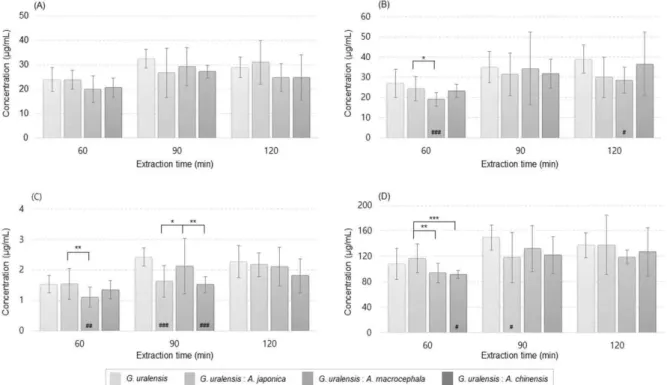
Concentrations of ononin and glycyrrhizin were
significantly reduced by co-extraction with
A. japonicafor 90 min (2.425 ± 0.294 ㎍/㎖ → 1.630 ± 0.516 ㎍/㎖
for ononin; 149.535 ± 19.512 ㎍/㎖ → 118.239 ± 37.466 ㎍/㎖ for glycyrrhizin) and
A. chinensis(2.425
± 0.294 ㎍/㎖ → 1.517 ± 0.262 ㎍/㎖ for ononin at 90 min; 107.993 ± 24.315 ㎍/㎖ → 91.283 ± 5.901
㎍/㎖ for glycyrrhizin at 60 min). Extraction with
A.macrocephala
significantly decreased the concentration of liquiritin at 60 min (27.046 ± 6.948 ㎍/㎖ → 19.037 ± 3.492 ㎍/㎖) and 120 min (38.962 ± 7.025
㎍/㎖ → 28.539 ± 6.479 ㎍/㎖), and of ononin at 60 min (1.526 ± 0.283 ㎍/㎖ → 1.108 ± 0.334 ㎍/㎖).
Concentrations of liquiritin (24.375 ± 6.048 ㎍/㎖
↔ 19.037 ± 3.492 ㎍/㎖), ononin (1.547 ± 0.512
㎍/㎖ ↔ 1.108 ± 0.334 ㎍/㎖ at 60 min; 1.630 ± 0.516 ㎍/㎖ ↔ 2.125 ± 0.916 ㎍/㎖ at 90 min), and glycyrrhizin (116.506 ± 22.830 ㎍/㎖ ↔ 93.777 ± 15.137 ㎍/㎖) significantly differed at 60 min and 90 min for extractions in the presence of
A. japonicaor
A. macrocephala, and co-extraction with
A. chinensissignificantly reduced concentrations of ononin at 90 min (2.125 ± 0.916 ㎍/㎖ → 1.517 ± 0.262 ㎍/㎖) and glycyrrhizin at 60 min (116.506 ± 22.830 ㎍/㎖ → 91.283 ± 5.901 ㎍/㎖), as compared with co-extraction with
A. macrocephalaor
A. japonica(Figure 4).
Fig. 4. Change in the concentrations of the four marker compounds after hot water co-extraction of G. uralensis (10 g) with Atractylodes rhizomes (10 g) for 60, 90, and 120 min. A, Liquiritin apioside; B, liquiritin; C, ononin; D, glycyrrhizin.
#, the difference of concentrations between single G. uralensis group vs. G. uralensis + Atractylodes rhizomes group with significance at
#p < 0.05, ##p < 0.01, and ###p < 0.001.
*, the difference of concentrations between G. uralensis + Atractylodes rhizomes groups with significance at *p < 0.05, **p < 0.01, and
***p < 0.001.
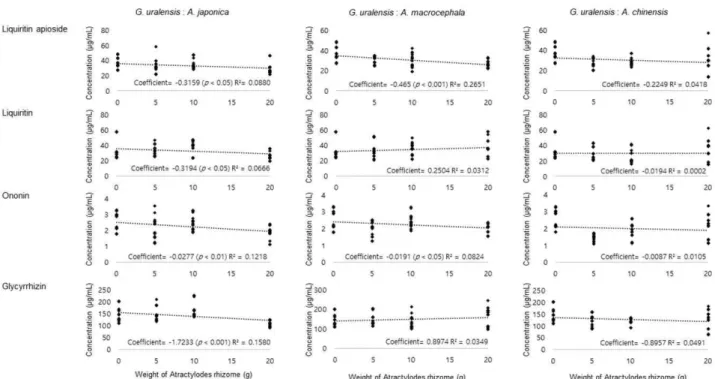
Negative regression coefficients and determination coefficients (R
2)indicated that increasing the weights of
Atractylodesin co-extraction reduced concentrations of the four marker compounds in
G. uralensis, with the exception of liquiritin and glycyrrhizin in
G.uralensis
:
A. macrocephalaco-extracts (Figure 5).
In contrast, extraction of
G. uralensisin the presence of the three
Atractylodesspecies time-dependently increased the concentrations of the four marker compounds, as was observed for the extraction of
G. uralensisalone (Figure 6).
Fig. 5. Regression equations and correlation coefficients (R2)of the four marker compounds in decoction of G. uralensis roots and rhizomes plus Atractylodes rhizomes.
Fig. 6. Regression equations and correlation coefficients (R2)of the four marker compounds in G. uralensis roots and rhizomes (10 g) plus Atractylodes rhizomes (10 g) co-extracts in using different decoction times (60, 90, and 120 min).
IV. Discussion
The concentrations of liquiritin apioside, ononin, and glycyrrhizin significantly decreased when
G.uralensis
was co-extracted with the at least one of the three species of
Atractylodes. This reduction can be explained by possibility that co-extraction with
Atractylodesrhizomes reduces 1) mass transfers and 2) water-solubilities of
G. uralensiscompounds into hot water, which leads to decrease of extraction efficiencies.
Previous studies have reported that the combination of herbs in decoctions usually reduce the extraction efficiencies of compounds from
G. uralensis17–19)and from other herbs
9), and This tendency was also observed in the present study and these reductions were mostly apparent for co-extractions with
A. chinensis. Co-extractions with three different
Atractylodesspecies for three different times also affected the concentrations of
G. uralensismarker compounds, except for liquiritin apioside. Moreover, time-dependent increase of the four marker compounds was caused by longer exposure to solvent which usually increases extraction efficiencies of bioactive compounds in extraction process
20,21).
Therefore, in the present study, influence of co- extraction of
G. uralensiswith
Atractylodesrhizomes and species-specific differences caused by three
Atractylodesspecies was observed on the extraction efficiencies of four marker compounds of
G. uralensis, although these interactions were not confirmed in all co-decoction conditions.
In the viewpoint of herbal decoctions, these results indicate that therapeutic effects of herbal formulae might be affected by species-specific characteristics of the herbal medicines combined because extraction efficiencies of the marker compounds are also altered by herbal combinations.
V. Conclusion
The chemical influences of the co-extraction of the rhizomes of
Atractylodes japonica,
A. macrocephala, or
A. chinensisand
Glycyrrhiza uralensisroots and rhizomes were evaluated by quantifying liquiritin apioside, liquiritin, ononin, and glycyrrhizin levels using validated HPLC-DAD methods.
1. Co-extraction of
G. uralensiswith
Atractylodesrhizomes reduced the concentrations of liquiritin apioside, liquiritin, ononin, and glycyrrhizin in
G. uralensis
hot-water extracts and this effect was greatest for co-extraction with
A. chinensis.
2. The concentrations of liquiritin apioside, liquiritin, ononin, and glycyrrhizin from
G. uralensisroots and rhizomes were altered by the presence of either of three
Atractylodesspecies during hot-water extraction and depended on different weight of
Atractylodesrhizomes present and extraction times.
Acknowledgements
This work was supported by a National Research Foundation of Korea (NRF) grant (No. 2015R1C1A1A01 053466).
References
1. Shen J, Mo X, Tang Y, Zhang L, Pang H, Qian Y, Chen Y, Tao W, Guo S, Shang E, Zhu S, Ding Y, Guo J, Liu P, Su S, Qian S, Duan JA. Analysis of herb–herb interaction when decocting together by using ultra-high-performance liquid chromatography–
tandem mass spectrometry and fuzzy chemical identification strategy with poly-proportion design.
J. Chromatogr. A. 2013 ; 1297 : 168–78.
2. Yang Y, Yin XJ, Guo HM, Wang RL, Song R, Tian Y, Zhang ZJ. Identification and comparative analysis of the major chemical constituents in the extracts of single Fuzi herb and Fuzi-Gancao herb-pair by UFLC-IT-TOF/MS. Chin. J. Nat. Medicines. 2014 ; 12(7) : 542–53.
3. Yin G, Cheng X, Tao W, Dong Y, Bian Y, Zang W, Tang D. Comparative analysis of multiple representative components in the herb pair Astragali Radix- Curcumae Rhizoma and its single herbs by UPLC- QQQ-MS. J. Pharm. Biomed. Anal. 2018 ; 148 : 224–29.
4. The Korea Food and Drug Administration,
The Korean Pharmacopeia, The Korea Food and Drug Administration, 11th edition, Notification No.
2018–68, 2018 : 44, 105.
5. Kim JH, Doh EJ, Lee G. Evaluation of medicinal categorization of
Atractylodes japonicaKoidz. by using internal transcribed spacer sequencing analysis and HPLC fingerprinting combined with statistical tools. Evid.-Based Complementary Altern. Med.
2016 ; 2016 : 1–12.
6. Kim JH, Doh EJ, Lee G. Chemical differentiation of genetically identified
Atractylodes japonica,
A.macrocephala