• 검색 결과가 없습니다.

Determination of Marginal Sowing Date for Soybean in Paddy Field Cultivation in the Southern Region of Korea

N/A
N/A
Protected

Academic year: 2021

Share "Determination of Marginal Sowing Date for Soybean in Paddy Field Cultivation in the Southern Region of Korea"

Copied!
9
0
0

로드 중.... (전체 텍스트 보기)

전체 글

(1)

Determination of Marginal Sowing Date for Soybean in Paddy Field Cultivation in the Southern Region of Korea

Hyeon Jin Park 1,† , Won-Young Han 1 , Ki-Won Oh 1 , Sang-Ouk Shin 1 , Byong Won Lee 1 , Jong-Min Ko 1 , In Youl Baek 1 , and Hang Won Kang 1

ABSTRACT A double-cropping system with soybean (Glycine max) following the cultivation of potato, garlic, and onion is widely adopted in the southern region of Korea. For this system, marginal dates for planting must be determined for profitable soybean yields, because the decision to plant soybean as a second crop is occasionally delayed by harvest of the first crop and weather conditions. In order to investigate the effect of planting date on soybean yield, three cultivars (early and late maturity) were planted on seven different dates from May 1 to July 30 in both paddy and upland fields across 2012 and 2013. Soybean yields were significantly different among the planting dates and the cultivars; however, the interaction between cultivar and planting date was not significant. Based on linear regression, the maximum yield of soybean was reached with a June 10 planting date, with a sharp decline in yield for crops planted after this date. The results of this study were consistent with those of a previous one that recommends early and mid-June as the optimum planting period. Regardless of soybean ecotype, a reduction in yield of greater than 20% occurred when soybean was planted after mid-July. Frost during soybean growth can reduce yields, and the late maturity cultivars planted on July 30 were damaged by frost before completing maturation and harvest; however, early maturity cultivars were safely harvested. For sufficient time to develop and reach profitable yields, the planting of soybean before mid-July is recommended.

Keywords : late planting, marginal, paddy, sowing date, soybean

DOI : http://dx.doi.org/10.7740/kjcs.2016.61.2.104

Original Research Article

ⓒ 본 학회지의 저작권은 한국작물학회지에 있으며, 이의 무단전재나 복제를 금합니다.

This is an Open-Access article distributed under the terms of the Creative Commons Attribution Non-Commercial License (http://creativecommons.org/licenses/by-nc/3.0) which permits unrestricted non-commercial use, distribution, and reproduction in any medium, provided the original work is properly cited.

1

Crop Production Technology Research Division, Department of Southern Area, NICS, RDA, Miryang, 50424, Korea

Corresponding author: Hyeon Jin Park; (Phone) +82-55-350-1269; (E-mail) [email protected]

<Received 8 March, 2016; Revised 8 June, 2016; Accepted 12 June, 2016>

Soybean (Glycine max (L.) Merr.) is an important crop worldwide for human food and livestock feed because of the high oil (18%) and protein (38%) contents (Hany et al., 2011). Particularly in Asian countries, including Korea, soybean is processed into different forms that include soymilk, tofu, soybean sprouts, and oil, in addition to fermented products such as soya paste and soy sauce (Coward et al., 1993; Messina and Messina, 2010).

In the southern region of Korea, with a relatively temperate climate, a double-cropping system with soybean following onion, garlic, and wheat is widely adopted. In this system, the sowing date of the second crop (soybean) can be delayed depending on the length of time required for the first crop and weather conditions. Double-cropping is widely adopted globally because of the economic and environmental advantages (e.g., more intensive use of arable areas, labor, and capital and

improvement of soil quality and alleviation of soil erosion, respectively), and thus the demand is high for information on cultivation practices with these systems. However, double-cropping systems also have some disadvantages. According to Board and Hall (1984), in a double-cropping system in the southeastern US, soybean yields declined because of the shortened period for vegetative growth and the earlier flowering induced by warm temperatures and changes in the length of day. Moreover, the change of seasons affects both photosynthetic and crop growth rates; hence, yields and yield components are also influenced (Hany et al., 2011).

Additionally, late sowing affects the germination of seeds and the vigor and composition of seedlings (Kumar et al., 2006;

Muhammad et al., 2009;Rahman et al., 2005). Thus, the

determination of appropriate marginal sowing dates is important

(2)

to provide a guideline for decisions on when to sow late-planted crops.

Soybean prices in Korea are maintained at high levels, and the income created by soybean cultivation was $645/10 a in 2012, which is 15.6% higher than that created by rice cultivation (Korean Statistical Information Service, 2012). Because of this increase in price, soybean cultivation in paddy fields has increased, whereas the cultivation of rice has decreased.

Therefore, information on soybean cultivation and the effects of late planting on development and yields in paddy fields is urgently required; however, very few studies have examined the effects of marginal planting dates on soybean yields.

The purpose of this study was to determine the effects of different sowing dates on the growth, development, and yield of three soybean cultivars (i.e., Daewonkong, Daepung, and Chamol) grown in both paddy and upland fields in the southern region of Korea. Based on the yield responses and climatic characteristics of the region, marginal sowing dates are recommended. The results of this study will contribute to the growing body of information on soybean cultivation in paddy fields and also help in the selection of late-sowing, adaptable cultivars in further studies.

Materials and Methods Preparation of plant materials

The field experiment was conducted for 2 years (2012 and 2013) in both paddy and upland fields at the Department of Functional Crops, National Institute of Crop Science, RDA, Miryang, Gyeongsangnam-Do (35.50345,128.746199). A split-plot block design was used with three replications. The main plots were planted with three cultivars with different times to maturity, i.e., Daewon and Daepung (late maturity) and Chamol (early maturity). The subplots were sowed on seven dates at 2 week intervals on May 1, May 20, June 10, June 30, July 10, July 20, and July 30. Each subplot was divided into eight rows, with inter-row spacing of 55 + 20 cm (row width + planting space) covered with PVC. The seeding rate was 19,047 plants/10 a, and the sowing depth was 4 cm.

The number of days from sowing to flowering and to maturity were recorded, in addition to data on soybean development, yield components, and yield. At the R6 stage, ten plants per plot were selected from the center two rows to determine plant height and number of branches, nodes, and pods. The percentages of

discolored, immature, and damaged seeds were determined after harvest. The 100-grain weight and plot yields were determined after seeds were air-dried to the moisture content of 14%.

Analysis of seed constituents

The protein content was analyzed by using protein analyzer (rapid N cube, Germany). Each soybean seed was ground using a high speed vibrating sample mill (CMT T1-100, Japan).

50 mg of ground samples were wrapped in nitrogen free paper and pressed to pellets with the forming tool. Glutamic acid (9.52% N) was used as test standard and a protein factor of 6.25 was used.

Total lipids were extracted using Soxhlet system (BUCHI Labotechnik, B-811, AG., Switzerland) using n-hexane. Fatty acid methyl esters (FAMEs) were prepared by acid-catalyzed transesterification of total lipid by adding CH

3

OH, H

2

SO

4

and C

7

H

8

to crude fat. FAMEs were subsequently analysed by gas chromatography (Agilent 1100; column: 30 m × 0.25 μm I.D., 0.5 μm flame ionization detected temperature at 210°C; carrier gas N

2

at 1.0 ml/min; injector temperature at 210°C; oven temperature programmed from 180 to 210°C). Quantitative data were calculated using the peak area ratio (% total fatty acids).

Matured seed collected at harvest from each planting date were analyzed for sucrose, glucose, galactose, fructose, raffinose, and stachyose concentrations. About 25 g of freeze dried powder sample was extracted with 70% ethanol. Sugar content was measured using Dionex Ultimate 3000 pump, autosampler, and column compartment, using Sodex 101 RI detector (column: 6.5 × 300 mm Sugar-Pak; Waters. column temperature at 80°C, detector temperature at 35°C, flow rate:

0.5 mL/min.).

Statistics

Experimental data were analyzed using PROC GLM (general linear model), and Duncan’s multiple range tests were used for mean comparisons. Additionally, PROC REG (regression) was applied to each cultivar to determine the point of declining yield as a function of sowing date (SAS Institute, Inc. 2009).

Results

Soybean growth and yield components

A wide range of sowing dates from early May to late July

(3)

Table 1. Cultivar × sowing date interaction effect for soybean growth, yield components, and yield in cultivated upland and paddy fields (2012–2013).

Soil Height

(cm)

Branch (ea)

Node (ea)

Pod (ea)

100-grain weight (g)

Yield (kg/10a)

Upland field

Cultivar 456.08** 0.33 ns 280.33** 161.60** 42.18** 11.37**

Sowing date 170.51** 16.33** 46.56** 1.89 ns 9.23** 76.46**

Cultivar

× sowing date 3.21 ns 4.78* 3.89* 1.31 ns 0.52 ns 0.38 ns

Paddy field

Cultivar 363.96** 0.57 ns 544.50** 157.64** 73.96** 21.90**

Sowing date 7.50** 4.95* 3.17 ns 0.83 ns 28.41** 37.72**

Cultivar

× sowing date 5.89** 0.19 ns 1.83 ns 1.65 ns 1.32 ns 0.72 ns * Significant at P ≤ 0.05

** Significant at P ≤ 0.01.

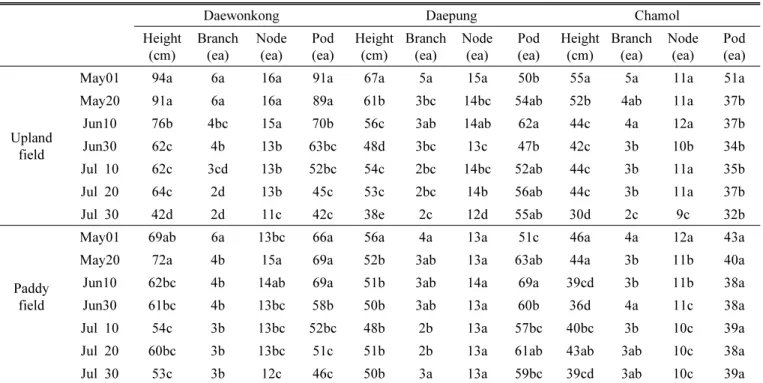
Table 2. Comparison of the growth and yield components of three soybean cultivars planted on seven different sowing dates (2012 –2013).

Daewonkong Daepung Chamol

Height (cm)

Branch (ea)

Node (ea)

Pod (ea)

Height (cm)

Branch (ea)

Node (ea)

Pod (ea)

Height (cm)

Branch (ea)

Node (ea)

Pod (ea)

Upland field

May01 94a 6a 16a 91a 67a 5a 15a 50b 55a 5a 11a 51a

May20 91a 6a 16a 89a 61b 3bc 14bc 54ab 52b 4ab 11a 37b

Jun10 76b 4bc 15a 70b 56c 3ab 14ab 62a 44c 4a 12a 37b

Jun30 62c 4b 13b 63bc 48d 3bc 13c 47b 42c 3b 10b 34b

Jul 10 62c 3cd 13b 52bc 54c 2bc 14bc 52ab 44c 3b 11a 35b

Jul 20 64c 2d 13b 45c 53c 2bc 14b 56ab 44c 3b 11a 37b

Jul 30 42d 2d 11c 42c 38e 2c 12d 55ab 30d 2c 9c 32b

Paddy field

May01 69ab 6a 13bc 66a 56a 4a 13a 51c 46a 4a 12a 43a

May20 72a 4b 15a 69a 52b 3ab 13a 63ab 44a 3b 11b 40a

Jun10 62bc 4b 14ab 69a 51b 3ab 14a 69a 39cd 3b 11b 38a

Jun30 61bc 4b 13bc 58b 50b 3ab 13a 60b 36d 4a 11c 38a

Jul 10 54c 3b 13bc 52bc 48b 2b 13a 57bc 40bc 3b 10c 39a

Jul 20 60bc 3b 13bc 51c 51b 2b 13a 61ab 43ab 3ab 10c 38a

Jul 30 53c 3b 12c 46c 50b 3a 13a 59bc 39cd 3ab 10c 39a

Means within a row followed by the identical letter are not significantly different, based on Duncan’s tests (P < 0.05).

was included in the experiment to better estimate the effect of planting date on soybean growth and yield responses.

The cultivar × sowing date interaction was not significant for the yield components (i.e., number of nodes and pods and 100-grain weight) in cultivated upland and paddy fields (Table 1). Therefore, to interpret yield response patterns for each cultivar, regression was also used to analyze the relationship between yield and sowing date. Although the three cultivars

were different ecotypes, the patterns of yield decline were similar, which supported the results from ANOVA.

The tallest plants with the most branches were planted on May 1 because these plants had sufficient time for growth.

The number of nodes increased with early plantings and was

the lowest when soybean was planted on July 30. The

number of pods also increased with early planting compared

with late planting.

(4)

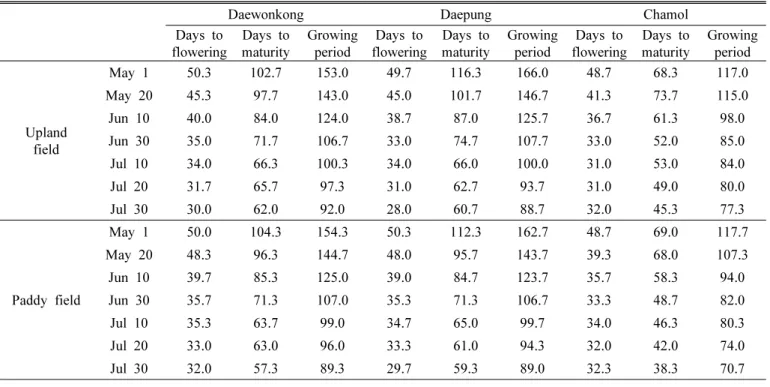
Table 3. Effect of sowing date on the number of days to flowering, days to maturity, and total growing days.

Daewonkong Daepung Chamol

Days to flowering

Days to maturity

Growing period

Days to flowering

Days to maturity

Growing period

Days to flowering

Days to maturity

Growing period

Upland field

May 1 50.3 102.7 153.0 49.7 116.3 166.0 48.7 68.3 117.0

May 20 45.3 97.7 143.0 45.0 101.7 146.7 41.3 73.7 115.0

Jun 10 40.0 84.0 124.0 38.7 87.0 125.7 36.7 61.3 98.0

Jun 30 35.0 71.7 106.7 33.0 74.7 107.7 33.0 52.0 85.0

Jul 10 34.0 66.3 100.3 34.0 66.0 100.0 31.0 53.0 84.0

Jul 20 31.7 65.7 97.3 31.0 62.7 93.7 31.0 49.0 80.0

Jul 30 30.0 62.0 92.0 28.0 60.7 88.7 32.0 45.3 77.3

Paddy field

May 1 50.0 104.3 154.3 50.3 112.3 162.7 48.7 69.0 117.7

May 20 48.3 96.3 144.7 48.0 95.7 143.7 39.3 68.0 107.3

Jun 10 39.7 85.3 125.0 39.0 84.7 123.7 35.7 58.3 94.0

Jun 30 35.7 71.3 107.0 35.3 71.3 106.7 33.3 48.7 82.0

Jul 10 35.3 63.7 99.0 34.7 65.0 99.7 34.0 46.3 80.3

Jul 20 33.0 63.0 96.0 33.3 61.0 94.3 32.0 42.0 74.0

Jul 30 32.0 57.3 89.3 29.7 59.3 89.0 32.3 38.3 70.7

Fig. 1. Monthly precipitation during the growing season for soybean in 2012 and 2013 at Miryang, Gyeongsangnam-Do.

The pod number response to delayed sowing was dependent on the cultivar. The largest decline in pod number occurred when Daewon was planted on July 30, whereas the change was relatively small for Daepung. Yields reflected the changes in pod number (Table 3).

Soybean growth period and yield

With a delay in sowing, the period for growth was reduced, and the days to flowering (DTF) were more affected than the days to maturity (DTM). Moreover, with the reduction in total growing days (TDM) as a result of late planting, the mid-to-late maturity cultivars (Daewon and Daepung) were less affected than the early maturity cultivar (Chamol), because of prolonged maturation caused by hot weather in October (Table 3). The delayed sowing and shortened growing period also resulted in a decrease in 100-grain weight for all three cultivars.

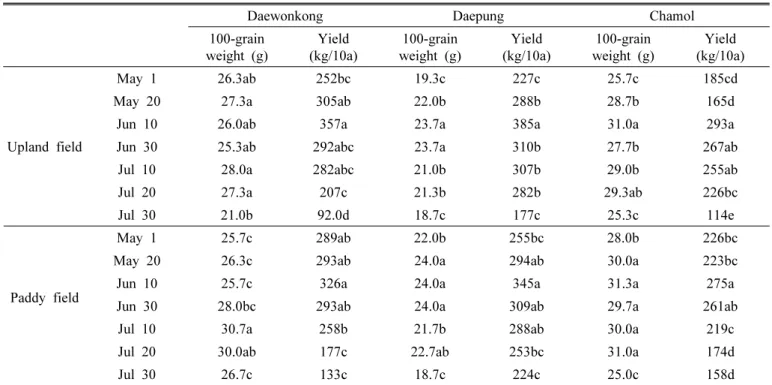
The interaction between cultivar and sowing date for yield was not significant; thus, the yield response to delayed planting was similar for the three cultivars, which all showed similar patterns of decline at later sowing dates. Maximum yields were achieved with sowing between June 10 and 30, with yields declining after June 30. When planted late in July, the yields decreased 20 – 30% compared with mid-to-late June sowing (Table 3).

The largest declines in yield with late sowing (July 30)

were for the cultivar Daewon, with redugctions of 74.2%

(upland) and 59.2% (paddy) compared with mid-to-late June plantings. The smallest decline in yield with delayed sowing occurred with the cultivar Daepung (54.0% decrease in the upland and 35.1% in the paddy). Compared with upland cultivation, the yields were higher and the rates of decline in yield were lower with delayed planting of soybean in the paddy field, with lower declines in yield in the paddy field of 25.3% (Daewon), 53.8%

(Daepung), and 30.4% (Chamol). The precipitation in 2012 and

2013 was below normal, but, in contrast to upland field soil,

(5)

Table 4. Comparison of 100-grain weight and yield of three soybean cultivars planted on seven different sowing dates (2012–2013).

Daewonkong Daepung Chamol

100-grain weight (g)

Yield (kg/10a)

100-grain weight (g)

Yield (kg/10a)

100-grain weight (g)

Yield (kg/10a)

Upland field

May 1 26.3ab 252bc 19.3c 227c 25.7c 185cd

May 20 27.3a 305ab 22.0b 288b 28.7b 165d

Jun 10 26.0ab 357a 23.7a 385a 31.0a 293a

Jun 30 25.3ab 292abc 23.7a 310b 27.7b 267ab

Jul 10 28.0a 282abc 21.0b 307b 29.0b 255ab

Jul 20 27.3a 207c 21.3b 282b 29.3ab 226bc

Jul 30 21.0b 92.0d 18.7c 177c 25.3c 114e

Paddy field

May 1 25.7c 289ab 22.0b 255bc 28.0b 226bc

May 20 26.3c 293ab 24.0a 294ab 30.0a 223bc

Jun 10 25.7c 326a 24.0a 345a 31.3a 275a

Jun 30 28.0bc 293ab 24.0a 309ab 29.7a 261ab

Jul 10 30.7a 258b 21.7b 288ab 30.0a 219c

Jul 20 30.0ab 177c 22.7ab 253bc 31.0a 174d

Jul 30 26.7c 133c 18.7c 224c 25.0c 158d

Means within a row followed by the identical letter are not significantly different, based on Duncan’s tests (P < 0.05).

Table 5. Variations in soybean protein and oil contents (%) according to sowing date and cultivar.

Date Daewonkong Daepung Chamol

Protein(%) Oil (%) Protein(%) Oil (%) Protein(%) Oil (%)

May 1 41.1 19.8 40.7 18.5 43.1 18.6

May 20 39.6 20.2 41.1 19.1 43.1 18.3

Jun 10 40.7 19.1 40.5 19.5 43.7 17.9

Jun 30 38.9 20.4 39.7 19.0 43.1 17.4

Jul 10 39.5 18.8 37.4 19.6 42.9 16.5

Jul 20 42.0 17.6 38.8 18.7 41.6 16.3

Jul 30 42.9 16.9 39.2 17.8 40.9 16.7

moisture was adequate during sowing and emergence in the paddy field, which led to higher seedling establishment, better growth, and higher yields (Fig. 1).

Variations in compositions of seeds planted at early and late dates

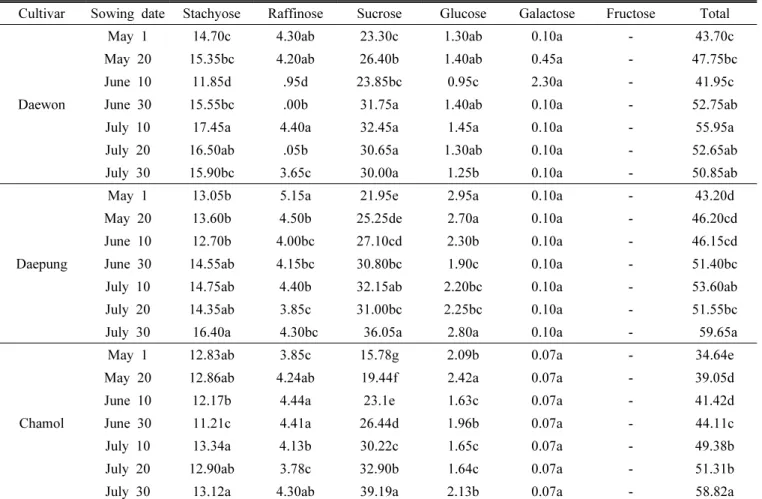
A strong interaction between the sugar content of the soybean cultivars, with the exception of galactose and fructose, and sowing date was observed (Table 6). Total sugar content increased as the delay in the soybean planting increased, and the main contributors to the increased sugar content were stachyose and sucrose (Table

7). The amounts of stachyose and sucrose were highest in soybeans planted in July 10

th

and July 30

th

, respectively.

The protein and oil content of Daepung and Chamol decreased when they were planted late. In Daewonkong, the protein content increased and the oil content decreased when it was planted late (Table 6). The lower temperature during the seed-filling stage might be responsible for the higher protein content in this cultivar.

Discussion

Climate change has strongly affected crop cultivation worldwide.

(6)

In the southern region of Korea, in which doublecropping is popular, soybean (second crop) can mature as late as October because of the prolonged high temperatures in this region. With this change in the environment, many soybean farmers plant later than the typical sowing date. However, the delayed sowing of soybean can result in significant declines in yields; thus, selection of an appropriate sowing date is very important.

Sowing date and soybean yield

Yield was significantly affected by the sowing date. The effect of sowing date on soybean development and yield has been examined in a variety of locations and environments. In some studies, the emergence of soybean seedlings is delayed or decreases in early plantings because of cold and wet soils (Egli and TeKrony, 1995, 1996; Lee et al., 2008). Additionally, plants are taller with earlier than later plantings and are more vulnerable to lodging (Ministry of Agriculture, Forestry and Fisheries of Japan, 1989). However, in other studies, early planting is linked to increases in yield. In these previous studies (Egli and Bruening, 2000; Kantolic and Slafer, 2001), positive correlations are detected between the numbers of pods and seeds on the primary stem (Ouattara and Weaver, 1995) and branches (Frederick et al., 2001) and soybean yields. Moreover, with early planting, yield components increase, such as the number of branches and pods per branch and the percentage grain yield per branch, leading to increases in yields (Akhter and Sneller, 1996).

In the southern region of Korea, a double-cropping system with soybean (Glycine max) following the cultivation of potato, garlic, and onion is widely adopted. In this system, the planting date for soybean is occasionally delayed, even to late in July, depending on the harvest of the first crop and weather conditions.

When planted late, plants are exposed to a shorter photoperiod and lower temperatures, which can cause severe interruptions in maturation and grain filling. Additionally, when the planting date is delayed until July, field operations are difficult because 50 – 60% of the annual precipitation is concentrated in summer (Korea Meteorological Administration, http://www.kma.

go.kr/weather/climate/average_south.jsp).

Most agricultural practices in Korea are focused on rice paddy cultivation, similar to some of the other Asian countries.

Recently, the income generated by soybean cultivation has gradually increased and is now higher than that of rice (Statistics

Korea, Agricultural Livestock Production Cost Survey), which has led to an escalation in soybean cultivation. In particular, many farmers convert paddy fields into upland soybean cultivation, which is currently 13% of the entire cultivated area (Statistics Korea, Agricultural Area Survey). Thus, more studies on the cultivation of soybean in uplands are required.

Soybean was planted from May 1 to June 30 at 2 week intervals and from July 10 to 30 at 1 week intervals to examine the effects of late planting. Plant height and branch and node number increased with early planting, which was shown most clearly in the paddy field. With the change in sowing date, a consistent pattern in pod number, as one of the primary yield components, was not observed, although the smallest number of pods occurred with a July 30 sowing.

The growth period was significantly reduced with a delay in soybean planting, and the reproductive stage was the most affected by a shortened growing season. Daepung had the greatest reduction in DTM among the three cultivars, with 47.8% and 47.2% in upland and paddy fields, respectively. In a previous study, although the pod and seed numbers decrease with late planting, the period of R6 –R8 is extended; thus, the grain weights reach normal values (Egli and Bruening, 2000;

Kane et al., 1997). However, this compensatory mechanism was not evident in this experiment, and the soybean cultivars that were planted late failed to acquire sufficient DTM and therefore also failed to complete grain filling. Thus, the decrease in seed grain weight caused by a shortened reproductive period was apparently the primary factor affecting the yield decline in late plantings.

Sowing date and seed composition

A shorter photoperiod and a lower temperature also affected

soybean seed compositions, including their sugar, protein, and

oil contents. The amount of protein and oil decreased as the

planting date was delayed in two cultivars, Daepung and

Chamol (Table 6), The relationship between soybean planting

date and three antioxidant contents were examined by Yi

(2005). Isoflavone, saponin, and anthocyanin contents increased

when the plants were exposed to high temperature during the

R6 (full seed) –R7 (maturity) stage. Therefore, planting soybean

on the appropriate date is also important for obtaining seeds

of the optimum or targeted quality.

(7)

Table 6. Importance of sowing date for soybean sugar content.

Stachyose Raffinose Sucrose Glucose Galactose Fructose Total

Cultivar 70.10** 25.12** 14.23** 433.62** 1.31ns - 16.60**

Sowing date 17.39** 14.72** 108.27** 26.01** 0.95ns - 38.50**

Cultivar × sowing date 5.36** 15.01** 12.17** 11.00** 0.95ns - 4.20**

**; < 0.01, *; 0 < 0.05, ns; nonsignificant

Table 7. Variation in seed sugar contents with plant sowing date.

Cultivar Sowing date Stachyose Raffinose Sucrose Glucose Galactose Fructose Total

Daewon

May 1 14.70c 4.30ab 23.30c 1.30ab 0.10a - 43.70c

May 20 15.35bc 4.20ab 26.40b 1.40ab 0.45a - 47.75bc

June 10 11.85d .95d 23.85bc 0.95c 2.30a - 41.95c

June 30 15.55bc .00b 31.75a 1.40ab 0.10a - 52.75ab

July 10 17.45a 4.40a 32.45a 1.45a 0.10a - 55.95a

July 20 16.50ab .05b 30.65a 1.30ab 0.10a - 52.65ab

July 30 15.90bc 3.65c 30.00a 1.25b 0.10a - 50.85ab

Daepung

May 1 13.05b 5.15a 21.95e 2.95a 0.10a - 43.20d

May 20 13.60b 4.50b 25.25de 2.70a 0.10a - 46.20cd

June 10 12.70b 4.00bc 27.10cd 2.30b 0.10a - 46.15cd

June 30 14.55ab 4.15bc 30.80bc 1.90c 0.10a - 51.40bc

July 10 14.75ab 4.40b 32.15ab 2.20bc 0.10a - 53.60ab

July 20 14.35ab 3.85c 31.00bc 2.25bc 0.10a - 51.55bc

July 30 16.40a 4.30bc 36.05a 2.80a 0.10a - 59.65a

Chamol

May 1 12.83ab 3.85c 15.78g 2.09b 0.07a - 34.64e

May 20 12.86ab 4.24ab 19.44f 2.42a 0.07a - 39.05d

June 10 12.17b 4.44a 23.1e 1.63c 0.07a - 41.42d

June 30 11.21c 4.41a 26.44d 1.96b 0.07a - 44.11c

July 10 13.34a 4.13b 30.22c 1.65c 0.07a - 49.38b

July 20 12.90ab 3.78c 32.90b 1.64c 0.07a - 51.31b

July 30 13.12a 4.30ab 39.19a 2.13b 0.07a - 58.82a

Means within a row followed by the identical letter are not significantly different, based on Duncan’s tests (P < 0.05).

Marginal sowing date in the southern region of Korea

In the southern region of Korea, the yields of late-sown soybean as a second crop are restricted by autumn frost and decreases in the photoperiod and temperature (Egli, 1998;

Imaizumi and Kay, 2006). Therefore, there is great demand to determine marginal sowing dates, with information on soybean yield patterns, by which soybean can complete maturation and harvest before the first day of frost. The combination of these two aspects (i.e., a marginal sowing date set based on the

yield and first frost date) could be a guideline for crop selection.

The shape of the regression curve was similar regardless of

soybean ecotype and soil condition. The yields of soybean

increased with planting until June 10 and then began to decrease

following that planting date. Decreases in photoperiod and

temperature affect crop growth rates (Egli, 1998), and, when

temperatures drop below 20°C (68°F) later in the season of

soybean growth, yields decline (Boote et al., 1998). Moreover,

late vegetative to early reproductive stages are particularly

(8)

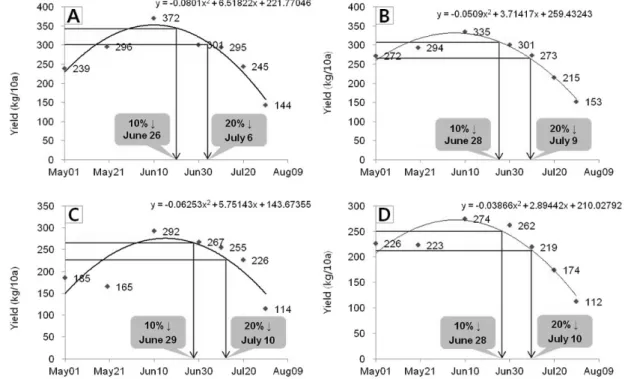
Fig. 2. Relationship between yield and sowing date for late maturity cultivars (Daewon and Daepung) in (A) upland and (B) paddy fields and for the early maturity cultivar in (C) upland and (D) paddy fields.

vulnerable to environmental stress (Board and Harville, 1998;

Board et al., 1992; Board and Tan, 1995).

The marginal planting date is set based on yield and has been determined in different locations with many different cultivars. In Miryang, Gyeongsangnam-Do, late maturity cultivars (Daewon and Daepung) showed a 30% decline in yields when planted after June 18 or 19, whereas the early maturity cultivar Chamol showed an identical decline in yield when planted between June 19 and June 23. Typically, the planting of soybean as a second crop is delayed until mid-to-late July in this double-cropping system, and therefore a decline in yield of more than 20% is expected relative to mid-June planting.

During the growth of soybean, frost is detrimental to yields and seed quality and can affect the development and therefore the yield at any time, from emergence to R7 (Saliba et al., 1982). In a double-cropping system, autumn frost can interfere with the safe maturation and harvest of soybean (Halvorson et al., 1995).

October 27 is the average first frost date (Korea Meteorological Administration, 1981~2010) in Gyeongsangnam-Do and Jeollanam- -Do, with the exception of coastal areas. We compared this date with the expected maturity date, which was determined from the regression analysis of growth (Fig. 2). Late maturity

cultivars could not complete grain filling by the first frost date when planted after July 30, and July 20 was the marginal date for a harvest without possible frost damage.

Although the decrease in growing period is comparatively greater than that for the late maturity cultivars, the early maturity cultivar could completely mature before the first frost, even with delayed planting.

Summary

A delay in the sowing of soybean beyond the critical date

caused a shift in the reproductive stage, which was sensitive

to changes in the environment and less favorable weather

conditions. However, in this double-cropping system, the

second crop of soybean can be planted later than this critical

date. Therefore, to complete maturation before the first frost

date and prevent a decline in yield, the choice of a marginal

planting date is very important. For the three soybean cultivars

examined in this study, a 30% decline in yield from the

maximum occurred with mid-to-late July plantings in the

southern region of Korea. To protect soybean crops from frost

damage, late maturity cultivars must be sown before July 20.

(9)

ACKNOWLEDGEMENT

The “Cooperative Research Program for Agriculture Science

& Technology Development (Project title: Research on the limit of planting time of upland crops and development of related optimal cropping system according to climate change, Project No. PJ008674022014)” of the Rural Development Administration, Republic of Korea, supported this work.

RERERENCES

Akhter, M. and C. H. Sneller. 1996. Yield and yield components of early maturing soybean genotypes in the mid-south. Crop Sci. 36 : 877-882. doi:10.2135/cropsci1996.0011183X0036000400010x.

Board, J. E. and B. G. Harville. 1998. Late-planted soybean yield response to reproductive source/sink stress. Crop Sci. 38 : 763/771.

Board, J. E. and W. Hall. 1984. Premature flowering in soybean yield reductions at nonoptimal planting dates as influenced by temperature and photoperiod. Agro. J. 76 : 700-704.

Board, J. E., M. Kamal, B. G. Harville. 1992. Temporal importance of greater light interception to increased yield in narrow-row soybean. Agron. J. 84 : 575-579.

Board, J. E. and Q. Tan. 1995. Assimilatory capacity effects on soybean yield components and number. Crop Sci. 39 : 846-851.

Boote, K. J., J. W. Jones, and G. Hoogenboom. 1998. Simulation of crop growth: CROPGRO model. 651-692. In R.M. Peart and R.B. Curry (ed.) Agricultural systems modeling and simulation.

Marcel Dekker, New York.

Coward, L., N. C. Barnes, K. D. Setchell, and S. Barnes. 1993.

Genistein, daidzein, and their. beta.-glycoside conjugates: antitumor isoflavones in soybean foods from American and Asian diets.

Journal of Agricultural and Food Chemistry, 41(11) : 1961-1967.

Egli, D. B., 1998. Seed biology and the yield of grain crops. CAB International, Oxford, 178.

Egli, D. B., and D. M. TeKrony. 1995. Soybean seed germination, vigor and field emergence. Seed Sci. Technol. 23:595-607.

Egli, D. B., and D. M. TeKrony. 1996. Seedbed conditions and prediction of field emergence of soybean seed. J. Prod. Agric.

9:365-370.

Egli, D. B. and W. P. Bruening. 2000. Potential of early-maturing soybean cultivars in late plantings. Agron. J. 92:532-537.

Frederick, J. R., C. R. Camp, and P. J. Bauer. 2001. Drought-stress effects on branch and mainstem seed yield and yield components of determinate soybean. Crop Sci.41:759-763. doi:10.2135/

cropsci2001.413759x.

Halvorson, M. A., T. C. Helms, and J. W. Enz. 1995. Evaluation of simulated fall freeze, planting date, and cultivar maturity in soybean. J. Prod. Agric. 8:589-594.

Imaizumi, T. and S. A. Kay. 2006. Photoperiodic control of flowering:

not only by coincidence. Trends Plant Sci. 11(11) : 550-558.

Kane M. V., C. C. Steele, and L. J Grabau. 1997. Early-maturing soybean cropping system: II. Growth and development responses to environmental conditions. Agro. J., 89 : 459-464.

Kantolic, A. G. and G. A. Slafer. 2001. Photoperiod sensitivity after flowering and seed number determination in indeterminate soybean cultivars. Field Crops Res. 72:109-118.

Korean Statistical Information Service (KOSIS). 2012. Agricultural and Livestock Production Cost Survey. Korean Statistical Information Service. Daejeon, Republic of Korea

Kumar, V., A. Rani, V. Pandey, P. Mande, and G. S. Chauhan. 2006.

Compositional traits of soybean seeds as influenced by planting date in India. Exp. Agric. 42:19-28.

Lee, C. D., D. B. Egli, and D. M. TeKrony. 2008. Soybean responses to plant population at early and late planting dates in the Mid-south.

Agron. J. 100:971-976.

Messina, M., Messina, V., 2010. The role of soy in vegetarian diets.

Nutrients 2, 855-888.

Ministry of Agriculture, Forestry and Fisheries of Japan. 1989.

Basic techniques for paddy field crop cultivation, Japan Muhammad, A., S. K. Khalil, K. B. Marwat, A. Z. Khan, I. H. Khalil,

Amanullah, and S. Arifullah. 2009. Nutritional quality and production of soybean land races and improved varieties as affected by planting dates. Pak. J. Bot. 41:683-689.

Ouattara, S. and D.B. Weaver. 1995. Eff ect of growth habit on yield components of late planted soybean. Crop Sci. 35:411-415.

doi:10.2135/cropsci1995.0011183X003500020022x

Rahman, M. M., J. G. Hampton, and M. J. Hill. 2005. The effect of time of sowing on soybean seed quality. Seed Sci. Technol.

33:687-697.

Saliba, M. R., L. E. Schreder, S. S. Hirano, and C. D. Upper. 1982.

Effect of freezing field-grown soybean plants at various stages of podfill on yield and seed quality. Crop Sci. 22:73-77.

Soybean Physiology and Biochemistry. Hany A. El-Shemy. Publisher:

InTech, Chapter 1: Soybean Yield Formation: What Controls It and How It Can Be Improved. 2011.

SAS Institute Inc. 2009. SAS/STAT

®

9.2 User’s Guide, Second Edition. Cary, NC: SAS Institute Inc.

Tuoying Ao 2011. Using Exogenous Enzymes to Increase the Nutritional Value of Soybean Meal in Poultry Diet, Soybean and Nutrition, Prof.

Hany El-Shemy (Ed.), ISBN: 978-953-307-536-5, InTech, Available from:http://www.intechopen.com/books/soybeanand- nutrition/using-exogenous-enzymes-to-increase-thenutritional- value-of-soybean-meal-in-poultry-diet

Yi, E. S., 2005. Variation in antioxidant components of black soybean as affected by variety and cultivation region. Dissertation for Doctor’s Degree. Dankook Univ.

Zhang, Q. Y., Q. L. Gao, S. J. Herbert, Y. S. Li, and A. M. Hashemi,

2010. Influence of sowing date on phenological stages, seed

growth and marketable yield of four vegetable soybean cultivars

in North-eastern USA. Afr J Agric Res, 5 : 2556-2562.

수치

Table 2. Comparison of the growth and yield components of three soybean cultivars planted on seven different sowing dates  (2012 –2013).
Table 3. Effect of sowing date on the number of days to flowering, days to maturity, and total growing days.
Table 4. Comparison of 100-grain weight and yield of three soybean cultivars planted on seven different sowing dates (2012–2013).
Table 7. Variation in seed sugar contents with plant sowing date.
+2

참조

관련 문서

This study was conducted from 24 May to 3 November in Cheju to investigate the effects of planting date and plant distance on the grain yield of black

Effect of planting date on growth and seed yield of Danfa black

A series of experiments was conducted from March 16 to July 12 in 2004 in Jeju Island to investigate the effects of sowing date, sowing rate, sand

This study was carried out to select superior soybean cultivars for forage production and to determine the optimum plant density and phosphate rate for

The total tuber yield (㎏/10a) of six potato cultivars as affected by harvest date.. Harvest date Atlantic Bakdoo Taepyong Chongsim Chilsong

In order to investigate the effects of process parameters on qualities of the drilled hole quantitatively, laser drilling experiments were carried out using

“The economic order of the Republic of Korea shall be based on a respect for the freedom and creative initiative of individuals in economic affairs.” The State may only

– Late Finish (LF): latest possible time an activity can finish based on the logic and durations identified in the network without extending the completion date of the