232 http://dx.doi.org/10.7850/jkso.2014.19.4.232
Free Access
유해 와편모조류 Cochlodinium polykrikoides와 규조류 Skeletonema sp.의 종간경쟁에서 용존 유기 영양염의 중요성
권형규1 · 김현정2 · 양한섭2 · 오석진2,*
1부경대학교 해양과학공동연구소
2부경대학교 해양학과
The Importance of Dissolved Organic Nutrients on the Interspecific Compe- tition between the Harmful Dinoflagellate Cochlodinium polykrikoides and
the Diatom Skeletonema sp.
H
YEONGK
YUK
WON1, H
YUNJ
UNGK
IM2, H
AN-S
OEBY
ANG2 ANDS
EOKJ
INO
H2,*
1Korea Inter-University Institute of Ocean Science, Pukyong National University, 45 Yongso-ro, Nam-Gu, Busan, 608-737 Korea
2Department of Oceanography, Pukyong National University, 45 Yongso-ro, Nam-Gu, Busan, 608-737 Korea
본 연구는 유해 와편모조류 Cochlodinium polykrikoides와 규조류 Skeletonema sp.의 용존 유기 영양염에 대한 이용 및 흡수능력을 통해서 종간 경쟁관계를 파악하였다. C. polykrikoides와 Skeletonema sp.는 용존 무기 질소와 무기인 이 외에 다양한 용존 유기 질소와 유기 인을 이용하여 성장하였다. 이는 용존 무기 질소 또는 무기 인이 제한 영양염 으로 작용하는 환경에서 중요한 생존전략으로 작용할 것이다. Urea와 glycerophospahte(glycero-P)의 흡수동력학 실 험으로부터 도출된 반포화상수(Ks) 값은 C. polykrikoides가 Skeletonema sp.에 비해서 낮은 값을 보였다. 이는 Skeletonema sp.가 C. polykrikoides에 비해서 urea와 glycero-P와 같은 유기 영양염에 대한 친화성이 높음을 의미한다. 하 지만 Skeletonema sp.가 유기 영양염에 대한 친화성이 높을지라도 C. polykrikoides가 α (ρmax/Ks) 값이 높아, 저농도의 영 양염 조건(<Ks)에서 효율적으로 urea 및 glycero-P를 흡수 가능한 것으로 나타났다. 따라서 단일배양 조건에서 획득한 용존 유기 영양염의 이용능력과 저 농도에서 효율적인 유기 영양염의 흡수 능력을 바탕으로 C. polykrikoides는 Skeletonema sp.과의 종간경쟁에서 유리한 위치에 있을 것으로 생각된다.
We investigated the interspecific competition between the harmful dinoflagellate Cochlodinium polykrikoides and diatom Skeletonema sp. based on the utilization and uptake of dissolved organic nutrients. C. polykrikoides and S. costatum were able to grow using dissolved organic nitrogen (DON) and dissolved organic phosphorus (DOP) as well as dissolved inorganic nitrogen (DIN) and dissolved inorganic phosphorus (DIP). This result indicates that the utilization of dissolved organic nutrients may play a role in surviving strategy in the DIN or DIP-limited environments. The half-saturation constants (Ks) of urea and glycerophosphate (glycero-P) calcu- lated from uptake kinetics experiment of C. polykrikoides was lower than those of Skeletonema sp. This result indicates that Skeletonema sp. have higher affinity for dissolved organic nutrients, such as urea and glycero-P, than C.
polykrikoides. Although Skeletonema sp. have higher affinity of dissolved organic nutrients, C. polykrikoides could effectively uptake for urea and glycero-P at sub-saturating nutrient concentrations (<Ks), because affinity coefficient, α (ρmax/Ks) of C. polykrikoides was higher than Skeletonema sp.. Therefore, C. polykrikoides by utili- zation and effectively uptake of dissolved organic nutrients under monoculture may have an advantageous posi- tion in the interspecific competition with Skeletonema sp. in the low nutrient environments.
Key words: Cochlodinium polykrikoides, Skeletonema sp., Dissolved organic nitrogen, Dissolved organic phosphorus
Received August 12, 2014; Revised September 23, 2014; Accepted October 11, 2014
*Corresponding author: [email protected]
서 론
해수 중 영양염은 용존 무기 영양염과 용존 유기 영양염으로 구 분되며, 전자는 용존 무기 질소(DIN; dissolved inorganic nitrogen)와 용존 무기 인(DIP; dissolved inorganic phosphorus)과 같은 제한 영양염이며, 후자는 여러 가지 분자량을 가지는 화합물이다. 일반 적으로 식물플랑크톤은 용존 무기 영양염을 성장에 이용하지만, 용존 무기 영양염이 부족한 환경에서는 수주 내 존재하는 다양한 기원의 용존 유기 질소(DON; dissolved organic nitrogen)와 용존 유기 인 (DOP; dissolved organic phosphorus)와 같은 유기 영양염을 성장에 이용하게 된다(Antia et al., 1991). 이러한 용존 유기 영양염은 미세 조류나 박테리아의 대사작용에 의한 배출(excretion), 동물플랑크톤의 섭식작용 및 육상으로부터 공급 등의 경로를 거쳐 해양으로 유입되며, 그 조성은 매우 복잡하고 다양하다(Antia et al., 1991). 특히, 일부 해 역에서 DON은 용존 총 질소(DTN; dissolved total nitrogen)의 89%
(Berman and Bronk, 2003), DOP의 경우 용존 총 인(DTP; dissolved total phosphorus)의 75%(Benitez-Nelson, 2000)의 성분비를 보여 오 히려 용존 무기 영양염에 비해서 높은 함량을 보이기도 하기에, DIN 또는 DIP가 제한된 환경에서는 DON 또는 DOP가 식물플랑크톤의 성장에 중요한 영양염 공급원일 가능성이 있다.
한편, 유해성 와편모조류 Cochlodinium polykrikoides는 우리나 라 뿐만 아니라 북미 대서양연안, 일본, 캐나다, 멕시코, Guatemala의 태평양연안 등에서 전 세계적으로 적조를 일으키는 종으로 막대 한 수산피해를 일으키고 있다(Yuki and Yoshimatsu, 1989; Whyte et al., 2001; Garate-Lizarraga et al., 2000; Park et al., 2013a). 우리나 라에서는 1982년 진해만에서 처음 발생한 이래 매년 여름철 마다 광범위 하게 발생하여 경제적 손실과 해양생태계의 황폐화를 초래 하고 있다. 특히, 지난 2013년에는 1995년의 746억원 이후 최고 규모인 약 249억원의 손실을 발생시켰다(Park et al., 2013b). 반면 규 조류 Skeletonema 속의 종은 광온 및 광염성을 지니며, 내만 뿐만 아니라 기수역에서 활발하게 증식을 하는 것으로 보고되어 있다 (Hasle, 1973). Skeletonema 속의 종들은 이전까지 Skeletonema costatum과 동일시하였으나, 최근 분류기법의 발달로 Skeletonema 속에는 약 20여종으로 분화된 종이 포함되어있는 것으로 밝혀졌 다(Hasle, 1973; Lee et al., 1997). 우리나라 연안에서 출현하는 Skeletonema 속에는 S. dohrnii, S. marinoi, S. subsalsam, S. japonicum 및 S. tropicum이 출현 하는 것으로 알려져 있다(Jung et al., 2009). 특 히, Skeletonema 속의 종은 C. polykrikoides 적조가 대규모로 발생하는 시기에 종종 함께 출현하기도 한다(Lim et al., 2002; Park et al., 2009). Skeletonema sp.는 C. polykrikoides가 높은 우점율을 보이는 7~8월에 함께 출현하기도 하며, C. polykrikoides와 혼합적조를 일 으키는 것으로 보고된바 있다(Lim et al., 2002; Park et al., 2009). 또 한 Lim et al.(2002)은 이 두 종의 혼합적조가 종간 경쟁에 의해 발생한 것으로 보고하였다. 이와 같이 C. polykrikoides와 Skeletonema sp.가 동시에 출현하는 경우, 이 두 종은 제한된 자원 및 공간 등에 대해 경쟁관계에 있음을 알 수 있다.
경쟁적 배타원리(competitive exclusion principle)에 따르면, 유 사한 생태적 지위를 가지는 종들은 동일한 자원에 대해 서로 경 쟁할 때 오직 한 종만이 생존이 가능하지만, 실제 해양에서 식물 플랑크톤 군집은 제한된 자원보다 더 많은 종이 공존하고 있다
(Gauge, 1932). 이와 같은 현상은 시·공간적으로 변화하는 자연환 경에 의해 발생하며, ‘Paradox of the phytoplankton’이라 표현한 다(Hutchinson, 1961). 또한 자연생태계의 급변하는 환경은 자원의 일 시적인 공급량을 변화시키며, 식물플랑크톤의 생태적 지위에 영향을 미친다. 그러나 해양 환경은 다양한 요인들로부터 복합적인 영향을 받 기 때문에 실내 실험의 결과만을 이용하여 식물플랑크톤의 경쟁 관계를 단정 짓기는 어렵다.하지만 Richerson et al.(1970)은 비 평형 경쟁 이론(non-equilibrium competition theory)에 근거한 모델을 이용하여 환경 조건에 따라 변화하는 식물플랑크톤의 증식을 재 현함으로써 평형상태에서 수행된 실험의 결과가 해양생태계에서 적용 가능 한 것을 확인하였다. 이처럼 단일 종에 대한 생리적 특 성의 규명은 자연생태계에서 종간경쟁 및 생존전략을 이해하기 위 해서 매우 중요한 과정이다. 따라서 본 연구에서는 연안해역에서 잠재적인 종간경쟁 관계에 위치한 유해 와편모조류 C. polykrikoides와 규조류 Skeletonema sp.의 단일 배양 조건하에서 용존 유기 영양염에 대한 이용 및 흡수능력의 결과를 바탕으로 종간 경쟁관계를 파악 하였으며, 이러한 결과를 향후 수치모델을 구현하기 위한 자료로 활용하고자 하였다.
재료 및 방법
C. polykrikoides와 Skletonema sp.의 분리 및 유지배양 C. polykrikoides는 한국해양과학기술원 해양시료도서관(No.
LMBE-VI)에서 순수 분리한 종을 분양받아 이용하였으며, Skeletonema sp.은 2013년 4월 자란만의 서쪽 연안(34°55'30.59''N, 128° 12'17.77''E)의 표층해수에서 pasteur pipette(Ø 50~100 μm)을 이용하여 분리하 였다. 분리한 세포는 여과해수를 이용하여 3~4회 반복 세척 하여 분리주를 확보하였다. 사용된 배지는 동해 외양수(36°0'0.02''N, 130°42'55.0''E)를 바탕으로 한 f/2 배지를 이용하였으며(Guillard and Ryther, 1962), selenium(H2SeO3)의 최종농도가 0.001 μM이 되게 첨가하였다(Doblin et al., 1999). 배양온도와 염분은 현장 수 온과 염분에 상응하는 조건인 20oC와 30 psu 였으며, 광량은 300 μmol m-2 s-1 (C. polykrikoides의 경우 14L : 10D; cool-white fluorescent lamp, Skeletonema sp.는 12L : 12D; cool-white fluorescent lamp)하에서 유지배 양을 하였다. 또한 C. polykrikoides와 Skeletonema sp.는 AM 9 항생 제를 이용하여 무균화 작업을 수행하였으며(Provasoil et al., 1959), 4',6'-diamidino-2-phenylindole(DAPI) 검사를 통하여 세포에 대한 무균화를 검증하였다(Poter and Feig, 1980). 더욱이 2차 오염을 막기 위해서 모든 실험 기구는 고압(202 kpa, 30 min) 및 건조멸균(120oC, 3 hr)후 사용하였으며, 모든 실험은 무균대에서 수행하였다.
C. polykrikoides와 Skletonema sp.의 용존 유기 질소 및 유기 인의 이용성 실험
용존 유기 질소와 유기 인에 대한 실험 종의 세포밀도 증감은 현미경을 이용한 직접 검경이 아닌 in vivo chlorophyll 형광값을 활용하였으며, 세포밀도는 in vivo chlorophyll 형광값과 세포밀도의 높은 상관관계로부터 도출되었다. 이러한 방법은 형광광도계에서 직접 측정이 가능한 배양튜브를 이용하기에 세포밀도의 확인을 위 한 배양튜브의 개폐가 없이 초기 배양상태를 계속 유지 할 수 있으며, 대량의 표본을 신속히 처리할 수 있다(Brand et al., 1981). 측정된 in
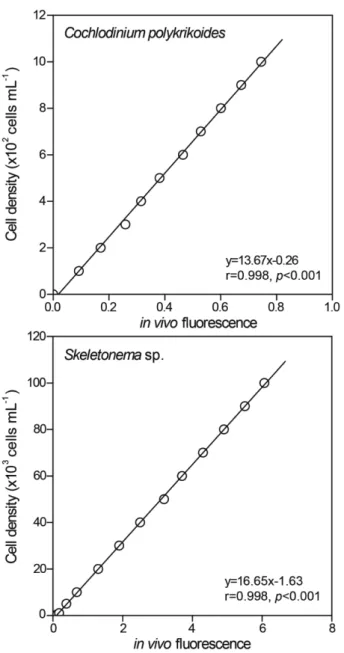
vivo chlorophyll 형광값과 세포밀도 사이의 관계를 파악하기 위해, 각 각의 세포를 유지배양과 동일한 조건하에서 대수성장기가 될 때 까지 배양하였다. 배양된 세포는 농축과 희석을 통해 여러 단계의 밀도로 조제하고, 형광광도계(Model 10-AU-005, Turner Designs, USA)로 in vivo chlorophyll 형광값을 측정하였다. 안정적인 형광값을 얻 기 위해서 배양된 세포를 약 5 분동안 암조건에서 방치한 후 측정하 였으며(Brand et al., 1981), 그 결과 세포밀도와 형광값 사이에는 통계적으로 매우 높은 유의성이 확인되었다(Fig. 1).
C. polykrikoides와 Skeletonema sp.의 질소 원(nitrogen source)에 대한 이용능력을 알아보기 위해 무기 질소원 3종, 유기 질소 원으로 urea 1종과 dissolved free amino acids(DFAA) 17종을 이용하였다(Table 1). 또한 인 원(phosphorus source)으로 무기 인 4종, 유기 인으로 nucleotide 6종, phosphomonoester(PME) 6종을 이용하였다(Table 2).
실험에 사용된 배지는 인공해수(AK; artificial Keller)를 기반으로
반 L1 배지이며(Keller et al., 1987), 질소원은 최종농도가 250 μM(NH4+는 20 μM), 인원은 25 μM이 되도록 조제하였다. 각각의 화합물이 첨가된 배지 5 mL에 사전배양을 통해 세포 내 질소 또는 인을 고갈시킨 세포를 약 100 cells mL-1이 되도록 접종하였다. 이 후 이틀간격으로 동일한 시간(오전 10시)에 in vivo chlorophyll 형 광값을 측정하였다. 세포의 성장속도(μ; specific growth rate)는 대 수성장을 보이는 기간 동안의 형광값과 식 (1)을 이용하여 계산하 였다. 모든 실험은 triplicate로 수행하였으며, 성장속도는 평균값 으로 나타내었으며, 명백히 오류로 판단된 값은 평균시 제외하였다.
Fig. 1. Relationships between cell density and in vivo chlorophyll fluorescence of Cochlodinium polykrikoides and Skeletonema sp.
Table 1. Nitrogen compounds used in this study
Nitrogen source Abbreviation Inorganic nitrogen
Nitrate NO3
Nitrite NO2
Ammonium NH4
Organic nitro- gen
urea Urea Urea
dissolved free amino acid (DFAA)
Alanine Ala
Arginine Arg
Aspartic acid Asp Glutamic acid Glu
Glycine Gly
Histidine His
Isoleucine Ile
Leucine Leu
Lysine Lys
Methionine Met
Phenylalanine Pal
Proline Pro
Serine Ser
Threonine Thr
Tryeonine Try
Tyrosine Tyr
Valine Val
Table 2. Phosphorus compounds used in this study
Phosphorus source Abbreviation
Inorganic phosphorus
Orthophosphate PO4
Metaphosphate Meta-P
Pyrophosphate Pyro-P
Tripolyphosphate Tripoly-P
Organic phospho-
rus
nucleotide
Adenosine 5-monophosphate AMP Adenosine 5-diphosphate ADP Adenosine 5-triphosphate ATP Cytidine 5-monophosphate CMP Uridine 5-monophosphate UMP Guanosine-5-monophosphate GMP
phospho- monoester
Fructose 6-phosphate F6P Fructose 1, 6-diphosphate FDP Glucose 1-phosphate G1P Glucose 6-phosphate G6P Glycerophosphate Glycero-P Ribose 5-phosphate R5P
(1) N0, Nt: 대수성장기에서 초기와 t시간 후의 세포밀도(cells mL-1) Δt: 대수성장기의 배양시간(day)
C. polykrikoides와 Skeletonema sp.의 정치배양을 통한 urea 및 glycerophosphate의 단계별 흡수 실험
식물플랑크톤의 영양염 흡수는 기본적으로 환경수 중의 영양염 농도에 의존하지만, 세포내에 영양염 pool을 가지는 경우 그 크기 에 따라 달라진다(Eppley et al., 1969). 따라서 흡수속도의 농도 의존성을 평가할 때는 영양염 첨가 후 흡수속도가 일정한 시간 즉, 정속흡수(surge uptake)를 보이며 세포내 영양염의 변화가 없는 시 간 내에 실험해야한다(Harrison et al., 1989). 따라서 영양염 흡수 실험을 수행하기 전에 영양염 흡수의 경시적인 변화를 파악하였다.
먼저, 세포내 질소와 인을 고갈시키기 위해 질소 또는 인원이 포함되 지 않은 AK 인공해수를 기반으로 한 L1배지에서 C. polykrikoides와 Skeletonema sp.를 사전배양 하였다. 세포의 성장이 정지할 때까지 배 양을 실시하고 질소원 urea 6 μM과 인 원 glycerophosphate (Glycero-P) 3 μM로 함유된 L1배지에 세포내 질소 또는 인 고갈된 C. polykrikoides와 Skeletonema sp.를 각각 접종하였다. Urea는 배양개시(0분), 10, 20, 30, 45, 60, 90, 120, 180, 240분, glycero-P는 0, 15, 30, 45, 60, 60, 120, 150, 240분에 각각 배양액을 채수하여 urea와 glycero-P를 측 정하였다. Urea는 diacetyl monoxime 법을 바탕으로 비색정량하 였으며(Koroleff, 1983), glycero-P는 DIP와 DTP의 농도를 각각 측정한 후(Strickland and Parsons, 1972), DTP에서 DIP를 제외한 DOP를 glycero-P로 간주하였다. 이 과정에서 흡수속도가 일정한 시간을 영양염 흡수실험을 위한 측정시간으로 정하였다.
영양염 흡수속도는 300 mL 배양용기(Pyrex, USA)에 urea가 1, 3, 5, 10, 20, 50, 100 μM의 7단계, glycero-P가 0.5, 1, 2, 5, 7, 10, 15 μM의 7단계로 조제된 L1 배지에 세포내 질소 또는 인 고갈 C.
polykrikoides 및 Skeletonema sp. (>1,000 cells mL-1)을 각각 접종 하였다. 배양시간은 상기에 서술된 실험의 결과를 바탕으로 정속 흡수를 보이는 시간으로 하였다. 특히, 영양염 고갈 세포를 함유 한 배양액을 첨가할 시 urea와 glycero-P 농도가 낮아지기 때문에 접종직후 배양액을 채수 하여 urea와 glycero-P를 측정하였으며, 실험 종료 후 재차 urea와 glycero-P를 측정하였다. 영양염 흡수속도와 영양염의 관계는 Michaelis-Menten 식에 대입하여 농도 의존성을 정량적으로 파악하였으며(Dugdale, 1967), 변수값(Ks)은 측정된 실험값을 식 (2)에 대입하여 비선형 최소자승법으로 계산하였다.
(2)
ρmax: 영양염 최대 흡수속도(pmol cell-1 hr-1) Ks: 반포화상수(μM)
S: 영양염 농도(μM)
결 과
C. polykrikoides와 Skeletonema sp.의 용존 유기 질소 및 용 존 유기 인의 이용성
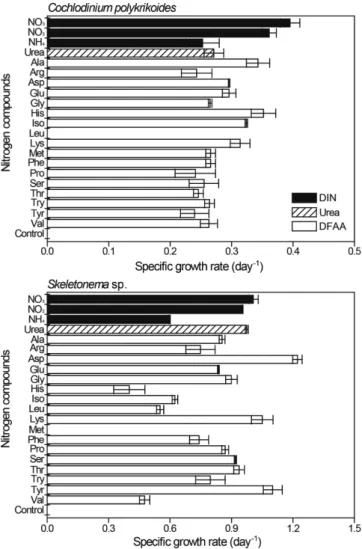
C. polykrikoides와 Skeletonema sp.는 용존 무기 영양염 뿐만 아니 라 다양한 형태의 용존 유기영양염을 이용하여 성장하였다(Figs. 2, 3).
질소 화합물의 경우(Fig. 2), C. polykrikoides의 DIN(NO3, NO2, NH4)에 대한 성장속도는 0.25~0.40 day-1(0.34±0.02 day-1)로 나타 났다. Urea는 0.27±0.03 day-1로, NO3의 성장속도와 비교하여 약 68%에 해당하였다. DFAA는 0.24~0.35 day-1(0.28±0.01 day-1)의 성장속도를 보였으며 NO3와 비교하여 약 71%에 해당하였다.
Skeletonema sp.의 경우 DIN에서 0.60~1.01 day-1(0.85±0.01 day-1)로 나타났다. Urea는 0.98±0.01 day-1로 NO3와 비교하여 약 97%에 해당하였으며, DFAA는 0.40~1.22 day-1(0.81±0.03 day-1)로 NO3에 대비하여 약 81%에 해당하였다. 특히, C. polykrikoides는 Leu, Skeletonema sp.는 Met에서 성장하지 않았다.
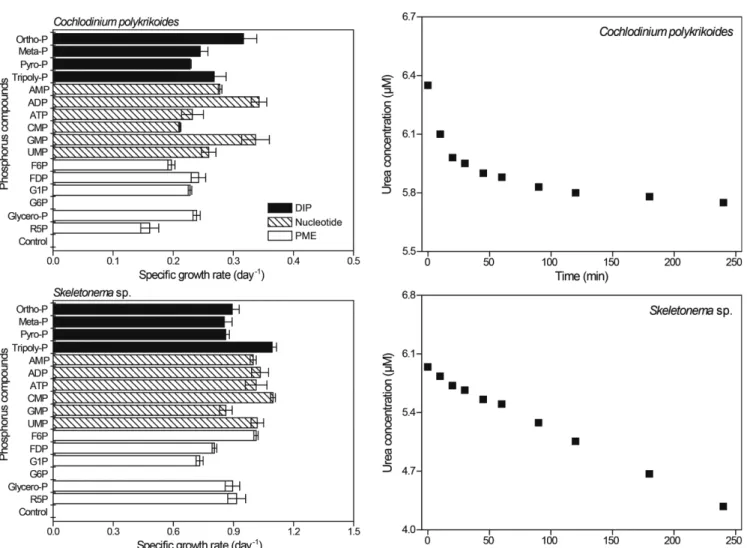
인 화합물의 경우(Fig. 3), C. polykrikoides는 DIP(Ortho-P, Meta-P, Pyro-P, Tripoly-P)에서 0.23~0.32 day-1(0.26±0.02 day-1)의 범위를 보였다. Nucleotide 계열 화합물(AMP, ADP, ATP, CMP, GMP, UMP)에서는 0.21~0.34 day-1(0.28±0.02 day-1)의 성장속도를 보여, Ortho-P와 비교하여 약 87%에 해당하였다. PME에서는 0.16~0.24 day-1(0.21±0.01 day-1)의 범위로 Ortho-P에 대비하여 약 67%에 해 당하였다. 반면에, Skeletonema sp.은 DIP에서 0.85~1.09 day-1(0.93±0.03 μ 1
Δt--- Nt N0 --- ln
=
ρ ρmax S Ks S+ ---
⋅
=
Fig. 2. Specific growth rate (day-1) of Cochlodinium polykrikoides and Skeletonema sp. incubated with various nitrogen compounds.
day-1)의 성장속도를 보였다. Nucleotide 계열 화합물과 PME에 대한 성장속도는 각각 0.86~1.10 day-1(1.00±0.03 day-1), 0.73~1.01 day-1 (0.87±0.02 day-1)로 나타났으며, Ortho-P의 성장속도와 비교한 결과 각각 112%, 98%에 해당하였다. 특히, 두 종 모두 G6P에서 성장 하지 않았다.
C. polykrikoides와 Skeletonema sp.의 정치배양을 통한 urea와 glycero-P의 흡수실험
Urea에 대한 정속흡수 실험 결과(Fig. 4), C. polykrikoides와 Skeletonema sp.의 배양액 중 urea는 시간에 따라 점차 감소하였다.
C. polykrikoides의 urea 흡수속도는 배양초기부터 20분 동안 3.04~6.08 pmol cell-1 hr-1로 나타났으나, 이후 0.10~0.81 pmol cell-1 hr-1로 현 저히 낮아지는 경향을 보였다(t-test, p<0.05). Skeletonema sp.의 경우 배양초기 부터 20분 동안 약 0.44 pmol cell-1 hr-1로 일정하였으나, 이후 0.15~0.29 pmol cell-1 hr-1로 흡수속도가 현저히 감소하였다 (t-test, p<0.05). 따라서 C. polykrikoides와 Skeletonema sp.의 urea 흡수속도 실험 시간을 20분으로 설정하였다.
Glycero-P에 대한 정속흡수 실험 결과의 경우(Fig. 5), 시간에 따라 배양액 중 glycero-P의 농도는 감소하였다. C. polykrikoides의
glycero-P 흡수속도는 배양초기부터 45분 동안 거의 일정하였으나 (3.39~4.01 pmolcell-1 hr-1), 이후에는 0.46~0.77 pmolcell-1 hr-1로 현저히 낮아졌다(t-test, p<0.05). Skeletonema sp.의 경우 흡수속도는 배양개시 45분 동안 거의 일정하였으나(0.058~0.087 pmol cell-1 hr-1), 이후 0~0.015 pmolcell-1 hr-1범위로 감소하였다(t-test, p<0.05). 따라서 C. polykrikoides와 Skeletonema sp.의 glycero-P 흡수 실험 시간을 45 분으로 설정하였다.
C. polykrikoides의 urea 흡수속도는 약 12 μM까지 농도가 증가 함에 따라 증가하였지만 그 이상의 농도에서는 유사하였다(Fig.
6). 이를 Michaelis-Menten 식으로 유도한 결과 ρmax는 6.44 pmol cell-1hr-1, Ks는 3.94 μM로 나타났다. Skeletonema sp. 또한 urea 농도에 따라 흡수속도가 증가하였으며, 약 4 μM 이상의 농도에서는 일정 한 흡수속도를 보였다(Fig. 6). 이를 Michaelis-Menten 식에 대입 하여 본 결과 ρmax는 0.042 pmol cell-1 hr-1, Ks는 1.57 μM이었다.
Glycero-P의 경우(Fig. 7), C. polykrikoides는 대한 흡수속도는 약 7 μM까지 농도가 증가함에 따라 증가하였지만 그 이상의 농 도에서는 유사하였다(Fig. 7). 이를 Michaelis-Menten 식으로 유도 한 결과 ρmax는 9.75 pmol cell-1 hr-1, Ks는 3.43 μM로 나타났다.
Skeletonema sp. 역시glycero-P 농도에 따라 흡수속도가 증가하였으 Fig. 4. Temporal changes in urea concentration after perturbing nitrogen- starved culture of Cochlodinium polykrikoides and Skeletonema sp.
Fig. 3. Specific growth rate (day-1) of Cochlodinium polykrikoides and Skeletonema sp. incubated with various phosphorus compounds.
며, 약 2 μM 이상의 농도에서는 일정하였다(Fig. 7). 이를 Michaelis- Menten 식에 대입하여 본 결과 ρmax는 0.097 pmol cell-1 hr-1, Ks는 0.64 μM 로 계산되었다.
고 찰
C. polykrikoides와 Skeletonema sp.의 용존 유기 질소 및 인의 이용성
해수 중 DON의 화학적 조성은 아직 명확히 알려져 있지 않지 만, 일반적으로 고분자 DON(M.W.>1 kDa)과 저분자 DON으로 구분할 수 있다(Antia et al., 1991). 고분자 DON은 protein, nucleic acids(DNA, RNA), humic substance 등이 포함되고, 저분자 DON의 경우는 urea, peptides, DFAA, amino sugars, purines, pyrimidines, pteridines, amides, methyl amides 등이 포함된다(Antia et al., 1991).
특히, urea와 DFAA와 같은 저분자 DON은 식물플랑크톤의 중요 한 질소공급원으로 알려져 있다(Antia et al., 1991). 본 연구 결과 C. polykrikoides와 Skeletonema sp.는 다양한 유기질소 화합물을 이
용하여 성장을 유지하였으며, urea의 경우 비교적 높은 이용능력을 보였다. 뿐만 아니라 와편모조류 Alexandrium tamarense, A.
catenella(Park, 2013), Gymnodinium breve(Steidinger et al., 1998), 규조류 Pseudo-nitzschia sp.(Auro and Cochlan, 2012), Thalassiosira weissflogii(McCarthy, 1972) 등 다양한 식물플랑크톤이 이용 가능한 것으로 보고되었다. 반면에 와편모조류 Gymnodinium instriatum (Nagasoe et al., 2010)과 Gambierdiscus toxicus(Lartigue et al.
2009)는 성장에 urea를 전혀 사용하지 않아, urea를 성장에 이용 하는 종과 그렇지 않은 종으로 구분되었다. Collier et al.(1999)에 따르면 urea의 가수분해 효소인 urease의 유전자 인코딩을 통해서 urea를 성장에 이용하는 남조류 Synechococcus 종주(WH7805)에 서는 urease 효소가 검출된 반면 urea를 성장에 이용하지 않은 남 조류 Synechococcus 종주(WH7803)는 urease 효소가 없는 것으로 밝혀졌다. 따라서 urea의 이용 유·무는 urease 효소의 보유 여부에 따라 다른 것으로 보인다. 하지만 urea를 이용하는 종 중에서도 그 이용능력에 차이를 보였다. 이러한 차이가 종 특이성(species- specific)인지, 또 다른 생리활성과 관련이 있는지 설명하기 힘들 지만 urease 활성이 수온(Mobley and Hausinger, 1989), DIN 농 도(Fan et al., 2003), 미량금속(Milligan and Harrison, 2000)에 민 Fig. 6. Urea uptake rate of Cochlodinium polykrikoides and Skel- etonema sp. as a function of the ambient urea concentration.
Fig. 5. Temporal changes in glycerophosphate concentration after perturbing phosphorus-starved culture of Cochlodinium polykrikoi- des and Skeletonema sp.
감하게 반응한다고 알려져 있기에, urease 활성의 차이가 urea의 이용능력과 밀접한 연관이 있을것으로 생각된다.
해양환경에서 DFAA는 식물플랑크톤의 질소공급원으로서 매우 중요하며, 종속영양 미생물에 의한 유기물 순환 및 에너지 공급단 계에서 중요한 작용을 한다(Williams, 1975). 본 연구 결과 C.
polykrikoides와 Skeletonema sp.은 성분별 차이는 보였지만 다양한 종류의 DFAA를 성장에 이용하였다. 본 연구 결과와 유사하게 규조류 Chaetoceros debile(Poulet and Martin-Jezequel, 1983), 와편모조류 A. tamarense, A. catenella(Park, 2013), 침편모조류 Chattonella antiqua, C. marina, C. ovata(Noh, 2009)에서 다양한 성분의 DFAA를 이용하여 성장이 가능 하였다. 특히, 본 연구에서 C. polykrikoides와 Skeletonema sp.는 다양한 DFAA 중 Ala, Arg, Asp, Gly 및 Lys에 서 NO3에 대하여 비교적 높은 성장속도를 보였다. Cowey and Corner(1966)에 의하면 식물플랑크톤의 체내 아미노산의 비율은 Arg 성분이 가장 높으며 Asp, Gly, Ala, Lys 성분도 우점하는 것 으로 보고되었다. 이러한 성분의 아미노산들은 식물플랑크톤 체내에 우점하는 동시에 해수 중에서도 우점하는 것으로 나타났다. 따라서 비교적 풍부한 성분을 효율적으로 흡수하여 성장에 이용하는 것 으로 생각된다.
DOP 화합물은 분자량에 따라 고분자 DOP(M.W.>10 kDa)와 저 분자 DOP로 구분된다. 저분자 DOP는 외양환경에서는 식물플랑 크톤에 쉽게 이용되지만, 연안환경에서는 육상기원이 대부분이고 난분해성 물질이 많아 쉽게 이용되지 않는다. 고분자 DOP는 ester 결합수에 따라 phosphomonoester, phosphodiester와 같은 분해성 DOP 화합물과 화학적으로 안정되어 가수분해효소에 의해 분해되지 않은 phosphonate로 구성된다. 본 연구 결과 C. polykrikoides와 Skeletonema sp.는 다양한 인 화합물을 이용하여 성장을 유지하였으 며, nucleotide 계열 화합물의 경우 비교적 높은 이용능력을 보였다. 본 연구결과와 유사하게 와편모조류 A. tamarense, Gymnodinium catenatum(Oh et al., 2002), Karenia mikimotoi(Yamaguchi et al., 2004a), 규조류 Chaetoceros didymus(Kwon, 2010), Eucampia zodiacus (Nishikawa and Hori, 2004), 침편모조류 C. ovata(Noh, 2009)등 에서 동일한 결과가 보고되었다. Nucleotide는 핵산의 구성성분으로, 핵산은 엽록체를 지니는 모든 식물플랑크톤에 존재한다(Coleman, 1985). 특히, 자연환경에서 ng L-1농도 수준으로 존재하는 것으로 알려져 있지만, DOP 중 유일하게 다양한 종의 식물플랑크톤이 이용 가능한 것으로 생각된다.
본 연구의 결과와 유사하게 다수의 식물플랑크톤 종에서 PME를 이용하여 성장을 한다는 보고가 있다. 와편모조류 A. tamarense (Kwon, 2010), Prorocentrum triestinum (Nishijima et al., 1989), 규조류 Chaetoceros ceratosporum (Yamaguchi et al., 2005), Eucampia zodiacus (Nishikawa and Hori, 2004) 및 침편모조류 C. antiqua, C. marina, C. ovata (Noh, 2009)에서 PME를 성장에 이용할 수 있 는 것으로 보고되었다. 하지만 침편모조류 Fibriocapsa japonica (Yamaguchi et al., 2005), Heterosigma akashiwo (Yamaguchi et al., 2008)는 PME를 성장에 이용하지 않았다. 특히, 본 연구의 Skeletonema sp.와 동일 속에 속하는 Hiroshima 만에서 분리된 S. costatum은 성장에 PME를 전혀 이용하지 않았으며(Oh et al., 2005), 가막만에서 분리된 S. costatum (Kwon, 2010) 및 본 연구의 Skeletonema sp.는 이 용 가능 하였다. 이처럼 동일 속 혹은 종 수준에서도 분리된 해역 에 따라 PME를 이용하는 종과 그렇지 않은 종이 구분되었지만, 왜 이런 차이가 보이는지 명확히 설명하기는 힘들고 동일종일지라도 분 리한 해역에 따라 다른 생리학적 특성을 보인다는 보고가 있어 (Gallagher, 1982), 분리된 해역의 특성에 따라 그 이용능력이 달라지는 것으로 생각된다. 또한 Hiroshima 만에서 분리된 S. costatum은 PME의 가수분해효소인 phosphatase의 활성이 보이지 않았기에 (Oh et al., 2005), PME를 이용하기 위한 phosphatase 활성 유·무도 중 요하게 작용할 것이다. 이상의 결과에서 C. polykrikoides와 Skeletonema sp.는 용존 무기 영양염 이외의 다양한 형태의 용존 유기 영양염을 이용하여 성장하였다. 따라서 이들 두 종의 유기 영양염의 이용능력은 무기 영양염이 제한된 환경에서 중요한 생존전략으로 생각되며, 종의 우점과정 및 종간경쟁에서 중요한 영향을 줄 것으로 생각된다.
C. polykrikoides와 Skeletonema sp.의 정치배양을 통한 urea와 glycero-P의 흡수실험
Ks는 제한 영양염에 대한 친화성을 지시하는 지표로 이용되며, 일반적으로 Ks 값이 낮은 경우 저농도의 영양염 조건에서 성장에 유리한 생리특성을 갖는다(Dugdale, 1967). 또한 세포의 크기가 큰 종은 높은 Ks 값을 보이고, 외양성 종(oceanic species)의 Ks Fig. 7. Glycerophosphate uptake rate of Cochlodinium polykrikoides
and Skeletonema sp. as a function of the ambient glycerophosphate concentration.
값은 연안성 종(neritic species)보다 낮고, 성장률이 높은 종일수 록 낮은 종보다 Ks 값이 낮은 경향을 보인다(Eppley et al., 1969).
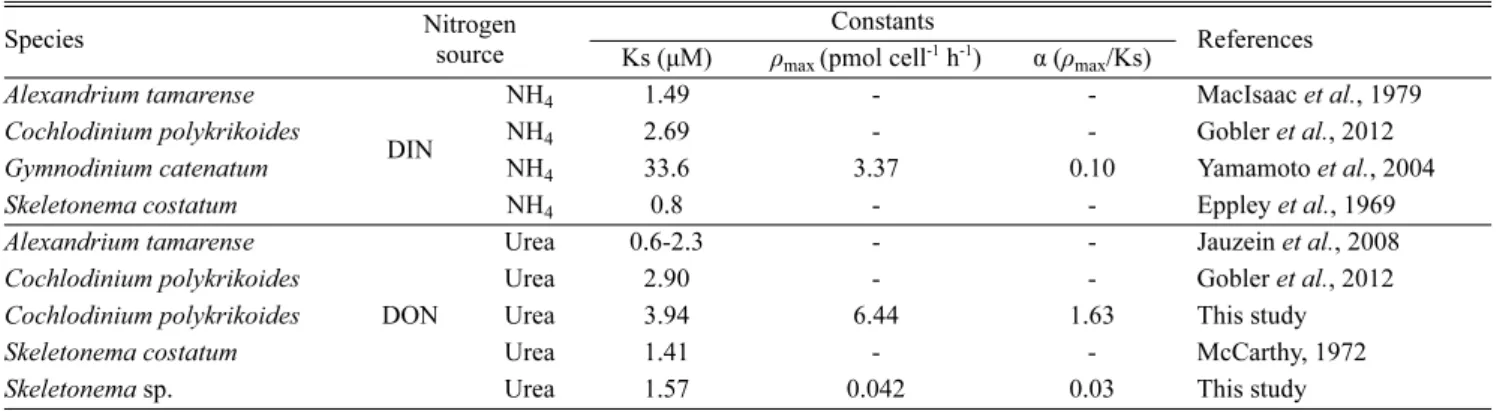
기존에 보고된 S. costatum의 NH4에 대한 Ks 값은 C. polykrikoides를 비롯하여 다른 와편모조류에 비해서 낮은 값을 보였다(Table 3).
Urea에 대한 Ks 값 역시 Skeletonema sp. 및 S. costatum이 가장 낮아, Skeletonema 속의 종은 무기 및 유기 질소 영양염에 대한 친화성이 높은 것을 의미한다. 또한 본 연구 실험종 및 S. costatum와 C. polykrikoides에서 보고된 NH4및 urea의 Ks 값을 보면(Table 3), 공통적으로 NH4+의 Ks 값이 낮은 것을 알 수 있다. 실제 질소계 영양염 중 식물플랑크톤은 흡수에 있어서 열역학적 에너지가 높 고 가장 환원된 형태인 NH4를 선택적으로 선호하는 것으로 알려 져 있다(McCarthy, 1980). 따라서 식물플랑크톤이 환원된 형태의 NH4를 이용할 경우 소비되는 에너지를 절약할 수 있기에 NH4의 Ks 값이 낮은 것으로 생각된다.
Ks 값이 영양염 제한 환경에서 식물플랑크톤의 영양염을 이용 할 수 있는 정도를 나타내지만, 저농도 영양염 조건(<Ks)에서는 식물플랑크톤의 종간 경쟁관계를 평가하는데 있어서는 Ks 값보다 친화성 지수 α(ρmax/Ks)가 더 유용하다(Harrison et al., 1989). 연 안환경에서 urea 농도는 마산만 0.16~0.53 μM (Park, 2013), Great Peconic Bay, Flanders Bay 및 Shinnecock Bay에서 0.10~1.08 μM (Gobler et al., 2012), Sagami Bay 0.45~0.70 μM (Mitamura and Saijo, 1980)로 보고되어, Skeletonema sp.와 C. polykrikoides의 urea에 대한 Ks 값보다 낮았다(Table 3). 하지만 α 값의 경우 C. polykrikoides가 Skeletonema sp.에 비해서 매우 높은 값을 보였다. 따라서 무기 질소가 제한된 연안역의 낮은 urea 농도 환경에서는 urea를 성장에 이용하기 위 해서 C. polykrikoides가 Skeletonema sp.에 비해서 효율적으로 urea를
흡수 가능하기에 종 경쟁에서 유리한 위치에 있을 것이다.
기존에 보고된 C. polykrikoides와 S. costatum의 DIP에 대한 Ks 값을 보면(Table 4), S. costatum은 C. polykrikoides를 비롯하여 다른 와 편모조류에 비해서 낮았으며, glycero-P의 경우도 본 연구의 Skeletonema sp.가 낮은 값을 보였다. 따라서 질소계 영양염과 유사 하게 Skeletonema 속의 종은 무기 및 유기 인에 대한 친화성이 높은 것으로 보인다. 또한 본 연구 실험종 및 S. costatum과 C. polykrikoides 에서 보고된 DIP의 Ks 값은 glycero-P의 Ks 값보다 낮았는데, 이 역시 부족한 DIP를 흡수하기 위해 glycero-P를 가수분해시키는 과 정에서 소비되는 에너지를 절약할 수 있기에 DIP에 대한 친화성이 높은 것으로 보인다.
연안해역에서 glycero-P에 대한 측정자료가 전무한 관계로 DOP 중 phosphatase에 의해 가수분해 되는 DOP의 농도 즉, PME 농 도는 가막만 0.02~0.17 μM (Kwon, 2010), California 연안해역 0.05~0.45 μM (Strickland and Solorzano, 1966), Hiroshima Bay 0.05~0.17 μM (Yamaguchi et al., 2004b), Tokyo Bay 및 Sagami Bay 에서 0.08~0.35 μM (Kobori and Taga, 1979)의 범위로, C. polykrikoides와 Skeletonema sp.의 glycero-P의 Ks 값에 비해서 낮았다(Table 4). 하 지만 urea와 동일하게 α 값의 경우 C. polykrikoides가 Skeletonema sp.
에 비해서 매우 높았다. 따라서 무기 인이 제한된 연안역의 낮은 PME 환경에서는 C. polykrikoides가 Skeletonema sp.에 비해서 효 율적으로 glycero-P를 흡수 가능하기에 종 경쟁에서 유리한 위치 에 있을 것이다.
Nakamura and Watanabe(1983)에 의하면 ρmax 값은 세포의 크 기에 따라 달라지기 때문에 식물플랑크톤의 상대적인 영양염 흡 수능력을 비교하기 위해서는 세포내 영양염 함유량(cell quota; Q0)를 Table 3. Comparison of uptake kinetic parameters for ammonium and urea uptake between Cochlodinium polykrikoides, Skeletonema sp. and various phytoplankton
Species Nitrogen
source
Constants
References Ks (μM) ρmax (pmol cell-1 h-1) α (ρmax/Ks)
Alexandrium tamarense
DIN
NH4 1.49 - - MacIsaac et al., 1979
Cochlodinium polykrikoides NH4 2.69 - - Gobler et al., 2012
Gymnodinium catenatum NH4 33.6 3.37 0.10 Yamamoto et al., 2004
Skeletonema costatum NH4 0.8 - - Eppley et al., 1969
Alexandrium tamarense
DON
Urea 0.6-2.3 - - Jauzein et al., 2008
Cochlodinium polykrikoides Urea 2.90 - - Gobler et al., 2012
Cochlodinium polykrikoides Urea 3.94 6.44 1.63 This study
Skeletonema costatum Urea 1.41 - - McCarthy, 1972
Skeletonema sp. Urea 1.57 0.042 0.03 This study
Table 4. Comparison of uptake kinetic parameters for phosphate and glycerophosphate uptake between Cochlodinium polykrikoides, Skeletonema sp. and various phytoplankton
Species Phosphorus
source
Constants
References Ks (μM) ρmax (pmol cell-1 h-1) α (ρmax/Ks)
Alexandrium tamarense
DIP
phosphate 2.60 1.40 0.54 MacIsaac et al., 1979
Cochlodinium polykrikoides phosphate 1.19 0.35 0.29 Kim, 2003
Gymnodinium catenatum phosphate 3.40 1.42 0.42 Yamamoto et al., 2004
Skeletonema costatum phosphate 0.68 - - Kwon, 2010
Cochlodinium polykrikoides
DOP Glycero-P 3.43 9.75 2.84 This study
Skeletonema sp. Glycero-P 0.64 0.0097 0.02 This study
바탕으로 계산된 최대 비흡수속도(specific uptake rate; Vmax=ρmax/ Q0)를 이용하여야 한다고 제시하였다. 본 연구에서 측정된 질소와 인에 대한 cell quota의 실측자료가 없기에 기존의 보고된 C. polykrikoides 와 Skeletonema sp.(S. costatum의 자료 활용)의 자료를 바탕으로 계산하였다. 질소에 대한 cell quota(QN0)는 C. polykrikoides는 5.25 pmol cell-1(Kim, 2003), Skeletonema sp.는 0.65 pmol cell-1(Lomas and Glibert, 2000)로 보고되어, urea Vmax를 계산하면 각각 1.23, 0.06 day-1로 계산된다. 또한 glycero-P의 Vmax는 C. polykrikoides (QP0=0.37 pmol cell-1; Kim, 2003)와 Skeletonema sp. (QP0=0.0033 pmol cell-1; Eppley et al., 1969)에서 각각 26.4와 2.9 day-1로 계산 된다. 이는 C. polykrikoides가 Skeletonema sp.에 비해서 urea와 glycero-P와 같은 유기 영양염의 흡수능력이 월등히 뛰어나다는 것을 의미한다. Sommer(1989)는 영양염 단계 및 흡수 전략을 바탕으로 영양염 흡수전략을 흡수한 영양염을 재빨리 성장에 이용하는 성장전 략(growth strategy)과 공급된 영양염을 바로 성장에 이용하지 않고 세포 내에 저장하는 저장전략(storage strategy)로 구분하였다. 빠른 μmax와 낮은 Ks 값을 보이는 Skeletonema sp.는 전자에 해당하고, 높은 Vmax및 Q0값을 보이는 C. polykrikoides는 후자에 해당한 다. 따라서 C. polykrikoides는 환경수 중 영양염 변동에 크게 영 향을 받지 않고 성장 할 수 있는 생존전략을 보이는 것으로 생각 된다. 또한 C. polykrikoides의 유영속도는 3.6 m hr-1 (Kim, 2003)로, G.
catenatum (1.2 m hr-1; Baba et al., 2001) 및 Gymnodinium mikimotoi (2.2 m hr-1; Koizumi et al., 1996)와 비교하여 비교적 빠른편에 속 한다. 따라서 과잉의 유기 영양염의 흡수는 성장을 위한 부족한 질소 및 인의 보충 뿐만 아니라 유영에 필요한 탄소 에너지 원으 로도 이용될 것이다.
한편, C. polykrikoides와 S. costatum은 대사과정에서 생성되는 이차 대사산물을 체외로 분비하여 경쟁종의 성장을 억제하거나 촉 진시키는 영향을 미치며 이를 타감작용(alleophathy)이라고 한다 (Tameishi et al., 2009; Tang and Gobler, 2010). 실례로, S. costatum과 와편모조류 Prorocentrum minimum의 혼합배양에서, S. costatum이 분비하는 물질은 P. minimum과의 종간 경쟁에서 P. minimum의 증식을 촉진시키는 것으로 알려져 있지만, 반대로 S. costatum의 증식이 P. minimum에 의해 조절되기도 한다(Tameishi et al., 2009).
이와 같은 현상이 자연환경에서 어느 정도 개체군 증식에 영향을 주는지는 불명확하나, 식물플랑크톤이 고농도로 존재할 시 생물 간의 간섭 및 타감작용은 충분히 개체군 증식에 영향을 미칠 것으로 생각된다. 따라서 식물플랑크톤의 종간 경쟁에서의 타감작용의 영 향을 파악하기 위해서는 더욱 세밀한 생리학적 연구가 필요할 것 으로 생각된다.
본 연구는 단일배양의 조건에서 C. polykrikoides와 Skeletonema sp.의 용존 유기 영양염의 이용능력을 바탕으로 종간 경쟁 관계를 평가하였다. 그 결과, 정상상태에서 용존 유기 영양염 측면만 고 려할 경우 C. polykrikoides가 Skeletonema sp.에 비해서 우점 할 가능성이 있는 것으로 나타났다. 하지만 자연환경에서 물리·생물·
화학적 요인이 상호복합적으로 영향을 미치고 있기에 특정 조건 에서 획득한 식물플랑크톤의 생리특성만으로 자연환경에 적용시 키기는 매우 힘들다. 하지만 앞서 설명한 바와 같이 단일배양의 조건에서 획득한 식물플랑크톤의 생리학적 자료를 이용하여 비 평형 경쟁 이론에 근거한 모델의 구현은 해양생태계에서 종간경쟁 관계를
이해하는 데 유용한 도구로 활용할 수 있다(Richerson et al., 1970). 특 히, Oh et al.(2007)은 A. tamarense, G. catenatum 및 S. costatum의 혼 합배양 및 단일배양의 실험결과를 이용하여 종경쟁모델을 구축하 였으며, 구축된 모델을 바탕으로 자연생태계에서 식물플랑크톤의 종천이를 검토하였다. 또한 Cermeno et al.(2011)은 Thalassiosira pseudonana와 Coccolithus braarudii의 생리학적 자료를 이용하여 비 평형 조건인 주기적인 영양염 공급 조건(pulsed mode)에서의 모델을 구현하였으며, 이를 통해 제한된 자원의 일시적인 공급이 식물플랑크톤의 종간경쟁과 매우 밀접하게 연관되어 있음을 확인 하였다. 따라서 본 연구의 결과와 같이 평형상태의 단일 배양조건 에서 획득한 결과는 수치모델을 활용하여 종간경쟁을 재현하기 위 해서 활용할 수 있을 것이며, 이는 해양생태계에서 종간경쟁을 이 해하는데 도움을 줄 것이다.
사 사
이 논문은 부경대학교 자율창의학술연구비(2014년; C-D-2014- 0422)에 의하여 연구되었습니다.
참고문헌(References)
Antia, N.J., P.J. Harrison and L. Oliveira, 1991. Phycological reviews: the role of dissolved organic nitrogen in phytoplankton nutrition, cell biology, and ecology. Phycol., 30: 1−89.
Auro, M.E. and W.P. Cochlan, 2012. Nitrogen utilization and toxin production by two diatoms of the Pseudo-nitzschia pseudodeli- catissima complex: P. cuspidata and P. fryxelliana. J. Phycol., 49:
156−169.
Baba, T., S. Hiyama and T. Tainaka, 2001. Vertical migration of the toxic dinoflagellate Gymnodinium catenatum and toxicity of cul- tures oyster in Senzaki Bay, Yamaguchi Prefecture. Bull. Plank- ton Soc. Jpn., 48: 95−99.
Benitez-Nelson, C.R., 2000. The biogeochemical cycling of phos- phorus in marine systems. Earth Sci. Rev., 51: 109−135.
Berman, T., and D.A. Bronk, 2003. Dissolved organic nitrogen: A dynamic participant in aquatic ecosystems. Aquat. Microbial Ecol., 31: 279−305.
Brand, L.E., R.R.L. Guillard and L.S. Murphy, 1981. A method for the rapid and precies determination of acclimated phytoplankton reproduction rates. J. Plankton Res., 3: 193−201.
Cermeno, P., J.B. Lee, K. Wyman, O. Schofield and P.G. Falkowski.
2011. Competitive dynamics in two species of marine phyto- plankton under non-equilibrium conditions. Mar. Ecol. Prog. Ser., 429: 19−28.
Coleman, A.W., 1985. Diversity of plastid DNA configuration among classes of eukaryote algae. J. Phycol., 21: 1−16.
Collier, J.L., B. Brahamsha and B. Palenik, 1999. The marine cya- nobacterium Synechococcus sp. WH7805 requires urease(urea amidohydrolase, EC 3.5.1.5) to utilize urea as a nitrogen source:
molecular-genetic and biochemical analysis of the enzyme. Micro- biol., 145: 447−459.
Cowey, C.B. and E.D.S. Corner, 1966. The amino-acid composition of certain unicellular algae, and of the faecal pellets produced by
Calanus finmarchicus when feeding on them. In: Some contem- porary studies in marine science, edited by Barnes, H. Allen and Unwin, London, pp. 225−231.
Dugdale, R.C., 1967. Nutrient limitation in the sea: dynamic, iden- tification, and significance. Limnol. Oceanogr., 12: 685−695.
Eppley, R.W., J.N. Rogers and J.J. McCarthy, 1969. Half-saturation constants for uptake of nitrate and ammonium by marine phyto- plankton. Limnol. Oceanogr., 14: 912−920.
Fan, C., P.M. Glibert, J. Alexander and M.W. Lomas, 2003. Char- acterization of urease activity in three marine phytoplankton spe- cies, Aureococcus anophagefferens, Prorocentrum minimum, and Thalassiosira weissflogii. Mar. Biol., 142: 949−958.
Gallagher, J.C., 1982. Physiological variation and electrophoretic banding patterns of genetically different seasonal populations of Skeletonema costatum (Bacillariophyceae). J. phycol., 18: 148−162.
Garate-Lizarraga, I., J.J. Bustilos-Guzmain, I. Morquecho and L.
Deveze, 2000. First outbreak of Cochlodinium polykrikoides in the Gulf of California. Harmful Algae News, 7 pp.
Gauge, G. E. 1932. Experimental studies on the struggle for exis- tence. 1. Mixed populations of two species of yeast. J. Exp. Biol., 9: 389−402.
Gobler, C.J., A. Burson, F. Koch, Y. Tang and M.R. Mulholland, 2012. The role of nitrogenous nutrients in the occurrence of harmful algal blooms caused by Cochlodinium polykrikoides in New York estuaries (USA). Harmful Algae, 17: 64−74.
Guillard, R.R.L. and D. Ryther, 1962. Studies of marine planktonic diatom I: Cyclotella nana Hustedt and Detonula confervacea (Cleve) Gran. Can. J. Microbiol., 8: 229−239.
Harrison, P.J., J.S. Parslow and H.L. Conway, 1989. Determination of nutrient uptake kinetic parameters: a comparison of methods.
Mar. Ecol. Prog. Ser., 52: 301−312.
Hasle, G.R., 1973. Morphology and taxonomy of Skeletonema costatum (Bacillariophyceae). Nor. J. Bot., 20: 109−137.
Hutchinson, G.E., 1961. The paradox of the plankton. Am. Nat., 95:
137−147.
Jauzein, C., S. Loureiro, E. Garces and Y. Collos. 2008. Interactions between ammonium and urea uptake by fice strains of Alexan- drium catenella (Dinophyceae) in culture. Aquat. Microb. Ecol., 53: 271−280.
Jung, S.W, S.M Yun, S.D. Lee, Y.O. Kim and J.H Lee, 2009. Mor- phological characteristics of four species in the genus Skele- tonema in coastal waters of South Korea. Algae, 24: 195−203.
Keller, M.D., R.C. Selvin, W. Claus and R.R.L. Guillard, 1987.
Media for the culture of oceanic ultraphytoplankton. J. Phycol., 23: 633−638.
Kim, D.I., 2003. Physiological and ecological studies on harmful red tide dinoflagellate Cochlodinium polykrikoides (Margalef). Ph.
D. Thesis, Kyushu University, Fukuoka, 154 pp.
Kobori, H. and N. Taga, 1979. Phosphatase activity and its role in the mineralization of organic phosphorus in coastal sea water. J. Exp.
Mar. Biol. Ecol., 36: 23−39.
Koizumi, Y., T. Uchida and T. Honjo, 1996. Diurnal vertical migra- tion of Gymnodinium mikimotoi during a red tide in Hoketsu Bay, Japan. J. Plankton Res., 18: 289−294.
Koroleff, F., 1983. Determination of urea. In: Methods of seawater
analysis, 2nd. edited by Grasshoff, K., M. Ehrhardt and K. Krem- ling, Verlag Chemie, Weinheim, pp 158−162.
Kwon, H.K., 2010. Utilization of dissolved organic phosphorus and alkaline phosphatase activity of phytoplankton. M. Sc. Thesis, Pukyung National University, Busan, 86 pp.
Lartigue, J., E.L.E. Jester, R.W. Dickey and T.A. Villareal, 2009.
Nitrogen source effects on the growth and toxicity of two strains of the ciguatera-causing dinoflagellate Gambierdiscus toxicus.
Harmful Algae, 8: 781−791.
Lim, W.A, C.S. Jung, C.K. Lee, Y.C. Cho, S.G. Lee, H.G. Kim and I.K. Chung, 2002. The outbreak, maintenance, and decline of the red tide dominated by Cochlodinium polykrikoides in the coastal waters off Southern Korea from August to October, 2000. J.
Korean Soc. Oceanogr., 7: 68−77.
Lee, J.H, H.S. Song and E.H. Lee, 1997. Red-tide on phytoplankton diatoms in Incheon Dock of Korea. Kor. J. Environ. Biol., 15:
119−129.
Lomas, M.W. and P.M. Glibert, 2000. Comparisons of nitrate uptake, storage, and reduction in marine diatoms and flagellates. J. Phy- col., 36: 903−913.
MacIsaac, J.J, G.S. Grunseich, H.E. Glover, C.M. and Yentsch, 1979.
Light and nutrient limitation in Gonyaulax excavata: nitrogen and carbon trace results. In: Toxic Dinoflagellate Blooms, edited by Taylor, D.L. and H.H. Seliger, Elsevier, NewYork, pp. 107−110.
McCarthy, J.J. 1972. The uptake of urea by marine phytoplankton. J.
Phycol., 8: 216−222.
McCarthy, J.J., 1980. Nitrogen. In: The Physiological Ecology of Phytoplankton, edited by Morris, I., Blackwell Scientific Publi- cations, Oxford, pp. 191−233.
Milligan, A.S. and P.J. Harrison, 2000. Effects of non-steady state iron limitation on nitrogen assimilatory enzymes in the marine diatom Thalassiosira weissflogii (Bacillariophycea). J. Plankton Res., 36: 78−86.
Mitamura, O. and Y. Saijo, 1980. In situ measurement of the urea decomposition rate and its turnover rate in the Pacific Ocean. Mar.
Biol., 58: 147−152.
Mobley, H.L.T. and R.P. Hausinger, 1989. Microbial ureases: signif- icance, regulation, and molecular characterization. Microbiol.
Rev., 53: 85−108.
Nakamura, Y. and M.M. Watanabe, 1983. Nitrate and phosphate uptake kinetics of Chattonella antiqua grown in light/dark cycles.
J. Oceanogr. Soc. Jpn., 39: 167−170.
Narasoe, S., T. Shikata, Y. Yamasaki, T. Matsubara, Y. Shimasaki, Y.
Ohima and T. Honjo, 2010. Effects on growth of the red-tide dinoflagellate Gymnodinium instriatum Freudenthal et Lee and a possible link to blooms of this species. Hydorbiol., 56: 225−238.
Nishijima, T., Y. Hata and S. Yamauchi, 1989. Physiological ecology of Prorocentrum triestinum. Bull. Jpn. Soc. Sci. Fish., 55: 2009−
2014.
Nishikawa, T. and Y. Hori, 2004. Effects of nitrogen, phosphorus and silicon on a growth of a diatom Eucampia zodiacus caused bleaching of seaweed Porphyra isolated from Harima-Nada, Seto Inland Sea, Japan. Nippon Suisan Gakkaishi, 70: 31−38.
Noh, I.H., 2009. Physiological and ecological studies on the harmful algae Chattonella spp. (Rhaphidophyceae) in the coastal waters
of Korea. Ph. D. Thesis, Chonnam National University, Yeosu, 269 pp.
Oh, S.J., T. Yamamoto, Y. Kataoka, O. Matsuda, Y. Matsuyama and Y. Kotani, 2002. Utilization of dissolved organic phosphorus by the two toxic dinoflagellates, Alexandrium tamarense and Gym- nodinium catenatum (Dinophyceae). Fish. Sci., 68: 416−424.
Oh, S.J., Y. Matsuyama, T. Yamamoto, M. Nakajima, H. Takatsuzi, and K. Hujisawa, 2005. Recent developments and causes of harmful dinoflagellates blooms in the Seto Lnland Sea-Ecological impor- tance of dissolved organic phosphorus (DOP). Bull. Coast Ocean- ogr., 43: 85−95.
Oh S.J, H.S. Yang and T. Yamamoto, 2007. Use of a mathematical model to assess the effects of dissolved organic phosphorus on species competition among the dinoflagellates Alexandrium tama- rense and Gymnodinium catenatum and the diatom Skeletonema costatum. J. Kor. Fish. Soc., 40: 39−49.
Park, J.A., 2013. DON utilization of toxic dinoflagellate Alexandrium tamarense and Alexandrium catenella isolated form Masan Bay.
M. Sc. Thesis, Pukyung National University, Busan, 92 pp.
Park, J.S., Y.H. Yoon and S.J. Oh, 2009. Variational Characteristics of Phytoplankton Community in the Mouth Parts of Gamak Bay, Southern Korea. Kor. J. Environ. Biol., 27: 205−215.
Park, T.G., W.A. Lim, Y.T. Park, C.K. Lee and H.J. Jeong, 2013a.
Economic impact, management and mitigation of red tides in Korea. Harmful Algae, 30S: S131−S143.
Park, K.W., J.W. Park, S.H. Yoon and Y.S. Seo, 2013b. Occurrence of Cochlodinium polykrikoides bloom, 2013. 2013 Autumn Meet- ing on the Korea Society of Oceanography, p. 95.
Porter, K.G. and Y.S. Feig, 1980. The use of DAPI for identifying and counting aquatic microflora. Limnol. Oceanogr., 25: 943−948.
Poulet, S.A. and V. Martin-Jezequel, 1983. Relationships between dissolved free amino acids, chemical composition and growth of the marine diatom Chaetoceros debile. Mar. Biol., 77: 93−100.
Provasoil, L., K. Shiraishi and J.R. Lance, 1959. Nutritional idiosyncrasies of Artemia and Tigriopus in monoxenic culture. Ann. N. Y. Sci., 77: 250−261.
Richersons, P, R. Armstrong and C.R. Goldman, 1970. Contempo- raneous disequilibrium, a new hypothesis to explain the ‘paradox of the plankton’. Pro. Nat. Acad. Sci., 67: 1710−1714.
Sommer, U., 1989. The role of competition for resources in phyto- plankton succession. In: Plankton Ecology: Succession in Plank- ton Communities, edited by Sommer, U., Springer-Verlag, New York, pp. 57−106.
Steidinger, K.A., G.A. Vargo, P.A. Tester and C.R. Tomas, 1998.
Bloom dynamics and physiology of Gymnodinium breve with emphasis on Gulf of Mexico. In: Physiological Ecology of Harm- ful Algal Blooms, edited by Anderson, D.M., A.D. Cembella and G.M. Hallegraeff, Springer, NewYork, pp. 135−153.
Strickland, J.D.H. and L. Solorzano, 1966. Determination of mon- oesterase hydrolysable phosphate and phosphomonoesterase activity in sea water. In: Some contemporary studies in marine science,
edited by Barnes, H., Allen and Unwin Ltd, London, pp. 665−674.
Strickland, J.D.H. and T.R. Parson, 1972. A practical handbook of seawater analysis. Fisheries Research Board of Canada, Ottawa, 310 pp.
Tameishi, M., Y. Yamasaki, S. Nagasoe, Y. Shimasaki, Y. Oshima and T. Honjo, 2009. Allelopathic effects of the Dinophyte Pro- rocentrum minimum on the growth of the Bacillariophyte Skel- etonema costatum. Harmful Algae, 8: 421−429.
Tang, Y.Z. and C.J. Gobler, 2010. Allelopathic effects of Cochlod- inium polykrikoides isolates and blooms from the estuaries of Long Island, New York, on co-occurring phytoplankton, Mar. Ecol.
Prog. Ser., 406: 19−13.
Whyte, J.N.C., N. Haigh, N.G. Ginther and L.J. Keddy, 2001. First record of blooms of Cochlodinium sp.(Gymnodiniales, Dinophy- ceae) causing mortality to aquacultured salmon on the west coast of Canada. Phycol., 40: 298−304.
Wiliams, P.J.B., 1975. Biological and chemical aspects of dissolved organic material in sea water, In: Chemical Oceanography, edited by Riley, J.P. and G. Skirrow, Academic Press Inc., London, pp.
301−363.
Yamamoto, Y., S.J. Oh and Y. Kataoka, 2004. Growth and uptake kinetics for nitrate, ammonium and phosphate by the toxic dino- flagellate Gymnodinium catenatum isolated from Hiroshima Bay, Japan. Fish. Sci., 70: 108−115.
Yamaguchi, H., T. Nishijima, H. Nishitani, K. Fukami and M. Adachi., 2004a. Organic phosphorus utilization and alkaline phosphatase production of 3 red tide phytoplankton. Nippon Suisan Gakkai- shi, 70: 123−130.
Yamaguchi, H., T. Nishijima, A. Oda, K. Fukami and M. Adachi, 2004b. Distribution and variation of alkaline phosphatase activity and phosphatase hydrolyzable phosphorus in coastal seawater.
Nippon Suisan Gakkaishi, 70: 333−342.
Yamaguchi, H., H. Sakou, K. Fukami, M. Adachi, M. Yamaguchi and N.
Nishijima, 2005. Utilization of organic phosphorus and produc- tion of alkaline phosphatase by the phytoplankton, Hepterocapsa circularisquama, Fibrocapsa japonica and Chaetoceros ceratos- porum. Plankton Biol. Ecol., 52: 65−75.
Yamaguchi, H., S. Sakamoto and M. Yamaguchi, 2008. Nutrition and growth kinetics in nitrogen- and phosphorus-limited cultures of the novel red tide flagellate Chattonella ovata (Raphidophyceae).
Harmful Algae, 7: 26−32.
Yuki, K. and S. Yoshimatsu, 1989. Two fish-killing species of Cochlo- dinium form Harima-Nada, Seto Inland Sea, Japan. In: Red Tides:
Biology, Environmental Science, and Toxicology, edited by Okaichi, T., D.M. Anderson and T. Nemoto, Elsevier, NewYork, pp. 451−452.
2014년 8월 12일 원고접수 2014년 9월 23일 수정본 접수 2014년 10월 11일 수정본 채택 담당편집위원: 이준백