Vol. 26, No. 7 (2016)
370
High Temperature Creep Properties of Al-Al
4C
3-Al
2O
3Alloy by Mechanical Alloying
Chang-Suk Han 1† and Han-Byeol Seo 2
1Department of Defense Science & Technology, Hoseo University
2Department of Nanobiotronics, Hoseo University, Hoseo-ro 79beon-gil, Baebang-myun, Asan City, Chungnam 31499, Republic of Korea
(Received May 12, 2016 : Revised June 13, 2016 : Accepted June 13, 2016)
Abstract
Tensile tests and creep tests were carried out at high temperatures on an Al-Al4C3 alloy prepared by mechanical alloying technique. The material contains about 2.0 % carbon and 0.9 % oxygen in mass percent, and the volume fractions of Al4C3 and Al2O3 particles are estimated at 7.4 and 1.4 %, respectively, from the chemical composition. Minimum creep rate decreased steeply near two critical stresses, σcl (the lower critical stress) and σcu (the upper critical stress), with decreasing applied stress at temperatures below 723 K. Instantaneous plastic strain was observed in creep tests above a critical stress, σci, at each test temperature. σcu and σci were fairly close to the 0.2 % proof stress obtained by tensile tests at each test temperature.It is thought that σcl and σcu correspond to the microscopic yield stress and the macroscopic yield stress, respectively. The lower critical stress corresponds to the local yield stress needed for dislocations to move in the soft region within subgrains. The creep strain in the low stress range below 723 K arises mainly from the local deformation of the soft region. The upper critical stress is equivalent to the macroscopic yield stress necessary for dislocations within subgrains or in subboundaries; this stress can extensively move beyond subboundaries under a stress above the critical point to yield a macroscopic deformation. At higher temperatures above 773 K, the influence of the diffusional creep increases and the stress exponent of the creep rate decreases.
Key words
tensile tests, creep, mechanical alloying, critical stress, yield stress.1. Introduction
Dispersion hardened alloys have some characteristic mechanical properties compared with other pure metals and solid solution alloys. They retain a high strength at a high temperature and the stress exponent of steady state (minimum) creep rate is usually fairly higher than those of other metals and alloys. Many dispersion hardened alloys have the threshold stress for creep deformation (critical stress in other words), below which the creep rate approaches to zero. It is thought that the threshold stress is very important in practical use of these alloys.
Mechanical alloying methods have been recently ex- pected to be techniques to produce high strength alloys. 1,2) These alloys are usually composed of very fine sub- structures and contain large volume fractions of oxide or carbide particles as dispersoids. The substructure is fairly stable at high temperatures due to a large quantity of fine
dispersoids. The creep behavior at high temperatures is complicated due to such substructures though the high strength is achieved. 3-6) The creep behavior of an Al- Al 4 C 3 -Al 2 O 3 alloy prepared by a mechanical alloying technique was examined in the previous work where the existence of two critical stresses was recognized at each temperature. 5)
In the present work, tensile tests at high temperatures and the accurate measurements of the instantaneous strain of creep deformation were carried out to obtain the information about the nature of the critical stresses.
2. Experimental Procedure 2.1 Specimens
The material used as a sample was an Al-Al 4 C 3 -Al 2 O 3 alloy in form of a hot rolled plate of 2 mm in thickness, which had been produced using a mechanical alloying
†
Corresponding author
E-Mail : [email protected] (C. -S. Han, Hoseo Univ.)
© Materials Research Society of Korea, All rights reserved.
This is an Open-Access article distributed under the terms of the Creative Commons Attribution Non-Commercial License (http://creative-
commons.org/licenses/by-nc/3.0) which permits unrestricted non-commercial use, distribution, and reproduction in any medium, provided the
original work is properly cited.
technique called reaction milling. The material contains about 2.0 % carbon and 0.9 % oxygen in mass percent, and the volume fractions of Al 4 C 3 and Al 2 O 3 particles are estimated as 7.4 and 1.4 % respectively, from the chemical composition. Specimens used for creep and tensile testes were cut from the plate and annealed at 823 K for 1 h.
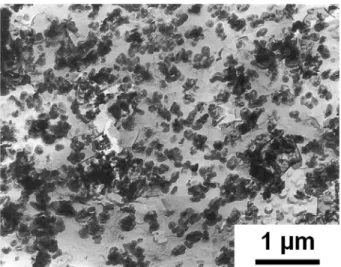
The TEM micrograph of an extraction replica taken from the annealed material is shown in Fig. 1, where fine particles are uniformly dispersed. The particle size dis- tribution, the relation between the diameter of particles and the fraction of the number of particles of the size, is shown in Fig. 2. The average diameter of dispersed particles was about 54 nm.
The TEM micrograph of the annealed material is shown in Fig. 3(a). The microstructure shows a complex dislocation structure consisting of very fine subgrains after the annealing. The average size of subgrains was about 0.42 μm. The substructure was fairly stable and thus the subgrain size increased only a little even by the long
time annealing for 240 h at 823 K.
2.2 Creep test and tensile test
Creep tests were carried out in air at temperatures from 573 to 823 K using a lever type creep machine under constant tensile stresses. The creep strain was directly measured using two extensometers attached to the gauge portion of specimen for the precise measurement of the instantaneous strain of creep deformation.
Tensile tests were carried out using an Instron type tensile testing machine at the strain rate of about 3.5 × 10 −4 s −1 in the temperature ranging from room temperature to 773 K. The elongation of specimens was accurately measured by a similar method as the creep tests using the extensometers to determine the yield stress as precisely as possible.
Fig. 2. The histogram of the dispersion of particles.
Fig. 1. The TEM micrograph of an extraction replica taken from the annealed materials.
Fig. 3. The TEM micrographs of (a) the annealed specimen, and (b) the specimen crept in the high stress range(674 K, log(σ/E) = −2.686,
σ = 113 MPa).
3. Results
The TEM micrographs of the annealed (a) and the deformed (b) specimens are shown in Fig. 3. It was observed that the subgrains coarsened a little and the subboundaries became more clear by the creep defor- mation in the high stress range as seen in the figure. In the low stress range, on the other hand, the coarsening of substructure was little observed.
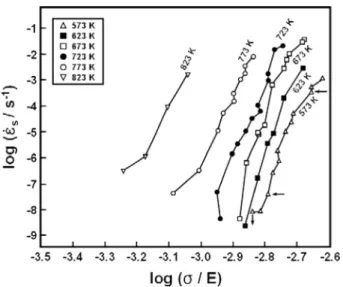
The stress dependence of the steady state creep rate (minimum creep rate) s is shown in Fig. 4. The applied stress σ is compensated by Young's modulus E at each temperature. At temperatures below 723 K, each curve has an inflexion point and is apparently divided into two regions, namely high and low stress ranges. s decreased steeply near a stress with the decrease in stress in each stress range. This shows that there are two critical stresses, lower critical stress σ cl and upper critical stress σ cu respectively, in the low and high stress ranges. At 773 K and 823 K, on the other hand, the lower critical stress could not be observed and the creep rate decreased relatively monotonically with the decrease in stress.
The examples of creep curve in the low and high stress ranges are shown in Fig. 5. These curves were obtained from the creep tests indicated by arrows in Fig. 4. The shape of the creep curve and the fracture strain varied remarkably between the low and high stress ranges. On other hand, the creep curve mainly consisted of the primary creep stage and the fracture strain was very small in the low stress range. The creep curve mainly consisted of the tertiary creep stage and the fracture strain increased up to about 40 % in the high stress range.
The relation between the instantaneous strain of creep deformation ε i , which was measured accurately using
extensometers, and the applied stress is shown in Fig. 6.
The stress is compensated by Young's modulus E. At first, ε i increased moderately with the increase in stress, which shows that ε i is composed of only the elastic strain.
Beyond a critical stress, σ ci , however, ε i increased steeply at each test temperature. It is thought that the instant- aneous strain contains the elastic and instantaneous plastic strain components above the critical stress σ ci .
Stress-strain curves obtained by tensile tests at temperatures from room temperature to 773 K are shown in Fig. 7 together with the magnified curves in the small strain region.
The temperature dependences of the yield stress(the proportional limit) σ y , 0.02 % proof stress σ 0.02 , 0.2 % proof stress σ 0.2 and maximum stress σ m , which are ob- tained from the above stress-strain curves, are shown in
ε′ε′
Fig. 4. Stress dependence of the steady state creep rate(minimum creep rate)
ε′s.
Fig. 5. Examples of creep curves at low and high stresses.
Fig. 6. The relation between the instantaneous strain of creep defor-
mation, ε
i, and the applied stress.
Fig. 8. In the figure, the temperature dependences of upper critical stress σ cu , lower critical stress σ cl and critical stress σ ci above which the instantaneous strain increase steeply, are also shown simultaneously. The upper critical stress σ cu at temperatures below 773 K were estimated by extrapolating the s - σ/E relations in the high stress range to the creep rate of 10 −7 s −1 in Fig.
4 and lower critical stress σ cl by extrapolating the curves in the low stress range to the creep rate of 10 −10 s −1 . The Orowan stress is also indicated in Fig. 8.
The Orowan stress was calculated from the distribution of dispersed particles in the extraction replica shown in Fig. 1, using the equation, 7)
stress was calculated in two cases, those are r 0 = b and r 0 = 4 b. The Orowan stress was between the 0.02 % proof stress and the 0.2 % proof stress at room temperature.
The maximum stress decreased gradually with a rise of temperature and the elongation became the largest at around 573 K. Necking was observed at temperatures below 673 K, but not at 723 K and 773 K. Shear fracture with fracture surface of about 45 degrees against the tensile axis was observed at temperatures below 473 K and above 723 K.
4. Discussion
In the present material, two critical stresses for creep deformation, upper critical stress σ cu and lower critical stress σ cl , were observed at each temperature below 723 K. The shape of the creep curve varied remarkably bet- ween the low and high stress ranges bounded by σ cu at each temperature. In the low stress range below σ cu , the creep curve consists of mainly the primary creep stage, which shows that the material apparently hardens with the creep strain gradually in the low stress range. In the high stress range, on the other hand, the tertiary creep stage occupies a large part of the creep curve, showing that the softening process of the material apparently occupies the creep deformation in the high stress range.
In the low stress range, creep curves mainly consist of the primary creep stage and the intrinsic steady state creep rate may not be measured. So the creep curves in the low stress range were analyzed by the θ projection method 8) using the following equation.
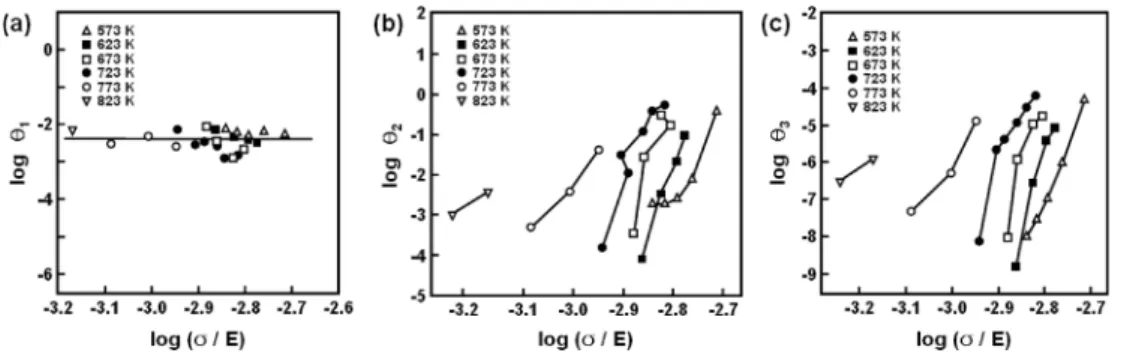
(2) In the above equation, ε is the creep strain, t is the creep time and θ 1 , θ 2 and θ 3 are the parameters deter- mined by approximating the creep curve by the equation using a least square method. Actual creep curves were fairly well described by the equation using the proper values of θ 1 , θ 2 and θ 3 . Stress dependences of the values of θ 1 , θ 2 and θ 3 are shown in Fig. 9. θ 1 does not depend on stress and temperature. θ 2 and θ 3 , which are concerned with the transient creep and the steady state creep, depend largely on stress. The relations between the
ε′ε = εi θ+
1
(1 e–– θ
2t
) θ+3
tFig. 7. (a) Stress-strain curves and (b) magnified curves in the
small strain region.
Fig. 8. Temperature dependences of the proportional limit (σ
y), proof
stresses ( σ
0.02, σ
0.2), maximum stress ( σ
m) and critical stresses ( σ
cl,
σcu and σ
ci) for creep deformation.
parameters, θ 2 and θ 3 , and the stress closely resemble the stress dependence of the minimum creep rate shown in Fig. 4. θ 2 and θ 3 decrease steeply with the decrease in stress, which shows distinctly the existence of the lower critical stress σ cl in the low stress range.
The critical stress for the instantaneous strain of creep, σ ci , over which the instantaneous plastic strain rises, exists at each temperature. It is thought that σ ci corresponds to the yield stress at each creep temperature. The mag- nitudes of σ cu and σ ci are almostly equal and very close to the 0.2 % proof stress, σ 0.2 , as seen in Fig. 8. This suggests that the critical stresses, σ cu and σ ci , correspond to the macroscopic yield stress. Moreover, σ 0.2 at high temperatures above 573 K is close to the maximum stress in stress-strain curve at each temperature, as shown in Fig. 8, which also indicates that extensive plastic de- formation occurs with work-softening at high stress range above the upper critical stress.
The results of the observation of microstructures also support the creep behavior mentioned above. The sub- structure after annealing was composed of fine subgrains and high densely distributed dislocations. In other words, the material was composed of fairly stably work hardened substructures. The variation of substructure was little observed even after the long time annealing at 723 K.
The coarsening of subgrains was observed, on the other hand, by the creep deformation in the high stress range.
This shows that the substructure becomes unstable at high temperatures under the stress larger than the upper critical stress. The strain softening and the subgrain growth have been observed during the creep of an IN9052 alloy in the high stress range above a transition stress. 6) It is supposed that dislocations within subgrains or in subboundaries can move beyond subboundaries under a high stress above the critical point to yield a macroscopic deformation.
In the low stress range, on the other hand, the creep curve consists of primary creep stage which shows that the material apparently work hardens and the creep rate decreases with the progress of creep deformation. In the stress-strain curves obtained by the tensile tests at high
temperatures, the material is also observed to work harden after yielding in the stress range below 0.2 % proof stresses. The work hardening behavior is ordinarily ascribed to an increase in the dislocation density with the progress of deformation. However, the substructure of the present material after annealing is composed of fine subgrains and high densely distributed dislocations. It seems hard to explain the reason of apparent hardening by the increase in the dislocation density in such material. It seems more reasonable to explain the work- hardening below 0.2 % proof stress by the exhaustion theory. 8) It may be reasonably assumed that the material is composed of soft and hard regions, and the local resistance to dislocation glide varies from place to place in a non-uniform way. The resistance is high in the hard region, the subboundaries or places with dislocations of high density. In the areas of low resistance, which correspond to the interiors of subgrains, dislocations can glide rather easily but the gliding distance is limited to about the average subgrain size.
In the low stress range of creep deformation, dislo- cations are expected to move toward the area of low resistance. The local movement of dislocations will produce a small amount of strain. It is expected in this situation that the creep curve shows a transient type creep, as represented by the logalithmic creep or the θ equation for primary creep as shown in eq.(2). Then, the lower critical stress σ cl corresponds to the stress which enables the dislocations to move within the interior of subgrains, namely the yield stress for the local defor- mation.
Rösler et al. examined the microstructure and creep behavior of aluminum alloys strengthened by oxide and carbide dispersoids, which were prepared by the mechanical alloying technique. 9) One of their materials is the same as that used in the present experiment. The existence of the lower critical stress, which was observed in the present work, has not been confirmed in their work. The lower critical stress might also have been observed in their work if there had been more detailed examinations at low temperatures below 723 K.
Fig. 9. Stress dependences of the parameters, (a) θ
1, (b) θ
2and (c) θ
3, in the low stress range.
considered that dislocations decrease the energy at the incoherent interface between the matrix and dispersed particles, therefore the attractive force is produced at the departure side of particles. The extent of the decrease in the energy of dislocations will depend on the property of the interface. The high dislocation density and the enrich- ment of dispersoid particles in subboundaries is thought to yield a higher value of the upper critical stress com- pared with the lower critical stress at each temperature.
At 773 K and 823 K, the upper critical stress was not observed thus clearly compared with the case at lower temperatures. The lower critical stress was not recognized at 773 K and 823 K. At low strain rates, the stress exponent of creep rate, n, changes from extremely high values at temperatures below 723 K to low values at 773 K and 823 K as seen in Fig. 4. The values of n at low strain rates at 773 K and 823 K are estimated as about 11 and 8 respectively. Rösler et al. obtained n = 13 for low strain rates at 773 K and explained the transition in stress exponent by the interface-reaction controlled diffusional creep. 9) The value of n estimated by the present work at low strain rates at 773 K ( n = 11) is close to their value and n decreases to lower value at 823 K. However, the transition of s from the high stress range to the low one, which is recognized at temperatures below 723 K, cannot be explained by the diffusional creep mechanism by Rösler et al. because there exists the lower critical stress in the low stress range at the temperatures.
5. Conclusions
1) The creep behavior of the present material is dis- tinctly different between two stress ranges, the low stress range and the high stress range.
2) The critical stress for creep deformation exists in each stress range below 723 K, the lower critical stress and the upper critical stress.
5) At higher temperature above 773 K, the influence of the diffusional creep increases, but the stress exponent of the creep rate decreases.
Acknowledgements
This research was supported by the Ministry of Trade, Industry and Energy(MOTIE), KOREA, through the Education program for Creative and Industrial Conver- gence(Grant Number N0000717).
References
1. S. Kawamori and T. Machida, Mater. Ttrans., 48, 373 (2007).
2. H. Dutta, A. Sen, J. Bhattacharjee, and S. K. Pradhan, J.
Alloys Compd., 493, 666 (2010).
3. T. Sakamoto, H. Kurishita, T. Furuno, T. Nagasaka, S.
Kobayashi, K. Nakai, S, Matsuo, H. Arakawa, A.
Nishimura, and T. Muroga, Mater. Sci. Eng., properties, microstructure and processing. A, Structural Mater., 528, 7843 (2011).
4. H. Reveron, O. Zaafrani, and G. Fantozzi, J. European Ceram. Soc., 30, 1351 (2010).
5. F. Dobes, M. Besterci, B. Ballokova, K. Sulleiova, and P.
Dymacek, Mater. Sci. & Eng. properties, microstructure and processing. A, Structural Mater., 532, 567 (2012).
6. K. Higashi, T. Okada, T. Mukai, and S. Tanimura, Mater.
Sci. & Eng. properties, microstructure and processing. A, Structural Materials, 159, L1 (1992).
7. D. Gould, P. B. Hirsch and F. J. Humphreys, Phil. Mag., 30, 1353 (1974).
8. R. W. Evans and B. Wilshire, Mater. Sci. Technol., 3, 701 (1987).
9. J. Rösler and E. Arzt, Acta Metall. Mater., 38, 671 (1990).
10. E. Arzt and D. S. Wilkinson, Acta Metall. Mater., 34, 1893 (1986).
ε′