(elasmobranchs)에 대해 최초의 분류체계를 세운 연구는 Müller and Henle (1841)에 의해 수행된 후, Garman (1913)에 의해 확립되었다. 홍어科 Family Rajidae (정 등, 1995) 의 형태형질에 근거한 최초의 계통분류학적 연구는Clark (1926)에 의해 시도된 후, 계 통유연관계에 대한 연구는 몇몇 연구자들에 의해 행해 져 왔다(Bigelow and Schroeder, 1953; Ishiyama, 1958, 1967; Stehmann, 1970; Hulley, 1972a; McEachran, 1984; McEachran and Miyake, 1990a; Ishihara, 1991;
Jeong, 1998; McEachran and Dunn, 1998).
홍어류(skates)는 대부분의 전세계 해역의 에서
수심 약 3000 m까지 서식하는 저서성 어류이며, 보존적 인 형태적 특징(morphological conservatism)을 가지면 서 骨 (cartilaginous fishes) 중에서 높은 종다양 성을 나타내는 독특한 그룹으로 전세계에 약 280 이 보고되어 骨 綱(Chondrichthyes) 총 (900~ 1100종)의 약 4분의 1을 차지하는 매우 번성한 그룹이 다(Compagno, 1991; Jeong, 1998; McEachran and Dunn, 1998).
동아시아(East Asia) 해역에는 속 수준(genus level)의 7개 상위분류군(supraspecific taxa)에 약 37 이 분포
─
─ 198 ──
한국산 홍어류 ( 판새아강 , 홍어과 ) 어류의 분류학적 연구 현황과 국명검토
정 충 훈 인하대학교 해양학과
A Review of Taxonomic Studies and Common Names of Rajid Fishes (Elasmobranchii, Rajidae) from Korea
Choong-Hoon Jeong
Ocean Science & Technology Institute, c/o Department of Oceanography, College of Natural Science, Inha University, Inchon 402-751, Korea
Based on the reviewing the present specimens and published data, taxonomic revision about the Korean names and distributional ranges of the rajid fishes (Rajidae) in Korea was conducted. As a result, the family Rajidae from Korea was classified into 4 genera encom- passing 11 species, Bathyraja bergi, B. isotrachys, Dipturus kwangtungensis, D. macrocauda, D. tengu, Okamejei acutispina, O. boesemani, O. kenojei, O. meerdervoortii, Raja koreana and R. pulchra. Proposed new Korean names are “Salhongeo-sok” for the genus Dipturus and the
“Hongeo-sok” for the genus Okamejei, because those are elevated from subgeneric to generic rank recently. In particular, the new korean names are needed to be given that, the genus Raja is “Chamhongeo-sok” and R. pulchra is “Chamhongeo”. The occurrence of Bathyraja bergi is recognized as in the Korean waters according to this revision. The check list and the map of geographic distributions of 11 species of Rajidae from Korea are presented.
Key words : Korean names, Rajidae, Bathyraja, Dipturus, Okamejei, Raja, distribution
하며(Chu and Meng, 1987; Deng et al., 1989; Ishihara, 1991; Chen and Joung, 1993; Hatooka and Yamada, 1993; Jeong and Nakabo, 1997), 2 의 미기재종(unde- scribed species)이 분포한다(Jeong et al., 1999a, b).
홍어科 어류는 內 및 間에 형태가 매우 유사하 고 변이가 많아 분류에 어려움이 많다. 따라서 홍어科 어류에 대한 분류를 명확히 하기 위해서는 어느 특정 해역만의 표본이 아닌 전세계, 또는 적어도 동아시아에 걸친 넓은 해역에서의 을 較檢 함이 필요하다.
한편, 우리 나라에서 홍어科 어류에 대한 연구는 (1425)에 의해 처음 “홍어( )”라는 이 사용된 이
후 (1814)이 에서 묵가오리( 加 )
(?=Raja fusca sensu Garman, 1913)를 보고한 바 있다 ( , 1954, 1977).
20세기에 들어와 비로소 한국 근해산 홍어科 어류의 분류학적 연구가 Jordan and Metz (1913)에 의해 시작 되었으며, 국내 학자에 의한 연구는 (1954, 1977), 金 과 姜(1993), 金 (1994), 정 등(1995) 및 Yamada et al. (1995) 등에 의해 수행되었다. (1977)은 한국산 홍 어科 어류 8 을 보고하였으며, 정 등(1995)이 한국산 Raja 어류 5 을 정리하면서 Rajidae科와 Raja 의
國 (=國 )의 更을 하였고, 國 記 으로 무늬홍어(Raja (Okamejei) acutispina)와 참홍어 (Raja (Dipturus) kwangtungensis) 2 을 보고하였다. 그 후 Yamada et al. (1995)에 의해 깨알홍어(Raja boese- mani)가 한국 미기록종으로 추가되었다.
본 연구에서는 그동안 Raja Linnaeus, 1758의 으 로 보고되었던 Okamejei Ishiyama, 1958이나 Dipturus Rafinesque, 1810이 으로 rank-up됨으로(Mc- Eachran and Dunn, 1998) 인하여 에 대한 國 이 필요하며, 더욱이 Rajidae科, Raja , R. pulchra및 R.
kwangtungensis의 국명사용에 혼란이 있으므로( , 1954, 1977; 金과 姜, 1993; 金 , 1994; 정 등, 1995;
Yamada et al., 1995; 김과 김, 1997; 이 등, 1999) 科 , 및 의 國 을 정리하고자 한다. 또한, 한국 해 역에 분포하는 홍어科 어류를 대상으로 국내외 연구현 황을 논의하고, 국내외 (Appendix 참고)과 을
토대로 하여 檢 와 를 정리하고
자 한다.
홍어科 의 究 과
및 國
1) Class Chondrichthyes 연골어강 2) Subclass Elasmobranchii 판새아강
Order Rajiformes 홍어목
Nelson (1994)과 Shirai (1996)는 상어 (Order Sela- chii sensu Bigelow and Schroeder, 1948) 이외의 모든 가 오리 (Order Batoidei sensu Bigelow and Schroeder, 1948, 1953; Superorder Batoidea sensu Compagno, 1973; Superorder Rajomorphii (Batoidea) sensu Com- pagno, 1991; Superorder Batoidea sensu McEachran et al., 1996)를 Order Rajiformes에 포함시켰으나, Esch- meyer (1998a)는 가오리 를 Pristiformes (sawf ishes), Torpediniformes (electric rays), Rajiformes 등의 3개 으로 구분한 바 있다.
Compagno (1991)는 Compagno (1973)에 따라 Rajo- morphii (Batoidea) 에 Pristiformes, Torpedini- formes, Myliobatiformes 등을 그대로 포함시켰으며, Rajiformes의 2 (Rhinobatoidei, Rajoidei)을 Rhino- batiformes와 Rajiformes(skates)의 목 수준(order level) 으로 rank-up시켜 5 으로 구분했다. McEachran et al.
(1996)은 Rhinobatiformes를 다시 Rhiniformes와 Rhynchobatiformes로 세분하여 Superorder Batoidea를 6개 으로 분류하면서 Rajiformes에 홍어科(Rajidae) 만을 포함시켰다.
한편, (1954)은 Rajiformes를 (=가오리 ), (1977)은 Rajida (Batoidei)를 홍어 , 金과 姜(1993)은 Rajiformes를 홍어 , 金 (1994)은 Rajiformes를 가 오리 , 김과 김(1997)은 Rajiformes를 홍어 으로 명명 하여 國 의 更이 많았다.
현재 김과 김(1997)에 의한 홍어 (Rajiformes)의 분 류체계는 Nelson (1994)과 Shirai (1996)의 분류체계와 유사하여 Order Rajiformes에 국내에 보고되어 있는 8 科의 모든 가오리 가 포함되어 있다(즉 Narcinidae, 전기가오리科; Rhinidae, 수구리科; Rhinobatidae, 가래상 어科; Rajidae, 홍어科; Dasyatidae, 색가오리科; Urolo- phidae, 흰가오리科; Gymnuridae, 나비가오리科; Mylio- batidae, 매가오리科).
Compagno (1991)와 McEachran et al. (1996)에 의하면 Order Rajiformes는 Family Rajidae만으로 구성된다하 여 Nelson (1994)과 Shirai (1996)의 분류체계와 다르므 로 한국산 가오리 어류를 대상으로 계통유연관계를
고려한 (order level)에서의 檢 가 求된다.
3) Family Rajidae Bonaparte, 1831 홍어과 (Hong-eo-kwa)
홍어 는 科 (family level)의 분류체계에 논란이 많았다. Hulley (1972a, b)는 홍어 를 Rajidae (Bona- parte, 1831), Anacanthobatidae (von Bonde et Swart,
1924), Arhynchobatidae (Fowler, 1941), Gurgesiellidae (de Buen, 1959), Pseudorajidae (Bigelow et Schroeder, 1962) 및 Crurirajidae (Hulley, 1972) 등의 6개 科로 구 분하였고, Compagno (1973)는 Anacanthobatidae, Arh- ynchobatidae, Pseudorajidae 및 Rajidae 등의 4개 科로 분류하였다. McEachran (1984)과 McEachran and Mi-
yake (1990a)는 홍어 를 두 개의 科 으로 분류하
였으나 을 부여하지 않았다.
Nelson (1994)과 McEachran and Dunn (1998)은 홍어 의 모든 科들을 Rajidae科에 포함시켰으며, 는 Subfamily Rajinae와 Subfamily Arhynchobatinae의 두 科를 하였다. 한편, Eschmeyer (1998b)와 Last and Stevens (1994)는 Anacanthobatidae를 별개의 科로 취급하기 때문에 檢 가 요구된다.
홍어科 어류는 난생이고, 난각(egg capsule)의 네 모 서리의 끝이 길다. 보통 2개의 등지느러미(dorsal f in)는 퇴화되었고, 는 또는 채찍모양이며 발전기관 (electric organ)이 비교적 발달해 있다. 배지느러미 (pelvic fin)는 (anterior lobe)과 (posterior
lobe)으로 나뉘어 있다. 성숙한 수컷의 가슴지느러미
(pectoral fin)의 양끝 부분에 棘(alar thorns)을 가 지며, 매우 잘 발달된 交 器(clasper)에는 ventral ter- minal clasper cartilage가 있다. 經 蓋骨(neurocrani- um) 앞쪽의 骨(rostral cartilage)은 되지 않았 고, ∙ 骨(propterygium)은 殼(nasal capsule) 부근까지 뻗쳐 있고, 基∙ 骨(basibranchial corpula)의 앞부분은 포크모양을 하고 있다는 共 (syna- pomorphy)에 의해 정의되는 群(monophyletic group)이다(Garman, 1913; Bigelow and Schroeder, 1953; Compagno, 1973; McEachran and Miyake, 1990a;
Nelson, 1994; McEachran and Dunn, 1998).
한편, 정 등(1995)은 Family Rajidae의 國 을 가오리 科에서 홍어科로 改 을 제안하였으나 김과 김(1997) 및 이 등(1999)에 의해 가오리科로 변경없이 사용되었 다. 하지만, 가오리 (rays)는 홍어 (skates)를 포함하 는 포괄적인 의미로 사용되며 (Compagno, 1973, 1991;
Nelson, 1994), 홍어 중에서 가장 먼저 記 된 이 홍어(Okamejei kenojei (Müller et Henle, 1841))이고, Rajiformes (홍어 )의 어원이나 의 구성으로 보아 홍 어科로 명명함이 타당하다고 사료된다. 또한, 손(1980) 은 Family Rajidae를 홍어科, Family Dasyatidae를 가 오리科( 國에서는 색가오리科)로 명명하고 있으므로 혼란을 방지하기 위해서도 정 등(1995)의 제안에 따라 홍어科로 한다.
1. Genus Bathyraja Ishiyama, 1958 저자가오리속 (Jeo-ja-ga-o-ri-sok)
Ishiyama (1958)는 홍어科 어류의 연구에서
Breviraja (nec Bigelow and Schroeder, 1948)에 B.
(Arctoraja), B. (Bathyraja) 및 B. (Notoraja)의 3개 아속 (subgenus)을 신설하였다. 그후 Ishiyama (1958)의 Breviraja (nec Bigelow and Schroeder, 1948)는 經 蓋骨(neurocranium)과 交 器(clasper)의 구조가 記
인 Breviraja Bigelow and Schroeder, 1948과 다르기 때문에 Bathyraja를 속 수준으로 승격시켰으며, Noto- raja는 Bathyraja 의 으로, Arctoraja는 Bathyraja 의 synonym으로 정리되었다(Ishiyama and Hubbs, 1968).
저자가오리 은 전세계 해역에 약 47 이 보고되었 고, 북태평양 해역에 의 약 반이 분포하며, 수심 약 3,000 m 전후까지 서식한다(Stehmann, 1986; McEachran and Miyake, 1990b; McEachran and Dunn, 1998). 각 에 대한 분포는 Dolganov (1985), Hatooka and Yamada
Fig. 1. Geographical distribution ranges of Bathyraja species. be=B. bergi; is=B. isotrachys.
(1993), Ishihara and Ishiyama (1985), Lindberg and Legeza (1959) 및 (1954, 1977) 등을 참고하였다(Fig.
1).
1) Bathyraja bergi Dolganov, 1985 바닥가오리 (Ba-dak-ga-o-ri)
여러 학자들에 의해 약 100년 간 Bathyraja isotra- chys (Günther, 1877)로 되었던 이다(Dolganov, 1985; Ishihara and Ishiyama, 1985). 본종은 Dolganov (1985)에 의해 Bathyraja bergi로, Ishihara and Ishiya- ma (1985)에 의해 B. pseudoisotrachys로 記 되었 으나 동물명명규약의 선취권에 의해 Dolganov (1985)의 학명이 유효하다.
(1954, 1977)은 Breviraja (nec Bigelow and Schroe- der, 1948)의 한 으로서 B. isotrachys (Günther)를 보 고하였는데, 肩胛 棘(scapular thorns), 작은 좁쌀 가시(顆 棘, minute prickles), 棘(enlarged thorns along medial line of tail), 骨(trunk and predorsal caudal vertebrae) , (intestinal spiral valves)의 등 몇몇 이 Ishiyama (1958, 1967)의 Bathyraja isotrachys (nec Günther)와 일치된다. Ishiyama (1958, 1967)의 B. isotrachys (nec Günther)는 Bathyraja bergi Dolganov의 오동정이었기에(Dolganov, 1985; Ishihara and Ishiyama, 1985) (1977)에 의한 기재의 일부는Bathyraja bergi라고 사료된다.
한편, 이 등(1999)은 쿠릴열도(Kuril Is.) 근해에서 채 집된 표본을 Bathyraja bergi Dolganov라 동정하여 ‘밑 홍어’에서‘바닥가오리’로 國 을 更하였다.
: (원산, 포항)~Okhotsk ; ∙ (Cho- shi)~Okhotsk .
2) Bathyraja isotrachys (Günther, 1877) 저자가오리(Jeo-ja-ga-o-ri)
으로 보고된 약 100년간 다른 (=B. bergi) 을 본종으로 오동정해왔다(Dolganov, 1985; Ishihara and Ishiyama, 1985).
(1954, 1977)에 의해 기재된 Breviraja isotrachys (Günther)는 기재의 일부가 Bathyraja bergi와 일치되며 (Dolganov, 1985; Amaoka et al., 1995), Lindberg and Legeza (1959)에 의해 포항 근해에 분포한다는 Bathy- raja isotrachys (Günther, 1877)의 기재의 일부는 Ishi- hara and Ishiyama (1985)에 의해 B. pseudoisotrachys로 정리되었으며, 현재는 B. bergi Dolganov, 1985가 유효하 다.
(1954, 1977)의 보고에 의하면 본종은 포항이나 원 산에서 일반적으로 볼 수 있다고 하였으나, 記 이
없으므로 을 토대로 한 記 가 요구된다. 저자가오리는 (1954)에 의해 國 되었으며, 최 근에는 김과 김(1997)에 의해 국내 서식어류 목록에 기 록되었다.
: (포항, 원산), Okhotsk ~ 國 . 2. Genus Dipturus Rafinesqe, 1810 살홍어속
(국명신칭 : Sal-hong-eo-sok)
Ishiyama (1958)는 Raja Linnaeus, 1758의
(new subgenus)으로서 Tengujei를 하였으나 Steh- mann (1970)에 의해 Dipturus의 junior synonym으로 정리되었다. Ishihara and Ishiyama (1986), McEachran and Fechhelm (1982), McEachran and Miyake (1986) 등 에 의해 유효성이 인정되었는데, Seret (1986)는 Oka- mejei Ishiyama, 1958의 senior synonym이라고 주장했 다. 한편, 은 McEachran and Dunn (1998)에 의해
에서 으로 승격되었다.
본 속의 3 중에서 살홍어 D. tengu (Jordan et
Fig. 2. Geographical distribution ranges of Dipturus species. kw=D. kwangtungensis; ma=D. macro- cauda; te=D. tengu.
Fowler, 1903)가 가장 먼저 記 되었고, 가장 일반적이 므로 살홍어 으로 國 을 한다.
대부분이 대형종으로 수심 1,000 m 정도까지 서식하 며 세계적으로 약 30종의 유효종(valid species)과 학명 이 부여되지 않은 종(unnamed species)이 9종 보고되어 있으며, 이중 동아시아 해역에는 6종이 보고되어 있다 (McEachran and Miyake, 1990b; Hatooka and Yamada, 1993; Last and Stevens, 1994; Stehmann, 1995; McEa- chran and Dunn, 1998; Jeong et al., 1999a). 각 에 대 한 분포는Ishiyama (1967), Chu and Meng (1987), Chen and Joung (1989), Nakaya (1992), Hatooka and Yamada (1993), Yamada et al. (1995), (1954, 1977) 및 손 (1980) 등을 참고하였다(Fig. 2).
1) Dipturus kwangtungensis (Chu, 1960) 광동홍어(Kwang-dong-hong-eo)
Chu (1960)는 모식표본(type specimen)을 國의 廣 (Guangdong Province)에서 채집했기 때문에
‘kwangtungensis’라고 하였다. 본종은 동정에 오류 가 많은 종인데, Ishihara (1987)는 모식표본을 조사하여 Ishiyama (1958, 1967), Lindberg and Legeza (1959), Nakaya (1984), Shen (1984), Yamada (1986) 등이 기재한 Raja kenojei는 본종의 오동정임을 밝힘으로서 일단 논 란을 해결했다. (1977)과 金 (1994)에 의한 Raja kenojei는 본종을 오동정(사진 및 일부 형질은 제외)한 것으로 생각된다.
한편, 정 등(Jun, 1995)은 본종을 國 記 으로 보고하면서 참홍어라 명명하였고, Yamada et al. (Dec.
1995)은 광동홍어라고 명명하였다. 이 등(1999)은 후자 를 따랐는데 權에 의해 참홍어라 명명함이 타당하 다고 사료되나, Raja pulchra (참홍어: 국명개칭)와 혼란 을 피하기 위해 Yamada et al. (1995)에 따라 광동홍어 로 명명한다.
: 중부해역 이남, (Aomori) 이 남~南 國 .
2) Dipturus macrocauda (Ishiyama, 1955) 도랑가오리(Do-rang-ga-o-ri)
(1954)은 Mori (1952)가 포항 근해에 분포한다고 보고한 Raja oxyrinchus Linnaeus, 1758 (oxyrhynchus는 틀린 철자)을 도랑가오리라고 國 하였는데, Mori (1952)는 Matsubara (1936)에 따라 오동정하였으며,
에 의한 Raja oxyrinchus (nec Linnaeus)는 Ishiyama (1955)에 의해 R. macrocauda로 告되었다. 한편, R. oxyrinchus Linnaeus, 1758은 대서양에 분포하는 종 이다(Stehmann and Bürkel, 1984).
(1977)의 보고 이후 아직 보고된 바 없는 종으로, 꼬리가 매우 크기 때문에 macro (Gk.=large)+cauda (L.= tail)의 합성어에 학명이 부여되었다.
: (포항)~ 동북부 해역; (Chiba) ~宮崎(Miyazaki) 까지의 연해.
3) Dipturus tengu (Jordan et Fowler, 1903) 살홍어(Sal-hong-eo)
‘tengu’ ( 拘)는 일본의 민화에서 나오는 상상의 요정 으로 얼굴이 붉고, 코가 대단히 높은 모양을 하고 있는 데, 본 종의 주둥이(snout)가 대단히 길기 때문에 붙여 진 학명이다(Jordan and Fowler, 1903). (1954)은 살 홍어라고 하였는데, 주둥이가 아주 길고 뾰족한 화 살 모양을 하고 있기 때문이다.
분류학적 문제점은 제기되지 않지만 가끔 동정에 오 류가 있는데, (1977, pl. 17.5, color pl. 6.1)이 보고한 Raja tengu는 O. kenojei를 오동정한 것으로 사료되며, Nakaya (1984)가 보고한 R. macrocauda는 본종을 오동 정한 것으로 생각된다. 한편, 와 (1996)는
주변에 서식함을 보고하였고, 이 등 (1999)은 國 의 (350 mm SL) 표본을 간단히 기재하였다.
: ∙ 의 남부해역, 이남~
Philippines 동부연안.
3. Genus Okamejei Ishiyama, 1958 홍어속 (국명신칭 : Hong-eo-sok)
Ishiyama (1958)는 홍어科 어류 7 (현재는 5 으로 정리됨)을 대상으로 Raja Linnaeus의
으로 신설했는데, Ishihara and Ishiyama (1986), Ishi- hara (1987), McEachran and Fechhelm (1982), Steh- mann (1976) 등에 의해 유효성이 인정되었다. 그러나, Seret (1986)는 Dipturus Rafinesque, 1810과 구별할 수 있는 형질(character)이 없어 junior synonym으로 정리 해야 한다고 주장했기 때문에 재검토가 요구된다. 한편, 본속은 최근 McEachran and Dunn (1998)에 의해 에서 으로 승격되었다.
본속의 중 가장 먼저 기재되고 가장 먼저 사용된 명칭은 우리 나라 전해역에서 가장 흔히 볼 수 있는 홍 어(Okamejei kenojei (Müller et Henle, 1841))이기 때문 에 의 國 을 홍어 이라 한다. Okamejei는 Okame (=low-nose)와 jei (=skate)의 합성어로(Ishiya- ma, 1958) 작은코홍어라는 뜻인데, 骨 (rostral cartilage)이 짧고, 작기 때문에 되었다.
소형종으로 수심 약 400 m까지 서식하며, 전세계에 약 14 의 유효종과 학명이 부여되지 않은 종(unnamed
species)이 2종 보고되어 있으며, 이중 동아시아 해역에 서는7종이 보고되었다(McEachran and Miyake, 1990b;
Hatooka and Yamada, 1993; Last and Stevens, 1994;
McEachran and Dunn, 1998; Jeong et al., 1999b).
각 에 대한 분포는 Chang et al. (1955), Ishiyama (1958, 1967), Chu and Meng (1987), Ishihara (1987), Chen and Joung (1989), Nakaya (1992), Hatooka and Yamada (1993), Yamada et al. (1995), (1954, 1977) 및 손(1980) 등을 참고하였다(Fig. 3).
1) Okamejei acutispina (Ishiyama, 1958) 무늬홍어(Mu-neui-hong-eo)
정 등(1995)에 의해 남해안에서 채집한 20개체를 재 료로 國 記 으로 보고된 종으로서 동정에 오류 가 많았다(Chu, 1960; Chu et al. 1963; Chu and Meng, 1984, 1987; Shen, 1984). 형태적 특징이 뚜렷하여 다른 종과 쉽게 구별되므로 최근에는 분류학적 문제점은 제 기되지 않고 있다.
: 남부해역과 南 일대, 남부해역
~ 國 .
2) Okamejei boesemani (Ishihara, 1987) 깨알홍어(Kkae-al-hong-eo)
및 國에서 오랫동안 Okamejei hollandi (Jor- dan et Richardson, 1909)로 오동정되었다(Matsubara, 1936, 1963; Ishiyama, 1958, 1967; Chu, 1960, 1962; Chu et al., 1963; Chu and Meng, 1984, 1987; Yamada, 1986).
Ishihara (1987)는 Dr. M. Boeseman (RMNH)의 제안에 따라 을 記 하였기 때문에 그의 이름을 학명에 이 용했다.
본종의 國 은Yamada et al. (1995)에 의해 되었 는데, 깨알 모양의 작은 암갈색 이 체반의 등쪽에 조밀하게 분포하기 때문에 붙여진 이름으로 생각된다.
: 남방 연근해, 根(Shimane)
∙高 (Kochi) ~南 國 .
3) Okamejei kenojei (Müller et Henle, 1841) 홍어(Hong-eo)
형태적 변이가 많아 여러 으로 告된 바가 있을 정도로 분류학적 혼란이 많았는데 지금도 논쟁이 계속되는 이다(Ishihara, 1987; 정 등, 1995). Raja porosa Günther, 1874와 Raja fusca Garman, 1885는
의 junior synonym으로 정리되었으나(Boeseman, 1979; Ishihara, 1987), Ishihara (1987)와 정 등(1995)에 의해 지적된 바와 같이 유효성에 대한 재검토가 필요하 다. 또한, (1977)에 의한 R. porosa도 Ishihara (1987) 와 정 등(1995)에 의해 R. (Okamejei) kenojei의 syno- nym으로 정리되었는데 金 (1994)과 김과 김(1997) 은 변경없이 사용하고 있어서 한국 내에서도 종명의 재 검토가 요구된다.
: , , 이남~南 國 . 4) Okamejei meerdervoortii (Bleeker, 1860)
오동가오리(O-dong-ga-o-ri)
본종은 유효성에 대한 논란이 많았는데 Boeseman (1979)이 분류학적 문제점을 정리하였다. 암수의 형태적 특징이 뚜렷하여 현재는 분류학적 문제점은 제기되지 않고 있다.
Jordan and Metz (1913)에 의해 국내 최초로 근 해에 분포한다고 보고된 후, Mori and Uchida (1934)와 Mori (1952)에 의해 보고되었다. (1954, 1977)은 표본 의 채집없이 본종을 소개하였는데, 정 등 (1995)이 20個 의 을 하여 告하였다. 에서 불리던 이름을 國 으로 사용했다( , 1954).
Fig. 3. Geographical distribution ranges of Okamejei species. ac=O. acutispina; bo=O. boesemani;
ke=O. kenojei; me=O. meerdervoortii.
: 南 의 동부해역, ∙ 이남의 연안~ 國 의 북부해역.
4. Genus Raja Linnaeus, 1758 참홍어속 (국명개칭 : Cham-hong-eo-sok)
Raja 은310 이상이 기재되어100 이상이 유효 한 매우 방대한 으로 가오리 (rays; Rajomorphii (Batoidea) sensu Compagno, 1991; Batoidea sensu McEachran et al., 1996) 총 종수(약 500종)의 약 5분의 1을 차지하며, 연골어강(Chondrichthyes) 중 가장 많은 을 포함하는 대표적인 이었다(McEachran and Miyake, 1990a, b; Compagno, 1991; Ishihara, 1991;
Jeong, 1998; Eschmeyer, 1998b).
약 10개 으로 구성되었던 Raja (sensu Mc- Eachran and Miyake, 1990a, b)은 간의 계통유연 관계에 논란이 많았는데, McEachran and Dunn (1998)은 모든 들을 으로 승격시켰다. 그래서, 현재의 Raja 은 대서양과 아프리카 주변 해역에 분포(Stehm-
ann and Bürkel, 1984; McEachran and Miyake, 1990b) 하는 들로 구성되어 있다.
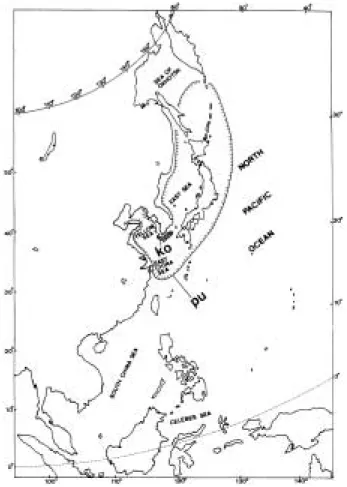
한편, McEachran and Miyake (1990a, b)는 McEa- chran and Miyake (1986)의 연구를 토대로 하여 북태평 양에 분포하는 6 을 대상으로 속 수준의 상위분류군으 로서 Raja North Pacif ic Assemblage를 假 하여 한국 해역에도 분포하는 Raja (Dipturus) pulchra를 포함시켰 다(R. pulchra참고).
우리 나라에서 Raja 은 가오리 ( , 1954, 1977)에
서 홍어 (정 등, 1995)으로 國 改 을 한 바 있
다. 그러나 본 연구에서 Okamejei 이 홍어 으로 國 됨으로서 Raja 에 대한 국명의 改 이 필요하 며, 위와 같이 들이 으로 승격된 현행 분류체계에 서 R. koreana Jeong et Nakabo와 R. pulchra Liu는 Raja 에 속하므로 의 國 改 이 필요한 실정이 다. 따라서, 두 중 R. pulchra (참홍어:국명개칭)가 먼 저 기재되었고(원기재순), 일반적으로 참홍어라 불리므 로 Raja 의 國 을 참홍어 으로 改 한다.
각 의 (Fig. 4)는 본문 중에 서술하였다. 1) Raja koreana Jeong et Nakabo, 1997
고려홍어 (Ko-ryeo-hong-eo)
본종은 國 에서holotype이 채집되었고, 본 해역 최초의 연골어류 이기 때문에 그것을 기념하기 위
해 “Korea”의 어원을 따라 고려홍어로 된 이다.
Jeong and Nakabo (1997)는 여러 가지의 파생형질 (derived character)과 고유파생형질(autapomorphy)에 의해 홍어科 어류의 어느 분류군(속이나 아속)에도 포 함되지 않지만 ∙ 骨(propterygium)의 앞쪽과 주 둥이 끝 (rostral appendix)이 서로 멀리 떨어져 있기 때 문에 일시적으로 Raja속에 포함시켰으나 새로운 상위분 류군의 설립을 주장했다. Jeong (1998)은 홍어 어류의 계통유연관계 추정에서 8 개체의 다양한 형태형질을 비 교하여 본종을 대상으로 신속(new genus)을 설립하였으 나 비공식적인 출판이었으므로 인정되지 않으며, Jeong
and Nakabo (1998)에 의해 로서 발표된 바가
있다.
본종은 제주해협(Cheju Strait)의 주변해역에만 분포 하여 분포범위가 대단히 좁은 한국 고유종으로 예상되 었으나(Jeong and Nakabo, 1997; Jeong, 1998), 최근 제
주도와 의 (Tsushima-jima) 및
(Goto-retto)를 잇는 삼각형의 중심해역에서 어획된1개 체를 關(Shimonoseki) 어시장에서 촬영한 사진을 토 대로 하여 일본 해역에도 분포한다고 보고된 바가 있는
데( , 1998), 우리 나라 해역에서 지극히 드물게
Fig. 4. Geographical distribution ranges of Raja species.
ko=R. koreana; pu=R. pulchra.
일본 해역으로 유입되었다고 생각된다.
: (목포 근해~제주도 북부해역);
서부연해.
2) Raja pulchra Liu, 1932 참홍어(국명개칭 : Cham-hong-eo) (Fig. 5)
우리 나라 홍어 어류 중에서 국명에 대한 논란이 가장 많은 으로서, 지금까지 눈가오리로 명명되었으나 몇몇 학자만이 알 수 있을 뿐이고 일반적으로 참홍어나 홍어 등으로 불려지는 종이다. 본종은 가장 일반적으로 불리는 참홍어로 國 更을 제안한다. 이전에 사용되 던 눈가오리라는 명칭은 본종의 가슴지느러미의 좌우에 원형의 큰 반점이 있기 때문에 붙여진 이름으로 생각되 는데, 에서는 안경홍어로 불리고 있다(손, 1980).
國 (Shandong Penn.) 주변에서 채집한 유
어(juvenile) 표본을 재료로 記 를 하였는데(Liu, 1932), Bathyraja smirnovi (Soldatov et Pavlenko, 1915) 와 분류에 혼란이 많았다(Ishiyama, 1967). 최근 Amao- ka et al. (1995)에 의해 보고된 Raja tengu (nec Jordan
and Fowler)는 을 한 것으로 사료된다.
‘pulchra’는 형태적 특징을 고려한 라틴어의 형용사로
아름답다는 뜻인데, 다른 홍어류 어류에 비해 깨끗하고 수려한 모양을 하고 있기 때문에 부여된 학명이라고 생 각되며 國에서는‘ ∙’로 불린다.
Ishihara (1987)는 본종을 Dipturus에 포함시켰으나 McEachran and Miyake (1990b)와 McEachran and Dunn (1998)은 Raja “North Pacific Assemblage”라는 정 확한 명칭이 부여되지 않은 상위분류군에 포함시켰기 때문에 차후 본종의 귀속에 대한 재검토가 요구되며, R.
N. Pac. Ass.는 가칭의 분류군(putative group)이므로 본 연구에서는Raja pulchra Liu로 변경없이 사용한다.
본종의 분포는 Chang et al. (1955), Ishiyama (1967) Hatooka and Yamada (1993) 및 (1954, 1977) 등을 참 고하였다.
: , , Okhotsk ~ 國 .
國 의 에 대한 考
이상의 재검토를 토대로 한국산 홍어과 어류의 종 목 록과 국명을 정리한 결과, 4 11 이 서식, 분포함을 알 수 있었다.
Fig. 5. Raja pulchra, dorsal (A) and ventral (B) views, FSIU 200, subadult male, 720 mm TL.
國 홍어科 의 과 國 Class Chondrichthyes 연골어강
Subclass Elasmobranchii 판새아강 Order Rajiformes 홍어목
Family Rajidae 홍어과
Bathyraja Ishiyama, 1958 저자가오리속 B. bergi Dolganov, 1985 바닥가오리 B. isotrachys (Günther, 1877) 저자가오리
Dipturus Rafinesque, 1810 살홍어속(국명신칭) D. kwangtungensis (Chu, 1960) 광동홍어 D. macrocauda (Ishiyama, 1955) 도랑가오리 D. tengu (Jordan et Fowler, 1903) 살홍어
Okamejei Ishiyama, 1958 홍어속(국명신칭) O. acutispina (Ishiyama, 1958) 무늬홍어 O. boesemani (Ishihara, 1987) 깨알홍어 O. kenojei (Müller et Henle, 1841) 홍어 O. meerdervoortii (Bleeker, 1860) 오동가오리
Raja Linnaeus, 1758 참홍어속(국명개칭) R. koreana Jeong et Nakabo, 1997 고려홍어 R. pulchra Liu, 1932 참홍어(국명개칭)
이상과 같이 두 에 대한 國 이 되었고, 각각 의 과 의 國 이 更되었다. Raja pulchra Liu는 눈가오리에서 참홍어로 國 이 변경되었는데, 실제로 어 류분류학자 몇몇 만이 눈가오리라는 명칭을 알고 있을 뿐이고 학계에서나 에서 대부분의 사람들이 R.
pulchra를 참홍어로 알고 있다. 한편, R. pulchra Liu, 1932 (참홍어)가 R. koreana Jeong et Nakabo, 1997 (고려 홍어)보다 먼저 되었기 때문에 Raja 의 을 참홍어 으로 하였다.
살홍어(Dipturus tengu)는 Tengujei (sensu Ishiyama, 1958)의 모식종(type species)이었는데, Tengujei는 Dipturus의 synonym으로 정리되었으나(Stehmann, 1970), 현재 에서는 Ishiyama (1958)에 의해 명명된 의 國 ( , Japanese name)을 그대로 사용하고 있다. 우리 나라에 분포하는 Dipturus 의 3 중 살홍 어와 도랑가오리가 동시에 기재되었는데( , 1954), 원 기재 상으로 D. tengu (Jordan et Fowler, 1903) (살홍어) 가 D. macrocauda (Ishiyama, 1955) (도랑가오리)보다 먼 저 기재되었으므로 살홍어 으로 國 하였다.
과 國 은 같이 변하는 것이 아니다. 은 세 계공통의 명칭이며, 모식표본(type specimen) 중에서 특 히 완모식표본(holotype)에 관련되어 있으며, 학명이 변 경되어도 국명은 바뀌지 않는다( , 1995). 학명을 보 증해 주는 가장 중요한 개념이 (type) 개념인데, 그룹에서는 모식종(type species)이 학명의 기준이 되는
모식이 되는 것이다( , 1995b). 홍어는 홍어科 어류 중 우리 나라에서 가장 오래된 명칭이며( , 1977), Okamejei kenojei (Müller et Henle, 1841) (홍어)는 동아 시아 해역에서 가장 먼저 기재된 이다(Eschmeyer, 1998a). 따라서, 홍어(O. kenojei)는 Okamejei 에 속하 므로 홍어 으로 의 國 을 하였다.
국명이 붙여진 종에 어떤 학명을 적용해야 하는 가는 연구에 의해 변경되지만, 국명과 종과의 관계는 변하지
않는다( , 1995). 國 은 우리 나라에서 의사소통을
위한 공통어로서 생물에 부여되는 이며, 을 대신하는 것이다. comment도 없는 synonym (
)이나 homonym ( )의 처리, 부적절한 國 의 및 更에는 명명 방법이나 선취권과 같은 規
이 없기 때문에 문제가 많다. 國 은 곧
이며, 國 은 에서의 에 해당하므로 과 마찬가지로 을 根據로 수행함이 국명의 혼란 을 막는 좋은 방법이 될 것이다( , 1995a; 能, 1995).
한편, McEachran and Dunn (1998)은 (suborder) 수준의 홍어 (Rajoidei)을 Family Rajidae로 정리하 면서 과 수준(family level)의 두 그룹(McEachran, 1984; McEachran and Miyake, 1990a)에 대하여 각각 새로운 科(Subfamily)와 (Tribe)을 했다. 한국 산 홍어科 어류도 2 , 2 으로 나뉘기 때문에 새로 운 아과와 족에 대한 國 이 필요하겠지만 아직도 홍어科 어류의 계통유연관계에는 미해결점이 남아 있어 상위분류군의 재변경이 예상되므로 차후로 미룬다.
한국산 홍어科 에 대한 考 과 國 및 를 하기 위해 국내외의 과 을 통하여 檢 하였다. 그 결과 홍어과 어류는 4 11 , 즉 Bathyraja bergi바닥가오리, B. isotrachys 저자 가오리, Dipturus kwangtungensis 광동홍어, D. macro- cauda도랑가오리, D. tengu살홍어, Okamejei acutispina 무늬홍어, O. boesemani 깨알홍어, O. kenojei 홍어, O.
meerdervoortii 오동가오리, Raja koreana 고려홍어 및 R. pulchra “참홍어” (國 改 ) 등으로 확인되었다.
Dipturus 과 Okamejei 은 에서 으로 승격되
었기 때문에 각각 “살홍어 ”과 “홍어 ”으로 國 하였고, Raja 은 “참홍어 ”으로 國 改 하였다. 분류 학적 재검토의 결과 Bathyraja bergi바닥가오리도 분포 함을 알 수 있었다. 한국산 홍어과 어류의 과
를 제시하였다.
표본이나 참고문헌을 제공해주신 國
敎 , 國 京 의 敎
, 敎 , 京 의 敎 ,
, 의 尼岡 敎 , 谷 宏
敎 , 國 科 館의 啓 ,
館의 岡 , 國 의
慶 敎 , 敎 , , 國科
究 의 敎 , ,독일
Federal Research Centre for Fisheries의 Dr. Matthias Stehmann, 미국 Texas A&M University의 Professor John D. McEachran과 Miami University의 Professor Samuel H. Gruber께 깊이 감사드린다.
Amaoka, K., K. Nakaya and M. Yabe. 1995. The Fishes of Northern Japan. Kita-nihon Kaiyo Center Co., Ltd., Sapporo, 390 pp. (in Japanese)
Bigelow, H.B. and W.C. Schroeder. 1948. Sharks. In: Tee- Van, J., C.M. Breder, S.F. Hildebrand, A.E. Parr and W.C. Schroeder (eds.), Fishes of the Western North Atlan-tic. Mem. Sears Found. Mar. Res., Yale Univ., New Haven, CT, 1(1) : 59~576.
Bigelow, H.B. and W.C. Schroeder. 1953. Sawfishes, gui- tarfishes, skates and rays. In: Tee-Van, J., C.M.
Breder, S.F. Hildebrand, A.E. Parr and W.C. Schroeder (eds.), Fishes of the Western North Atlantic. Mem.
Sears Found. Mar. Res., Yale Univ., New Haven, CT, 1(2) : 1~514.
Boeseman, M. 1979. Some remarks on the identity of the Japanes rays Raja kenojei Müller & Henle, 1841, and Raja meerdervoortii Bleeker, 1860. Zool. Meded., 53(25) : 273~281.
Chang, C.L., Q.T. Cheng, B.S. Zheng, S.Z. Li, W.L. Zheng and W.B. Wang. 1955. Fishes of the Yellow Sea and Bohai Sea. Science Press, Beijing, xviii+353 pp. (in Chinese)
Chen, C.T. and S.T. Joung. 1989. Fishes of the genus Raja (Rajiformes : Rajidae) from Taiwan. J. Taiwan Mus., 42(2) : 1~12.
Chen, C.T. and S.T. Joung. 1993. Chondrichthyes. In:
Shen, S.C. (ed.), Fishes of Taiwan. Dept. Zool., Natl.
Taiwan Univ., Taipei, pp. 29~91. (in Chinese)
Chu, Y.T. 1960. Chondrichthyes of China. Science Press, Beijing, x+226 pp. (in Chinese)
Chu, Y.T. 1962. Elasmobranchii. In: Institute of Zoology of Academia Sinica, Institute of Oceanography of Acade- mia Sinica and Shanghai Fisheries University (eds.), Fishes of the South China Sea. Science Press, Beijing, pp. 1~94. (in Chinese)
Chu, Y.T., C.L. Zhang and Q.T. Cheng (eds.). 1963. Fishes of the East China Sea. Science Press, Beijing, xxviii +642 pp. (in Chinese)
Chu, Y.T. and Q.W. Meng. 1984. Chondrichthyes. In: Chu, Y.T. (ed.), The Fishes of Fujian Province (Part I). Fujian Science and Technology Press, Fujian, pp. 13~104.
Chu, Y.T. and Q.W. Meng. 1987. Chondrichthyes. In:
Cheng, Q.T. and B.S. Zheng (eds.), Systematic Synopsis of Chinese Fishes (Vol. 1, 2), Science Press, Beijing, pp.
4~46, pp. 646~692. (in Chinese)
Clark, R.S. 1926. Rays and skates, a revision of the Euro- pean species. Fisheries Board for Scotland Sci. Invest., 1 : 1~66.
Compagno, L.J.V. 1973. Interrelationships of living elas- mobranchs. In: Greenwood, P.H., R.S. Miles and C.
Patterson (eds.), Interrelationships of Fishes. Zool. J.
Linn. Soc., Academic Press, London, 53(Suppl. 1) : 15~61.
Compagno, L.J.V. 1991. The evolution and diversity of sharks. In: Gruber, S.H. (ed.), Discovering Sharks.
Amer. Lit. Soc., Highlands, NJ, Spec. Publ., 14 : 15~22.
Deng, S.M., G.Q. Xiong and H.X. Zhan. 1989. The Deep Water Fishes of the East China Sea. Xue Lin Publi- shing House, Shanghai, 356 pp. (in Chinese)
Dolganov, 1985. New species of skates of the family Raji- dae from the Northwestern Pacific Ocean. Voprosy Ikhtiol., 25(3) : 415~425. (in Russian)
Eschmeyer, W.N. 1998a. Species in a classification. In:
Eschmeyer, W.N. (ed.), Catalog of Fishes. Part III. Cali- fornia Academy of Science, San Francisco, pp. 2175
~2448.
Eschmeyer, W.N. 1998b. Genera in a classification. In:
Eschmeyer, W.N. (ed.), Catalog of Fishes. Part IV. Cali- fornia Academy of Science, San Francisco, pp. 2449
~2494.
Garman, S. 1913. The Plagiostomia. Mem. Mus. Comp.
Zool. Harv., 36 : 1~515, pls. 1~75.
Günther, A. 1877. Preliminary notes on new f ishes collect- ed in Japan during the expedition of H.M.S. ‘Chal- lenger.’ Ann. Mag. Nat. Hist., Ser. 4, 20(119) : 433~ 446.
Hatooka, K. and U. Yamada. 1993. Rajidae. In: Nakabo, T.
(ed.), Fishes of Japan with Pictorial Keys to the Speci- es. Tokai Univ. Press, Tokyo, pp. 132~140. (in Japane- se)
Hulley, P.A. 1972a. The origin, interrelationship and distribution of southern African Rajidae (Chondrich- thyes, Batoidei). Ann. S. Afr. Mus., 60(1) : 1~103.
Hulley, P.A. 1972b. The family Gurgesiellidae (Chondri- chthyes, Batoidei) with reference to Pseudoraja atlanta Bigelow and Schroeder. Copeia, (1972) : 356~359.
Ishihara, H. 1987. Revision of the Western North Pacific species of the genus Raja. Japan. J. Ichthyol., 34(3) : 241~285.
Ishihara, H. 1991. Biogeography of the skates of the family Rajidae. Aquabiology, 13(4) : 280~286. (in Japanese) Ishihara, H. and R. Ishiyama. 1985. Two new North Pacific
skates (Rajidae) and a revised key to Bathyraja in the area. Japan. J. Ichthyol., 32(2) : 143~179.
Ishihara, H. and R. Ishiyama. 1986. Systematics and distribution of the skates of the North Pacific (Chon- drichthyes, Rajoidei). In: Uyeno, T., R. Arai, T. Taniu- chi and K. Matsuura (eds.), Indo-Pacific Fish Biology:
Proceedings of the Second International Conference on Indo-Pacific Fishes. Ichthyol. Soc. Jpn., Tokyo, pp. 269
~280.
Ishiyama, R. 1955. Studies on the rays and skates belong- ing to the family Rajidae, found in Japan and adjacent regions. 6. Raja macrocauda, a new skate. J. Shimono- seki Coll. Fish., 4(1) : 43~51.
Ishiyama, R. 1958. Studies on the rajid fishes (Rajidae) found in the waters around Japan. J. Shimonoseki Coll.
Fish., 7 : 193~394.
Ishiyama, R. 1967. Fauna Japonica. Rajidae (Pisces).
Biogeogr. Soc. Japan, Tokyo, vi+84 pp., 32 pls.
Ishiyama, R. and C.L. Hubbs. 1968. Bathyraja, a genus of Pacific skates (Rajidae) regarded as phyletically dis- tinct from the Atlantic genus Breviraja. Copeia, (1968) : 407~410.
Jeong, C.H. 1998. Phylogenetic Relationships of Skates (Chondrichthyes, Rajoidei) with Description of a New Genus. Ph. D. Diss. Kyoto University, Kyoto, 77 pp.
(Unpublished.)
Jeong, C.H. and T. Nakabo. 1997. Raja koreana, a new species of skate (Elasmobranchii, Rajoidei) from Korea.
Ichthyol. Res., 44(4) : 413~420.
Jeong, C.H. and T. Nakabo. 1998. An described genus of skate (Pisces, Elasmobranchii, Rajoidei) from Korea. In:
1998 Spring Joint Meeting of Zoological Society of Korea and the Korean Society of Systematic Zoology, Programe and Abstracts. Wonju, Korea, Apr. 24~25 1998, p. 33.
Jeong, C.H., T. Nakabo and H.L. Wu. 1999a. A new species of skate (Elasmobranchii, Rajidae) from China. In: Ab- stracts, 1999 Spring Joint Meeting of the Korean Soci-
eties on Fisheries Science, Pusan, Korea, May 14 1999, p. 500.
Jeong, C.H., T. Nakabo and H.L. Wu. 1999b. A new species of skate (Elasmobranchii, Rajidae) from the South China Sea. In: Abstracts, 1999 Autumn Joint Meeting of the Korean Societies on Fisheries Science, Tong- yeong, Korea, Oct. 22 1999, pp. 303~304.
Jordan, D.S. and H.W. Fowler. 1903. A review of the elas- mobranchiate fishes of Japan. Proc. U.S. Natl. Mus., 26(1324) : 593~674.
Jordan, D.S. and C.W. Metz. 1913. A catalog of the fishes known from the waters of Korea. Mem. Carnegie Mus., 6(2) : 1~65.
Last, P. and J.D. Stevens. 1994. Sharks and Rays of Australia. CSIRO, Tasmania, pp. 299~359.
Lindberg, G.U. and M.I. Legeza. 1959. Fishes of the Sea of Japan and the Adjacent Areas of the Sea of Okhotsk and the Yellow Sea. Part I. Amphioxi, Petromyzones, Myxini, Elasmobranchii, Holocephali. Translated from Russian. Israel Program for Scientific Translations, Jerusalem 1967, pp 106~130.
Liu, F.H. 1932. The elasmobranchiate fishes of north China. Sci. Rep. Natl. Tsing Hua Univ., Ser. B, 1(15) : 133~191. (in Chinese)
Matsubara, K. 1936. Fauna Nipponica, Vol. 15, Fas. 2, No.
2. Order Plagiostomi II (Rays), Order Holocephali, Subclass Elasmobranchii (Class Pisces). Sanseido, Tokyo, 70 pp. (in Japanese)
Matsubara, K. 1963. Fish Morphology and Hierarchy (2nd ed.). Part I-III. Ishizaki-shoten, Tokyo, xi+1605 pp, 135 pls. (in Japanese)
McEachran, J.D. 1984. Anatomical investigations of the New Zealand skates Bathyraja asperula and B. spini- fera, with an evaluation of their classification within the Rajoidei (Chondrichthyes). Copeia, (1984) : 45~58.
McEachran, J.D. and K.A. Dunn. 1998. Phylogenetic analy- sis of skates, a morphologically conservative clade of elasmobranchs (Chondrichthyes: Rajidae). Copeia, (1998) : 271~290.
McEachran, J.D., K.A. Dunn and T. Miyake. 1996. Inter- relationships of the batoid fishes (Chondrichthyes:
Batoidea). In: Stiassny, M.L.J., L.R. Parenti and G.D.
Johnson (eds.), Interrelationships of Fishes. Academic Press, San Diego, pp. 63~84.
McEachran, J.D. and J.D. Fechhelm. 1982. A new species of skates from Western Indian Ocean, with comments on the status of Raja (Okamejei) (Elasmobranchii, Rajiformes). Proc. Biol. Soc. Wash., 95 : 440~455.
McEachran, J.D. and T. Miyake. 1986. Interrelationships within a putative monophyletic group of skates (Chon-
drichthyes, Rajoidei, Rajini). In: Uyeno, T.R., Arai, T.
Taniuchi and K. Matsuura (eds.), Indo-Pacific Fish Biology: Proceedings of the Second International Con- ference on Indo-Pacific Fishes. Ichthyol. Soc. Jpn., Tokyo, pp. 281~290.
McEachran, J.D. and T. Miyake. 1990a. Phylogenetic interrelationships of skates: a working hypothesis (Chondrichthyes, Rajoidei). In: Pratt, H.L., Jr., S.H.
Gruber and T. Taniuchi (eds.), Elasmobranchs as Living Resources: Advances in the Biology, Ecology, Systematics, and the Status of the Fisheries. NOAA Tech. Rep. NMFS 90 : 285~304. U.S. Department of Commerce, Washington, D.C.
McEachran, J.D. and T. Miyake. 1990b. Zoogeography and bathymetry of skates (Chondrichthyes, Rajoidei). In:
Pratt, H.L., Jr., S.H. Gruber and T. Taniuchi (eds.), Elasmobranchs as Living Resources: Advances in the Biology, Ecology, Systematics, and the Status of the Fisheries. NOAA Tech. Rep. NMFS 90 : 305~326. U.S.
Department of Commerce, Washington, D.C.
Mori. T. 1952. Check list of the fishes of Korea. Mem. Hyo- go Univ. Agr., 1(3) : 1~228. 1 map. (in Japanese) Mori, T. and K. Uchida. 1934. A revised catalogue of the
fishes of Korea. J. Chosen Nat. Hist. Soc., 19 : 1~23. (in Japanese)
Müller, J. and F.G.J. Henle. 1841. Systematische Beschrei- bung der plagiostomen. Veit and Co., Berlin, pp. 132
~156, pls. 46~50.
Nakaya, K. 1984. Rajidae. In: Okamura, O. and T. Kitaji- ma (eds.), Fishes of the Okinawa Trough and the Adjacent Waters. I. The intensive research of unex- ploited fishery resources on continental slopes. Japan Fish. Reso. Conserv. Assoc., pp. 62~69. (in Japanese and English)
Nakaya, K. 1992. Rajidae. In: Masuda, H., K. Amaoka, C.
Araga, T. Uyeno and T. Yoshino (eds.), The Fishes of the Japanese Archipelago (3rd ed.). Tokai University Press, Tokyo, pp. 12~15, pls. 14~16, pl. 336, pl. 372.
Nelson, J.S. 1994. Fishes of the World (3rd ed.). John Wiley
& Sons, Inc., New York, 600 pp.
Seret, B. 1986. Deep water skates of Madagascar (Chon- drichthyes, Rajoidei). In: Uyeno, T., R. Arai, T. Taniuchi, and K. Matsuura (eds.), Indo-Pacific Fish Biology:
Proceedings of the Second International Conference on Indo-Pacific Fishes. Ichthyol. Soc. Jpn., Tokyo, pp.
256~260.
Shen, S.C. 1984. Coastal Fishes of Taiwan. Taiwan Muse- um, Taipei, 190 pp. (in English and Chinese)
Shirai, S. 1996. Phylogenetic interrelationships of neosela- chians. In: Stiassny, M.L.J., L.R. Parenti and G.D.
Johnson (eds), Interrelationships of Fishes. Academic Press, San Diego, pp. 9~34.
Stehmann, M. 1970. Vergleichend morphologische und anatomische Untersuchungen zur Neuordnung der Systematik der nordostatlantischen Rajidae (Chon- drichthyes, Batoidei). Arch. FischWiss., 21(2) : 73~164.
Stehmann, M. 1976. Revision der Rajoiden-Arten des nördlichen Indischen Ozean und Indopazifik (Elasmo- branchii, Batoidea, Rajiformes). Beaufortia, 24(315) : 133~175.
Stehmann, M. 1986. Notes on the systematics of the rajid genus Bathyraja and its distribution in the world oceans. In: Uyeno, T., R. Arai, T. Taniuchi and K.
Matsuura (eds.), Indo-Pacific Fish Biology: Proceedings of the Second International Conference on Indo-Pacific Fishes. Ichthyol. Soc. Jpn., Tokyo, pp. 261~268.
Stehmann, M. 1995. First and new records of skates (Chon- drichthyes, Rajiformes, Rajidae) from the west African continental slope (Morocco to South Africa), with des- criptions of two new species. Arch Fish. Mar. Res., 43(1) : 1~119.
Stehmann, M. and D.L. Bürkel. 1984. General remarks, explanation of terms and mode of presentation for Hypotremata (Rajiformes). In: Whitehead, P.J.P., M.L.
Bauchot, J.C. Hureau, J. Nielsen and E. Tortonese (eds.), Fishes of the North-eastern Atlantic and the Mediterranean. Vol. I. Unesco, Paris, pp. 151~211.
Yamada, U. 1986. Rajidae. In: Okamura, O. (ed.), Fishes of the East China Sea and the Yellow Sea. Seikai Reg.
Fish. Res. Lab., Nagasaki, pp. 32~36. (in Japanese) Yamada, U., S. Shirai, M. Tokimura, S. Deng, Y. Zheng, C.
Li, Y.U. Kim and Y.S. Kim. 1995. Names and Illustra- tions of Fishes from the East China Sea and the Yellow Sea -Japanese∙Chinese∙Korean -. Overseas Fish- ery Cooperation Foundation, Tokyo, 288 pp.
김용억∙김익수. 1997. 어상강. 한국동물분류학회 편저, 한국 동물명집(곤충제외). 아카데미서적, 서울, pp. 243~281.
金 ∙金 ∙金 . 1994. 國 近 鑑.
國 , , 299 pp.
金 ∙姜 . 1993. 國 鑑. 아카데미서적, 서
울, 477 pp.
손용호. 1980. 조선동해어류지. 과학백과사전출판사, 평양, 464 pp.
이장욱∙김용억∙박영철∙문대연∙김종빈∙김진구∙백철 인∙양원석∙김영승∙김영섭∙황선재∙안두해∙조현
수∙김순송∙오택윤∙최석관∙김두남∙허성회∙유정화.
1999. 태평양산 원양어류도감. 해양수산부∙국립수산진흥 원, 부산, 512 pp.
∙ . 1996. 에 하는
과 그 . 國 , 8(1) : 64~73.
基. 1954. 國 . 工 , 서울, 517 pp.
基. 1977. 國 . , 서울, 727 pp.
정충훈∙이영철∙김재흡∙양서영. 1995. 한국산 Raja속 (Pisces, Rajidae) 어류의 계통분류학적 연구. 한국동물분 류학회지, 11(2) : 207~221.
啓 . 1995a. の について- しのゴンベを減
らすために-. シンポジウム, に關する
, 2. , 42(3/4) : 345.
啓 . 1995b. - 規 の と -.
シンポジウム, に關する , 7. ,
42(3/4) : 347.
. 1995. と について. シンポ
ジウム, に關する , 8. , 42(3/4) :
347~348.
能宏. 1995. プロのエゴとアマチュアの -
にあたっての -. シンポジウム,
に關する , 1. , 42(3/4) : 344~345.
∙ ∙ . 1998. 關 に
げされたコウライカスベ ( ) Raja koreana Jeong
and Nakabo, 1997. ニュス, 區 究 ,
崎, 93 : 9~10.
Received October 20, 1999 Accepted November 27, 1999
Appendix. Comparative materials
본 연구에 이용된 各 의 은 다음의 각 機關에 管되어 있다: FAKU, Faculty of Agriculture, Kyoto University, Japan;
FSIU, Laboratory of Fisheries, Department of Oceanography, College of Natural Science, Inha University, Korea; FSC, Laboratory of Ichthyology, Shanghai Fisheries University, China; HK, Hong Kong subexpedition of the Stanford University Naga expedition; HUMZ, Laboratory of Marine Zoology, Faculty of Fisheries, Hokkaido University, Japan;
IOCAS, Institute of Oceanology, Chinese Academy of Science, China; MTUF, Museum of Tokyo University of Fisheries, Japan; NA, The southern South China Sea subexpedition of the Stanford University Naga expedition.
Bathyraja bergi Dolganov: 10 specimens- FAKU 64117, 64119, 64121~64123, 64131, 111825, 111846, 111942, 111943. B.
isotrachys (G nther): 4 specimens- FAKU 111825, 111846, 111942, 111943. Dipturus kwangtungensis (Chu): Holotype, Dr. Y.T. Chu personal collection number 57-0676. 31 specimens- FAKU 57707; FSC D2429, N02230, S06588, S06451;
FSIU 201~217, 262, 303, 304; HUMZ 25047, 35014, 94973; MTUF 25047, 25056, 25128. D. macrocauda (Ishiyama): 5 specimens- MTUF 25884; Dr. R. Ishiyama personal collection number 844, 851, 854, 860. D. tengu (Jordan et Fowler): 16 specimens- FAKU 111498, 111512; Dr. R. Ishiyama personal collection number 90, 843, 845, 847, 1028, 14934~14942.
Okamejei acutispina (Ishiyama): Holotype, FAKU 111488. 3 paratypes- FAKU 111489, MTUF 24644, 25158. 44 specimens- FAKU 58249, 111540~111543; FSIU 141~160; HUMZ 33695, 33776, 34872; MTUF 20710, 24131, 25160, 25061, 25192, 25196, 25197, 25200, 25202~25204, 25209, 25213, 25214, 25237, 25915. O. boesemani (Ishihara): 13 paratypes- HK 8, 22, 23, 30, 32, 33; HUMZ 15855, 33375, 37603, 37633; MTUF 24644, 24648, 25988. 14 specimens- FSIU 305; HK 15; MTUF 24131, 24135, 24139, 24140, 24636, 24637, 24640, 24641, 24643, 24647, 24649; NA 8. O. kenojei (M ller et Henle): 165 specimens- FAKU 63258~63262, 63735~63757, 64180~64185, 111510; FSIU 1~20, 22~27, 29~33, 39, 44~46, 58, 60~63, 66, 89~119, 228~230, 233~243, 245~246; HUMZ 33149, 33153, 33157, 33160, 33161, 33163, 33164, 33167, 34839, 34840, 34842, 34879, 34963, 81305; IOCAS-62-0052, 40496; MTUF 24633, 24634, 25065, 25175, 25177~25179, 25181, 25186, 25187, 25219, 25221, 25222, 25234~25238, 25240, 25241, 25923, 25926, 25927, 25932, 25934, 25938. O. meerdervoortii (Bleeker): MTUF 25050 (holotype of Raja (Okamejei) macrophthalma sensu Ishiyama, 1958); 7 paratypes of R. (O.) macrophthalma- MTUF 25051, 25053, 25149~25152, 25155, 25880. 30 specimens- FSIU 121~140, HUMZ 34914, 34917, 34964, 34965, 34967, 34972, 48310; MTUF 25986, 25987, 25989. Raja koreana Jeong et Nakabo: Holotype, FSIU 247. 7 specimens- FAKU 64141~64143; FSIU 266, 301~302. Raja pulchra Liu: 23 specimens- FSIU 161~178, 181~200; HUMZ 35068, 92010, 92013; MTUF 25891~25893.