Original Article
571
Kor J Fish Aquat Sci 46(5),571-574,2013
한수지 46(5), 571-574, 2013서 론
해조류는 해양생태계내에서일차생산자로서이산화탄소를 흡수하여 태양광을 에너지원으로 광합성을 수행하며
,
빛에 민감하게작용한다.
또한유영생물및무척추동물의산란처와 서식처로 중요할 뿐만 아니라,
열대 우림에 비해 대기 중 이산화탄소 흡수 능력이2-5
배 정도 높고,
연안 오염물질의 정화 기능 등 지구 환경과 해양생태계에서 매우 중요한 역할을담당하고있으며, Alginic acid, carrageenan, agar
등의 산업소재 및식품첨가물로 이용되어온천연자원임과 동시에최근다양한신물질의원천생물로가치가급증하고
(Gram et
al., 2009),
해양바이오매스및 신재생에너지개발등 바이오산업소재로서중요성이부각되고있다
(Han, 2008).
해양의 기초생산자인 해조류에게 빛은 광합성을 위한 원동력이다
.
특히빛의파장이나,
조성은세포의색소,
화학적 조성,
이온수송및생장속도에관여하는등해조류의생리적인측면을 조절하는 중요한 요인으로 알려져 있다
(Wallen and
Green, 1971; Vesk and Jeffrey, 1977; Rivkin, 1989; Schmid and Dring, 1993).
이와같이광원및광량은해조류가광합성을 함에있어서가장중요한인자로인식되고있다.
배양의형태 및 목적에 따라사용하는 광원은차이가 있지만일반적으로 태양광이나 형광등,
메탈등,
수은등이나 백열등과 같은 일반광을가장많이사용한다.
그러나일반광은높은유지비용 및과도한열의발생으로인해최근광원으로연구되고있는 발광다이오드(Light-Emitting Diode: LED)
나광섬유(Optical
fibar)
에비하여배양효율및경제성이낮은것으로인식되고있다
(Chen et al., 2008; Heo et al., 2002).
발광다이오드(LED)
는기술및연구개발을통하여기존조명보다고효율,
저전력 소비,
환경친화적으로 발전되고 뛰어난 내구성 및 견고성을 갖추어 다양한 산업에 이용되고 있으며,
빛을 필요로 하는 다양한분야에응용이가능하다.
뿐만아니라식물의광합성및 생장에필요한파장을분리하여단일사용하거나혼합사용하는Article history;
Received 7 June 2013; Revised 22 July 2013; Accepted 2 September 2013
*Corresponding author: Tel: +82. 51. 629. 6546 Fax: +82. 51. 629. 6538 E-mail address: [email protected]
Kor J Fish Aquat Sci 46(5) 571-574, October 2013 http://dx.doi.org/10.5657/KFAS.2013.0571 pISSN:0374-8111, eISSN:2287-8815
ⓒ The Korean Society of Fishereis and Aquatic Science. All rights reserved
발광다이오드(LED) 조명을 이용한 녹조 구멍갈파래(Ulva pertusa)의 생장
부경대학교 해양과학공동연구소, 부경대학교 생태공학과1
권천중ㆍ최창근
1*Growth of Ulva pertusa Kjellman (Chlorophyta, Ulvophyceae) by a Light-Emitting Diode (LED) Light Source
To determine an efficient growth system for algal cultivation and to develop adequate culture system utilizing LED light, we investigated the effects of fluorescent and light emitting diode (LED) light source on the growth of Ulva pertusa . U . pertusa was cultured at 17 ºC under a light intensity of 35 µmol photons m
-2s
-1and a 10L:14D photoperiod using either fluorescent or LED lamps. After 1 week of incubation under the same environmental condition, the length and width of Ulva pertusa grown under LED light were 1.5- and 1.9-fold greater, respectively, than the length and width of algae grown under fluorescent light. After two weeks, length and width were 2.6- and 2.0-fold greater, respectively, in algae grown under LED light. Total length and width of Ulva pertusa after three weeks of incubation were 1.7- and 1.2-fold greater in algae grown under LED light than those grown under fluorescent light. Therefore, the LED light induced significantly higher growth of Ulva pertusa than fluorescent light.
Key words: Light Emitting Diode, Algal cultivation, Growth, Ulva pertusa
Chun Jung Kwon and Chang Geun Choi1*Korea Inter-University Institute of Ocean Science, Pukyong National University, Busan 608-737, Korea
1
Department of Ecological Engineering, Pukyong National University, Busan 608-737, Korea
권천중
ㆍ
최창근572
등임의로조절이가능하며
,
조명시간 동안분 단위또는초 단위로 점등시간의 조절이 가능하다.
또한 발광다이오드는 광량개선과 함께 기존 조명의 광원과 같은 연색지수(Color Rendering Index: CRI)
와온도(Correlated Color Temperature:
CCT)
특징을 갖추고 있어,
광량 효율이 향상된 제품들이출시되고 있다
.
따라서 에너지 절감 효과 및 환경보전 측면에서 미국 유럽 등 선진국에서는 국가적 수행과제로서 발광다이오드광원개발비중이급속도로높아지고있다.
현재 발광다이오드를 인공 광원으로 이용한 연구는 식물재배와 미세조류배양및생장에이용되고있으나(Barta et al., 1992;
Kawai et al., 1996; Lee and Palsson, 1994; Oh et al., 2007),
해조류에기술을적용한연구사례는없었으며연구개념조차 제시되지않은실정이다.
따라서본연구는해조류의 생장에 미치는광의 영향을연구하기 위하여실내배양 실험을 통해 생장 특성을 비교하였다.
여기서 도출된 결과를 분석하여 해조류배양에효율적인생장시스템을탐색하고,
발광다이오드(LED)
광원을활용한효율적인배양시스템개발을위한기초자료확보차원에서본연구를수행하였다
.
재료 및 방법
실험 재료 및 배양 조건
연구대상 시료인 녹조 구멍갈파래
(Ulva pertusa)
는 부산시 기장군 동백리 해안에서 채집하였으며,
실험실에서 성숙한 엽체를 선별하여 여과 해수로 수 차례 세척하였다.
세척한 엽체는멸균해수에넣은후,
현미경하에서붓을이용하여엽체 표면에 착생한오염물질 및 부착생물을 제거하였다.
세척이 끝난엽체는ES medium (West and Mc Bride, 1999)
이첨가된 여과 멸균해수에 넣어 유주자 방출을유도하였으며,
방출된 유주자가포함된해수를채수하여멸균된Petri dish
로옮겼다.
이petri dish
는17℃, 10L:14D
광주기 조건으로 조절된 인큐베이터에서6
주간 배양하였으며,
여기서 얻은 유엽을 생장실험에사용하였다.
생장실험은인큐베이터내에형광등(RGB, FHF32SS∙EX-W,
남영전구, Korea)
과 자체 제작한LED
조명(RGB, LMTP553RGBX, Lumimicro Ltd, Korea)
을광원으로35 µmol photons m
-2s
-1(QSL-2100, Biospherical Instrument Inc., CA USA),
수온17℃,
광주기10L:14D
조건에서ES medium
이 첨가된 통기(aeration)
성 배양병을 사용하여3
반복구로 수행하였으며,
각 반복구에는5
개체의 유엽을넣어3
주간실시하였다(Table 1).
생장특성
광원에 따른 생장 변화를 알아보기 위하여 배양 후
1
주일 간격으로 엽체의 길이를 측정하였고 그 결과를 이용하여 상대생장률(RGR, Relative Growth Rate)
을 아래의 식을 이용하여 계산하였다(Rueness and Tananger, 1984; Beadle, 1993).
RGR = (ln Xt
2– ln Xt
1) / T
2– T
1여기서
Xt
1과Xt
2는각각T
1과T
2시간의배양된파래엽체길이결 과
실험에 사용한 어린 엽체의 체장과 엽폭은 형광등의 경우 체장
1540.86±455.72 µm,
엽폭202.18±78.12 µm
였고, LED
조명에서는 체장1579.48±378.52 µm,
엽폭234.00±82.98 µm
이였다.
배양1
주 후 형광등 조건에서 엽체 체장은2049.79±622.48 µm,
엽폭356.77±125.95 µm
로 생장하였으며, LED
조명 조건에서 체장과 엽폭은2590.87±703.61 µm, 511.08±201.82 µm
로각각측정되었다.
배양2
주후엽체의체장과엽폭은일반광에서2470.10±698.20 µm, 483.39±177.30 µm
로, LED
에서3997.72±1113.71 µm, 889.71±313.49 µm
를 나타냈으며, 3
주 후에는형광등 조건에서체장4970.76±1434.40 µm,
엽폭1667.71±583.53 µm, LED
조명조건에서체장10548.12±3461.10 µm,
엽폭3552.80±1349.26 µm
로나타났다(Table 2, Fig. 1).
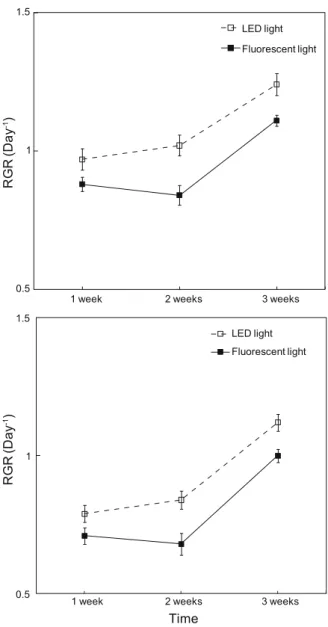
광조건에따른구멍갈파래의상대생장률
(RGR)
을살펴보면, LED
조명 배양 조건에서 체장 생장률은0.99-1.26 day
-1,
엽폭의생장률은0.8-1.13 day
-1로나타났으며,
일반광에서의Table 2. Ulva pertusa. Changes on length and width under two light system
Length (µm±SD) Width (µm±SD)
Fluorescent light LED light Fluorescent light LED light
0 1540.86± 455.72 1579.48± 378.52 202.18± 78.12 234.00± 82.98
1 week 2049.79± 622.48 2590.87± 703.61 356.77± 125.95 511.08± 201.82
2 weeks 2470.10± 698.20 3997.72± 1113.71 483.39± 177.30 889.71± 313.49
3 weeks 4910.76±1434.40 10548.12± 3461.10 1667.71± 583.53 3552.80±1349.26 Table 1. Indoor culture condition used to influence of temperature, light source, light intensity, photoperiod and culture medium
Temperature (℃) Light source Light intensity (µmol photons m-2s-1) Photoperiod (L:D) Medium Remark
17 Fluorescent lightLED light 35 10:14 ES aeration, triplicate
LED 조명을 이용한 구멍갈파래의 생장
573
체장과엽폭생장률은
0.89-1.11 day
-1, 0.72-1.01 day
-1로각각 조사되었다. LED
조명하에서는체장과엽폭의상대생장률이 전배양기간에걸쳐증가하는경향을나타내고있으나,
형광등 배양 조건에서는 배양2
주 후에 정체기를 나타내지만 이후 증가하는양상을보였다(Fig. 2).
고 찰
해조류의 생장과성숙은다양한환경조건
(
수온,
광,
영양염,
섭식,
경쟁)
의 영향을 받는 것으로 알려져 있으나(Lüning, 1990; Pizaro and Santelices, 1993),
그중수온과광이가장 중요한 제한 요인으로 밝혀져 있다(Druehl et al., 1987;
Vásquez and Vega, 2001).
광원이해조류의생장에미치는영향에 관한이전연구는단일파장을이용한실험이대부분이다. Mercada et al., (2002)
은 홍조류Gracilaria tenuistipitata
의 생장이 백색파장에서 증가한다고 보고 하였으나,
동일한 홍조류인Porphyra umbilicalis
와 지중해 연안에 생육하는 갈조류Cystoseira barbata
를대상으로 한연구에서는 청색파장에서 생장이증가하는것으로보고되었다(Baghdadli et al., 1994;
Figueroa et al., 1995).
즉,
단일파장에서도해조류종에따라 생장특성을달리한다고알려졌다.
본 연구에서는 파장에 따른 구멍갈파래의 생장 실험이 수행되지 않아어떤 파장이생장에중요하게 기여를하는지 확인하지 못하였다
.
그러나 온도,
광주기와 광량이 동일한 조건하에서, LED
조명을 사용한 실험구에서 배양1
주 후 형광등조건의엽체에비해체장은1.9
배,
엽폭은1.5
배크게 생장하는것으로나타났다.
또한, 2
주후의체장과엽폭은각각2.6
배, 2.0
배, 3
주후체장은1.7
배,
엽폭은1.2
배크게생장하는0 4000 8000 12000
0 1 week 2 weeks 3 weeks
Le ng th (μm )
Time
Fluorescent light LED light
0 1000 2000 3000 4000
0 1 week 2 weeks 3 weeks
W id th (μm)
Time
Fluorescent light LED light
0.5 1 1.5
1 week 2 weeks 3 weeks
R G R (D ay
-1) R G R (D ay
-1)
LED light Fluorescent light
0.5 1 1.5
1 week 2 weeks 3 weeks
Time
LED light Fluorescent light
0 4000 8000 12000
0 1 week 2 weeks 3 weeks
Le ng th (μm )
Time
Fluorescent light LED light
0 1000 2000 3000 4000
0 1 week 2 weeks 3 weeks
W id th (μm)
Time
Fluorescent light LED light
0.5 1 1.5
1 week 2 weeks 3 weeks
R G R (D ay
-1) R G R (D ay
-1)
LED light Fluorescent light
0.5 1 1.5
1 week 2 weeks 3 weeks
Time
LED light Fluorescent light
Fig. 1. Ulva pertusa. A variation of length and width under two light system. Bars are standard error (n=15).
Fig. 2. Ulva pertusa. The relative growth rate (RGR) of total length (A) and width (B) under two light system. Bars are standard error (n=15).
권천중
ㆍ
최창근574
것으로확인되어형광등조건에비해서
LED
조명이생장에더욱효율적이라는연구결과를얻을수있었다
.
가시광선과 자외선을 이용한 해조류 생장에 대한 연구결과에서,
구멍갈파래의어린 발아체는청색광에서 가장 효율적이라고 보고된바있다(Han et al., 2004).
본연구에사용된형광등과LED
조명은복수파장으로서모두청색파장을포함하고있다.
따라서,
이번 연구결과에서도 청색파장이 생장률에 영향을준것으로예상되며
, LED
조명내청색파장이구멍갈파래의광합성과정에긍정적작용을한것으로판단된다
.
본 연구는 녹조류 구멍갈파래를 이용하여 광원에 따른 해조류의 생장반응을 규명하기 위한연구로 해조류배양과 해조류종묘의대량생산시인공광원으로
LED
조명을적용 할수있는가에대한기초자료를제공하기위하여수행하였다.
추후에해조류를 대상으로 각각의개별 파장에대한 연구가 수행된다면,
새로운광원으로사용될수있는LED
가해조류의 생장과관련된다양한생리학적 기작을명확하게 설명할수 있을것으로기대된다.
사 사
이 논문은
LED-
해양융합기술연구센터의 지원에 의하여연구되었습니다
.
참고문헌
Baghdadli D, Tremblin G and Ducher D. 1994. The effect of light quality on growth, photosynthesis and development in cultivated thalli of
Cystoseria barbata
C. Ag. f.aurantia
(Kütz.) Giaccone (Phaeophyceae, Fucales). Bot Mar 37, 43- Barta DJ, Tibbitts TW, Bula RJ and Morrow RC. 1992. 50.Evaluation of light emitting diode characteristics for a space- based plant irradiation source. Adv Space Res 12, 141-149.
Beadle CL. 1993. Growth analysis. In: Photosynthesis and Production in a Changing Environment, a Filed and Laboratory Manual. Hall DO, Scurlock JMO, Bolhar- Nordenkampf HR, Leegood RC and Long SP (Eds.), Chapman Hall, London, U.K., 36-46.
Chen C, Saratale G, Lee C, Chen P and Chang J. 2008.
Phototrophic Hydrogen Production in Photobioreactors Coupled with Solar-energy-excited Optical Fibers.
International Journal of Hydrogen Energy 33, 6878-6885.
http://dx.doi.org/10.1016/j.ijhydene.2008.09.014.
Druehl LD, Cabot EL and Lloyd KE. 1987. Seasonal growth of
Laminaria groenlandica
as a function of plant age. Can J Bot 65, 1599-1604.Figueroa FL, Aguilera J and Niell FX. 1995. Red and blue light regulation of growth and photosynthetic metabolism in
Porphyra umbilicalis
(Bangiales, Rhodophyta). Eur J Phycol 30, 11-18.Gram LE, Gram JM and Wilcox LW. 2009. Algae (2ed.) Benjamin Cumming. New York. U.S.A., 616.
Han SO. 2008. Algae based energy materials. J Kor Soc New and Renewable Energy 4, 50-55.
Han T, Kong JA, Han YS, Kang SH and Häder DP. 2004. UV-A/
blue light-induced reactivation of spore germination in UV-B irradiated
Ulva pertusa
(Chlorophyta). J Phycol 40, 315- 322. http://dx.doi.org/10.1111/j.1529-8817.2004.03069.x.Heo JW, Lee CW and Paek KY. 2002. Characteristics of growth and flowering on some bedding plants grown in mixing fluorescent tube and light-emitting diode. Acta Hort 580, 77-82.
Kawai S, Watanabe H, Yoshino T, Tanaka F and Suzuki M.
1996. Light emitting diodes as the light source for plant growth regulators. Abs J Jap Hort Sci 454-455.
Lee CG and Palsson BO. 1994. High-Density Algal Photobioreactors Using Light-Emitting Diodes. Biotec and Bioeng 44, 1161-1167.
Lüning K. 1990. Seaweeds: Their Environment, Biogeography and Ecophysiology. Wiley Interscience, New York, U.S.A.
Mercado JM, Sánchez P, Carmona R and Niell FX. 2002.
Limited acclimation of photosynthesis the blue light in the seaweed
Gracilaria tenuistipitata.
Physiol Plant 114, 491- 498. http://dx.doi.org/10.1034/j.1399-3054.2002.1140319.x.Oh SJ, Park DS, Yang HS, Yoon YH and Hojo H. 2007.
Bioremediation on the Benthic Layer in Pollutied inner Bay by promotion of Microphytobenthos growth Using Light Emitting Diode (LED). J Kor Soc for Mar Environ Eng 10, 93-101.
Pizarro, A. and B. Santelices. 1993. Environmental variation and large scale
Gracilaria production. Hydrobiol. 260/261,
357-363.Rivkin RB. 1989. Influence of irradiance and spectral quality on the carbon metabolism of phytoplankton. I. Photosynthesis, chemical composition and growth. Mar Ecol Prog Ser 55, 291-304.
Rueness J and Tananger T. 1984. Growth in culture of four red algae form Norway with potential for mariculture.
Hydorobiol 116/117, 303-307.
Schmid R and Dring MJ. 1993. Rapid, blue-light-induced acidifications at the surface of
Ectocarpus
and other marine macroalgae. Plant Physiol 101, 907-913. http://dx.doi.org/10.1023/A:1011152922832.
Vásquez JA and Vega JMA. 2001.
Chondracanthus chamissoi
(Rhodophyta, Gigartinales) in northern Chile: ecological aspects for management of wild populations. J Appl Phycol 13, 267-277.Vesk M and Jeffrey SW. 1977. Effect of blue-green light on photosynthetic pigments and chloroplast structure in unicellular marine algae from six classes. J Phycol 13, 280- Wallen DG and Green GH. 1971. Light quality in relation to 288.
growth, photosynthetic rates and carbon metabolism in two species of marine plankton algae. Mar Biol 10, 34-43.
West JA and McBride DL. 1999. Long-term and diurnal carpospore discharge patterns in the Ceramiaceae, Rhodomelaceae and Delesseriaceae (Rhodophyta). Hydrobiol 298/299, 101-113.