한국산 잡곡류의 이화학적 특성과 항산화활성
⁃연구노트⁃
이하규1․황인국1․김현영1․우관식2․이성희3․우선희4․이준수1․정헌상1†
1충북대학교 식품공학과, 2농촌진흥청 기능성작물부
3괴산군 농업연구소, 4충북대학교 식물자원학과
Physicochemical Characteristic and Antioxidant Activites of Cereals and Legumes in Korea
Ha Kyu Lee1, In Guk Hwang1, Hyun Young Kim1, Koan Sik Woo2, Seong Hee Lee3, Seon Hee Woo4, Junsoo Lee1, and Heon Sang Jeong1†
1
Dept. of Food Science and Technology, Chungbuk National University, Chungbuk 361-763, Korea
2
National Institute of Crop Science, RDA, Gyeongnam 627-803, Korea
3
Goesan Agricultural Technology and Extension Cnter, Chungbuk 367-863, Korea
4
Dept. of Crop Science, Chungbuk National University, Chungbuk 361-763, Korea
Abstract
Physicochemical characteristics and antioxidant activities of twelve varieties of legumes and cereals in Korea were analyzed and compared. Crude protein content was higher in legumes (20.60~34.47%) than in cereals (8.96
~15.45%). Crude fat contents of soybean (17.73%) and black soybean (18.79%) were higher than other legumes (0.68~1.38%) and cereals (1.01~5.39%). The major minerals were potassium, calcium and sodium, and especially calcium and potassium were high in legumes. Unsaturated fatty acids composition ranged from 66.79% in cowpea to 85.14% in soybean, and Ω-3 fatty acids (linolenic acid) content was higher of 7.47~48.25% in legumes than 0.36~3.71% in cereals. Total polyphenol content was higher 1.32~4.15 mg/g in 80% EtOH extracts from legumes than 0.53~2.83 mg/g in cereals. DPPH and ABTS radical scavenging activities were high values of 62.60%
and 264.20 mg AA eq/g, respectively, in EtOH extract from sorghum.
Key words: minor cereal, legume, cereal, physicochemical characteristic, antioxidant activity
†Corresponding author. E-mail: [email protected]
†Phone: 82-43-261-2570, Fax: 82-43-271-4412
서 론
잡곡은 식량작물 중 백미와 찹쌀을 제외한 보리, 율무, 콩, 조, 기장, 수수, 옥수수 등을 말하며, 쌀과 비교하여 열등 작 물로서 여겨져 왔으나, 잡곡에는 비타민, 무기질 및 식이섬 유가 쌀의 2~3배 정도 많고 기타 다양한 생리활성물질이 다량 함유되어있어 건강을 유지시키는 보조식량으로서의 역할이 중요시되고 있다(1).
잡곡에 대한 연구는 옥수수의 생리활성 연구(2), 조의 정 장작용 및 불면증 치료작용 연구(3), 보리의 혈중 콜레스테 롤 저하 효과와 간의 콜레스테롤 축적억제 및 수용성 β- glucan 연구(4,5), 율무의 항암성분인 coixenolide 연구(6)와 혈당강하 성분인 coixans A, B 및 C 연구(7)가 진행되었으 며, 수수의 탄닌과 페놀성분에 대한 항산화작용 및 색소의 항암작용(8) 등 다양한 연구가 진행되었다. 또한 기장은 지 방질과 비타민 A 등이 많고 지사, 빈혈과 객풍을 억제한다고
알려져 있으며(9), 대두는 필수아미노산이 다량 함유되어 있 고 리놀레산과 비타민 E도 충분히 들어있어 동물성 지방의 과잉섭취로 인한 콜레스테롤을 낮추어 동맥경화증의 예방 및 치료 효과가 보고되었다(10,11). 또한 녹두의 피부질환 및 미백효과(12), 팥의 각기와 피로회복 효과 및 아미노산 보족효과(13), 흑태 안토시아닌의 항산화 효과(14,15), 강낭 콩의 항암 효과(16,17) 등이 보고되었다. 이렇듯 잡곡류의 생리활성에 관한 다양한 연구가 보고되었지만, 국내에서 생 산되는 잡곡류의 이화학적 특성 및 항산화 활성에 관한 체계 적인 연구는 부족한 실정이다.
따라서 본 연구에서는 국내에서 재배되는 수종의 잡곡 에 대한 일반성분 함량과 항산화성분인 총 폴리페놀과 플 라보노이드 함량 그리고 항산화 활성을 조사하여 잡곡을 이용한 기능성식품 개발을 위한 기초자료로 제공하고자 하 였다.
재료 및 방법
재료 및 처리방법
본 연구에서 사용된 찰옥수수(Zea mays L., Waxy-Corn), 차조(Setaria italica L. Beauv, Italian millet), 수수(Sor-
ghum bicolor (L.) Moench, Sorghum), 율무쌀(Coix la- cryma-jobi L. var. mayuen Stapf, Adlay), 기장(Panicum miliaceum L., Common millet), 보리쌀(Hordeum vulgare
var. nudum Spenn, Barley), 대두(Glycine max (L.) Merr, Soybean), 녹두(Phaseolus radiatus L., Mung bean), 팥 (Phaseolus angularis (Willd.) W.F.Wight, Red bean), 흑태 (Glycine max (L.) Merr., Black soybean), 동부(Vignaunguiculata (L.) Walp, Cowpea), 강낭콩(Phaseolus vul- garis L., Kidney bean)은 충북 괴산지역에서 생산된 것을
농가에서 구매 후 세척하여 분쇄기(Micro hammer cutter mill type-3, Culatti AG, Zurich, Swiss)로 100 mesh로 분쇄 하여 밀봉용기에 담아 냉장실에 저장하면서 시료로 사용하 였다. 항산화 물질 함량 및 항산화 활성 측정을 위하여 분쇄 된 시료 2 g에 80% EtOH 100 mL을 가하여 80oC 수욕조에 1시간 3반복 추출한 후 감압 여과하였다. 여과된 추출물은 회전 진공농축기(N-1000, EYELA, Tokyo, Japan)를 이용 하여 40oC에서 감압 농축하여 용매를 완전히 제거한 후 동결 건조(FD-5508, Ilshin Lab Co., Seoul, Korea)하여 항산화 활성 및 특성분석에 사용하였다.일반성분 분석
일반성분은 AOAC 방법(18)에 따라 분석하였다. 즉, 수분 은 105oC 상압건조법, 조단백질은 semi-micro Kjeldahl 법, 조지방은 soxhlet 법, 조회분은 550oC 직접 회화법으로 측정 하였다. 무기성분 함량은 건식법으로 측정하였다. 즉, 시료 1 g을 550oC에서 회화한 후 0.5 N HNO3을 넣고 GF/C(90 mm, Cat No. 1822 090, Whatman International Ltd., Maid- stone, England) 여과지로 여과한 다음 0.5 N HNO3 50 mL로 정용하여 Inductively Coupled Plasma Spectrometer(ICP, Thermo Jarrell Ash, Franklin, MA, USA)로 분석하였다.
지방산 분석
지방산 조성은 Lee 등(19)의 유채 표준지방산 분석법에 준하여 분석하였다. 추출된 지방 50 μL를 취하여 15 mL vial 에 넣고 35% 3 N HCl/methanol 용액과 45% methanol을 혼합한 반응시약 4 mL을 첨가하여 60oC 수욕조에서 30분간 반응시킨 다음 n-hexane 2 mL을 첨가한 후 교반하였다.
0.88% NaCl 1 mL을 가하여 층 분리시킨 후 원심분리 하여 상등액 일정량을 취하여 GC(Agilent 6850, Agilent Techn- ologies, Wilmington, NC, USA)로 분석하였다. Column은 HP-Innowax 19091N-133(0.25 μm i.d.×30 m, Agilent Technologies)을 사용하였고, column 온도는 120oC에서 1분 간 유지 후 250oC까지 1분당 10oC 승온하여 5분간 유지하였
다. Injection 온도는 270oC, detector 온도는 280oC로 하였으 며, carrier gas는 N2를 1.8 mL/min로 흘려주었다.
항산화 물질 함량 측정
총 폴리페놀 함량은 Dewanto 등(20)의 방법에 따라 Folin- Ciocalteu reagent가 80% 에탄올 추출물의 폴리페놀성 화합 물에 의해 환원된 결과 몰리브덴 청색으로 발색하는 것을 원리로 분석하였다. 즉, 각 추출물 100 μL에 2% Na2CO3 용 액 2 mL를 가한 후 3분간 방치하고 50% Folin-Ciocalteu reagent 100 μL를 가한 후 30분 반응한 다음 반응액의 흡광 도 값을 750 nm에서 측정하였다. 표준물질로 garlic acid (Sigma Chemical Co., St. Louis, MO, USA)를 사용하여 검 량선을 작성하였으며, 시료의 무게 g 중의 mg garlic acid로 나타내었다. 총 플라보노이드 함량은 Choi 등(21)의 방법에 따라 에탄올 추출물 250 μL에 증류수 1 mL과 5% NaNO2
375 μL를 가한 다음 5분 후 10% AlCl3․6H2O 150 μL를 가하 여 6분간 방치하고 1 N NaOH 500 μL를 가하였다. 11분 후 반응액의 흡광도 값을 510 nm에서 측정하였고, 표준물질로 (+)-catechin hydrate(Sigma Chemical Co.)를 사용하여 구 한 검량선으로부터 시료의 무게 g 중의 mg catechin으로 나타내었다.
항산화 활성 측정
전자공여능(Electron donating ability, EDA)은 Blois(22) 의 방법을 변형하여 측정하였다. 즉, 80% 에탄올 추출물 0.2 mL에 0.2 mM 1,1-diphenyl-2-picrylhydrazyl(DPPH, Sig- ma-Aldrich, St. Louis, MO, USA) 용액 0.8 mL를 가하고 잘 혼합한 후 실온에서 30 분간 방치한 후 520 nm에서 흡광 도를 측정하였다. 전자공여능은 시료첨가구와 비첨가구의 흡광도 차이를 백분율로 구하였다. 총 항산화력은 ABTS cation decolorization assay 방법(20)에 따라 측정하였다.
2,2'-Azino-bis-3-ethylbenzothiazoline-6-sulfonic acid (ABTS, Sigma-Aldrich) 7.4 mM과 potassium persulphate 2.6 mM을 하루 동안 암소에 방치하여 ABTS․+ 이온을 형 성시킨 후 이 용액을 735 nm에서 흡광도 값이 1.4~1.5가 되도록 몰 흡광계수(ε=3.6×10⁴ M-1cm-1)를 이용하여 증류 수로 희석하였다. 희석된 ABTS 용액 1 mL에 추출액 50 μL를 가하여 흡광도의 변화를 정확히 90분 후에 측정하였으 며, 표준물질로서 L-ascorbic acid(Sigma-Aldrich)를 동량 첨가하였고, 총 항산화력은 AEAC(L-ascorbic acid equiv- alent antioxidant capacity, mg AA eq/g)로 표현하였다.
통계분석
통계분석은 SPSS 통계프로그램(Statistical Package for the Social Science, Ver. 12.0 SPSS Inc., Chicago, IL, USA) 을 이용하여 각 측정군의 평균과 표준편차를 산출하고 시료 간의 차이 유무를 one-way ANOVA(Analysis of variation) 로 분석한 뒤 Duncan's multiple range test를 이용하여 유의 성을 검정하였다.
Table 1. Proximate compositions of cereals and legumes in Korea
Varieties Moisture (%) Crude protein (%) Crude fat (%) Crude ash (%)
Waxy-corn Italian millet Sorghum Adlay
Common millet Barley
12.21±0.191)ef2) 13.33±0.01gh 13.23±0.04gh 10.27±0.38b 12.61±0.02fg 11.75±0.03def
10.55±0.35ab 8.96±0.45a 10.98±0.51b 15.45±0.12c 11.87±0.37b 9.07±0.52a
4.50±0.11e 3.29±0.15d 2.64±0.02c 5.39±0.23f 2.14±0.16c 1.01±0.06ab
1.53±0.05d 1.25±0.01c 1.13±0.10c 1.67±0.04d 0.83±0.18b 0.63±0.10a Soybean
Mung bean Red bean Black soybean Cowpea Kidney bean
9.11±1.43a 11.82±0.03def 13.74±0.04h 10.36±0.00bc 11.35±0.09cde 10.98±0.20bcd
34.47±1.63e 22.23±1.07d 21.12±1.62d 34.10±0.01e 21.52±0.10d 20.60±0.02d
17.73±0.25g 0.89±0.20ab 0.68±0.41a 18.79±0.38h 1.38±0.20b 1.21±0.30ab
4.69±0.10h 3.57±0.08f 3.22±0.01e 5.13±0.07i 3.15±0.03e 3.86±0.01g
1)Mean±SD.
2)Any means in the same column followed by the different superscripts are significantly different (p<0.05) by Duncan's multiple range test.
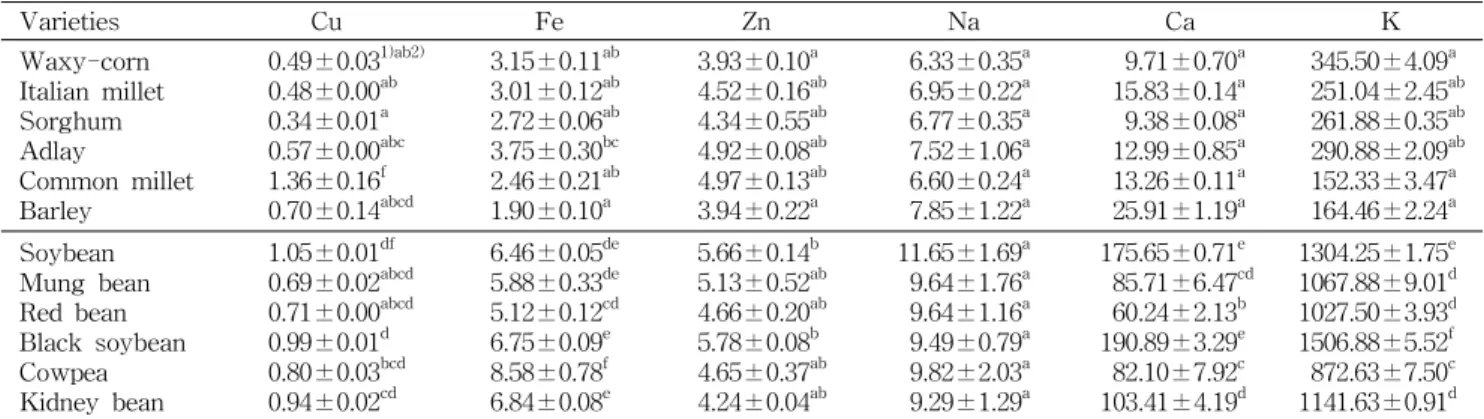
Table 2. Mineral elements of cereals and legumes in Korea (mg/100 g)
Varieties Cu Fe Zn Na Ca K
Waxy-corn Italian millet Sorghum Adlay
Common millet Barley
0.49±0.031)ab2) 0.48±0.00ab 0.34±0.01a 0.57±0.00abc 1.36±0.16f 0.70±0.14abcd
3.15±0.11ab 3.01±0.12ab 2.72±0.06ab 3.75±0.30bc 2.46±0.21ab 1.90±0.10a
3.93±0.10a 4.52±0.16ab 4.34±0.55ab 4.92±0.08ab 4.97±0.13ab 3.94±0.22a
6.33±0.35a 6.95±0.22a 6.77±0.35a 7.52±1.06a 6.60±0.24a 7.85±1.22a
9.71±0.70a 15.83±0.14a 9.38±0.08a 12.99±0.85a 13.26±0.11a 25.91±1.19a
345.50±4.09a 251.04±2.45ab 261.88±0.35ab 290.88±2.09ab 152.33±3.47a 164.46±2.24a Soybean
Mung bean Red bean Black soybean Cowpea Kidney bean
1.05±0.01df 0.69±0.02abcd 0.71±0.00abcd 0.99±0.01d 0.80±0.03bcd 0.94±0.02cd
6.46±0.05de 5.88±0.33de 5.12±0.12cd 6.75±0.09e 8.58±0.78f 6.84±0.08e
5.66±0.14b 5.13±0.52ab 4.66±0.20ab 5.78±0.08b 4.65±0.37ab 4.24±0.04ab
11.65±1.69a 9.64±1.76a 9.64±1.16a 9.49±0.79a 9.82±2.03a 9.29±1.29a
175.65±0.71e 85.71±6.47cd 60.24±2.13b 190.89±3.29e 82.10±7.92c 103.41±4.19d
1304.25±1.75e 1067.88±9.01d 1027.50±3.93d 1506.88±5.52f 872.63±7.50c 1141.63±0.91d
1)Mean±SD
2)Any means in the same column followed by the different superscripts are significantly different (p<0.05) by Duncan's multiple range test.
결과 및 고찰
일반성분 및 무기성분 함량
잡곡의 일반성분인 수분, 조단백질, 조지방 및 조회분 함 량을 분석한 결과는 Table 1과 같다. 잡곡의 수분 함량은 9.11~13.74% 범위로 일반 곡류의 저장에 적합한 함량을 보 였으며, 곡류의 조단백질 함량은 차조 8.96%에서 율무쌀 15.45% 범위로 율무쌀이 가장 높은 함량을 보였으며, 두류 는 20.60~34.47% 범위로 대두가 가장 높은 함량을 나타내 었다. 조지방 함량은 두류의 대두와 흑태가 각각 17.73 및 18.79%로 높은 함량을 나타내었고 그 밖의 곡류는 1.01~
5.39% 그리고 두류는 0.68~1.38% 범위로 낮은 값을 나타내 었으며, 식품성분표(23)와 유사한 값을 나타내었다. 무기성 분은 구리, 철, 아연, 나트륨, 칼슘 및 칼륨 6종이 검출되었으 며, 곡류에 비하여 두류에서 대체적으로 높은 함량을 나타내 었다(Table 2). 곡류 중 구리는 0.34(수수)~1.36 mg/100 g (기장) 범위로 분포하였으며, 두류는 0.69~1.05 mg/100 g 범위로 대두가 가장 높은 함량을 나타내었다. 철은 보리의 1.90에서 동부의 8.58 mg/100 g 범위로 두류인 동부가 가장
높은 함량을 나타내었고, 아연은 3.93~5.78 mg/100 g 범위 로 분석되었다. 나트륨은 6.33~11.65 mg/100 g 범위로 대두 가 가장 높은 함량을 보였다. 칼슘은 곡류에서는 9.38~25.91 mg/100 g 범위로 보리가 가장 높았으며, 두류에서는 60.2 4~190.89 mg/100 g 범위로 흑태가 가장 높았고 곡류보다 2~7배 이상 높은 함량을 나티내었다. 칼륨은 곡류에서는 152.33~345.50 mg/100 g 범위이었으며, 두류는 872.63~
1506.88 mg/100 g 범위로 곡류보다 두류에 많이 함유되어 있었다.
지방산 조성
잡곡의 지방산조성을 분석한 결과는 Table 3에서 보는 바와 같이 주요 지방산은 불포화지방산으로 전체 지방의 66.79~85.14% 범위를 차지하고 있었으며, 대부분은 linoleic acid(C18:2)가 가장 높은 함량비를 나타내었고 강낭콩의 23.74%에서 차조의 64.60% 범위에 분포하였다. 그러나 율무 쌀은 oleic acid(C18:1)가 49.98%로 가장 높았으며, 강낭콩은 linolenic acid(C18:3)가 48.25%로 가장 높은 함량비를 나타 내었다. Ω-3 지방산인 linolenic acid(C18:3) 함량은 곡류에
Table 3. Fatty acid compositions of cereals and legumes in Korea (Unit: %)
Varieties Waxy
corn
Italian
millet Sorghum Adlay Common
millet Barley Soy bean
Mung bean
Red bean
Black soy bean
Cowpea Kidney bean Caprylic acid (C8:0)
Capric acid (C10:0) Myristic acid (C14:0) Palmitic acid (C16:0) Stearic acid (C18:0) Arachidic acid (C20:0) Behenic acid (C22:0) Lignoceric acid (C24:0)
0.09 3.44 0.04 14.39 1.36 0.64 ND1) ND
0.11 3.20 0.02 7.77 3.71 1.38 0.44 ND
0.12 2.99 ND 12.78 1.61 0.26 ND ND
0.04 2.92 0.02 12.84 1.39 0.25 0.06 ND
0.06 1.63 0.04 11.41 1.27 0.44 0.30 ND
0.19 3.15 ND 23.01 2.19 ND ND ND
ND 2.22 0.06 10.04 1.93 0.29 0.32 ND
0.14 2.35 0.14 20.69 4.69 1.47 1.17 0.65
0.14 1.93 0.12 19.83 3.09 0.72 1.57 1.12
ND 2.40 0.06 11.27 2.21 0.29 0.33 ND
0.22 2.87 0.08 19.54 2.85 1.22 4.34 2.11
0.20 2.53 0.09 9.14 1.62 0.55 0.72 0.53 Saturates 19.95 16.64 17.77 17.52 15.16 28.54 14.86 31.31 28.53 16.56 33.21 15.39 Palmitoleic acid (C16:1)
Oleic acid (C18:1)
0.38 31.70
0.14 15.48
0.33 39.21
0.37 49.98
0.35 24.18
ND 16.40
0.54 25.29
0.43 18.80
ND 8.53
ND 29.48
0.36 15.20
0.20 12.42 Monoenes 32.08 15.62 39.53 50.35 24.53 16.40 25.83 19.23 8.53 29.48 15.56 12.62 Linoleic acid (C18:2)
Linolenic acid (C18:3)
46.87 1.09
64.60 3.13
40.99 1.70
31.78 0.36
59.36 0.96
51.35 3.71
50.31 9.00
32.45 17.01
39.46 23.49
46.48 7.47
26.10 25.13
23.74 48.25 T-polyenes 47.97 67.73 42.69 32.13 60.32 55.06 59.31 49.47 62.94 53.96 51.23 71.99
1)Not detected.
Table 4. Total polyphenol and flavonoid contents, and antioxidant activities of 80% EtOH extracts from cereals and legumes in Korea
Varieties Polyphenol (mg/g) Flavonoid (mg/g) DPPH2) (%) AEAC3) (mg AA eq/g) Waxy-corn
Italian millet Sorghum Adlay
Common millet Barley
1.43±0.021)f4) 0.58±0.01a 2.83±0.04h 0.78±0.02b 0.53±0.01a 1.23±0.01c
0.33±0.02bc 0.36±0.00c 2.08±0.03f 0.17±0.00a 0.13±0.04a 0.29±0.01b
10.65±0.46d 6.36±0.92b 62.60±1.09i 7.05±1.07b 1.47±0.66a 24.79±0.24f
59.51±2.19b 21.38±5.40a 264.20±1.35f 18.90±3.58a 6.69±1.30a 65.96±4.69b Soybean
Mung bean Red bean Black soybean Cowpea Kidney bean
3.01±0.06i 2.45±0.04g 4.15±0.02l 3.46±0.06k 1.32±0.10d 3.33±0.01j
2.03±0.04f 0.93±0.00e 4.20±0.06i 2.69±0.02h 0.73±0.01d 2.52±0.05g
0.44±0.27a 16.01±0.81e 37.93±1.23g 23.86±0.05f 9.03±0.54c 42.27±0.47h
118.85±9.70c 184.27±6.82d 226.98±9.93e 186.15±8.15d 124.06±4.70c 193.20±6.63d
1)Mean±SD. 2)DPPH radical scavenging activity. 3)ABTS radical scavenging activity.
4)Any means in the same column followed by the different superscripts are significantly different (p<0.05) by Duncan's multiple range test.
서 0.36~3.71% 범위로 보리가 가장 높았으며, 두류에서는 7.47~48.25%로 강낭콩이 가장 높았다. 포화지방산은 곡류 및 두류 모두 palmitic acid(C16:0)가 가장 높았으며, 그 다음 으로는 capric acid(C10:0)와 stearic acid(C18:0)가 높았다.
찰옥수수의 지방산함량을 분석한 Soh 등(24)의 연구와 마찬 가지로 본 연구에서도 oleic acid와 linoleic acid가 주요한 지방산으로 나타났으며, 두류에 대한 지방산조성도 Lee 등 (25)의 결과와 유사하였고 그 밖의 차조, 수수 및 기장 모두 식품성분표(23)의 결과와 유사하였다.
항산화물질 함량
잡곡의 80% 에탄올 추출물에 대한 총 폴리페놀 함량 측정 결과는 Table 4에서 보는 바와 같이 곡류에서는 수수의 에탄 올 추출물이 2.83 mg/g으로 가장 높게 나타났으며, 기장이 0.53 mg/g으로 가장 낮게 나타났다. 두류에서는 팥의 에탄
올 추출물이 4.15 mg/g으로 가장 높았고 동부가 1.32 mg/g 으로 가장 낮게 나타났다. 곡류 및 두류 모두 종피의 색이 붉거나 검은 색을 많이 가진 품종의 에탄올 추출물이 높은 총 폴리페놀 함량을 나타내었다. 플라보노이드 함량은 곡류 에서는 수수의 에탄올 추출물이 2.08 mg/g으로 다른 품종에 비해 높은 함량을 나타내었으며, 두류에서는 팥이 4.20 mg/g으로 높았고 총 폴리페놀 함량과 마찬가지로 유색품종 에서 높게 나타났다. Seo 등(26)의 연구에서도 찰옥수수의 폴리페놀의 함량은 색의 유무에 따라 많은 차이가 난다고 하였으며, 본 실험 결과와 여러 가지 시료의 폴리페놀 함량 을 측정한 연구 결과와는 차이를 보였으나 시료의 품종, 숙 성시기, 껍질 색깔, 실험절차, 표준물질, 추출방법 등에 따라 분석치 간의 차이가 크므로 총 폴리페놀 함량의 단순한 비교 는 적합하지 않다고 하였다(27).
항산화 활성
DPPH radical 소거능으로 표현된 항산화 활성을 2 mg/mL 농도에서 측정한 결과는 Table 4에서 보는 바와 같이 곡류에 서는 수수의 80% 에탄올 추출물이 62.60%로 가장 높았으며, 그 다음으로는 보리쌀이 24.79%로 높았고 그 밖의 곡류에서 는 10.65~1.47% 범위의 낮은 항산화 활성을 나타내었다.
두류 에탄올 추출물에서는 강낭콩과 팥이 각각 42.27 및 37.93%로 높았으며, 콩은 0.44%로 낮은 항산화 활성을 나타 내었다. ABTS 라디칼 소거능으로 표현된 총 항산화력은 수수의 에탄올 추출물에서 264.20 mg AA eq/g으로 가장 높은 총 항산화활성을 보였으며 그 밖의 곡류는 6.69~65.96 mg AA eq/g 범위의 활성을 나타내었다. 이러한 결과는 Kwak 등(28)이 보고한 항산화 활성은 수수가 가장 높고 그 다음으로 기장, 율무였다는 연구결과와 유사하였다. 두류의 경우 118.85~226.98 mg AA eq/g 범위로 팥의 에탄올 추출 물이 가장 높았고 그 다음으로는 강낭콩, 흑태, 녹두 순이었 다. 두류에 대한 항산화활성을 분석한 Chang 등(29)의 연구 에서도 강낭콩, 팥, 흑태 등이 높아다는 결과와 유사하였다.
폴리페놀 함량과 항산화 활성 간에 비례관계가 나타나지 않 은 것은 폴리페놀뿐만 아니라 안토시아닌계 색소, 토코페롤, 및 그 밖의 성분들에 의한 상승효과에 기인된 것으로 판단된 다(30).
요 약
잡곡의 이용 증진을 위하여 국산 잡곡 12종에 대한 이화학 적 특성 및 항산화 활성을 분석한 결과는 다음과 같다. 조단 백질 함량은 두류(20.60~34.47%)가 곡류(8.96~15.45%)에 비하여 높았으며, 조지방 함량은 대두와 흑태에서 각각 17.73 및 18.79%로 높았으며 그 밖의 잡곡류에서는 0.68~5.39%
범위였다. 잡곡의 주요 무기성분은 칼륨, 칼슘 및 나트륨 등 이었으며, 특히 두류에서 칼슘 및 칼륨 함량이 높았다. 지방 산 조성은 불포화지방산이 66.79~84.84%로 많았으며, Ω-3 지방산(linolenic acid) 함량은 두류에서 7.47~48.25% 범위 로 곡류의 0.36~3.71%보다 높았다. 총 폴리페놀과 플라보 노이드 함량은 두류의 80% 에탄올 추출물이 곡류보다 많았 으며, DPPH 및 ABTS radical 소거능은 수수의 에탄올 추출 물이 2 mg/mL의 농도에서 각각 62.60% 및 264.20 mg AA eq/g으로 가장 우수하였으며, 강낭콩 및 팥에서 높은 항산화 활성을 나타내었다. 이와 같은 잡곡별 성분함량 및 항산화 활성 결과는 기능성식품 개발을 위한 자료로서 활용될 수 있으리라 생각된다.
감사의 글
본 연구는 농촌진흥청 지역농업 특성화기술개발과제(과 제번호: 20090101-054-044-001-01-00)의 연구비 지원에 의
하여 연구되었으며 이에 감사드립니다.
문 헌
1. Kim YS, Lee GC. 2006. A survey on the consumption and satisfaction degree of the cooked rice mixed with mul- ti-grain in Seoul. Kyeonggi and Kangwon area. Korean J
Food Culture 21: 661-669.
2. Park CH, Park CG, Jang GJ, Choi YS. 2008. Science and
culture of micellaneous grain. Kangwon National Universi-
ty Publishing Department, Chuncheon, Korea. p 53-147.3. Hyun YH. 2000. Food material. Hyungseul publish, Seoul, Korea. p 47-56.
4. Jeong HS, Lee SY, Park NK, Hur HS, Min YK. 1998.
Isolation and concentration technique of β-glucan for de- velopment of functional foods. RDA J Agi Sci 40: 81-87.
5. Quershi A, Burger WC, Prentice N, Bird HR, Sunde ML.
1980. Regulation of lipid metabolism in chick liver by diet- ary cereals. J Nutr 110: 388-393.
6. Tanimura A. 1961. Studies on the anti-tumor component in the seeds of Coix lachryma-jobi L. var. ma-yuen (Roman) Stapf. II. The structure of coixenolide. Chem Phar Bull 9:
45- 53.
7. Takahashi M, Konno C, Hikino H. 1986. Isolation and hypo- glycemic activity of coixans, A, B and C glycans of Coix
lachryma-jobi L. var. ma-yuen seeds. Planta Med 52: 64-65.
8. Dykes L, Rooney LW. 2006. Sorghum and millet phenols and antioxidants. J Cereal Sci 44: 236-251.
9. Ahn DK. 1998. Illustrated book of Korean medicinal herbs.
Kyohak Publishing Co., Ltd., Seoul, Korea. p 887.
10. Kim YH. 2003. Biological activities of soyasaponins and their genetic and environmental variations in soybean.
Korean J Crop Sci 48: 49-57.
11. Hawrylewicz EJ, Zapata JJ, Blair WH. 1995. Soy and ex- perimental cancer: Animal studies. J Nutr 125: 698-708.
12. Noh MJ, Kwon JH, Byun MW. 2001. Water-soluble compo- nents of small red bean and mung bean exposed to gamma irradiation and methyl bromide fumigation. Korean J Food
Sci Technol 33: 184-189.
13. Chang HG. 1999. Information on Food for the Health of
Modem People. Shinkwang Publishing Co., Seoul, Korea.
p 45-50.
14. Francis FJ. 1984. Future trends. In Developments in Food
Colors-2. Walford J, ed. Applied Science Publishers, New
York, USA. p 233-247.15. Tsuda T, Shiga K, Ohshima K, Kawakishi S, Osawa T.
1996. Inhibition of lipid peroxidation and the active oxygen radical scavenging effect of anthocyanin pigments isolated from Phaseolus vulgaris L. Biochem Pharmacol 52: 1033- 1039.
16. Peumans WJ, Van Damme EJM. 1998. Recent advances in the purification and characterization of plant lectins. In
COST 98: Effects of Antinutrients on the Nutritional value of Legume Diets. Bardocz S, Gelencser E, Pusztai A, eds.
European Commission, Brussels, Belgium. Vol 1, p 1-7.
17. Pusztai A. 1991. Lectins and their specificity. In Plant
lectins. Pusztai A, ed. Cambridge University Press, Cam-
bridge, UK. p 3-31.18. AOAC. 1995. Official methods of analysis. 16th ed. Associa- tion of Official Analytical Chemists, Washington, DC, USA.
4:17, 32:21,22,32.
19. Lee JI, Kye BM. 1970. Effect of oil quality by extracting hour on rape. Res Rept RDA (CP) 13: 89-94.
20. Dewanto V, Wu X, Liu RH. 2002. Processed sweet corn
has higher antioxidant activity. J Agric Food Chem 50:
4959-4964.
21. Choi Y, Kim MH, Shin JJ, Park JM and Lee J. 2003. The antioxidant activities of the some commercial teas. J Korean
Soc Food Sci Nutr 32: 723-727.
22. Blois MS. 1958. Antioxidant determinations by the use a stable free radical. Nature 181: 1199-1203.
23. National Rural Living Science Institute, R.D.A. 2001. Food
Composition Table. 6th revision. p 14-74.
24. Soh HS, Lee SP, Ha YD. 2002. Total lipid content and fatty acid composition in Setaria italica, Panicum miliaceum and
Sorghum bicolor. J East Asian Soc Dietary Life 12: 123-
128.25. Lee IB, Choi KJ, Yu KK, Chang KW. 1992. Tocopherols and fatty acids in plant seeds from Korea. J Korean Agric
Chem Soc 35: 1-5.
26. Seo YH, Kim IJ, Yie AS, Rhee HI, Min HK. 1999. Genetic
analysis of fatty acid composition in waxy corn. Korea J
Breed 31: 63-69.
27. Lee JH, Lee SR. 1994. Analysis of phenolic substances con- tent in Korean plant foods. Korean J Food Sci Technol 26:
310-316.
28. Kwak CH, Lim SJ, Kim SA, Park SC, Lee MS. 2004. Anti- oxidative and antimutagenic effects of Korean buckwheat, sorghum, millet and Job's tears. J Korean Soc Food Sci
Nutr 33: 921-927.
29. Chang SM, Nam SH, Kang MY. 2002. Biological activ- ity/nutrition: Screening of the antioxidative activity, anti- mutagenicity and mutagenicity of the ethanolic extracts from Legumes. Korean J Food Sci Technol 34: 1115-1122.
30. Kim SH, Kwon TW, Lee YS, Choung MG, Moon GS. 2005.
A major antioxidantive components and comparison of an- tioxidative activities in black soybean. Korean J Food Sci
Technol 37: 73-77.
(2010년 6월 7일 접수; 2010년 7월 9일 채택)