http://dx.doi.org/10.5229/JKES.2013.16.4.204
− 204 −
Development of Pore-filled Ion-exchange Membranes for Efficient All Vanadium Redox Flow Batteries
Moon-Sung Kang*
Department of Environmental Engineering, Sangmyung University, Cheonan 330-720, Korea (Received November 15, 2013 : Accepted November 19, 2013)
Abstract : Thin pore-filled cation and anion-exchange membranes (PFCEM and PFAEMs, t
m= 25-30 µ m) were prepared using a porous polymeric substrate for efficient all-vanadium redox flow battery (VRB). The electrochemical and charge-discharge performances of the mem- branes have been systematically investigated and compared with those of commercially avail- able ion-exchange membranes. The pore-filled membranes were shown to have higher permselectivity as well as lower electrical resistances than those of the commercial membranes.
In addition, the VRBs employing the pore-filled membranes exhibited the respectable charge- discharge performances, showing the energy efficiencies ( EE) of 82.4% and 84.9% for the PFCEM and PFAEM, respectively ( cf. EE = 87.2% for Nafion 1135). The results demonstrated that the pore-filled ion-exchange membranes could be successfully used in VRBs as an efficient separator by replacing expensive Nafion membrane.
Keywords : Pore-filled, Cation and anion-exchange membranes, All-vanadium redox flow battery, Charge-discharge performances
1. Introduction
Recently, large-scale energy storage systems have been attracting great attention because they are one of the essential components of the smart grid for a stable electricity supply. Especially, redox flow bat- tery (RFB) is known as one of very promising large- scale energy storage batteries.
1-3)The main feature of this system is the use of active electrode materials dissolved in a solution, and therefore it can offer several advantages such as very fast electrode reac- tion, unlimited system design for high power and capacity, instant and fast recharging by replacing the spent electrolytes and so on.
1-3)There are a variety of redox couples which can be used in flow batter- ies, and, for example, all-vanadium redox flow bat- tery (VRB), which is the most widely used, is a type of rechargeable flow battery that employs vana- dium ions in different oxidation states as the active electrode materials.
1-5)Since a membrane is one of
the most important components dominating the charge-discharge performances in a RFB system, the development of highly efficient membranes is very essential for successful application of RFBs.
2,4)In a RFB system, both cation- and anion-exchange mem- branes can be used for the separation between anolyte and catholyte. Especially, cation-exchange membranes with high proton permeability such as Nafion have been most widely utilized in VRB sys- tems.
6)Meanwhile, since the cation-exchange mem- branes intrinsically cannot prevent the crossover of cationic redox species through the membrane and the use of highly expensive membranes such as Nafion causes the increase in the system cost.
4,7)Recently, therefore, anion-exchange membranes are being inves- tigated and developed for RFB applications due to their cost-effectiveness and relatively low crossover of active electrode materials.
4,8-13)As suggested by Vijayakumar et al., moreover, the irreversible mem- brane fouling degrading the ion-exchange capacity is possibly originated from the charge interaction between positively charged redox materials and nega- tively charged sulfonic acid groups in cation-
*E-mail: [email protected]
exchange membranes.
14)In this respect, the use of anion-exchange membranes with positively charged groups seems to be more advantageous for long-term operation.
Among various types of ion-exchange membranes, a pore-filled membrane (PFM) is known to possess extraordinary properties such as high dimensional and chemical stabilities.
15,16)The PFMs composed of a chemically inert and mechanically tough porous sub- strate and a polymer with ion-exchange groups (i.e.
ionomers) that fills the pores can provide both high ion conductivity and excellent mechanical properties.
The concept of the PFM is shown in Fig. 1. In addition, undesirable excessive swelling of the mem- brane can be effectively prevented by the mechani- cally strong porous substrate. Recently, there have been several attempts with the pore-filled membrane in RFBs.
17-21)In this paper, we reported the development of pore-filled cation and anion-exchange membranes (PFCEMs and PFAEMs, respectively) with a thick- ness of about 25-30 µ m for efficient VRB applica- tions. In addition, their electrochemical properties and charge-discharge efficiencies were compared with those of the commercial membranes.
2. Experimental
2.1. Materials and membrane preparation A commercial battery separator film (Hipore, t
m= 25 µ m, Asahi Kasei E-materials Corp., Japan) having excellent mechanical properties ( i.e. tensile s t r e n g t h = 1 5 2 M P a a n d e l o n g a t i o n r a t i o a t break = 68.2%) was employed as the substrate for preparing thin ion-exchange membranes. The physical characteristics of the porous substrate are summarized in Table 1. Styrene (Sty), vinylbenzyl chloride
(VBC), and divinylbenzene (DVB) were employed as the base monomers and benzoyl peroxide (BPO) was utilized for an initiator. Monomer mixtures were pre- pared with Sty, VBC, DVB, and BPO and the mole ratios (Sty to VBC) were 1:0.8 and 1:0 for the PFAEM and PFCEM, respectively. A weight frac- tion of Sty and VBC mixture was 95% while that of DVB was 5%. In those mixtures, additional 2 wt.% of BPO based on the weight sum of mono- mers was further added as an initiator. All the chem- icals were purchased from Aldrich (USA) and used as received without further purification. The porous substrate was immersed in monomer mixture for an hour, followed by a radical polymerization process conducted in a thermal oven at 80
oC for 3 hr. The porous film filled with poly(Sty-DVB) polymer was treated in a strong acid solution (chlorosulfuric acid : sulfuric acid = 1:1 wt. ratio) at 30
oC for 10 h to pre- pare the PFCEM. An amination process was also conducted by soaking the film filled with poly(Sty- VBC-DVB) copolymer in a 0.5 M trimethylamine (TMA) aqueous solution at 40
oC for 5 h. Finally, the membranes were washed with deionized water and kept in a 0.5 M NaCl solution.
2.2. Membrane characterizations
Fourier transform infrared (FT-IR) spectrometry anal- ysis was performed with a BIO-RAD FTS 3000 FT-IR spectrometer, equipped with a GRASEBY SPECAC diamond-attenuated total reflectance, and averaged 16 scans at 4 cm
−1of resolution. The water uptake (WU,
%) of the membranes were measured by comparing the wet and dry weights and the ion-exchange capacity (IEC, meq./g dry membrane) was determined by a con- ventional titration method described elsewhere.
23)The membrane conductivities were measured using lap-made 4-point probe cell connected to an impedance ana- lyzer. A membrane electrical resistance (MER) was measured using the electrical impedance spectroscopy with a clip cell. The magnitude of impedance ( Z ) Fig. 1. The concept of pore-filled membranes.
Table 1. Characteristics of commercial porous substrate Material Thickness
( µ m) Porosity, ε (%)
Tortuosity, τ (-)
Pore size
a)( µ m) Polyethylene 25 48.5 4.74 ranged from
0.05 to 1
a)
estimated form the FE-SEM image
22)and the phase angle of impedance ( θ ) of a membrane were measured and converted into MER ( Ω ·cm
2) value using the following equation:
24,25)(1)
The apparent transport number of anion through the membranes was also determined by the conven- tional emf method using a two-compartment cell (each volume = 0.23 L) and a pair of Ag/AgCl elec- trodes.
24)The current-voltage (I-V) curves for the membranes were obtained using the two-compartment cell equipped with a pair of Ag/AgCl reference elec- trodes and the voltage was swept from 0 to 5 V at a scan rate of 10 mV s
−1during the measurement.
24)2.3. RFB performance evaluation tests As the redox active materials, 2 M V
2(OSO
4)
3in 3 M H
2SO
4(anolyte) and 2 M VOSO
4in 3 M H
2SO
4(catholyte) were employed to evaluate the charge-dis- charge characteristics of membranes. The galvano- sta tic cha rge -disch arge tests using diff e rent membranes were performed using a battery cycler (WBCS3000S, Wonatech, Korea) in the potential range of 0.9-1.9 V at a current of 250 mA with a lab-made non-flowing cell (membrane effective area = 12.5 cm
2) including a pair of carbon felt elec- trodes (GF20-3, Nippon Graphite, Japan).
3. Results and Discussion
The pictures of porous substrate and prepared pore- filled ion-exchange membrane (Fig. 2) revealed that an opaque porous substrate was changed into a transparent film after the pore-filling and successive polymerization of monomers. The FE-SEM images also clearly demon- strate that pores in the substrates are completely filled with polymers and there are no visible open pores in the membranes (data not shown).
22)The structures of the quaternized poly(Sty-DVB-VBC) and sulfonated poly(Sty-DVB) are illustrated in Fig. 2.
The syntheses of the ion-exchange polymers were con- firmed from the FT-IR/ATR spectra shown in Fig. 3.
The absorption bands assigned to the aromatic group were observed at 1600 and 1475 cm
−1, indicating that styrene and DVB were introduced to the membranes. In
the sulfonated membrane, the absorption bands assigned to sulfonic acid groups were observed at 1123 and 1002 cm
−1, and the spectra for S = O stretching vibration was also shown at 1370 and 1163 cm
−1. In the aminated membrane, the peaks assigned to quaternary ammonium group were observed at 980, 893, and 812 cm
−1.
The I-V characteristics of the commercial mem- MER = ( Z
sample⋅ cos θ
sampleZ
blank⋅ cos θ
blank) area × –
Fig. 2. Pictures of (a) porous substrate and (b) prepared pore-filled ion-exchange membrane (right).
Fig. 3. Molecular structures of quaternized poly(Sty- DVB-VBC) and sulfonated poly(Sty-DVB).
Fig. 4. FT-IR spectra of porous substrate and pore-filled
ion-exchange membranes.
brane and prepared membranes are shown in Fig. 5.
The typical three characteristic regions (i.e. the first region of approximately ohmic behavior, the second region showing a plateau, and the third region of a rapid current increase governed by electroconvec-
tion) were observed in all the curves, proving that the membranes function as an ion-selective bar- rier.
26,27)Moreover, the pore-filled membranes exhib- ited excellent I-V properties comparable with those of the commercial membranes.
The physical and electrochemical properties of the membranes are summarized in Table 2. The PFCEM and PFAEM showed higher levels of the WU and IEC compared with those of the commercial mem- branes. In addition, the electrical resistances of the pore-filled membranes were significantly lower than those of the commercial membranes mainly due to the reduced membrane thickness. The pore-filled membranes also exhibited high conductivities compa- rable with those of the commercial membranes. The transport numbers for counter ions of the pore-filled membranes were shown to be somewhat higher than those of the commercial membranes. In summary, the prepared pore-filled membranes (both the PFCEM and PFAEM) exhibited excellent electrochemical properties for an efficient ion-exchange membrane.
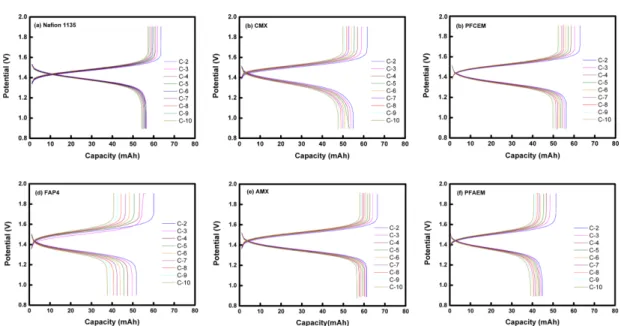
The RFB experiments were conducted to investi- gate the effect of the membranes on the charge-dis- charge characteristics. Fig. 6 shows the charge- discharge curves of VRBs utilizing different cation and anion-exchange membranes, showing that the charge-discharge performances were largely dependent upon the membrane properties. The efficiencies in the charge-discharge tests are listed in Table 3. Nafion Fig. 5. I-V curves of (a) cation-exchange membranes and
(b) anion-exchange membranes (measured in a 0.05 M NaCl solution).
Table 2. Physical and electrochemical characteristics of membranes
Membranes WU
a)(%)
IEC
b)(meq./g)
Membrane thickness
( µ m)
Conductivity
c)(mS/cm)
Electrical resistance
d)( Ω cm
2)
Transport No.
e)( - )
Nafion 1135 (DuPont) 19.5 0.91 95 9.31 1.02 0.962
CMX
(Astom Corp.) 26.2 1.60 165 5.87 2.81 0.966
PFCEM 34.3 2.35 30 5.51 0.55 0.981
FAP4
(FuMA-Tech) 16.2 0.76 55 2.27 2.42 0.932
AMX
(Astom Corp.) 21.1 1.40 135 3.40 3.97 0.970
PFAEM 55.7 1.79 25 5.19 0.48 0.975
a)
Water uptake (WU)
b)
Ion-exchange capacity (IEC)
c)
Membrane conductivity obtained by 2-point probe impedance measurement (in a 0.5 M NaCl aq. solution)
d)
Membrane area resistance measured using a clip cell connected to an impedance analyzer (in a 0.5 M NaCl aq. solution)
e)