1. Introduction
1.1. Background and Purpose
International environmental treaty against global warming has continuously developed with awareness that compromise of economic development and environmental conservation directly lead to the progress of future society. All over the world, need for sustainable development is gaining its importance. So paradigm of national development intending to protect environmental pollution and greenhouse gas has been proposed, and every country is presenting many systems and policies for greenhouse reduction.
Especially, energy consumption in building takes up approximately 25% of the whole nation consumption and with the improvement in lifestyle and increase in number of buildings, energy consumption increase is expected. According to this, Korea has announced 'Low Carbon Green Growth' aiming at 30%
reduction compared to BAU(Business As Usual) until 2020 as a new national vision. Efforts to establish energy efficiency strategy in building energy are sustained currently, and establishment of systematic regulations such as revising 'Building Energy
pISSN 2288-968X, eISSN 2288-9698 http://dx.doi.org/10.12813/kieae.2015.15.3.021
Conservation Design Standards' is being done.
But we need the follow-up countermeasure for ‘high- performance building’ based on these systematic regulations. Now, United States and European communities have developed high-efficiency technology for the efficiency of building energy.
Korea is attempting to certify green buildings through application of green building strategy but the situation is still insufficient to catch up the level of foreign high technology which is being developed rapidly.
Thus this research intends to comprehend the technological trend applied to each building by analyzing energy performance level through case study analysis in the foreign high-performance building.
1.2. Research method and scope
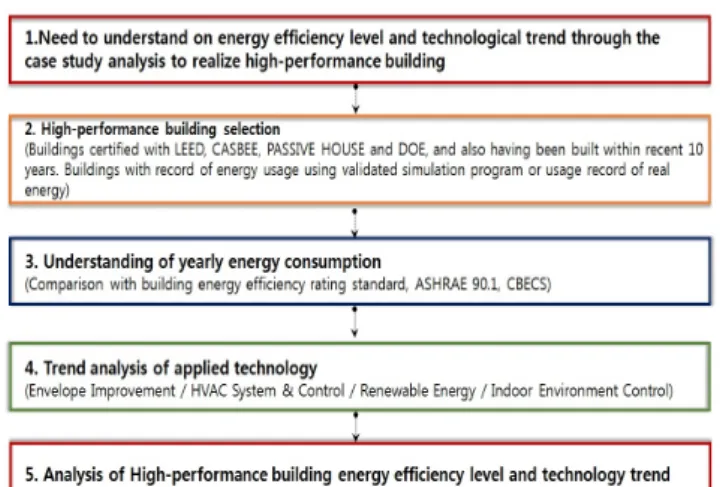
The flow chart of this research for realization of high- performance building is shown in Fig. 1. In this study, high-performance building should be the ones that have been built in recent 10 years and was limited only to those with LEED certification in United States, with CASBEE certification in Japan, with Passive House certification in Germany. We analyzed annual energy consumption of each selected building and compared these
KIEAE Journal
Korea Institute of Ecological Architecture and Environment 73
1)
Analysis of Energy Performance and Green Strategies in the Foreign High-Performance Buildings
Park, Doo-Yong*⋅Kim, Chul-Ho*⋅Lee, Seung-Eon**⋅Yu, Ki-Hyung**⋅Kim, Kang-Soo***
* Department of Architecture, Korea University, Seoul, Korea([email protected], [email protected])
** Korea Institute of Civil Engineering and Building Technology, Gyeonggi-do, Korea([email protected], [email protected]) *** Corresponding author, Department of Architecture, Korea University, Seoul, Korea([email protected])
A B S T R A C T K E Y W O R D
Purpose: In this study, we analyzed the energy performance levels and high-performance technology trends through the case studies of foreign high-performance buildings. Method: Buildings built within 10 years were selected for the analysis of recent trends. we analyzed the buildings of U.S.A, Germany and Japan using LEED certified buildings, Passive House certified buildings and CASBEE certified buildings database for the case study of foreign high-performance buildings. A total of 20 high-performance buildings including 14 cases in U.S.A, 4 cases in Germany and 4 cases in Japan were selected. Annual energy consumption levels for 20 high-performance buildings were collected with the actual energy consumption data or data from simulation programs officially recognized by DOE.
Annual energy consumption were compared with the energy performance standard of the office buildings in the CBECS database, ASHRAE Standard 90.1-2004 and Building Energy Efficiency Rating System in Korea. Result: The order of the green strategies applied in the main categories are Renewable Energy(63%), Indoor Environment Control(51%), Envelope Improvement(44%) and HVAC System & Control(28%). Specified strategies most widely used in the sub-categories are high-performance Insulation (70%), High Efficiency Heating, Cooling Source Equipment(85%), Photovoltaic&Solar Thermal(80%) and Daylighting(80%).
ⓒ 2015 KIEAE Journal
High-Performance Building LEED, CASBEE Passive House Certification Green Strategies Energy Performance
A C C E P TA N C E IN F O Received April 23,2015
Final revision received May 21, 2015 Accepted May 26, 2015
to three standards of domestic and foreign energy performance.
1. CBECS(Commercial Buildings Energy Consumption Survey) was used. This energy standard is a national sample survey that collects energy usage data and building features related to energy in United States which having been performed since 1979 until now.
2. To compare annual energy consumption in recent 10 years, we compared annual energy consumption of high-performance building that requires minimum demand condition of ASHRAE 90.1 Standard 2004(Office Building).
3. We compared annual energy consumption of high-performance building to building energy efficiency rating standard (1st grade) in Korea.
Technology applied to foreign high-performance buildings was classified into four kinds, such as Envelope Improvement, HVAC System & Control, Renewable Energy, and Indoor Environment Control.
2. Theoretical study
2.1. Literature Review
Researches related to high-performance building have mainly been focusing on certification system analysis such as LEED and CASBEE. In domestic case Park, Seoung-Tae and Kim, Kang-Soo1) (2009) analyzed the cases of LEED after classifying buildings into office, education, living and culture to examine the international trend of eco-friendly building and examined technology applied in certified building cases.
In foreign cases, Edwin Rodriguez-Ubinas2) and others (2014) analyzed energy efficiency and technology strategy of passive house building. Analyzed technology includes thermal performance, ice thermal storage, evaporative cooling and night ventilation strategy, and we examined the effect of these technologies on energy performance and comfort in passive house.
Domestic researches that analyzed high-performance building have continuously been performed, but still detailed analysis regarding energy performance and application technology are insufficient and mainly focusing on general analysis.
Thus this research intends to quantitatively comprehend the technology trend applied to each building and analyze energy performance level through case analysis in the foreign high-performance buildings.
3. Case study of foreign high-performance buildings
3.1. Selection of foreign high-performance building List of foreign high-performance buildings is shown in Table 1 and they were selected according to following conditions.
⦁Buildings that have been built within recent 10 years
⦁Buildings with the certification of LEED(Platinum~Silver), Passive house certification, CASBEE ‘S’ class
⦁Buildings with simulation energy usage record using program validated by DOE or actual energy usage data.
Fig. 1. Flow diagram
Image Building Description Image Building Description
US A
1. Wind NRG Partners Manufacturing Facility (LEED Gold)
US A
11. CBF Merrill Environmental Center (LEED Platinum)
GE R
2. Solarsiedlung GmbH (P.H Certification)
12. Environmental Protection's Cambria Office (LEED Gold)
3. Energon Office Building (P.H Certification)
13. Center for Neighborhood Technology (LEED Platinum)
US A
4. City of White Rock Operations Building (LEED Gold)
14. The Conde Nast Building at 4Times Squre
GE R
5. Supfina Grieshber GmbH & Co.
(P.H Certification)
15. The Plaza at PPL Center (LEED Gold)
6. Lu-Teco Office Building (P.H Certification)
PJ N
16. Takenaka Corporation Tokyo Main office (CASBEE S Rank)
US A
7. Alberici Corporate Headquarters (LEED Platinum)
17. Obayashi Technical Research Institute Main Building (CASBEE S Rank)
8. Chicago Center for Green Technology (LEED Platinum)
US A
18. Herman Miller Market Place (LEED Gold)
9. Heifer International Headquarters (LEED Platinum)
PJ N
19. Marunouchi Park Building (CASBEE S Rank)
10. Electronic Arts Headquarters Phase II (LEED Silver)
20. Tokyo Gas Kohoku NT Building (CASBEE S Rank) Table 1. Foreign high-performance building list
(U.S.A, Germany=GER, Japan=JPN Total : 20)
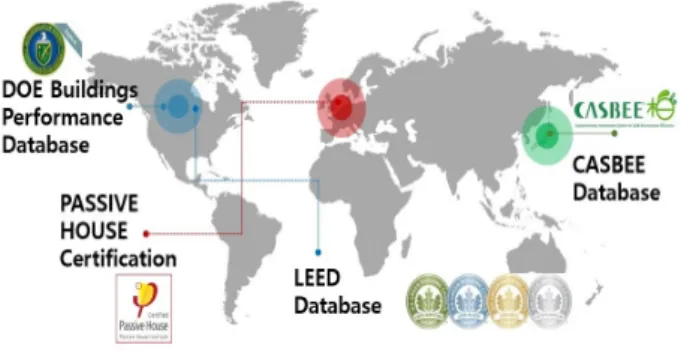
Based on this, 12 in United States, 4 in Germany and 4 in Japan, and 20 in total were shown in Table 1 and the database map reviewed is shown in Fig. 2.
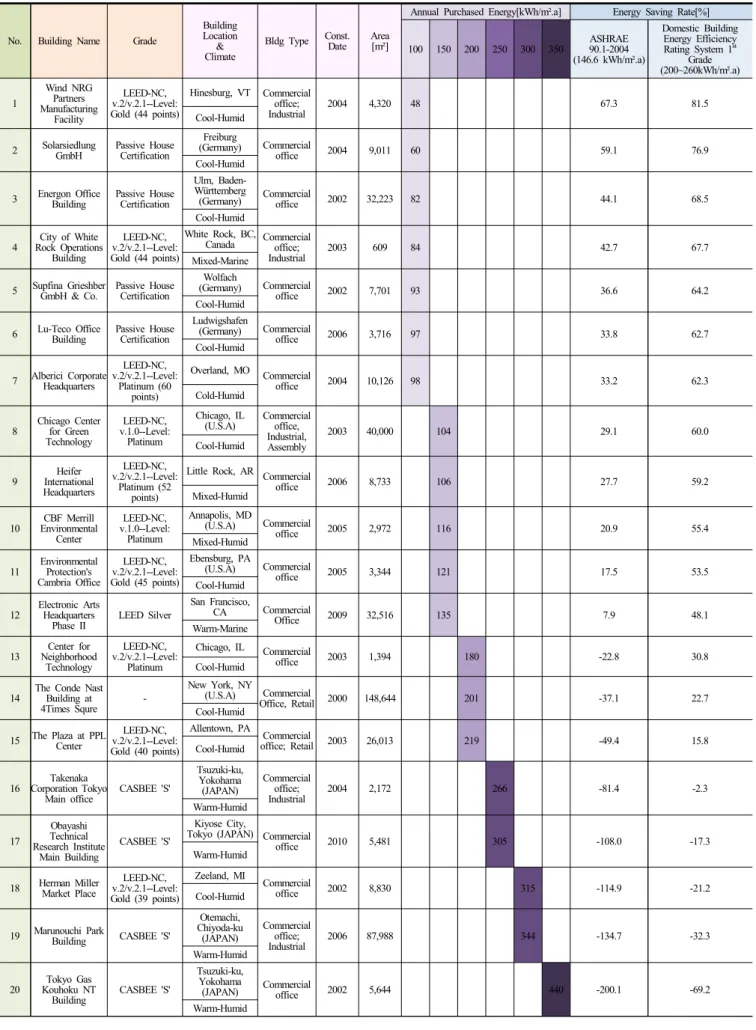
General information and comparison between annual energy consumption and its reduction rate of foreign high-performance building are shown in Table 2. Table 2 summarized building name, certification class, building location & climate, usage, years built, area, energy consumption and reduction rate. Regarding energy consumption, those of buildings with more than one data or all simulation energy usage along with actual energy consumption are belong to the case of United States and Germany. Actual energy consumption data are collected in the case of Japan.
Annual energy consumption was classified into 5 levels that are below 100kWh/m².a, 100~150kWh/m².a, 150~200kWh/m².a, 200~
250kWh/m².a, 250~300kWh/m².a, 300~350kWh/m².a and more than 350kWh/m².a. Annual energy consumption of total 20 high-performance buildings in United States, Germany and Japan was examined and organized in order from lowest to highest by each level. Besides, regarding energy reduction rate, 146.6 kWh/m².a that is the upper limit of annual energy consumption of office building satisfying the minimum requirements of ASHRAE 90.1 2004 and 200~260 kWh/m².a that is the requirement for 1st grade of Korea building energy efficiency rating system are selected for comparison.
Buildings with annual energy consumption below 100kWh/m².a were no. 1(Wind NRG Partners Manufacturing Facility), 2(Solarsiedlung GmbH), 3(Energon Office Building), 4(City of White Rock Operations Building), 5(Supfina Grieshber GmbH &
Co.), 6(Lu-Teco Office Building), and 7(Alberici Corporate Headquarters) of United States and annual energy consumption reduction rate was 33.2%~67.3% compared to 146.6 kWh/m².a, annual energy consumption of office building that satisfies the minimal requirements of ASHRAE 90.1 2004. Compared to the upper limit between 200~260 kWh/m².a which is the guideline for 1st grade of Korea building energy efficiency rating it was analyzed that annual energy consumption was reduced by 62.3%~81.5%.
Buildings consumed annual energy from 100kWh/m².a to 150kWh/m².a were no. 8(Chicago Center for Green Technology), 9(Heifer International Headquarters), 10(Environmental Protection's Cambria Office), 11(CBF Merrill Environmental Center), and 12(Electronic Arts Headquarters Phase II), and showed reduction rate each by 29.1%, 27.7%, 20.9%, 17.5%, and 7.9% compared to the minimum requirements of ASHRAE 90.1 2004. Compared to the guideline for 1st grade of domestic building energy efficiency rating, it showed energy reduction by 48.1%~60.0%.
Buildings that showed annual energy consumption of 150~200kWh/m².a much more than minimum requirements of ASHRAE 90.1 2004 were no. 13(Center for Neighborhood Technology). Annual energy consumption range of 200~
250kWh/m².a were no. 14(The Conde Nast Building at 4Times Squre) and 15(The Plaza at PPL C enter). But they used energy reduced each by 30.8%, 22.7%, 15.8% in its annual energy consumption rather than 260 kWh/m².a which is the standard upper limit for 1st grade of domestic building energy efficiency rating.
Buildings distributed in 250~300kWh/m².a that is higher than annual energy consumption of 1st grade of domestic building energy efficiency rating and minimum requirements of ASHRAE 90.1 2004 were no. 16(Takenaka Corporation Tokyo Main office).
Buildings that showed annual energy consumption of 300~350kWh/m².a was no. 17(Obayashi Technical Research Institute Main Building), no. 18(Herman Miller Market Place), and no.19(Marunouchi Park Building). Buildings that used yearly energy higher than 350kWh/m².a was no. 20(Tokyo Gas Kohoku NT Building).
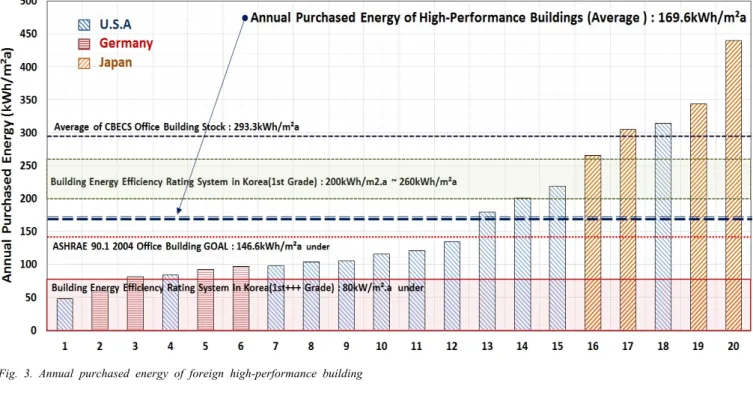
Fig. 3 shows the order from lowest to highest regarding annual energy consumption of total 20 high-performance buildings in United States, Japan and Germany. 3 types of horizontal dot lines signify standard value of annual energy consumption. First, average value (293.3kWh/m².a) of CBECS(Commercial Buildings Energy Consumption Survey) database, second, 1st grade of Korea building energy efficiency rating system(more than 200kWh/m².a below 260kWh/m².a), third, energy goal of office building that satisfies minimum requirements of ASHRAE 90.1 2004 (146.6kWh/m².a) were set as standard values.
The range of annual energy consumption of total 20 high-performance buildings is 48~440kWh/m².a, with average value of 169.6kWh/m².a. Compared to average value of CBECS database, except 3 Japan Buildings (no. 17, 19, 20), and 1 United Sates building(no. 18), all of them was shown to have used energy below standard value of CBECS. No. 1~15 received the grade higher than 1st grade and No. 16~20 received the grade below of 1st grade in the domestic building energy efficiency rating. Compared to ASHRAE 90.1 2004, No. 1~12 used energy below 146.6kWh/m².a which is the standard value of ASHRAE 90.1 2004.
Fig. 2. Database map of foreign high-performance buildings
No. Building Name Grade
Building Location
&
Climate
Bldg Type Const.
Date Area [m²]
Annual Purchased Energy[kWh/m².a] Energy Saving Rate[%]
100 150 200 250 300 350 ASHRAE 90.1-2004 (146.6 kWh/m².a)
Domestic Building Energy Efficiency Rating System 1st
Grade (200~260kWh/m².a) 1
Wind NRG Partners Manufacturing
Facility
LEED-NC, v.2/v.2.1--Level:
Gold (44 points)
Hinesburg, VT Commercial office;
Industrial 2004 4,320 48 67.3 81.5
Cool-Humid 2 Solarsiedlung
GmbH Passive House Certification
Freiburg
(Germany) Commercial
office 2004 9,011 60 59.1 76.9
Cool-Humid 3 Energon Office
Building Passive House Certification
Ulm, Baden- Württemberg
(Germany) Commercial
office 2002 32,223 82 44.1 68.5
Cool-Humid 4 City of White
Rock Operations Building
LEED-NC, v.2/v.2.1--Level:
Gold (44 points)
White Rock, BC,
Canada Commercial office;
Industrial 2003 609 84 42.7 67.7
Mixed-Marine 5 Supfina Grieshber
GmbH & Co. Passive House Certification
Wolfach
(Germany) Commercial
office 2002 7,701 93 36.6 64.2
Cool-Humid 6 Lu-Teco Office
Building Passive House Certification
Ludwigshafen
(Germany) Commercial
office 2006 3,716 97 33.8 62.7
Cool-Humid 7 Alberici Corporate
Headquarters
LEED-NC, v.2/v.2.1--Level:
Platinum (60 points)
Overland, MO Commercial
office 2004 10,126 98 33.2 62.3
Cold-Humid 8 Chicago Center
for Green Technology
LEED-NC, v.1.0--Level:
Platinum
Chicago, IL
(U.S.A) Commercial office, Industrial, Assembly
2003 40,000 104 29.1 60.0
Cool-Humid
9 Heifer
International Headquarters
LEED-NC, v.2/v.2.1--Level:
Platinum (52 points)
Little Rock, AR Commercial
office 2006 8,733 106 27.7 59.2
Mixed-Humid 10 CBF Merrill
Environmental Center
LEED-NC, v.1.0--Level:
Platinum
Annapolis, MD
(U.S.A) Commercial
office 2005 2,972 116 20.9 55.4
Mixed-Humid 11 Environmental
Protection's Cambria Office
LEED-NC, v.2/v.2.1--Level:
Gold (45 points)
Ebensburg, PA
(U.S.A) Commercial
office 2005 3,344 121 17.5 53.5
Cool-Humid 12 Electronic Arts
Headquarters
Phase II LEED Silver
San Francisco,
CA Commercial
Office 2009 32,516 135 7.9 48.1
Warm-Marine 13 Center for
Neighborhood Technology
LEED-NC, v.2/v.2.1--Level:
Platinum
Chicago, IL Commercial
office 2003 1,394 180 -22.8 30.8
Cool-Humid 14 The Conde Nast
Building at
4Times Squre -
New York, NY
(U.S.A) Commercial
Office, Retail 2000 148,644 201 -37.1 22.7
Cool-Humid 15 The Plaza at PPL
Center
LEED-NC, v.2/v.2.1--Level:
Gold (40 points)
Allentown, PA
Commercial
office; Retail 2003 26,013 219 -49.4 15.8
Cool-Humid 16 Takenaka
Corporation Tokyo
Main office CASBEE 'S'
Tsuzuki-ku, Yokohama (JAPAN)
Commercial office;
Industrial 2004 2,172 266 -81.4 -2.3
Warm-Humid 17
Obayashi Technical Research Institute
Main Building
CASBEE 'S'
Kiyose City,
Tokyo (JAPAN) Commercial
office 2010 5,481 305 -108.0 -17.3
Warm-Humid 18 Herman Miller
Market Place
LEED-NC, v.2/v.2.1--Level:
Gold (39 points)
Zeeland, MI
Commercial
office 2002 8,830 315 -114.9 -21.2
Cool-Humid
19 Marunouchi Park
Building CASBEE 'S'
Otemachi, Chiyoda-ku
(JAPAN)
Commercial office;
Industrial 2006 87,988 344 -134.7 -32.3
Warm-Humid 20 Tokyo Gas
Kouhoku NT
Building CASBEE 'S'
Tsuzuki-ku, Yokohama
(JAPAN) Commercial
office 2002 5,644 440 -200.1 -69.2
Warm-Humid
Table 2. Foreign high-performance building’s general information, annual purchased energy and saving rate
4. Specified technologies of Foreign high- performance buildings
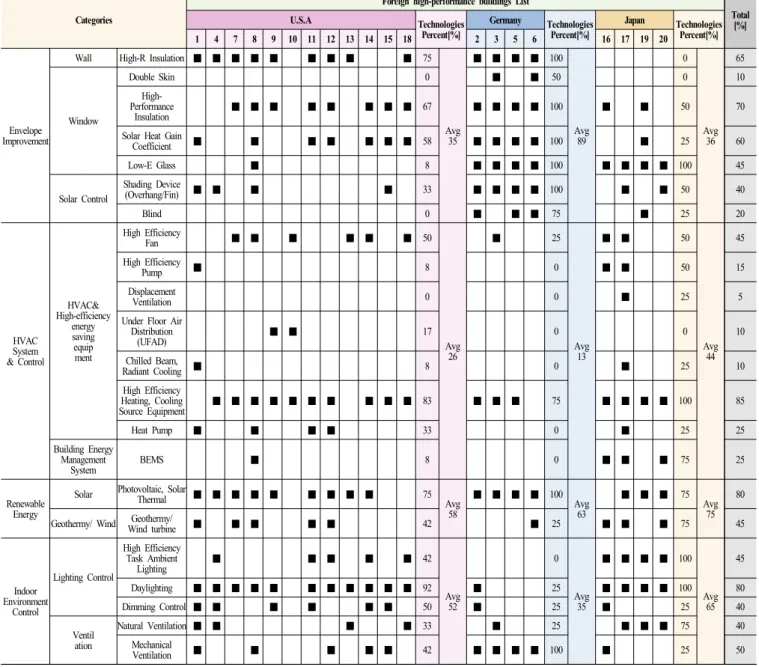
4.1. Classification and analysis of specified technologies Table 3 shows specified technology applied in each building, total of 20 high-performance buildings in United States, Germany and Japan. Technology applied to foreign high-performance building was largely classified into 4 fields(Envelope Improvement, HVAC System & Control, Renewable Energy, and Indoor Environment Control), and following states the detailed technology applied by each field.
⦁Envelope Improvement
High-R Insulation, Double Skin, High-Performance Insulation, Solar Heat Gain Coefficient, Low-E, Shading Device (Overhang/Fin), Blind
⦁HVAC System & Control
High Efficiency Fan & Pump, Displacement Ventilation, Under Floor Air Distribution(UFAD), Chilled Beam, Radiant Cooling, High Efficiency Heating, Cooling Source Equipment, Heat Pump, Building Energy Management System
⦁Renewable Energy
Photovoltaic & Solar Thermal, Geothermy/Wind turbine
⦁Indoor Environment Control
High Efficiency/Task Ambient Lighting, Daylighting, Dimming Control, Natural Ventilation, Mechanical Ventilation
Fig. 4 shows the graph indicating analyzed technology trend applied in each country of United States, German and Japan.
Envelope Improvement technology is mostly applied in German building (89%) compared to that of United States (35%) and Japan(36%). HVAC System & Control technology was used widely in Japan building(44%). And Renewable Energy technology was used the most in buildings of Japan(75%) showing the similar trend in those of United States(58%), and Germany (63%). Indoor Environment Control technology as well was applied the most in buildings of Japan(65%) and was ranked in the order of United States(52%), and Germany(35%).
Table 3 analyzes application ratio of Envelope Improvement technologies. Buildings in United States showed the relatively high ratio of 75% in Wall High-R Insulation, and application ratio of Envelope Improvement was about 35%. Buildings in Germany Fig. 3. Annual purchased energy of foreign high-performance building
Fig. 4. Application rate of high-performance technologies
showed high application ratio in High-R Insulation, High-Performance Insulation, Solar Heat Gain Coefficient, Low-E, and Shading Device(Overhang/Fin) technologies when compared to those in United States and Japan, and Envelope Improvement application was 89% in Germany, being the highest among those in any country. Japan buildings showed high application ratio of Low-E Glass, and overall application ratio of Envelope Improvement technologies was 36%.
Application ratio in HVAC System & Control showed high ratio of High Efficiency Heating, Cooling Source Equipment in every buildings in United States, Germany and Japan, and the ratios were 83%, 75%, 100% each. Overall ratio of HVAC System & Control was analyzed 26%, 13%, 44% each for United States, Germany and Japan.
Application ratio of Renewable Energy technologies shows that
the most applied one is Photovoltaic & Solar Thermal technology with 75%, and 42% in Geothermy/Wind turbine technology in United States Building. In U.S.A application ratio of Renewable Energy technologies was about 58%. German Building's Renewable Energy technologies shows all application of Photovoltaic & Solar Thermal technology with overall application ratio of 63%. Regarding buildings in Japan the application ratio of Renewable Energy technologies was analyzed to be 75% each in Photovoltaic & Solar Thermal technology and Geothermy/Wind turbine technology.
Analysis of Indoor Environment Control shows 92% application in Daylighting technology and 50% application in Dimming Control technology regarding United States buildings. Overall application ratio of Indoor Environment Control technologies was about 52% in U.S.A. In case of German buildings, Mechanical
Categories
Foreign high-performance buildings List
Total
U.S.A Technologies [%]
Percent[%]
Germany Technologies Percent[%]
Japan Technologies Percent[%]
1 4 7 8 9 10 11 12 13 14 15 18 2 3 5 6 16 17 19 20
Envelope Improvement
Wall High-R Insulation ■ ■ ■ ■ ■ ■ ■ ■ ■ 75
Avg35
■ ■ ■ ■ 100
Avg89
0
Avg36 65
Window
Double Skin 0 ■ ■ 50 0 10
High- Performance
Insulation ■ ■ ■ ■ ■ ■ ■ ■ 67 ■ ■ ■ ■ 100 ■ ■ 50 70
Solar Heat Gain
Coefficient ■ ■ ■ ■ ■ ■ ■ 58 ■ ■ ■ ■ 100 ■ 25 60
Low-E Glass ■ 8 ■ ■ ■ ■ 100 ■ ■ ■ ■ 100 45
Solar Control
Shading Device
(Overhang/Fin) ■ ■ ■ ■ 33 ■ ■ ■ ■ 100 ■ ■ 50 40
Blind 0 ■ ■ ■ 75 ■ 25 20
System HVAC
& Control
HVAC&
High-efficiency energy saving equip ment
High Efficiency
Fan ■ ■ ■ ■ ■ ■ 50
Avg26
■ 25
Avg13
■ ■ 50
Avg44 45 High Efficiency
Pump ■ 8 0 ■ ■ 50 15
Displacement
Ventilation 0 0 ■ 25 5
Under Floor Air Distribution
(UFAD) ■ ■ 17 0 0 10
Chilled Beam,
Radiant Cooling ■ 8 0 ■ 25 10
High Efficiency Heating, Cooling
Source Equipment ■ ■ ■ ■ ■ ■ ■ ■ ■ ■ 83 ■ ■ ■ 75 ■ ■ ■ ■ 100 85
Heat Pump ■ ■ ■ ■ 33 0 ■ 25 25
Building Energy Management
System BEMS ■ 8 0 ■ ■ ■ 75 25
Renewable Energy
Solar Photovoltaic, Solar
Thermal ■ ■ ■ ■ ■ ■ ■ ■ ■ 75
Avg58
■ ■ ■ ■ 100 Avg63
■ ■ ■ 75 Avg75
80 Geothermy/ Wind Geothermy/
Wind turbine ■ ■ ■ ■ ■ 42 ■ 25 ■ ■ ■ 75 45
Indoor Environment
Control
Lighting Control
High Efficiency Task Ambient
Lighting ■ ■ ■ ■ ■ 42
Avg52
0 Avg35
■ ■ ■ ■ 100 Avg65
45
Daylighting ■ ■ ■ ■ ■ ■ ■ ■ ■ ■ ■ 92 ■ 25 ■ ■ ■ ■ 100 80
Dimming Control ■ ■ ■ ■ ■ ■ 50 ■ 25 ■ 25 40
Ventil ation
Natural Ventilation ■ ■ ■ ■ 33 ■ 25 ■ ■ ■ 75 40
Mechanical
Ventilation ■ ■ ■ ■ ■ 42 ■ ■ ■ ■ 100 ■ 25 50
Table 3. Specified technologies in foreign high-performance buildings
Ventilation was all applied, and the ratio of Indoor Environment Control technology was about 35%. Japan buildings were mainly applied with High Efficiency/Task Ambient Lighting and Daylighting technology, and overall application ratio of Indoor Environment Control technologies was about 65%.
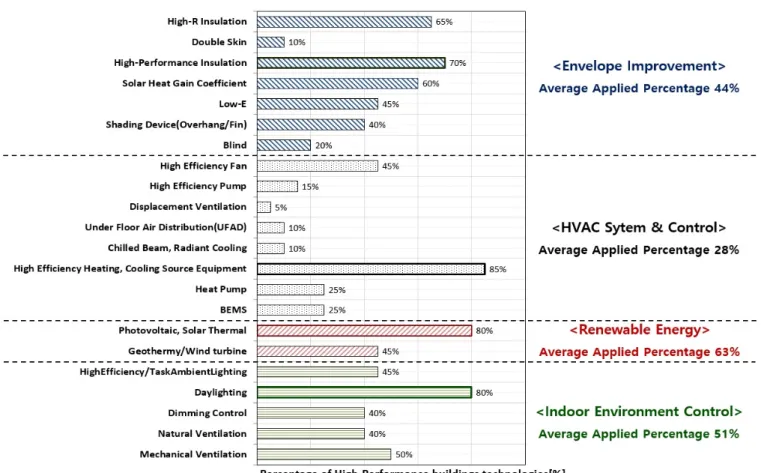
Fig. 5 analyzed application ratio of foreign high-performance building. Based on 4 classifications of high-performance building, the order of average ratio is Renewable Energy(63%), Indoor Environment Control(51%), Envelope Improvement(44%), and HVAC System & Control(28%). In each details of 4 classifications, the technologies mainly applied in high-performance building were high-performance Insulation (70%) of window in case of Envelope Improvement, High Efficiency Heating, Cooling Source Equipment(85%) in case of HVAC System & Control, Photovoltaic
& Solar Thermal(80%) in case of Renewable Energy, and Daylighting(80%) in case of Indoor Environment Control.
5. Conclusion
Through case study of foreign high-performance building, this research quantitatively analyzed the technology application trend applied to each building, and energy efficiency level, and the conclusion is as follows.
(1) The range of yearly energy consumption of total 20 high-performance building was 48~440kWh/m².a and the average value was 169.6kWh/m².a. Compared to the average value of CBECS database, except 3 Japan buildings, and 1 in United States, every one used the energy below the CBECS standard value.
Compared to the standard value of Korea building energy efficiency rating, No. 1~15 buildings rank above the 1st grade. No.
16~20 rank below the 1st grade. Compared to ASHRAE 90.1 2004, No. 1~12 buildings used energy below standard value 146.6kWh/m².a.
(2) Analysis of application ratio of Envelope Improvement shows relatively high rate in Wall High-R Insulation with 75%
regarding buildings in United States, and application ratio of overall technologies was 35%. In German buildings, they showed high application ratio in all High-R Insulation, high-performance Insulation, Solar Heat Gain Coefficient, Low-E, and Shading Device(Overhang/Fin), and application ratio of overall technology was the highest among three countries with 89%. Japan buildings show high application ratio of Low-E Glass, and average application ratio was 36%.
(3) Application ratio of HVAC System & Control shows high ratio of High Efficiency Heating, Cooling Source Equipment in buildings in three countries and it was analyzed each 83%, 75%, Fig 5. Application analysis of foreign high-performance buildings technologies
and 100%. Average application ratio in HVAC System & Control was 26%, 13%, and 44% each for United States, Germany and Japan.
(4) Application ratio of Renewable Energy shows that Photovoltaic & Solar Thermal technology was the most applied up to 75% and Geothermy/Wind turbine was applied up to 42% in United States. Overall application ratio of technologies was about 58%. German buildings were all applied with Photovoltaic & Solar Thermal technology, and overall application ratio of technologies was about 63%. Japan buildings were applied with Photovoltaic &
Solar Thermal technology and Geothermy/Wind turbine each with 75% ratio.
(5) Analysis of Indoor Environment Control shows Daylighting technology was applied highly up to 92%, while Dimming Control technology was applied up to 50%. Overall application ratio of technologies was about 52%. German buildings were all applied with Mechanical Ventilation technology and overall application ratio of technologies was about 35%. Japan buildings were applied mainly with High Efficiency/Task Ambient Lighting and Daylighting technology and overall application ratio of technologies was about 65%.
(6) Envelope Improvement technology was applied the most to German buildings(89%). HVAC System & Control technology was applied the most in Japan buildings(44%). Renewable Energy(75%) and Indoor Environment Control (65%) were applied the most in Japan buildings.
(7) Based on 4 classifications of high-performance building, the order of application ratio was Renewable Energy(63%), Indoor Environment Control(51%), Envelope Improvement(44%), and HVAC System & Control(28%).
(8) The technologies mostly used in sub-category high- performance building were high-performance Insulation(70%) of window in Envelope Improvement, High Efficiency Heating, Cooling Source Equipment(85%) in HVAC System & Control, Photovoltaic & Solar Thermal(80%), in Renewable Energy, Daylighting(80%) in case of Indoor Environment Control.
This research quantitatively analyzed the technology application trend to each building selected and energy performance level through case study of high-performance building, and in future research comparison analysis of energy reduction rate will be conducted.
Acknowledgements
This research was supported by a grant(15AUDP-B079104-02) from Architecture & Urban Development Research Program funded by Ministry of Land, Infrastructure and Transport of Korean government
Reference
[1]박성태, 김강수, “건축물 용도별 분류에 따른 친환경 건축 발전 경 향 연구”, 한국생태환경건축학회 논문집, v.9 n.2(통권 36호), 2009.
4 // Park, Seoung-Tae, Kim, Kang-Soo, An Analysis of the Green Building Development Trends in Accordance with Usage of Building in Certified Cases of LEED, Korea Institute of Ecological Architecture and Environment, 2009. 4
[2] Edwin Rodriguez-Ubinas, Claudio Montero, Passive design strategies and performance of Net Energy Plus Houses, Energy and Buildings, 2014
[3] U.S. Energy Information Administration. Commercial Buildings Energy Consumption Survey (CBECS); 2003.
[4] Deru, M. P. Torcellini, Analysis of the Design and Energy Performance of the Pennsylvania Department of Environmental Protection Cambria Office Building. Technical Report. Publication : NREL/TP-550-34931, 2005
[5] ASHRAE Standard 90.1-2004: Energy Standard for Buildings Except Low-Rise Residential Buildings; 2004.
[6] P. Torcellini, S. Pless, M. Deru, B. Griffith, N. Long, and R. Judkoff, Lessons Learned from Case Studies of Six high-performance buildings.
Technical Report. Publication : NREL/TP-550-34931, 2006
[7] Takehito Imanari, Satoshi Ogawa, Tatsuo Nobe, Shin-ichi Tanabe, Renovation of “Earth Port” for Net-Zero Energy Building, Purdue University, 2012