• 검색 결과가 없습니다.

Role of the transforming growth factor (TGF)-β1 and TGF-β1 signaling pathway on the pathophysiology of respiratory pneumococcal infections

N/A
N/A
Protected

Academic year: 2021

Share "Role of the transforming growth factor (TGF)-β1 and TGF-β1 signaling pathway on the pathophysiology of respiratory pneumococcal infections"

Copied!
12
0
0

로드 중.... (전체 텍스트 보기)

전체 글

(1)

Yeungnam Univ J Med 2017;34(2):149-160

Role of the transforming growth factor (TGF)-β1 and TGF-β1 signaling pathway on the pathophysiology of respiratory pneumococcal infections

Maria Jose Andrade, Jae Hyang Lim

Department of Microbiology, College of Medicine, Ewha Womans University, Seoul, Korea

Streptococcus pneumoniae, pneumococcus, is the most common cause of community-acquired pneumonia (CAP). CAP is an important infectious disease with high morbidity and mortality, and it is still one of the leading causes of death worldwide. Many genetic factors of the host and various environmental factors surrounding it have been studied as important determinants of the pathophysiology and outcomes of pneu- mococcal infections. Various cytokines, including transforming growth factor (TGF)-β1, are involved in diffe- rent stages of the progression of pneumococcal infection. TGF-β1 is a cytokine that regulates a wide range of cellular and physiological functions, including immune and inflammatory responses. This cytokine has long been known as an anti-inflammatory cytokine that is critical to preventing the progression of an acute infection to a chronic condition. On the other hand, recent studies have unveiled the diverse roles of TGF-β1 on different stages of pneumococcal infections other than mitigating inflammation. This review summarizes the recent findings of the role of TGF-β1 on the pathophysiology of pneumococcal infections, which is funda- mental to developing novel therapeutic strategies for such infections in immune-compromised patients.

Keywords: TGF-beta1; Pneumococcus; Inflammation; Fibrosis

Copyright ©2017 Yeungnam University College of Medicine

This is an Open Access article distributed under the terms of the Creative Commons Attribution Non-Commercial License (http://creative- commons.org/licenses/by-nc/4.0/) which permits unrestricted non-commercial use, distribution, and reproduction in any medium, provided the original work is properly cited.

Received: October 11, 2017, Revised: November 13, 2017 Accepted: November 20, 2017

Corresponding Author: Jae Hyang Lim, Department of Microbiology, College of Medicine, Ewha Womans University, 1071 Anyangcheon-ro, Yangcheon-gu, Seoul 07985, Korea

Tel: +82-2-2650-5832, Fax: +82-2-2653-8891 E-mail: [email protected]

INTRODUCTION

Streptococcus pneumoniae , also known as pneumococcus, is a human pathogen normally found in the nasopharynx of healthy individuals. Although pneumococcus is part of the normal flora in the upper respiratory tract, it is a major cause of death and it is responsible for more than a million deaths each year [1]. Children under 5 years of age and adults over the age of 65 are most susceptible populations to pneumoco- ccus and, thus, have the highest morbidity and mortality rates related to this pathogen than any other group [2]. Although

two types of vaccines, pneumococcal conjugate vaccine and pneumococcal polysaccharide vaccine, have been developed, their use is more common in developed regions and their efficacy is still far limited [3-5]. As both vaccines are made with pneumococcal capsular polysaccharides, the immune re- sponses induced by vaccination are only effective against the serotypes included in the vaccine. Moreover, their use has led to an increase in pneumococcal infections with non-vaccine serotypes, a phenomenon called serotype replacement [2,6].

In addition, the vaccine’s efficacy is reduced in populations with weaker adaptive immune systems, as is the case for the populations mentioned earlier, as well as in individuals with other immune-compromising conditions [3,6,7]. Therefore, many studies have focused on understanding the early defense mechanisms against pneumococcal infections, and how these mechanisms prevent the dissemination of the pathogen and the development of invasive pneumococcal diseases (IPDs).

They also try to develop therapeutic strategies that regulate

(2)

pneumococcal infections, even in cases where the patient has a weaker adaptive immune system.

Transforming growth factor (TGF) is a family of proteins that control a diversity of cell processes, including cell differen- tiation, cell division, and apoptosis, and have important roles during embryogenesis and development [8]. This family of proteins includes the TGF-β1, TGF-β2, TGF-β3, bone mor- phogenic proteins (BMPs), activins/inhibins, nodal, growth di- fferentiation factors, and Müllerian inhibiting substances [9].

TGF-β1 is the most extensively studied protein in the TGF family. Since its first purification at the beginning of the 1980s, studies have reported the role of TGF-β1 in the regulation of development, as well as in the immune system, tissue rege- neration and even the progression of various diseases [10].

The immune regulatory functions of TGF-β1 have been studied extensively in the adaptive immune system since it was first found to be a master regulator of T cell tolerance; it regulates the proliferation, differentiation, and cellular activities of T cell subsets [11,12]. On the other hand, few studies have ex- amined the role of TGF-β1 in regulating the innate immune system, particularly against respiratory bacterial infections.

The expression of TGF-β1 has been reported in patients and mice models with acute lung injury (ALI)/acute respiratory distress syndrome (ARDS) [13], but the role of TGF-β1 on the pathophysiology of respiratory bacterial infections is not com- pletely understood. Many studies have been conducted to un- derstand the role TGF-β1 plays during the different stages of a pneumococcal infection, which is the most common cause of bacterial ALI/ARDS. This review discusses the research in- to the role of TGF-β1 and its signaling pathways in the patho- physiology of pneumococcal infections.

Expression and activation of TGF-β1

TGF-β1 is expressed initially as a pre-pro-TGF-β1, which contains an N-terminal signal peptide that is cleaved for the remaining pro-TGF-β1 to function. Pro-TGF-β1 is formed by a pro-domain, called the latency-associated protein (LAP), and the biologically active C-terminal polypeptide [14]. Normally, these two proteins will stay linked, forming the small latent complex. Some cells, however, produce TGF-β1 and deposit it on the extracellular matrix (ECM) as the large latent com- plex (LLC). The LLC is formed by an interaction of pro-TGF-

β1 with the latent TGF-β1 binding protein, which renders TGF-β1 inactive [14]. Latent TGF-β1 is then activated by pro- teases and integrins, such as matrix metalloproteinase (MMPs) and αvβ6 and αvβ8 integrins [14-17]. Furthermore, proteins present on the ECM, e.g. fibrin, fibronectin, and thrombo- spondin, can also activate or prevent the function of TGF-β1 by mechanisms not yet completely defined [11,14].

TGF-β1 signaling pathways

TGF-β1 transmits signals through the cell surface type I (TβRI) and type II (TβRII) serine/threonine kinase receptors [18]. TβRs are normally on the cell surface as homodimers.

Once TGF-β1 binds to the homodimers of TβRII, the TβRI homodimers join them to form a hetero-tetrameric receptor complex [9], which is then phosphorylated by TβRII. The acti- vation of TβRs by TGF-β1 triggers the Smad-dependent signa- ling pathway and many other non-canonical signaling path- ways, including ERK1/2, p38 mitogen activated protein kina- ses (MAPKs) and phosphoinositide 3-kinase (PI3K)-Akt sig- naling (Fig. 1) [19,20].

1. Smad-dependent signaling pathway

Eight Smad proteins are found in humans and are sub- divided into receptor-regulated Smads (R-Smads), common mediator Smad (Co-Smad), and inhibitory Smads (I-Smads).

Among them, Smad1, Smad2, Smad3, Smad5, and Smad8 are R-Smads; Smad4 is Co-Smad, and Smad 6 and Smad7 are I-Smads [18]. Generally, Smad2 and Smad3 are R-Smads activated by TGF-β1 [14] once they are phosphorylated by activated TβRI [11]. Phosphorylated R-Smads then interact with Smad4 and translocate into the nucleus where they in- teract with transcription factors and initiate the transcription of TGF-β1 target genes [8,9,21]. Ultimately, the genes that are activated depend on the type of cells being stimulated and the type of transcription factors interacting with the Smad proteins.

Activated TβR complexes are internalized through endocy-

tosis either at the clathrin-coated pits or caveolin-positive lipid

rafts [22]. The receptors at the clathrin-coated pits are guided

to early endosomes filled with a Smad anchor for receptor

activation protein, which recycles and returns TβRs to the

(3)

Fig. 1. Smad-dependent and Smad-independent signaling pathways activated by TGF-β1. TGF-β1 binds and activates the cell surface receptors, TβRs, and activated TβRs transmit signals through Smad-dependent and Smad-independent signaling pathways. In Smad-dependent pathway, receptor-regulated Smads (R-Smads) are phosphorylated by activated TβRI, which then form heterotrimeric complex with common mediator Smad (Co-Smad) and translocate into the nucleus. In Smad-independent pathways, multiple kinases including p38, Erk, and JNK mitogen activated protein kinases (MAPKs), inhibitor of nuclear factor-κB kinase β, and Akt are activated via TGF-β-activated kinase 1, Raf, and phosphoinositide 3-kinase. All these individual pathways regulate the expression of TGF-β1 target genes by regulating their own transcription factors, but they also directly phosphorylate Smad proteins, conversing both Smad-dependent and Smad-independent pathways.

TAK1, TGF-β- activated kinase 1; IKK, inhibitor of nuclear factor-κB kinase; NF-κB, nuclear factor-κB;

MKK, MAPK kinase; PI3K, phosphoinositide 3-kinase; TFs, transcription factors.

cell surface. On the other hand, caveolin-positive lipid rafts form vesicles containing I-Smads and Smad-ubiquitination-re- gulatory factors (Smurfs) to mark TβRs for degradation [22].

2. Smad-independent signaling pathway

In addition to the Smad proteins, phosphorylated TβRs activate MAPK kinase kinases (MAP3Ks) including TGF-β-ac- tivated kinase 1 (TAK1) and Raf, which play critical roles in the TGF-β1-induced Smad-independent signaling pathways [19]. Activated TAK1 activates MAPK kinase and the inhibitor of nuclear factor (NF)-κBβ, which results in subsequent acti- vation of MAPKs, such as JNK and p38 MAPKs, and NF-κB.

The activation of Raf by TGF-β1 stimulates MEK1/2, which then activates Erk1/2 MAPK. In addition to the activation of

the MAPKs and NF-κB signaling pathways, TGF-β1 also stim- ulates PI3K, which then activates Akt [20]. Although all these individual pathways regulate the expression of the TGF-β1 target genes by regulating their own target transcription fac- tors, they can also phosphorylate Smad proteins directly, con- verging both Smad-dependent and Smad-independent path- ways [9,23].

The signaling pathways activated by TGF-β1 also crosstalk

with many others, for example, with the innate immune signa-

ling pathways induced by Interleukin-1 receptor (IL-1R) and

Toll-like receptors (TLRs). IL-1R and TLRs activate the path-

ways mediated by TNF receptor-associated factor 6 (TRAF6)

and TAK1, which are fundamental for the TGF-β1-induced

activation of the JNK/p38 MAPK pathways [19,20].

(4)

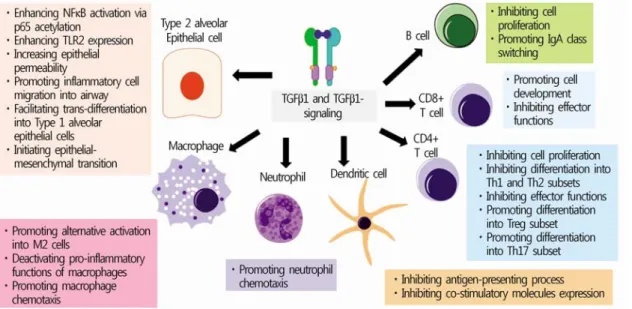
Fig. 2. Immune modulatory functions of TGF-β1 on cells in the airway. The role of TGF-β1 on airway epithelial cells, macrophages, neutrophils, dendritic cells, CD4 and CD8 expressing T cells, and B cells are summarized.

Regulation of the immune cells by the TGF-β1 and TGF-β signaling pathways

Invading microbes first encounter tissue resident macro- phages and epithelial cells. The sensing of microbes by these cells triggers the innate immune response by producing a range of cytokines and acute phase proteins, which then re- cruit circulating monocytes and neutrophils. At the same time, epithelial dendritic cells (DCs) phagocyte microbes and acti- vate the adaptive immune T and B cells [24,25]. TGF-β1 acts as a positive or negative regulator of the immune/inflammatory responses by regulating the activation, proliferation, and dif- ferentiation of these cells (Fig. 2).

1. Epithelial cells

Respiratory epithelial cells are threatened continuously by airborne microbes, and therefore well equipped with a strong innate immune system [26]. Pathogenic factors are sensed by epithelial cells via the cell surface expressing pattern recogni- tion receptors (PRRs) including TLRs, and intracellular PRRs, which detect invading intracellular microbes and their com- ponents. The recognition of microbial factors stimulates the cells to produce other PRRs, acute phase proteins and cyto- kines, to recognize the microbes more efficiently, inhibit bac- terial growth, recruit inflammatory cells to the site of infec-

tion, and to enhance the phagocytic activity [24]. Alveolar epi- thelium expresses TGF-β1, which is upregulated further upon an infection with respiratory bacterial pathogens, including Mycobacterium tuberculosis ( M. tuberculosis ) [27-29], Pseu- domonas aeruginosa [30-33], nontypeable Haemophilus influ- enzae (NTHi) [34-36], and pneumococcus [35,37].

At the early stages of infection, TGF-β1 positively regulates the epithelial inflammatory responses in the airway epithelium by enhancing the transcriptional activity of NF-κB and en- hancing TLR2 expression [38-40]. TGF-β1 synergistically en- hances the NTHi- and pro-inflammatory cytokine tumor ne- crosis factor (TNF)-α-induced inflammation via the acetyla- tion of p65, which results in enhanced NTHi- and TNF-α-in- duced-NF-κB activation and subsequent inflammation [38,39].

The epithelial cell expression of TLR2 is upregulated follo-

wing NTHi infection, but TLR2 expression is under tight

control by p38 MAPK to avoid detrimental inflammatory res-

ponses [40]. On the other hand, activation of the TGF-β1 sig-

naling pathway by a NTHi infection upregulates the MAPK

phosphatase (MKP)-1 expression, which then inhibits the p38-

mediated inhibition of TLR2 expression, thereby promoting

inflammation. In addition, TGF-β1 increases the epithelial

permeability by downregulating epithelial tight junction in-

tegrity, and promotes the migration of inflammatory cells

from the blood to the airway and the leakage of anti-microbial

molecules from the circulation [41-43]. These findings in the

(5)

airway epithelium suggest that TGF-β1 acts as a positive regu- lator for airway inflammation during respiratory bacterial in- fections, in contrast to its well-known inflammation mitigat- ing effect.

Following an acute inflammation process, type II alveolar epithelial cells differentiate into type I alveolar epithelial cells and fibroblasts to regenerate the epithelial structures damaged due to acute and severe infections [44-46]. The TGF-β1 and TGF-β1 signaling pathways assist in the tissue regeneration processes by stimulating the trans-differentiation of type II alveolar epithelial cells to type I alveolar epithelial cells [45].

TGF-β1 also facilitates the tissue regeneration processes by inducing an epithelial-mesenchymal transition (EMT). Tran- scription factors induced by TGF-β1, such as Snail and Slug, inhibit the expression of tight junction proteins and E-cadhe- rin, thereby stimulating the trans-differentiation of type II alveolar epithelial cells to mesenchymal cells expressing N- cadherin and producing ECM[47,48]. The regulation of epi- thelial cell differentiation by TGF-β1 is necessary to regenerate the damaged epithelium, but these processes often result in tissue destruction and pulmonary fibrosis [49,50].

2. Phagocytes

Phagocytes, such as macrophages and neutrophils, are the most effective cells in removing microbes. Alveolar macro- phages are the most abundant phagocytes in the normal al- veolar space without an active infection. In the resting con- dition, the phagocytic activity of resident macrophages is sup- pressed by TGF-β1, which is believed to be a major reason for their relatively long lifespan in tissues [51]. Once they encounter microbes, the expression of TβRs is downregula- ted, leaving them less responsive to TGF-β1. Activated alveo- lar macrophages phagocyte and kill invading microbes and secrete pro-inflammatory cytokines to recruit circulating mo- nocytes/macrophages and neutrophils [16]. Following extra- vasation, macrophages undergo phenotypic polarization pro- cesses and develop into distinctive subsets of macrophages.

The specific phenotypic polarization of macrophages is deter- mined by the microenvironmental signals, such as the type of activator and the type of cytokines activating macrophage polarization. TLR ligands along with interferon (IFN)-γ lead to the classical activation of macrophages, which results in macrophages expressing pro-inflammatory cytokines, and ha-

ving anti-microbial activities (the so called M1 macrophages).

If macrophages are polarized under IL-4 and IL-13-rich condi- tions, they are polarized into cells expressing IL-10 and TGF- β1. This polarization process is called alternative activation, and results in heterogeneous and functionally distinct macro- phage subsets, known as M2 macrophages [52].

Although the removal of invading microbes by phagocytes is essential to control an infection, the surrounding tissues are damaged by the byproducts of phagocytosis including toxic reactive oxygen species, mammalian toxic proteases, and nu- cleases [25]. Alternatively activated M2 cells clean up dead neutrophils and damaged epithelial cells during inflammation, and once the clearance of apoptotic cells, called efferocytosis, begins, it signals the deactivation of the inflammatory process [51]. Although the precise mechanism used for TGF-β1 deacti- vation of the inflammatory response is unclear, TGF-β1 was found to promote the ubiquitination and degradation of MyD88, a master adaptor molecule for TLRs activation ex- cept for TLR3, as well as downregulate the expression of the major histocompatibility complex class II [52]. In addi- tion, neutrophil chemotaxis depends on the TGF-β1 and TGF- β1 signaling pathway because the neutrophils in Smad3

-/-

mice had an impaired chemotactic response and the production of IL-8, a chemokine necessary for the migration of neutrophils, was blocked [12]. Therefore, at early stages of bacterial infec- tions in the lung, TGF-β1 may facilitate the acute inflammatory responses by promoting the extravasation of phagocytes, and promoting the resolution of inflammation by deactivating the phagocytes and promoting their M2 polarization.

3. Dendritic cells

DCs are present in non-lymphoid tissues, such as the lungs,

as immature DCs [53]. In non-lymphoid tissues, the DCs pha-

gocyte antigens, such as invading microbes, and migrate to

the secondary lymphoid organs to present captured antigens

to T cells and activate them [53]. DCs produce considerable

amounts of TGF-β1 [54,55], but the effects of TGF-β1 on the

function and activation of DCs are not completely under-

stood. On the other hand, a series of experimental data sug-

gest that TGF-β1 and the TGF-β1 signaling pathways func-

tion mainly as negative regulators of the self-immune re-

sponses because TGF-β1 inhibits the antigen-presenting proc-

ess and the expression of co-stimulatory molecules on DCs

(6)

[56,57]. Furthermore, the activation of DCs by TGF-β1 is dependent largely on the cell surface expression of integrin αvβ8, and the loss of αvβ8 on DCs results in dysregulated immune responses, including a decrease in regulatory T (Treg) cells [57]. This suggests that TGF-β1 has important roles on DCs activation and subsequent regulation of T cell homeo- stasis. In contrast, Laouar et al. showed that the DC-specific inhibition of TGF-β1 signaling had no effects on the DC func- tion [58]. The role of TGF-β1 and the TGF-β1 signaling path- ways on the cellular and immunological functions of DCs needs to be investigated further, particularly in response to specific bacterial pathogens.

4. T and B cells

TGF-β1 is fundamental to the regulation of T and B cells [11,12]. Helper T (Th) cells expressing CD4 are differentiated into different Th cell subsets including Th1, Th2, Th17, and Treg depending on the complex interaction between the DC- presenting antigens and cytokines participating in the activa- tion process. Th1 cells expressing IFN-γ enhance the phago- cytic activities of macrophages, and Th2 cells expressing IL-4 and 5 stimulate B cell activation to produce antigen-specific antibodies. The Th17 cells express IL-17 and are subdivided further into regulatory Th17 cells, expressing IL-9 and IL-10, and pathogenic Th17 cells, expressing IFN-γ and granulocyte- macrophage colony-stimulating factor [59]. Treg cells inhibit the effector functions of the T cell subsets, DCs, and macro- phages via IL-10, IL-35, and TGF-β1 [60,61]. TGF-β1 blocks the transcription factors T-Bet and GATA-3 in CD4 expres- sing Th cells, preventing the differentiation of Th cells into Th1 and Th2, thereby stimulating the generation of Treg cells [62]. Furthermore, TGF-β1 stimulates the expression of Foxp3, a transcription factor involved in generation of Treg cells and in the inhibition of pro-inflammatory cytokine pro- duction and enhancement of anti-inflammatory cytokines like IL-10 and TGF-β1 [63]. TGF-β1 is essential for preventing Th17 cell differentiation into the pathogenic Th17 subset and to keep it with a regulatory Th17 phenotype [59]. In addition, in thymocytes, TGF-β1 promotes IL-7Rα expression, and the signaling through this receptor, together with one from the T cell receptor, is required for the development of CD8

+

T cells [64,65]. On the other hand, TGF-β1 inhibits the diffe- rentiation of CD8

+

T cells into cytotoxic T lymphocytes [65].

TGF-β1 inhibits the growth of B cells and activates their apoptotic pathways through the downregulation of NF-κB/Rel [66]. Although TGF-β1 was found to inhibit immunoglobulin synthesis, it also enhances the presentation of antigens to B cells and induces a class switch of immunoglobulin M(IgM) to IgA [62] for the immune defense of mucosal surfaces. Ex- periments that specifically block B cell-specific TGF-β1 showed a decrease in IgA production, which could be emulated by blocking Smad2, while a Smad3 deficiency did not affect the levels of IgA [12].

Overall, TGF-β1 functions mainly as a repressor to restrict the pro-inflammatory functions of T cells by limiting Th1 and Th2 cell differentiation and by promoting Treg and regulatory Th17 cell differentiation. On the other hand, TGF-β1 may play a critical role in the mucosal immunology, which is a key defense mechanism in respiratory bacterial infections, by enhancing IgA secretion.

Regulation of pneumococcal infections by the TGF-β1 and TGF-β1 signaling pathway

1. Pathophysiology of respiratory pneumococcal infections

The first point of entry for pneumococcus is through the

upper respiratory system, which is colonized by pneumo-

coccus prior to infection. Attachment to the surface of epi-

thelial cells is the first step in establishing an infection. Mul-

tiple pneumococcal factors, including pneumococcal surface

adhesion A, choline binding protein A (CbpA), and pneumo-

coccal phosphorylcholine (ChoP), and the host receptors, such

as sialic acid, polymeric immunoglobulin receptor (pIgR), and

platelet-activating factor receptor (PAF-R), are involved in this

process [67]. The prolonged colonization and delayed cleara-

nce of pneumococcus results in overgrowth of the bacteria

on the epithelial surface [68]. Therefore, the timely removal

of epithelial pneumococcus is also the first step in inhibiting

pneumococcal infections. Epithelial cells respond to pneumo-

cocci by producing various antimicrobial molecules to directly

kill or opsonize them. The opsonized pneumococcus is phago-

cytosed by macrophages, neutrophils, and DCs [1]. Epithelial

cells also produce pro-inflammatory cytokines and chemo-

kines to recruit and activate phagocytes from the blood [69].

(7)

Therefore, after successful colonization, pneumococcus must invade the epithelial layers to avoid the mucosal defense me- chanisms. Among the many pneumococcal pathogenic factors, the cytoplasmic toxin pneumolysin has been considered a ma- jor virulence factor facilitating the dissemination of pneumo- coccus inside the body [70]. Pneumolysin binds to cholesterol on epithelial cells, and oligomerization of the pneumolysin- cholesterol complexes form membrane pores large enough to lysis the cell [71]. The loss of epithelial cell barrier integrity and enhanced epithelial permeability lead to the trans-epithe- lial migration of pneumococcus to the bloodstream. Plasmin, the activated form of plasminogen, binds to pneumococcus, which leads to the cleavage of tight junctions and the subse- quent migration of pneumococcus through the epithelial layer [72]. Pneumococcus can also be internalized into epithelial cells via several different mechanisms. Pneumococcal binding to the ECM component, vitronectin, facilitates the intra-epi- thelial and endothelial translocation of pneumococcus [73].

Pneumococcal surface protein C and CbpA bind to the pIgR on the epithelial cell surface and facilitate the internalization of pneumococcus [74]. The epithelial internalization of pneu- mococcus is also achieved through binding to the PAF-R and laminin receptor via ChoP and CbpA, respectively [75].

Once a pneumococcus enters the circulation, circulating an- ti-bacterial proteins, including C-reactive protein, long pen- traxin 3, complements, and antibodies, bind to pneumococcus.

Opsonization with these proteins enhances phagocytosis by macrophages and neutrophils. As they enter the circulation, pneumococcus can also cross the endothelium and enter other tissues, e.g., the subarachnoid space through the blood-brain barrier [76]. Once they reach the central nervous system, the damages caused by pneumococcus and the inflammatory re- sponse are detrimental regardless of the extent of the damage.

The bacteria can be removed effectively if treatment is ini- tiated and the pneumococcal strain causing the infection is susceptible to the antibiotics introduced. On the other hand, sterile inflammation and even septic shock due to the released pneumococcal pathogenic factors from dead cells are often observed.

2. Regulation of pneumococcal infections by the TGF-β1 and TGF-β1 signaling pathways The enhanced expression of TGF-β1 has been found in

the bronchoalveolar lavage fluid and blood from patients with a pneumococcal infection and animal models of pneumoco- ccal infections [77,78]. Pneumococcus stimulates the produc- tion of TGF-β1 from the nasopharyngeal epithelial cells and fibroblasts, which in turn activates T cell differentiation into Treg cells and played critical roles for the prolonged coloni- zation and delayed clearance of pneumococcus from the na- sopharynx [78]. In addition, the prolonged colonization of pneumococcus in the nasopharynx facilitates the alternative activation of macrophages into M2 macrophages, limiting the pro-inflammatory responses in the nasopharynx and allowing the persistence of pneumococcal carriage [78]. Therefore, the pneumococci appear to employ the host anti-inflammatory and anti-immune responses by stimulating the production of TGF-β1, and successfully colonizing the nasopharynx without causing inflammation. On the other hand, clinical studies with pneumococcal infection-prone children also showed the im- portant role of TGF-β1 on limiting pneumococcal infections in these patients [79,80]. Low nasopharyngeal colonization by pneumococcus was associated with enhanced Th17 cell immunity [79], whereas repeated infections with pneumoco- ccus was associated with a significant defect on the differen- tiation of blood mononuclear cells to Th17 cells following pneumococcal infections [80]. Furthermore, the addition of exogenous cytokines promoting Th17 polarization including TGF-β1 could rescue the cells to differentiate into Th17 cells, which suggests that TGF-β1 inhibits pneumococcal coloniza- tion in the nasopharynx by activating Th17 cells [80]. Such controversial findings on the role of TGF-β1 in pneumococcal colonization need to be investigated further experimentally.

Following the successful colonization of the nasopharynx, pneumococcus must translocate into the body to establish an infection. Pneumococcus activates the p38 MAPK and TGF-β 1 signaling pathways to transmigrate through the epithelial barrier [42]. Pneumococcal colonization was reported to en- hance and activate transcription factor Snail-1, which is under the control of TGF-β1. Snail-1 inhibits E-cadherin and ulti- mately causes the loss of the tight junctions and opens the epithelial barrier, leaving the tissue vulnerable to bacteria [43].

During a pneumococcal infection, the loss of tight junctions

was also caused by the Snail-1 dependent downregulation of

claudins, which are the key components of the tight junctions

[34]. Although pneumococcus induced the activation of the

TGF-β1 signaling pathway, and transepithelial migration of

(8)

pneumococcus was blocked by the TβR1 inhibitor, SB431542 [42], it is still unclear whether the production of TGF-β1 is involved or TβR1-dependent activation of TGF-β1 signaling pathway is activated directly by pneumococcus. Another im- portant respiratory bacterial pathogen, NTHi, was found to activate TβR1-dependent TGF-β1 signaling pathway directly via the expression of a TGF-β1-like molecule [40]. In addi- tion, the expression of PAI-1, an acute phase protein regula- ted mainly via the TGF-β1 signaling pathway, is also induced directly by the pneumococcal toxin pneumolysin [81]. There- fore, it would be interesting to know if pneumococcus also activates the TGF-β1 signaling pathway directly by expressing a TGF-β1-like molecule, as NTHi does, or if TβRs are acti- vated by pneumococcus via another mechanism that is not completely understood.

Following acute inflammation and injury during a pneumo- coccal infection, the removal of damaged cells and edematous solution from the alveolar space is important to minimize tis- sue damage [82]. Efferocytosis against apoptotic and necrotic cells is conducted mainly by alternatively activated M2 mac- rophages, and TGF-β1 promotes efferocytosis by stimulating alternative M2 activation [83]. TGF-β1 also promotes tissue regeneration by stimulating the trans-differentiation of type 2 epithelial cells to type 1 epithelial cells and sealing the de- nuded epithelial layer by stimulating the production of ECM, like collagen, and by stimulating the EMT process to supply fibroblasts to the surrounding injured tissues [45-48]. Altho- ugh this is important for tissue repair, the uncontrolled accu- mulation of collagen and the EMT process can lead to further complications, such as lung fibrosis [49,50]. Therefore, the expression of TGF-β1 and activation of the TGF-β1 signaling pathways are tightly regulated. For example, GSK3β-STUB1 maintains a low epithelial cell response to TGF-β1 by ubiqui- tinating and degrading Smad3 [49,84]. Following a pneumo- coccal infection, however, pneumococcus activates Akt, which in turn deactivates GSK3β and inhibits the GSK3β-STUB1- dependent degradation of Smad3 [49]. This process enhances the epithelial responsiveness to TGF-β1 and promotes the pro- duction of the TGF-β1-response genes, such as collagen and PAI-1. The protein deubiquitinase CYLD suppresses this pro- cess by deubiquitinating and inhibiting Akt. Nevertheless, if the inhibitory effect of CYLD is lost, lungs infected with and damaged by pneumococcus undergo fibrotic changes due to the enhanced responsiveness to TGF-β1 [49]. As a result,

fibrotic scar tissue is often found in the lungs of patients follo- wing severe pneumococcal infections, which indicates a fail- ure of the tight regulation of the tissue regeneration process in these patients [49].

Excess extracellular water inhibits the normal lung func- tions, such as gas exchange, and inhibits the lung defense me- chanisms against invading microbes. Pulmonary edema forms when the increase in lung vascular permeability cannot be opposed by the active clearance of fluid by the epithelium [85]. Clearance of this fluid is achieved through osmosis via a sodium gradient produced by sodium channels, such as the epithelial sodium channels (ENaCs) [86]. The enhanced ex- pression of TGF-β1 was observed in the bronchoalveolar lav- age fluids of ALI/ARDS patients and mice, and TGF-β1 signal- ing causes the internalization of ENaCs by inducing endocy- tosis of its β subunit, which stabilizes the αβγENaC complex on the cell membrane [86]. TGF-β1 also inhibited the mRNA expression of the α subunit of ENaC (αENaC) [87], thereby decreasing the movement of sodium across the alveolar mem- brane, disrupting the sodium gradient and prolonging alveo- lar edema [88]. Prolonged alveolar edema eventually induces hypoxic epithelial cell injury and death.

CONCLUSION

TGF-β1 is a highly conserved structure across species that diverged from one another millions of years ago, which high- lights the great importance of these protein. Moreover, it is strongly involved in multiple signaling pathways and its effects can be just as varied. When examining the effects of TGF-β1 on respiratory bacterial infections, a pattern clearly appears;

TGF-β1 plays a role in the initial inflammatory response and

its resolution. On the other hand, when its pro-inflammatory

effects persist during the resolution phase, TGF-β1 stimulates

the EMT, leading to pulmonary fibrosis. Pneumococcus ap-

pears to actively employ the TGF-β1 and TGF-β1 signaling

pathways to successfully colonize the nasopharynx by suppre-

ssing the anti-bacterial mucosal immune/inflammatory res-

ponses. When the mucosal immune responses are activated,

the pneumococci activate the TGF-β1 signaling pathways to

disrupt the epithelial barrier integrity and facilitate its disse-

mination into the circulation. Moreover, TGF-β1 inhibits the

alveolar fluid clearance, which results in hypoxic epithelial

injury and impaired mucosal anti-microbial defense responses.

(9)

During the recovery and tissue regeneration processes, pneu- mococci enhances the cellular responsiveness to TGF-β1 and activation of the TGF-β1 signaling pathways, which results in aberrant tissue remodeling and the development of fibrotic scarring in lung tissues. Because TGF-β1 and TGF-β1 signaling pathways have varying roles at the different stages of pneu- mococcal infections, it is unclear if inhibition or activation of TGF-β1 and TGF-β1 signaling pathway would be beneficial to the host. Nevertheless, at least in the mice model of pneu- mococcal infections, specific inhibitions of TGF-β1 or TβRs effectively prevented the transepithelial dissemination of pneu- mococcus and the development of IPDs at the early stages of infection and prevented the development of lung fibrosis at the later stages of infection. Nevertheless, this gives rese- archers the possibility of finding a treatment for pneumo- coccal infections by targeting the TGF-β1 and TGF-β1 signal- ing pathways.

After decades of research, there are still many details re- garding the precise mechanisms of TGF-β1 and the exact reason why one function or other is expressed at a particular moment. Further studies will be needed to gain a complete understanding of this cytokine and the ways in which its sig- naling can be influenced.

ACKNOWLEDGEMENT

This study was supported by a grant from the National Re- search Foundation of Korea (NRF-2015R1D1A1A01059338).

CONFLICT OF INTEREST

No potential conflict of interest relevant to this article was reported.

ORCID

Maria Jose Andrade, https://orcid.org/0000-0003-4436-1353 Jae Hyang Lim, https://orcid.org/0000-0003-0972-9271

REFERENCES

1. Periselneris J, José RJ, Brown JS. Pulmonary immune response

to Streptococcus pneumoniae. Shortness Breath 2014;3:147- 58.

2. Tan TQ. Pediatric invasive pneumococcal disease in the United States in the era of pneumococcal conjugate vaccines. Clin Microbiol Rev 2012;25:409-19.

3. Berical AC, Harris D, Dela Cruz CS, Possick JD. Pneumoco- ccal vaccination strategies. An update and perspective. Ann Am Thorac Soc 2016;13:933-44.

4. Torres A, Bonanni P, Hryniewicz W, Moutschen M, Reinert RR, Welte T. Pneumococcal vaccination: what have we learnt so far and what can we expect in the future? Eur J Clin Micro- biol Infect Dis 2015;34:19-31.

5. Wissinger E, Goulding J, Hussell T. Immune homeostasis in the respiratory tract and its impact on heterologous infection.

Semin Immunol 2009;21:147-55.

6. Feldman C, Anderson R. Review: current and new generation pneumococcal vaccines. J Infect 2014;69:309-25.

7. Simon AK, Hollander GA, McMichael A. Evolution of the immune system in humans from infancy to old age. Proc Biol Sci 2015;282:20143085.

8. ten Dijke P, Hill CS. New insights into TGF-beta-Smad signal- ling. Trends Biochem Sci 2004;29:265-73.

9. Derynck R, Zhang YE. Smad-dependent and Smad-indepen- dent pathways in TGF-beta family signalling. Nature 2003;

425:577-84.

10. Sporn MB. The early history of TGF-beta, and a brief glimpse of its future. Cytokine Growth Factor Rev 2006;17:3-7.

11. Fujio K, Komai T, Inoue M, Morita K, Okamura T, Yama- moto K. Revisiting the regulatory roles of the TGF-β family of cytokines. Autoimmun Rev 2016;15:917-22.

12. Sanjabi S, Oh SA, Li MO. Regulation of the immune response by TGF-β: from conception to autoimmunity and infection.

Cold Spring Harb Perspect Biol 2017;9. pii: a022236.

13. Pittet JF, Griffiths MJ, Geiser T, Kaminski N, Dalton SL, Huang X, et al. TGF-beta is a critical mediator of acute lung injury. J Clin Invest 2001;107:1537-44.

14. Budi EH, Duan D, Derynck R. Transforming growth factor-β receptors and Smads: regulatory complexity and functional versatility. Trends Cell Biol 2017;27:658-72.

15. Jenkins G. The role of proteases in transforming growth fac- tor-beta activation. Int J Biochem Cell Biol 2008;40:1068-78.

16. Travis MA, Sheppard D. TGF-β activation and function in immunity. Annu Rev Immunol 2014;32:51-82.

17. Song Y, Pittet JF, Huang X, He H, Lynch SV, Violette SM, et al. Role of integrin alphav beta6 in acute lung injury in- duced by Pseudomonas aeruginosa. Infect Immun 2008;76:

2325-32.

18. Moustakas A, Heldin CH. The regulation of TGF beta signal transduction. Development 2009;136:3699-714.

19. Hirata Y, Takahashi M, Morishita T, Noguchi T, Matsuzawa A. Post-translational modifications of the TAK1-TAB com- plex. Int J Mol Sci 2017;18. pii: E205.

20. Zhang YE. Non-Smad pathways in TGF-beta signaling. Cell Res 2009;19:128-39.

21. Shen X, Hu PP, Liberati NT, Datto MB, Frederick JP, Wang

XF. TGF-beta-induced phosphorylation of Smad3 regulates

(10)

its interaction with coactivator p300/CREB-binding protein.

Mol Biol Cell 1998;9:3309-19.

22. Itoh S, ten Dijke P. Negative regulation of TGF-beta recep- tor/Smad signal transduction. Curr Opin Cell Biol 2007;19:

176-84.

23. Xu P, Liu J, Derynck R. Post-translational regulation of TGF- β receptor and Smad signaling. FEBS Lett 2012;586:1871-84.

24. Mogensen TH. Pathogen recognition and inflammatory sig- naling in innate immune defenses. Clin Microbiol Rev 2009;

22:240-73.

25. Soehnlein O, Lindbom L. Phagocyte partnership during the onset and resolution of inflammation. Nat Rev Immunol 2010;10:427-39.

26. Newton AH, Cardani A, Braciale TJ. The host immune re- sponse in respiratory virus infection: balancing virus clear- ance and immunopathology. Semin Immunopathol 2016;38:

471-82.

27. Hornef MW, Wick MJ, Rhen M, Normark S. Bacterial strat- egies for overcoming host innate and adaptive immune res- ponses. Nat Immunol 2002;3:1033-40.

28. Hirsch CS, Yoneda T, Averill L, Ellner JJ, Toossi Z. Enhan- cement of intracellular growth of Mycobacterium tuberculosis in human monocytes by transforming growth factor-beta 1.

J Infect Dis 1994;170:1229-37.

29. Tsai WC, Tsai JJ, Chen CJ, Yen JH, Ou TT, Liu HW. Mono- cyte-derived cytokine--IL-12, TGF-beta 1 and TNF-alpha in patients with tuberculosis. Kaohsiung J Med Sci 2002;18:

17-22.

30. Borthwick LA, Sunny SS, Oliphant V, Perry J, Brodlie M, Johnson GE, et al. Pseudomonas aeruginosa accentuates epi- thelial-to-mesenchymal transition in the airway. Eur Respir J 2011;37:1237-47.

31. Kernacki KA, Goebel DJ, Poosch MS, Hazlett LD. Early cyto- kine and chemokine gene expression during Pseudomonas aeruginosa corneal infection in mice. Infect Immun 1998;66:

376-9.

32. Dorfman R, Sandford A, Taylor C, Huang B, Frangolias D, Wang Y, et al. Complex two-gene modulation of lung disease severity in children with cystic fibrosis. J Clin Invest 2008;

118:1040-9.

33. Yang JJ, Wang DD, Sun TY. Flagellin of Pseudomonas aerugi- nosa induces transforming growth factor beta 1 expression in normal bronchial epithelial cells through mitogen activated protein kinase cascades. Chin Med J (Engl) 2011;124:599- 605.

34. Clarke TB, Francella N, Huegel A, Weiser JN. Invasive bacte- rial pathogens exploit TLR-mediated downregulation of tight junction components to facilitate translocation across the epi- thelium. Cell Host Microbe 2011;9:404-14.

35. Francis SM, Tan ME, Fung PR, Shaw JG, Semmler AB, Na- taatmadja M, et al. Peripheral compartment innate immune response to Haemophilus influenzae and Streptococcus pneu- moniae in chronic obstructive pulmonary disease patients.

Innate Immun 2013;19:428-37.

36. Diab A, Zhu J, Lindquist L, Wretlind B, Link H, Bakhiet M.

Cytokine mRNA profiles during the course of experimental

Haemophilus influenzae bacterial meningitis. Clin Immunol Immunopathol 1997;85:236-45.

37. Hebda PA, Piltcher OB, Swarts JD, Alper CM, Zeevi A, Doyle WJ. Cytokine profiles in a rat model of otitis media with effusion caused by eustachian tube obstruction with and with- out Streptococcus pneumoniae infection. Laryngoscope 2002;

112:1657-62.

38. Ishinaga H, Jono H, Lim JH, Kweon SM, Xu H, Ha UH, et al. TGF-beta induces p65 acetylation to enhance bacteria- induced NF-kappaB activation. EMBO J 2007;26:1150-62.

39. Ishinaga H, Jono H, Lim JH, Komatsu K, Xu X, Lee J, et al.

Synergistic induction of nuclear factor-kappaB by transfor- ming growth factor-beta and tumour necrosis factor-alpha is mediated by protein kinase A-dependent RelA acetylation.

Biochem J 2009;417:583-91.

40. Mikami F, Lim JH, Ishinaga H, Ha UH, Gu H, Koga T, et al.

The transforming growth factor-beta-Smad3/4 signaling path- way acts as a positive regulator for TLR2 induction by bacteria via a dual mechanism involving functional cooperation with NF-kappaB and MAPK phosphatase 1-dependent negative cross-talk with p38 MAPK. J Biol Chem 2006;281:22397- 408.

41. Vogelmann R, Nguyen-Tat MD, Giehl K, Adler G, Wedlich D, Menke A. TGFbeta-induced downregulation of E-cadher- in-based cell-cell adhesion depends on PI3-kinase and PTEN.

J Cell Sci 2005;118:4901-12.

42. Beisswenger C, Coyne CB, Shchepetov M, Weiser JN. Role of p38 MAP kinase and transforming growth factor-beta sig- naling in transepithelial migration of invasive bacterial patho- gens. J Biol Chem 2007;282:28700-8.

43. Beisswenger C, Lysenko ES, Weiser JN. Early bacterial colo- nization induces toll-like receptor-dependent transforming growth factor beta signaling in the epithelium. Infect Immun 2009;77:2212-20.

44. Olsen CO, Isakson BE, Seedorf GJ, Lubman RL, Boitano S.

Extracellular matrix-driven alveolar epithelial cell differentia- tion in vitro. Exp Lung Res 2005;31:461-82.

45. Bhaskaran M, Kolliputi N, Wang Y, Gou D, Chintagari NR, Liu L. Trans-differentiation of alveolar epithelial type II cells to type I cells involves autocrine signaling by transforming growth factor beta 1 through the Smad pathway. J Biol Chem 2007;282:3968-76.

46. Crosby LM, Waters CM. Epithelial repair mechanisms in the lung. Am J Physiol Lung Cell Mol Physiol 2010;298:L715-31.

47. Lee K, Nelson CM. New insights into the regulation of epithe- lial-mesenchymal transition and tissue fibrosis. Int Rev Cell Mol Biol 2012;294:171-221.

48. Kim KK, Kugler MC, Wolters PJ, Robillard L, Galvez MG, Brumwell AN, et al. Alveolar epithelial cell mesenchymal tran- sition develops in vivo during pulmonary fibrosis and is regu- lated by the extracellular matrix. Proc Natl Acad Sci U S A 2006;103:13180-5.

49. Lim JH, Jono H, Komatsu K, Woo CH, Lee J, Miyata M, et al. CYLD negatively regulates transforming growth factor- β-signalling via deubiquitinating Akt. Nat Commun 2012;3:

771.

(11)

50. Gieseck RL 3rd, Wilson MS, Wynn TA. Type 2 immunity in tissue repair and fibrosis. Nat Rev Immunol 2017 [Epub ahead of print].

51. Angsana J, Chen J, Liu L, Haller CA, Chaikof EL. Efferocy- tosis as a regulator of macrophage chemokine receptor expre- ssion and polarization. Eur J Immunol 2016;46:1592-9.

52. Gordon S. Alternative activation of macrophages. Nat Rev Immunol 2003;3:23-35.

53. Condon TV, Sawyer RT, Fenton MJ, Riches DW. Lung den- dritic cells at the innate-adaptive immune interface. J Leukoc Biol 2011;90:883-95.

54. Gruschwitz MS, Hornstein OP. Expression of transforming growth factor type beta on human epidermal dendritic cells.

J Invest Dermatol 1992;99:114-6.

55. de Saint-Vis B, Fugier-Vivier I, Massacrier C, Gaillard C, Van- bervliet B, Aït-Yahia S, et al. The cytokine profile expressed by human dendritic cells is dependent on cell subtype and mode of activation. J Immunol 1998;160:1666-76.

56. Worthington JJ, Fenton TM, Czajkowska BI, Klementowicz JE, Travis MA. Regulation of TGFβ in the immune system:

an emerging role for integrins and dendritic cells. Immunobio- logy 2012;217:1259-65.

57. Travis MA, Reizis B, Melton AC, Masteller E, Tang Q, Proc- tor JM, et al. Loss of integrin alpha(v)beta8 on dendritic cells causes autoimmunity and colitis in mice. Nature 2007;449:

361-5.

58. Laouar Y, Sutterwala FS, Gorelik L, Flavell RA. Transforming growth factor-beta controls T helper type 1 cell development through regulation of natural killer cell interferon-gamma.

Nat Immunol 2005;6:600-7.

59. Maddur MS, Miossec P, Kaveri SV, Bayry J. Th17 cells: biol- ogy, pathogenesis of autoimmune and inflammatory diseases, and therapeutic strategies. Am J Pathol 2012;181:8-18.

60. Vignali DA, Collison LW, Workman CJ. How regulatory T cells work. Nat Rev Immunol 2008;8:523-32.

61. Caridade M, Graca L, Ribeiro RM. Mechanisms underlying CD4+ Treg immune regulation in the adult: from experiments to models. Front Immunol 2013;4:378.

62. Schmidt-Weber CB, Blaser K. Regulation and role of trans- forming growth factor-beta in immune tolerance induction and inflammation. Curr Opin Immunol 2004;16:709-16.

63. Yoshimura A, Wakabayashi Y, Mori T. Cellular and molecular basis for the regulation of inflammation by TGF-beta. J Bio- chem 2010;147:781-92.

64. Ouyang W, Oh SA, Ma Q, Bivona MR, Zhu J, Li MO. TGF-β cytokine signaling promotes CD8+ T cell development and low-affinity CD4+ T cell homeostasis by regulation of inter- leukin-7 receptor α expression. Immunity 2013;39:335-46.

65. Oh SA, Li MO. TGF-β: guardian of T cell function. J Immunol 2013;191:3973-9.

66. Arsura M, Wu M, Sonenshein GE. TGF beta 1 inhibits NF- kappa B/Rel activity inducing apoptosis of B cells: transcrip- tional activation of I kappa B alpha. Immunity 1996;5:31-40.

67. Bogaert D, De Groot R, Hermans PW. Streptococcus pneu- moniae colonisation: the key to pneumococcal disease. Lancet Infect Dis 2004;4:144-54.

68. Kohler TP, Scholz A, Kiachludis D, Hammerschmidt S. Induc- tion of central host signaling kinases during pneumococcal infection of human THP-1 cells. Front Cell Infect Microbiol 2016;6:48.

69. Whitsett JA, Alenghat T. Respiratory epithelial cells orches- trate pulmonary innate immunity. Nat Immunol 2015;16:

27-35.

70. Rai P, He F, Kwang J, Engelward BP, Chow VT. Pneumoco- ccal pneumolysin induces DNA damage and cell cycle arrest.

Sci Rep 2016;6:22972.

71. Kadioglu A, Weiser JN, Paton JC, Andrew PW. The role of Streptococcus pneumoniae virulence factors in host respira- tory colonization and disease. Nat Rev Microbiol 2008;6:288- 301.

72. Attali C, Durmort C, Vernet T, Di Guilmi AM. The interaction of Streptococcus pneumoniae with plasmin mediates transmi- gration across endothelial and epithelial monolayers by inter- cellular junction cleavage. Infect Immun 2008;76:5350-6.

73. Bergmann S, Lang A, Rohde M, Agarwal V, Rennemeier C, Grashoff C, et al. Integrin-linked kinase is required for vitro- nectin-mediated internalization of Streptococcus pneumoniae by host cells. J Cell Sci 2009;122:256-67.

74. Elm C, Braathen R, Bergmann S, Frank R, Vaerman JP, Kae- tzel CS, et al. Ectodomains 3 and 4 of human polymeric im- munoglobulin receptor (hpIgR) mediate invasion of Strepto- coccus pneumoniae into the epithelium. J Biol Chem 2004;

279:6296-304.

75. Orihuela CJ, Mahdavi J, Thornton J, Mann B, Wooldridge KG, Abouseada N, et al. Laminin receptor initiates bacterial contact with the blood brain barrier in experimental meningi- tis models. J Clin Invest 2009;119:1638-46.

76. Dando SJ, Mackay-Sim A, Norton R, Currie BJ, St John JA, Ekberg JA, et al. Pathogens penetrating the central nervous system: infection pathways and the cellular and molecular mechanisms of invasion. Clin Microbiol Rev 2014;27:691- 726.

77. Mizrachi-Nebenzahl Y, Lifshitz S, Teitelbaum R, Novick S, Levi A, Benharroch D, et al. Differential activation of the immune system by virulent Streptococcus pneumoniae strains determines recovery or death of the host. Clin Exp Immunol 2003;134:23-31.

78. Neill DR, Coward WR, Gritzfeld JF, Richards L, Garcia-Gar- cia FJ, Dotor J, et al. Density and duration of pneumococcal carriage is maintained by transforming growth factor β1 and T regulatory cells. Am J Respir Crit Care Med 2014;189:

1250-9.

79. Hoe E, Boelsen LK, Toh ZQ, Sun GW, Koo GC, Balloch A, et al. Reduced IL-17A secretion is associated with high levels of pneumococcal nasopharyngeal carriage in Fijian children.

PLoS One 2015;10:e0129199.

80. Basha S, Kaur R, Mosmann TR, Pichichero ME. Reduced t- helper 17 responses to streptococcus pneumoniae in infec- tion-prone children can be rescued by addition of innate cyto- kines. J Infect Dis 2017;215:1321-30.

81. Lim JH, Stirling B, Derry J, Koga T, Jono H, Woo CH, et al.

Tumor suppressor CYLD regulates acute lung injury in lethal

(12)

Streptococcus pneumoniae infections. Immunity 2007;27:

349-60.

82. Novak ML, Koh TJ. Macrophage phenotypes during tissue repair. J Leukoc Biol 2013;93:875-81.

83. Gong D, Shi W, Yi SJ, Chen H, Groffen J, Heisterkamp N.

TGFβ signaling plays a critical role in promoting alternative macrophage activation. BMC Immunol 2012;13:31.

84. Guo X, Ramirez A, Waddell DS, Li Z, Liu X, Wang XF. Axin and GSK3- control Smad3 protein stability and modulate TGF- signaling. Genes Dev 2008;22:106-20.

85. Frank JA, Matthay MA. TGF-β and lung fluid balance in ARDS. Proc Natl Acad Sci U S A 2014;111:885-6.

86. Peters DM, Vadász I, Wujak L, Wygrecka M, Olschewski A, Becker C, et al. TGF-β directs trafficking of the epithelial so- dium channel ENaC which has implications for ion and fluid transport in acute lung injury. Proc Natl Acad Sci U S A 2014;

111:E374-83.

87. Peteranderl C, Sznajder JI, Herold S, Lecuona E. Inflamma- tory responses regulating alveolar ion transport during pul- monary infections. Front Immunol 2017;8:446.

88. Lutter R, Spiteri M. Current perspectives in epithelial cell

injury and repair: consequences for epithelial functions. Eur

Respir Rev 2005;14:126-30.

수치

Fig. 1. Smad-dependent and Smad-independent signaling pathways activated by TGF-β1. TGF-β1 binds and activates the cell surface receptors, TβRs, and activated TβRs transmit signals through Smad-dependent and Smad-independent signaling pathways
Fig. 2. Immune modulatory functions of TGF-β1 on cells in the airway. The role of TGF-β1 on airway epithelial cells, macrophages, neutrophils, dendritic cells, CD4 and CD8 expressing T cells, and B cells are summarized.

참조

관련 문서