IEEE 802.15.4에서 GTS의 확장개념에 관한 연구
전동근*
A study on the Implementation Extended Concept of GTS in IEEE 802.15.4
Dong-Keun Jeon* 요 약
무선 통신 기술에 있어서 눈부신 발전은 서로 멀리에 있는 사람들 간에 통신을 가능케 했다. 최근에는, 저 비용과 단순한 하드웨어를 기반으로 하는 무선 시스템을 이용한 근거리 음성커뮤니케이션의 필요성이 급속히 대두되고 있다. 그러나, 이러한 애플리케이션은 작은 지역에서 같은 무선 채널로 다중 이용자(multi-users)들이 통신하는 것을 요구하기 때문에, 현존하는 음성 기술들은 이러한 애플리케이션들에 직접적으로 적용하는 것은 적절치가 않다. 본 논문에서는 다중 이용자 음성통신을 가능케 하는 참신한 아이디어를 제안하고자 한다 특히, 단거리 무선 해결책으로서, 저전력, 저비용을 바탕으로 한 IEEE 802. 15. 4를 이용한다. 그러나, 원래 그 표준 은 음성 통신을 위해 개발된 것은 아니기 때문에, 음성 통신에 적당하도록 GTS의 확장 개념을 이용함으로써 원래의 운용계획을 확장한다. 제안된 운용계획의 용량과 타당성은 다양한 음성 압축비에서 양적 분석을 통해 평가된다.
ABSTRACT
Remarkable advances in wireless communication technology have enabled communications among people who are far away from each other. In recent, the needs of local area voice communication using a wireless system based on low-cost and simple hardware are rapidly rising. However, since these applications require that the multi-users communicate on the same wireless channel in a small area, the existing voice technologies are not suitable for directly applying to these applications. Therefore, in this paper I propose a novel idea enabling multi-user voice communication. In particular, as a short range wireless solution, I employ the IEEE 802.15.4 based on low power and low cost. However, since originally the standard is not developed for voice communication, we extend the original scheme to be suitable for the voice communication by utilizing the extended concept of GTS. The capacity and validity of the proposed scheme are evaluated through quantitative analysis in various voice compression rates.
키워드
Protocol, Voice Communication, Wireless Sensor Network, GTS, IEEE 802.15.4 프로토콜, 음성 통신, 무선 센서 네트워크, 지티에스 ,IEEE 802.15.4
* 교신저자(corresponding author) : Dept. of Mechatronics, Incheon National University, Incheon, Korea([email protected]) 접수일자 : 2015. 02. 16 심사(수정)일자 : 2015. 03. 13 게재확정일자 : 2015. 03. 23
Ⅰ. Introduction
Remarkable advances in wireless communication technology have enabled communications among people who are far away from each other. In
recent, the needs of local area voice communication using a wireless system based on low-cost and simple hardware are rapidly rising. However, since these applications require that the multi-users communicate on the same wireless channel in a
small area, the existing voice technologies are not suitable for directly applying to these applications.
Existing researches for voice communication mainly focus on one-to-one communication. The examples of solutions for one-to-one communication are DECT[1] for cordless phone and bluetooth[2] for a wireless handsfree. The existing solution for multi-user communication is the Push-to-Talk (PTT) service. Even though PTT service is popular, it has some disadvantages. The first is that only one user can catch the chance to speak.
The second is that we need to push the button to switch voice reception mode to transmit mode before use. The applications for multi-user communication require that the multi-users communicate on the same wireless channel in a small area, the existing voice technologies are not suitable for directly applying to these applications.
When several people enter into conversation, there is few case of saying at the same time because an user starts to speak after finishing other’s saying. In this paper, we propose a novel idea inspired by the nature of talking and based on the extended concept of GTS in IEEE 802.15.4 that can use the same wireless channel for multi-user voice communication in limited range. In particular, as a short range wireless solution, we employ the IEEE 802.15.4 based on low power and low cost[1].
The rest of the paper is organized as follows.
We provide a review of characteristics of voice communication in Section II. We describe our extended MAC structure for Multi-user voice communication in Section III. The evaluated capacity and validity of proposed scheme through quantitative analysis are presented in Section IV.
Concluding remarks are provided in Section V.
Ⅱ. Characteristics of Voice Communication 2.1. Requirements
Voice communications have some unique features compared to other information-based communic- ation. At first, to support one-to-one comm- unication, the actual data rates on the same channel must be greater than twice the data rates required by the two end systems. The actual data rate, A, on the medium can easily be seen to be
(1)
where R is the effective data rate, Tp is the propagation delay, Tg is the guard time, and Tb is the bust transmission time[2].
Second, the acceptable maximum delay should be satisfied with 150 milliseconds in one-way, according to the G.114 ITU-T standard[6].
2.2 Traditional Technologies for Voice DECT[1] is the standard that proposed for cordless system. DECT system uses time division duplex as channel access method. In DECT, a single frame occupies 10ms and consists of 24 TDMA time slots. Thus, each time slot occupies 0.417ms. Base station or handset transfers 320 bits for one slot duration. For the default configuration, the first 12 time slots define 12 logical channels for transmission from base station to handset (forward direction), and the remaining 12 time slots define 12 logical channels for transmission from handset to base station (reverse direction). For voice digitization, DECT makes use of 32Kbps ADPCM.
Bluetooth[3] is an industrial specification for wireless personal area network(PANs). Bluetooth provides a way to connect and exchange info- rmation between devices such as mobile phone headset. Bluetooth offers two different types of links, a synchronous connection-oriented link(SCO) and an asynchronous connection link(ACL). SCO is link for connection required symmetrical, circuit- switched, point-to-point connections. Each SCO link
carries voice at 64Kbps. Each device performs frequency hopping with 1,600hops/s in a pseudo random fashion. The time between two hops is called a slot, which is an interval of 625㎲. In case of SCO type HV3, every sixth slot is used for an SCO link between the master and slave.
In [4], Eustathia Ziouva et al present the integration of packetized voice and data traffic over an IEEE802.11 BSS network and analyze its performance in terms of maximum number of supported conversations and minimum bandwidth available for data transfers.
In [5], R.Mangharam et al make the real-time voice streaming platform called Firefly in wireless sensor network. Firefly is composed of several integrated layers including specialized low-cost hardware, a sensor network operating system, a real-time link layer and network scheduling. For 2-way voice communication, the authors investigate TDMA-based slot scheduling with balanced bi-directional latency while meeting audio timeliness requirements. They use IEEE 802.15.4 PHY, but choose a modified MAC based on TDMA.
2.3 Summary
As previously investigated, various solutions for voice communication are being used in wide application areas. However, we mainly focus on a local area voice communication among multi-users, which have unique characteristics such as same frequency use, a number of users and so forth. For the target application, existing researches depending on one-to-one communication is not suitable.
Specifically, even though PTT service is popularly used for multi-user communication, it shows some disadvantages as well. The first is that only one user can catch the chance to speak. The second is that we need to push the button to switch voice reception mode to transmit mode before use.
Therefore, a development of a new scheme well suitable for this application is required[7].
Ⅲ. Voice communication over IEEE 802.15.4
3.1. System Model
First of all, we assume that all devices are equipped with RF modem based on IEEE 802.15.4 PHY (250Kbps data rate in the 2.4GHz bands). We do not consider employing 868/915 MHz band because the bandwidths in those frequency bands are inappropriate for carrying voice traffic. The other assumption is that all devices are within each other’s transmission range because we consider local area communication[8].
The ADPCM waveform codec as voice encoder is chosen since the ADPCM provides low trans- mission data rates, low
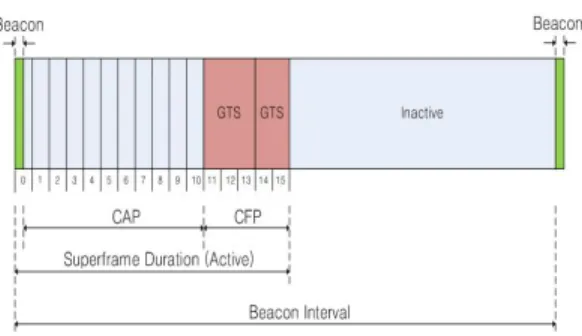
Fig. 1 The IEEE 802.15.4 superframe structure in beacon-enabled mode
compression delay, simple implementation archi- tecture on low cost hardware[5].
3.2 Extended MAC structure for Multi-user Voice Communication
IEEE 802.15.4 standard allows the optional use of a superframe structure. The superframe is bounded by network beacons sent by the coordinator and is divided into 16 equally sized slots, as shown in Figure 1. Optionally, the superframe can have an active and an inactive portion[9]. During the inactive portion, the coordinator may enter a low-power mode because the coordinator should not interactive with its PAN. The beacon frame is
transmitted in the first slot of each superframe.
The beacons are used to synchronize the attached devices, to identify the PAN, and to describe the structure of the superframes. Any device wishing to communicate during the contention access period(CAP) between two beacons competes with other devices using a slotted CSMA-CA mech- anism. For low-latency applications or applications requiring specific data bandwidth, the PAN coordinator may dedicate portion of the active superframe to that application[10]. These portions are called guaranteed time slots (GTSs). The GTSs form the contention-free period (CFP), which always appears at the end of the active superframe starting at a slot boundary immediately following the CAP, as shown in Figure 1. The PAN coordinator may allocate up to seven of these GTSs, and a GTS may occupy more than one slot period. However, a sufficient portion of the CAP remains for contention-based access of other networked devices or new devices wishing to join the network. All contention-based transactions are completed before the CFP begins. Also each device transmitting in a GTS ensures that its transaction is complete before the time of the next GTS or the end of the CFP[11].
For voice communication, the most critical factor is time constraint. Contention-based scheme does not guarantee appropriate packet delay and a number of packets will be dropped due to the contention. Thus, the voice data should be transmitted in a guaranteed rate. Fortunately, the IEEE 802.15.4 reserves a guaranteed time slot called GTS for future use. Our motivation begins from GTS concept, but actual mechanism and architecture is different.
In case that the original mechanism is used for voice without any modification, the device having a voice packet will request GTS allocation and should wait until receiving next beacon notifying that GTS is allocated to the device. It means that the device
can send a voice packet after some delay. Thus, the pure superframe structure cannot be applied to the voice communication. Therefore we modify the standard to enable voice communication over IEEE 802.15.4.
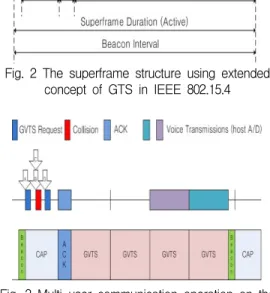
As mentioned in the previous section, TDMA- based slot scheduling is the most desirable for voice traffic with time constraints. Thus, we adopt TDMA-based slot scheduling structure using extended concept of GTS. Figure 2 depicts a proposed superframe structure which is modified to accommodate multi-user voice traffics.
The inactive portion in IEEE 802.15.4 to maximize number of users who speak concurrently as well as to ensure smooth communication is eliminated. The power saving is secondary problem in the target application. The superframe duration is equal to the beacon interval accordingly. The proposed superframe for multi-user voice comm- unication consists of the contention access period, the ACK period, and the contention free period, as shown in Figure 2. The contention free period is also divided into some equally sized time slots. A beacon is used for time synchronization. During the contention period, the devices wishing to transmit voice packet request an allocation of dedicated time slot. We call it Guaranteed Voice Time Slot(GVTS). During the ACK period, the PAN coordinator broadcasts the ACK packet containing the allocation list of GVTS. Lastly, during the contention free period, only the devices listed in the ACK packet can broadcast its own voice packet to the group conversation members without contention through the allocated slot time and all other devices that participate with a group conversation can hear the voice packet and play.
3.3 Voice communication over the proposed scheme
Figure 3 illustrates the operation of proposed scheme for multi-user communication. The PAN
coordinator broadcasts beacon frame to the devices participating a group conversation periodically. After identifying a beacon frame, the devices wishing to transmit a voice packet request GVTS to the coordinator using unslotted CSMA/CA during the contention access period. The PAN coordinator that receives GVTS requests allocates GVTSs in arrival order. The number of GVTS slot to be allocated is limited differently according to used voice codec.
Only selected some devices are listed in the PAN coordinator’s GVTS list and the result returns as the ACK packet containing the GVTS list.
Fig. 2 The superframe structure using extended concept of GTS in IEEE 802.15.4
Fig. 3 Multi-user communication operation on the proposed scheme
The major difference between original GTS and GVTS is an acknowledge method of the allocated list. All the devices may know which devices are allocated for this opportunity. Thus, the allocated devices broadcast their own voice packet and other devices can hear that.
The allocation is maintained until data trans- mission of the guaranteed devices is finished. If the allocated slots are idle for five continuous frames, the coordinator releases the corresponding GVT slot. If the other devices request GVTS in the next superframe, the coordinator checks the number of idle GVT slots and allocates the idle GVTSs for some or all of devices that request according to the number of idle GVT slots.
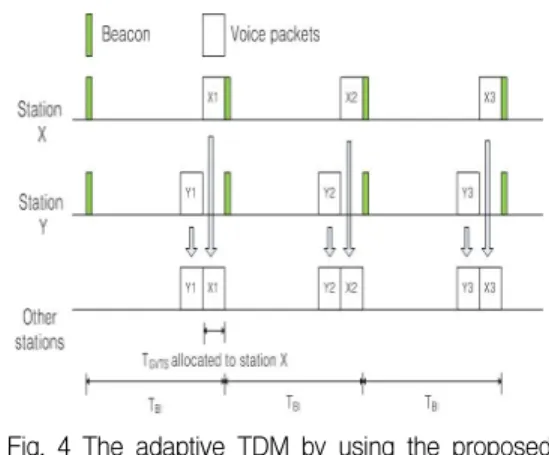
Figure 4 illustrates the operation of proposed multi-user voice communication scheme for some continuous frames. The devices which get a chance to speak can broadcast their own voice packet at the each time allocated by the coordinator. The other devices that participate in PAN hear the voice packet and play. This scheme operates like adaptive TDM system. These operations enable multi-user voice communication in limited range.
Ⅳ. Numerical Analysis
4.1 Notation and Model
Let Ts, Rs, and Tvp denote the voice packet generation interval, the voice sampling rate, and the transmission time of a voice packet with size TsRs
bits respectively. Since the maximum MAC data payload, aMaxMACFrameSize, is equal to aMaxP- HYPacketSize (127byte) – aMaxFrameOverhead (25byte) = 102 bytes [6]. The size of voice packet must be up to aMaxFrameSize. The data generated during beacon interval (TBI) should be transferred using some IEEE 802.15.4 slots.
≤ m ax
m ax
(2)
where N is the number of time slots in a superframe for transferring a voice packet, LmaxMSDU
is the maximum size of MSDU, LmaxPPDU is the maximum size of PPDU, TSI is the slot
Fig. 4 The adaptive TDM by using the proposed scheme
interval, and Rc is the channel bit rate.
Therefore, the number of time slots for transferring a voice packet is calculated as
≥ m ax
m ax
(3)
Let Dmax define the maximum voice packet delay.
The device that doesn’t have the allocated GVTS cannot send voice packet and discards voice packet.
Therefore, the maximum delay Dmax is the transmission delay of the device that uses GVTS closed to next beacon. In order words, Dmax is equal to TBI.
m ax (4)
The G.114 ITU-T standard describes that a 150 milliseconds one-way delay is acceptable for high voice quality [7]. Thus, TBI should be less than 150ms. According to [6], the beacon interval is 16*0.960*2BOms. Thus, the upper bound of beacon order (BO) is 3. TBI is equal to 122.28ms and the number of needed slots for transferring voice data should be more than 3 when using 32kbps ADPCM codec. The duration of GVTS is calculated as
(5)
Thus, the minimum TGVTS is equal to 23.04ms when BO is equal to the upper bound value of 3 and using 32kbps ADPCM voice codec. The number of needed slot for transferring voice data for different ADPCM encoding rate is shown in Table 1. The superframe should contain more than 1 or 2 slots according to beacon interval for the contention access period and 1 slot for the ACK period and other slots for the contention free period. When using 32kbps ADPCM, The PAN coordinator can allocate up to 4 GVTSs in each superframe because the superframe consists of 16 equally sized slots. Therefore, we allocate 4 slots for contention period and 1 slot for the ACK period. It means that up to 4 users can speak at the same time. The number of GVTS per frame is shown in Table 2. When using 8kbps ADPCM, the superframe has 12 GVTS and it mean that up to 12 users can speak at the same time.
Table 1. The number of needed slots for transferring voice data
Encoder The number of slots for transferring voice data
ADPCM(32Kbps) 3
ADPCM(16Kbps) 2
ADPCM(12Kbps) 1
ADPCM(8Kbps) 1
Table 2. The number of slots and the number of GVTS in a frame for each voice encoding method
Encoder Number of slots for
GVTS
Number of GVTS per
frame
ADPCM(32Kbps) 3 4
ADPCM(16Kbps) 2 6
ADPCM(12Kbps) 1 12
ADPCM(8Kbps) 1 12
Ⅴ. Conclusion and discussion In this paper, we propose the novel scheme for multi-user voice communication in short range
wireless networks based on the IEEE 802.15.4.
Then we evaluate the maximum number of users who can speak at the same time when using various voice codec. However, our scheme has several drawbacks at the current state. First, energy efficiency is not enough considered in our scheme because the energy consumption is the secondary problem in the voice communication.
Second, our scheme supports only one-hop range communication.
We are investigating to implement the multi-user voice communication system in limited range by using the proposed scheme. In the future, we would like to investigate better scheme for solving problems.
감사의 글
This work was supported by the Incheon National Universi ty Research Grant in 2013
Reference
[1] William Stallings, “Wireless Communications and networks,” Prentice Hall.
[2] Eustathia Ziouva and Theodore Antonakop- oulos, “CBR Packetized Voice Transmission in IEEE802.11 Networks,” Sixth Symposium on Computers and Communications, 2001, pp. 64-71.
[3] Rahul Mangharam, Anthony Rowe, Raj Rajk- umar, and Ryohei Suzuki. “Voice over sensor network,” IEEE Real-Time System Symposium, 2006.
[4] S. Lee, “Video Flame Detection with Periodicity Analysis Based False Alarm Rejection”, J. of the Korea Institute of Electronic Communication Sciences, vol. 6, no. 4, August 2011, pp. 479-485.
[5] Deboarah Estrin, Ramesh Govindan, John Heidemann, “Scalable Coordination in Sensor Networks,” USC Technical Report, 1999, pp. 3.
[6] Charles E. Perkins, “Ad hoc Networking,”
Addison Wisely, 2010.
[7] K. Kim, K. Ban, S. Heo and E. Kim, “Design and Implementation of System for Sensing Data Collection in RFID/USN”, The Korea Institute of Electronic Communication Sciences, vol. 5, no. 2, April 2010, pp. 221-226.
[8] Jennifer Bray, Charles F. Sturman, “BLUE- TOOTH Connect without Cables,” Prentice Hall, 2001.
[9] B. Kim, “Service Quality Criteria for Voice Services over a WiBro Network”, The Korea Institute Of Electronic Communication Sciences, vol. 6, no. 6, December 2011, pp. 823-829.
[10] E. Shih, S. Cho, Nathan Ickes, and Rex Min.
“Physical Layer Driven Protocol and Algo- rithm Design for Energy-Efficient Wireless Sensor Networks,” Communication ACM, 2011, pp. 272-286.
[11] K. Sohrabi, J. Geo, Y. Ailawadhi, G. Pottie,
“Protocols for Self-Organization of a Wireless Sensor Network,” Proc. ACM Mobicom 9, 2010, pp. 174-175.
저자 소개
전동근(Dong-Keun Jeon)
B. S., Electronics Engineering, Korea Univ., 1986
M.S., Electronics Engineering, Korea Univ., 1988
Ph. D., Electronics Engineering, Korea Univ., 1992 March 1993-Present: Professor Mechatronics Enginerring Dept., Incheon National University, Korea